Why in News?
On September 22, 2026, the U.S., Denmark and Greenland signed a security agreement expanding American military access to Greenland while retaining its existing territorial status. It follows President Donald Trump’s repeated demands to acquire the island, including threats of force.
- The agreement provides Trump a diplomatic exit from his acquisition demand while securing an expanded American strategic presence.
- For Denmark and Greenland, it reduces immediate pressure over sovereignty, although concerns about long-term autonomy remain.
| UPSC Relevance: GS-2 International Relations: International Agreements, Arctic Region Prelims: Greenland’s geography, Arctic region, GIUK Gap, NATO. |
About Greenland:
Geographical features:
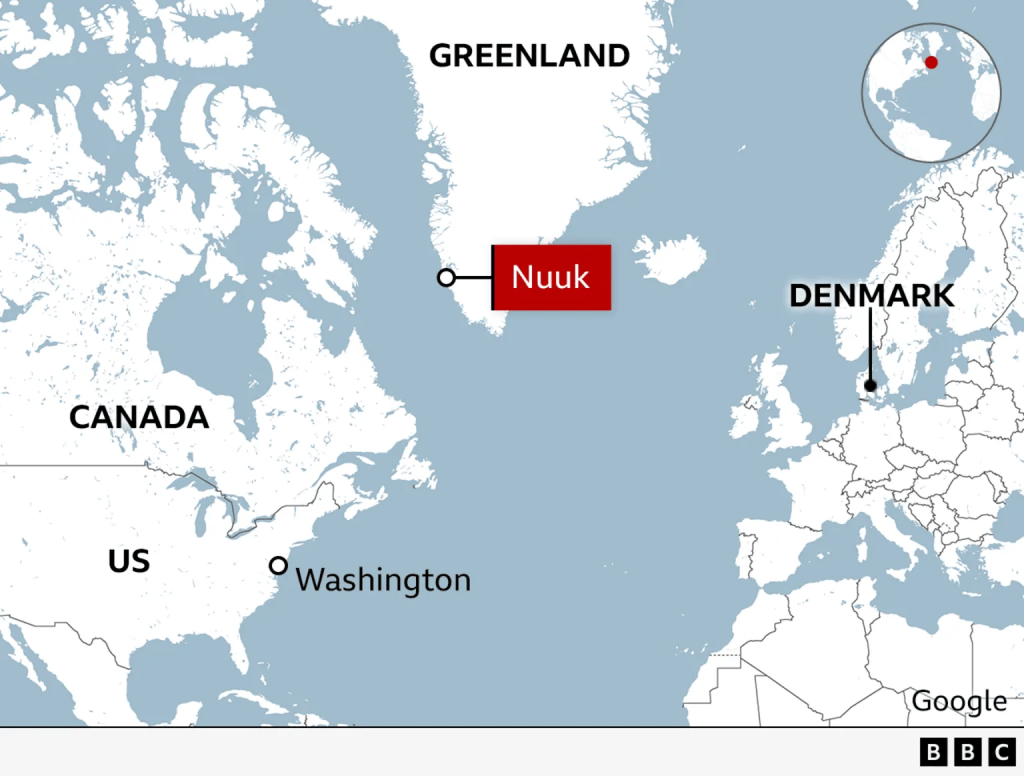
- Location: Geographically part of North America, lying between the Arctic and North Atlantic Oceans.
- Size: The world’s largest island, excluding continental landmasses such as Australia.
- Population and capital: Approximately 57,000 people; Nuuk is the capital.
- Ice cover: Around 80% of its surface is covered by the ice sheet and glaciers.
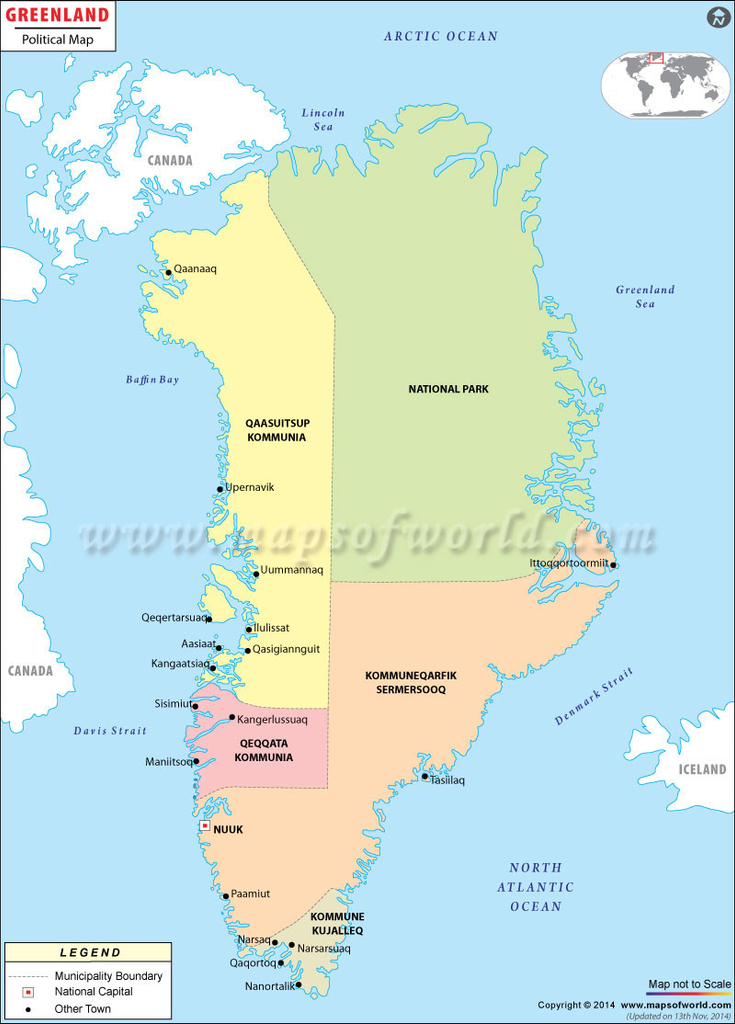
- Map locations:
- Baffin Bay and Davis Strait lie towards Canada
- Greenland Sea lies to the east
- Denmark Strait separates Greenland from Iceland
Political status:
- Greenland is a self-governing territory within the Kingdom of Denmark.
- It obtained Home Rule in 1979, followed by expanded autonomy under the 2009 Self-Government Act.
- Its elected Parliament and government administer transferred domestic responsibilities.
- Denmark retains responsibility for areas including defence, security, monetary policy and overarching foreign policy, while Greenland has specified external-affairs powers.
- Greenland assumed responsibility for mineral resources in 2010. The Self-Government Act recognises its people’s right to self-determination.
EU distinction: Greenland is outside the EU, but Greenlanders holding Danish nationality are EU citizens.
Key Provisions of the US-Greenland-Denmark Security Agreement:
The agreement supplements the 1951 U.S.-Denmark Defence Agreement and subsequent arrangements.
(i) Military Expansion:
- New and Expanded Bases: Allows the U.S. to expand the Pituffik Space Base and build two new military sites at Narsarsuaq (southern Greenland) and Mestersvig (eastern coast).
- Operational Rights: Grants U.S. aircraft and vessels broad flyover, landing, and undersea transit rights across Greenlandic territory and waters.
- Missile Defence: Includes frameworks for cooperation on advanced defence systems, such as the proposed “Golden Dome”.
(ii) Security & Third-Party Restrictions:
- Non-NATO Ban: Prohibits non-NATO or non-allied nations from maintaining an ongoing military presence or establishing bases on the island.
- Defence Continuity: Specifies that if Greenland ever achieves independence, both Denmark and Greenland must ensure the new nation remains inside NATO.
(iii) Investment & Economic Safeguards:
- Sensitive Sectors: Bars investors from outside NATO, NATO partners, or the European Union from gaining major influence or control over critical infrastructure and resource extraction/mining.
- Local Enforcement: Greenland retains the authority to screen and regulate these sensitive investments directly.
(iv) Governance & Status:
- Sovereignty: Reaffirms Greenland’s status as a self-governing territory within the Kingdom of Denmark and requires that U.S. actions respect local society and traditions.
- Ratification: The pact features no fixed end date, but it requires formal approval from the parliaments of both Denmark and Greenland to officially enter into force.
Significance of the Agreement:
- Diplomatic de-escalation: Provides a negotiated route away from territorial acquisition threat. Expands military access and strengthens the U.S.’s influence over Arctic security without acquiring the territory.
- Protection of territorial status: Enables Denmark and Greenland to preserve the existing constitutional arrangement.
- Reduced intra-NATO friction: Helps contain a dispute between the U.S. and Denmark, both founding NATO members.
- Greater Greenlandic participation: Greenland’s inclusion as a signatory acknowledges that its future cannot be negotiated solely between larger powers.
Why is Greenland Strategically Important?
- Defence of North America: Greenland’s Arctic position makes it valuable for detecting threats approaching North America across polar routes. The U.S. Pituffik Space Base, formerly Thule Air Base, supports missile warning, missile defence, space surveillance and satellite operations.
- Monitoring the North Atlantic: The Greenland-Iceland-United Kingdom (GIUK) Gap comprises maritime passages connecting Arctic and northern European waters with the North Atlantic. Monitoring these passages is important for tracking submarine movements and protecting transatlantic maritime communication routes.
- Growing Arctic competition: The US has concerns about Russian military activity and expanding Chinese engagement in the Arctic. Greenland offers the U.S. a platform for surveillance, logistics and deterrence as the region’s strategic importance increases.
- Critical mineral resources: The European Commission reported in 2023 that 25 of its 34 identified critical raw materials occur in Greenland. These resources could support clean-energy technologies, electronics and diversification of mineral supply chains.
- Emerging shipping opportunities: Declining Arctic sea ice could increase seasonal access to northern shipping routes, creating interest in ports, logistics and search-and-rescue infrastructure. However, difficult weather, variable ice conditions and limited infrastructure constrain commercial viability.
- Global climate significance: Greenland’s land-ice loss contributes to global sea-level rise, while freshwater entering the North Atlantic can influence ocean circulation.
Major Concerns and Necessary Legal Dimensions:
- Sovereignty and the threat of force: Article 2(4) of the UN Charter prohibits threats or use of force against a state’s territorial integrity or political independence. A proposal for a consensual territorial arrangement is legally different from coercive annexation.
- NATO solidarity: Article 1 of the North Atlantic Treaty requires peaceful settlement of disputes and restraint from threats or force inconsistent with the UN Charter. Acquisition threats against an ally (Denmark is the founding member of NATO) therefore undermine the alliance’s foundational commitments.
- Constraints on future independence: The agreement’s continuity provisions raise a political question: how much strategic choice would a future independent Greenland retain? Moreover, Greenland currently falls within NATO through Denmark.
- Militarisation of the Arctic: Expanded bases and missile-defence infrastructure could intensify competing military deployments, making environmental protection and scientific cooperation more difficult.
- Indigenous rights and environmental costs: Military construction and mining can affect Inuit communities, traditional livelihoods and fragile ecosystems. Local consultation, environmental assessment and equitable economic benefits are essential. Greenland has not imposed a blanket ban on mining: its mineral authority explicitly supports mining while restricting uranium activities under legislation introduced in 2021.
- Arctic waters are not entirely global common: Under UNCLOS, Arctic waters comprise different legal zones:
- Territorial seas: Subject to coastal-state sovereignty, with applicable passage rights.
- Exclusive Economic Zones: Coastal states possess specified resource rights; other states retain navigation and other lawful freedoms.
- High seas: Areas beyond national maritime jurisdiction where high-seas freedoms apply.
Therefore, neither Arctic coastal states nor an external military power can claim unrestricted ownership of the entire Arctic Ocean.
The Greenland agreement offers a diplomatic retreat from acquisition threats while expanding American strategic access. Its durability will depend on reconciling Arctic security with sovereignty, Greenlandic self-determination and environmental protection.
Practice Prelims MCQ:
Q. Consider the following statements:
- Greenland is geographically part of North America and politically part of the Kingdom of Denmark.
- Greenland is a member of the European Union.
- The GIUK Gap connects Arctic and northern European waters with the North Atlantic.
Which of the statements given above are correct?
(a) 1 and 2 only
(b) 1 and 3 only
(c) 2 and 3 only
(d) 1, 2 and 3
Answer: (b) Greenland is outside the EU, although Greenlanders holding Danish nationality are EU citizens.
Mains Practice Question:
Q. With reference to recent security arrangements, evaluate how Greenland reflects the friction between strategic competition, resource exploitation and ecological protection in the Arctic.
Tell Google you want more of this.
Add Anantam IAS as a preferred sourceOne tap, and this site shows up more often in your own Top Stories, AI Overviews and AI Mode. Remove it any time.