Why in News?
On 24 September 2026, the Department of Science and Technology reported an RRI experiment measuring a quantum measure of about 1.17, while photon-detection probability remained within its ordinary bounds.
- The Raman Research Institute experiment used an optical event filter to select a collection of possible photon routes and determine their quantum measure.
- The measured quantum measure was about 1.17, consistent within uncertainty with an apparatus-adjusted prediction of about 1.18.
- The reported result was published in Quantum; it concerns a generalized measure incorporating interference, not a probability greater than one.
- A measurement claim is meaningful only after identifying the quantity being measured: a generalized quantum measure and a detector probability are different quantities.
- The work links foundational theory to a laboratory measurement, while proposed computing applications still require further development.
UPSC Relevance
Prelims Relevance
- Quantum history: a possible evolution or route between preparation and detection.
- Event: a selected set of histories in this framework.
- Interference: wave-like contributions from different routes combine.
- Polarisation: orientation of light-wave oscillation, used here to distinguish routes.
- Detection probability: remains between zero and one.
Mains Relevance
GS Paper 3
- Indigenous research in quantum measurement and enabling science.
- Separating an experimental result from proposed technological applications.
Essay
- Scientific progress requires both new questions and precise limits on claims.
Background and Context
Histories, events and interference
Instead of asking only about a system at one instant, the histories viewpoint considers possible routes through its evolution between preparation and detection.
- A history is one possible way a quantum system evolves. For the optical experiment, the relevant examples are photon routes between source and detector, rather than a list of independently observed particle journeys.
- An event is a selected collection of these histories. Quantum Measure Theory assigns it a generalized weight that includes interference between routes, so the weight cannot automatically be interpreted as an ordinary frequency.
- Interference means contributions from different possible routes combine like waves. The combined effect depends on their relationship, rather than simply adding probabilities as though the alternatives were separately observed and independent of interference.
- Constructive interference can reinforce contributions, analogous to overlapping wave crests. This helps explain the unusual measure, but does not mean the apparatus creates extra photons or records more than certainty at its detector.
- The main comparison is quantum measure versus probability. An ordinary probability lies between zero and one; a measure assigned to a selected history collection can exceed one because it incorporates interference differently.
How the optical experiment accessed the measure
The experiment connected a question about selected routes to observable optical powers through a calibrated event filter, making an abstract quantity experimentally accessible.
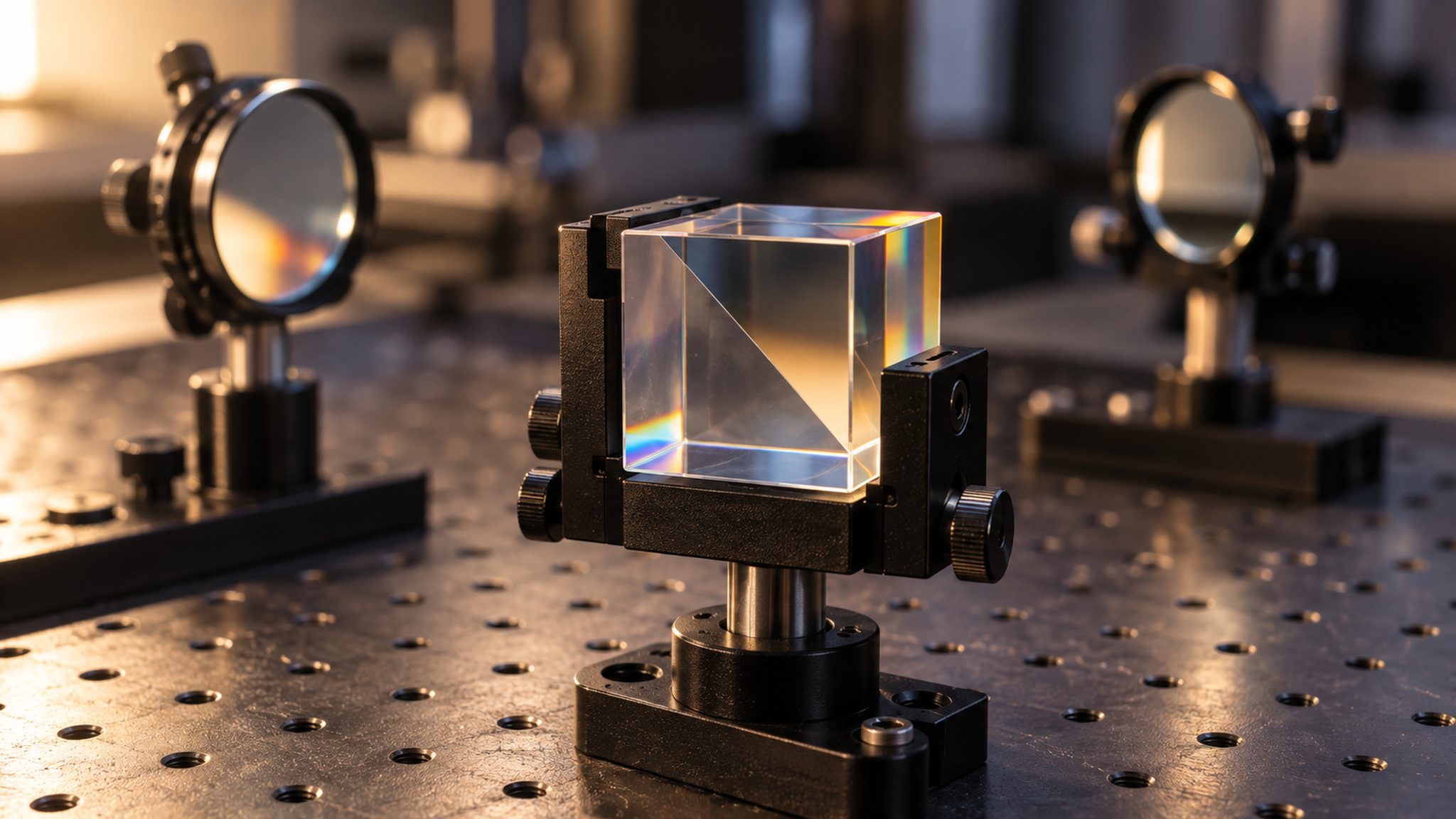
- The researchers allowed laser light to traverse different routes in an optical setup. Their event filter was designed to select a particular collection of routes, giving the measurement a clearly specified event to examine.
- Polarisation, the orientation of light-wave oscillation, distinguished routes within the arrangement. It supplied a controllable marker for selecting the intended collection, rather than requiring the researchers to observe each possible history separately.
- The team then erased the distinguishing information so the selected routes could interfere. Both selection and interference mattered: retaining information that separates routes would change the relationship the filter was intended to probe.
- Measurements of input and output laser power were used to infer photon-detection probability. The filter’s calibration then connected that probability to quantum measure; the reported measure was not simply the detector probability renamed.
- The calibrated result was compared with a prediction accounting for apparatus imperfections. Agreement within experimental uncertainty supports the measurement method; it does not imply that every possible history collection was tested by this experiment.
What the result establishes and what remains open
The finding expands experimentally accessible questions about quantum processes; it must not be promoted into claims about gravity, certainty or finished computing hardware.
- The official research account reports an experimentally measured quantum measure above one. The achievement is giving operational access to this generalized quantity, while preserving the distinction between measured optical response and calibrated interpretation.
- The inferred detector probability remains between zero and one. Calling the result a chance greater than certainty would confuse two mathematical quantities and misrepresent both the experiment and the probability rule it respects.
- A future event filter might select photon histories while leaving photons available for subsequent quantum operations. That potential application is different from the reported power-based measurement and should not be described as already demonstrated.
- Quantum Measure Theory has links to foundational work motivated partly by quantum gravity. This optical experiment does not test a theory of quantum gravity merely because the framework has that intellectual origin.
- The researchers explicitly say the work does not resolve the quantum measurement problem. For policy analysis, its value is an additional experimental capability, with further engineering and scientific questions separating foundational research from practical deployment.
Way Forward
Build on a precisely defined result
- Evaluate calibration and apparatus uncertainty alongside the reported value so subsequent measurements can be compared meaningfully.
- Treat non-destructive filtering as a further development objective, requiring evidence that selected photons remain available for later operations.
- Keep public explanations clear about measure, probability and application status; avoid presenting foundational optics as completed quantum-computing hardware.
Conclusion
- A quantum measure above one is compatible with ordinary detection probabilities because the two quantities answer different questions. Interference and calibration are the essential links in understanding the result.
- The achievement is experimental access to a history-based quantity. Its scientific significance can be recognised without claiming impossible probabilities, a solution to the measurement problem or a demonstrated test of quantum gravity.
UPSC Practice Questions
Prelims MCQ 1
With reference to the reported quantum-measure experiment, consider the following statements:
- A quantum measure can include interference between possible histories.
- The experiment measured a photon-detection probability greater than one.
- The event filter’s calibration was used to determine the quantum measure.
How many of the above statements are correct?
(a) Only one (b) Only two (c) All three (d) None
Answer: (b) Only two
Explanation:
Statements 1 and 3 are correct. The quantum measure exceeded one, while the detection probability remained between zero and one.
Prelims MCQ 2
What does an event represent in the histories-based framework described in the experiment?
(a) A selected collection of possible histories. (b) An observed violation of the speed of light. (c) A guaranteed photon detection at every output. (d) A completed quantum-computing operation.
Answer: (a) A selected collection of possible histories.
Explanation:
The event is the chosen set of histories or routes. The generalized measure incorporates their interference and is inferred using the calibrated filter.
UPSC Mains Questions
- Explain how a quantum measure can exceed one without violating the bounds of ordinary probability. Discuss the role of interference and calibration.
- Assess the significance of experimental access to foundational quantum quantities. Why should research communication distinguish demonstrated measurements from prospective computing applications?
Sources: PIB, Ministry of Science and Technology and Raman Research Institute, QuIC Laboratory.
Frequently Asked Questions
Did scientists measure a probability greater than one?
No. The photon-detection probability remained between zero and one. The value above one was a quantum measure, a generalized weight assigned to a chosen collection of histories that includes interference.
What is a quantum history in this experiment?
A history describes a possible evolution between preparation and detection. In this optical arrangement, the researchers considered possible photon routes and selected a collection of those routes as the event of interest.
How was the quantum measure determined?
Researchers inferred detection probability from input and output laser powers, then used the event-filter calibration to determine quantum measure. The detector probability itself was not reported as exceeding its normal upper bound.
Does the result prove quantum gravity or solve the measurement problem?
No. Although Quantum Measure Theory has connections to research motivated by quantum gravity, the optical experiment does not test such a theory. The researchers also explicitly state that it does not resolve the measurement problem.
Is the proposed computing filter already available?
The release describes a future possibility: selecting photon histories while preserving photons for further operations. That non-destructive application should not be confused with the reported experiment, which inferred the measure using optical power measurements.
Tell Google you want more of this.
Add Anantam IAS as a preferred sourceOne tap, and this site shows up more often in your own Top Stories, AI Overviews and AI Mode. Remove it any time.