Why in News?
On 24 September 2026, the Department of Biotechnology announced the commercial-use launch of PLA-based bioplastics and support for a planned pilot facility at Balrampur Chini Mills.
- The initiative uses renewable sugar-based feedstock to create a materials value chain beyond conventional sugar products.
- The pilot-scale R&D facility will be established at Kumbhi, Uttar Pradesh; the announcement does not establish that it is already operating.
- The proposed work covers specialised PLA grades and co-polymers, process development and customer validation.
- A change in feedstock can reduce reliance on fossil inputs without automatically solving waste collection or disposal.
- The policy question is whether biomanufacturing can deliver useful materials alongside credible, locally available end-of-life arrangements.
UPSC Relevance
Prelims Relevance
- PLA: polylactic acid, a polymer derived from lactic acid.
- Bio-based: describes the biological origin of the feedstock.
- Biodegradation: biological breakdown depends on material and environmental conditions.
- Industrial composting: a managed treatment process, distinct from home composting.
- Pilot facility: tests and develops processes before wider scale-up.
Mains Relevance
GS Paper 3
- Biotechnology-led industrial diversification and indigenous process development.
- Waste-management infrastructure, environmental claims and material substitution.
Essay
- An environmentally promising material still needs an effective disposal system.
Background and Context
What the launch establishes
The announcement combines a commercial-use launch with a separate research facility that is still planned, so their implementation status must remain distinct.
- Balrampur Chini Mills is taking forward the PLA initiative under the BioE3 framework. The official release identifies renewable sugar feedstock as the industrial starting point, connecting an agricultural resource with a manufactured material.
- The planned pilot is intended to develop specialised grades and co-polymers. This is a research and validation role; its announcement should not be presented as proof of an already commissioned production line.
- Process know-how concerns how production can be repeated reliably, not simply whether a material can be made once. The pilot is expected to generate technical and economic evidence needed for subsequent commercial translation.
- Customer validation checks whether a developed material suits its intended application. A successful laboratory result does not by itself demonstrate that the material will meet a manufacturer’s processing needs or a buyer’s performance requirements.
- Industrial diversification is the central policy significance: biological resources can supply material production as well as established uses. The release describes a potential value chain; it does not establish every claimed economic or environmental outcome.
From sugar feedstock to a polymer
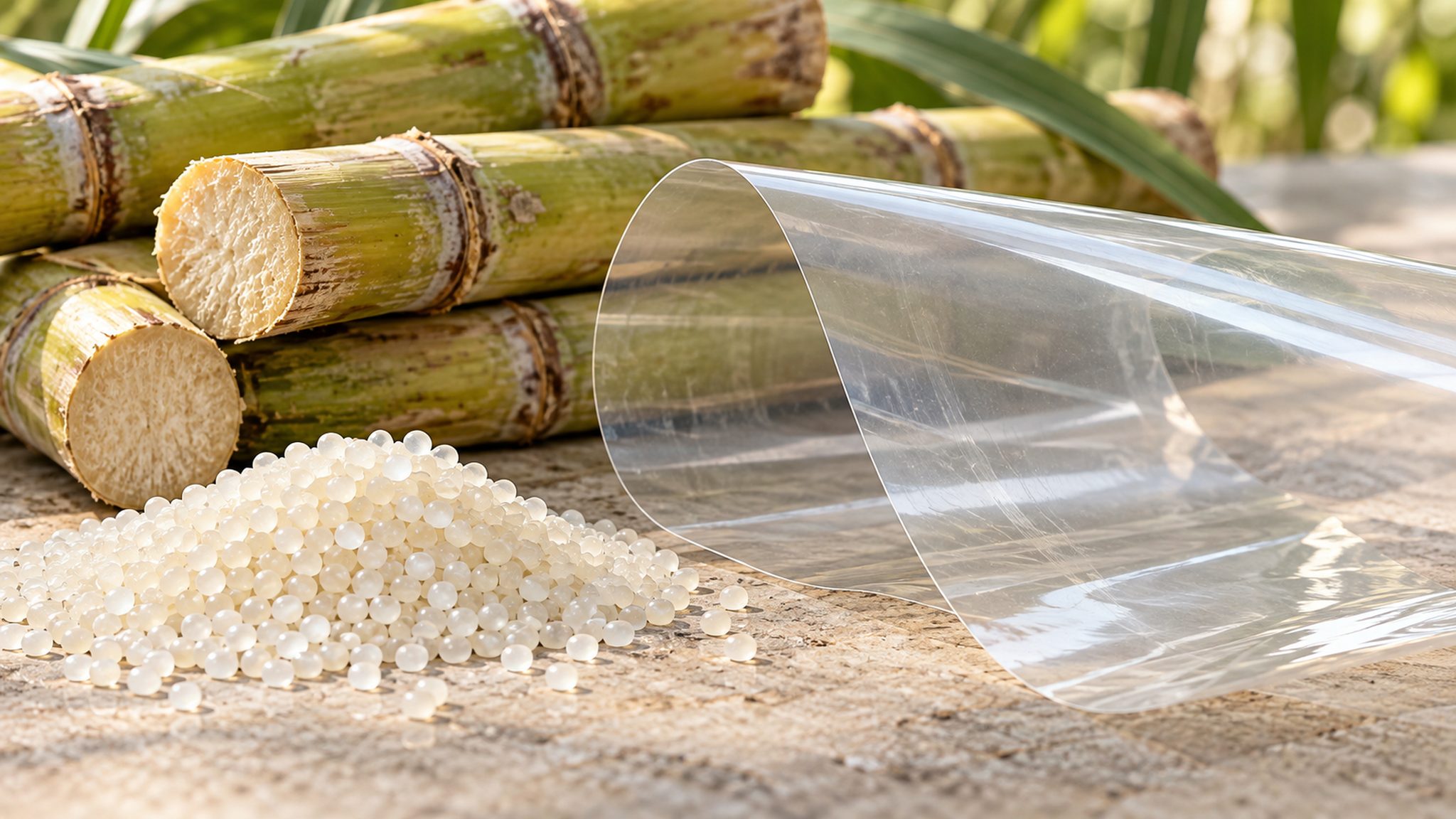
PLA manufacture connects biological feedstock with chemical conversion; the finished material is a polymer, not unprocessed plant matter or sugar pressed into a mould.
- Sugar-based feedstock supplies the starting resource, while lactic acid is the intermediate identified in the release. Keeping these stages separate explains how agricultural inputs become materials with properties different from the original crop.
- Lactic acid is a small molecular building block, whereas PLA consists of linked units forming polymer chains. Calling the resulting product bio-based identifies its origin; it does not mean the product remains biologically unchanged.
- Polymer manufacture adds a conversion stage between the renewable resource and the finished product. An assessment must examine that stage as well as the feedstock, rather than treating agricultural origin as a complete environmental verdict.
- Specialised grades are relevant because different applications demand different material properties. The pilot’s research mandate includes these grades and co-polymers, rather than assuming that one standard formulation will serve every possible use equally well.
- Resource recovery and renewable sourcing ask different questions: one concerns using discarded material, the other concerns where inputs originate. The leather protein-recovery example illustrates why these descriptions should not be treated as interchangeable environmental claims.
Why disposal conditions matter
The useful distinction is between a material’s origin and its fate after use: one label cannot answer both questions for a consumer or waste operator.
- Bio-based describes feedstock origin; biodegradable describes breakdown under specified conditions. UNEP’s material comparison treats managed facilities and natural environments separately, rather than assigning one universal breakdown outcome to every environment.
- Industrial compostability is not permission to discard PLA in soil, rivers or the sea. A managed treatment claim cannot be converted into an assurance of home compostability or harmless litter under uncontrolled environmental conditions.
- Hydrolysis can break PLA down towards lactic acid before further microbial processing. A DOE-hosted research presentation examines pretreatment and anaerobic degradation; it does not establish that untreated litter follows the same pathway in nature.
- Collection and acceptance must connect the used product with a suitable facility. A compostability claim has limited practical value if the local operator cannot identify, segregate or accept that product into its actual treatment process.
- Environmental evaluation should compare the complete route from input to treatment. The urban waste LCA note explains system boundaries; here, the immediate distinction is renewable origin versus the specific conditions needed after disposal.
Way Forward
Match the product with a real treatment route
- Require specific claims about the tested product and disposal conditions, rather than an unqualified biodegradable label.
- Link procurement to collection arrangements and confirmation that the receiving facility accepts the material.
- Use the pilot to publish performance and process evidence supporting scale-up, with separate reporting of planned and operational capabilities.
Conclusion
- PLA offers a route from renewable sugar resources to manufactured materials, but feedstock origin does not settle the disposal question. The proposed pilot should be judged on evidence supporting usable grades and repeatable processes.
- For an answer, connect industrial innovation with verified end-of-life conditions: distinguish the commercial-use launch from the planned pilot, and distinguish a managed treatment pathway from claims that a product will disappear wherever it is discarded.
UPSC Practice Questions
Prelims MCQ 1
With reference to PLA-based materials, consider the following statements:
- Bio-based describes the origin of a material’s feedstock.
- Industrial compostability automatically establishes marine biodegradability.
- PLA is a polymer associated with lactic acid.
How many of the above statements are correct?
(a) Only one (b) Only two (c) All three (d) None
Answer: (b) Only two
Explanation:
Statements 1 and 3 are correct. Performance in a managed composting system does not establish biodegradability in the sea.
Prelims MCQ 2
What is the principal role of the planned PLA pilot-scale R&D facility described in the announcement?
(a) Certifying that all bio-based plastics degrade in seawater (b) Replacing municipal waste segregation (c) Developing grades and process evidence for commercial translation (d) Eliminating the need for customer validation
Answer: (c) Developing grades and process evidence for commercial translation
Explanation:
The announced pilot is intended to develop specialised PLA grades, process know-how and validation evidence. It is still planned.
UPSC Mains Questions
- Explain why a bio-based plastic cannot be assessed solely by the renewable origin of its feedstock.
- Discuss how pilot-scale research and waste-management infrastructure can support responsible commercialisation of PLA-based materials.
Sources: PIB, Ministry of Science and Technology and UNEP.
Frequently Asked Questions
What is PLA?
PLA means polylactic acid. It is a polymer associated with lactic acid and can be produced using renewable sugar-based feedstock. Its biological input does not determine how it behaves in every disposal environment.
Is the announced pilot already operational?
The official release says the pilot-scale R&D facility will be established at Kumbhi. The commercial-use launch and the planned research facility are separate developments and should not be described as the same operational milestone.
Can PLA be put in a home compost bin?
An industrial compostability claim alone is insufficient. Home composting involves different conditions, so consumers should follow the specific product’s verified instructions and the requirements of the local treatment provider.
Does bio-based mean harmless if littered?
No. Bio-based identifies feedstock origin, while breakdown depends on the material and its surroundings. It does not establish rapid disappearance in soil or water, or justify releasing a product into the environment.
Tell Google you want more of this.
Add Anantam IAS as a preferred sourceOne tap, and this site shows up more often in your own Top Stories, AI Overviews and AI Mode. Remove it any time.