Why in News?
The Ministry of Defence (MoD) signed a ₹810.79-crore contract with Bharat Dynamics Limited (BDL) to procure 160 Satellite Smart Anti-Airfield Weapons (SAT-SAAW) and associated equipment for the Indian Air Force.
| UPSC Relevance: GS-3 Science and Technology: Defence Technology Prelims: Satellite Smart Anti-Airfield Weapons, Glide Bomb |
What is SAT-SAAW?
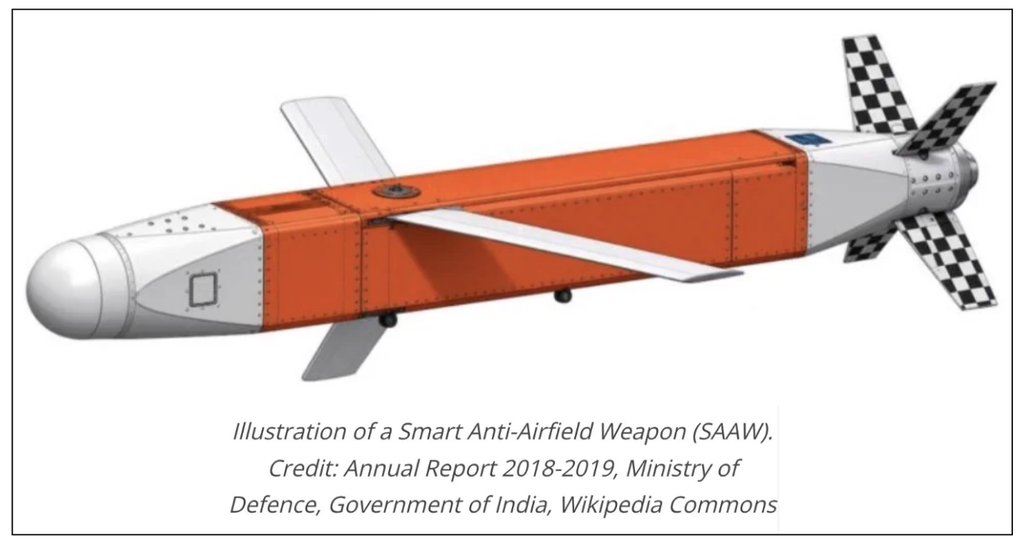
- SAT-SAAW stands for Satellite Smart Anti-Airfield Weapon. It is an air-to-ground precision-guided glide bomb designed to neutralise enemy airfields from stand-off distance/range.
- Indigenously developed by: Research Centre Imarat, a DRDO laboratory.
- Major targets: It can be employed against runways and taxi tracks, hardened aircraft shelters and hangars, bunkers, Radar installations, ammunition and fuel storage facilities and other reinforced ground targets.
Major Features of SAT-SAAW:
- Maximum range of approximately 100 km, depending on the aircraft’s release altitude, speed and other flight conditions.
- Precision guidance: SAT-SAAW uses an Inertial Navigation System and Satellite-based navigation updates. The satellite-navigation configuration has an accuracy of less than seven metres under stated conditions.
- Lightweight: weighs approximately 125 kg and is about 1.85 metres long. Its relatively light weight enables fighter aircraft to carry multiple weapons in a single mission.
- Multiple launch platforms: can be launched from aircraft such as Su-30MKI, Jaguar and Hawk.
- Delayed-action capability allows the weapon to penetrate a hardened surface, such as a runway or bunker, before detonating. This produces greater structural damage than an explosion occurring only on the surface.
How does a Glide Bomb work?
A glide bomb differs from an ordinary gravity bomb.
- It is released from an aircraft at high altitude and speed.
- Deployable or fixed aerodynamic surfaces provide lift.
- The guidance system calculates and corrects its flight path.
- Satellite-navigation updates reduce accumulated navigation errors.
- The weapon glides towards the pre-designated target. Its fuze detonates the warhead at the required time or after penetration.
Glide Bomb versus Missile:
- A missile normally uses an onboard propulsion system during a substantial part of its flight.
- A glide bomb generally has no sustained propulsion after release; it uses the aircraft’s altitude and speed, along with aerodynamic lift, to reach the target.
Consequently, glide bombs can be lighter and cheaper than comparable powered missiles, but their range depends more heavily on the aircraft’s release conditions.
Significance:
- By damaging runways, radars and support infrastructure, the weapon can temporarily reduce an enemy air force’s ability to launch, recover and sustain combat aircraft.
- It would enable the IAF to neutralise critical enemy airfield infrastructure while reducing the exposure of its aircraft.
Practice Prelims MCQ:
Q. With reference to the Satellite Smart Anti-Airfield Weapon, consider the following statements:
- It is an air-to-ground precision-guided glide bomb.
- It has been designed and developed indigenously by DRDO.
- It requires continuous rocket propulsion throughout its flight.
- It can be launched from platforms such as the Su-30MKI, Jaguar and Hawk.
Which of the statements given above are correct?
(a) 1 and 2 only
(b) 1, 2 and 4 only
(c) 2, 3 and 4 only
(d) 1, 2, 3 and 4
Answer: (b): A glide bomb primarily uses aerodynamic lift and the launching aircraft’s altitude and speed; it does not require continuous rocket propulsion.
Tell Google you want more of this.
Add Anantam IAS as a preferred sourceOne tap, and this site shows up more often in your own Top Stories, AI Overviews and AI Mode. Remove it any time.