Daily Digest
UPSC · Civil Services Examination
Current Affairs · Thursday, 30 July 2026
Current affairs curated and edited by Anantam IAS faculty — pulled from The Hindu, PIB, IDSA, Foreign Affairs and the ministries. Read, annotate, revise.
Old Rajinder Nagar · Delhi 110005 · anantamias.com
Coal Washeries: Why Installed Capacity Is Not Becoming Output
Why in News?
The Standing Committee on Coal, Mines and Steel has called for greater priority to coal beneficiation, timely modernisation of ageing washeries and removal of logistical constraints that suppress the supply of higher-quality domestic coal.
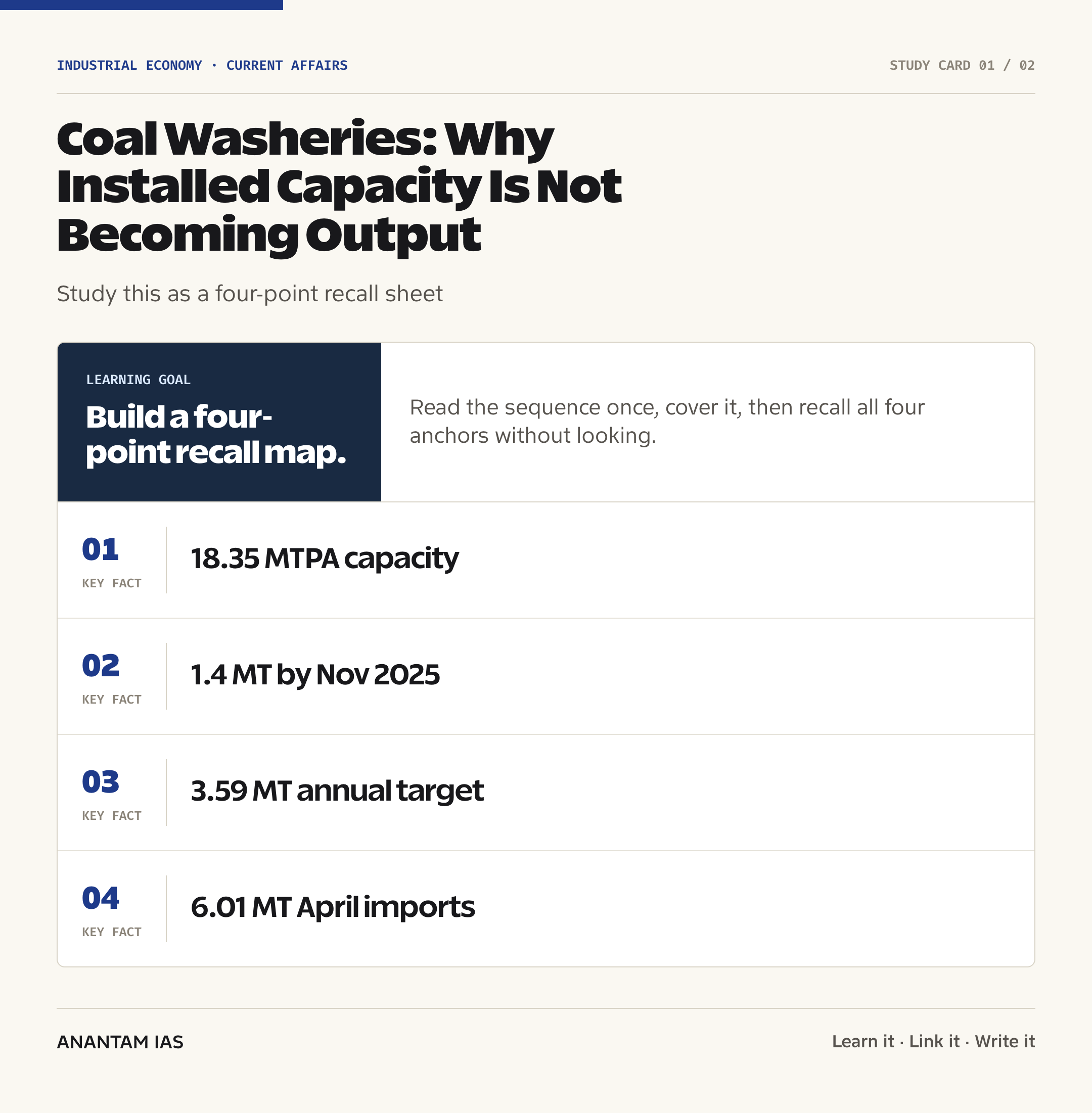
The immediate issue is a capacity-throughput gap. Coal India Limited (CIL) has an operable coking-coal washing capacity of 18.35 million tonnes per annum (MTPA), but the Ministry of Coal’s Annual Report 2025-26 recorded only 1.4 MT of washed coking-coal production up to November 2025 against an annual target of 3.59 MT.
- The Hindu reported the panel’s diagnosis: aged infrastructure, legacy technology, delayed raw-coal supply from mine pitheads and washery designs incompatible with the feed coal.
- The official Eighteenth Report on the Ministry of Coal’s Demands for Grants noted that several washeries installed about 35 years ago were operating at low efficiency.
- The same parliamentary report asked the Ministry to examine a separate modernisation budget so domestic blast furnaces receive more washed coal.
- The panel favoured washeries at or near pitheads and alignment of future plants with mine-expansion plans and First Mile Connectivity.
- Pithead removal of ash and impurities can reduce dead-weight movement, improve transport efficiency and lower emissions associated with moving unusable mineral matter.
The development matters in the context of:
- India has substantial coal resources, but much domestic coking coal has high ash content; resource quantity and steel-grade quality are different questions.
- The gap matters for the blast furnace-basic oxygen furnace steel route, which needs metallurgical coal with suitable coking properties and controlled ash.
- Import substitution depends on a full chain: mine production, stable feed quality, washing yield, rail evacuation, steel-plant acceptance and commercial contracts.
- Coal washing offers efficiency gains but also produces rejects and slurry, so water recirculation, effluent treatment and safe reject use remain essential.
UPSC Relevance
Prelims Relevance
- Coal washing and coal beneficiation refer to separating mineral impurities, especially ash-bearing material, from raw coal.
- Coking coal softens and forms coke on heating without air; it is used mainly in the blast furnace steel route.
- Non-coking coal is used mainly for power and industrial heat; washing cannot turn it into coking coal.
- Yield is the share of raw feed recovered as clean coal at a specified quality; lower target ash can reduce yield.
- First Mile Connectivity covers mechanised movement from the mine or pithead to a loading or dispatch point.
- Coal India Limited operates through subsidiaries including Bharat Coking Coal Limited and Central Coalfields Limited in major coking-coal areas.
- Mission Coking Coal seeks to raise domestic production and reduce steel-sector reliance on imported coking coal.
- A Washery Developer and Operator arrangement can bring specialised technology and operations to new or monetised washeries.
- The Ministry of Coal handles development and operation of coal washeries except those assigned to the Department of Steel.
- Pithead beneficiation removes part of the non-combustible mineral matter before long-distance transport.
Mains Relevance
GS Paper 3
- Infrastructure: distinguish installed capacity from effective throughput, recovery yield, product quality and assured evacuation.
- Industrial policy: connect domestic washed coking coal with steel competitiveness, foreign-exchange exposure and supply security.
- Resource efficiency: assess whether pithead beneficiation lowers avoidable freight, fuel use and emissions per unit of useful coal.
- Environmental management: examine water use, slurry, rejects, effluent treatment and mine-washery cumulative impacts.
GS Paper 2
- Legislative oversight: show how a department-related Standing Committee uses evidence and recommendations to expose implementation gaps.
- Public-sector governance: evaluate performance metrics, technology renewal, procurement, contracting and inter-agency coordination in CIL subsidiaries.
Essay
- A machine’s nameplate capacity is not development; reliable institutions and connected infrastructure convert capacity into outcomes.
- Self-reliance is strongest when it improves resource efficiency rather than merely replacing one source of supply with another.
- Industrial policy must reconcile security of supply, commercial viability and environmental accountability.
Background and Context
What a coal washery actually does
A washery upgrades raw coal by exploiting physical differences between combustible coal and heavier mineral impurities.
- Raw coal is first crushed and sized; different size fractions may need different separation circuits rather than one uniform machine.
- In dense-medium or gravity separation, particles respond differently according to relative density, allowing a clean-coal stream, middlings and rejects to be separated.
- Washing mainly lowers ash-forming mineral matter; it may also improve consistency, but it does not create the intrinsic caking property required of coking coal.
- The key trade-off is yield versus quality: demanding a lower-ash product can send more borderline material into middlings or rejects and reduce clean-coal recovery.
- A washery’s nameplate capacity measures possible raw-coal throughput under design conditions. It does not guarantee product output, recovery, quality or annual operating hours.
- Students should separate four quantities in an answer: feed capacity, raw coal actually fed, clean-coal yield and saleable washed-coal output.
- Beneficiation performance must be reported at a stated product-ash specification; an output figure without the achieved quality can hide a poor or commercially unusable result.
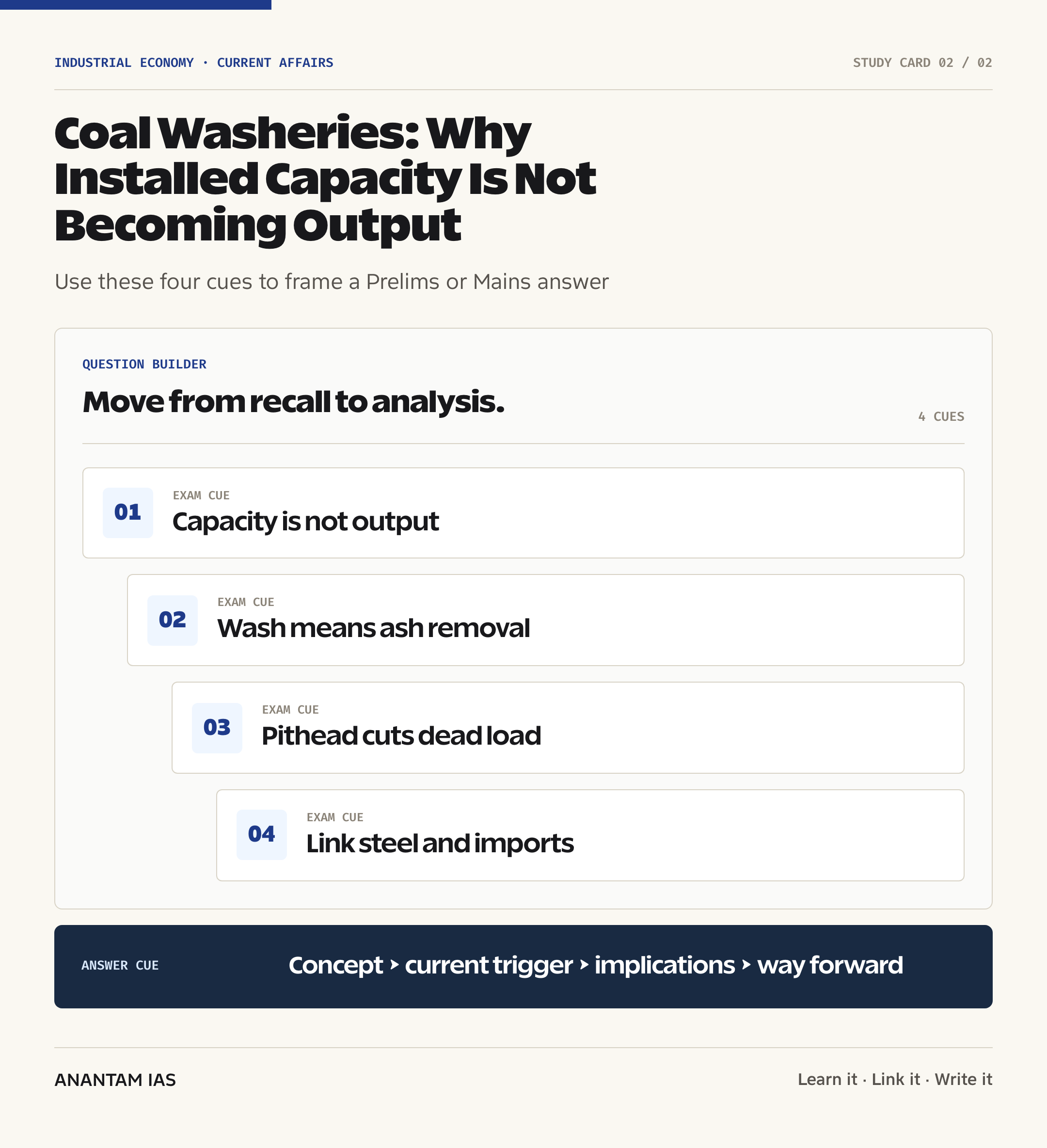
Reading the capacity-output evidence correctly
The official numbers show both spare nameplate capacity and a much smaller annual production ambition.
- The Ministry of Coal Annual Report 2025-26 states that CIL operates 10 coking-coal washeries with total operable capacity of 18.35 MTPA.
- That capacity includes three newly commissioned washeries with a combined capacity of 11.6 MTPA, so aggregate capacity alone does not prove that old-plant constraints have disappeared.
- Up to November 2025, official washed coking-coal production was 1.4 MT against an annual target of 3.59 MT.
- The correct comparison is not a simple utilisation percentage unless the time period, feed availability, operating days, design coal and recovery yield are held constant.
- The Hindu’s report used 3.59 MT in describing the output gap; the Ministry’s annual report identifies it as the annual target and separately records production through November. The official distinction should govern answer writing.
- A strong diagnosis asks where tonnes were lost: no raw feed, plant downtime, unsuitable feed, low recovery, quality rejection, weak offtake or dispatch congestion.
- The panel’s concern is still valid without converting these figures into a crude percentage: the production target itself was far below the aggregate operable feed capacity.
Why installed capacity can remain idle
A washery is one node in a mine-to-metal chain, so constraints outside the plant can depress its output.
- Ageing equipment raises downtime, maintenance needs and process instability; legacy circuits may not deliver the ash level or recovery expected by current steel users.
- Feed variability matters because Indian coal seams and mining sections can differ in ash, size distribution and washability; a design tuned to one feed may perform poorly on another.
- Delayed movement of raw coal from the pithead creates feed starvation, even when the washery itself has nominal spare capacity.
- A mismatch between mine plan and washery design can create either too little feed, unsuitable feed or a product that lacks a secure offtake agreement.
- Rail sidings, silos, conveyors, loading systems and rake availability determine whether washed coal and by-products can leave the site without inventory congestion.
- Commercial performance also depends on transparent sampling, third-party quality checks and pricing that rewards usable quality, not merely raw tonnage.
- Modern equipment cannot compensate for an unstable feed schedule. Mine production and washery campaigns need a shared quantity-quality plan backed by stockyard blending.
Why pithead beneficiation changes logistics
The panel’s pithead recommendation links coal quality with First Mile Connectivity rather than treating washing as an isolated factory process.
- Locating a washery near the mine can remove part of the ash and impurities before coal enters a long rail journey.
- This can reduce the movement of dead weight, improve wagon productivity and lower transport energy per tonne of useful coal delivered.
- A pithead layout can integrate mine conveyors, crushing, washing, silos and rapid loading under a single mechanised chain.
- But rejects then remain near the mine, concentrating the need for safe storage, authorised use and water management in the coalfield.
- Future washeries should be sized against realistic mine expansion, washability studies and user demand; otherwise an oversized plant merely reproduces the capacity-output gap.
- This logistics lens complements India’s wider coal-market reforms: a transparent contract still fails if the specified quality cannot be physically produced and delivered.
- The freight gain should be verified as avoided impurity movement, additional useful-coal tonnes per rake and lower transport energy, not assumed from plant location alone.
The steel and import-security connection
Washed domestic coking coal can displace part of imported material, but washing alone cannot erase geological and quality constraints.
- In the blast furnace-basic oxygen furnace route, coke acts as fuel, reducing agent and structural support for the burden inside the furnace.
- High ash increases slag volume and can raise coke consumption, energy demand and handling costs, which is why steelmakers require a controlled metallurgical-coal blend.
- Domestic coal may still need blending with imported low-ash coking coal after washing; the policy goal is credible partial substitution, not an automatic end to imports.
- The Ministry of Coal reported that April 2026 coking-coal imports were 6.01 MT, slightly above 5.93 MT a year earlier, even as several other coal-import categories fell.
- That contrast shows why coking coal is a resource-quality vulnerability tied to steel growth, not merely a temporary shortage of generic coal.
- Read the issue alongside India’s broader coal-sector reform framework: mining reform, linkages, washing, logistics and user contracts must reinforce one another.
- Import substitution should be counted only when domestic washed coal is accepted in a steel blend and displaces comparable imported tonnes without impairing furnace performance.
Environmental gains and environmental burdens
Washing can improve resource and transport efficiency, but it is not impact-free or equivalent to decarbonisation.
- Removing ash before transport can reduce the tonnes hauled for the same amount of useful coal and reduce ash handled at the consuming plant.
- More consistent coal quality can support steadier combustion or metallurgical operation, but the climate benefit depends on actual energy and material savings across the chain.
- Wet washing uses water and can produce slurry and effluent; closed-loop water systems, thickeners and functional effluent-treatment plants are basic safeguards.
- Washery rejects can create dust, fire and runoff risks unless quality-tested and directed to an authorised, technically suitable use or engineered disposal.
- The Standing Committee asked for effluent-treatment plants at washeries to protect neighbouring farmland and groundwater.
- Coal beneficiation should not be confused with coal gasification: the former physically separates impurities, while the latter chemically converts coal into synthesis gas.
- An honest assessment uses a mine-to-use boundary: washery electricity, water, reject management, rail savings and steel-plant performance all belong in the calculation.
How to frame the governance problem
The central failure is coordination: capacity creation, mine supply, technology, logistics, environmental control and steel demand have been measured in separate silos.
- A department-related Standing Committee cannot execute projects, but its evidence-based scrutiny can force the Ministry to explain gaps between assets, targets and outcomes.
- Performance dashboards should publish plant-wise feed, output, yield, ash reduction, downtime and dispatch, with comparable definitions.
- Modernisation decisions need washability data and life-cycle costing; replacing hardware without correcting unsuitable feed or weak offtake can leave throughput unchanged.
- Contracts under a Washery Developer and Operator route need output-quality, recovery, water and availability obligations rather than a capacity figure alone.
- Independent sampling and reconciliation from mine to steel plant can reduce disputes over grade slippage and make domestic blending decisions more bankable.
- Parliamentary follow-up should test whether recommendations changed plant performance, not stop at sanctioning money or announcing new capacity.
- Public reporting should pair every modernisation outlay with a baseline and deadline, so later scrutiny can attribute improvement to technology, logistics or better feed.
Way Forward
Audit each bottleneck before adding capacity
- Publish a plant-wise technical audit covering design life, feed characteristics, recovery curves, downtime, product ash and evacuation constraints.
- Classify each washery for renovation, technology replacement, feed redesign, commercial restructuring or closure based on measurable evidence.
- Use effective throughput and quality-adjusted output as primary indicators, not sanctioned MTPA.
Integrate mines, washeries and First Mile Connectivity
- Synchronise mine expansion, conveyor and silo commissioning, washery capacity, rail siding work and downstream demand.
- Prefer pithead sites where washability and environmental appraisal support them, so impurities are removed before long-distance haulage.
- Create contingency plans for feed interruptions and rake constraints so one failed node does not idle the entire chain.
Use technology for variable Indian coal
- Base process selection on seam-specific washability tests and flexible circuits that can handle changing size and ash profiles.
- Deploy sensors, automated controls and preventive maintenance only with trained operators and verified calibration.
- Support pilot-to-commercial research on difficult high-ash coking coal and publish recovery and cost results.
Tie contracts to steel-sector acceptance
- Create long-tenor supply and offtake arrangements with transparent specifications, independent sampling and predictable price adjustments.
- Measure import substitution as accepted domestic washed coal in metallurgical blends, not as planned capacity.
- Allow steelmakers and washeries to co-design blend trials while retaining competition and public accountability.
Make environmental controls non-negotiable
- Require closed-loop water use where feasible, operational effluent-treatment plants and real-time monitoring of critical discharge parameters.
- Track the quantity, quality, destination and final use of rejects and slurry to prevent dumping and secondary pollution.
- Include nearby communities, farmland and groundwater indicators in the performance review of every washery.
Conclusion
India’s washery challenge is not a shortage of installed machinery on paper. It is a systems problem in which ageing plants, variable feed, weak mine alignment, logistics and product acceptance prevent 18.35 MTPA of operable capacity from translating into dependable washed coking-coal supply.
A credible policy should measure quality-adjusted output from pithead to blast furnace, modernise only against evidence, and internalise water, slurry and reject costs. That is how beneficiation can improve steel security and freight efficiency without becoming another capacity announcement.
UPSC Practice Questions
Prelims MCQ 1
With reference to coal beneficiation, consider the following statements:
- It separates mineral impurities, especially ash-bearing material, from raw coal.
- Pithead beneficiation can reduce the non-combustible material transported over long distances.
- Washing cannot convert non-coking coal into coking coal.
How many of the above statements are correct?
(a) Only one (b) Only two (c) All three (d) None
Answer: (c) All three
Explanation:
All three are correct. Beneficiation is a physical quality-upgrading process; it can remove part of the ash before transport, but it cannot create the intrinsic caking properties of coking coal.
Prelims MCQ 2
Which measure most directly addresses the washery capacity-output gap identified by the parliamentary panel?
(a) Building washeries independently of mine plans (b) Moving unwashed impurities to distant steel plants (c) Aligning pithead washeries with mine expansion and First Mile Connectivity (d) Treating installed MTPA as the same as washed-coal production
Answer: (c) Aligning pithead washeries with mine expansion and First Mile Connectivity
Explanation:
The panel linked modernisation with raw-coal supply and logistics. Pithead siting and coordination with mine expansion and First Mile Connectivity address feed, transport and evacuation together.
UPSC Mains Questions
- India’s coal-washery problem is less about nominal capacity and more about conversion of capacity into quality-adjusted output. Analyse the technological, logistical, commercial and institutional causes of this gap, and suggest measurable indicators for holding coal public-sector enterprises accountable.
- Pithead beneficiation can improve freight efficiency and steel-sector resource security, yet it may concentrate water, slurry and reject burdens in mining regions. Evaluate this trade-off and propose safeguards that combine industrial policy with environmental justice.
- Domestic washed coking coal can reduce import exposure but cannot remove every geological and metallurgical constraint. Discuss how mine planning, beneficiation, blending, long-term offtake and transparent quality assurance should be integrated into India’s steel raw-material strategy.
Sources: Standing Committee on Coal, Mines and Steel; Ministry of Coal and The Hindu.
Frequently Asked Questions
What is a coal washery?
A coal washery is a plant that upgrades raw coal by separating ash-bearing mineral matter and other impurities through crushing, sizing and physical separation. It produces clean coal, middlings and rejects. Its rated capacity refers to raw-feed throughput under design conditions, not guaranteed saleable output.
Why is 18.35 MTPA not actual output?
The 18.35 MTPA figure is CIL’s operable coking-coal washing capacity. Actual output depends on raw-coal feed, operating days, plant availability, feed washability, recovery yield, product specifications and dispatch. The Ministry recorded 1.4 MT of production through November 2025 against a 3.59 MT annual target.
Why should washeries be near pitheads?
A pithead washery removes part of the ash and impurities before long-distance transport. This can reduce dead-weight haulage, improve wagon use and integrate conveyors, silos and rapid loading. It also keeps rejects near the mine, where strict water, storage and disposal safeguards are needed.
Can washing end coking-coal imports?
No. Washing can make more domestic coking coal usable and support partial import substitution, but it cannot change every geological property. Indian steelmakers may still need imported low-ash coal for blending and furnace performance. The realistic objective is secure, accepted domestic supply within a technically suitable blend.
How does washing affect the environment?
Benefits can include less ash transported and more consistent useful coal. Costs include water demand, slurry, effluent, rejects, dust and possible groundwater or farmland impacts. Closed-loop water systems, functional effluent treatment, reject tracking and community monitoring are needed to prevent shifting pollution to mining regions.
What should government measure?
Government should publish plant-wise raw feed, operating hours, downtime, clean-coal output, recovery yield, ash reduction, product rejection, water use, effluent compliance and dispatch. These indicators show where capacity is being lost and are more informative than announcing nameplate MTPA or project expenditure alone.
Source: https://anantamias.com/current-affairs/coal-washeries-capacity-output-gap/
ILO Convention No. 193: India’s Split Vote on Platform-Worker Rights
Why in News?
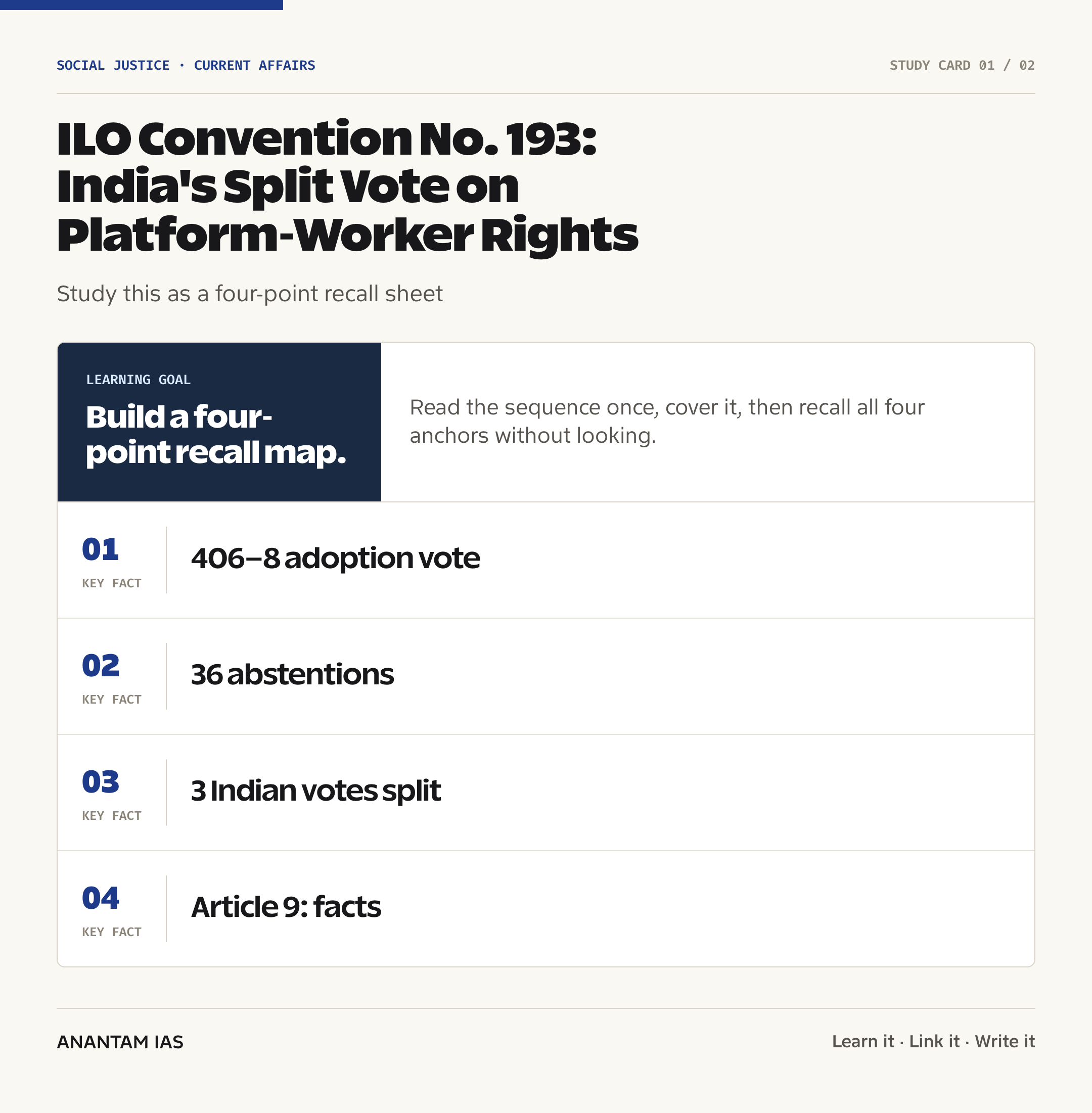
The Hindu examined India’s position on ILO Convention No. 193, the Decent Work in the Platform Economy Convention adopted by the International Labour Conference in Geneva on 12 June 2026. The recorded vote was 406 in favour, 8 against and 36 abstentions.
The official ILO voting record shows a split within India’s tripartite participation: India’s employer delegate and worker delegate voted for adoption, while a government delegate abstained. The Convention remains open to India for later ratification; an abstention at adoption is not a permanent legal bar.
- Convention No. 193 is the first international labour standard dedicated specifically to the platform economy.
- The Convention covers location-based work, such as ride-hailing and delivery, and online work, such as data labelling and digital tasks.
- Its scope extends to platform workers in the formal and informal economy, whether or not they are in an employment relationship.
- The ILO’s recorded result was 406–8, with 36 abstentions; India’s worker and employer representatives supported the instrument.
- The latest ILO NORMLEX instrument profile checked for this note listed zero ratifications, so the Convention had not entered into force.
The development matters in the context of:
- The dispute is not only about benefits. It asks whether a contractual label can override the facts of control, work and payment in deciding a worker’s legal status.
- Platform workers face risks created by algorithmic management: automated task allocation, rating, pay calculation, monitoring and account deactivation.
- India already recognises gig and platform workers under the Code on Social Security, 2020, but Convention No. 193 offers a wider benchmark linking status, pay, safety, data rights and remedies.
UPSC Relevance
Prelims Relevance
- ILO Convention No. 193 was adopted at the 114th International Labour Conference on 12 June 2026.
- An ILO member’s Conference delegation is constitutionally tripartite: two government delegates, one employer delegate and one worker delegate.
- Convention No. 193 applies to all digital labour platforms and platform workers in both formal and informal economies, subject to tightly framed national exclusions.
- Article 9 requires correct classification guided mainly by facts relating to work performance and remuneration, not merely the contract’s label.
- Article 10 requires timely and full payment due under law, agreement or contract; the applicable minimum-wage guarantee is expressly tied to workers in an employment relationship.
- Article 12 requires social-security access on terms no less favourable than for other workers with the same status in employment.
- Articles 13–15 address algorithmic monitoring, decision-making, written explanations, review and appropriate human involvement.
- Under Article 27, the Convention enters into force 12 months after the second ratification is registered; for later ratifying states, it applies 12 months after registration.
- Under Article 19 of the ILO Constitution, newly adopted instruments must be submitted to the competent national authority even before a state chooses whether to ratify.
Mains Relevance
GS Paper 2
- Use the issue to examine welfare governance, labour protection, social justice and accountability for automated decisions.
- Assess the balance between regulatory flexibility and a minimum rights floor for workers whose income depends on platforms.
GS Paper 2
- Connect India’s vote to the ILO’s tripartite structure, treaty adoption, ratification and the domestic role of Parliament and competent authorities.
- Distinguish an adoption vote from ratification: voting behaviour has political significance, while binding treaty obligations arise only after ratification and entry into force.
GS Paper 3
- Analyse how digital platforms create work and formalisation opportunities while transferring fuel, equipment, waiting-time and income risks to workers.
- Evaluate algorithmic management as an economic-governance issue involving productivity, competition, data protection and access to livelihood.
Essay
- Technology changes the organisation of work faster than the moral claim to dignity at work.
- Flexibility is meaningful only when workers can understand, contest and survive the rules that govern their income.
Background and Context
What Convention No. 193 Covers
The Convention creates a common floor without forcing every platform worker into one employment category.
- Article 1 defines a digital labour platform through digital technologies and automated decision-making systems that organise or facilitate paid service work.
- A digital platform worker is a person employed or engaged for paid work organised or facilitated by a platform, regardless of their classification.
- Article 2 covers online and location-based work, and workers in formal as well as informal economies.
- A member may exclude only limited categories where substantial special problems arise, after consultation; it must explain the exclusion in ILO reports and consider progressive extension.
- The Convention recognises intermediaries and subcontracting chains, preventing a platform from escaping responsibility simply by placing another entity between itself and the worker.
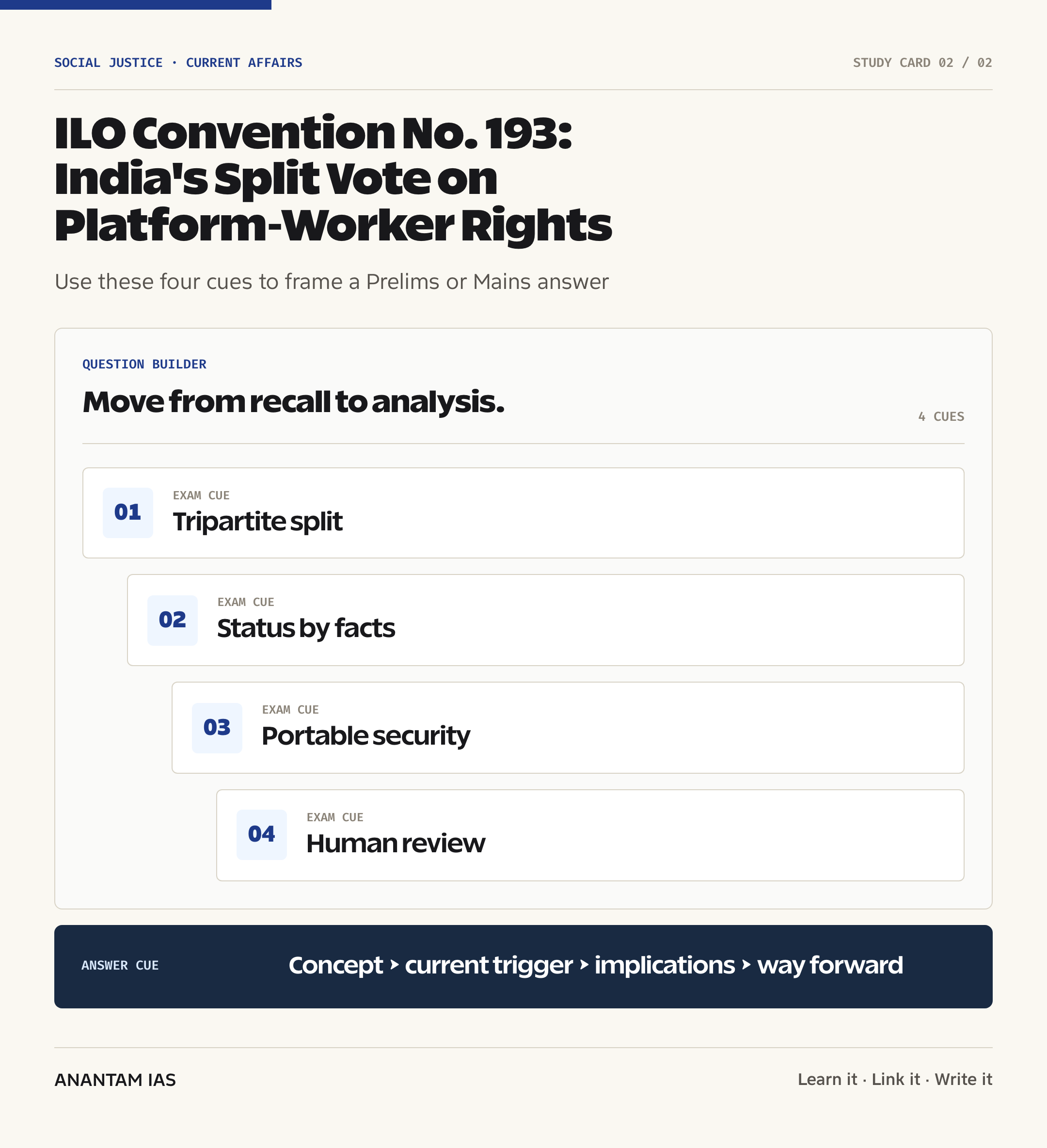
Tripartism and India's Split Position
The vote is a useful illustration of how the ILO gives governments, employers and workers distinct voices.
- Under the ILO Constitution, each member may send two government delegates, one employer delegate and one worker delegate; non-government delegates act independently.
- The official roll records India’s employer representative and worker representative among the 406 votes for adoption.
- An Indian government representative appears among the 36 abstentions. The record supports describing India’s position as internally split, not as unanimous national rejection.
- The adoption vote made Convention No. 193 an ILO standard, but it did not itself bind India. Binding obligations depend on ratification registered with the ILO.
- India can still ratify later. Even without ratification, the instrument supplies a policy benchmark and must be brought before the competent authority under the ILO Constitution.
Classification: Facts Before Contract Labels
Worker classification determines which rights attach to the relationship, making Article 9 the Convention’s structural core.
- Platforms may describe workers as independent partners, yet still shape price, access to tasks, ratings, performance and continued access to the app.
- Article 9 asks states to determine the existence or absence of an employment relationship mainly from facts about performance and payment, while considering platform-work specificities.
- The Convention does not declare every worker an employee and does not prohibit self-employment; it seeks accurate status and suitable protection.
- Correct classification matters because minimum wage, compensation of work expenses and some other guarantees depend on whether the person is in an employment relationship.
- Some rights are broader than employee status, including fundamental principles at work, safety, protection from violence, data safeguards and access to remedies.
Pay, Safety and Social Protection
The Convention combines universal protections with status-sensitive entitlements rather than pretending every platform arrangement is identical.
- Articles 3–6 cover freedom of association, collective bargaining, freedom from forced and child labour, non-discrimination, safe work and protection from violence and harassment.
- Article 5 protects a worker who leaves a situation reasonably believed to present imminent and serious danger, without undue consequences.
- Article 10 requires payment due under applicable rules to be timely, full, lawfully deducted and made through lawful means.
- For workers in an employment relationship, pay excluding tips cannot fall below the applicable statutory or negotiated minimum wage; states must consider whether similar protection should extend to others.
- Article 12 uses a comparability rule: platform workers should receive social-security protection no less favourable than workers with the same employment status.
- Article 23 reinforces no-less-favourable treatment, preventing digital intermediation from becoming a reason for inferior protection.
Algorithms, Data and Deactivation
Convention No. 193 treats software rules as labour-governance rules when they shape work or access to income.
- Article 13 requires platforms to disclose automated systems used to monitor or evaluate work and to explain their effects on conditions or access to work.
- Article 15 supports a written explanation and review of significant adverse automated decisions, including non-payment, suspension, deactivation or termination.
- Review must include appropriate human involvement; an automated appeal loop cannot be the only answer to an automated penalty.
- Article 16 requires legitimate-purpose processing and gives workers rights to seek access, rectification and erasure, subject to data-retention law.
- Article 17 prohibits suspension, deactivation or termination on discriminatory or otherwise unlawful grounds.
- Article 21 requires safe, fair and effective dispute-resolution mechanisms and appropriate remedies for workers and platforms.
India's Domestic Baseline
India has statutory recognition and a funding framework, but Convention No. 193 asks a wider set of questions about the employment relationship and platform power.
- The Code on Social Security, 2020, in force from 21 November 2025, defines gig workers, platform workers and aggregators and enables welfare schemes for these groups.
- The Code permits schemes covering life and disability, accident, health, maternity and old-age protection and provides a role for the National Social Security Board.
- Its aggregator contribution may be notified between 1% and 2% of annual turnover, capped at 5% of the amount paid or payable to gig and platform workers.
- The Code’s categories do not by themselves resolve whether a particular worker is an employee. Convention Article 9 adds a fact-based status test that could reshape access to employment-linked rights.
- India’s policy gap is best framed as recognition versus enforceable delivery: registration, funding, benefit eligibility, portability, claims, appeal and classification all need workable rules.
- A worker may earn through several apps, migrate between states or alternate between platform and non-platform work. A usable system needs a single portable worker record without making one platform the gatekeeper of identity or benefits.
- The central framework and state welfare initiatives must agree on worker identification, contribution credit and benefit portability. Otherwise the same worker can be duplicated, excluded or lose continuity when crossing a state border.
- State legislation, including Rajasthan’s Platform Based Gig Workers Act, 2023, shows that welfare boards and transaction-linked funding can be designed locally. But fragmented state databases and contribution rules would raise compliance costs and weaken portability.
- The Code focuses on social-security schemes, while Convention No. 193 joins welfare to classification, occupational safety, pay transparency, algorithmic accountability and remedies. Domestic alignment would need more than a welfare-fund notification.
- For the domestic framework, revise Anantam IAS notes on social security for gig and informal workers and the guide to gig workers’ rights.
From Algorithmic Disclosure to Enforceable Due Process
The Convention identifies the right questions, but national rules must convert disclosure and review into procedures that work at platform speed.
- A platform should disclose which systems influence task allocation, dynamic pricing, ratings, incentives, fraud flags and deactivation, not merely publish a broad statement that algorithms are used.
- An explanation must identify the decisive inputs, the rule applied and the available appeal route in language the worker can understand. A generic fraud label is not a meaningful written explanation.
- Human involvement should be real: the reviewer needs authority to inspect records, correct data, restore access and reverse withheld payment. A support agent reading the same automated output would not satisfy the purpose of human review.
- Time limits matter because account suspension can remove a worker’s daily income. Domestic rules should create urgent interim review for deactivation, alongside ordinary grievance and appeal channels.
- Platforms should preserve auditable logs of notices, significant decisions, human interventions and outcomes. Regulators need secure access for enforcement without requiring publication of commercially sensitive information, which Article 24 also protects.
- Workers who use multiple platforms need consistent minimum safeguards. A common national protocol can define notice, explanation, review and data correction while allowing states to provide additional welfare and enforcement mechanisms.
Legal Effect and Ratification Path
Adoption, submission, ratification and entry into force are separate stages and should not be collapsed into one.
- The 12 June vote completed adoption by the International Labour Conference; it did not automatically rewrite national labour law.
- The latest ILO instrument profile checked for this note showed zero ratifications and no in-force date.
- Under Article 27, two registered ratifications are needed to start the clock for global entry into force, which occurs 12 months later.
- For each later ratifying member, the Convention becomes binding 12 months after its ratification is registered.
- The official texts adopted at the 114th session include the Convention but not a companion Recommendation. A Recommendation is normally non-binding guidance that can supply more detailed implementation choices; its absence does not weaken the Convention’s legal status after ratification.
- The Convention deliberately leaves implementation routes open. Article 24 permits laws, regulations, collective agreements, court decisions or a combination consistent with national practice, while requiring consultation with representative employer and worker organisations.
- Before ratification, India can conduct a conformity review identifying provisions already covered, those needing rules and those requiring primary legislation. This separates genuine legal conflicts from administrative gaps.
- Submission to the competent authority under the ILO Constitution should precede a reasoned decision. Ratification is an executive international act, but domestic enforceability depends on changes made through India’s constitutional and legislative processes.
- Implementation may use laws, regulations, collective agreements, court decisions or a combination, in consultation with representative employer and worker organisations.
- Ratification would require India to examine the relationship between central labour codes, state welfare laws, platform contracts, data rules and accessible enforcement.
Way Forward
Publish a Reasoned National Position
- Place the Convention before the competent authority with an article-by-article comparison of Indian law and a public explanation of the abstention.
- Use genuine tripartite consultation with worker organisations, aggregators, states and independent labour experts before deciding on ratification.
Build a Fact-Based Classification Test
- Assess control over price, task allocation, monitoring, discipline, customer access and economic dependence instead of relying only on the platform’s contractual label.
- Create a rebuttable, evidence-based process with clear burdens of proof and fast appeals so classification disputes don’t require years of litigation.
Make Social Security Portable
- Tie benefits to the worker across platforms and states, with transparent contributions, interoperable records and protection for intermittent work.
- Publish dashboards on registration, contributions, eligible workers, claims, rejection reasons and grievance disposal, while protecting personal data.
Regulate Algorithmic Management
- Require plain-language notice of pay rules, ratings, task allocation and deactivation triggers, plus a written explanation for adverse decisions.
- Guarantee timely human review, restoration of wrongly blocked accounts and compensation where unlawful deactivation causes income loss.
Conclusion
Convention No. 193 does not abolish flexible platform work. It draws a line between flexibility and unaccountable risk transfer by combining accurate classification with rights that follow the worker.
India’s split vote should lead to a transparent legal comparison, not a symbolic argument about Geneva. The practical test is whether a worker can receive fair payment, carry social protection, understand an algorithmic decision and obtain a remedy when access to livelihood is wrongly removed.
UPSC Practice Questions
Prelims MCQ 1
With reference to ILO Convention No. 193, consider the following statements:
- It applies to digital platform workers in both formal and informal economies.
- It automatically classifies every digital platform worker as an employee.
- It provides for written explanation and review of certain adverse automated decisions.
How many of the above statements are correct?
(a) Only one (b) Only two (c) All three (d) None
Answer: (b) Only two
Explanation:
Statements 1 and 3 are correct. Statement 2 is incorrect: Article 9 requires correct classification based mainly on facts about work and payment, but the Convention does not impose one status on every worker.
Prelims MCQ 2
When will ILO Convention No. 193 first enter into force under its Article 27?
(a) Immediately after adoption by the International Labour Conference (b) Six months after the first member ratifies it (c) Twelve months after the second registered ratification (d) Only after a majority of ILO members ratify it
Answer: (c) Twelve months after the second registered ratification
Explanation:
Article 27 requires two registered ratifications. The Convention first enters into force 12 months after the second is registered; it binds each later ratifying member 12 months after that member’s registration.
UPSC Mains Questions
- ILO Convention No. 193 does not impose a single employment status, yet it challenges platform business models built on contractual labels. Examine how its fact-based classification test can reconcile genuine self-employment with protection against disguised employment.
- India’s worker and employer delegates supported ILO Convention No. 193 while a government delegate abstained. Discuss what this split reveals about tripartism, treaty-making and the need for transparent domestic consultation on labour standards.
- Algorithmic management converts software design into a question of livelihood and due process. Evaluate the safeguards India needs for automated pay, ratings, task allocation and account deactivation in the platform economy.
Sources: International Labour Organization and The Hindu.
Frequently Asked Questions
What is ILO Convention No. 193?
It is the Decent Work in the Platform Economy Convention adopted on 12 June 2026. It is the first international labour standard devoted specifically to platform work, covering classification, payment, safety, social security, automated systems, personal data, deactivation and access to remedies.
Did India vote against the Convention?
No. The official roll records India’s employer and worker delegates voting in favour, while an Indian government delegate abstained. This is best described as a split tripartite position. Abstention at adoption does not stop India from ratifying the Convention later.
Does it make every gig worker an employee?
No. Article 9 requires states to classify workers correctly, guided mainly by facts about how work is performed and paid. It neither mandates employee status for everyone nor bans self-employment. The aim is to prevent contractual labels from concealing the real working relationship.
What protection applies regardless of status?
Its broad floor includes fundamental principles and rights at work, occupational safety and health, protection from violence and harassment, safeguards for personal data, lawful treatment in deactivation and access to dispute resolution. Some pay protections are expressly linked to an employment relationship.
How does it regulate platform algorithms?
Platforms must disclose relevant automated monitoring and decision systems and explain their effects on work. Workers should be able to request written reasons and review for major adverse outcomes such as non-payment, suspension, deactivation or termination, with appropriate human involvement.
Is the Convention already binding on India?
No. An ILO Convention becomes binding on a member only after ratification is registered and the treaty enters into force for that member. India has not ratified Convention No. 193. The instrument can still guide policy, and the ILO Constitution requires submission to the competent authority.
Source: https://anantamias.com/current-affairs/india-ilo-convention-193-gig-worker-protections/
CAQM Drone Monitoring: Closing the stubble-burning detection gap
Why in News?
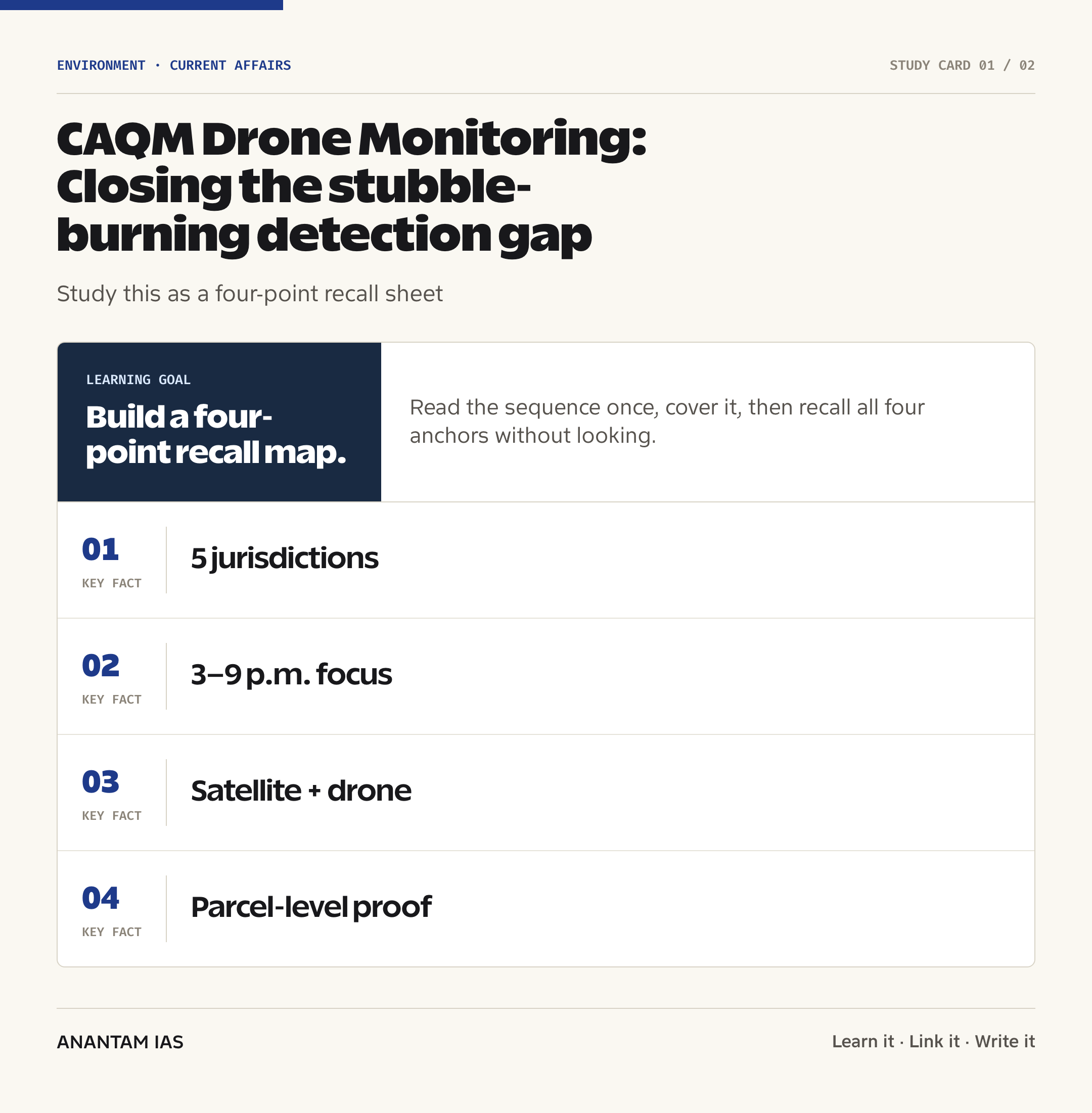
The Commission for Air Quality Management has urged the governments of Delhi, Haryana, Punjab, Uttar Pradesh and Rajasthan to use drone surveillance for monitoring paddy-stubble fires. The Hindu reported the advice on July 30, 2026, ahead of the paddy-harvest season.
The proposed flights would focus on hotspot villages and fire-prone paddy areas, especially from 3 p.m. to 9 p.m. This is the period in which deliberate late burning can be timed to reduce the chance of detection during a satellite overpass.
- Unmanned aerial vehicles can be deployed quickly and can capture high-resolution, near-real-time views below cloud or smoke conditions that may complicate wide-area observation.
- Drone imagery can locate active fires, identify smoke plumes, outline affected fields and create time-stamped visual evidence for field verification.
- States were advised to prepare advance flight plans, estimate the required number of sorties and prioritise historically fire-prone locations.
- Detected incidents should be overlaid on cadastral maps, which show land-parcel boundaries, so officials can identify the affected field more precisely.
- All flights must comply with the Drone Rules, 2021; an environmental objective does not remove aviation-safety and airspace obligations.
The development matters in the context of:
- This matters in the context of a known temporal detection gap: satellites offer broad, repeatable coverage, but they do not watch every field continuously.
- It also tests whether environmental technology can strengthen cooperative federalism without reducing crop-residue policy to punishment alone.
- For background on residue-based alternatives, see bio-bitumen from farm residue and compressed biogas and energy security.
UPSC Relevance
Prelims Relevance
- CAQM is a statutory body under the Commission for Air Quality Management in National Capital Region and Adjoining Areas Act, 2021.
- Section 12 empowers CAQM to coordinate action by Delhi, Punjab, Haryana, Rajasthan and Uttar Pradesh and to issue written directions that authorities must follow.
- CAQM’s territorial remit covers the National Capital Region and adjoining areas insofar as their pollution affects NCR air quality.
- The standard protocol for estimating crop-residue fire events was developed by ISRO with State Remote Sensing Centres and the Indian Agricultural Research Institute, and was issued by CAQM in August 2021.
- IARI’s CREAMS Laboratory publishes daily crop-fire event data using the satellite-based protocol.
- A satellite identifies an active-fire location during an overpass; burn-scar assessment uses suitable imagery to estimate the land area affected after burning.
- A cadastral map records parcel boundaries and supports field-level attribution; it is different from a general topographic or administrative map.
- The Drone Rules, 2021 govern civilian drone operations, including registration, airspace permissions and operational safety.
- Direction No. 99 of 2026 requires Punjab, Haryana and Uttar Pradesh to implement state action plans aimed at complete elimination of paddy-stubble burning in 2026.
Mains Relevance
GS Paper 3
- Technology for air-pollution monitoring, crop-residue management, remote sensing and evidence-based environmental enforcement.
- Trade-offs between in-situ management, ex-situ straw use, crop diversification, farm economics and deterrent action.
- The difference between counting detected fires and measuring their actual contribution to ambient air quality under changing weather.
GS Paper 2
- CAQM as an example of inter-State environmental governance for a pollution airshed that does not follow political boundaries.
- Accountable use of drones: lawful operations, transparent protocols, parcel-level evidence, grievance redress and protection against arbitrary enforcement.
Essay
- Technology can make the State more observant, but durable compliance depends on making the cleaner choice economically workable.
- Air is a shared commons: local farm decisions and regional meteorology create costs across administrative borders.
Background and Context
Why satellites need a ground-level complement
Satellite monitoring remains the regional backbone, while drones fill a narrower spatial and temporal gap.
- Wide-area strength: satellites scan large agricultural regions through a standard, comparable protocol and enable daily reporting across States.
- Overpass constraint: a satellite observes a location at particular times; a fire lit and extinguished between usable observations may escape an active-fire count.
- Drone advantage: district teams can send a UAV to a priority cluster, alter its flight path and gather closer imagery during the higher-risk evening period.
- Complement, not replacement: satellite alerts help allocate scarce sorties; drones refine location; ground officers confirm the incident and initiate lawful action.
- Burn scars: later imagery can show that residue was burnt even where an active flame was missed, but verification still matters because spectral signatures can be misread.
The proposed detection-to-action chain
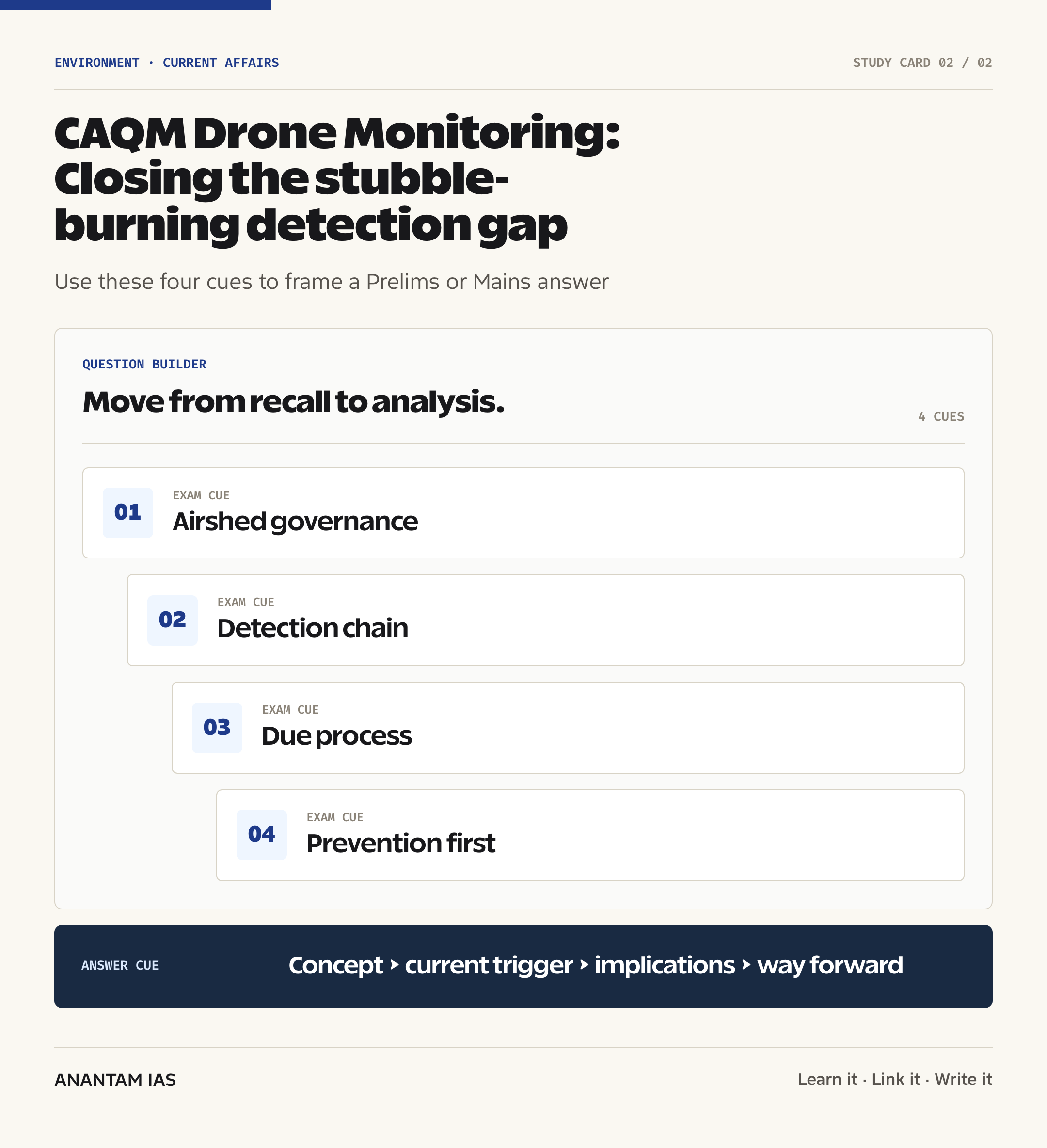
The governance value lies in linking an observation to a verified field response, not in collecting more images.
- Prioritise: combine historical fire data, harvesting progress and district hotspot lists to select villages and flight windows.
- Observe: use a planned sortie to record fire, smoke, coordinates and a reliable timestamp while respecting notified airspace restrictions.
- Attribute: overlay the coordinates on a cadastral map to identify the land parcel; do not treat automated matching as final proof.
- Verify: send a trained field team or designated nodal officer to establish what was burnt, by whom and under what circumstances.
- Respond: record evidence, facilitate residue-management support where needed, and apply compensation or other enforcement only under the applicable legal process.
- Learn: feed confirmed outcomes back into the district dashboard so a false alert, repeat hotspot or machinery gap changes the next intervention.
CAQM's statutory and federal role
CAQM was designed for an airshed problem in which emissions and administrative responsibility cross borders.
- Under the CAQM Act, 2021, the Commission coordinates pollution-control action among Delhi and the relevant adjoining States.
- Section 12 allows it to take measures, seek information, prepare guidelines and issue binding written directions for protecting NCR air quality.
- Direction No. 99, approved in May 2026, asks Punjab, Haryana and Uttar Pradesh to carry out their paddy-residue action plans with a target of complete elimination.
- The Direction calls for farm-level mapping of the planned residue-management route, specific nodal officers, updated inventories of crop-residue management machinery and district-wise real-time dashboards.
- Drone monitoring extends this architecture to Delhi and Rajasthan as well because smoke movement and pollution control require an airshed approach, even where the intensity of paddy burning differs.
- Students should separate CAQM from the Central Pollution Control Board: CAQM is the regional coordinating commission; CPCB remains the national pollution-control board and can support field monitoring.
What the official data establish
Verified fire counts show major improvement, but a lower count should be interpreted with care.
- PIB reported that Punjab recorded 5,114 fire counts during the 2025 paddy season, 53% below 2024.
- Haryana recorded 662 fire counts in the same season, also 53% below 2024.
- The government attributes the decline to State and district action plans, machinery deployment, enforcement, awareness and greater ex-situ use of straw.
- Official monitoring for the 2025 season included 31 CPCB flying squads across 18 Punjab districts and 13 Haryana districts during October-November; they supplied daily updates, photographs and compliance status.
- A fire count is a detected event, not a direct measure of emissions, burnt area or the percentage contribution of stubble smoke to Delhi’s daily pollution.
- Meteorology, other emission sources and detection conditions affect the observed relationship between farm fires and Delhi’s winter air pollution.
Prevention must remain larger than surveillance
Farmers burn residue mainly because the harvest-to-sowing window is short and alternatives can carry access, timing and transport costs.
- In-situ options manage straw within the field through suitable machinery and agronomic practices, reducing transport needs.
- Ex-situ options turn straw into feedstock for biomass energy, industrial boilers, bio-ethanol, compressed biogas, pellets, briquettes, packaging or other products.
- Custom Hiring Centres can widen machinery access; Direction No. 99 calls for rent-free CRM machinery for small and marginal farmers through these centres.
- Crop diversification and shorter-duration paddy varieties can reduce both residue pressure and the time conflict before wheat sowing.
- A credible system should first diagnose whether a hotspot reflects missing machinery, poor repair support, weak straw markets, delayed harvesting or deliberate evasion.
- Surveillance deters only when farmers also see a timely, affordable and reliable non-burning pathway.
Risks and safeguards in drone-based enforcement
High-resolution monitoring improves precision only when its operating and evidentiary rules are equally precise.
- False attribution: coordinates near a parcel boundary, drifting smoke or outdated land records can point to the wrong holder; field verification and an appeal channel are essential.
- Selective enforcement: flights concentrated only where administration is easiest can distort the hotspot picture; sortie criteria and coverage should be disclosed.
- Evidence integrity: authorities need secure timestamps, geolocation, retention rules and an audit trail from image capture to enforcement order.
- Privacy and proportionality: cameras should collect what is needed for crop-fire monitoring, avoid unrelated household surveillance and limit retention of non-evidentiary footage.
- Aviation safety: operators must follow the Drone Rules, 2021, approved airspace conditions, weather limits and competent operating procedures.
- Capacity: drones require trained personnel, maintenance, batteries, data links and rapid ground teams; hardware without an institutional response loop creates only a demonstration.
How to judge whether the intervention works
Evaluation must distinguish better observation from actual environmental improvement.
- Coverage indicator: record the share of identified hotspots covered during the planned risk window, not just the total number of sorties. A large flight count can conceal repeated coverage of easy locations while remote clusters remain unobserved.
- Detection indicator: compare drone alerts with satellite active-fire alerts, later burn-scar assessment and ground reports. The useful question is which genuine incidents each layer adds, not which technology produces the largest raw total.
- Verification indicator: disclose how many alerts were confirmed, rejected or remained unresolved after field inspection. A falling confirmation rate may signal weak targeting, geolocation error or inconsistent evidentiary standards rather than changing farmer behaviour.
- Response indicator: measure the time between an alert and a field visit, the action recorded and whether a residue-management service was offered. Time-stamped imagery loses enforcement and prevention value when the administrative response arrives after the field has changed.
- Equity indicator: compare machinery access, straw collection and enforcement across farm-size groups and villages. A system that penalises cultivators in poorly served areas without correcting the service deficit can be precise in location yet unfair in policy.
- Outcome indicator: track confirmed burning, estimated burnt area and repeat incidents separately. A single large burn and several small burns need not have the same emissions significance, even when both appear as events in a count.
- Air-quality indicator: interpret local fire data with wind, boundary-layer conditions and other emission sources. Lower farm-fire counts support risk reduction, but they don’t establish a fixed daily share in Delhi’s particulate pollution.
- Institutional indicator: audit data quality, lawful flight compliance, grievance disposal, equipment uptime and district coordination. Durable capacity is shown when officials can use the system consistently through the harvest peak, not merely during a launch exercise.
- Learning indicator: require the next season’s action plan to explain how verified gaps changed hotspot selection, machinery placement, custom-hiring capacity and straw-market arrangements. Monitoring becomes governance only when its evidence alters resource allocation.
- Decision rule: expand drone coverage where it adds confirmed incidents or accelerates prevention; redesign it where alerts duplicate satellite data or arrive too late for action. Public spending should follow demonstrated information gain and field response, while savings from low-value sorties should strengthen machinery, repair and straw-lifting services through iterative correction at the district level.
Way Forward
Build a risk-based flight plan
- Combine harvesting calendars, past fire records, weather and live satellite alerts to schedule sorties, with transparent criteria for selecting hotspot villages.
- Reserve the 3 p.m.–9 p.m. window for focused coverage while retaining daytime flights for baseline mapping and operational safety.
- Coordinate district aviation permissions and publish standard operating procedures before the harvest peak.
Create evidence that can withstand review
- Integrate drone records with cadastral layers, but require human verification before fixing responsibility.
- Use a common evidence format for location, time, image, field report and action taken; preserve a tamper-evident audit trail.
- Give affected cultivators notice, access to the relevant record and a prompt grievance mechanism.
Link every alert to prevention support
- Show nodal officers the nearest available CRM machine, repair centre, straw aggregator or ex-situ buyer when an at-risk field is identified.
- Measure response time, machinery availability, verified burning and repeat incidents, not the number of drone flights alone.
- Target scarce public support at small and marginal farmers and villages where a demonstrated service gap makes compliance difficult.
Evaluate outcomes honestly
- Publish detected fires, confirmed fires, burn-scar area, false alerts and action taken as separate indicators.
- Commission independent assessment of whether drone deployment closes the evening gap without producing biased or duplicative enforcement.
- Keep the policy goal centred on less burning and cleaner air, not a technology procurement target.
Conclusion
CAQM’s drone proposal is best understood as a last-mile monitoring layer. Satellites supply consistent regional intelligence; drones can investigate a high-risk place and time; cadastral and field checks can connect the observation to a defensible administrative response.
But detection is only one part of crop-residue governance. The strongest model combines credible enforcement with machinery access, repair support, straw markets, crop choices and accountable inter-State coordination. A drone can show where a fire is burning; policy must make sure the farmer has a workable reason not to light it.
UPSC Practice Questions
Prelims MCQ 1
With reference to monitoring of paddy-stubble burning in India, consider the following statements:
- The standard satellite protocol was developed by ISRO in consultation with State Remote Sensing Centres and IARI.
- IARI’s CREAMS Laboratory publishes daily crop-fire event data under this protocol.
- A cadastral map is primarily used to forecast wind-driven movement of smoke plumes.
How many of the above statements are correct?
(a) Only one (b) Only two (c) All three (d) None
Answer: (b) Only two
Explanation:
Statements 1 and 2 are correct. A cadastral map shows land parcels and boundaries; it helps identify an affected field, not forecast atmospheric transport.
Prelims MCQ 2
Which provision gives CAQM broad power to coordinate action and issue written directions for protecting NCR air quality?
(a) Section 3 of the Environment (Protection) Act, 1986 (b) Section 12 of the CAQM Act, 2021 (c) Section 20 of the Air (Prevention and Control of Pollution) Act, 1981 (d) Section 5 of the National Green Tribunal Act, 2010
Answer: (b) Section 12 of the CAQM Act, 2021
Explanation:
Section 12 sets out CAQM’s powers and functions, including inter-governmental coordination and binding written directions.
UPSC Mains Questions
- Drone surveillance can close a temporal and spatial gap in satellite monitoring of crop-residue fires, but it cannot by itself eliminate stubble burning. Examine the technology’s value and limitations, and propose a detection-to-support framework for accountable environmental enforcement.
- Air pollution in Delhi-NCR is an airshed governance problem rather than a problem confined to one State. Discuss the statutory role of CAQM and the cooperative-federal mechanisms needed to manage crop-residue burning across adjoining jurisdictions.
- Precision monitoring can improve environmental compliance only when precision is matched by due process. Analyse the evidentiary, privacy, aviation-safety and equity safeguards required for using drones in parcel-level farm-fire enforcement.
Sources: CAQM and PIB, Ministry of Environment, Forest and Climate Change and The Hindu.
Frequently Asked Questions
Why does CAQM want drones for stubble fires?
Drones can inspect a selected hotspot quickly, capture close and time-stamped imagery, locate flames and smoke, and map the affected field. They are meant to complement satellite alerts and ground inspections, especially during evening hours when a short-lived fire may fall between usable satellite observations.
Which governments received the drone-monitoring advice?
The advice covered the governments of Delhi, Haryana, Punjab, Uttar Pradesh and Rajasthan. These jurisdictions are linked through the NCR airshed and CAQM’s statutory coordination role, though the intensity and geography of paddy-residue burning are not identical across all five.
Why is the 3 p.m.–9 p.m. window important?
CAQM identified the late-afternoon and evening period as a priority because attempts to avoid satellite detection are considered more likely then. Focused sorties can narrow this temporal blind spot, but flights must still follow aviation-safety, airspace, weather and visibility requirements.
How do cadastral maps help enforcement?
A cadastral map shows individual land parcels and their boundaries. Overlaying verified drone coordinates can help officials identify the field linked to a fire. It should not be treated as automatic proof: boundary errors, smoke drift and land-record issues require on-ground confirmation and an opportunity to contest attribution.
Do drones replace satellite monitoring?
No. Satellites provide repeatable, wide-area surveillance through a standard protocol, while drones offer flexible and higher-resolution inspection of selected areas. A sound system uses satellites to flag risk, drones to refine evidence and field officers to verify facts and connect farmers with support or lawful enforcement.
What is the main policy limitation?
Better detection does not remove the economic and logistical causes of burning. Farmers also need timely machinery, repairs, affordable custom hiring, straw collection and buyers, suitable crop choices and a workable sowing window. Surveillance is credible only when a practical non-burning alternative is available.
Source: https://anantamias.com/current-affairs/caqm-drone-monitoring-stubble-burning-hotspots/