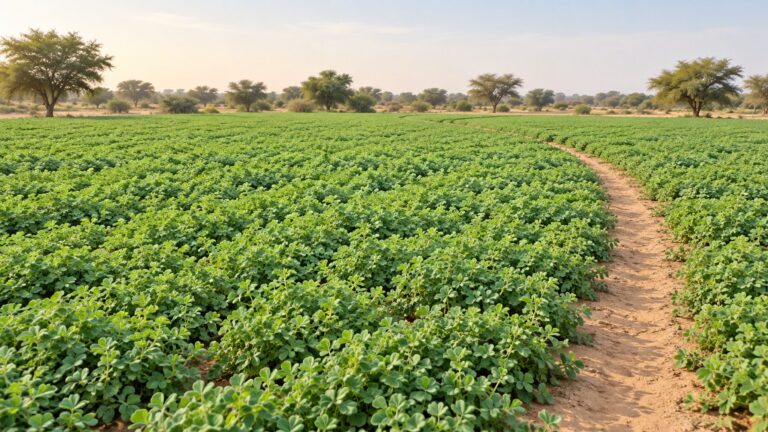
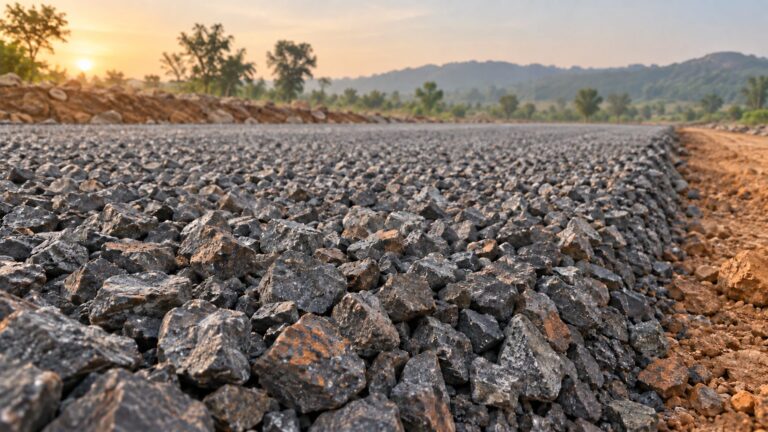
India’s January 2026 bio-bitumen update connected two stubborn policy problems: road-building dependence on petroleum bitumen and the annual burning of crop residue. CSIR labs demonstrated bio-bitumen from rice straw through pyrolysis and showed its use in road construction trials.
For UPSC, this is a compact GS-III topic because it brings together science and technology, infrastructure, circular economy, pollution control, farmer income and import dependence. It is exactly the kind of applied innovation that can appear in both Prelims and Mains.
This article explains bio-bitumen as a policy instrument, not a laboratory curiosity, and maps how it can support cleaner roads and better residue management.
Quick Facts
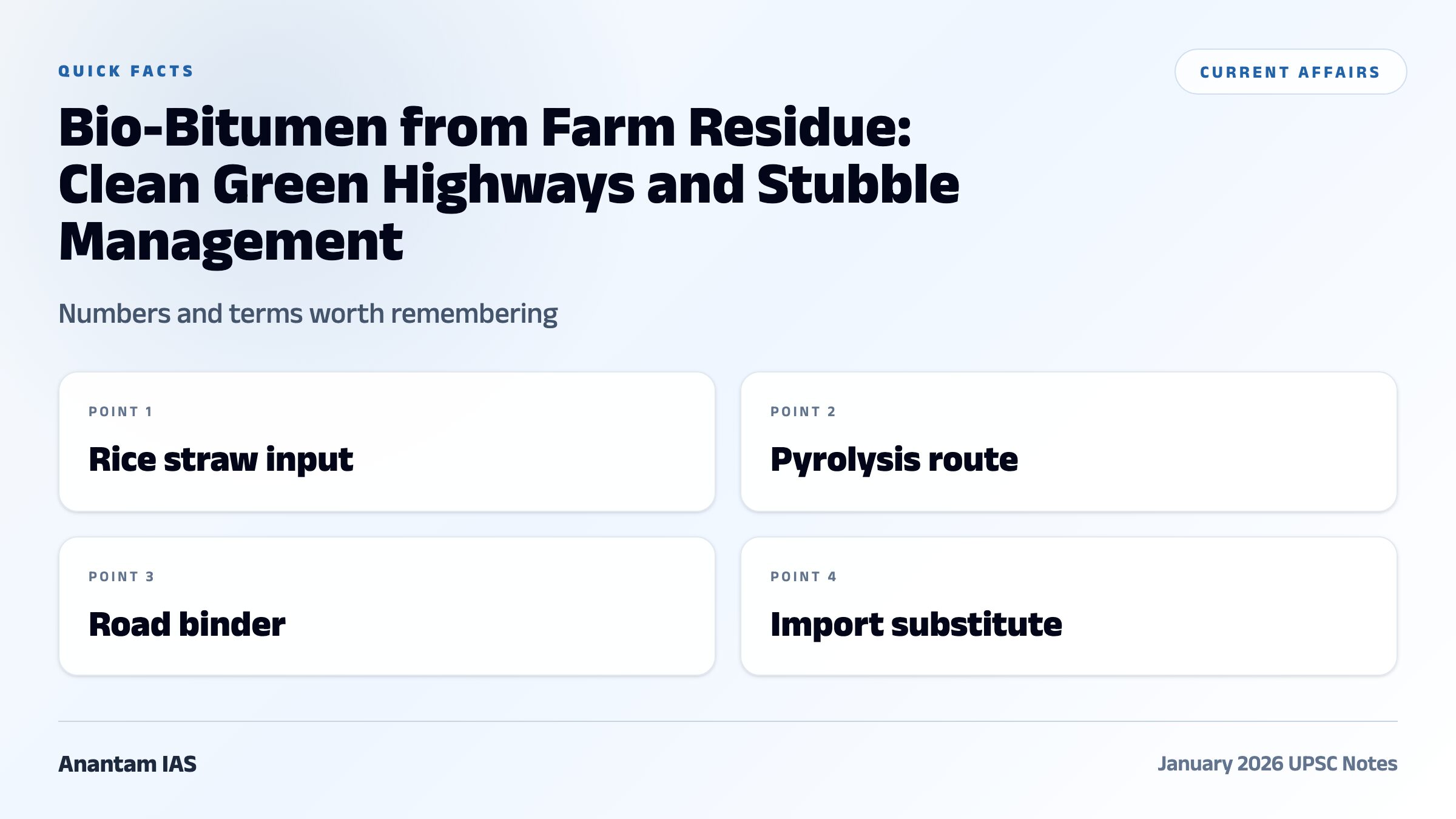
- CSIR-CRRI and CSIR-IIP are central institutions in the bio-bitumen demonstration.
- Rice straw can be converted into bio-oil through pyrolysis and processed into bio-bitumen.
- Bio-bitumen can partially replace petroleum bitumen in road construction.
- A demonstration road stretch was reported on NH-40 in Telangana.
- India imports a large share of petroleum bitumen, creating an import-substitution opportunity.
- Crop-residue burning is a major air-pollution source in northern India.
- Official source: PIB, Ministry of Science and Technology.
What Just Happened
The official update highlighted India’s progress in producing bio-bitumen from agricultural residue and using it in road trials. The technology uses rice straw, a residue often burnt in fields, as a feedstock for a useful infrastructure material.
The policy significance is that a waste stream becomes a road-construction input. If scaled, the same farm residue that worsens winter air pollution could earn value in a supply chain linked to highways.
The topic also aligns with the Clean Green Highways idea: reduce fossil dependence in road materials, lower waste burning and improve the life-cycle profile of infrastructure.
Background and Historical Context
Bitumen is a petroleum-derived binder used in asphalt roads. India consumes large volumes of it for national highways, state highways and urban roads. Import dependence exposes the sector to crude-price volatility.
Rice straw burning is driven by tight sowing windows, low residue value, labour shortage and mechanised harvesting. Farmers often burn residue because removing it costs money and delays the next crop.
Bio-bitumen attempts to change the economics. If residue becomes a purchased input, farmers have a reason to collect and sell it. But that requires aggregation, transport, processing plants and assured demand from road agencies.
Key Features of Bio-Bitumen Technology
The core policy architecture can be read through these features.
- Feedstock: rice straw and other biomass residues can be used.
- Process: pyrolysis converts biomass into bio-oil, which can be upgraded for bitumen blending.
- Use case: partial replacement of petroleum bitumen in asphalt roads.
- Institutional role: CSIR laboratories provide research, testing and standards support.
- Environmental link: the technology can reduce open burning if procurement works.
- Infrastructure link: highways can create steady demand for the material.
Why It Matters
This is a high-yield UPSC topic because it joins current news with durable syllabus themes.
- It connects air-pollution control with farmer incentives, not only enforcement.
- It gives GS-III content on circular economy, clean technology and infrastructure.
- It shows import substitution without crude industrial protectionism.
- It helps candidates write integrated answers on stubble burning beyond bans and fines.
Detailed Analysis: Environment Lens
The technology solves only half the problem. Producing bio-bitumen is important, but the policy challenge is feedstock logistics. Rice straw is bulky, seasonal and scattered across millions of farms.
Demand assurance is essential. Road agencies must create clear procurement standards and blending norms. Without predictable demand, farmers and processors will not invest in collection chains.
It is better as a portfolio tool. Bio-bitumen will not eliminate stubble burning alone. It should sit alongside in-situ residue management, biomass power, compressed biogas, pellets and soil-health practices.
Comparative Perspective
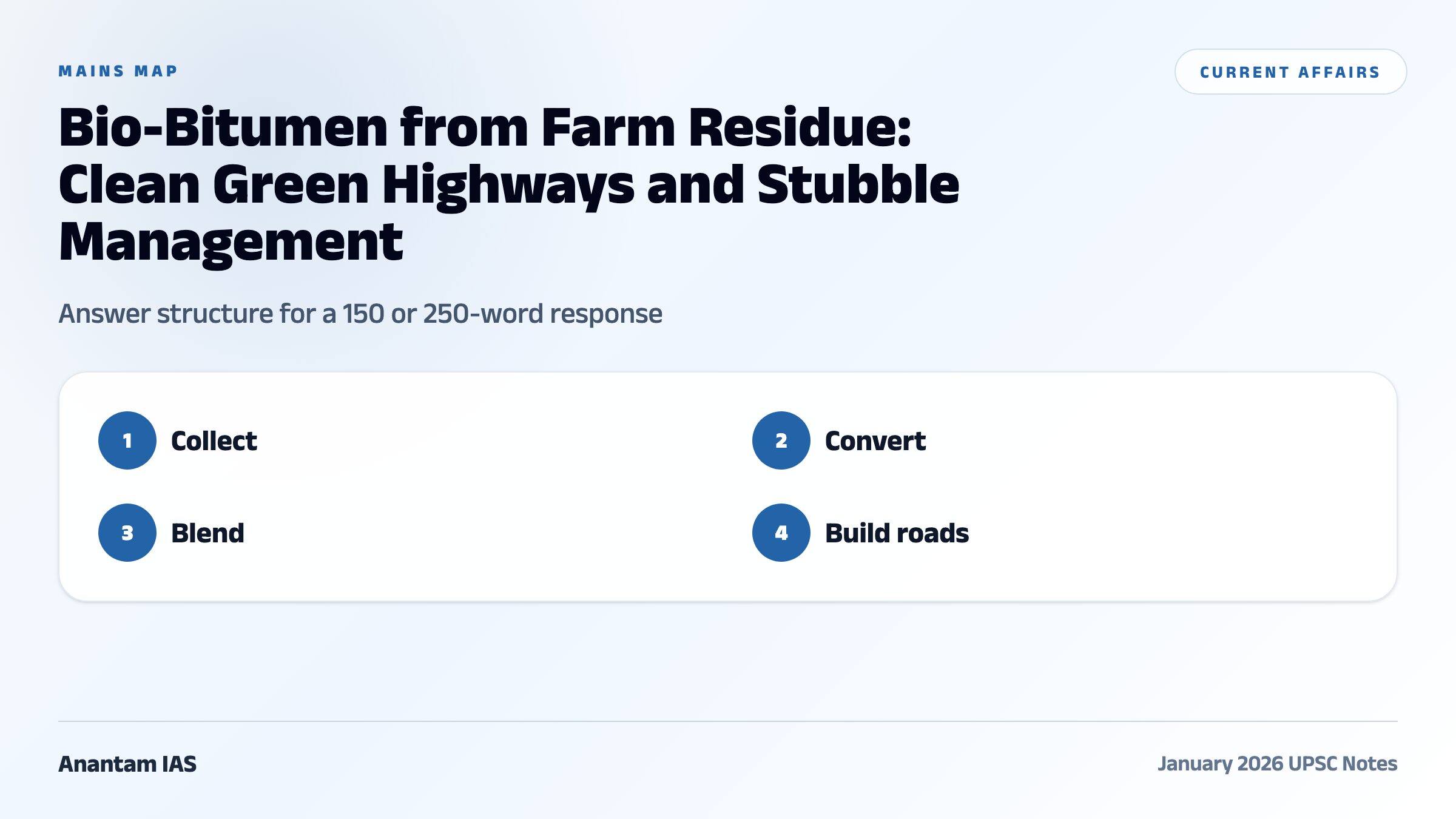
A comparison helps prevent the answer from becoming a one-dimensional news summary.
- In-situ residue management: machines like Happy Seeder retain residue in fields but require farmer adoption.
- Compressed biogas: converts residue into fuel but depends on plant economics and gas offtake.
- Bio-bitumen: links residue to road construction and import substitution.
- Ex-situ biomass power: uses residue for energy but faces collection and tariff challenges.
Challenges
The policy or institutional promise runs into recurring constraints.
- Residue aggregation is expensive because rice straw is bulky.
- Quality standards must prove road durability across climate zones.
- Farmers need timely payments and local collection points.
- Processing plants must be located close enough to feedstock sources.
- Public procurement rules must allow innovative materials without compromising road safety.
Prelims Pointers
- Bitumen is a petroleum-derived binder used in road construction.
- Pyrolysis is thermal decomposition in limited or no oxygen.
- CSIR-CRRI works on roads and transport infrastructure research.
- CSIR-IIP works on petroleum and energy research.
- Crop-residue burning contributes to particulate pollution.
- Circular economy aims to convert waste streams into useful inputs.
Mains Questions
- Bio-bitumen can turn stubble from an air-pollution liability into an infrastructure input. Discuss the opportunities and constraints. (GS Paper III, 250 words)
- Why have enforcement-heavy approaches failed to solve crop-residue burning? Suggest incentive-based alternatives. (GS Paper III, 250 words)
- Evaluate the role of public procurement in scaling clean technologies. (GS Paper III, 150 words)
- Circular economy solutions require ecosystem design, not only innovation. Analyse with reference to bio-bitumen. (GS Paper III, 250 words)
Way Forward
India should begin with regional procurement corridors in high-residue districts, linking farmer-producer organisations, biomass aggregators, CSIR-tested processors and highway contractors.
Standards must be strict. A green road material that fails early will lose credibility quickly. Field performance across heat, rain and heavy traffic should guide blending limits.
Bio-bitumen is a promising bridge between clean technology and farmer income, but its success will be decided by logistics and procurement, not the press release.
The examiner is unlikely to reward a bare fact dump here. The better answer connects the January 2026 event to institutional design, implementation capacity and India’s long-term development priorities.
Frequently Asked Questions
What is bio-bitumen?
Bio-bitumen is a bitumen-like road binder produced partly from biomass such as rice straw, usually through thermochemical processing.
Why is bio-bitumen important for India?
It can reduce petroleum-bitumen dependence and create value for crop residue that is otherwise often burnt.
Which institutions are involved?
CSIR-CRRI and CSIR-IIP are key institutions mentioned in the official bio-bitumen update.
Can bio-bitumen end stubble burning?
No. It can help if scaled well, but it must be combined with other residue-management options.
What is pyrolysis?
Pyrolysis is heating biomass in limited or no oxygen to produce bio-oil, char and gases.
What is the main bottleneck?
The hard part is collecting, transporting and processing bulky residue at a cost that works for farmers and road agencies.
Tell Google you want more of this.
Add Anantam IAS as a preferred sourceOne tap, and this site shows up more often in your own Top Stories, AI Overviews and AI Mode. Remove it any time.