Why in News?
The Standing Committee on Coal, Mines and Steel has called for greater priority to coal beneficiation, timely modernisation of ageing washeries and removal of logistical constraints that suppress the supply of higher-quality domestic coal.
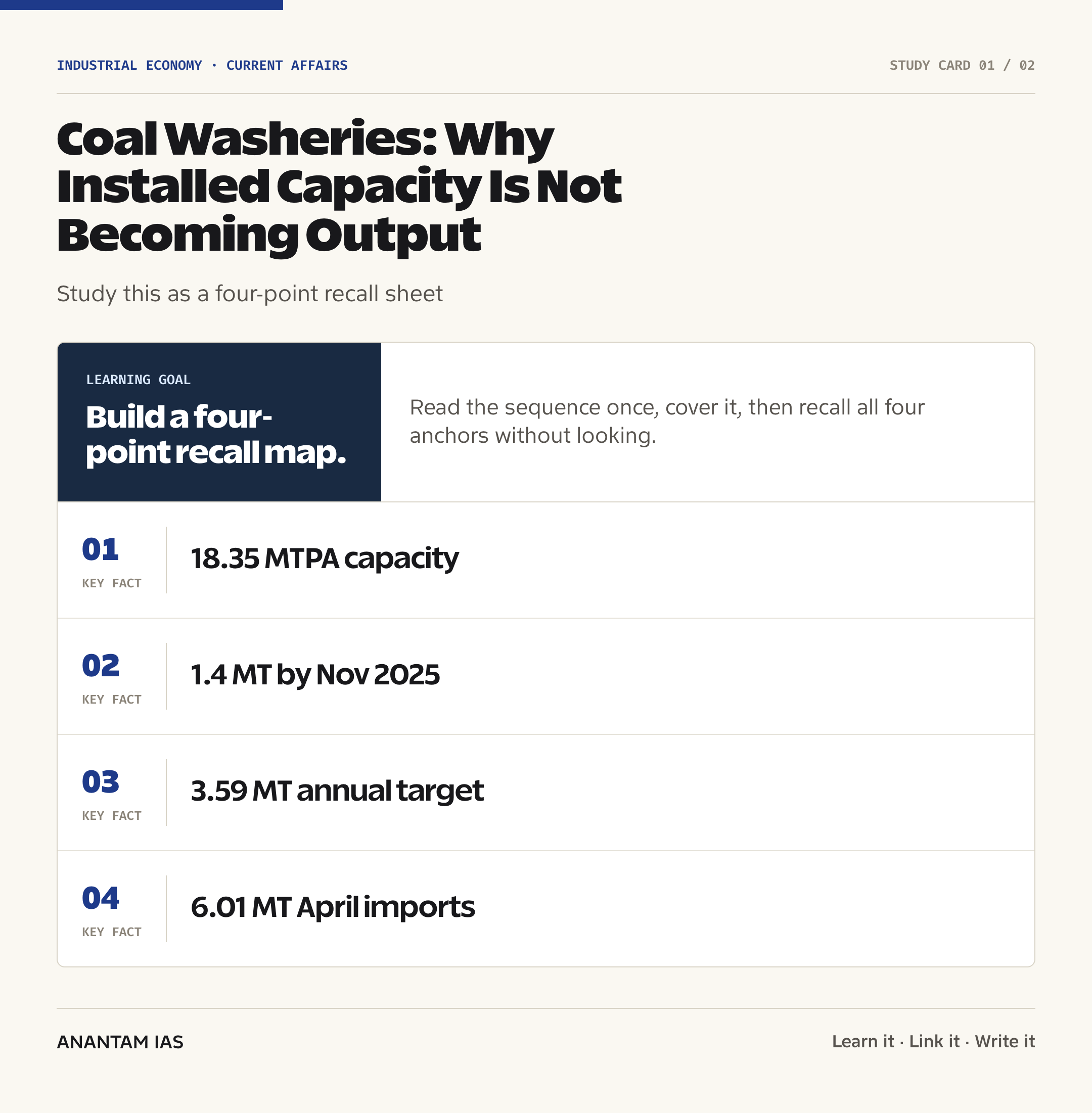
The immediate issue is a capacity-throughput gap. Coal India Limited (CIL) has an operable coking-coal washing capacity of 18.35 million tonnes per annum (MTPA), but the Ministry of Coal’s Annual Report 2025-26 recorded only 1.4 MT of washed coking-coal production up to November 2025 against an annual target of 3.59 MT.
- The Hindu reported the panel’s diagnosis: aged infrastructure, legacy technology, delayed raw-coal supply from mine pitheads and washery designs incompatible with the feed coal.
- The official Eighteenth Report on the Ministry of Coal’s Demands for Grants noted that several washeries installed about 35 years ago were operating at low efficiency.
- The same parliamentary report asked the Ministry to examine a separate modernisation budget so domestic blast furnaces receive more washed coal.
- The panel favoured washeries at or near pitheads and alignment of future plants with mine-expansion plans and First Mile Connectivity.
- Pithead removal of ash and impurities can reduce dead-weight movement, improve transport efficiency and lower emissions associated with moving unusable mineral matter.
The development matters in the context of:
- India has substantial coal resources, but much domestic coking coal has high ash content; resource quantity and steel-grade quality are different questions.
- The gap matters for the blast furnace-basic oxygen furnace steel route, which needs metallurgical coal with suitable coking properties and controlled ash.
- Import substitution depends on a full chain: mine production, stable feed quality, washing yield, rail evacuation, steel-plant acceptance and commercial contracts.
- Coal washing offers efficiency gains but also produces rejects and slurry, so water recirculation, effluent treatment and safe reject use remain essential.
UPSC Relevance
Prelims Relevance
- Coal washing and coal beneficiation refer to separating mineral impurities, especially ash-bearing material, from raw coal.
- Coking coal softens and forms coke on heating without air; it is used mainly in the blast furnace steel route.
- Non-coking coal is used mainly for power and industrial heat; washing cannot turn it into coking coal.
- Yield is the share of raw feed recovered as clean coal at a specified quality; lower target ash can reduce yield.
- First Mile Connectivity covers mechanised movement from the mine or pithead to a loading or dispatch point.
- Coal India Limited operates through subsidiaries including Bharat Coking Coal Limited and Central Coalfields Limited in major coking-coal areas.
- Mission Coking Coal seeks to raise domestic production and reduce steel-sector reliance on imported coking coal.
- A Washery Developer and Operator arrangement can bring specialised technology and operations to new or monetised washeries.
- The Ministry of Coal handles development and operation of coal washeries except those assigned to the Department of Steel.
- Pithead beneficiation removes part of the non-combustible mineral matter before long-distance transport.
Mains Relevance
GS Paper 3
- Infrastructure: distinguish installed capacity from effective throughput, recovery yield, product quality and assured evacuation.
- Industrial policy: connect domestic washed coking coal with steel competitiveness, foreign-exchange exposure and supply security.
- Resource efficiency: assess whether pithead beneficiation lowers avoidable freight, fuel use and emissions per unit of useful coal.
- Environmental management: examine water use, slurry, rejects, effluent treatment and mine-washery cumulative impacts.
GS Paper 2
- Legislative oversight: show how a department-related Standing Committee uses evidence and recommendations to expose implementation gaps.
- Public-sector governance: evaluate performance metrics, technology renewal, procurement, contracting and inter-agency coordination in CIL subsidiaries.
Essay
- A machine’s nameplate capacity is not development; reliable institutions and connected infrastructure convert capacity into outcomes.
- Self-reliance is strongest when it improves resource efficiency rather than merely replacing one source of supply with another.
- Industrial policy must reconcile security of supply, commercial viability and environmental accountability.
Background and Context
What a coal washery actually does
A washery upgrades raw coal by exploiting physical differences between combustible coal and heavier mineral impurities.
- Raw coal is first crushed and sized; different size fractions may need different separation circuits rather than one uniform machine.
- In dense-medium or gravity separation, particles respond differently according to relative density, allowing a clean-coal stream, middlings and rejects to be separated.
- Washing mainly lowers ash-forming mineral matter; it may also improve consistency, but it does not create the intrinsic caking property required of coking coal.
- The key trade-off is yield versus quality: demanding a lower-ash product can send more borderline material into middlings or rejects and reduce clean-coal recovery.
- A washery’s nameplate capacity measures possible raw-coal throughput under design conditions. It does not guarantee product output, recovery, quality or annual operating hours.
- Students should separate four quantities in an answer: feed capacity, raw coal actually fed, clean-coal yield and saleable washed-coal output.
- Beneficiation performance must be reported at a stated product-ash specification; an output figure without the achieved quality can hide a poor or commercially unusable result.
Reading the capacity-output evidence correctly
The official numbers show both spare nameplate capacity and a much smaller annual production ambition.
- The Ministry of Coal Annual Report 2025-26 states that CIL operates 10 coking-coal washeries with total operable capacity of 18.35 MTPA.
- That capacity includes three newly commissioned washeries with a combined capacity of 11.6 MTPA, so aggregate capacity alone does not prove that old-plant constraints have disappeared.
- Up to November 2025, official washed coking-coal production was 1.4 MT against an annual target of 3.59 MT.
- The correct comparison is not a simple utilisation percentage unless the time period, feed availability, operating days, design coal and recovery yield are held constant.
- The Hindu’s report used 3.59 MT in describing the output gap; the Ministry’s annual report identifies it as the annual target and separately records production through November. The official distinction should govern answer writing.
- A strong diagnosis asks where tonnes were lost: no raw feed, plant downtime, unsuitable feed, low recovery, quality rejection, weak offtake or dispatch congestion.
- The panel’s concern is still valid without converting these figures into a crude percentage: the production target itself was far below the aggregate operable feed capacity.
Why installed capacity can remain idle
A washery is one node in a mine-to-metal chain, so constraints outside the plant can depress its output.
- Ageing equipment raises downtime, maintenance needs and process instability; legacy circuits may not deliver the ash level or recovery expected by current steel users.
- Feed variability matters because Indian coal seams and mining sections can differ in ash, size distribution and washability; a design tuned to one feed may perform poorly on another.
- Delayed movement of raw coal from the pithead creates feed starvation, even when the washery itself has nominal spare capacity.
- A mismatch between mine plan and washery design can create either too little feed, unsuitable feed or a product that lacks a secure offtake agreement.
- Rail sidings, silos, conveyors, loading systems and rake availability determine whether washed coal and by-products can leave the site without inventory congestion.
- Commercial performance also depends on transparent sampling, third-party quality checks and pricing that rewards usable quality, not merely raw tonnage.
- Modern equipment cannot compensate for an unstable feed schedule. Mine production and washery campaigns need a shared quantity-quality plan backed by stockyard blending.
Why pithead beneficiation changes logistics
The panel’s pithead recommendation links coal quality with First Mile Connectivity rather than treating washing as an isolated factory process.
- Locating a washery near the mine can remove part of the ash and impurities before coal enters a long rail journey.
- This can reduce the movement of dead weight, improve wagon productivity and lower transport energy per tonne of useful coal delivered.
- A pithead layout can integrate mine conveyors, crushing, washing, silos and rapid loading under a single mechanised chain.
- But rejects then remain near the mine, concentrating the need for safe storage, authorised use and water management in the coalfield.
- Future washeries should be sized against realistic mine expansion, washability studies and user demand; otherwise an oversized plant merely reproduces the capacity-output gap.
- This logistics lens complements India’s wider coal-market reforms: a transparent contract still fails if the specified quality cannot be physically produced and delivered.
- The freight gain should be verified as avoided impurity movement, additional useful-coal tonnes per rake and lower transport energy, not assumed from plant location alone.
The steel and import-security connection
Washed domestic coking coal can displace part of imported material, but washing alone cannot erase geological and quality constraints.
- In the blast furnace-basic oxygen furnace route, coke acts as fuel, reducing agent and structural support for the burden inside the furnace.
- High ash increases slag volume and can raise coke consumption, energy demand and handling costs, which is why steelmakers require a controlled metallurgical-coal blend.
- Domestic coal may still need blending with imported low-ash coking coal after washing; the policy goal is credible partial substitution, not an automatic end to imports.
- The Ministry of Coal reported that April 2026 coking-coal imports were 6.01 MT, slightly above 5.93 MT a year earlier, even as several other coal-import categories fell.
- That contrast shows why coking coal is a resource-quality vulnerability tied to steel growth, not merely a temporary shortage of generic coal.
- Read the issue alongside India’s broader coal-sector reform framework: mining reform, linkages, washing, logistics and user contracts must reinforce one another.
- Import substitution should be counted only when domestic washed coal is accepted in a steel blend and displaces comparable imported tonnes without impairing furnace performance.
Environmental gains and environmental burdens
Washing can improve resource and transport efficiency, but it is not impact-free or equivalent to decarbonisation.
- Removing ash before transport can reduce the tonnes hauled for the same amount of useful coal and reduce ash handled at the consuming plant.
- More consistent coal quality can support steadier combustion or metallurgical operation, but the climate benefit depends on actual energy and material savings across the chain.
- Wet washing uses water and can produce slurry and effluent; closed-loop water systems, thickeners and functional effluent-treatment plants are basic safeguards.
- Washery rejects can create dust, fire and runoff risks unless quality-tested and directed to an authorised, technically suitable use or engineered disposal.
- The Standing Committee asked for effluent-treatment plants at washeries to protect neighbouring farmland and groundwater.
- Coal beneficiation should not be confused with coal gasification: the former physically separates impurities, while the latter chemically converts coal into synthesis gas.
- An honest assessment uses a mine-to-use boundary: washery electricity, water, reject management, rail savings and steel-plant performance all belong in the calculation.
How to frame the governance problem
The central failure is coordination: capacity creation, mine supply, technology, logistics, environmental control and steel demand have been measured in separate silos.
- A department-related Standing Committee cannot execute projects, but its evidence-based scrutiny can force the Ministry to explain gaps between assets, targets and outcomes.
- Performance dashboards should publish plant-wise feed, output, yield, ash reduction, downtime and dispatch, with comparable definitions.
- Modernisation decisions need washability data and life-cycle costing; replacing hardware without correcting unsuitable feed or weak offtake can leave throughput unchanged.
- Contracts under a Washery Developer and Operator route need output-quality, recovery, water and availability obligations rather than a capacity figure alone.
- Independent sampling and reconciliation from mine to steel plant can reduce disputes over grade slippage and make domestic blending decisions more bankable.
- Parliamentary follow-up should test whether recommendations changed plant performance, not stop at sanctioning money or announcing new capacity.
- Public reporting should pair every modernisation outlay with a baseline and deadline, so later scrutiny can attribute improvement to technology, logistics or better feed.
Way Forward
Audit each bottleneck before adding capacity
- Publish a plant-wise technical audit covering design life, feed characteristics, recovery curves, downtime, product ash and evacuation constraints.
- Classify each washery for renovation, technology replacement, feed redesign, commercial restructuring or closure based on measurable evidence.
- Use effective throughput and quality-adjusted output as primary indicators, not sanctioned MTPA.
Integrate mines, washeries and First Mile Connectivity
- Synchronise mine expansion, conveyor and silo commissioning, washery capacity, rail siding work and downstream demand.
- Prefer pithead sites where washability and environmental appraisal support them, so impurities are removed before long-distance haulage.
- Create contingency plans for feed interruptions and rake constraints so one failed node does not idle the entire chain.
Use technology for variable Indian coal
- Base process selection on seam-specific washability tests and flexible circuits that can handle changing size and ash profiles.
- Deploy sensors, automated controls and preventive maintenance only with trained operators and verified calibration.
- Support pilot-to-commercial research on difficult high-ash coking coal and publish recovery and cost results.
Tie contracts to steel-sector acceptance
- Create long-tenor supply and offtake arrangements with transparent specifications, independent sampling and predictable price adjustments.
- Measure import substitution as accepted domestic washed coal in metallurgical blends, not as planned capacity.
- Allow steelmakers and washeries to co-design blend trials while retaining competition and public accountability.
Make environmental controls non-negotiable
- Require closed-loop water use where feasible, operational effluent-treatment plants and real-time monitoring of critical discharge parameters.
- Track the quantity, quality, destination and final use of rejects and slurry to prevent dumping and secondary pollution.
- Include nearby communities, farmland and groundwater indicators in the performance review of every washery.
Conclusion
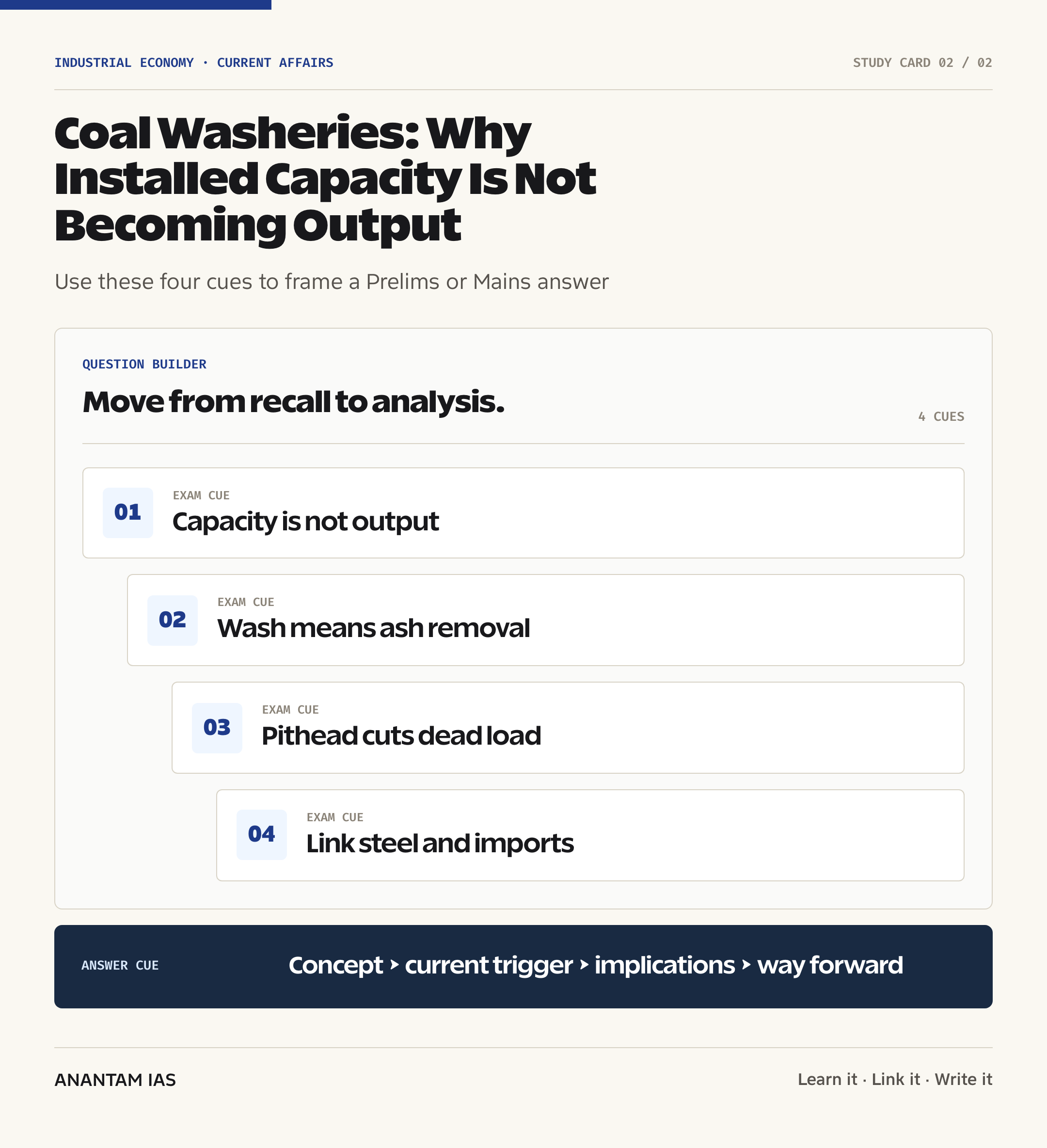
India’s washery challenge is not a shortage of installed machinery on paper. It is a systems problem in which ageing plants, variable feed, weak mine alignment, logistics and product acceptance prevent 18.35 MTPA of operable capacity from translating into dependable washed coking-coal supply.
A credible policy should measure quality-adjusted output from pithead to blast furnace, modernise only against evidence, and internalise water, slurry and reject costs. That is how beneficiation can improve steel security and freight efficiency without becoming another capacity announcement.
UPSC Practice Questions
Prelims MCQ 1
With reference to coal beneficiation, consider the following statements:
- It separates mineral impurities, especially ash-bearing material, from raw coal.
- Pithead beneficiation can reduce the non-combustible material transported over long distances.
- Washing cannot convert non-coking coal into coking coal.
How many of the above statements are correct?
(a) Only one (b) Only two (c) All three (d) None
Answer: (c) All three
Explanation:
All three are correct. Beneficiation is a physical quality-upgrading process; it can remove part of the ash before transport, but it cannot create the intrinsic caking properties of coking coal.
Prelims MCQ 2
Which measure most directly addresses the washery capacity-output gap identified by the parliamentary panel?
(a) Building washeries independently of mine plans (b) Moving unwashed impurities to distant steel plants (c) Aligning pithead washeries with mine expansion and First Mile Connectivity (d) Treating installed MTPA as the same as washed-coal production
Answer: (c) Aligning pithead washeries with mine expansion and First Mile Connectivity
Explanation:
The panel linked modernisation with raw-coal supply and logistics. Pithead siting and coordination with mine expansion and First Mile Connectivity address feed, transport and evacuation together.
UPSC Mains Questions
- India’s coal-washery problem is less about nominal capacity and more about conversion of capacity into quality-adjusted output. Analyse the technological, logistical, commercial and institutional causes of this gap, and suggest measurable indicators for holding coal public-sector enterprises accountable.
- Pithead beneficiation can improve freight efficiency and steel-sector resource security, yet it may concentrate water, slurry and reject burdens in mining regions. Evaluate this trade-off and propose safeguards that combine industrial policy with environmental justice.
- Domestic washed coking coal can reduce import exposure but cannot remove every geological and metallurgical constraint. Discuss how mine planning, beneficiation, blending, long-term offtake and transparent quality assurance should be integrated into India’s steel raw-material strategy.
Sources: Standing Committee on Coal, Mines and Steel; Ministry of Coal and The Hindu.
Frequently Asked Questions
What is a coal washery?
A coal washery is a plant that upgrades raw coal by separating ash-bearing mineral matter and other impurities through crushing, sizing and physical separation. It produces clean coal, middlings and rejects. Its rated capacity refers to raw-feed throughput under design conditions, not guaranteed saleable output.
Why is 18.35 MTPA not actual output?
The 18.35 MTPA figure is CIL’s operable coking-coal washing capacity. Actual output depends on raw-coal feed, operating days, plant availability, feed washability, recovery yield, product specifications and dispatch. The Ministry recorded 1.4 MT of production through November 2025 against a 3.59 MT annual target.
Why should washeries be near pitheads?
A pithead washery removes part of the ash and impurities before long-distance transport. This can reduce dead-weight haulage, improve wagon use and integrate conveyors, silos and rapid loading. It also keeps rejects near the mine, where strict water, storage and disposal safeguards are needed.
Can washing end coking-coal imports?
No. Washing can make more domestic coking coal usable and support partial import substitution, but it cannot change every geological property. Indian steelmakers may still need imported low-ash coal for blending and furnace performance. The realistic objective is secure, accepted domestic supply within a technically suitable blend.
How does washing affect the environment?
Benefits can include less ash transported and more consistent useful coal. Costs include water demand, slurry, effluent, rejects, dust and possible groundwater or farmland impacts. Closed-loop water systems, functional effluent treatment, reject tracking and community monitoring are needed to prevent shifting pollution to mining regions.
What should government measure?
Government should publish plant-wise raw feed, operating hours, downtime, clean-coal output, recovery yield, ash reduction, product rejection, water use, effluent compliance and dispatch. These indicators show where capacity is being lost and are more informative than announcing nameplate MTPA or project expenditure alone.
Tell Google you want more of this.
Add Anantam IAS as a preferred sourceOne tap, and this site shows up more often in your own Top Stories, AI Overviews and AI Mode. Remove it any time.