Daily Digest
UPSC · Civil Services Examination
Current Affairs · Saturday, 5 September 2026
Current affairs curated and edited by Anantam IAS faculty — pulled from The Hindu, PIB, IDSA, Foreign Affairs and the ministries. Read, annotate, revise.
Old Rajinder Nagar · Delhi 110005 · anantamias.com
NSE Co-Location and Dark Fibre Cases Reach Closure
Why in News?
The Supreme Court disposed of SEBI’s appeals in the NSE co-location and dark-fibre matters after taking note of the regulator-exchange settlement.
- The revised settlement total was about ₹1,491 crore across the two matters.
- The underlying disputes concerned alleged preferential speed and connectivity advantages in exchange infrastructure.
- Disposal closed the pending appeals after earlier Securities Appellate Tribunal orders had set aside disgorgement directions.
- A stock exchange is a market infrastructure institution, so equal and transparent access is central to confidence in price discovery.
- Settlement can end proceedings without a full final adjudication of every contested factual and legal issue.
UPSC Relevance
Prelims Relevance
- SEBI regulates securities markets under the SEBI Act, 1992 and related securities laws.
- The Securities Appellate Tribunal hears appeals against specified orders of SEBI and other financial regulators.
- Co-location places a participant’s server close to an exchange matching engine to reduce communication latency.
- Dark fibre is unused optical-fibre capacity that can be leased for dedicated high-speed connectivity.
- Disgorgement seeks to deprive a person or entity of gains linked to wrongdoing; it differs from a conventional penalty.
Mains Relevance
GS Paper 3
- Fair access to market infrastructure
- Technology, latency and regulatory design in securities markets
GS Paper 2
- Settlement, appellate review and regulatory accountability
- Institutional credibility and reasoned enforcement
Essay
- In digital markets, a small technical advantage can become a large institutional fairness problem.
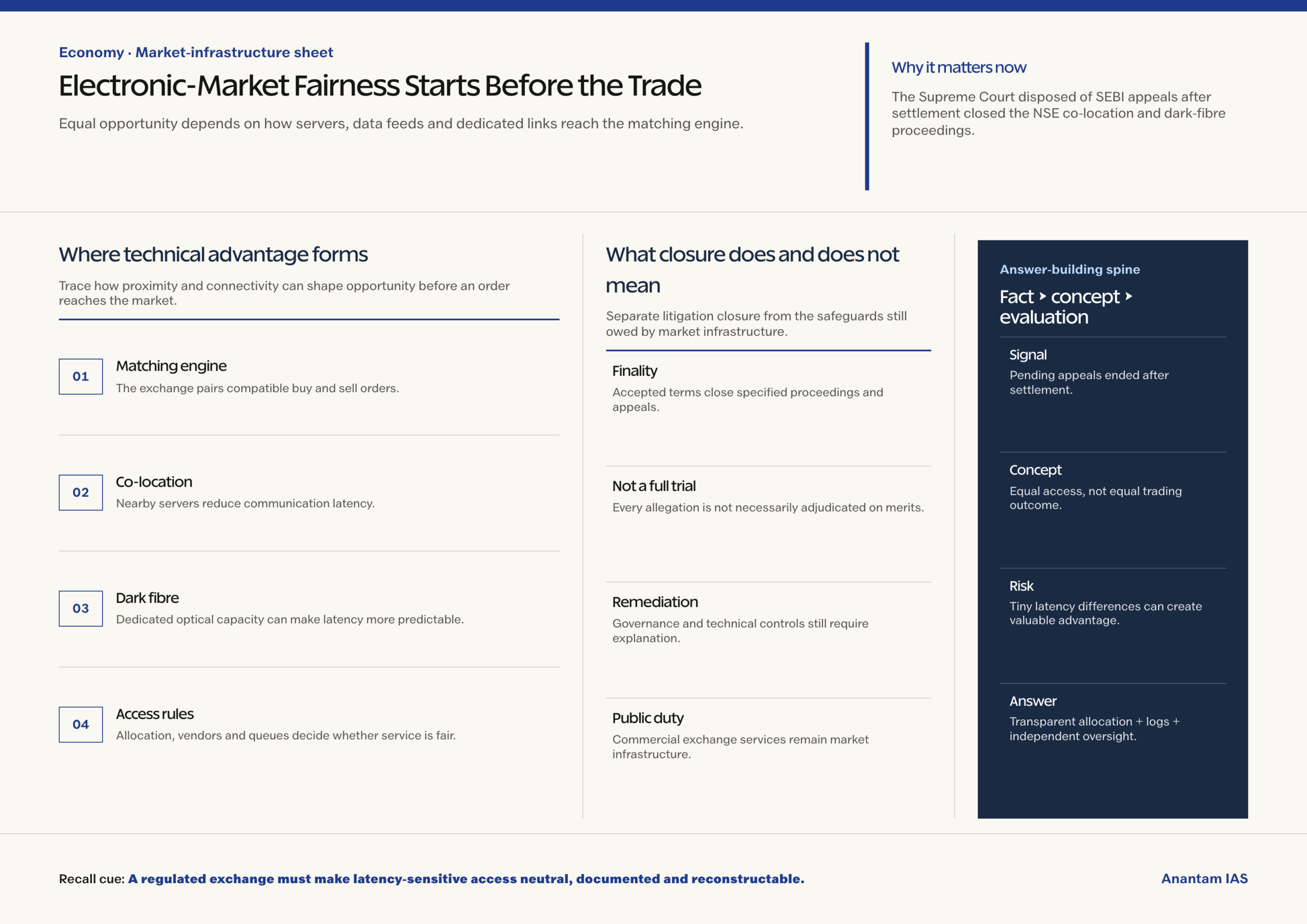
Background and Context
Why Co-Location Speed Matters
Electronic trading converts tiny differences in information arrival and order placement into potentially valuable competitive advantages.
- An exchange matching engine receives orders and applies market rules to pair compatible buy and sell instructions.
- Co-located servers sit physically closer to that engine, reducing network latency compared with systems connected from farther away.
- The service is not inherently improper when eligibility, queues, data feeds, racks and connectivity are offered through fair and transparent rules.
- The regulatory concern arises when some brokers receive earlier access, superior connections or operational information unavailable on equal terms.
- Even microsecond advantages can matter for automated strategies that react to price changes before slower participants receive the same market data.
How Dark Fibre Fits the Same Fairness Question
Dedicated connectivity can improve reliability and speed, but access conditions determine whether it strengthens infrastructure or privileges a few users.
- Dark fibre refers to optical strands not currently lit by the owner and available for another operator to equip and use.
- A dedicated link can offer lower and more predictable latency than a shared network, making its allocation commercially significant.
- Exchange governance should disclose approved vendors, connection standards, testing and availability so equivalent users can seek comparable service.
- Monitoring needs network logs and configuration records because unequal technical access may not appear in ordinary trade-price surveillance.
- The core principle is not equal trading outcomes; it is equal opportunity to access the exchange’s regulated infrastructure under published conditions.
What Settlement Resolves and Leaves Open
A settlement closes specified proceedings through accepted terms, but it is not identical to a court deciding every allegation after trial.
- SEBI had appealed tribunal decisions that set aside earlier disgorgement directions in the co-location and dark-fibre matters.
- The revised terms combined prior deposits and an additional payment to reach the accepted settlement amount disclosed by NSE.
- Once the regulator and exchange reported settlement, the Supreme Court no longer needed to decide the pending appeals on their merits.
- Settlement provides finality and reduces litigation cost, yet public confidence also depends on transparent reasons, remediation and future controls.
- The episode remains a governance lesson for exchanges whose commercial ambitions must remain subordinate to neutral market-infrastructure duties.
Why an Exchange Has Public-Infrastructure Duties
An exchange is commercially operated, yet its rules and systems organise price discovery for the entire securities market.
- Its matching engine, data feeds and access services affect investors beyond the immediate brokers who purchase high-speed infrastructure.
- Conflicts arise when revenue from premium access competes with the duty to keep allocation rules neutral, disclosed and consistently enforced.
- Board oversight and regulatory supervision must treat technology architecture as a market-conduct issue, not leave it solely to engineering teams.
Way Forward
Protect Equal Technical Access
- Publish objective allocation, queue, vendor and connectivity standards for every latency-sensitive exchange service.
- Retain auditable network, rack, login and data-feed records that allow independent reconstruction of access conditions.
- Explain settlement remediation and governance changes clearly enough to preserve deterrence and institutional trust.
- Separate listing or commercial pressures from regulatory decisions concerning the exchange’s public-infrastructure obligations.
Conclusion
- The case closure removes pending litigation, but its durable lesson is that electronic-market fairness begins with equal technical access to regulated infrastructure.
- A strong answer should explain latency, co-location and dark fibre, then distinguish settlement finality from a complete adjudication on merits.
UPSC Practice Questions
Prelims MCQ 1
With reference to securities-market infrastructure, consider the following statements:
- Co-location can reduce latency by placing servers near an exchange matching engine.
- Dark fibre is optical-fibre capacity that can be equipped for dedicated connectivity.
- The Securities Appellate Tribunal is part of the National Stock Exchange.
How many of the above statements are correct?
(a) Only one (b) Only two (c) All three (d) None
Answer: (b) Only two
Explanation:
Statements 1 and 2 are correct. SAT is a statutory appellate body, not part of NSE.
Prelims MCQ 2
What is the main purpose of disgorgement in market regulation?
(a) To deprive an entity of gains linked to wrongdoing (b) To guarantee investor returns (c) To create a stock exchange (d) To approve every settlement automatically
Answer: (a) To deprive an entity of gains linked to wrongdoing
Explanation:
Disgorgement is remedial and seeks to remove gains connected with unlawful conduct.
UPSC Mains Questions
- Why does equal technical access matter for the legitimacy of an electronic securities market? Explain using co-location and dark-fibre services.
- Regulatory settlement provides finality but is not equivalent to adjudication on merits. Discuss the accountability implications.
Sources: Moneycontrol / Reuters and National Stock Exchange.
Frequently Asked Questions
What is exchange co-location?
It is a service that places trading servers near an exchange’s matching engine to reduce communication latency.
What is dark fibre?
It is unused optical-fibre capacity that can be equipped and leased for dedicated, high-speed network connectivity.
Why did regulators examine these services?
The concern was whether some brokers received preferential speed or connectivity rather than fair access under transparent rules.
Did settlement decide every allegation?
No. Settlement closed specified proceedings on accepted terms; it is different from a final adjudication of every contested issue.
Source: https://anantamias.com/current-affairs/nse-colocation-dark-fibre-settlement/
Census 2027: The Caste Open-Column Method
Why in News?
Officials said Census 2027 will not use Central and State OBC lists as its caste codebook because those lists contain classes beyond identifiable castes.
- Scheduled Caste and Scheduled Tribe entries can be anchored to constitutionally notified lists.
- Other respondents will use an open caste column rather than select from merged OBC lists.
- The design shifts the hardest task from field selection to post-enumeration classification and standardisation.
- Reservation lists are designed to identify eligible backward classes, not to serve automatically as a national classification of every caste.
- Open text captures self-identification but can create spelling, synonym, sub-caste, title and language variants that complicate aggregation.
UPSC Relevance
Prelims Relevance
- Census is a Union subject under Entry 69 of the Union List.
- Scheduled Castes and Scheduled Tribes are specified through Presidential notifications under Articles 341 and 342.
- The National Commission for Backward Classes has constitutional status under Article 338B.
- Central and State OBC lists may differ because reservation administration operates across different jurisdictions.
- An open-ended response records self-description first and requires later coding into consistent analytical categories.
Mains Relevance
GS Paper 2
- Census design, social justice and data legitimacy
- Difference between caste, class and reservation eligibility
GS Paper 1
- Complexity of caste identities across regions and languages
- Enumeration and the social construction of categories
Essay
- The categories a State counts shape what it can see, compare and remedy.
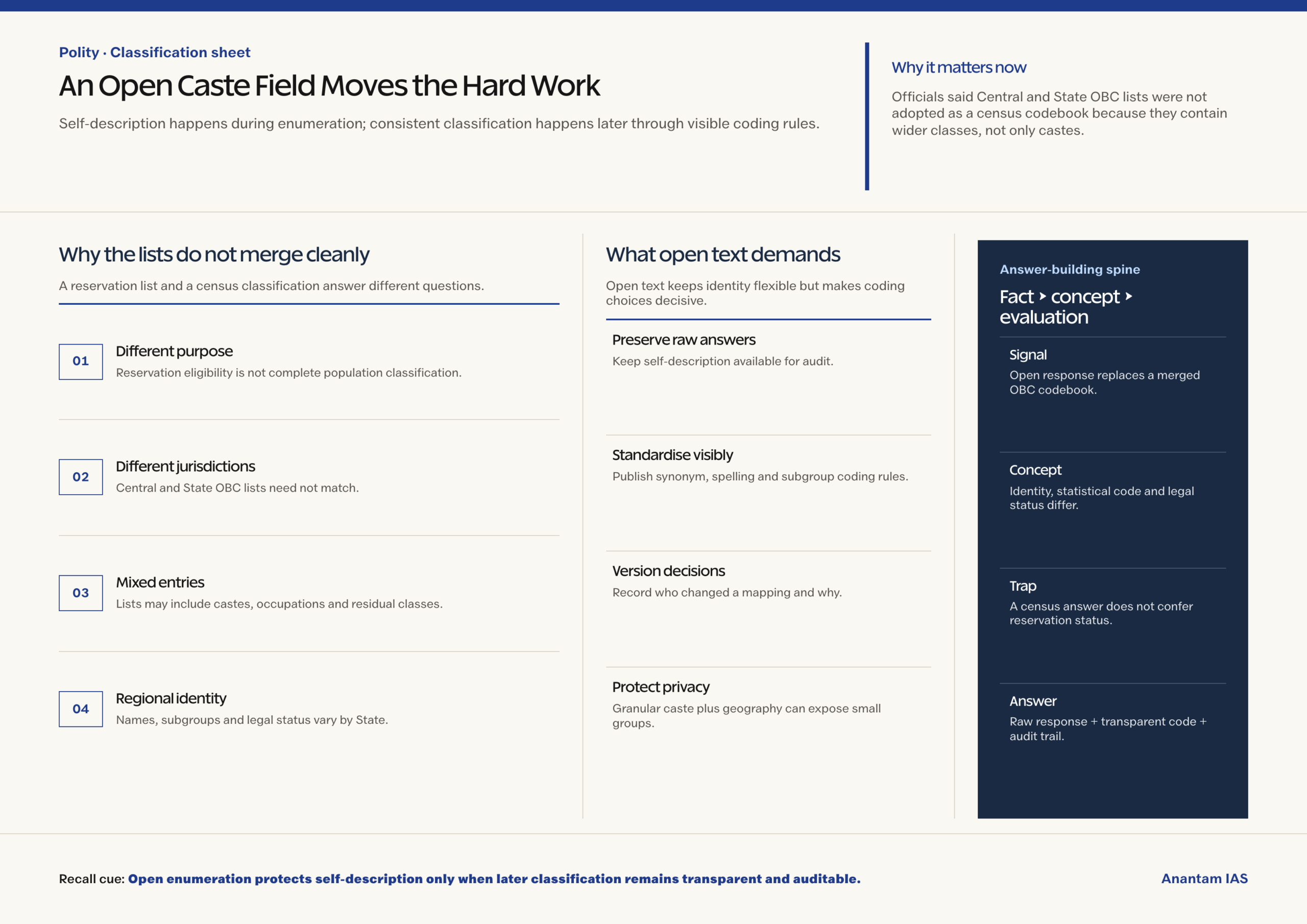
Background and Context
Why OBC Lists Are Not a Ready Caste Codebook
A reservation list answers who is eligible under a legal policy; a census codebook must classify population responses consistently.
- OBC lists may contain castes, communities, occupational groups, residual labels and locally defined classes created for affirmative-action administration.
- The Central list and each State list can differ because eligibility is assessed for different institutions, jurisdictions and social contexts.
- A single community name may have variants, subgroups or different status across States, preventing simple national merging without contested judgments.
- Treating every listed class as one caste would convert an administrative eligibility category into a demographic identity without sufficient basis.
- SC and ST enumeration differs because Articles 341 and 342 create State-specific notified lists that provide a formal identification anchor.
What an Open Column Gains and Loses
Open response respects self-identification and local vocabulary, but transfers complexity into coding, cleaning and publication.
- Respondents can state a caste name without being forced into a preselected list that omits or misclassifies their identity.
- The same group may appear under alternate spellings, honorifics, surnames, sub-castes, translations or broad community labels.
- Enumerators may record phonetically or influence wording, creating geographic variation that reflects field practice as well as real identity.
- Coders must decide when two labels are synonyms and when they represent distinct groups, a choice with political and statistical consequences.
- Transparent coding rules, audit trails and a residual category are needed so cleaning does not silently erase small or contested communities.
The Data-Quality and Legitimacy Test
Reliable caste data needs consistent field capture, defensible classification and clear separation from automatic entitlement decisions.
- Training must distinguish caste response from religion, occupation, surname and reservation category without asking enumerators to adjudicate identity.
- Multilingual reference tools can reduce spelling variation while preserving the respondent’s original answer for later review and correction.
- Pilot coding should test ambiguous, composite and region-specific responses before the national exercise fixes its classification protocol.
- Publication should explain suppression, aggregation and uncertainty so users do not mistake a cleaned table for a perfect social map.
- Census results can inform policy, but inclusion in a count does not by itself create OBC, SC or ST legal status.
Why Original Responses Must Be Preserved
Standardisation creates useful tables, but preserving the uncoded response keeps classification decisions open to audit and later correction.
- Without the original text, researchers cannot detect whether a published category combines distinct identities or splits synonyms across several codes.
- Versioned coding dictionaries can record who changed a mapping, why it changed and which published aggregates were affected.
- Privacy safeguards remain essential because granular caste responses combined with geography can expose small communities even after names are removed.
Way Forward
Make Coding Transparent
- Preserve original responses alongside standardised codes and publish the rules used to merge or separate labels.
- Pilot multilingual coding with independent demographic, sociological and statistical review before nationwide tabulation.
- Create audit and appeal mechanisms for systematic classification errors without letting political bargaining rewrite raw records.
- Explain clearly that demographic enumeration and statutory reservation recognition are related but legally distinct processes.
Conclusion
- The open-column method avoids forcing reservation lists into a job they were not designed to perform, but it makes post-enumeration coding decisive.
- A strong answer should distinguish self-identification, statistical classification and legal status, then demand transparent rules and preserved raw responses.
UPSC Practice Questions
Prelims MCQ 1
With reference to social-group enumeration in India, consider the following statements:
- Census is a Union List subject.
- Scheduled Castes are specified under Article 341.
- Inclusion in a census response automatically creates OBC legal status.
How many of the above statements are correct?
(a) Only one (b) Only two (c) All three (d) None
Answer: (b) Only two
Explanation:
Statements 1 and 2 are correct. Census self-identification does not automatically confer reservation status.
Prelims MCQ 2
What is the main statistical challenge of an open caste column?
(a) It prevents self-identification (b) It creates varied labels requiring defensible standardisation (c) It abolishes State OBC lists (d) It transfers Census to the State List
Answer: (b) It creates varied labels requiring defensible standardisation
Explanation:
Open text captures local identity but produces spelling, synonym and subgroup variation that must be coded transparently.
UPSC Mains Questions
- Why can Central and State OBC lists not be adopted mechanically as a national caste codebook for Census 2027?
- An open response protects self-identification but complicates statistical comparability. Suggest safeguards for caste-data coding and publication.
Sources: ChennaiOnline and DD News.
Frequently Asked Questions
Why were OBC lists not used directly?
They contain different State and Central classes, including occupational or residual groups, and were designed for reservation administration rather than complete population classification.
What is an open caste column?
It lets respondents state their caste in their own words instead of choosing from a fixed national list.
What problem does open text create?
Alternate spellings, synonyms, titles, sub-castes and language variants require transparent post-enumeration standardisation.
Does a census entry confer reservation status?
No. Demographic recording and legal recognition under OBC, SC or ST frameworks are distinct processes governed by separate rules.
Source: https://anantamias.com/current-affairs/census-2027-caste-open-column-method/
Stubble-Fire Monitoring: Beyond Satellite Fire Counts
Why in News?
CAQM asked ISRO to improve crop-residue-fire analysis by measuring burnt area and distinguishing fire intensity instead of relying mainly on event counts.
- Current monitoring uses a standard satellite protocol developed with State remote-sensing centres and agricultural researchers.
- Late-evening burning can occur after some polar-orbiting satellite passes.
- CAQM wants evidence that better reflects the scale and likely emissions of each burn, not only the number of detected points.
- A falling fire count can exaggerate progress if burn timing changes or one detected event covers a much larger field.
- Better measurement improves enforcement and source attribution but does not replace affordable residue-management alternatives for farmers.
UPSC Relevance
Prelims Relevance
- Polar-orbiting satellites observe locations during scheduled passes; geostationary satellites can watch the same broad region more continuously.
- A fire count records detected thermal anomalies, while burnt area estimates the land surface affected.
- Ground-truthing compares remote-sensing results with field observations.
- CAQM is a statutory body for the National Capital Region and adjoining areas.
- Crop-residue smoke is one contributor to seasonal particulate pollution, whose share varies by weather and period.
Mains Relevance
GS Paper 3
- Remote sensing in environmental governance
- Agricultural-residue management and seasonal air pollution
GS Paper 2
- Metrics, incentives and inter-State regulatory coordination
- Evidence quality in compliance claims
Essay
- A target improves governance only when the metric cannot be gamed.
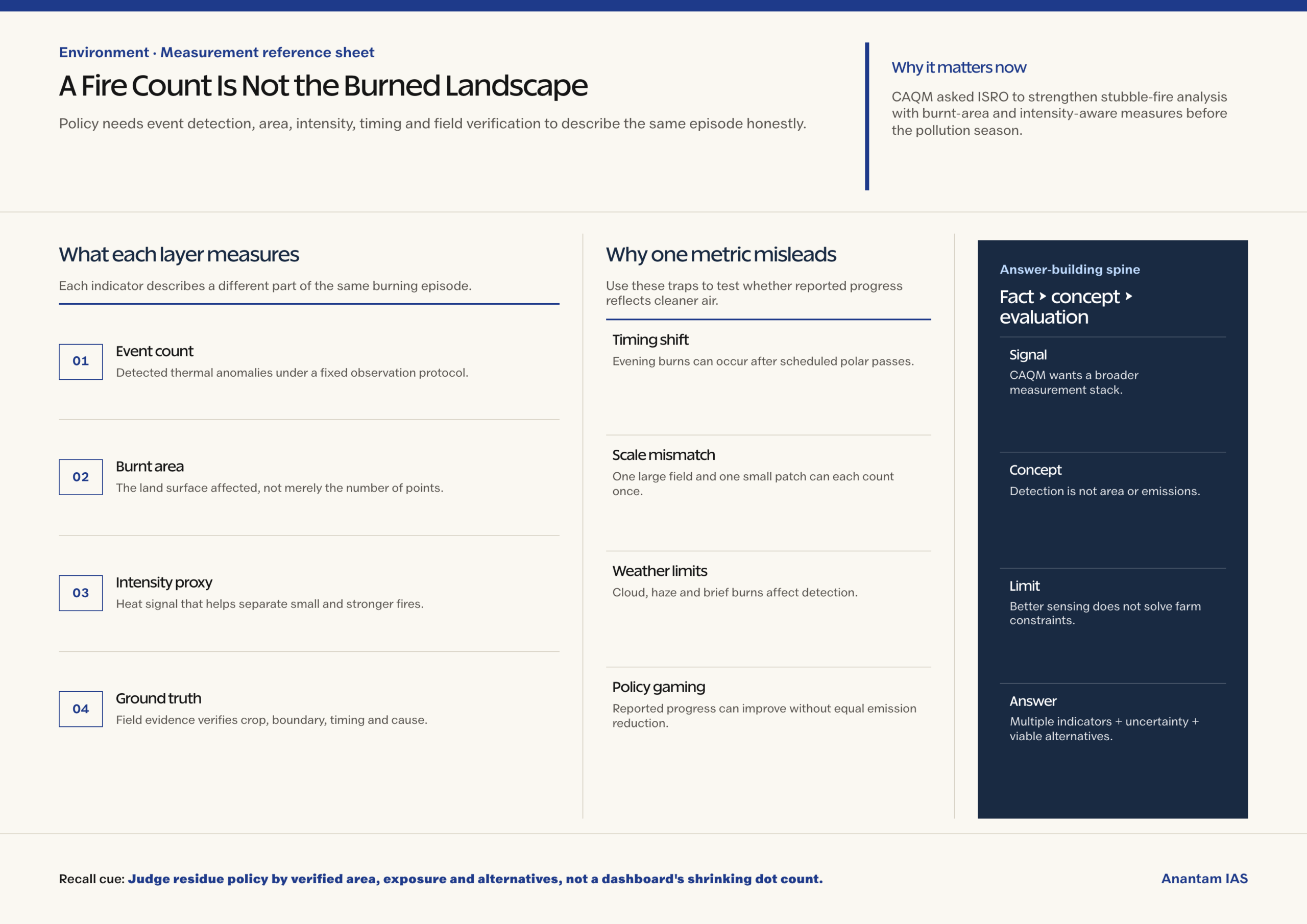
Background and Context
What a Satellite Fire Count Actually Measures
Remote sensing detects thermal signals, but a detected point is not a complete measure of area burned or pollution released.
- Sensors identify heat anomalies when energy from a fire is strong enough, sufficiently unobscured and present during the observation window.
- Cloud, haze, small fires, brief burns and the satellite’s timing can cause real events to be missed or recorded inconsistently.
- One fire point may represent a small patch or a large field, so equal counts do not necessarily mean equal residue or emissions.
- A lower count can reflect changed behaviour, changed weather, changed crop patterns or changed detection conditions rather than only cleaner practice.
- Consistent protocols remain useful for comparison, but interpretation must respect what the sensor and algorithm can actually observe.
Why Burnt Area and Intensity Improve the Picture
A better measurement stack combines several indicators because each answers a different question about the event and its consequences.
- Burnt area estimates spatial extent, helping distinguish many small burns from fewer large ones that affect more residue.
- Fire radiative measures can help classify intensity, though converting heat into emissions still requires fuel and combustion assumptions.
- Higher-frequency geostationary observations can reveal evening activity that scheduled polar passes may miss, with their own resolution trade-offs.
- Ground checks validate crop type, boundary, timing and whether a thermal signal came from residue burning rather than another heat source.
- Air-quality models then combine fire information with wind, boundary-layer height and other pollution sources to estimate contribution to regional particulate levels.
Measurement Reform Is Not Farm Policy
Accurate detection can diagnose the problem, but farmers still face a narrow field-clearance window and real machinery costs.
- Paddy residue must often be cleared quickly before wheat sowing, making burning a fast option when labour and machinery are unavailable.
- Enforcement based on weak metrics can punish unevenly, invite disputes and reward jurisdictions that optimise reported counts instead of reducing smoke.
- In-situ machines, decomposers, crop diversification and residue markets address different constraints; no single intervention suits every farm and residue type.
- State comparisons should publish method changes and uncertainty so apparent annual improvement is not mistaken for a fully comparable time series.
- The policy goal is lower exposure and sustainable residue use, not merely a visually reassuring dashboard with fewer red dots.
How Metrics Change Administrative Incentives
When governments are judged by one headline count, the measurement itself can redirect enforcement, reporting and farmer behaviour.
- Officials may prioritise visible count reduction over larger but less frequent burns, exposure outcomes or durable residue-use systems.
- Farmers can shift burning time when observation windows become predictable, producing statistical improvement without equivalent emission reduction.
- A balanced scorecard should reward verified area reduction, cleaner alternatives and lower exposure while penalising data gaps and unexplained method changes.
Way Forward
Use a Measurement Stack
- Combine event counts, burnt area, intensity indicators, geostationary observation and field verification under a documented protocol.
- Publish uncertainty, missed-observation windows and method revisions beside every seasonal comparison.
- Link enforcement to verified evidence while expanding timely machinery, residue markets and crop-transition support.
- Evaluate success through exposure, emissions and sustainable residue management rather than event counts alone.
Conclusion
- Moving beyond fire counts strengthens the evidence chain from remote sensing to air-quality action, especially when burn timing can evade scheduled observations.
- A strong answer should separate detection, burnt-area estimation, emission attribution and farm incentives instead of treating one satellite metric as the entire policy.
UPSC Practice Questions
Prelims MCQ 1
With reference to satellite monitoring of crop-residue fires, consider the following statements:
- A fire count is identical to burnt area.
- Polar-orbiting satellites observe a location during scheduled passes.
- Ground-truthing can validate remote-sensing classifications.
How many of the above statements are correct?
(a) Only one (b) Only two (c) All three (d) None
Answer: (b) Only two
Explanation:
Statements 2 and 3 are correct. Event count and burnt area are different measurements.
Prelims MCQ 2
Why can geostationary observation complement a polar-orbiting satellite for fire monitoring?
(a) It can observe a broad region more frequently (b) It needs no validation (c) It measures every pollutant directly (d) It eliminates cloud interference
Answer: (a) It can observe a broad region more frequently
Explanation:
Frequent observation can reveal timing changes, though resolution and atmospheric limitations remain.
UPSC Mains Questions
- Why can satellite fire counts become a misleading performance metric for crop-residue management? Suggest a better evidence framework.
- Accurate environmental monitoring is necessary but insufficient for behavioural change. Discuss with reference to stubble burning.
Sources: Hindustan Times and PIB, Ministry of Environment.
Frequently Asked Questions
What does a satellite fire count record?
It records detected thermal anomalies under a stated observation protocol, not the complete area burned or emissions released.
Why measure burnt area?
Burnt area distinguishes the spatial scale of events, preventing a few large burns from appearing equivalent to a few small ones.
What is ground-truthing?
It compares satellite classifications with field evidence to verify crop type, location, timing and the actual source of a signal.
Will better monitoring stop stubble burning?
Not alone. Farmers also need timely machinery, viable residue markets, suitable alternatives and fair enforcement based on verified evidence.
Source: https://anantamias.com/current-affairs/stubble-fire-monitoring-counts-burnt-area/
Police-Station CCTV: Modernisation Must Deliver Accountability
Why in News?
The Supreme Court asked the Union government to use available police-modernisation funds for CCTV gaps instead of waiting for a proposed replacement mission.
- The existing ASUMP scheme is due to continue until March 2027.
- The Centre is seeking approval for a broader Police Modernisation Mission.
- The case concerns non-functional police-station CCTV and compliance with the Paramvir Singh Saini directions.
- A camera installed but not recording, storing or retrieving footage offers only symbolic compliance.
- Police modernisation must combine operational capability with constitutional accountability for people held in State custody.
UPSC Relevance
Prelims Relevance
- Police and public order fall primarily in the State List of the Seventh Schedule.
- The Union supports police modernisation through financial assistance and coordination despite State responsibility for policing.
- Paramvir Singh Saini v. Baljit Singh required CCTV coverage at key police-station locations.
- CCTV safeguards depend on recording, storage, maintenance, access and independent oversight, not installation alone.
- Continuing mandamus allows a constitutional court to monitor compliance over time.
Mains Relevance
GS Paper 2
- Judicial monitoring of custodial safeguards
- Centre-State roles in police reform
GS Paper 3
- Technology and internal-security modernisation
- Operational resilience of evidence systems
Essay
- Technology strengthens rights only when institutions maintain and answer for it.
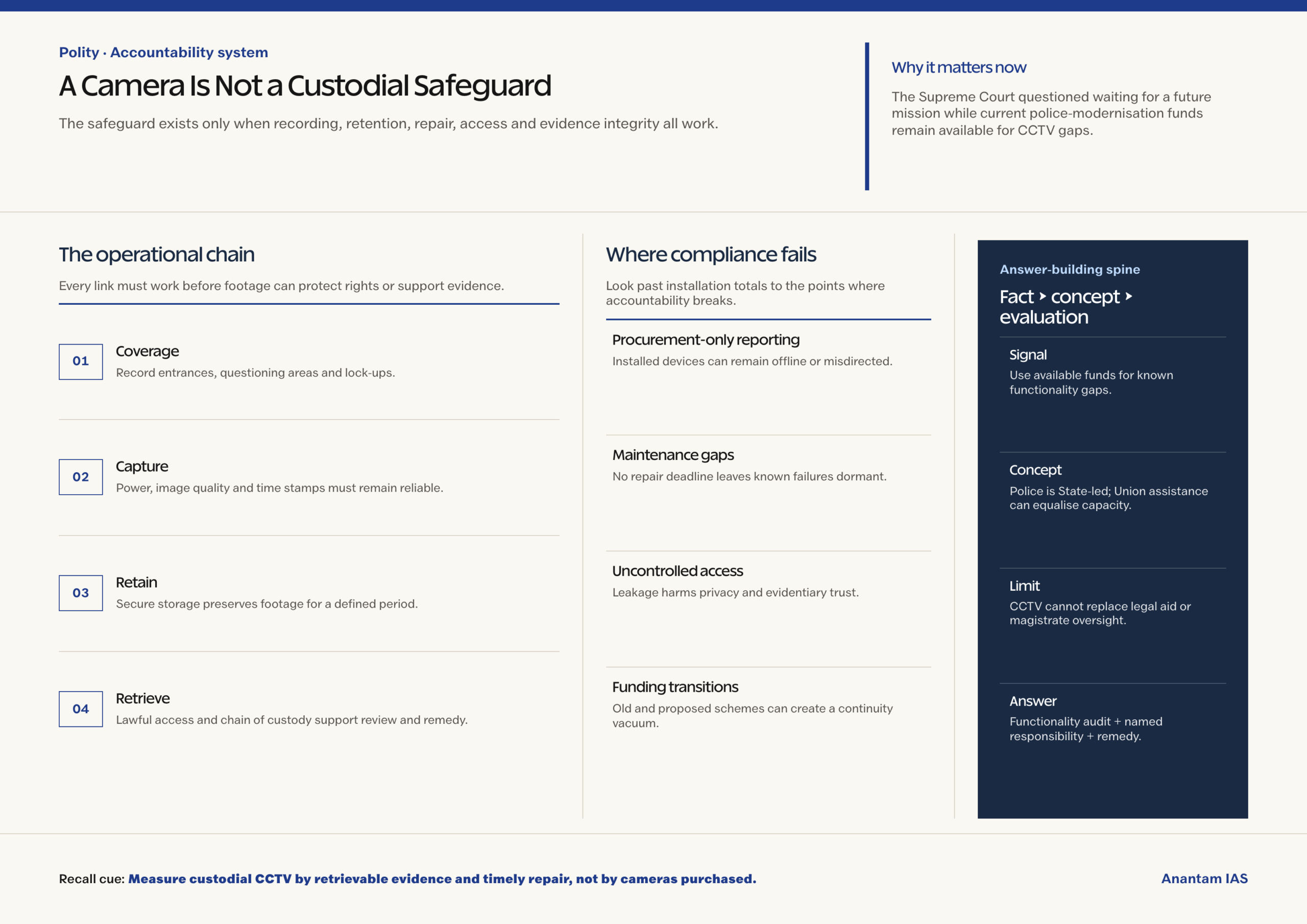
Background and Context
Why Police-Station CCTV Is a Rights Safeguard
Custody creates a steep power imbalance, so reliable records can deter abuse and preserve evidence when accounts conflict.
- CCTV can document entry, movement, questioning and lock-up conditions, making unexplained gaps or injuries easier to investigate.
- The safeguard protects detainees and honest officers by replacing unsupported allegation or denial with time-linked visual evidence.
- Coverage must include locations where questioning or confinement occurs; a camera confined to the station entrance misses the highest-risk spaces.
- Footage access requires a lawful process that protects privacy while enabling courts, investigators and oversight bodies to examine alleged abuse.
- CCTV cannot replace arrest records, medical examination, legal aid, magistrate oversight or accountability for unlawful detention.
Installation Is Not Functionality
The weakest link may be electricity, storage, maintenance or retrieval rather than the absence of a camera on paper.
- A functional system needs clear image quality, accurate time stamps, adequate retention and protection against routine deletion or tampering.
- Power backup and network resilience matter because outages often coincide with precisely the periods that later attract scrutiny.
- Maintenance contracts need repair deadlines and escalation routes; otherwise failed cameras can remain dormant while inventories still show compliance.
- District and State dashboards can flag offline devices, storage failures and missing feeds, but alerts must trigger verified field action.
- Independent audits should compare equipment lists with random footage retrieval rather than accepting self-certified installation reports.
Modernisation Finance and Federal Responsibility
A proposed future mission cannot justify leaving available funds unused while known custodial safeguards remain incomplete.
- States run police stations, identify gaps, procure equipment and maintain systems because policing remains their constitutional responsibility.
- Union assistance can reduce unequal State capacity and support common technical standards, procurement quality and interoperable monitoring.
- Funding transitions need continuity so one scheme’s closure and another’s approval do not create a maintenance or procurement vacuum.
- Modernisation spending should separate rights-critical infrastructure from weapons, vehicles and general technology to prevent CCTV needs from disappearing inside an umbrella budget.
- Outcome reporting must show functional coverage, retention and repair time, not only expenditure released or devices purchased.
Privacy and Evidence Integrity
Surveillance safeguards can protect rights only when access is controlled and footage remains trustworthy from capture through courtroom use.
- Role-based access, tamper logs and secure export procedures reduce unauthorised viewing, selective deletion and leakage of sensitive custodial footage.
- Retention periods should preserve evidence long enough for complaints while avoiding indefinite storage of every visitor and detainee without purpose.
- A documented chain of custody is necessary when footage supports disciplinary, criminal or judicial proceedings, because authenticity may be contested.
- Complaint procedures should let detainees or families seek preservation quickly before routine retention periods erase potentially relevant evidence.
Way Forward
Make Every Link Auditable
- Map uncovered and non-functional locations, then use existing funds before waiting for a successor programme.
- Adopt common standards for coverage, retention, power backup, security, repair time and lawful footage access.
- Require independent random retrieval audits and publish aggregate functionality data without exposing sensitive footage.
- Preserve funding continuity while assigning named responsibility for every unresolved camera or storage failure.
Conclusion
- Police-station CCTV is effective only as a maintained accountability system, not as a procurement count.
- A strong answer should connect State policing, Union assistance and continuing judicial oversight through the operational chain from recording to retrieval and remedy.
UPSC Practice Questions
Prelims MCQ 1
With reference to police administration in India, consider the following statements:
- Police is primarily a State List subject.
- The Union may provide financial assistance for police modernisation.
- CCTV installation alone guarantees compliance with custodial safeguards.
How many of the above statements are correct?
(a) Only one (b) Only two (c) All three (d) None
Answer: (b) Only two
Explanation:
Statements 1 and 2 are correct. Compliance also requires functioning recording, retention, access and oversight.
Prelims MCQ 2
The Supreme Court’s police-station CCTV directions are associated with which case?
(a) Paramvir Singh Saini v. Baljit Singh (b) Kesavananda Bharati v. State of Kerala (c) S.R. Bommai v. Union of India (d) Indra Sawhney v. Union of India
Answer: (a) Paramvir Singh Saini v. Baljit Singh
Explanation:
The Paramvir Singh Saini case established detailed CCTV expectations for police stations and investigating agencies.
UPSC Mains Questions
- Why should police-station CCTV be evaluated as an accountability system rather than a technology procurement project?
- Discuss the Centre-State and judicial roles in ensuring continuity of custodial safeguards during police-modernisation funding transitions.
Sources: LiveLaw and Supreme Court of India.
Frequently Asked Questions
Why are police-station cameras important?
They can deter abuse, preserve evidence and clarify disputed accounts of questioning, detention and lock-up conditions.
Is installing a camera enough?
No. The system needs coverage, power, recording, retention, maintenance, secure retrieval and independent oversight.
Who is responsible for policing?
Police is primarily a State subject, though the Union supports modernisation through funding, standards and coordination.
Can CCTV replace other safeguards?
No. Arrest records, medical examination, legal aid, magistrate oversight and investigation of abuse remain essential.
Source: https://anantamias.com/current-affairs/police-station-cctv-modernisation-accountability/
Indian-Language AI Models for Education and Public Services
Why in News?
Bodhan AI and AI4Bharat launched four foundational Indian-language AI model capabilities for use through open-weight releases and hosted application programming interfaces.
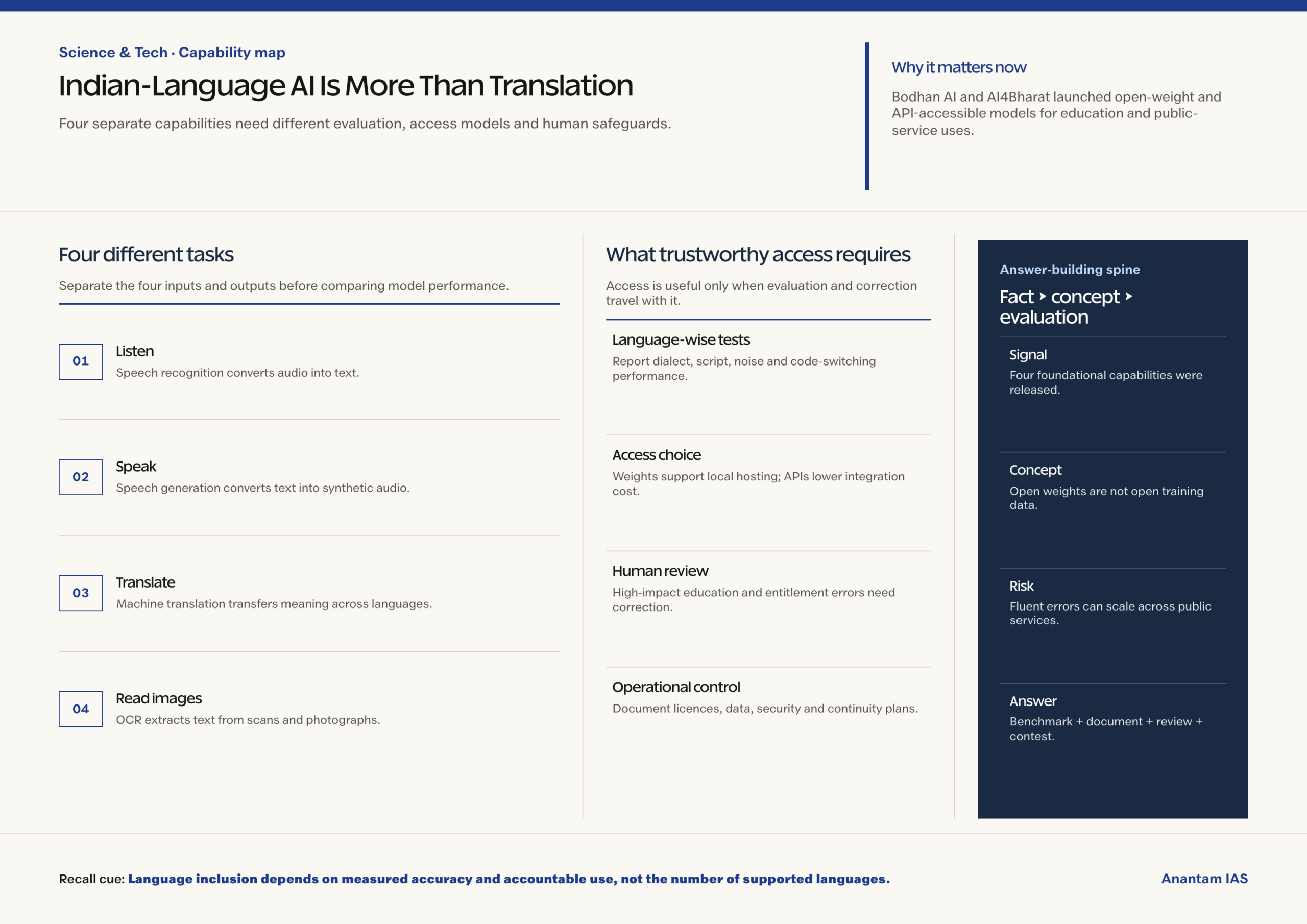
- The suite covers speech recognition, speech generation, machine translation and optical character recognition.
- Bodhan AI is an IIT Madras-incubated Centre of Excellence in AI for Education supported by the Union Education Ministry.
- Open weights and hosted APIs offer different access routes for institutions with different technical capacity.
- Language technology can lower access barriers where public information, classrooms and digital services remain dominated by English.
- Sovereign deployment claims must still be tested through data governance, benchmark transparency, security and performance across language varieties.
UPSC Relevance
Prelims Relevance
- Automatic speech recognition converts spoken audio into text.
- Speech generation converts text or linguistic representation into synthetic audio.
- Machine translation converts content between languages, while optical character recognition extracts text from images or scans.
- Open-weight access exposes trained model parameters under stated licence conditions; it does not necessarily disclose training data or code.
- An API lets another application request model outputs without hosting the model itself.
Mains Relevance
GS Paper 3
- Public digital infrastructure for multilingual AI
- Open models, capability access and technological self-reliance
GS Paper 2
- Language inclusion in education and public services
- Accountability for automated translation and transcription
Essay
- Digital inclusion depends on whose language a system can understand accurately.
Background and Context
Four Capabilities, Four Different Tasks
Calling every language system a chatbot hides the distinct inputs, outputs and failure modes of the released capabilities.
- Speech recognition maps audio to text and must handle accent, code-switching, background noise and domain-specific vocabulary.
- Speech generation produces audio from text; intelligibility, naturalness, pronunciation and safe voice use matter alongside raw language coverage.
- Machine translation transfers meaning across languages, where literal word substitution can lose context, register, idiom or official terminology.
- Optical character recognition extracts text from printed or scanned material and must cope with script shapes, layout, blur and mixed-language pages.
- Combining these tools can support lecture transcription, accessible reading, translated notices and searchable archives, but errors can compound across stages.
Open Weights and Hosted APIs Solve Different Problems
The access model determines who can inspect, adapt, host and govern a foundational model in practice.
- Open weights allow capable institutions to run or fine-tune a model locally, subject to licence terms, infrastructure and security controls.
- Weights alone do not reveal the training corpus, data-cleaning choices, evaluation set or every risk embedded during model development.
- Hosted APIs lower the entry barrier for smaller education-technology firms because they avoid maintaining expensive inference infrastructure.
- API dependence can create recurring cost, service continuity and vendor-control risks when essential public functions rely on one hosted endpoint.
- A mixed route can support local sovereign deployment for sensitive workloads and API access where convenience and rapid integration matter more.
The Inclusion Claim Needs Evidence
Language coverage is meaningful only when systems work for real speakers, scripts, subjects and public-service consequences.
- Benchmarks should report performance separately by language, dialect, gender, age, audio condition and task instead of one national average.
- Education use requires subject accuracy and age-appropriate expression because fluent mistranslation can teach a misconception with high confidence.
- Public-service deployment needs human review where an error could affect entitlement, examination, health guidance, grievance handling or legal rights.
- Training and evaluation data need lawful collection, representative coverage, documentation and safeguards against exposing personal or copyrighted material.
- Feedback systems should let users contest errors and improve terminology without turning marginalised speakers into unpaid data cleaners.
Sovereign Infrastructure Is More Than Hosting
Running a model on domestic infrastructure can improve control, but sovereignty also depends on knowledge, data and operational independence.
- Institutions need skilled teams, documented models, secure compute and the ability to maintain systems after a grant or vendor contract ends.
- Domestic hosting does not cure biased training data, weak evaluation or opaque licence restrictions that limit adaptation and public scrutiny.
- Procurement should avoid permanent lock-in by requiring exportable data, clear interfaces, service continuity plans and measurable language-wise performance.
- Public funding can also support shared evaluation sets so competing systems are compared under consistent, openly documented conditions.
Way Forward
Build Accountable Language Infrastructure
- Publish language-wise benchmarks, model cards, licence terms and known limitations for every capability.
- Provide human review and correction routes for high-impact education and government uses.
- Support local hosting where privacy, continuity or sovereignty outweighs the convenience of a hosted API.
- Test dialects, code-switching and low-resource scripts with representative communities before scaling deployment.
Conclusion
- The launch expands access to foundational Indian-language AI, but open availability is only the first layer of public value.
- A strong answer should separate the four technical tasks, compare weights with APIs, and test inclusion through transparent language-wise performance and human accountability.
UPSC Practice Questions
Prelims MCQ 1
With reference to language AI, consider the following statements:
- Optical character recognition extracts text from images or scans.
- Automatic speech recognition converts audio into text.
- Open weights necessarily disclose the complete training dataset.
How many of the above statements are correct?
(a) Only one (b) Only two (c) All three (d) None
Answer: (b) Only two
Explanation:
Statements 1 and 2 are correct. Open-weight release does not automatically disclose the full training dataset.
Prelims MCQ 2
What is the main function of an application programming interface for a hosted AI model?
(a) It lets another application request model outputs (b) It guarantees error-free translation (c) It reveals all training data (d) It removes computing costs
Answer: (a) It lets another application request model outputs
Explanation:
An API provides a defined route for software to send inputs and receive outputs from a hosted service.
UPSC Mains Questions
- Open-weight models and hosted APIs create different forms of technological access. Discuss with reference to Indian-language AI.
- What safeguards are necessary when multilingual AI is deployed in education and public-service delivery?
Sources: The Hindu and AI4Bharat.
Frequently Asked Questions
What four capabilities were launched?
The suite covers speech recognition, speech generation, machine translation and optical character recognition for Indian-language applications.
What does open-weight mean?
It means trained model parameters are available under stated licence conditions; it does not automatically expose the training corpus or full source code.
Why offer hosted APIs?
APIs let institutions integrate model capabilities without maintaining their own inference infrastructure, though they create cost and dependency trade-offs.
What is the main public-service risk?
A fluent but wrong output can affect learning or entitlements, so high-impact uses need language-wise testing, documentation and human review.
Source: https://anantamias.com/current-affairs/indian-language-ai-open-weights-public-services/
Perimenopause Care Enters State Health Policy
Why in News?
Tamil Nadu and Karnataka announced dedicated approaches to perimenopause and menopause care, bringing midlife women’s needs into routine public health services.
- Tamil Nadu announced screening, counselling and treatment through primary health centres and higher facilities.
- Karnataka introduced Ruthu Thare, a women’s health policy with a strong perimenopause and menopause focus.
- Both approaches envisage community outreach, well-women screening and referral to district hospitals or medical colleges.
- Women’s public health programmes have often concentrated on pregnancy and reproductive years while overlooking the longer midlife transition.
- Recognising symptoms within routine care can reduce stigma, delayed diagnosis and fragmented visits across physical and mental-health services.
UPSC Relevance
Prelims Relevance
- Menopause is confirmed after 12 consecutive months without menstruation when no other cause explains the change.
- Perimenopause is the transition before menopause and may extend across several years.
- Oestrogen and progesterone levels change as ovarian function declines.
- Primary health centres can provide first-contact screening, counselling and referral rather than every case requiring tertiary care.
- Menopause is a natural life stage, though symptoms may require clinical evaluation and treatment.
Mains Relevance
GS Paper 2
- Gender-responsive public health beyond reproductive care
- Primary-care integration and referral continuity
GS Paper 1
- Social stigma around women’s ageing
- Unpaid care, work and midlife health
Essay
- A health system becomes universal only when it recognises neglected life stages.
Background and Context
What the Midlife Transition Involves
Perimenopause is a variable transition, not a single event, and its symptoms differ widely in timing, intensity and duration.
- Menopause marks the permanent end of menstrual periods; perimenopause describes the preceding years of hormonal and cycle changes.
- Common experiences include hot flashes, sleep disruption, irregular periods, joint discomfort, fatigue and mood changes, but no single symptom defines every case.
- Symptoms can affect work, caregiving and mental well-being even when they are dismissed as a private or inevitable inconvenience.
- Clinical assessment matters because anaemia, thyroid disorders, depression and other conditions may overlap with symptoms attributed to the transition.
- Care ranges from accurate information and lifestyle support to symptom-specific medicines; treatment must reflect individual risks, preferences and clinical evaluation.
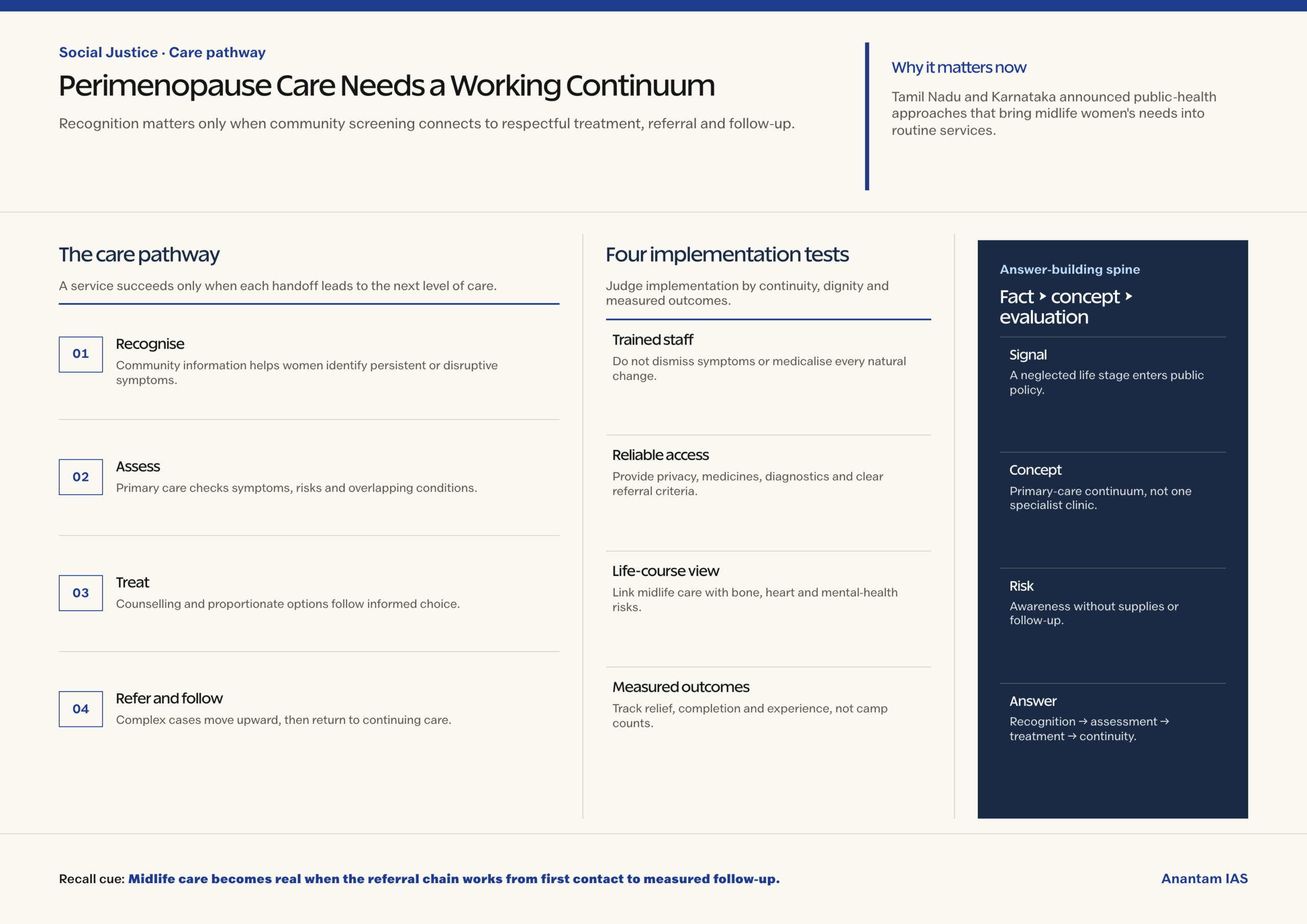
Why Primary-Care Integration Matters
A public programme can make care reachable only when community recognition connects to a functioning clinical pathway.
- Community outreach can normalise discussion and help women recognise when persistent symptoms deserve assessment instead of silent endurance.
- Primary health centres can provide initial history, basic screening, counselling and follow-up close to home at lower cost.
- Clear referral criteria are needed for severe bleeding, complex mental-health needs, suspected cancer, osteoporosis risk or treatment contraindications.
- District hospitals and medical colleges should support rather than replace first-contact care through specialist advice, diagnostics and back-referral.
- Continuity matters because one awareness camp without records, medicines, trained staff and follow-up will not change access.
The Implementation Test
Policy recognition is valuable, but quality depends on training, informed choice, reliable supplies and respectful communication.
- Health workers need protocols that neither trivialise symptoms nor medicalise every natural change, preserving proportionate and evidence-based care.
- Counselling must explain benefits, limitations and risks of available treatments without presenting one therapy as suitable for every woman.
- Mental-health screening should connect to confidential support because sleep loss, anxiety and mood symptoms can reinforce each other.
- Programmes must reach rural women, informal workers and marginalised groups who may lack time, privacy, transport or specialist access.
- Monitoring should measure symptom relief, referral completion, follow-up and patient experience, not merely the number of camps or screenings.
Why a Life-Course Lens Changes Policy
A life-course approach links midlife symptoms with earlier health, present work and later risks instead of isolating one clinic visit.
- Nutrition, physical activity, reproductive history and chronic conditions shape midlife health, making prevention and longitudinal records useful before severe symptoms appear.
- Workplace flexibility and accurate information can reduce avoidable absence without forcing women to disclose private health details or accept stigma.
- Midlife visits offer a practical entry point for cardiovascular, bone, cancer and mental-health risk assessment when services remain coordinated and proportionate.
- Digital or paper records should follow the patient across facilities so repeat visits build continuity instead of restarting assessment each time.
Way Forward
Build a Continuum of Midlife Care
- Train primary-care teams with simple symptom, risk, referral and follow-up protocols linked to specialist support.
- Ensure private consultation, reliable medicines, diagnostics and mental-health pathways at each level of care.
- Use community communication to reduce stigma while making clear that severe or unusual symptoms need clinical evaluation.
- Track outcomes and patient experience across age, location and social group to detect who remains outside the programme.
Conclusion
- Bringing perimenopause into routine care corrects a gendered blind spot between maternal health programmes and old-age services.
- A strong answer should treat the policy as a continuum of care: recognition, first-contact assessment, informed treatment, referral and measured follow-up.
UPSC Practice Questions
Prelims MCQ 1
With reference to menopause, consider the following statements:
- It is confirmed after 12 consecutive months without menstruation when no other cause explains it.
- Perimenopause always lasts exactly one year.
- Symptoms may require assessment even though menopause is a natural transition.
How many of the above statements are correct?
(a) Only one (b) Only two (c) All three (d) None
Answer: (b) Only two
Explanation:
Statements 1 and 3 are correct. The duration of perimenopause varies considerably.
Prelims MCQ 2
Which is the most appropriate role for a primary health centre in perimenopause care?
(a) Replace every specialist service (b) Provide screening, counselling, basic management and referral (c) Restrict care to reproductive-age women (d) Treat every symptom with one standard medicine
Answer: (b) Provide screening, counselling, basic management and referral
Explanation:
Primary care should act as the accessible first contact within a referral-linked continuum.
UPSC Mains Questions
- Why has midlife women’s health remained a blind spot in public health policy? Evaluate the promise of primary-care-based perimenopause services.
- Policy announcements do not by themselves create a continuum of care. Discuss with reference to screening, referral and follow-up.
Sources: The Hindu and World Health Organization.
Frequently Asked Questions
What is perimenopause?
It is the transition leading to menopause, when hormonal and menstrual changes may occur over several years.
Is menopause a disease?
No. It is a natural life stage, though disruptive symptoms and overlapping medical conditions may need assessment and treatment.
What can primary health centres provide?
They can offer first-contact screening, counselling, basic symptom management, follow-up and referral for complex or high-risk cases.
How should implementation be measured?
Useful measures include symptom improvement, referral completion, continuity, medicine availability and patient experience, disaggregated by social and geographic access.
Source: https://anantamias.com/current-affairs/perimenopause-care-primary-health-systems/
Tamil Nadu’s Birth Decline and the Demographic Transition
Why in News?
Tamil Nadu recorded about 45,000 fewer births in 2025 than in 2024, renewing debate about low fertility, population momentum and ageing.
- Registered births fell from 8.47 lakh in 2024 to 8.02 lakh in 2025.
- The decline was about 5.3%, according to Civil Registration System data cited by The Hindu.
- Experts urged investment in education, childcare, social security and elderly care instead of panic-driven pronatalist incentives.
- Falling births can improve per-child investment before they tighten the future labour supply.
- Ageing changes the dependency burden from child support toward pensions, chronic care and community-based elder services.
UPSC Relevance
Prelims Relevance
- Total fertility rate measures the average number of children expected per woman under prevailing age-specific fertility rates.
- Replacement-level fertility is commonly approximated at 2.1 births per woman, though the exact level varies with mortality.
- Population momentum allows growth to continue after fertility falls because large younger cohorts enter reproductive ages.
- The Civil Registration System records births and deaths continuously; it differs from the decennial Census.
- Ageing raises the old-age dependency ratio when older cohorts grow relative to the working-age population.
Mains Relevance
GS Paper 1
- Demographic transition and regional population divergence
- Ageing, migration and changing family structures
GS Paper 2
- Social-security and care-system readiness
- Human-capital investment under low fertility
Essay
- Demography creates a window for policy, not a mechanical destiny.
Background and Context
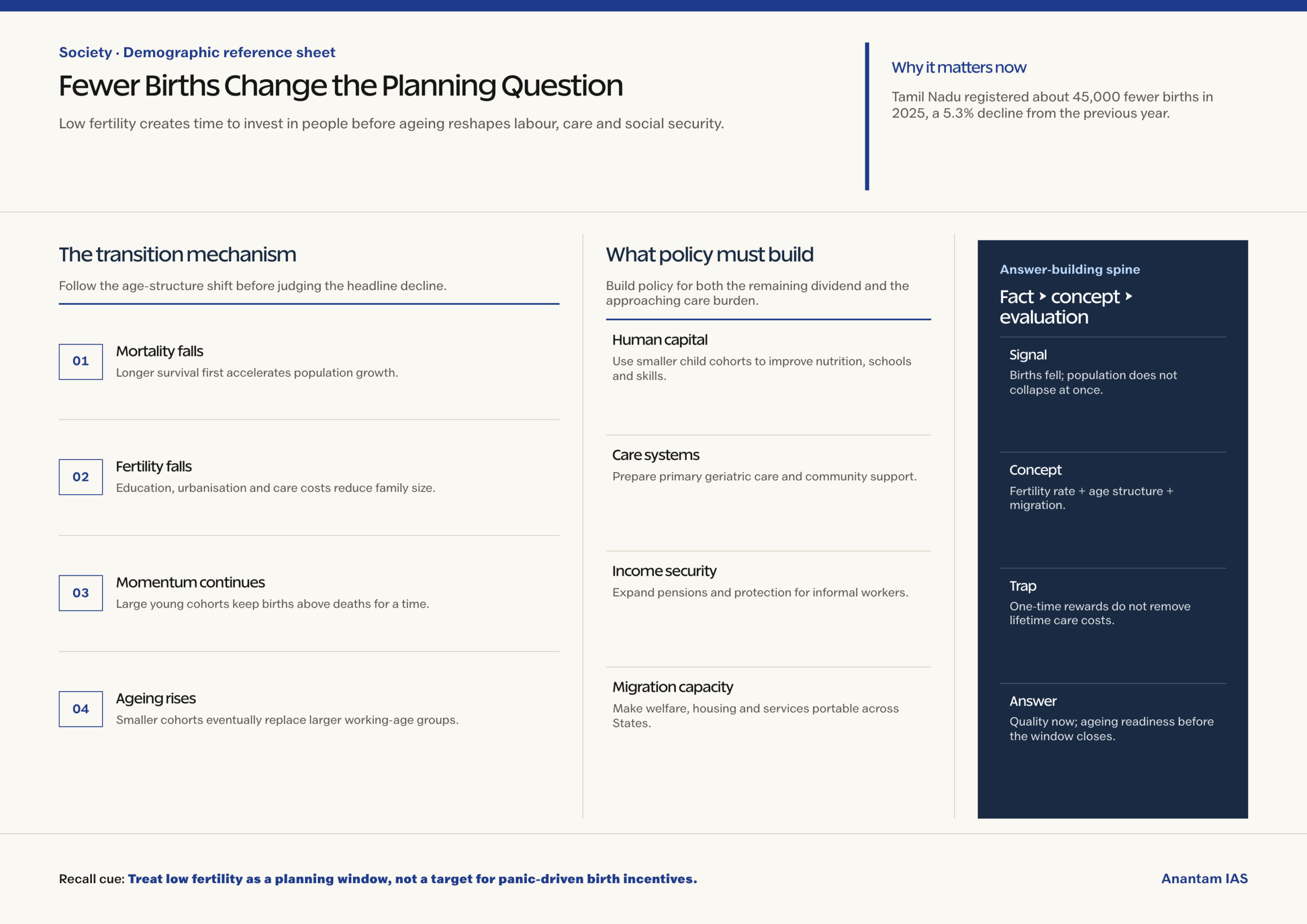
How Demographic Transition Changes Population Growth
Birth decline is one stage in a longer shift from high mortality and fertility toward longer lives and smaller families.
- In the early transition, mortality falls first while births remain high, creating rapid population growth and a young age structure.
- Fertility later falls with urbanisation, female education, contraception, lower infant mortality and rising costs of raising children.
- Growth may continue for decades because population momentum depends on the age structure, not only the current fertility rate.
- Once smaller cohorts replace larger ones, natural increase slows and may turn negative unless migration offsets the decline.
- Tamil Nadu entered below-replacement fertility earlier than many States, so its age-structure effects appear sooner in public policy.
The Dividend Can Become an Ageing Burden
Low fertility can create gains, but only when institutions convert a favourable age structure into productive and secure lives.
- A smaller child cohort can permit higher spending per child on nutrition, schooling, health and skills without increasing total budgets proportionately.
- The demographic dividend is realised only when working-age people find productive employment; a large labour force without jobs can deepen insecurity.
- Longer life expectancy expands demand for geriatric care, chronic-disease management, accessible housing and reliable income after retirement.
- Women often provide unpaid elder care while remaining in paid work, making care infrastructure a labour-force and gender-equality issue.
- Inter-State migration may replenish workers, but it also requires portable welfare, rental housing, language inclusion and protection from discrimination.
Why Birth Incentives Alone Rarely Reverse Fertility
A financial reward at childbirth does not remove the long-term constraints that shape couples’ decisions about family size.
- Delayed marriage, insecure employment, housing costs and unequal care work influence fertility more persistently than a one-time transfer or gift.
- Pronatalist schemes can pressure women while treating reproduction as a numerical target instead of protecting autonomy, health and economic opportunity.
- Affordable crèches, predictable work, parental leave and quality schools reduce the continuing cost of care more directly than symbolic incentives.
- Policy must distinguish fewer births from immediate population collapse; age structure makes demographic change gradual and gives governments planning time.
- The central test is whether a low-fertility State improves life across generations while building pensions, health care and community support before ageing accelerates.
Why Regional Divergence Matters for India
India’s demographic transition is uneven, so one national population narrative can conceal opposite planning needs across States.
- Earlier-transition States need ageing, care and workforce strategies while younger States still require rapid expansion of education, health and employment capacity.
- Fiscal transfers and political representation become sensitive when population control, current need and historical performance point toward different allocation principles.
- Migration can connect young workers with ageing labour markets, but only if housing, welfare portability, language services and social acceptance develop together.
Way Forward
Plan for Quality and Care
- Publish age-structured projections alongside birth registrations so policy responds to cohorts rather than one year’s headline decline.
- Expand childcare, school quality, women’s employment support and migrant-worker portability while the working-age window remains open.
- Build primary geriatric care, long-term-care standards, pension coverage and community services before family care capacity contracts.
- Evaluate fertility incentives against autonomy, cost, duration and evidence instead of assuming every additional subsidy changes lifetime decisions.
Conclusion
- Tamil Nadu’s falling births mark a mature demographic transition, not an emergency that can be solved by rewarding childbirth.
- A strong answer should connect population momentum with the closing demographic-dividend window, then prioritise human capital, migration governance and ageing-ready social protection.
UPSC Practice Questions
Prelims MCQ 1
With reference to population momentum, consider the following statements:
- Population can continue growing after fertility falls below replacement level.
- It is influenced by the age structure of the population.
- It is identical to the rate of natural increase.
How many of the above statements are correct?
(a) Only one (b) Only two (c) All three (d) None
Answer: (b) Only two
Explanation:
Statements 1 and 2 are correct. Population momentum reflects age structure; natural increase is the difference between births and deaths.
Prelims MCQ 2
Which institution operates India’s continuous system for registering births and deaths?
(a) Finance Commission (b) Civil Registration System (c) National Sample Survey (d) Inter-State Council
Answer: (b) Civil Registration System
Explanation:
The Civil Registration System continuously records vital events, unlike the periodic Census.
UPSC Mains Questions
- Falling fertility is a planning opportunity before it becomes an ageing challenge. Discuss with reference to India’s regional demographic divergence.
- Why do one-time birth incentives have limited power to reverse low fertility? Suggest a rights-based social-policy response.
Sources: The Hindu and Civil Registration System.
Frequently Asked Questions
What is replacement-level fertility?
It is the fertility level at which a population replaces itself across generations without migration, commonly approximated at 2.1 births per woman.
What is population momentum?
It is continued population growth after fertility declines because a large cohort of young people is still entering reproductive ages.
Does fewer births mean immediate population decline?
No. The outcome depends on deaths, migration and age structure, so population can keep growing or remain stable for years.
What should low-fertility States prioritise?
They should invest in child quality, productive employment, migrant inclusion, pensions, geriatric care and support for unpaid caregivers.
Source: https://anantamias.com/current-affairs/tamil-nadu-birth-decline-demographic-transition/
UNCLOS remains the ‘Constitution of the Oceans’
Why in News?
Ramon Magsaysay Award winner Tommy Koh, who presided over the final negotiations of the Third UN Conference on the Law of the Sea, has reiterated that the UN Convention on the Law of the Sea (UNCLOS) remains the “constitution of the world’s oceans”.
His remarks assume significance amid disputes concerning the Strait of Hormuz, South China Sea, seabed resources and dark fleet shipping.
| UPSC Relevance: GS-2: International institutions and international law; GS-3: Maritime security and Blue economy Prelims: UNCLOS, transit passage, EEZ, and customary international law |
What is UNCLOS?
Adopted in 1982 and in force since 1994, UNCLOS establishes a comprehensive legal order governing the oceans. With 172 parties, it enjoys near-universal acceptance.
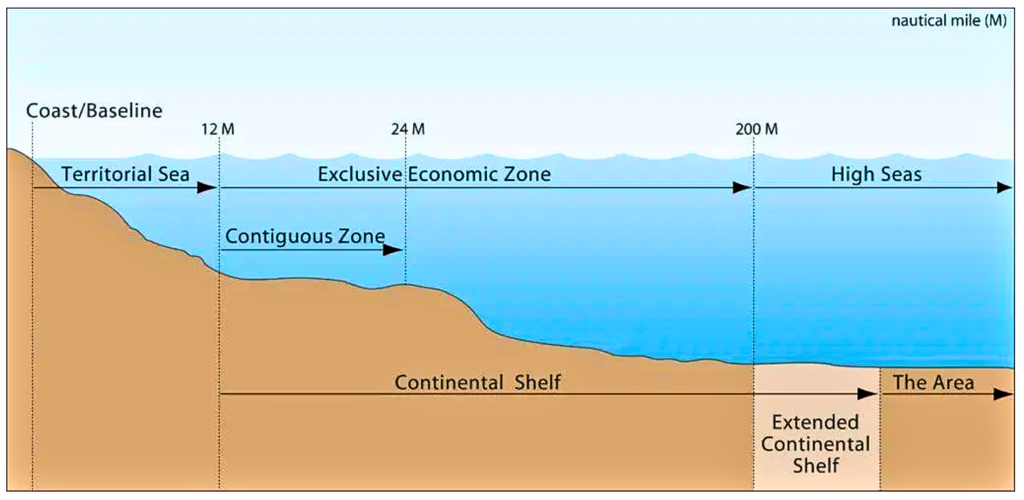
It defines maritime zones and balances coastal-State rights with navigational freedoms:
- Territorial Sea: Up to 12 nautical miles; the coastal State exercises sovereignty.
- Contiguous Zone: Up to 24 nautical miles; limited enforcement jurisdiction.
- Exclusive Economic Zone: Up to 200 nautical miles; sovereign rights over natural resources.
- Continental Shelf: Rights over seabed and subsoil resources.
- High Seas: Open to all States, subject to international law.
- The Area: Seabed beyond national jurisdiction, designated the common heritage of humankind.
UNCLOS also created the International Tribunal for the Law of the Sea (ITLOS), the International Seabed Authority (ISA) and the Commission on the Limits of the Continental Shelf (CLCS).
| The Strait of Hormuz and Transit Passage: The Strait of Hormuz is an international strait connecting two areas of high seas or EEZ and is vital for global oil and LNG transportation. Under UNCLOS, ships and aircraft enjoy transit passage through straits used for international navigation. Unlike innocent passage through ordinary territorial waters, transit passage includes navigation and overflight; generally extends to commercial vessels, warships and submarines operating in their normal mode; and cannot be suspended by States bordering the strait. Iran has signed but not ratified UNCLOS. Koh argues that transit passage has acquired the status of customary international law and is consequently binding even on non-parties. Customary law develops from widespread State practice followed out of a belief that such practice is legally obligatory. |
Why does UNCLOS retain its Authority?
- It provides a common framework for navigation, fishing, seabed mining, maritime boundaries, environmental protection and scientific research.
- Even the United States, which has not ratified UNCLOS, accepts many of its navigational provisions as authoritative customary law.
- It offers peaceful dispute-settlement mechanisms through ITLOS, the International Court of Justice and arbitral tribunals.
- Its architecture has evolved through supplementary agreements rather than reopening the entire Convention. The BBNJ or High Seas Treaty, which entered into force in January 2026, extends conservation rules for marine biodiversity beyond national jurisdiction.
Emerging Challenges:
- Excessive and overlapping maritime claims, especially in the South China Sea
- reluctance of powerful States to comply with adverse arbitral awards
- militarisation of international waters and strategic chokepoints
- disagreements over deep-seabed mining and benefit-sharing
- climate-induced sea-level rise affecting maritime baselines
- illegal fishing, autonomous vessels and undersea infrastructure; and
- dark or shadow fleets that conceal ownership, manipulate identification systems and evade sanctions, insurance and safety requirements.
The IMO has warned that such fleets increase risks of collision, oil spills, fraudulent registration and evasion of liability. These problems require coordinated flag-State, port-State and IMO action rather than legally questionable unilateral enforcement on the high seas.
Significance for India:
- India ratified UNCLOS in 1995 and regards it as the legal basis for maritime rights and obligations. It protects India’s interests in its EEZ, island territories, sea lanes, fisheries, offshore resources and deep-ocean exploration.
- India’s acceptance of the 2014 India-Bangladesh maritime boundary award also demonstrated its commitment to peaceful, rules-based dispute settlement.
UNCLOS remains indispensable because it replaces competing assertions of power with commonly accepted maritime rules.
Its principal weakness lies not in its architecture, but in selective compliance and inadequate enforcement. Strengthening multilateral institutions and respecting dispute-settlement outcomes are therefore essential to preserve a free, stable and sustainable ocean order.
Source: https://anantamias.com/current-affairs/unclos-remains-the-constitution-of-the-oceans/
No Takers for ₹37,500-Crore Coal Gasification Scheme
Why in News?
Reports suggest that the government’s ₹37,500 crore incentive scheme for surface coal and lignite gasification had received no applications ahead of its September 7, 2026 deadline, raising questions about project viability.
However, the Coal Ministry clarified that the final number could be determined only after the online window closed.
| UPSC Relevance: GS-3: Environment and Biodiversity; GS-3: Economy: Energy & Infrastructure Prelims: Coal Gasification Scheme (key facts), Coal Gasification, Syngas |
What is Coal Gasification?
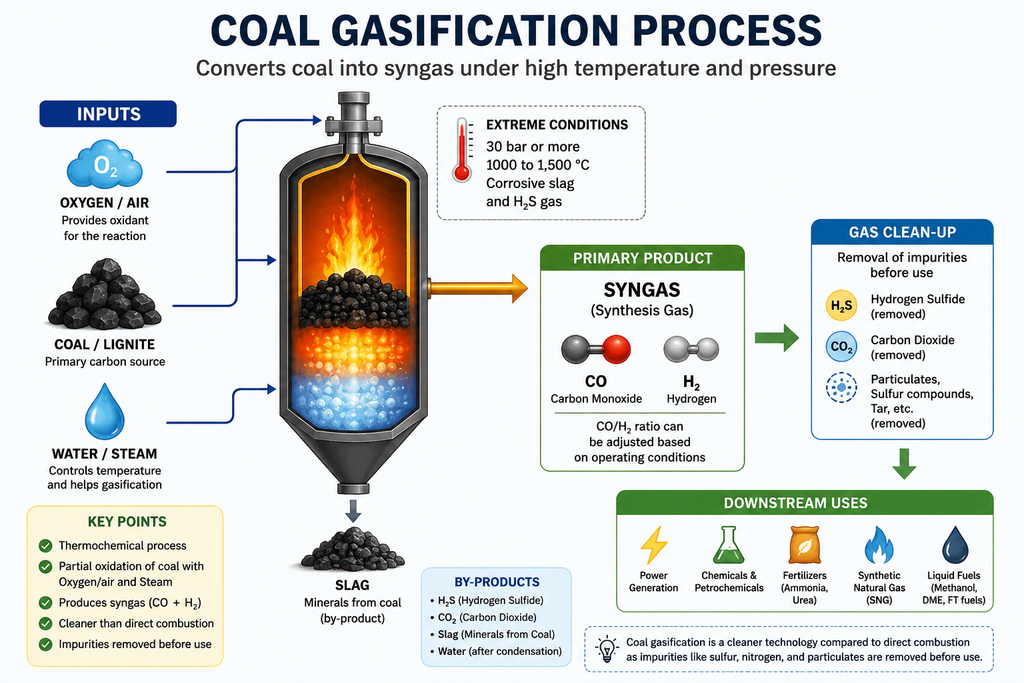
Coal gasification is a thermochemical process in which coal reacts with controlled quantities of oxygen or air and steam at high temperature and pressure. Instead of being burnt directly, coal is converted into synthesis gas or syngas, consisting mainly of:
- hydrogen
- carbon monoxide
- carbon dioxide; and
- smaller quantities of methane and impurities.
Syngas can be converted into methanol, ammonia, urea, synthetic natural gas, hydrogen, dimethyl ether and liquid fuels.
The scheme concerns surface gasification, where mined coal is processed in an above-ground plant. In underground coal gasification, the coal seam is converted into gas in situ.
About the Scheme:
- Approved in May 2026, the scheme seeks to gasify approximately 75 million tonnes of coal and lignite, contributing to the National Coal Gasification Mission’s target of 100 million tonnes by 2030.
- Its major provisions include:
- financial assistance of up to 20% of plant and machinery costs
- maximum assistance of ₹5,000 crore per project
- disbursement in four milestone-linked instalments
- selection through competitive bidding; and
- coal linkages for up to 30 years.
The scheme builds upon the National Coal Gasification Mission (2021), and the ₹8500 crore programme approved in 2024 (under which eight projects involving assistance of ₹6,233 crore are reportedly under implementation).
Why is Coal Gasification being Promoted?
- Import substitution: Syngas can reduce dependence on imported LNG, methanol, ammonia and fertiliser feedstocks.
- Energy security: It converts India’s abundant coal reserves into value-added fuels and chemicals.
- Industrial development: It can support fertilisers, petrochemicals, steel and synthetic-fuel industries.
- Management of local pollutants: Sulphur, particulates and other impurities can be removed from syngas before its final use.
- Easier carbon capture: Gasification produces relatively concentrated carbon dioxide streams, making pre-combustion carbon capture technically easier than in conventional coal combustion.
Why is Industry Hesitant?
- High capital requirement: Integrated gasification and downstream chemical plants require large upfront investment and long construction periods. A 20% capital incentive may not adequately cover technological and market risks.
- High-ash Indian coal: India’s low-grade, high-ash coal reduces efficiency, raises ash-handling costs and may require coal washing or specially designed indigenous gasifiers. The National Coal Gasification Mission itself recognises this as a major constraint.
- Limited domestic experience: India lacks an extensive record of operating large commercial coal-to-chemical plants. Dependence on foreign technology licensors increases costs and execution risks.
- Uncertain product demand: Lenders require assured purchasers and predictable prices for methanol, synthetic gas, hydrogen and fertiliser products. Capital support cannot substitute for long-term offtake arrangements.
- Water and land requirements: Gasification plants need substantial land, water, electricity, oxygen-production facilities and downstream pipelines, often in coal-bearing regions already facing ecological and social pressures.
- Carbon intensity: Gasification is cleaner than direct combustion regarding some local pollutants, but it is not inherently low-carbon. Without effective carbon capture, utilisation and storage, coal-derived hydrogen and chemicals may have high life-cycle greenhouse-gas emissions.
- Transition risk: Falling renewable-energy costs, green hydrogen and tighter carbon standards may make long-lived coal-based projects commercially uncompetitive or create stranded assets.
Way Forward:
- The government should support pilot plants designed specifically for high-ash Indian coal and link incentives to gasification efficiency, product output and emissions performance.
- Long-term coal-pricing and product-offtake arrangements could improve bankability.
- New projects must incorporate CCUS readiness, life-cycle emission assessment, water recycling, ash utilisation and community safeguards.
- Plants should preferably be located near coal mines, downstream consumers and suitable carbon-storage or utilisation facilities.
- Every project should undergo a transparent comparison with alternatives such as natural gas, biomass and green hydrogen.
- Public incentives must not create permanent dependence on commercially unviable or carbon-intensive technologies.
The reported lack of early applications reveals that coal gasification cannot be scaled through capital subsidies alone. Its future depends on solving the combined problems of technology, assured demand, environmental sustainability and financial viability.
Coal gasification may assist import substitution during the energy transition, but it cannot automatically be labelled “clean energy” without deep carbon capture and strict environmental safeguards.
Source: https://anantamias.com/current-affairs/no-takers-for-%e2%82%b937500-crore-coal-gasification-scheme/
The Gulf is Calling, and New Delhi Must Listen
Context
India’s engagement with West Asia has traditionally rested on energy imports, trade, migrant labour and remittances. New Delhi followed a cautious multi-alignment strategy: maintaining simultaneous relations with Saudi Arabia, the UAE, Iran and Israel without joining competing regional blocs.
This transactional but balanced approach worked while the United States remained the principal external guarantor of Gulf security. However, regional wars, drone and missile attacks, disruption of maritime routes and the perceived unpredictability of American engagement are now reshaping West Asia’s security architecture.
A changing West Asia requires a more assertive Indian role in pursuing real, hard-power security partnerships.
| UPSC Relevance: GS-2 International Relations: India and its Neighbourhood, West Asia Mains: Emerging security alignments in West Asia and their implications for India. |
A Region Vital to India:
The Gulf cannot be treated merely as an economic hinterland:
- India-GCC trade reached approximately $178 billion in 2024-25.
- The region remains a major source of India’s crude oil and LNG.
- Around one crore Indians live in GCC countries, making their security and welfare a major national concern.
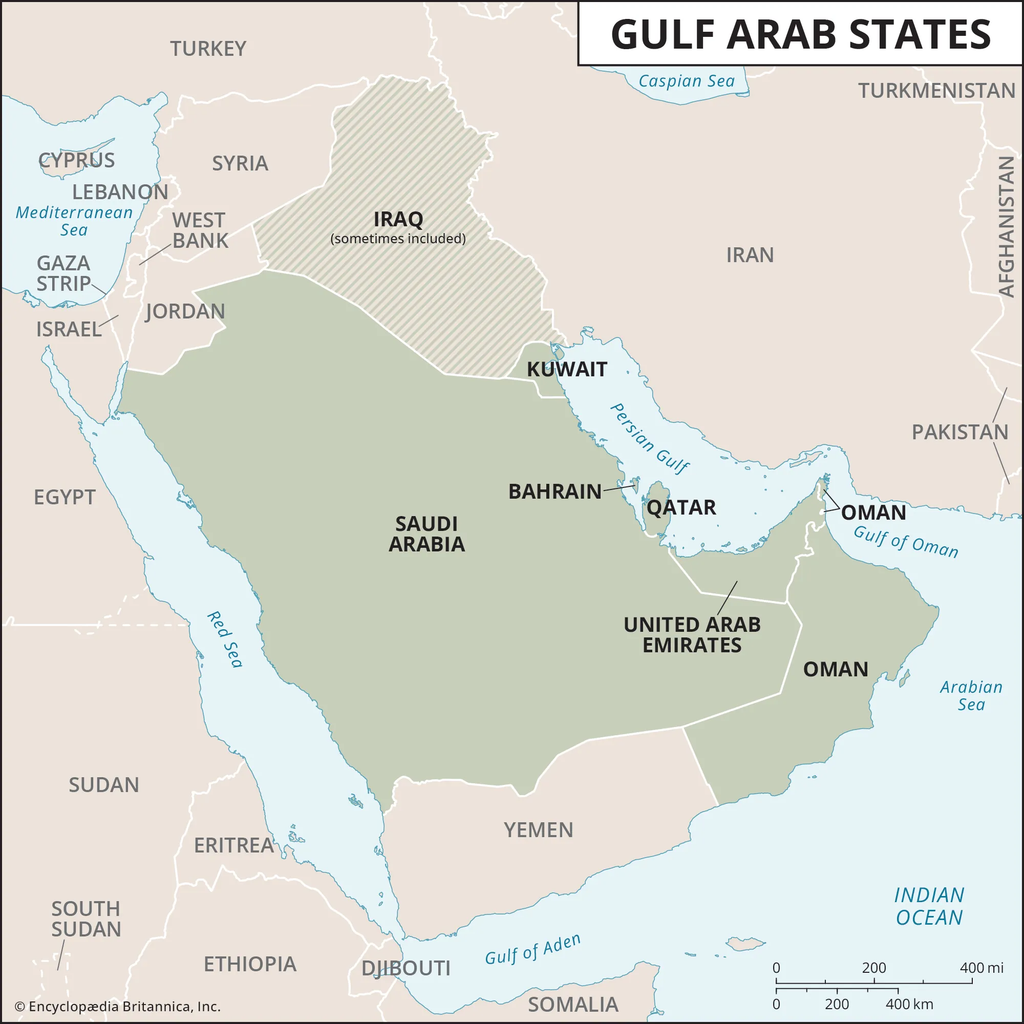
- The Strait of Hormuz and Bab-el-Mandeb connect India with its energy suppliers and European markets.
- Initiatives such as the India-Middle East-Europe Economic Corridor (IMEC) depend upon regional stability.
Mecca Defence Agreement: A Structural Signal:
- The Mecca Joint Defence Agreement, signed by Saudi Arabia, Türkiye and Pakistan in August 2026, treats an armed attack on one member as an attack on all. It seeks to combine Saudi financial resources, Türkiye’s defence technology and military capabilities, and Pakistan’s operational experience.
- For India, the agreement is significant because it creates an institutionalised security arrangement near its western maritime approaches and gives Pakistan a larger role in Gulf security. It does not automatically make Saudi Arabia hostile to India (the pact has been presented as defensive), but its operational ambiguity requires close monitoring.
- More broadly, it indicates that West Asian countries no longer seek only trade and investment partners; they increasingly require air and missile defence, intelligence, maritime security, counter-drone systems and defence-industrial cooperation.
Limits of Economic Engagement:
- The recent regional conflicts have demonstrated that even advanced ports, refineries, logistics corridors and financial centres remain vulnerable to inexpensive drones, missiles, sabotage and cyberattacks. Disruption at a single maritime chokepoint can raise energy prices and interrupt global supply chains.
- The Gulf’s development model also depends heavily on expatriate labour and foreign investment. Prolonged insecurity could lead to capital flight, labour evacuation and interruptions in remittance flows. Thus, trade ties and diaspora diplomacy alone cannot preserve India’s influence or interests.
Way Forward:
- Expand maritime partnerships:
- India should deepen naval coordination with the UAE, Oman and Saudi Arabia across the Gulf of Oman, Strait of Hormuz, Arabian Sea and Gulf of Aden. Joint patrols, logistics arrangements, exercises and interoperable maritime-surveillance networks can protect commercial shipping.
- India is not starting from zero. Under Operation Sankalp, the Indian Navy has escorted shipping, responded to piracy and drone-related incidents and maintained deployments in the western Indian Ocean. Its Information Fusion Centre-Indian Ocean Region also enables maritime information-sharing.
- Build defence-industrial partnerships: India can offer Gulf countries co-development and joint production of naval systems, drones, counter-drone technologies, electronic warfare equipment and cybersecurity solutions. Defence relations must progress from buyer-seller arrangements towards long-term technology and manufacturing partnerships.
- Strengthen bilateral and minilateral cooperation: Flexible security arrangements with the UAE, Oman, Saudi Arabia, Israel and other willing partners would allow India to address particular challenges without entering a rigid military alliance. Platforms such as the India-GCC Strategic Dialogue and I2U2 should acquire stronger security and technology dimensions.
- Protect people and economic assets: India needs coordinated evacuation plans, consular databases and contingency mechanisms for its Gulf diaspora. Strategic petroleum reserves, diversified energy imports and resilience planning for IMEC and other trade corridors are equally necessary.
- Strategic Caution: India should aim to become a credible security contributor, rather than claiming to be the Gulf’s unilateral security guarantor. Excessive military commitments could entangle it in conflicts involving Iran, Israel, Türkiye and Arab states, strain naval resources and undermine strategic autonomy.
Its approach must therefore combine a stronger maritime presence with continued engagement with Iran, support for peaceful dispute settlement and avoidance of sectarian or bloc-based alignments.
The era of a largely passive and transactional Indian presence in West Asia is ending. India must supplement energy, trade and diaspora ties with maritime security, intelligence and defence-industrial cooperation.
The objective should be neither withdrawal nor military entanglement, but an evolution from multi-alignment to issue-based, capability-backed partnerships that protect India’s interests while contributing to regional stability.
Source: https://anantamias.com/current-affairs/the-gulf-is-calling-and-new-delhi-must-listen/
NCPCR campaign rescues over 3800 from Child Labour
Why in News?
A nationwide campaign coordinated by the National Commission for Protection of Child Rights (NCPCR) led to the rescue of over 3800 children and the registration of more than 575 FIRs.
The “Pan-India Rescue and Rehabilitation” campaign, conducted between June and August 2026, brought together State governments, district magistrates, labour departments, police and child-protection authorities. It targeted factories, brick kilns, workshops, construction sites, hotels, markets and trafficking hotspots.
| UPSC Relevance: GS-2 Social Justice: Vulnerable Sections; Welfare Mechanism Mains: Child Labour: Challenges, Constitutional Framework and Government initiatives. |
What is Child Labour?
- The ILO defines child labour as work that deprives children of their childhood, dignity and potential or harms their physical and mental development.
- Not every age-appropriate activity undertaken by a child constitutes child labour; the crucial considerations are the child’s age, nature of work, working conditions and interference with education.
Under the Child and Adolescent Labour (Prohibition and Regulation) Act, 1986, as amended in 2016:
- A child is a person below 14 years.
- An adolescent is a person aged 14-18 years.
- Employment of children below 14 is prohibited in all occupations and processes.
- Limited exceptions exist for helping in a family enterprise after school hours or during vacations and working as a child artist under prescribed safeguards.
- Adolescents cannot be employed in legally specified hazardous occupations and processes.
The family-enterprise exception remains controversial because informal, caste-based and home-based labour can be concealed as assistance to the family.
Extent of the Problem:
- According to Census 2011, approximately 10.1 million children aged 5-14 years were recorded as main or marginal workers (about 3.9% of the child population in this age group). The absence of a more recent nationwide Census-based estimate makes it difficult to assess current trends and target interventions accurately.
- Child labour is concentrated in agriculture and informal activities such as domestic work, construction, roadside establishments, brick kilns, mining, garment work, fireworks and small manufacturing units. Girls’ labour is particularly undercounted because it frequently occurs inside households.
Constitutional and Legal Safeguards:
- Article 15(3): Permits special provisions for children.
- Article 21A: Guarantees free and compulsory education for children aged 6-14.
- Article 23: Prohibits trafficking, begar and forced labour.
- Article 24: Prohibits employment of children below 14 in factories, mines and hazardous work.
- Article 39(e) and (f): Directs the State to prevent abuse and exploitation of children.
- Juvenile Justice Act, 2015: Treats vulnerable and exploited children as children in need of care and protection.
- Bonded Labour System (Abolition) Act, 1976: Applies where children are employed against family debts or advances.
- India has ratified ILO Convention 138 on minimum age and Convention 182 on the worst forms of child labour.
About the National Commission for Protection of Child Rights (NCPCR):
- NCPCR is a statutory body constituted under the Commissions for Protection of Child Rights Act, 2005, under the administrative control of the Ministry of Women and Child Development.
- It reviews child rights safeguards, investigates violations and monitors laws such as the RTE Act, Juvenile Justice Act and POCSO Act.
Why does Child Labour Persist?
- Poverty, indebtedness and inadequate adult wages: When adult earnings are insufficient, families depend on children’s income or labour for survival. Debt may also push entire families into bonded work.
- School dropout and poor learning outcomes: Inaccessible schools, indirect educational costs and weak learning outcomes reduce the perceived value of education, particularly at the secondary level.
- Migration and trafficking: Informal contractors often exploit migrant families by making false employment promises, separating children from support systems and placing them in unregulated workplaces.
- Social acceptance of family-based work: Child labour is frequently normalised as skill-learning or assistance to parents. The family-enterprise exception can consequently conceal prolonged or hazardous work.
- Demand for cheap labour: Employers prefer children because they can be paid less, made to work longer and are less likely to organise, negotiate wages or report exploitation.
- Weak labour inspections: Child labour is concentrated in scattered farms, homes, workshops, brick kilns and small enterprises that remain difficult to identify and inspect regularly.
- Concealed domestic and home-based work: Children (particularly girls) often undertake domestic service, unpaid household work and home-based production, making their exploitation largely invisible in official statistics.
- Poor prosecution and fragmented rehabilitation: Low conviction rates weaken deterrence, while inadequate counselling, compensation, education and family support increase the risk of children returning to work.
Child labour is both a cause and consequence of poverty: work pushes children out of school, while lack of education perpetuates low skills and intergenerational deprivation.
Way Forward:
Rescue is only the first step. Without counselling, compensation, family-income support and sustained educational mainstreaming, children may return to work or be trafficked again.
Authorities should therefore:
- track every child from rescue to regular school attendance
- prepare individual rehabilitation plans through Child Welfare Committees
- link families with food security, housing, social protection and livelihood schemes
- conduct frequent hotspot-based inspections
- strengthen the PENCIL portal and interoperable child-tracking systems
- monitor contractors and business supply chains; and
- measure outcomes through rehabilitation and convictions, not rescue numbers alone.
The NCPCR campaign demonstrates the value of coordinated enforcement. However, eliminating child labour requires a shift from episodic rescues to a comprehensive strategy combining quality education, family livelihood security, credible prosecution and long-term rehabilitation, in line with SDG Target 8.7.
Source: https://anantamias.com/current-affairs/ncpcr-campaign-rescues-over-3800-from-child-labour/
Bonded Labour Persists in India’s Agricultural Sector
Why in News?
Authorities rescued 32 alleged bonded labourers, including seven women, from a sugarcane field at Ganganadoddi village in Karnataka’s Chamarajanagar district. Thirty workers had reportedly been recruited from Tamil Nadu and one each from Andhra Pradesh and Bihar.
The workers were allegedly lured with promises of employment, paid little or no wages, prevented from interacting with outsiders and moved across farms in Karnataka and Tamil Nadu. Their injuries and prolonged confinement underline the intersection of bonded labour, unsafe migration and labour trafficking.
| UPSC Relevance: GS-2 Social Justice: Vulnerable Sections; Welfare Mechanism Mains: Bonded Labour: Challenges, Constitutional Framework and Government initiatives. |
What is Bonded Labour?
- Under the Bonded Labour System (Abolition) Act, 1976, bonded labour refers to forced work arising from a debt, advance, customary obligation, inherited liability or social relationship, often performed:
- without wages or for nominal wages
- without freedom to change employment
- with restrictions on movement; or
- under the loss of control over one’s labour or property.
- Bonded labour is therefore a form of forced labour linked to debt or obligation. Forced labour is a broader category and may exist even without a debt. E.g., Threats, confinement or extreme economic compulsion deprive a worker of genuine choice.
Constitutional and Legal Protection:
- Article 21: Protects life and human dignity.
- Article 23: Prohibits trafficking, begar and similar forms of forced labour. It is enforceable against both the State and private individuals.
- Article 39(e): Directs the State to prevent abuse of workers’ health and strength.
- Bonded Labour System (Abolition) Act, 1976: Abolishes bondage, extinguishes bonded debts and entrusts identification, release and rehabilitation primarily to State governments, District Magistrates and vigilance committees.
- Code on Wages, 2019: Effective from November 2025, extends minimum-wage protection to employees across sectors.
Judicial Rulings:
- In People’s Union for Democratic Rights v. Union of India (1982), the Supreme Court held that labour extracted for less than the statutory minimum wage could amount to forced labour under Article 23.
- In Bandhua Mukti Morcha v. Union of India (1984), it placed a positive obligation on governments to identify, release and rehabilitate bonded workers.
Rehabilitation Framework:
Central Sector Scheme for Rehabilitation of Bonded Labourer:
- Under the Scheme revised in 2022:
- Immediate assistance of up to ₹30,000 may be provided after rescue
- Rehabilitation assistance is ₹1 lakh for an adult male
- ₹2 lakh for women, children and specified vulnerable categories; and
- ₹3 lakh in cases of extreme deprivation, trafficking, sexual exploitation or disability.
- Non-cash support may include housing, land, healthcare, education, skills, livelihood assistance, PDS coverage and wage employment.
India has ratified the ILO Abolition of Forced Labour Convention, 1957 (No. 105), which aims at eliminating all forms of forced or compulsory labour.
Why does Bonded Labour Persist?
- Poverty and informal debt: Poor households often depend on employers or moneylenders for emergency loans. Wage advances are then manipulated into ever-growing debts, restricting workers’ freedom to leave.
- Caste and tribal marginalisation: SCs, STs and other socially excluded communities frequently lack land, assets and bargaining power, making them especially vulnerable to coercive labour relations.
- Distress migration: Migrants recruited through unregistered contractors are often deceived about wages and working conditions. Their unfamiliarity with the destination and language increases dependence on employers.
- Low legal awareness: Illiteracy and limited knowledge of minimum wages, freedom of movement and rehabilitation rights prevent workers from recognising and reporting exploitation.
- Absence of employment records: Oral contracts and cash payments allow employers to manipulate accounts, withhold wages and falsely inflate workers’ debts.
- Weak labour inspection: Bonded labour is concentrated in dispersed and informal workplaces such as farms, brick kilns, mines and plantations, which frequently remain outside effective regulatory supervision.
- Administrative and judicial delays: Delays in issuing release certificates, providing compensation and prosecuting employers weaken deterrence and may force survivors back into exploitative work.
- Non-portable welfare benefits: Migrant workers may lose access to rations, healthcare, housing and social security benefits outside their home State, increasing their dependence on contractors.
- Gender and age vulnerabilities: Women and children face additional risks of sexual exploitation, unpaid domestic work, trafficking and denial of education, while such exploitation often remains hidden within family-based labour arrangements.
Women and children face compounded risks, including sexual exploitation, unpaid household work and denial of education.
Way Forward:
- District administrations must conduct regular surveys in vulnerable sectors, register labour contractors and ensure the use of written multilingual employment contracts.
- Interstate coordination should enable workers to receive release certificates and rehabilitation benefits without jurisdictional delays.
- A national digital portal should track workers from rescue to sustainable rehabilitation.
- Rehabilitation must combine compensation with housing, healthcare, counselling, skill development, MGNREGA work, a portable ration and social security benefits.
- Investigations should target the entire chain (recruiters, contractors and principal employers), not merely the immediate supervisor.
Rescue is only the first step. Unless workers receive timely rehabilitation, secure livelihoods and access to institutional credit, poverty may push them back into bondage.
Eliminating bonded labour is essential to realise constitutional dignity and achieve SDG Target 8.7, which calls for ending forced labour, modern slavery, human trafficking and child labour.
Source: https://anantamias.com/current-affairs/bonded-labour-persists-in-indias-agricultural-sector/
Toxic Pond Threatens Rare Turtles in Haryana
Why in News?
Untreated sewage has allegedly contaminated the pond within the Shri Guru Gorakhnath Community Reserve at Kajalheri village in Haryana’s Fatehabad district. Pollution, destruction of nesting sites and road mortality now threaten an estimated 150-200 freshwater turtles.
| UPSC Relevance: GS-3 Environment and Biodiversity: Protected Areas; Biodiversity Prelims: Community Reserves; Major Turtle species in India |
About the Reserve:
- Notified by Haryana in 2019, the approximately 3.5-hectare reserve emerged from the local Bishnoi community’s long tradition of protecting turtles.
- A community reserve is declared under Section 36C of the Wildlife (Protection) Act, 1972, generally on community or private land where residents voluntarily participate in conserving wildlife and habitats.
Turtle Species Reported:
1. Indian Softshell Turtle
- Also called the Ganges softshell turtle
- IUCN status: Endangered
- Has a flat, leathery shell, webbed limbs and an elongated snout.
- Found mainly in the Indus, Ganga, Brahmaputra and Mahanadi river systems, as well as canals, lakes and ponds.
- Functions as both a predator and a scavenger in freshwater ecosystems.

2. Red-crowned Roofed Turtle
- IUCN status: Critically Endangered
- Adult males develop striking red, yellow and blue colouration during the breeding season.
- It is primarily associated with deep rivers and requires undisturbed sandbanks for nesting.
- The National Chambal Sanctuary is among its last major strongholds.

3. Indian Peacock Softshell Turtle
- IUCN status: Endangered
- Juveniles possess distinctive eye-like markings resembling a peacock’s feathers.
- It inhabits rivers, lakes and ponds across India and neighbouring South Asian countries.

All three species are listed in Schedule I of the Wildlife (Protection) Act, giving them the highest level of statutory protection. They are also covered by CITES Appendix I, which generally prohibits commercial international trade.
A comprehensive scientific census is required to verify the present species composition and population.
Why are Turtles Ecologically Important?
- Freshwater Turtles:
- consume carrion and help clean water bodies
- control populations of fish, insects and molluscs
- recycle nutrients within aquatic ecosystems
- serve as both predators and prey in food webs; and
- act as bio-indicators, since their declining health often reflects deterioration of the entire wetland ecosystem.
Unlike terrestrial tortoises, turtles are largely aquatic but must come onto land for basking and nesting. Therefore, they require both clean water and undisturbed banks.
Way Forward:
- Immediate measures must include stopping sewage inflow, testing water quality, veterinary treatment, and temporarily protecting affected turtles.
- Long-term action should create a separate sewage-treatment facility, fence the reserve, construct safe nesting mounds and basking sites, regulate cattle and stray dogs, and establish road-crossing structures.
The crisis shows that merely notifying a protected area is insufficient. The reserve requires an annual scientific census, disease surveillance and an adequately funded community-based management plan. Any translocation should be treated as a last resort and undertaken only under expert supervision.
UPSC PYQ 2013
Q. Consider the following fauna of India
1. Gharial
2. Leatherback turtle
3. Swamp deer
Which of the above is/are endangered?
(a) 1 and 2 only
(b) 3 only
(c) 1, 2 and 3
(d) None
Answer: (a)
Source: https://anantamias.com/current-affairs/toxic-pond-threatens-rare-turtles-in-haryana/
ISRO launches Advanced Imaging Satellite EOS-05
Why in News?
ISRO successfully launched the 2,367-kg EOS-05 Earth-observation satellite aboard GSLV-F17 from Sriharikota on September 4, 2026. The satellite was precisely injected into a sub-geosynchronous transfer orbit about 18 minutes after lift-off.
| UPSC Relevance: GS-3 Science and Technology: Astronomy and Space Technology Prelims: Advanced Imaging Satellite EOS-05; Earth-observation satellite |
About EOS-05:
- EOS-05 is India’s first dedicated imaging satellite designed to operate from geosynchronous orbit, approximately 36,000 km above Earth. After injection into the transfer orbit, its onboard propulsion system will gradually raise and circularise the orbit.
- Launch Vehicle: Geosynchronous Satellite Launch Vehicle (GSLV-F17)
- Unlike most Indian remote-sensing satellites operating in Low Earth Orbit, EOS-05 can continuously observe a large part of the Indian region and provide frequent or near-real-time imagery, subject to cloud cover and sensor limitations. It has therefore been described as an “eye in the sky”.

Major Applications:
- Agriculture: crop monitoring, drought assessment and yield estimation
- Disaster management: rapid tracking of cyclones, floods, forest fires and landslides
- Environment: monitoring forests, wetlands, pollution and land-use changes
- Development planning: urban growth, infrastructure and water-resource management
- Strategic purposes: persistent surveillance of borders, coastlines and other sensitive areas
| Geosynchronous versus Geostationary Orbit: A geosynchronous satellite completes one orbit in roughly 24 hours, matching Earth’s rotation. A geostationary orbit is a special geosynchronous orbit that is circular and lies directly above the equator, making the satellite appear stationary from Earth. These orbits provide wide and persistent coverage. However, because they are far from Earth, their spatial resolution is generally lower than that of Low Earth Orbit satellites. EOS-05 therefore complements, rather than replaces, high-resolution LEO and all-weather radar satellites. |
Significance of the Launch:
The mission marked the 19th flight of the GSLV and carried the heaviest satellite launched by this vehicle so far. GSLV uses India’s indigenous CE-7.5 cryogenic engine in its upper stage. GSLV-F17 restores confidence in ISRO’s launch programme while strengthening India’s sovereign capacity in Earth observation, disaster preparedness and strategic intelligence.
India must integrate EOS-05 data with LEO satellites, radar imagery, drones and ground-based observations. Faster data processing, inter-agency sharing and last-mile delivery to farmers, disaster authorities and local governments will determine its real developmental value.
Source: https://anantamias.com/current-affairs/isro-launches-advanced-imaging-satellite-eos-05/