Why in News?
The Supreme Court disposed of SEBI’s appeals in the NSE co-location and dark-fibre matters after taking note of the regulator-exchange settlement.
- The revised settlement total was about ₹1,491 crore across the two matters.
- The underlying disputes concerned alleged preferential speed and connectivity advantages in exchange infrastructure.
- Disposal closed the pending appeals after earlier Securities Appellate Tribunal orders had set aside disgorgement directions.
- A stock exchange is a market infrastructure institution, so equal and transparent access is central to confidence in price discovery.
- Settlement can end proceedings without a full final adjudication of every contested factual and legal issue.
UPSC Relevance
Prelims Relevance
- SEBI regulates securities markets under the SEBI Act, 1992 and related securities laws.
- The Securities Appellate Tribunal hears appeals against specified orders of SEBI and other financial regulators.
- Co-location places a participant’s server close to an exchange matching engine to reduce communication latency.
- Dark fibre is unused optical-fibre capacity that can be leased for dedicated high-speed connectivity.
- Disgorgement seeks to deprive a person or entity of gains linked to wrongdoing; it differs from a conventional penalty.
Mains Relevance
GS Paper 3
- Fair access to market infrastructure
- Technology, latency and regulatory design in securities markets
GS Paper 2
- Settlement, appellate review and regulatory accountability
- Institutional credibility and reasoned enforcement
Essay
- In digital markets, a small technical advantage can become a large institutional fairness problem.
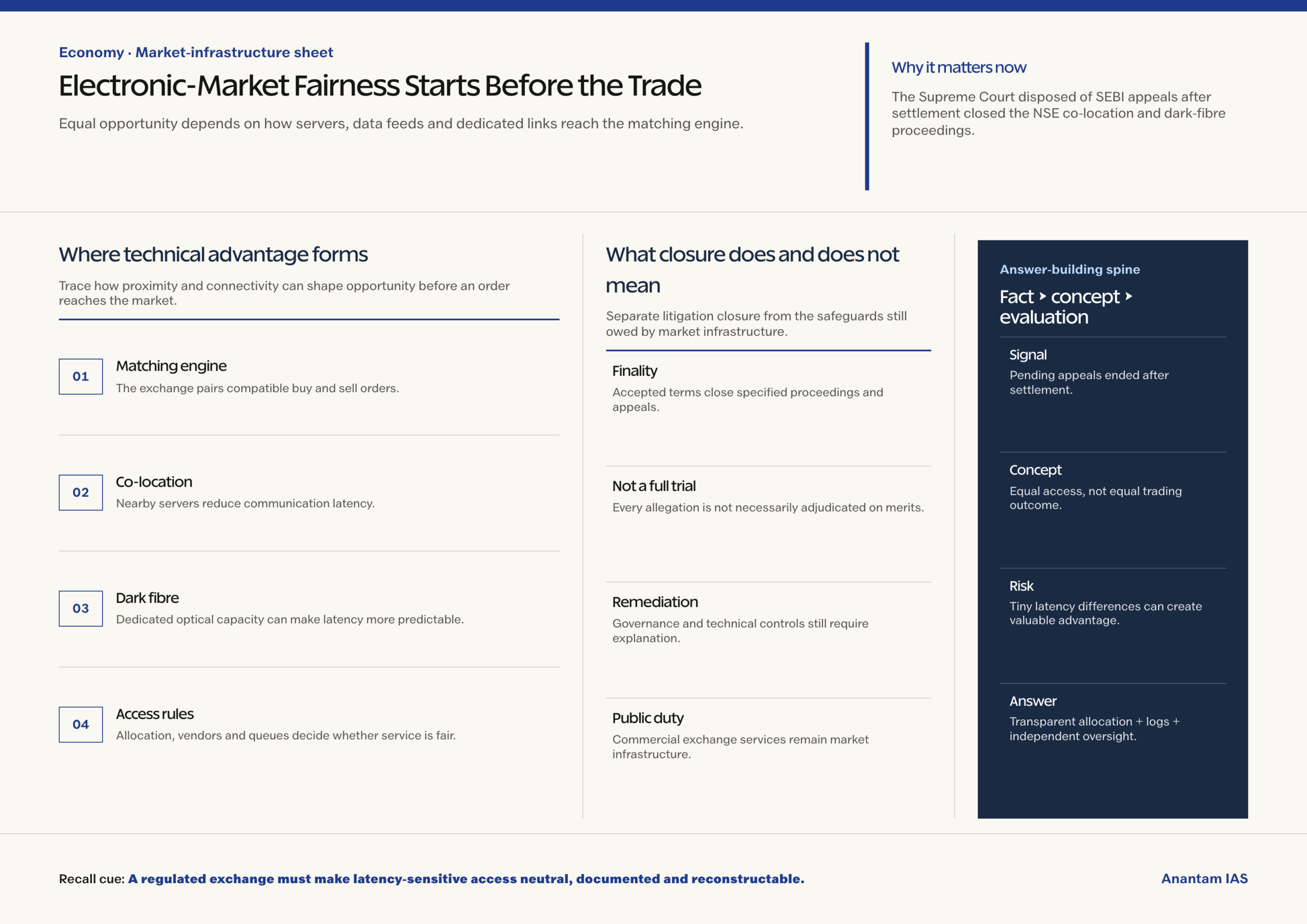
Background and Context
Why Co-Location Speed Matters
Electronic trading converts tiny differences in information arrival and order placement into potentially valuable competitive advantages.
- An exchange matching engine receives orders and applies market rules to pair compatible buy and sell instructions.
- Co-located servers sit physically closer to that engine, reducing network latency compared with systems connected from farther away.
- The service is not inherently improper when eligibility, queues, data feeds, racks and connectivity are offered through fair and transparent rules.
- The regulatory concern arises when some brokers receive earlier access, superior connections or operational information unavailable on equal terms.
- Even microsecond advantages can matter for automated strategies that react to price changes before slower participants receive the same market data.
How Dark Fibre Fits the Same Fairness Question
Dedicated connectivity can improve reliability and speed, but access conditions determine whether it strengthens infrastructure or privileges a few users.
- Dark fibre refers to optical strands not currently lit by the owner and available for another operator to equip and use.
- A dedicated link can offer lower and more predictable latency than a shared network, making its allocation commercially significant.
- Exchange governance should disclose approved vendors, connection standards, testing and availability so equivalent users can seek comparable service.
- Monitoring needs network logs and configuration records because unequal technical access may not appear in ordinary trade-price surveillance.
- The core principle is not equal trading outcomes; it is equal opportunity to access the exchange’s regulated infrastructure under published conditions.
What Settlement Resolves and Leaves Open
A settlement closes specified proceedings through accepted terms, but it is not identical to a court deciding every allegation after trial.
- SEBI had appealed tribunal decisions that set aside earlier disgorgement directions in the co-location and dark-fibre matters.
- The revised terms combined prior deposits and an additional payment to reach the accepted settlement amount disclosed by NSE.
- Once the regulator and exchange reported settlement, the Supreme Court no longer needed to decide the pending appeals on their merits.
- Settlement provides finality and reduces litigation cost, yet public confidence also depends on transparent reasons, remediation and future controls.
- The episode remains a governance lesson for exchanges whose commercial ambitions must remain subordinate to neutral market-infrastructure duties.
Why an Exchange Has Public-Infrastructure Duties
An exchange is commercially operated, yet its rules and systems organise price discovery for the entire securities market.
- Its matching engine, data feeds and access services affect investors beyond the immediate brokers who purchase high-speed infrastructure.
- Conflicts arise when revenue from premium access competes with the duty to keep allocation rules neutral, disclosed and consistently enforced.
- Board oversight and regulatory supervision must treat technology architecture as a market-conduct issue, not leave it solely to engineering teams.
Way Forward
Protect Equal Technical Access
- Publish objective allocation, queue, vendor and connectivity standards for every latency-sensitive exchange service.
- Retain auditable network, rack, login and data-feed records that allow independent reconstruction of access conditions.
- Explain settlement remediation and governance changes clearly enough to preserve deterrence and institutional trust.
- Separate listing or commercial pressures from regulatory decisions concerning the exchange’s public-infrastructure obligations.
Conclusion
- The case closure removes pending litigation, but its durable lesson is that electronic-market fairness begins with equal technical access to regulated infrastructure.
- A strong answer should explain latency, co-location and dark fibre, then distinguish settlement finality from a complete adjudication on merits.
UPSC Practice Questions
Prelims MCQ 1
With reference to securities-market infrastructure, consider the following statements:
- Co-location can reduce latency by placing servers near an exchange matching engine.
- Dark fibre is optical-fibre capacity that can be equipped for dedicated connectivity.
- The Securities Appellate Tribunal is part of the National Stock Exchange.
How many of the above statements are correct?
(a) Only one (b) Only two (c) All three (d) None
Answer: (b) Only two
Explanation:
Statements 1 and 2 are correct. SAT is a statutory appellate body, not part of NSE.
Prelims MCQ 2
What is the main purpose of disgorgement in market regulation?
(a) To deprive an entity of gains linked to wrongdoing (b) To guarantee investor returns (c) To create a stock exchange (d) To approve every settlement automatically
Answer: (a) To deprive an entity of gains linked to wrongdoing
Explanation:
Disgorgement is remedial and seeks to remove gains connected with unlawful conduct.
UPSC Mains Questions
- Why does equal technical access matter for the legitimacy of an electronic securities market? Explain using co-location and dark-fibre services.
- Regulatory settlement provides finality but is not equivalent to adjudication on merits. Discuss the accountability implications.
Sources: Moneycontrol / Reuters and National Stock Exchange.
Frequently Asked Questions
What is exchange co-location?
It is a service that places trading servers near an exchange’s matching engine to reduce communication latency.
What is dark fibre?
It is unused optical-fibre capacity that can be equipped and leased for dedicated, high-speed network connectivity.
Why did regulators examine these services?
The concern was whether some brokers received preferential speed or connectivity rather than fair access under transparent rules.
Did settlement decide every allegation?
No. Settlement closed specified proceedings on accepted terms; it is different from a final adjudication of every contested issue.
Tell Google you want more of this.
Add Anantam IAS as a preferred sourceOne tap, and this site shows up more often in your own Top Stories, AI Overviews and AI Mode. Remove it any time.