Why in News?
Tamil Nadu and Karnataka announced dedicated approaches to perimenopause and menopause care, bringing midlife women’s needs into routine public health services.
- Tamil Nadu announced screening, counselling and treatment through primary health centres and higher facilities.
- Karnataka introduced Ruthu Thare, a women’s health policy with a strong perimenopause and menopause focus.
- Both approaches envisage community outreach, well-women screening and referral to district hospitals or medical colleges.
- Women’s public health programmes have often concentrated on pregnancy and reproductive years while overlooking the longer midlife transition.
- Recognising symptoms within routine care can reduce stigma, delayed diagnosis and fragmented visits across physical and mental-health services.
UPSC Relevance
Prelims Relevance
- Menopause is confirmed after 12 consecutive months without menstruation when no other cause explains the change.
- Perimenopause is the transition before menopause and may extend across several years.
- Oestrogen and progesterone levels change as ovarian function declines.
- Primary health centres can provide first-contact screening, counselling and referral rather than every case requiring tertiary care.
- Menopause is a natural life stage, though symptoms may require clinical evaluation and treatment.
Mains Relevance
GS Paper 2
- Gender-responsive public health beyond reproductive care
- Primary-care integration and referral continuity
GS Paper 1
- Social stigma around women’s ageing
- Unpaid care, work and midlife health
Essay
- A health system becomes universal only when it recognises neglected life stages.
Background and Context
What the Midlife Transition Involves
Perimenopause is a variable transition, not a single event, and its symptoms differ widely in timing, intensity and duration.
- Menopause marks the permanent end of menstrual periods; perimenopause describes the preceding years of hormonal and cycle changes.
- Common experiences include hot flashes, sleep disruption, irregular periods, joint discomfort, fatigue and mood changes, but no single symptom defines every case.
- Symptoms can affect work, caregiving and mental well-being even when they are dismissed as a private or inevitable inconvenience.
- Clinical assessment matters because anaemia, thyroid disorders, depression and other conditions may overlap with symptoms attributed to the transition.
- Care ranges from accurate information and lifestyle support to symptom-specific medicines; treatment must reflect individual risks, preferences and clinical evaluation.
Why Primary-Care Integration Matters
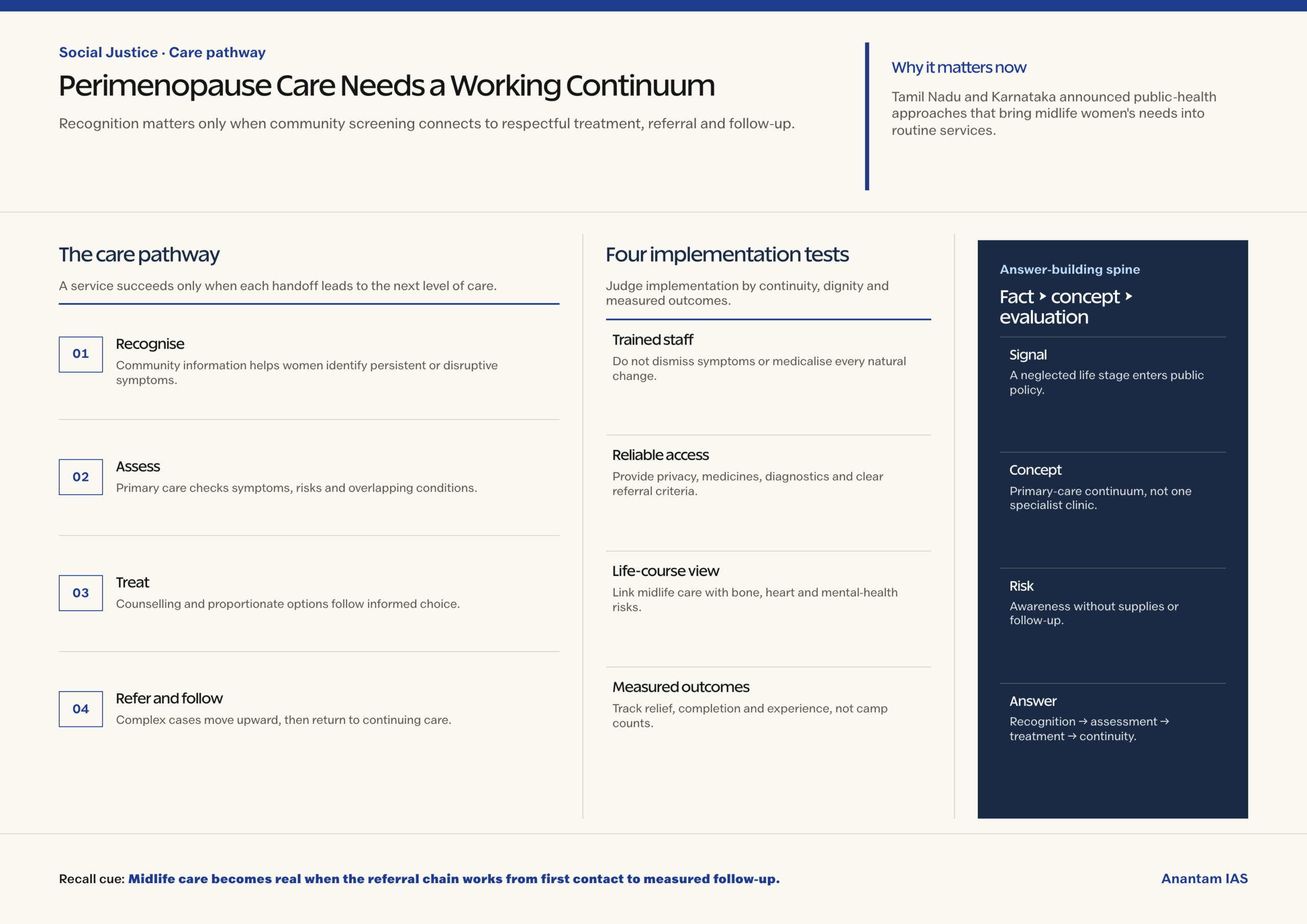
A public programme can make care reachable only when community recognition connects to a functioning clinical pathway.
- Community outreach can normalise discussion and help women recognise when persistent symptoms deserve assessment instead of silent endurance.
- Primary health centres can provide initial history, basic screening, counselling and follow-up close to home at lower cost.
- Clear referral criteria are needed for severe bleeding, complex mental-health needs, suspected cancer, osteoporosis risk or treatment contraindications.
- District hospitals and medical colleges should support rather than replace first-contact care through specialist advice, diagnostics and back-referral.
- Continuity matters because one awareness camp without records, medicines, trained staff and follow-up will not change access.
The Implementation Test
Policy recognition is valuable, but quality depends on training, informed choice, reliable supplies and respectful communication.
- Health workers need protocols that neither trivialise symptoms nor medicalise every natural change, preserving proportionate and evidence-based care.
- Counselling must explain benefits, limitations and risks of available treatments without presenting one therapy as suitable for every woman.
- Mental-health screening should connect to confidential support because sleep loss, anxiety and mood symptoms can reinforce each other.
- Programmes must reach rural women, informal workers and marginalised groups who may lack time, privacy, transport or specialist access.
- Monitoring should measure symptom relief, referral completion, follow-up and patient experience, not merely the number of camps or screenings.
Why a Life-Course Lens Changes Policy
A life-course approach links midlife symptoms with earlier health, present work and later risks instead of isolating one clinic visit.
- Nutrition, physical activity, reproductive history and chronic conditions shape midlife health, making prevention and longitudinal records useful before severe symptoms appear.
- Workplace flexibility and accurate information can reduce avoidable absence without forcing women to disclose private health details or accept stigma.
- Midlife visits offer a practical entry point for cardiovascular, bone, cancer and mental-health risk assessment when services remain coordinated and proportionate.
- Digital or paper records should follow the patient across facilities so repeat visits build continuity instead of restarting assessment each time.
Way Forward
Build a Continuum of Midlife Care
- Train primary-care teams with simple symptom, risk, referral and follow-up protocols linked to specialist support.
- Ensure private consultation, reliable medicines, diagnostics and mental-health pathways at each level of care.
- Use community communication to reduce stigma while making clear that severe or unusual symptoms need clinical evaluation.
- Track outcomes and patient experience across age, location and social group to detect who remains outside the programme.
Conclusion
- Bringing perimenopause into routine care corrects a gendered blind spot between maternal health programmes and old-age services.
- A strong answer should treat the policy as a continuum of care: recognition, first-contact assessment, informed treatment, referral and measured follow-up.
UPSC Practice Questions
Prelims MCQ 1
With reference to menopause, consider the following statements:
- It is confirmed after 12 consecutive months without menstruation when no other cause explains it.
- Perimenopause always lasts exactly one year.
- Symptoms may require assessment even though menopause is a natural transition.
How many of the above statements are correct?
(a) Only one (b) Only two (c) All three (d) None
Answer: (b) Only two
Explanation:
Statements 1 and 3 are correct. The duration of perimenopause varies considerably.
Prelims MCQ 2
Which is the most appropriate role for a primary health centre in perimenopause care?
(a) Replace every specialist service (b) Provide screening, counselling, basic management and referral (c) Restrict care to reproductive-age women (d) Treat every symptom with one standard medicine
Answer: (b) Provide screening, counselling, basic management and referral
Explanation:
Primary care should act as the accessible first contact within a referral-linked continuum.
UPSC Mains Questions
- Why has midlife women’s health remained a blind spot in public health policy? Evaluate the promise of primary-care-based perimenopause services.
- Policy announcements do not by themselves create a continuum of care. Discuss with reference to screening, referral and follow-up.
Sources: The Hindu and World Health Organization.
Frequently Asked Questions
What is perimenopause?
It is the transition leading to menopause, when hormonal and menstrual changes may occur over several years.
Is menopause a disease?
No. It is a natural life stage, though disruptive symptoms and overlapping medical conditions may need assessment and treatment.
What can primary health centres provide?
They can offer first-contact screening, counselling, basic symptom management, follow-up and referral for complex or high-risk cases.
How should implementation be measured?
Useful measures include symptom improvement, referral completion, continuity, medicine availability and patient experience, disaggregated by social and geographic access.
Tell Google you want more of this.
Add Anantam IAS as a preferred sourceOne tap, and this site shows up more often in your own Top Stories, AI Overviews and AI Mode. Remove it any time.