Why in News?
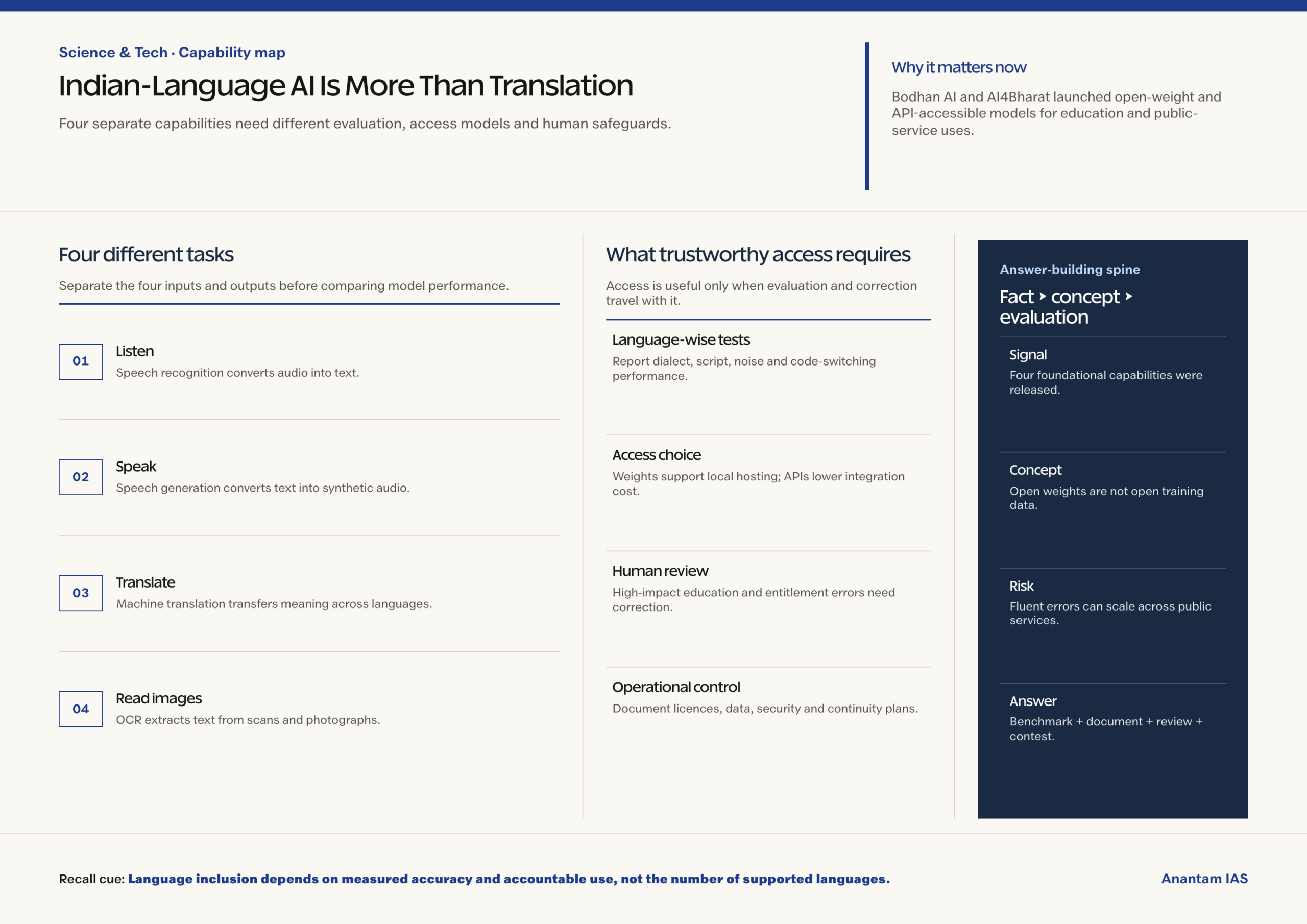
Bodhan AI and AI4Bharat launched four foundational Indian-language AI model capabilities for use through open-weight releases and hosted application programming interfaces.
- The suite covers speech recognition, speech generation, machine translation and optical character recognition.
- Bodhan AI is an IIT Madras-incubated Centre of Excellence in AI for Education supported by the Union Education Ministry.
- Open weights and hosted APIs offer different access routes for institutions with different technical capacity.
- Language technology can lower access barriers where public information, classrooms and digital services remain dominated by English.
- Sovereign deployment claims must still be tested through data governance, benchmark transparency, security and performance across language varieties.
UPSC Relevance
Prelims Relevance
- Automatic speech recognition converts spoken audio into text.
- Speech generation converts text or linguistic representation into synthetic audio.
- Machine translation converts content between languages, while optical character recognition extracts text from images or scans.
- Open-weight access exposes trained model parameters under stated licence conditions; it does not necessarily disclose training data or code.
- An API lets another application request model outputs without hosting the model itself.
Mains Relevance
GS Paper 3
- Public digital infrastructure for multilingual AI
- Open models, capability access and technological self-reliance
GS Paper 2
- Language inclusion in education and public services
- Accountability for automated translation and transcription
Essay
- Digital inclusion depends on whose language a system can understand accurately.
Background and Context
Four Capabilities, Four Different Tasks
Calling every language system a chatbot hides the distinct inputs, outputs and failure modes of the released capabilities.
- Speech recognition maps audio to text and must handle accent, code-switching, background noise and domain-specific vocabulary.
- Speech generation produces audio from text; intelligibility, naturalness, pronunciation and safe voice use matter alongside raw language coverage.
- Machine translation transfers meaning across languages, where literal word substitution can lose context, register, idiom or official terminology.
- Optical character recognition extracts text from printed or scanned material and must cope with script shapes, layout, blur and mixed-language pages.
- Combining these tools can support lecture transcription, accessible reading, translated notices and searchable archives, but errors can compound across stages.
Open Weights and Hosted APIs Solve Different Problems
The access model determines who can inspect, adapt, host and govern a foundational model in practice.
- Open weights allow capable institutions to run or fine-tune a model locally, subject to licence terms, infrastructure and security controls.
- Weights alone do not reveal the training corpus, data-cleaning choices, evaluation set or every risk embedded during model development.
- Hosted APIs lower the entry barrier for smaller education-technology firms because they avoid maintaining expensive inference infrastructure.
- API dependence can create recurring cost, service continuity and vendor-control risks when essential public functions rely on one hosted endpoint.
- A mixed route can support local sovereign deployment for sensitive workloads and API access where convenience and rapid integration matter more.
The Inclusion Claim Needs Evidence
Language coverage is meaningful only when systems work for real speakers, scripts, subjects and public-service consequences.
- Benchmarks should report performance separately by language, dialect, gender, age, audio condition and task instead of one national average.
- Education use requires subject accuracy and age-appropriate expression because fluent mistranslation can teach a misconception with high confidence.
- Public-service deployment needs human review where an error could affect entitlement, examination, health guidance, grievance handling or legal rights.
- Training and evaluation data need lawful collection, representative coverage, documentation and safeguards against exposing personal or copyrighted material.
- Feedback systems should let users contest errors and improve terminology without turning marginalised speakers into unpaid data cleaners.
Sovereign Infrastructure Is More Than Hosting
Running a model on domestic infrastructure can improve control, but sovereignty also depends on knowledge, data and operational independence.
- Institutions need skilled teams, documented models, secure compute and the ability to maintain systems after a grant or vendor contract ends.
- Domestic hosting does not cure biased training data, weak evaluation or opaque licence restrictions that limit adaptation and public scrutiny.
- Procurement should avoid permanent lock-in by requiring exportable data, clear interfaces, service continuity plans and measurable language-wise performance.
- Public funding can also support shared evaluation sets so competing systems are compared under consistent, openly documented conditions.
Way Forward
Build Accountable Language Infrastructure
- Publish language-wise benchmarks, model cards, licence terms and known limitations for every capability.
- Provide human review and correction routes for high-impact education and government uses.
- Support local hosting where privacy, continuity or sovereignty outweighs the convenience of a hosted API.
- Test dialects, code-switching and low-resource scripts with representative communities before scaling deployment.
Conclusion
- The launch expands access to foundational Indian-language AI, but open availability is only the first layer of public value.
- A strong answer should separate the four technical tasks, compare weights with APIs, and test inclusion through transparent language-wise performance and human accountability.
UPSC Practice Questions
Prelims MCQ 1
With reference to language AI, consider the following statements:
- Optical character recognition extracts text from images or scans.
- Automatic speech recognition converts audio into text.
- Open weights necessarily disclose the complete training dataset.
How many of the above statements are correct?
(a) Only one (b) Only two (c) All three (d) None
Answer: (b) Only two
Explanation:
Statements 1 and 2 are correct. Open-weight release does not automatically disclose the full training dataset.
Prelims MCQ 2
What is the main function of an application programming interface for a hosted AI model?
(a) It lets another application request model outputs (b) It guarantees error-free translation (c) It reveals all training data (d) It removes computing costs
Answer: (a) It lets another application request model outputs
Explanation:
An API provides a defined route for software to send inputs and receive outputs from a hosted service.
UPSC Mains Questions
- Open-weight models and hosted APIs create different forms of technological access. Discuss with reference to Indian-language AI.
- What safeguards are necessary when multilingual AI is deployed in education and public-service delivery?
Sources: The Hindu and AI4Bharat.
Frequently Asked Questions
What four capabilities were launched?
The suite covers speech recognition, speech generation, machine translation and optical character recognition for Indian-language applications.
What does open-weight mean?
It means trained model parameters are available under stated licence conditions; it does not automatically expose the training corpus or full source code.
Why offer hosted APIs?
APIs let institutions integrate model capabilities without maintaining their own inference infrastructure, though they create cost and dependency trade-offs.
What is the main public-service risk?
A fluent but wrong output can affect learning or entitlements, so high-impact uses need language-wise testing, documentation and human review.
Tell Google you want more of this.
Add Anantam IAS as a preferred sourceOne tap, and this site shows up more often in your own Top Stories, AI Overviews and AI Mode. Remove it any time.