Why in News?
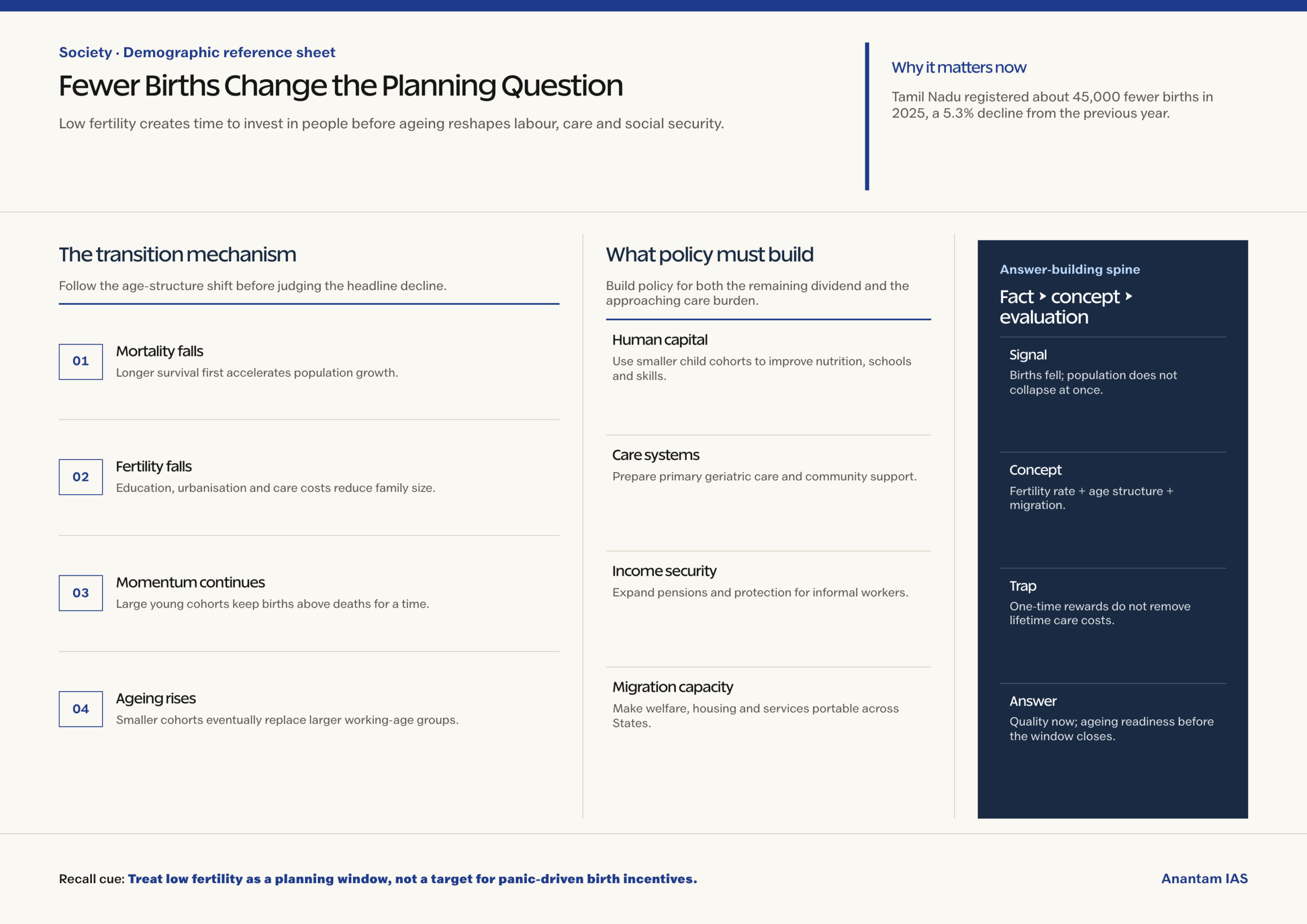
Tamil Nadu recorded about 45,000 fewer births in 2025 than in 2024, renewing debate about low fertility, population momentum and ageing.
- Registered births fell from 8.47 lakh in 2024 to 8.02 lakh in 2025.
- The decline was about 5.3%, according to Civil Registration System data cited by The Hindu.
- Experts urged investment in education, childcare, social security and elderly care instead of panic-driven pronatalist incentives.
- Falling births can improve per-child investment before they tighten the future labour supply.
- Ageing changes the dependency burden from child support toward pensions, chronic care and community-based elder services.
UPSC Relevance
Prelims Relevance
- Total fertility rate measures the average number of children expected per woman under prevailing age-specific fertility rates.
- Replacement-level fertility is commonly approximated at 2.1 births per woman, though the exact level varies with mortality.
- Population momentum allows growth to continue after fertility falls because large younger cohorts enter reproductive ages.
- The Civil Registration System records births and deaths continuously; it differs from the decennial Census.
- Ageing raises the old-age dependency ratio when older cohorts grow relative to the working-age population.
Mains Relevance
GS Paper 1
- Demographic transition and regional population divergence
- Ageing, migration and changing family structures
GS Paper 2
- Social-security and care-system readiness
- Human-capital investment under low fertility
Essay
- Demography creates a window for policy, not a mechanical destiny.
Background and Context
How Demographic Transition Changes Population Growth
Birth decline is one stage in a longer shift from high mortality and fertility toward longer lives and smaller families.
- In the early transition, mortality falls first while births remain high, creating rapid population growth and a young age structure.
- Fertility later falls with urbanisation, female education, contraception, lower infant mortality and rising costs of raising children.
- Growth may continue for decades because population momentum depends on the age structure, not only the current fertility rate.
- Once smaller cohorts replace larger ones, natural increase slows and may turn negative unless migration offsets the decline.
- Tamil Nadu entered below-replacement fertility earlier than many States, so its age-structure effects appear sooner in public policy.
The Dividend Can Become an Ageing Burden
Low fertility can create gains, but only when institutions convert a favourable age structure into productive and secure lives.
- A smaller child cohort can permit higher spending per child on nutrition, schooling, health and skills without increasing total budgets proportionately.
- The demographic dividend is realised only when working-age people find productive employment; a large labour force without jobs can deepen insecurity.
- Longer life expectancy expands demand for geriatric care, chronic-disease management, accessible housing and reliable income after retirement.
- Women often provide unpaid elder care while remaining in paid work, making care infrastructure a labour-force and gender-equality issue.
- Inter-State migration may replenish workers, but it also requires portable welfare, rental housing, language inclusion and protection from discrimination.
Why Birth Incentives Alone Rarely Reverse Fertility
A financial reward at childbirth does not remove the long-term constraints that shape couples’ decisions about family size.
- Delayed marriage, insecure employment, housing costs and unequal care work influence fertility more persistently than a one-time transfer or gift.
- Pronatalist schemes can pressure women while treating reproduction as a numerical target instead of protecting autonomy, health and economic opportunity.
- Affordable crèches, predictable work, parental leave and quality schools reduce the continuing cost of care more directly than symbolic incentives.
- Policy must distinguish fewer births from immediate population collapse; age structure makes demographic change gradual and gives governments planning time.
- The central test is whether a low-fertility State improves life across generations while building pensions, health care and community support before ageing accelerates.
Why Regional Divergence Matters for India
India’s demographic transition is uneven, so one national population narrative can conceal opposite planning needs across States.
- Earlier-transition States need ageing, care and workforce strategies while younger States still require rapid expansion of education, health and employment capacity.
- Fiscal transfers and political representation become sensitive when population control, current need and historical performance point toward different allocation principles.
- Migration can connect young workers with ageing labour markets, but only if housing, welfare portability, language services and social acceptance develop together.
Way Forward
Plan for Quality and Care
- Publish age-structured projections alongside birth registrations so policy responds to cohorts rather than one year’s headline decline.
- Expand childcare, school quality, women’s employment support and migrant-worker portability while the working-age window remains open.
- Build primary geriatric care, long-term-care standards, pension coverage and community services before family care capacity contracts.
- Evaluate fertility incentives against autonomy, cost, duration and evidence instead of assuming every additional subsidy changes lifetime decisions.
Conclusion
- Tamil Nadu’s falling births mark a mature demographic transition, not an emergency that can be solved by rewarding childbirth.
- A strong answer should connect population momentum with the closing demographic-dividend window, then prioritise human capital, migration governance and ageing-ready social protection.
UPSC Practice Questions
Prelims MCQ 1
With reference to population momentum, consider the following statements:
- Population can continue growing after fertility falls below replacement level.
- It is influenced by the age structure of the population.
- It is identical to the rate of natural increase.
How many of the above statements are correct?
(a) Only one (b) Only two (c) All three (d) None
Answer: (b) Only two
Explanation:
Statements 1 and 2 are correct. Population momentum reflects age structure; natural increase is the difference between births and deaths.
Prelims MCQ 2
Which institution operates India’s continuous system for registering births and deaths?
(a) Finance Commission (b) Civil Registration System (c) National Sample Survey (d) Inter-State Council
Answer: (b) Civil Registration System
Explanation:
The Civil Registration System continuously records vital events, unlike the periodic Census.
UPSC Mains Questions
- Falling fertility is a planning opportunity before it becomes an ageing challenge. Discuss with reference to India’s regional demographic divergence.
- Why do one-time birth incentives have limited power to reverse low fertility? Suggest a rights-based social-policy response.
Sources: The Hindu and Civil Registration System.
Frequently Asked Questions
What is replacement-level fertility?
It is the fertility level at which a population replaces itself across generations without migration, commonly approximated at 2.1 births per woman.
What is population momentum?
It is continued population growth after fertility declines because a large cohort of young people is still entering reproductive ages.
Does fewer births mean immediate population decline?
No. The outcome depends on deaths, migration and age structure, so population can keep growing or remain stable for years.
What should low-fertility States prioritise?
They should invest in child quality, productive employment, migrant inclusion, pensions, geriatric care and support for unpaid caregivers.
Tell Google you want more of this.
Add Anantam IAS as a preferred sourceOne tap, and this site shows up more often in your own Top Stories, AI Overviews and AI Mode. Remove it any time.