Why in News?
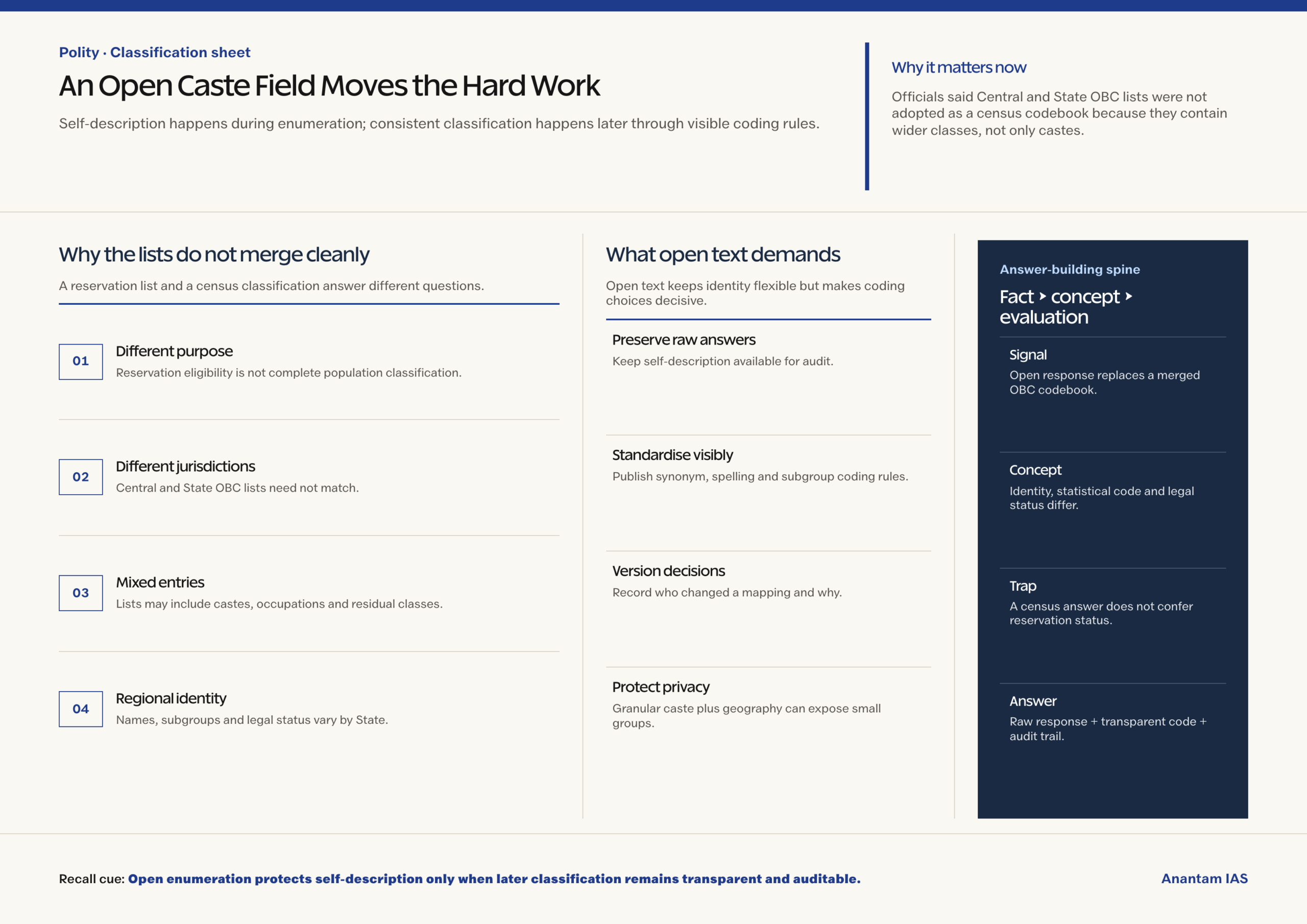
Officials said Census 2027 will not use Central and State OBC lists as its caste codebook because those lists contain classes beyond identifiable castes.
- Scheduled Caste and Scheduled Tribe entries can be anchored to constitutionally notified lists.
- Other respondents will use an open caste column rather than select from merged OBC lists.
- The design shifts the hardest task from field selection to post-enumeration classification and standardisation.
- Reservation lists are designed to identify eligible backward classes, not to serve automatically as a national classification of every caste.
- Open text captures self-identification but can create spelling, synonym, sub-caste, title and language variants that complicate aggregation.
UPSC Relevance
Prelims Relevance
- Census is a Union subject under Entry 69 of the Union List.
- Scheduled Castes and Scheduled Tribes are specified through Presidential notifications under Articles 341 and 342.
- The National Commission for Backward Classes has constitutional status under Article 338B.
- Central and State OBC lists may differ because reservation administration operates across different jurisdictions.
- An open-ended response records self-description first and requires later coding into consistent analytical categories.
Mains Relevance
GS Paper 2
- Census design, social justice and data legitimacy
- Difference between caste, class and reservation eligibility
GS Paper 1
- Complexity of caste identities across regions and languages
- Enumeration and the social construction of categories
Essay
- The categories a State counts shape what it can see, compare and remedy.
Background and Context
Why OBC Lists Are Not a Ready Caste Codebook
A reservation list answers who is eligible under a legal policy; a census codebook must classify population responses consistently.
- OBC lists may contain castes, communities, occupational groups, residual labels and locally defined classes created for affirmative-action administration.
- The Central list and each State list can differ because eligibility is assessed for different institutions, jurisdictions and social contexts.
- A single community name may have variants, subgroups or different status across States, preventing simple national merging without contested judgments.
- Treating every listed class as one caste would convert an administrative eligibility category into a demographic identity without sufficient basis.
- SC and ST enumeration differs because Articles 341 and 342 create State-specific notified lists that provide a formal identification anchor.
What an Open Column Gains and Loses
Open response respects self-identification and local vocabulary, but transfers complexity into coding, cleaning and publication.
- Respondents can state a caste name without being forced into a preselected list that omits or misclassifies their identity.
- The same group may appear under alternate spellings, honorifics, surnames, sub-castes, translations or broad community labels.
- Enumerators may record phonetically or influence wording, creating geographic variation that reflects field practice as well as real identity.
- Coders must decide when two labels are synonyms and when they represent distinct groups, a choice with political and statistical consequences.
- Transparent coding rules, audit trails and a residual category are needed so cleaning does not silently erase small or contested communities.
The Data-Quality and Legitimacy Test
Reliable caste data needs consistent field capture, defensible classification and clear separation from automatic entitlement decisions.
- Training must distinguish caste response from religion, occupation, surname and reservation category without asking enumerators to adjudicate identity.
- Multilingual reference tools can reduce spelling variation while preserving the respondent’s original answer for later review and correction.
- Pilot coding should test ambiguous, composite and region-specific responses before the national exercise fixes its classification protocol.
- Publication should explain suppression, aggregation and uncertainty so users do not mistake a cleaned table for a perfect social map.
- Census results can inform policy, but inclusion in a count does not by itself create OBC, SC or ST legal status.
Why Original Responses Must Be Preserved
Standardisation creates useful tables, but preserving the uncoded response keeps classification decisions open to audit and later correction.
- Without the original text, researchers cannot detect whether a published category combines distinct identities or splits synonyms across several codes.
- Versioned coding dictionaries can record who changed a mapping, why it changed and which published aggregates were affected.
- Privacy safeguards remain essential because granular caste responses combined with geography can expose small communities even after names are removed.
Way Forward
Make Coding Transparent
- Preserve original responses alongside standardised codes and publish the rules used to merge or separate labels.
- Pilot multilingual coding with independent demographic, sociological and statistical review before nationwide tabulation.
- Create audit and appeal mechanisms for systematic classification errors without letting political bargaining rewrite raw records.
- Explain clearly that demographic enumeration and statutory reservation recognition are related but legally distinct processes.
Conclusion
- The open-column method avoids forcing reservation lists into a job they were not designed to perform, but it makes post-enumeration coding decisive.
- A strong answer should distinguish self-identification, statistical classification and legal status, then demand transparent rules and preserved raw responses.
UPSC Practice Questions
Prelims MCQ 1
With reference to social-group enumeration in India, consider the following statements:
- Census is a Union List subject.
- Scheduled Castes are specified under Article 341.
- Inclusion in a census response automatically creates OBC legal status.
How many of the above statements are correct?
(a) Only one (b) Only two (c) All three (d) None
Answer: (b) Only two
Explanation:
Statements 1 and 2 are correct. Census self-identification does not automatically confer reservation status.
Prelims MCQ 2
What is the main statistical challenge of an open caste column?
(a) It prevents self-identification (b) It creates varied labels requiring defensible standardisation (c) It abolishes State OBC lists (d) It transfers Census to the State List
Answer: (b) It creates varied labels requiring defensible standardisation
Explanation:
Open text captures local identity but produces spelling, synonym and subgroup variation that must be coded transparently.
UPSC Mains Questions
- Why can Central and State OBC lists not be adopted mechanically as a national caste codebook for Census 2027?
- An open response protects self-identification but complicates statistical comparability. Suggest safeguards for caste-data coding and publication.
Sources: ChennaiOnline and DD News.
Frequently Asked Questions
Why were OBC lists not used directly?
They contain different State and Central classes, including occupational or residual groups, and were designed for reservation administration rather than complete population classification.
What is an open caste column?
It lets respondents state their caste in their own words instead of choosing from a fixed national list.
What problem does open text create?
Alternate spellings, synonyms, titles, sub-castes and language variants require transparent post-enumeration standardisation.
Does a census entry confer reservation status?
No. Demographic recording and legal recognition under OBC, SC or ST frameworks are distinct processes governed by separate rules.
Tell Google you want more of this.
Add Anantam IAS as a preferred sourceOne tap, and this site shows up more often in your own Top Stories, AI Overviews and AI Mode. Remove it any time.