Indus Waters Treaty 1960 — River Allocation, Provisions, Tensions & UPSC Guide
Complete guide to the Indus Waters Treaty 1960 covering river allocation between India and Pakistan, World Bank mediation, key provisions, recent tensions, and UPSC relevance.
The Indus Waters Treaty (IWT) of 1960 is one of the most enduring bilateral agreements in the history of international diplomacy. Signed between India and Pakistan with the World Bank as a mediator, this treaty has governed the sharing of the waters of the Indus River system for over six decades — surviving wars, crises, and periods of near-total breakdown in bilateral relations. For UPSC aspirants, the IWT is a critical topic spanning International Relations (GS Paper II), Geography (GS Paper I), and Environment (GS Paper III).
Note on terminology: The commonly searched term "Indus Valley Treaty" refers to the Indus Waters Treaty. The Indus Valley is a geographical and historical term associated with the Indus Valley Civilisation; the treaty concerns water-sharing.
Background
After the Partition of India in 1947, the Indus River system — which originates in Tibet (China) and flows through India and Pakistan before draining into the Arabian Sea — became a source of dispute. The partition divided the river basin between two hostile states, with critical canals and headworks falling on different sides of the border.
The immediate crisis:
- The headworks (control structures) of the Upper Bari Doab Canal and other canals that irrigated vast tracts of West Punjab (now in Pakistan) were located in East Punjab (India).
- In April 1948, India temporarily stopped water flow from these headworks, causing a water crisis in Pakistan. Though the flow was restored quickly, this episode made clear that a formal water-sharing agreement was essential.
World Bank mediation:
- In 1951, the World Bank (International Bank for Reconstruction and Development) offered to mediate.
- After nine years of negotiations (1951-1960), the treaty was finalised.
Signing of the Treaty
The Indus Waters Treaty was signed on 19 September 1960 in Karachi by:
- Jawaharlal Nehru (Prime Minister of India)
- Ayub Khan (President of Pakistan)
- W.A.B. Iliff (Vice President of the World Bank, representing the Bank)
The treaty was accompanied by a financial package: the Indus Basin Development Fund, to which the World Bank, the US, UK, Canada, Germany, Australia, and New Zealand contributed, helping Pakistan build replacement infrastructure (dams, canals, link canals) to compensate for the loss of eastern river waters.
River Allocation
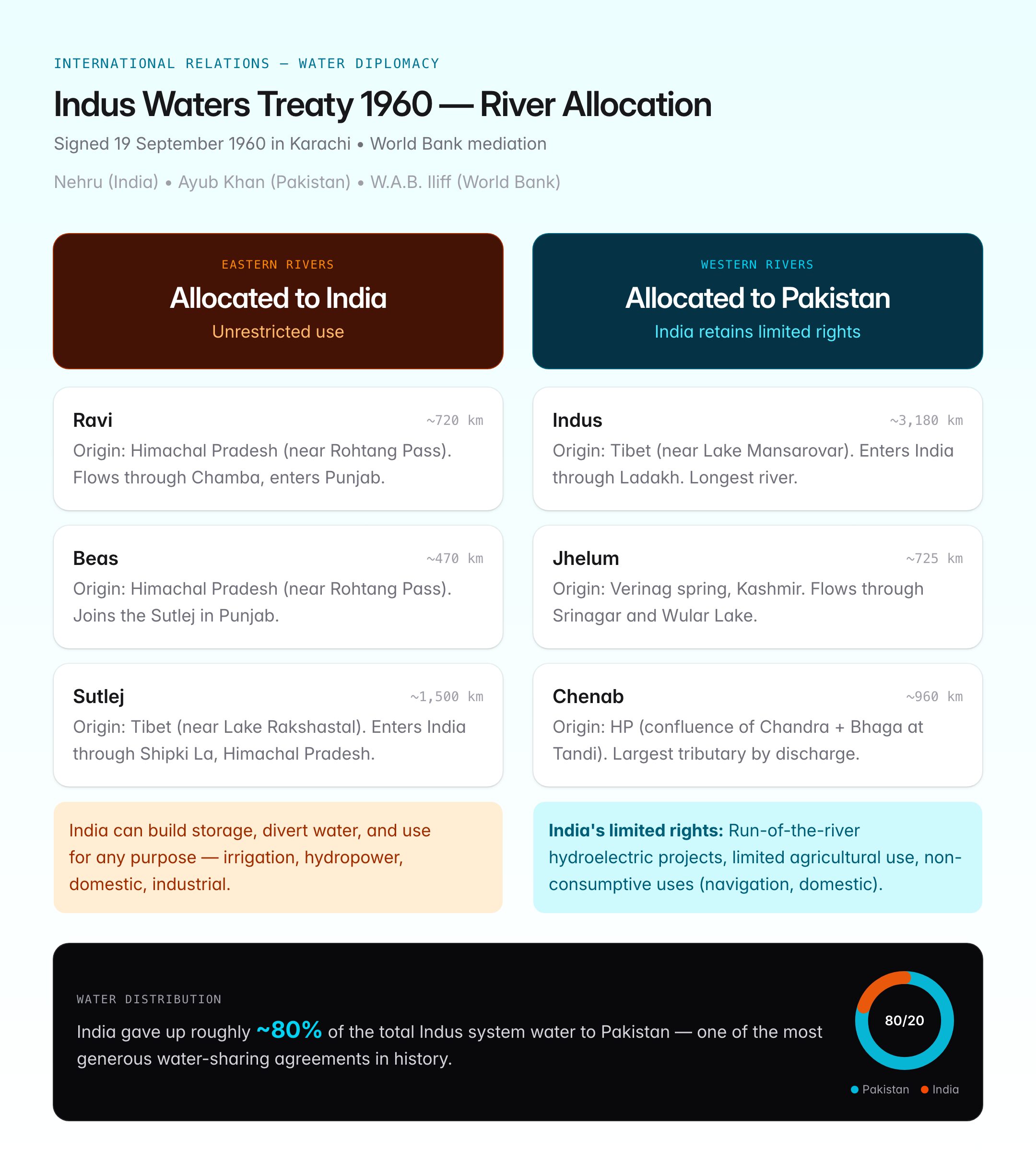
The core of the treaty is the division of the six rivers of the Indus system between India and Pakistan.
The Six Rivers
| Category | Rivers | Allocated To |
|---|---|---|
| Eastern Rivers | Ravi, Beas, Sutlej | India |
| Western Rivers | Indus, Jhelum, Chenab | Pakistan |
Key Terms of Allocation
Eastern Rivers (India):
- India has unrestricted use of the waters of the Ravi, Beas, and Sutlej.
- India can build storage, divert water, and use these rivers for any purpose — irrigation, hydropower, domestic, industrial.
Western Rivers (Pakistan):
- Pakistan has unrestricted use of the waters of the Indus, Jhelum, and Chenab.
- However, India retains limited rights on the western rivers, including:
- Run-of-the-river hydroelectric projects (where water is used to generate power but not stored in large reservoirs — the water flows through the turbines and returns to the river).
- Limited agricultural use (specified acreage for irrigation).
- Non-consumptive uses such as navigation and domestic purposes.
Critical point for UPSC: India gave up roughly 80% of the total water of the Indus system to Pakistan under this treaty — one of the most generous water-sharing agreements in history. The western rivers carry significantly more water than the eastern rivers.
River Details
| River | Origin | Length (approx.) | Notes |
|---|---|---|---|
| Indus | Tibet (near Lake Mansarovar) | 3,180 km | Longest river; enters India through Ladakh |
| Jhelum | Verinag spring, Kashmir | 725 km | Flows through Srinagar, Wular Lake |
| Chenab | Himachal Pradesh (confluence of Chandra and Bhaga rivers at Tandi) | 960 km | Largest tributary by discharge |
| Ravi | Himachal Pradesh (near Rohtang Pass) | 720 km | Flows through Chamba, enters Punjab |
| Beas | Himachal Pradesh (near Rohtang Pass) | 470 km | Joins the Sutlej in Punjab |
| Sutlej | Tibet (near Lake Rakshastal) | 1,500 km | Enters India through Shipki La in Himachal Pradesh |
Key Provisions of the Treaty
Dispute Resolution Mechanism
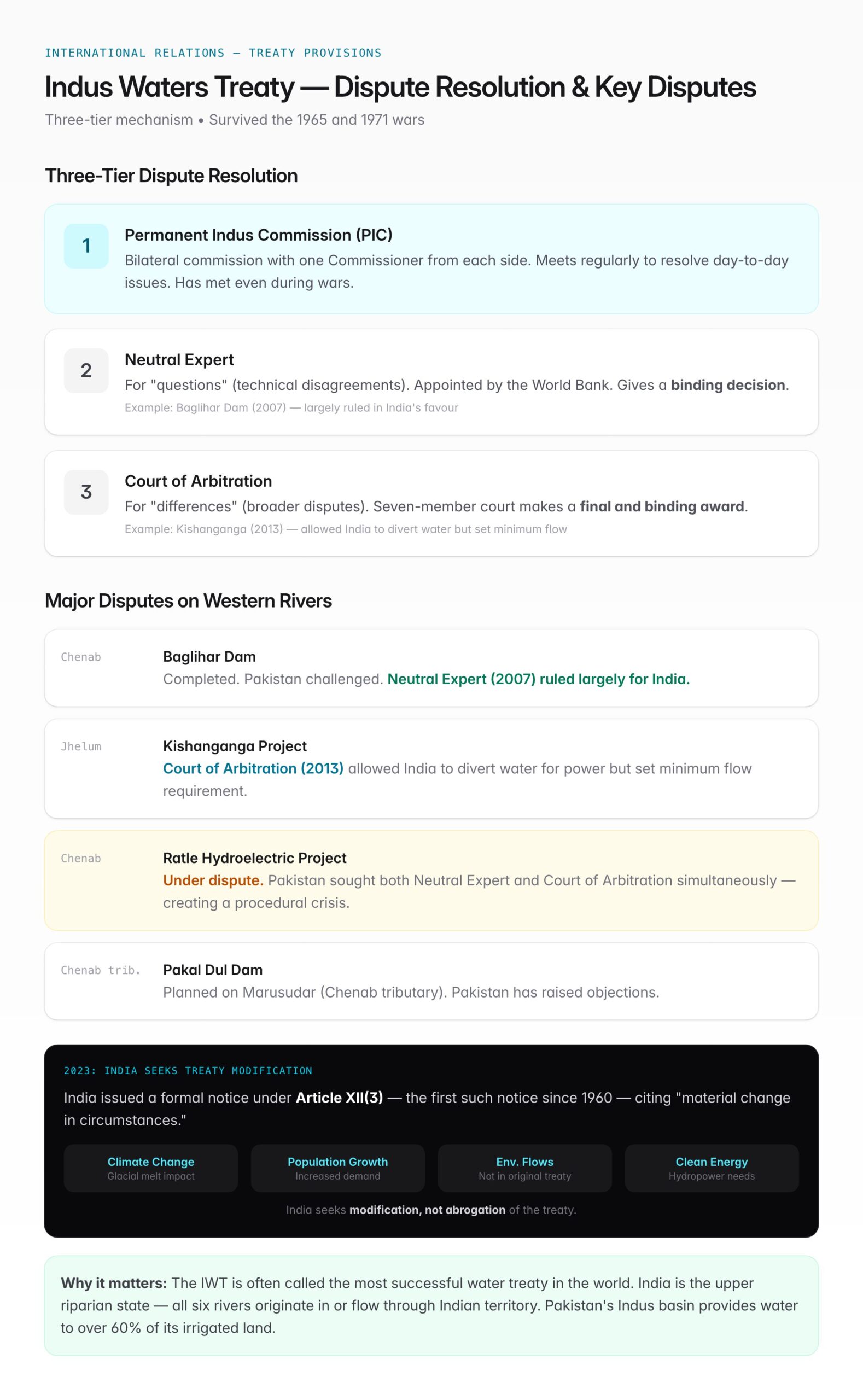
The treaty provides a three-tier dispute resolution mechanism:
| Tier | Mechanism | Description |
|---|---|---|
| Tier 1 | Permanent Indus Commission (PIC) | A bilateral commission with one Commissioner from each side; meets regularly to resolve day-to-day issues |
| Tier 2 | Neutral Expert | For "questions" (technical disagreements) — a neutral expert appointed by the World Bank gives a binding decision |
| Tier 3 | Court of Arbitration | For "differences" (broader disputes) — a seven-member Court of Arbitration makes a final and binding award |
The Permanent Indus Commission has met regularly since 1960, even during the 1965 and 1971 India-Pakistan wars. This is often cited as evidence of the treaty's robustness.
Transition Period
The treaty provided a 10-year transition period (1960-1970) during which India continued to supply water to Pakistan from the eastern rivers while Pakistan built replacement canals and dams. This period was funded by the Indus Basin Development Fund.
Data Sharing
Both countries are required to exchange hydrological data (river flow data, precipitation data) on a regular basis. This provision ensures transparency and enables monitoring of compliance.
Major Projects and Disputes
India's Projects on Western Rivers
India has built or planned several run-of-the-river hydroelectric projects on the western rivers, which have been contested by Pakistan:
| Project | River | State | Status/Dispute |
|---|---|---|---|
| Baglihar Dam | Chenab | Jammu & Kashmir | Completed; Pakistan challenged it. Neutral Expert (2007) largely ruled in India's favour |
| Kishanganga (Neelum) Project | Jhelum (Kishanganga tributary) | Jammu & Kashmir | Court of Arbitration (2013) allowed India to divert water for power generation but set a minimum flow requirement |
| Ratle Hydroelectric Project | Chenab | Jammu & Kashmir | Under dispute; Pakistan requested both a Neutral Expert and a Court of Arbitration simultaneously, creating a procedural crisis |
| Pakal Dul Dam | Marusudar (Chenab tributary) | Jammu & Kashmir | Planned; Pakistan has raised objections |
The 2023-2024 Crisis: Dual Proceedings
In a major development, Pakistan simultaneously sought a Neutral Expert and a Court of Arbitration for the Kishanganga and Ratle disputes. India objected, arguing that the same dispute cannot be referred to two different mechanisms. The World Bank, after initially pausing both processes (2016), eventually appointed both a Neutral Expert and a Court of Arbitration, which India contested as a violation of the treaty.
In 2023, India issued a formal notice to Pakistan seeking modification of the Indus Waters Treaty under Article XII(3), citing a "material change in circumstances" — the first such notice since the treaty's signing. India argued that the treaty, negotiated in the 1950s, did not account for:
- Climate change and its impact on glacial melt and river flows.
- Population growth and increased water demand.
- Environmental flow requirements.
- The need for clean energy (hydropower).
This notice opened a new phase in the treaty's history and is a potential Mains question topic.
India's Position: Modification, Not Abrogation
India has consistently maintained that it does not seek to abrogate (cancel) the Indus Waters Treaty but rather to modify it to reflect contemporary realities. The distinction is important:
- Abrogation would end the treaty entirely, creating legal and diplomatic chaos.
- Modification (under Article XII) allows the parties to renegotiate specific provisions by mutual agreement.
India's leverage comes from the fact that it is the upper riparian state — all six rivers originate in or flow through Indian territory before reaching Pakistan.
Strategic and Geopolitical Significance
- The IWT is often called the most successful water treaty in the world, having survived multiple wars and crises.
- It is cited in international law as a model for transboundary water management.
- The treaty gives India limited leverage over Pakistan, which depends heavily on the Indus system for agriculture (Pakistan's Indus basin provides water to over 60% of its irrigated land).
- China factor: The Indus originates in Tibet, and China's upstream activities (dams, diversions) could affect the entire treaty framework — a dimension not addressed in the 1960 treaty.
UPSC Relevance
GS Paper Mapping:
- Prelims: River allocation (eastern/western), signing year, signatories, World Bank role, dispute resolution mechanism.
- GS Paper I (Mains): Geography — Indus river system, transboundary rivers.
- GS Paper II (Mains): India-Pakistan relations, bilateral agreements, international mediation.
- GS Paper III (Mains): Water resources, conservation, climate change impact on rivers.
- Essay: Water diplomacy, climate change and international treaties, India-Pakistan relations.
Key Prelims Facts:
- The Indus Waters Treaty was signed on 19 September 1960 in Karachi by Nehru and Ayub Khan, with World Bank mediation.
- Eastern rivers (Ravi, Beas, Sutlej) were allocated to India; western rivers (Indus, Jhelum, Chenab) to Pakistan.
- India has limited rights on western rivers, including run-of-the-river hydroelectric projects.
- India gave up approximately 80% of the total Indus system water to Pakistan.
- The Permanent Indus Commission is the first tier of dispute resolution.
- The Baglihar Dam dispute was resolved by a Neutral Expert in 2007.
- The Kishanganga dispute was decided by a Court of Arbitration in 2013.
- India issued a notice for modification of the treaty in 2023 — the first such notice since 1960.
- The treaty survived the 1965 and 1971 India-Pakistan wars.
- The Chenab River originates in Himachal Pradesh at the confluence of the Chandra and Bhaga rivers.