50 Most Important UPSC Essay Topics for 2026
50 high-probability essay topics for UPSC 2026, clustered by theme — philosophical, economic, social, environment, tech, governance, international — with a practice calendar.
The Essay paper rewards topic anticipation, structural discipline, and reading range. UPSC never repeats a topic verbatim, but the underlying themes cycle every 3–5 years. This page lists curated essays for UPSC 2026 — each prompt has either not been asked before, sits at a current-affairs inflection point, or covers a philosophical idea due for return. Write outlines for at least 25, full essays for 10.
Curated by Gaurav Tiwari, founder & lead mentor at AnantamIAS. Last refreshed for the 2026 cycle.
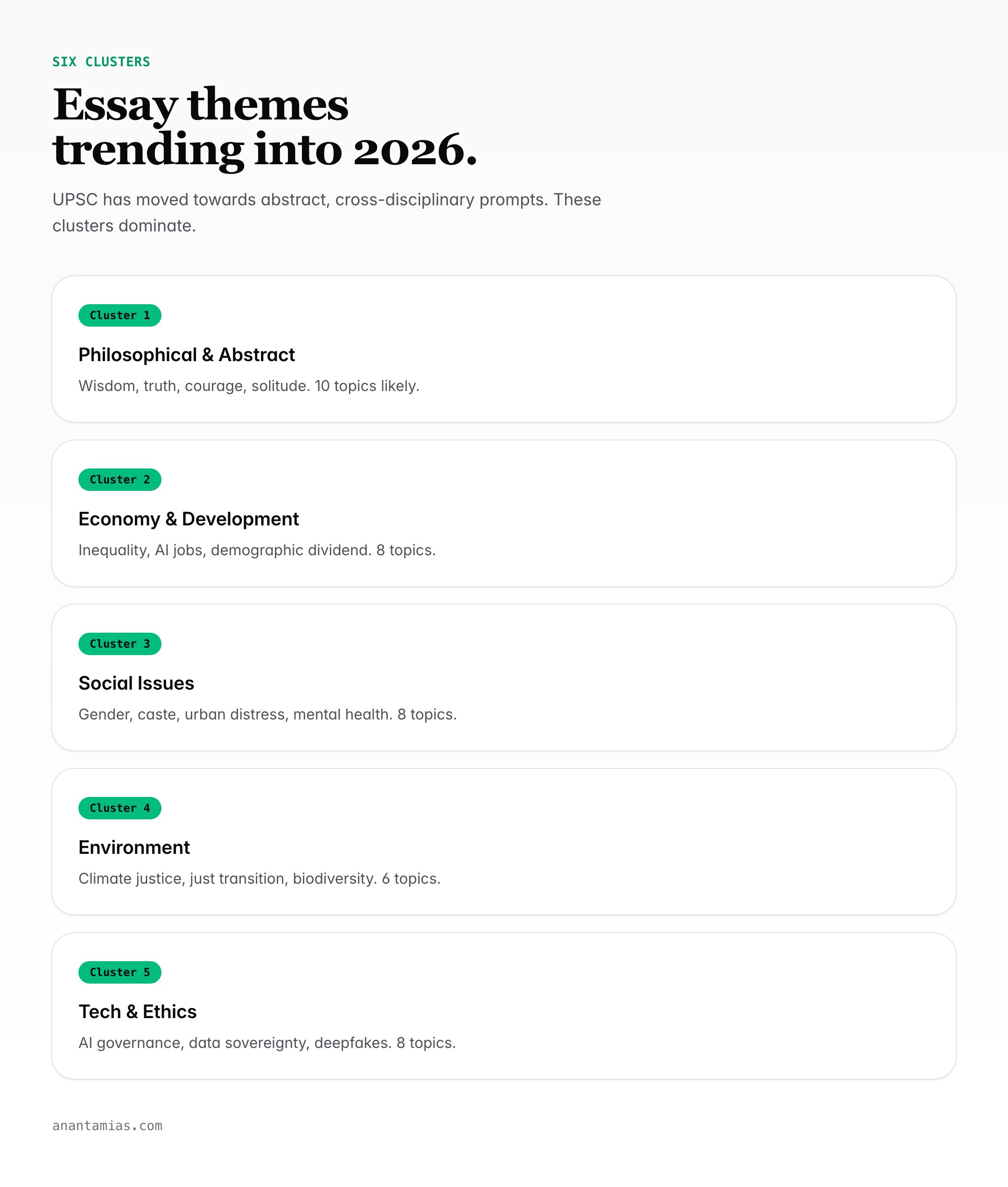
Philosophical & Reflective
The most rewarded section in any Essay paper. Pick prompts that let you weave thinkers (Kautilya, Gandhi, Kant, Camus, Berlin), Indian classical references (Upanishads, Tirukkural), and at least one contemporary case. Avoid the trap of becoming abstract for two pages.
Full essays — written and ready to study
- We do not see things as they are; we see them as we are
- Every age believes it is unique; every age is mistaken
- Silence is the loudest answer to noise
- The map is not the territory
- To know what you know and what you do not know — that is true knowledge
- Freedom is the discipline of choosing what to refuse
- Memory is the architect of identity; forgetting is its sculptor
- Hope is not the absence of darkness; it is the courage to begin again
- The shortest path between two truths often runs through a paradox
Additional topics to outline
- Wisdom is knowing what to overlook
- A mind without purpose will wander in dark places
- Patience is a form of action, not the absence of it
- Solitude is where we meet ourselves
- The limits of our language are the limits of our world
- We are shaped not by what we gain but by what we are willing to lose
- To question well is to half-answer
- Boredom is the gateway to imagination
- Beauty is not what is rare; it is what is noticed
- A truth is not less true for being unwelcome
Society, Identity & Values
The Indian society cluster carries the highest predictive value year-on-year. Anchor every claim in primary data — NFHS, Census, NCRB, NSS — not opinion-column claims. The examiner is looking for empirical seriousness paired with moral imagination.
Full essays — written and ready to study
- Education without empathy is mere instruction
- Loneliness in a connected age is a wound the algorithm cannot heal
- India's strength lies in its plurality, not its uniformity
- The wealth of a nation is the wellbeing of its weakest
- Social Media, FOMO and Youth Loneliness
Additional topics to outline
- Caste persists because economics has not replaced it
- The girl child is still a budget line, not a citizen
- Ageing India: a problem we have not begun to name
- Marriage as an institution is being renegotiated, not rejected
- Welfare for the disabled: compassion or constitutional duty?
- Mental health is public health
- The declining village and the discontented city
- A society is measured by how it treats its strangers
- Identity politics: liberator or fragmenter?
- Indian middle class — the conscience that lost its voice
Economy & Development
Economy-tilted essay topics ask for numeracy with conscience. Every claim about growth, jobs, or fiscal posture should carry an RBI / NSO / Economic Survey citation, then be tested against equity. Pair growth-only thinkers (Lal, Bhagwati) against welfare-first thinkers (Sen, Drèze) for balanced arguments.
Topics to outline
- Growth without equity is statistically impressive, socially dangerous
- Demographic dividend is a policy choice, not a gift
- India's middle-income trap: reality or rhetoric?
- Farm to firm: the unfinished migration of Indian labour
- Green growth: oxymoron or imperative?
- Cryptocurrencies and the future of monetary sovereignty
- MSMEs are the forgotten engine of the Indian economy
- Informal work, formal aspirations
- Productivity is the truest form of patriotism
- A national balance sheet that does not value nature lies twice
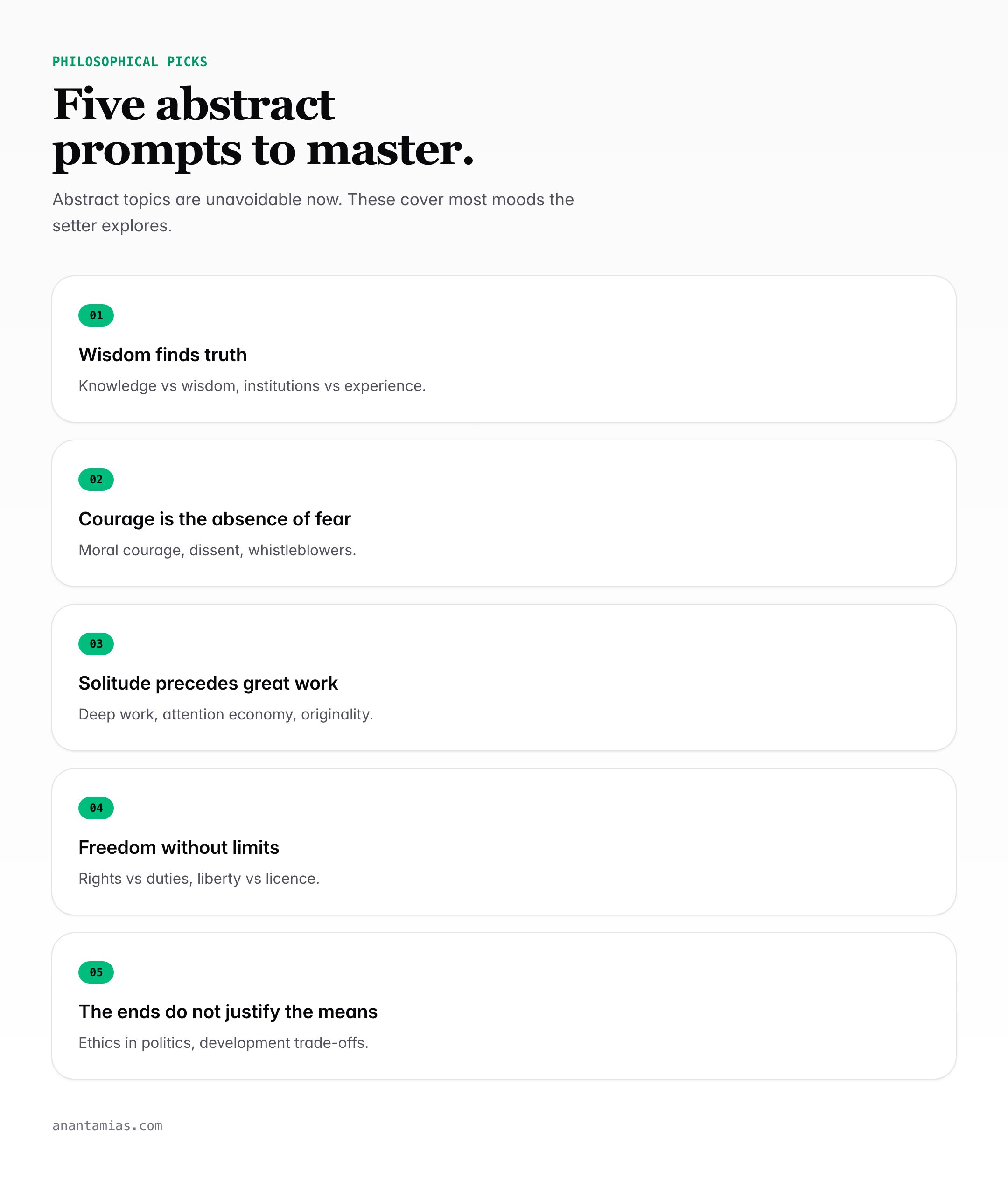
Science, Technology & Ethics
The fastest-moving cluster in terms of current-affairs gravity. Pair the technology with its governance question in every paragraph — AI with liability, gene editing with consent, surveillance with proportionality. The examiner expects you to know NITI Aayog AI strategy, DPDP Act 2023, ISRO programme architecture at a basic level.
Full essays — written and ready to study
- Artificial intelligence holds up a mirror to whoever holds it
- The artist finds beauty; the engineer finds use; both find truth
- In an age of abundance, the rarest commodity is attention
Additional topics to outline
- AI will not replace humans; humans who use AI will replace those who do not
- The algorithm is the new editor-in-chief
- Genetic editing: the god game we cannot unlearn
- Space is the last commons; who writes the rules?
- Privacy is the first casualty of convenience
- Deepfakes and the death of visual truth
- Digital India has a rural shadow
- Technology solves problems it first created
- Open-source is the language of a freer future
- When machines speak, will silence become a virtue?
Environment & Climate
Treat this as a civilisational cluster, not a sectoral one. The strongest essays connect ecology to economy to ethics — Naess's deep ecology, Vandana Shiva, the Niyamgiri case, CoP outcomes, the Mission LiFE framing. Concrete biodiversity hotspots and Indian river-basin examples carry more weight than IPCC-only references.
Full essays — written and ready to study
Additional topics to outline
- Forests are not lungs; they are libraries
- Water will be the oil of the 21st century
- Climate justice is the new non-alignment
- The Himalayas are a nation, not a backdrop
- Plastic is a philosophy before it is a pollutant
- Rewilding: can India reclaim what it lost?
- A coastline is a country; we have not finished reading it
- Net-zero without net-equity is a moral fraud
Governance & Democracy
Constitutional themes get rewarded when they go beyond Laxmikant — into Granville Austin, Mehta & Khilnani, Madhav Khosla. Cite landmark cases (Kesavananda, Maneka Gandhi, Indra Sawhney) with year + paragraph context, not bare names. Anchor governance examples in the last 24 months.
Full essays — written and ready to study
Additional topics to outline
- Democracy cannot be delivered; it must be practised
- Federalism is India's most under-appreciated innovation
- The quiet erosion of institutions
- Majoritarianism is a democratic disease, not its cure
- Judicial activism: constitutional necessity or overreach?
- Local government is the unfinished chapter of the Constitution
- Trust is the unwritten preamble of every Constitution
- A bureaucracy too cautious is a state too slow
International & Civilisational
Bring continuity and rupture together — civilisational claims (Vasudhaiva Kutumbakam, NAM) paired with hard interests (energy security, semiconductor supply chains, Indo-Pacific posture). Avoid recycling Nehruvian abstractions without contemporary anchors.
Full essays — written and ready to study
- To preserve heritage is to participate in the future
- Borders are drawn on maps; bridges are built between hearts
Additional topics to outline
- Neighbourhood first, but not at any cost
- India's soft power: myth or muscle?
- The Global South speaks, but does anyone listen?
- Civilisation, not nation: India's long horizon
- The Indo-Pacific is a geography of intentions
- Diaspora as foreign policy
- A multipolar world without multipolar institutions is unstable
Short Essays — Mains-Style Format
Shorter, sharper pieces (400–600 words) that double as essay outlines and Mains GS-II/III answers. Each is a compressed argument with a clear thesis, three supports, and a conclusion that takes a position.
- Is technology widening or narrowing inequality in India?
- Federalism is best preserved by trust, not by litigation
- The classroom of 2035 — what should it look like?
- Adaptation to climate change cannot be left to the market alone
- Can technology serve human values, or must it shape them?
- The case for rural revival in an urbanising India
- Secularism in practice — protection, not preference
- India's demographic dividend and the workforce of 2040
How to use this list
- Pick 25 topics across all seven clusters. Read the linked essays where available; outline the rest yourself.
- Write 10 full essays — at least one from every cluster.
- Build a quote bank of 50 lines (Tagore, Gandhi, Ambedkar, Marcus Aurelius, Russell, Camus, Sen, Khilnani). Two quotes per essay maximum.
- Build an example bank of 30 concrete cases — Aspirational Districts Programme, Niti Aayog SDG Index, NREGA outcomes, Chandrayaan-3, India-Bhutan hydro, Rwanda gender quotas. Memorise numbers, not vibes.
- Time every full essay at 75 minutes (paper allows 90 — leave a 15-minute buffer for the second essay).
- Get one peer review per essay. Self-evaluation is a trap.
Common mistakes (and how to avoid them)
- Starting with a quote. Examiners see 200 of these. Start with a paradox, a concrete image, or a specific year-and-place anecdote.
- Treating the topic as a slogan. Every essay topic is a claim with an unstated counter-claim. Find the counter, name it, then resolve it.
- One-sided argumentation. Even a “no” answer needs 25% of its body to engage the strongest version of the opposing view.
- Examples that all come from one decade. Reach across centuries — Ashoka to Aadhaar, Bhakti movement to NDA government, Gandhi to GenAI.
- Conclusion that summarises instead of resolves. A conclusion takes a position and points at a way forward. It is not the introduction in past tense.
- Recycled phrases. “In the realm of…”, “It is need of the hour…”, “As the famous saying goes…” — cut these from your active vocabulary.
- No structural signposts. Use three-line transitions between major sections — the reader should never have to ask “what is the connection”.
Opening-line formulae that work
- The paradox opener: “India’s strength has always been its contradictions — and so has its weakness.” Names the tension upfront.
- The specific-image opener: Drop the reader into a date and place. “In December 2022, the Indian rupee fell past 83 to a dollar — a number that, for the first time in a generation, made the diaspora richer than the salaried Indian.”
- The historical-arc opener: A single sentence connecting two distant moments. “Between Ashoka’s rock edicts and the National Education Policy 2020, the Indian state has rehearsed the same question: how do we teach a republic to remember itself?”
- The thinker-in-conversation opener: Quote one thinker, then immediately put them in tension with another. “Tagore wrote that patriotism cannot be the final shelter of the spirit. Ambedkar, fifty years later, would insist it must be at least the floor of justice.”
- The personal-anecdote opener: Use sparingly. Anchor in a sensory detail (a railway platform, a temple courtyard, a grandmother’s account book) before pivoting to the macro.
Preparation calendar (sample, 16 weeks)
| Weeks | Focus | Output target |
|---|---|---|
| 1–4 | Reading range — 2 op-eds + 1 long-form essay per day. Build the quote & example banks. | 30 outlines |
| 5–8 | Full essays, untimed. Focus on introductions and structure. | 1 full essay per week |
| 9–12 | Timed essays (90 min / 1000–1200 words). Two essays per week. | 8 timed essays |
| 13–14 | Peer review + rewrite cycle. Read your old essays — fix introductions and conclusions only. | 4 rewrites |
| 15–16 | Full essay-paper simulations. One full paper per week, evaluated by a mentor. | 2 full mocks |
Reading list — short and ruthless
- Indian thought: Discovery of India (Nehru), The Argumentative Indian (Sen), India After Gandhi (Guha), The Idea of India (Khilnani).
- Constitutional & political: India’s Founding Moment (Khosla), Granville Austin’s Working a Democratic Constitution.
- Economy: Latest Economic Survey + India Development Report (IGIDR). Skim, don’t memorise.
- Philosophy: Meditations (Marcus Aurelius), Two Concepts of Liberty (Berlin), What is Justice? (Sandel), the Bhagavad Gita.
- Op-eds (daily): The Hindu editorial + Indian Express explained + at least one Caravan long-form per week.
- Avoid: coaching essay compilations beyond a single past-year reference set. They homogenise voice.
Frequently Asked Questions
How many topics should I practise?
Outlines for 25, full essays for 10. Quality of outlining matters more than volume — an outline that names the thesis, two counter-claims, four examples across decades, two thinkers and a forward-looking conclusion is worth a dozen weak full essays.
Are philosophical topics really asked?
Yes — roughly one philosophical or abstract prompt per section since 2014, often the most popular section among toppers. They reward wide reading more than coaching notes.
How do I pick between two topics on exam day?
Pick the one for which you have six concrete examples across at least three disciplines (history, economy, science, literature, current affairs). Don’t pick the one you find "deepest" — that path leads to abstraction without anchor.
Should I memorise essays?
No. Memorise frameworks, quotes, and examples. Essays written from memorised paragraphs read mechanical to evaluators who’ve seen hundreds of scripts.
What word count should I target?
1000–1200 words per essay. Below 900 reads thin; above 1400 reads padded. The structure is more diagnostic of marks than the length.
How do I write a strong conclusion?
A conclusion does three things: restates the thesis in different words, acknowledges what remains contested, and points at a way forward. It is not a list of "let us all work together" platitudes.
Is the Essay paper score really decisive?
In the top 200 ranks, Essay scores cluster between 125 and 145. A 15-mark gap on Essay is harder to close than a 15-mark gap on most GS papers. Treat it as the third decisive paper, not an afterthought.
Where can I get my essays reviewed?
Post your draft in the Essay Writing community space — the peer-review etiquette is pinned there. AnantamIAS faculty drop in on structurally weak submissions.