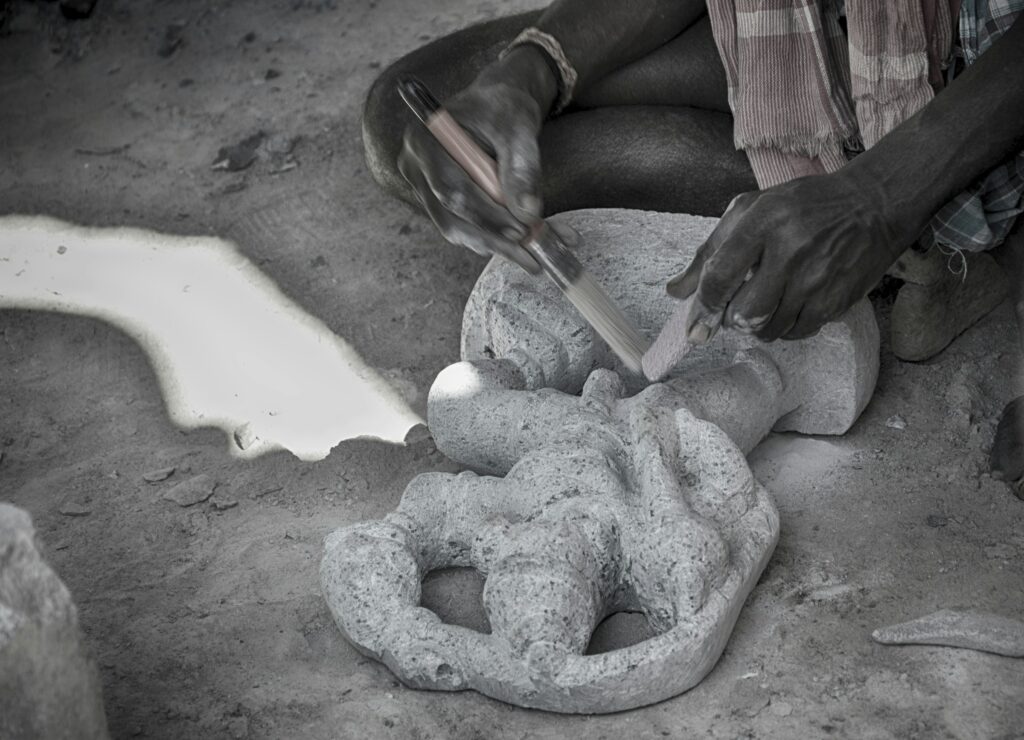
Step into a quiet workshop in the shadow of a temple and you will find a stone carver matching a fresh block of granite to a thousand-year-old pillar, copying a flourish no living person designed. A few streets away, a weaver’s family throws the shuttle on a loom their great-grandmother set up, repeating a pattern older than the nation that now protects it with a legal tag. Neither person is looking backward. Both are sending something forward — a skill, a memory, a way of seeing — to people not yet born. This guide breaks down the topic the way it should be handled in the examination hall: first why an examiner would set it, then the angles, the time map, the paragraph blueprint, and a complete model essay you can study, dissect and adapt.
Why UPSC could set this in 2026 — and what it would really test
This is a predicted topic for the UPSC CSE Mains 2026 Essay paper, not a past question. It belongs to the abstract-yet-current strand the essay paper has favoured since 2020 — a philosophical line (“to preserve heritage is to participate in the future”) sitting on top of live national debates: Geographical Indication tags protecting artisan livelihoods, the Archaeological Survey of India’s conservation choices, fresh UNESCO World Heritage inscriptions, and the tension between keeping traditions alive and freezing them behind glass.
An examiner setting this would be testing four things at once. One, can you read a paradox — preservation framed as future-making, not nostalgia — without collapsing it into a “save our culture” speech. Two, can you marshal range, moving across culture, economy, policy and philosophy rather than writing one long heritage-tourism note. Three, can you handle the genuine counter-current, that preservation can ossify a society and hold back progress. Four, can you write 1,100 disciplined words that examine the claim rather than 1,500 that merely celebrate it. Handle all four and you score in the 130s; celebrate only, and you stall in the 90s.
Five angles that unlock “To preserve heritage is to participate in the future”
The trap with a quote like this is to read it as a slogan for protecting monuments and ride that for 1,100 words. The mark-pulling answer instead names several lenses and weaves them. Here are the five most defensible readings. You do not need all five — three, treated well, is the sweet spot — but knowing all five makes your choice conscious.
- Heritage as inheritance and transmission — the literal reading. Preservation is not storage; it is handing a living skill or memory to the next generation. A craft kept alive is a craft kept usable. This opens up intangible heritage — Kutiyattam, Vedic chanting, Yoga, Ramlila — recognised precisely because they are practised, not displayed.
- Heritage as economy and livelihood — preservation as a future income, not a museum cost. Geographical Indication tags on Banarasi sarees, Channapatna toys or Mysore silk turn cultural memory into protected, exportable livelihood. This angle anchors the abstract claim in jobs, wages and rural dignity.
- Heritage as identity and continuity — a society that forgets its past loses the vocabulary to imagine its future. Language, festival, cuisine and ritual give a people a shared map. The angle here is psychological and civilisational rather than economic.
- Heritage as the raw material of innovation — the future is built by remixing the past, not erasing it. Modern architecture borrowing from stepwells, designers reworking handloom motifs, scientists revisiting traditional medicine. Preservation keeps the source code; innovation forks it.
- Heritage as stewardship across generations — the ethical reading. We hold heritage in trust, not in ownership; conserving a monument or a forest grove is an act of justice toward those who come after us. This pulls in environmental heritage, sacred groves, and the idea of intergenerational equity.
A strong essay takes angles 1, 2 and 4 as its backbone (transmission, livelihood, innovation), uses 3 to give it civilisational weight and 5 to close on an ethical note. That gives the essay rhythm — claim, complication, resolution — rather than a single straight line of praise.
A time map for the 1,500-second window
One essay deserves about 75 to 90 minutes inside the three-hour paper. Spending more on Essay 1 starves Essay 2. The single biggest source of below-100 scores is poor time discipline — beautiful introductions, panicked conclusions. Use a rough breakdown like this:
| Minutes | Activity | What it earns you |
|---|---|---|
| 0 — 10 | Decode the topic. Write the thesis in one line. List 4 to 5 angles. Pick 3. | Direction. The single most important investment of the 90 minutes. |
| 10 — 18 | Brainstorm examples — GI tags, UNESCO sites, ASI, crafts, a personal hook. | The substance the body paragraphs will run on. |
| 18 — 22 | Draft a paragraph-level outline — 12 to 15 bullets, in sequence. | Prevents the mid-essay drift that kills 60% of attempts. |
| 22 — 80 | Write the essay — opening, body, conclusion — without re-planning. | The actual marks come from this window. Protect it. |
| 80 — 85 | Read the conclusion. Tighten the last two sentences. Fix factual errors. | Conclusions are over-weighted by examiners. A clean ending saves 5 marks. |
Notice what is not on the list: rewriting the introduction halfway, hunting for the perfect quote, decorative diagrams, fancy underlining. None of that earns marks. Discipline does.
What to add — and what to avoid at all costs
The essay paper rewards what most aspirants under-do and punishes what most aspirants over-do. Memorise this list before you walk into the hall.
Add liberally
- One precise thesis, stated by the end of paragraph two and not abandoned. “Preservation is not the freezing of a past but the funding of a future; what we keep alive becomes the material the next generation builds with.”
- Concrete examples across three or four domains — one cultural (Kutiyattam, Ramlila, the Jaipur restoration), one economic (a GI-tagged craft sustaining a weaving cluster), one policy or institutional (ASI conservation, UNESCO inscription) and one philosophical or literary (Tagore on tradition, the banyan as a living archive).
- One Indian philosophical or constitutional anchor. Tagore’s warning against making the past a prison, the Fundamental Duty under Article 51A(f) to value and preserve composite culture, the Upanishadic idea of knowledge passed mouth to ear.
- The counter-argument, handled briefly — that preservation can ossify and hold a society back — then resolved, not dodged.
- Two or three short, named quotes — one per major section is enough. Attribute them honestly or paraphrase.
- A clean conclusion that returns to the opening image — the carver, the weaver — not a fresh argument.
Avoid — even when tempted
- Restating the topic in the first sentence. “Heritage is our greatest treasure…” signals you have nothing to add. Open with an image.
- Drifting into a single domain. A 1,100-word essay only on monuments, or only on tourism, reads like a GS note. Range matters.
- Unsourced statistics. “Heritage tourism employs crores” — if you cannot name the source, do not write the number.
- Hot-button political examples. Naming current parties, leaders or specific contested sites introduces avoidable risk. Use the institution, not the personality.
- Pure nostalgia. “Everything old was better” is a school-essay reflex. The paper rewards examination, not sentiment.
- Museumising the argument. Treating heritage only as objects in glass cases ignores living traditions, which are the stronger half of the case.
A paragraph-by-paragraph blueprint
Twelve paragraphs at roughly 90 words each gets you to 1,080. Thirteen at 90 each gets you near 1,170. What follows is a 13-paragraph plan that maps cleanly onto the model essay below. Each line is what that paragraph is doing, not what it is saying.
- Opening image — the stone carver and the weaver, hands at work, sending a skill forward. No mention of the topic yet.
- The pivot to thesis — name the topic, then state the thesis in one sentence: preservation is participation in the future.
- Define the terms — heritage (tangible, intangible, natural), and what “participate in the future” really claims.
- Angle 1 — Transmission — living traditions like Kutiyattam and Vedic chanting survive only by being practised, not stored.
- Indian anchor — Tagore’s distinction between tradition as root and tradition as prison; the Fundamental Duty to preserve composite culture.
- Angle 2 — Livelihood — GI tags turning craft memory into protected, future-facing income for whole clusters.
- Angle 3 — Innovation — the future is built by remixing the past: architecture from stepwells, design from handlooms.
- Institutions — the ASI, UNESCO inscription, GI registries: the machinery that keeps heritage usable across generations.
- The complication — museumisation — preservation done wrong freezes a tradition and empties it of life.
- Counter-argument handled — yes, clinging to heritage can ossify a society; no, that is bad preservation, not preservation itself.
- Way forward — individual — learning a craft, speaking a mother tongue, the citizen as a link in the chain.
- Way forward — institutional and ecological — funding living traditions, intergenerational equity, sacred groves and natural heritage.
- Closing image — return to the carver and weaver; close with one resonant line tying preservation to the future.
How to make an examiner stop and read
An essay examiner reads several hundred scripts in a sitting. The first paragraph decides whether they read the second with attention or on autopilot. Four small habits separate the essays that get read from the ones that get skimmed.
- Open with a scene, not a statement. A stone carver, a loom, a conservator brushing dust from a fresco, a grandmother teaching a song. Concrete images cost no marks and earn attention.
- Use the topic phrase itself two or three times. Once in the thesis, once at the turn, once at the close. It signals discipline and prevents drift.
- Vary sentence length. A short sentence after three long ones lands. Examiners feel rhythm before they parse meaning.
- End paragraphs with the takeaway, not with examples. Place the example mid-paragraph; let the last sentence carry the thought.
The complete essay — “To preserve heritage is to participate in the future”
What follows is a model essay of about 1,200 words built on the blueprint above. Read it twice — once for the argument, once for the moves. The moves are what you can carry into your own essay; the argument is one of many you could make.
In a low workshop beside an old temple, a stone carver lifts his chisel to a fresh block of granite and matches, curve for curve, a flourish first cut a thousand years ago. He is not copying a dead man’s work; he is keeping a dead man’s hand alive in his own. A few lanes away, a weaver throws a shuttle across a loom his great-grandmother strung, repeating a border older than the republic that now protects it with a legal tag. Neither of them is looking backward. Both are sending something forward — a skill, a memory, a way of seeing — to people not yet born.
This is the quiet truth behind the claim that to preserve heritage is to participate in the future. The phrase sounds like a paradox, because we habitually file preservation under nostalgia and the future under invention. But heritage is not a backward-facing act of storage. It is the deliberate transmission of what one generation judges worth carrying, so that the next has something to build with. What we choose to keep alive becomes the raw material of what comes next.
Some definitions help. Heritage is wider than monuments. It is tangible — temples, stepwells, manuscripts, forts; intangible — a raga, a recipe, a ritual, a tongue; and natural — a sacred grove, a wetland, a seed variety. “To participate in the future” is the stronger half of the sentence. It claims that preservation is not a cost we pay to the past but an investment we make in the future: a society that keeps its inheritance usable hands its children both a map and a toolkit.
Consider intangible heritage first, because it makes the point most sharply. Kutiyattam, the Sanskrit theatre of Kerala, and the tradition of Vedic chanting were recognised by UNESCO not as relics but as living practices — they exist only in the bodies and breath of those who perform them. A chant that is written down but never recited is already half dead. Preservation here cannot mean a glass case; it can only mean a student sitting before a teacher, learning to make the sound. The tradition survives by being practised into the future, or it does not survive at all.
Rabindranath Tagore drew the line precisely. He warned against turning the past into a prison while insisting it remain a root — a thing that feeds new growth rather than a wall that blocks it. The Indian Constitution echoes the same instinct in Article 51A, which makes it a Fundamental Duty of every citizen to value and preserve the rich heritage of our composite culture. The framers did not file culture under sentiment; they filed it under civic responsibility, an obligation owed forward.
The economic case is just as concrete. A Geographical Indication tag on a Banarasi saree, a Channapatna toy or Mysore silk does something subtle: it converts a community’s inherited skill into a protected, future-facing livelihood. The tag tells a buyer in another country that this object carries a particular place and history that cannot be counterfeited. For the weaver, the carver, the toy-maker, preservation is not an abstraction but a wage, and the craft becomes worth teaching a daughter precisely because it has a future.
Preservation also feeds invention. The future is rarely built from nothing; it is built by remixing what already exists. Contemporary architects studying the cooling logic of stepwells and courtyard homes have rediscovered low-energy answers to a warming climate. Designers reworking handloom motifs give an ancient weave a new market. Even the renewed scientific interest in traditional plants and practices begins with a tradition that someone bothered to keep. Heritage is the source code; innovation is the fork. Erase the source and you have nothing to improve upon.
None of this happens by accident. It depends on institutions doing patient, unglamorous work. The Archaeological Survey of India conserving a crumbling fresco, the careful dossier that wins a site a place on the UNESCO World Heritage list, the registry that grants and defends a GI tag — these are the machinery that keeps heritage usable across generations rather than letting it decay or be appropriated. Institutions translate the sentiment of “we should preserve” into the practice of actually doing so.
Yet preservation has a failure mode, and an honest essay must name it. Done badly, preservation becomes museumisation: a living dance frozen into a fixed routine for tourists, a tongue reduced to ceremonial phrases, a festival emptied of meaning and kept only for the camera. When that happens, the form survives but the life leaks out. The object is preserved; the heritage is not. Bad preservation embalms; good preservation keeps breathing.
It might be objected that this whole celebration is misplaced — that clinging to heritage holds a society back, that reverence for the old can shelter injustice and stall progress, that some inheritances deserve to be let go. The objection is partly right and entirely instructive. A caste hierarchy or a cruel custom is indeed an inheritance, and to abandon it is moral progress, not loss. But this is an argument against preserving everything indiscriminately, not against preservation as such. Participating in the future means choosing what to carry — keeping the craft and the chant, discarding the cruelty. Preservation is curation, and curation is a forward-looking judgement.
What does this ask of an individual? Small, concrete things. To learn a craft from someone older. To speak a mother tongue to a child rather than letting it lapse. To visit, and so help fund, the living quarter of a heritage town and not only its photographed facade. Every citizen who learns and passes on becomes a link in a chain that would otherwise break. The future of a tradition is decided one teacher and one student at a time.
And of institutions and the republic? To fund living traditions, not only stone ones; to treat conservation as a duty owed to citizens not yet born; to extend the same care to natural heritage — the sacred grove, the wetland, the heirloom seed — as to the built kind. This is intergenerational equity in its plainest form: we hold heritage in trust, never in ownership. The banyan we sit under was planted by someone we never met, and the shade is the only thanks they will ever receive — or ask for.
Return, then, to the carver and the weaver with which we began. Their hands move over old patterns, but their faces are turned toward tomorrow, toward the apprentice watching and the child who will inherit the loom. They are not curators of a dead past; they are participants in a future they will not see. That is the whole meaning of the claim. To preserve heritage is not to look backward at all. It is to keep the fire lit long enough to hand it on.
Word count: approximately 1,200.
How to use this model essay
Do not memorise it. Memorised essays read like memorised essays, and examiners spot them within two paragraphs. Use the model the way a chess student uses a master game: study the opening image, the pivot to thesis, the placement of the Indian anchor, the way the counter-argument is raised and then resolved, the way each paragraph hands the reader to the next. Then take a related topic — “Tradition is the handing on of the fire, not the worship of ashes” or “Development without conservation is borrowing from the unborn” — and write your own essay on the same blueprint. Repeat the exercise eight to ten times and the structure becomes muscle memory. On exam day, the only thing you should have to think about is the topic itself.
Tell Google you want more of this.
Add Anantam IAS as a preferred sourceOne tap, and this site shows up more often in your own Top Stories, AI Overviews and AI Mode. Remove it any time.