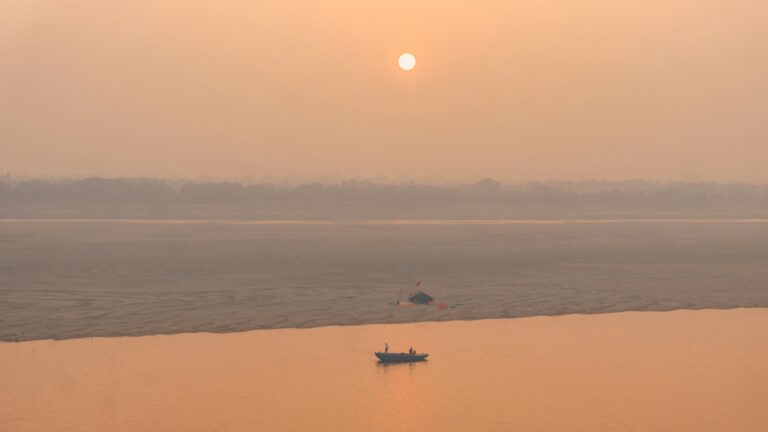

A glacier does not argue. It simply retreats, a few metres a year, leaving behind bare rock that has not seen daylight in ten thousand years. No tribunal sat in judgment; no verdict was read out. And yet a kind of trial is under way, with our generation in the dock and the unborn as the only witnesses who matter. “Climate change is the moral examination of our generation” reframes a problem we usually file under science or economics as something older and harder — a question of conscience. This guide breaks the topic down the way it should be tackled in the hall: first why an examiner might set it, then the angles, the time map, a paragraph blueprint, and a complete model essay you can study and adapt.
Why UPSC could set this in 2026 — and what it would really test
This is a predicted topic for the UPSC CSE Mains 2026 Essay paper, not a past question — and it is a strong candidate. The essay paper has drifted since 2020 towards abstract-but-current prompts, and climate change sits at the intersection of a live news cycle (record-breaking heat seasons, contentious COP negotiations, loss-and-damage funds) and a timeless ethical dilemma. A topic phrased as a moral examination is deliberately built to separate two kinds of candidate.
The first writes a GS-III answer in disguise — emissions data, the Paris Agreement, renewable-energy targets — and scores in the 90s. The second reads the word “moral” and “our generation” and understands the real test. One, can you treat climate change as an ethical question of duty across time, not a technical one. Two, can you hold the tension between the Global South’s right to develop and the planet’s need to decarbonise without preaching. Three, can you anchor a planetary subject in Indian thought and policy rather than borrowing entirely from the West. Four, can you write disciplined, examined prose rather than alarmist sermon. Handle all four and the essay scores in the 130s.
Four angles that unlock “Climate change is the moral examination of our generation”
The trap with a topic like this is to pick the obvious angle — “we must save the planet” — and ride it for 1,100 moralising words. The mark-pulling answer instead names several distinct lenses and weaves them. Here are the four most defensible readings. You do not need all four; three, treated well, is the sweet spot, but you should know all four so your choice is conscious.
- Intergenerational justice — the core reading. The generation that benefited from cheap carbon is not the one that will pay the bill. An examination implies a verdict delivered later, by people not yet born, who had no vote. This opens up the ethics of duty to the future and the idea of the planet as a trust, not a possession.
- Equity between nations — climate justice and Common But Differentiated Responsibilities. Those who emitted least face the worst floods and droughts. The moral question is who pays, and whether the Global South must choose between dignity and decarbonisation. This is where the counter-argument lives.
- The ethics of restraint — climate change as a crisis of want disguised as a crisis of need. Gandhi’s line that the earth provides enough for every person’s need but not every person’s greed turns the subject from technology to character. Sustainability becomes a moral discipline, not merely an engineering target.
- The test of collective will — an examination is also a test of whether a generation can act on knowledge it already has. We are the first to feel the warming and the last who can still limit it. The angle here is agency: knowledge without action is the real failure the topic warns against.
A strong essay uses angles 1 and 3 as its backbone (justice across time, the ethics of restraint), brings in 2 as the hard tension (development versus decarbonisation) and closes on 4 (will and agency). That gives the essay rhythm — duty, complication, resolution — instead of a single straight line of warning.
A time map for the 1,500-second window
One essay deserves about 75 to 90 minutes inside the three-hour paper. Spending more on Essay 1 starves Essay 2. The single biggest source of below-100 essay scores is poor time discipline — beautiful introductions, panicked conclusions. Use a rough breakdown like this:
| Minutes | Activity | What it earns you |
|---|---|---|
| 0 — 10 | Decode the topic. Underline “moral” and “our generation”. Write the thesis in one line. List 4 angles. Pick 3. | Direction. The single most important investment of the 90 minutes. |
| 10 — 18 | Brainstorm examples, quotes, scholars, episodes — science, India policy, ethics, history. | The substance the body paragraphs will run on. |
| 18 — 22 | Draft a paragraph-level outline — 12 to 13 bullets, in sequence. | Prevents the mid-essay drift that kills 60% of attempts. |
| 22 — 80 | Write the essay — opening, body, conclusion — without re-planning. | The actual marks come from this window. Protect it. |
| 80 — 85 | Read the conclusion. Tighten the last two sentences. Fix factual errors. | Conclusions are over-weighted by examiners. A clean ending saves 5 marks. |
Notice what is not on the list: rewriting the introduction halfway, hunting for the perfect emission statistic, decorative diagrams. None of that earns marks. Discipline does.
What to add — and what to avoid at all costs
The essay paper rewards what most aspirants under-do and punishes what most aspirants over-do. Memorise this list before you walk into the hall.
Add liberally
- One precise thesis, stated by the end of paragraph two and not abandoned. “Climate change is a moral examination because it asks whether a generation will accept duties it can postpone, towards people it will never meet.”
- Concrete examples across three or four domains — one scientific (the carbon budget, tipping points), one Indian policy (Panchamrit pledge, net-zero by 2070, the LiFE mission), one ethical or philosophical (Gandhi on need and greed, the idea of a planetary trust) and one historical (the Bishnoi sacrifice at Khejarli, the Chipko movement).
- Two or three short, named ideas — Common But Differentiated Responsibilities, the Brundtland definition of sustainable development, the Gandhian distinction between need and greed. One per major section is enough.
- One Indian anchor used substantively. The Bishnoi and Chipko traditions, the Atharvaveda’s prayer to the earth, India’s climate-justice argument at the multilateral table. An Indian anchor in an essay full of Western statistics stands out.
- A counter-argument handled honestly. The Global South’s case that development cannot wait for the rich world’s conscience — raised fully, then resolved, not dismissed.
- A clean conclusion that returns to the opening image — not a fresh argument, not a new statistic.
Avoid — even when tempted
- Restating the topic in the first sentence. “Climate change is indeed the moral examination of our generation…” signals you have nothing to add. Open with an image.
- Turning it into a GS-III answer. A 1,100-word essay that lists emission figures, COP outcomes and renewable targets reads like a mains answer. The word “moral” is the assignment.
- Unsourced statistics. “The planet will be uninhabitable by 2050” — if you cannot name the source, do not write the number. Examiners cross-mark this.
- Naming current leaders or parties. The essay is graded by humans across the ideological spectrum. Refer to the office, the ministry or the mission — never the personality.
- Apocalyptic moralising. “We are doomed unless we act now” reads like a placard. The essay paper rewards examination, not exhortation.
- One-sided guilt. Blaming only industry, or only the West, or only consumers flattens a layered problem. Range and fairness mark better than indignation.
A paragraph-by-paragraph blueprint
Twelve paragraphs at roughly 95 words each gets you to about 1,140. What follows is a 13-paragraph plan that maps cleanly onto the model essay below. Each line is what that paragraph is doing, not what it is saying.
- Opening image — a retreating glacier or a parched reservoir that physically embodies a slow verdict. No mention of the topic yet.
- The pivot to thesis — name the topic, then state in one sentence why it is a moral examination and not merely a scientific one.
- Define the terms — what “moral examination” means; why “our generation” is the unit; the difference between a technical problem and an ethical one.
- Angle 1 — Intergenerational justice — the carbon budget as a debt; the unborn as the examiners; the planet as a trust held, not owned.
- Indian anchor — the Bishnoi at Khejarli, Chipko, the Atharvaveda’s earth-prayer; conservation as moral tradition long before it was policy.
- Angle 3 — The ethics of restraint — Gandhi on need versus greed; consumption as a moral and not only an economic choice; the LiFE idea.
- The hard tension — equity between nations — Common But Differentiated Responsibilities; who emitted and who suffers; the fairness question.
- India’s position concretely — Panchamrit, net-zero by 2070, the climate-justice argument at the multilateral table; leading without abandoning the poor.
- Counter-argument handled — the Global South’s case that development cannot wait; raised fully, then resolved with the idea of a just transition.
- Angle 4 — The test of will — we are the first to feel it and the last who can limit it; knowledge already exists; the failure would be inaction.
- Way forward — individual — the discipline of restraint, mindful consumption, the LiFE ethic of small repeated choices.
- Way forward — institutional — finance for the vulnerable, technology transfer, an honest multilateralism, education that treats the future as a stakeholder.
- Closing image — return to the glacier or reservoir; close with one resonant line about the verdict.
How to make an examiner stop and read
An essay examiner reads several hundred scripts in a sitting. The first paragraph decides whether they read the second with attention or with autopilot. Four small habits separate the essays that get attention from the ones that get skimmed.
- Open with a scene, not a statement. A retreating glacier, a dry village handpump, a child studying by a flooded doorway. Concrete images cost no marks and earn attention.
- Use the topic phrase itself two or three times across the essay. Once in the thesis, once at the turn, once at the close. It signals discipline and prevents drift.
- Vary sentence length. A short sentence after three long ones lands. Examiners feel rhythm before they parse meaning.
- End paragraphs with the takeaway, not with examples. Place the example mid-paragraph. Let the last sentence be the thought, so the reader carries it forward.
The complete essay — “Climate change is the moral examination of our generation”
What follows is a model essay built on the blueprint above. Read it twice — once for the argument, once for the moves. The moves are what you can carry into your own essay; the argument is one of many you could make.
High in the Himalaya, a glacier that fed a river for ten thousand years is pulling back up its own valley, leaving grey boulders where there was once blue ice. No one signed an order for this. No court convened. And yet a kind of judgment is being delivered, slowly, in a language of receding snowlines and failing monsoons, and the people best placed to read the verdict have not yet been born. The strange thing about this trial is that the accused and the jury belong to different centuries. We act; they pay; and they will never be able to call us to the stand.
This is why “climate change is the moral examination of our generation” is the truest framing of the crisis. The science is settled enough; the engineering is improving. What is genuinely undecided is whether a generation that holds the knowledge will accept the duties that come with it — towards people it will never meet, payable in sacrifices it could comfortably postpone. A moral examination is not a test of what we know. It is a test of what we will do when no one alive can punish us for failing.
The distinction matters because it changes the kind of answer required. A technical problem asks for a better instrument; a moral one asks for a better character. The central difficulty is not the absence of solar panels but the presence of a temptation — to enjoy the convenience now and let the bill arrive after we are gone. The unit of judgment, tellingly, is not the individual but “our generation”, because no single person caused this and no single person can fix it. We are graded together.
Consider first the matter of justice across time. Scientists speak of a carbon budget — a finite quantity of greenhouse gas the atmosphere can absorb before warming crosses dangerous thresholds. Every tonne we emit is a tonne subtracted from the inheritance of those who follow: borrowing against an account held by people who cannot consent to the loan. The old idea that the earth is not a possession to be spent but a trust to be passed on, intact, captures the duty exactly. A trustee who liquidates the estate for present comfort is not merely imprudent; he has failed a test of fidelity. That is the examination at the heart of the topic.
India did not need the language of climate science to grasp this. In 1730, in the village of Khejarli in Rajasthan, the Bishnoi woman Amrita Devi and hundreds who followed her gave their lives clinging to khejri trees to stop them being felled for a palace. Two and a half centuries later, the women of Chipko wrapped their arms around Himalayan forests against the contractor’s axe. The Atharvaveda addresses the earth as a mother and prays not to wound her. Long before sustainability became policy, this civilisation treated restraint towards nature as a moral, not merely practical, obligation.
That tradition leads naturally to the ethics of restraint, where the examination is hardest to pass. Gandhi’s observation that the earth provides enough for every person’s need but not for every person’s greed reframes the entire crisis: the planet is not short of resources for survival, only for excess. Climate change, in this reading, is a crisis of want disguised as a crisis of need. India’s call for a lifestyle of conscious, low-impact consumption — the idea behind the LiFE mission — is less an economic policy than a moral one, asking the comfortable to distinguish, honestly, between what they require and what they merely desire.
Here the examination acquires its sharpest tension, between nations rather than generations. The countries that grew rich by burning two centuries of coal are not the ones drowning first; the islands and deltas that contributed least face the rising sea earliest. The principle of Common But Differentiated Responsibilities, written into global climate agreements, translates this unfairness into duty: all must act, but not equally, because all did not cause it equally. A moral examination that ignored this asymmetry would be no examination — merely the strong lecturing the weak.
India has tried to answer both halves of that question at once. Through the Panchamrit commitments and a pledge of net-zero emissions by 2070, it accepts a share of the burden while insisting, at the multilateral table, that historical emitters honour their debt through finance and technology. The argument is one of climate justice: a country where millions still climb out of poverty cannot be asked to freeze its development to atone for emissions it never made. To lead on climate without abandoning the poor refuses the easy answers of both denial and surrender.
It might be objected that all this talk of duty is a luxury of the already-developed. For a family without reliable electricity, decarbonisation can sound like a demand to stay poor so that others may keep their conscience clean. The objection is serious and partly right. But it does not dissolve the examination; it sharpens it. The answer is not that the poor must wait, but that the transition must be just — clean energy made cheap, the cost falling first on those who can bear it, development and decarbonisation pursued together rather than traded against each other. Fairness, not delay, is the moral reply.
What finally makes this a generational test is timing. Ours is the first generation to feel the warming in its own weather and the last that can still hold it within tolerable limits. The knowledge is in our hands; the instruments largely exist. The one thing that could still make us fail is the gap between knowing and doing — the quiet decision to treat an emergency as a matter for the next decade. An examination is failed not only by ignorance but by the candidate who knows the answer and declines to write it.
For an individual, passing this examination looks unglamorous: using less, repairing rather than replacing, treating every act of consumption as a small moral choice rather than a private indulgence. These are the habits the LiFE ethic gathers into a way of living. None alone cools the planet, but together they rebuild the muscle of restraint that an age of abundance has let wither.
For institutions, it looks like honesty: finance that actually reaches the vulnerable rather than being promised and withheld, technology shared rather than hoarded, a multilateralism that keeps its word, and education that counts the unborn among the stakeholders of every decision. None of these are new ideas. Each must be renewed in every decade, because the temptation to postpone is permanent even when the science is not.
Return, finally, to the glacier with which we began. It keeps its slow accounts whether or not we attend to them, and the river that depends on it will one day run thin for villages that did nothing to deserve the loss. Climate change is the moral examination of our generation precisely because the marking happens after the candidate has left the hall. We will not see our own results. The most we can do is write the kind of answer we would not be ashamed to have read aloud by those who inherit the consequences — and then live as though the verdict already mattered.
Word count: approximately 1,200.
How to use this model essay
Do not memorise it. Memorised essays read like memorised essays, and examiners spot them in two paragraphs. Use the model the way a chess student uses a master game: study the opening image, the pivot to thesis, the placement of the Indian anchor, the way the counter-argument is raised fully and then resolved, and the return to the opening scene at the close. Then take a related predicted topic — try “Sustainability is the new measure of progress” or “We do not inherit the earth from our ancestors, we borrow it from our children” — and write your own essay on the same blueprint. Repeat the exercise eight to ten times and the structure becomes muscle memory.
Tell Google you want more of this.
Add Anantam IAS as a preferred sourceOne tap, and this site shows up more often in your own Top Stories, AI Overviews and AI Mode. Remove it any time.