Daily Digest
UPSC · Civil Services Examination
Current Affairs · Monday, 10 November 2025
Current affairs curated and edited by Anantam IAS faculty — pulled from The Hindu, PIB, IDSA, Foreign Affairs and the ministries. Read, annotate, revise.
Old Rajinder Nagar · Delhi 110005 · anantamias.com
Aditya-L1’s Close Look at Coronal Mass Ejections (CMEs)


Why in News?
Scientists from the Indian Institute of Astrophysics (IIA), using the Visible Emission Line Coronagraph (VELC) payload aboard India’s Aditya-L1, collaborated with NASA to study a Coronal Mass Ejection (CME).
UPSC Relevance
Prelims, GS3, Awareness in the fields of IT, Space, Computers, Robotics, Nano-technology, Bio-technology and issues relating to Intellectual Property Rights.
PYQ
2025
Consider the following space missions:
I. Axiom-4
II. SpaDeX
III. Gaganyaan
How many of the space missions given above encourage and support micro-gravity research?
a) Only one
b) Only two
c) All the three
d) None
2024 – What are asteroids? How real is the threat of them causing extinction of life? What strategies have been developed to prevent such a catastrophe?
The Observations
- These are the very first spectroscopic observations of a CME in the visible wavelength range close to its lift-off from the Sun.
- Location Advantage: Aditya-L1’s positioning at the Sun-Earth Lagrangian L1 point provides a sustained, 24-hour view of the Sun, which is crucial for these observations.
- Scientists used the VELC to estimate crucial parameters of the CME very close to the Sun’s visible surface.
- Electron Density: Approximately 370 million electrons per cubic centimetre (significantly higher than the non-CME corona’s 10-100 million).
- Energy: Estimated to be around 9.4 × 10²¹ joules.
- Mass: Nearly 270 million tons.
- Initial Speed: 264 km/sec.
- Temperature: 1.8 million degrees on the Kelvin scale.
Future Expectations
- The unique near-Sun spectroscopic data from VELC is vital for understanding the parameters of a CME in relation to what is lost from the Sun during such an event.
- With the Sun nearing its maximum activity phase of the current sunspot cycle 25, the now-stabilised VELC is expected to observe more energetic eruptions.
CME vs Solar Flare
| Feature | Solar Flare | Coronal Mass Ejection (CME) |
| Primary Output | Electromagnetic Radiation (photons, including X-rays and Gamma-rays). | Mass/Matter (a gigantic cloud of superheated plasma, or charged particles, embedded with a magnetic field). |
| Analogy | Like the muzzle flash of a cannon. | Like the cannonball itself. |
| Speed to Earth | Speed of light (~300,000 km/s). Reaches Earth in about 8 minutes. | Much slower (from a few hundred to over 3,000 km/s). Takes 15 hours to 3 days to reach Earth. |
| Duration | Brief, lasting from minutes to a few hours. | Longer event, occurring over several hours as the massive cloud billows away. |
| Effect at Earth | Radio blackouts and degradation of navigation signals (due to radiation hitting the ionosphere). | Geomagnetic storms (due to the magnetic cloud hitting Earth’s magnetosphere), potentially causing power grid disruptions, satellite damage, and intense auroras. |
| Correlation | The strongest flares are often, but not always, associated with CMEs. | CMEs sometimes occur without a strong solar flare being detected (called a “stealth CME”). |
About Aditya-L1 Mission
- India’s First Solar Mission: It is the first dedicated space-based Indian mission to study the Sun.
- The Aditya-L1 mission was launched on September 2, 2023 by ISRO using the PSLV-C57 rocket from the Satish Dhawan Space Centre (SDSC) in Sriharikota.
- Strategic L1 Orbit: It is placed in a halo orbit around the Sun-Earth Lagrange Point 1 (L1), approximately 1.5 million km from Earth.
- Unique Advantage: This L1 location provides a continuous, uninterrupted view of the Sun without occultation (eclipses), enabling real-time monitoring of solar activity.
- Focus on Coronal Heating: A primary objective is to address the major unsolved problem of why the Sun’s outermost layer (the Corona) is dramatically hotter (millions of degrees) than its surface (the Photosphere, around 6,000 K).
- VELC Payload (The Coronagraph):
- The Visible Emission Line Coronagraph (VELC) is the main instrument.
- It is the closest-to-the-Sun space coronagraph currently capable of performing simultaneous imaging, spectroscopy, and spectro-polarimetry in the visible wavelength range.
- It can image the solar corona very close to the visible edge of the Sun (down to 1.05 times the solar radius), providing the closest-ever visible-light spectroscopic observations of Coronal Mass Ejections (CMEs).
- Multi-Layer Study: It carries seven payloads designed to study the Sun’s atmosphere across its three layers: the Photosphere, the Chromosphere, and the Corona.
- In-situ and Remote Sensing: It performs both remote sensing (looking at the Sun) and in-situ (measuring particles and fields at the L1 point) observations simultaneously, linking the cause (solar activity) with the effect (space weather).
What are Lagrange Points?

- Lagrange Points (or L-points) are positions in space where the gravitational forces of two large orbiting bodies (like the Sun and Earth) and the centripetal force required for a small object to move with them precisely balance each other out.
- These points are essentially “parking spots” where a spacecraft or small object can maintain a fixed position relative to the two large bodies with minimal fuel consumption for course correction.
- Italian-French mathematician Joseph-Louis Lagrange first discovered these five specific points (L1 through L5) in the late 18th century as a solution to the “restricted three-body problem” in celestial mechanics.
Anatomy of Sun
The Sun is composed of two main sections: the Interior and the Atmosphere. The Sun’s activity, which drives space weather, is governed by its Solar Cycle.

Inner Layers (Interior)
These layers are where the Sun’s energy is generated and transported outward.
- Core: The innermost region, where temperatures (~15 million K) and pressure are immense, driving nuclear fusion (converting hydrogen into helium) to create the Sun’s energy.
- Radiative Zone: A thick layer surrounding the core where energy is transported by photons that bounce randomly from particle to particle.
- Convection Zone: The outermost layer of the interior where energy is carried to the surface by vast, rising, and falling currents of hot plasma (like boiling water).
Outer Layers (Atmosphere)
These layers are visible and extend out into space, driven by the energy from the interior.
- Photosphere: The visible surface of the Sun. It has a temperature of about 5,800 K and is marked by sunspots (cooler, dark regions created by intense magnetic fields).
- Chromosphere: A thin layer above the photosphere that is slightly hotter and appears reddish during a total solar eclipse.
- Corona: The outermost layer of the Sun’s atmosphere. It extends millions of kilometers into space, and surprisingly, is millions of degrees Celsius—much hotter than the photosphere. It’s the source of the solar wind.
The Solar Cycle and Space Weather
The Solar Cycle is a periodic, approximately 11-year cycle of increasing and decreasing activity on the Sun, driven by the generation and reorganization of its magnetic field.
| Phase | Duration | Key Characteristics | Associated Events |
| Solar Minimum | Starts the cycle (approx. 11 years) | The Sun’s magnetic field is simple; very few or no sunspots are visible. | Low occurrence of major space weather events. |
| Solar Maximum | The peak of the cycle (midpoint) | The Sun’s magnetic field becomes highly complex and twisted, resulting in the maximum number of sunspots and active regions. | High frequency and intensity of major space weather events. |
Associated Space Weather Events
Solar activity caused by the complex magnetic fields during the Solar Maximum includes:
- Sunspots: Darker, cooler areas on the photosphere where intense magnetic fields inhibit the flow of heat. Their number is the main indicator of the solar cycle phase.
- Solar Flares: Sudden, intense bursts of electromagnetic radiation (like X-rays and radio waves) released when magnetic field lines snap and reconnect near sunspot groups. They travel at the speed of light.
- Coronal Mass Ejections (CMEs): Massive clouds of magnetized plasma and charged particles ejected from the corona into space. They are often, but not always, associated with solar flares. CMEs are the primary cause of severe geomagnetic storms on Earth.
- The energy and particles released during these events can impact Earth, causing phenomena like auroras (Northern and Southern Lights) and potentially disrupting power grids, satellites, and communication systems (Space Weather).
Source: https://anantamias.com/current-affairs/aditya-l1s-close-look-at-coronal-mass-ejections-cmes/
Climate change and Carbon in Soil

Context:
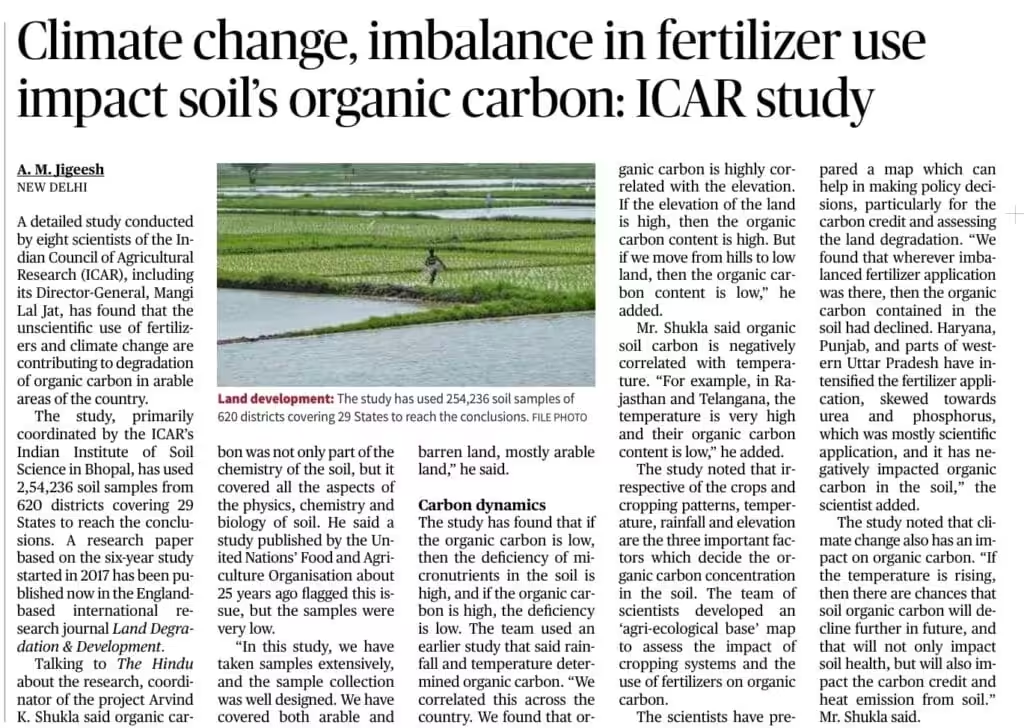
A comprehensive study by the Indian Council of Agricultural Research (ICAR) has revealed that climate change and imbalanced fertilizer use are causing a sharp decline in soil organic carbon (SOC) across India’s arable lands — posing a long-term threat to soil fertility, crop productivity, and carbon sequestration goals.
UPSC Relevance:
Environment
UPSC PYQ:
Q. Which of the following adds/add carbon dioxide to the carbon cycle on the planet Earth?
- Volcanic action
- Respiration
- Photosynthesis
- Decay of organic matter
Select the correct answer using the code given below.
a) 1 and 3 only
b) 2 only
c) 1, 2 and 4 only
d) 1, 2, 3 and 4
Key Findings of the Study:
- The study was conducted by ICAR–Indian Institute of Soil Science, Bhopal, covering
254,236 soil samples from 620 districts across 29 states — one of the most extensive soil studies in India. - Published in the international journal Land Degradation & Development.
- Findings highlight that unscientific fertilizer use, especially excess nitrogenous fertilizers (urea), and rising temperatures are leading to degradation of soil health.
Main Observations:
Decline in Soil Organic Carbon (SOC):
- SOC levels are negatively correlated with temperature — higher temperatures (as in Rajasthan & Telangana) reduce SOC.
- SOC is positively correlated with elevation — hill soils have higher organic content than lowland soils.
Impact of Fertilizer Imbalance:
- Overuse of urea and phosphorous, especially in Punjab, Haryana, and Western UP, has led to reduced SOC.
- Balanced use of organic manures and biofertilizers can mitigate this decline.
Climate Link:
- Climate change, by increasing surface temperatures, further accelerates organic carbon loss, affecting carbon credit and heat emission balance.
Soil Health Implications:
- Low SOC causes micronutrient deficiency and poor soil structure, reducing water retention and productivit
Soil Carbon:
The ideal percentage of soil organic matter and carbon contained in soil compounds is not known. Estimates have shown that 2 to 5% of the soil organic matter is microbial biomass. Some studies have found that about 50 to 90% of the organic matter in the soil is mineral-associated organic matter that will remain in the soil for a long period of time.
Carbon is Crucial?
- It’s captured in plants’ photosynthetic process by using sunlight and air to release oxygen.
- It’s nature’s free energy source for soil microbial processes and to other animals as feed.
- It’s our free energy source provided through the plants and animals we consume as food.
- It leaks from plant roots as food for soil microorganisms that bring nutrients to the plants.
- It’s contained in plant roots that provide foods for soil microorganisms.
- It provides structure in regenerating soils to help resist against soil erosion.
- It increases the cycling of plant nutrients back to newly growing plants.
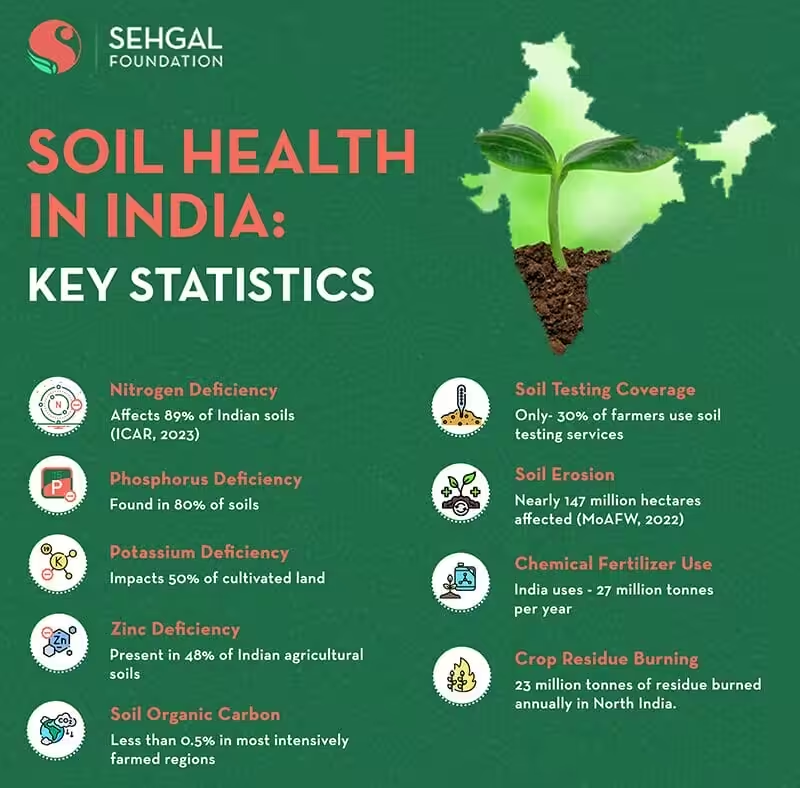
Soil Health in India:
Impacts of Soil Degradation:
- Desertification:
- Desertification can be characterized by the droughts and arid conditions the landscape endures as a result of human exploitation of fragile ecosystems. Effects include land degradation, soil erosion and sterility, and a loss of biodiversity, with huge economic costs for nations where deserts are growing.
- Loss of arable land
- Arable land is any land that can be used to grow crops. Many of the practices used in growing those crops can lead to the loss of topsoil and destruction of soil characteristics that make agriculture possible.
- Clogged and polluted waterways
- Soil eroded from the land, along with pesticides and fertilizers applied to fields, washes into streams and waterways. This sedimentation and pollution can damage freshwater and marine habitats and the local communities that depend on them.
- Increased flooding
- Land is often transformed from a forest or other natural landscape, such as floodplains and wetlands, into a crop field or pasture. The converted land is less able to soak up water, making flooding more common. There are methods to improve soil water holding capacity as well as restoration and maintenance of wetlands.
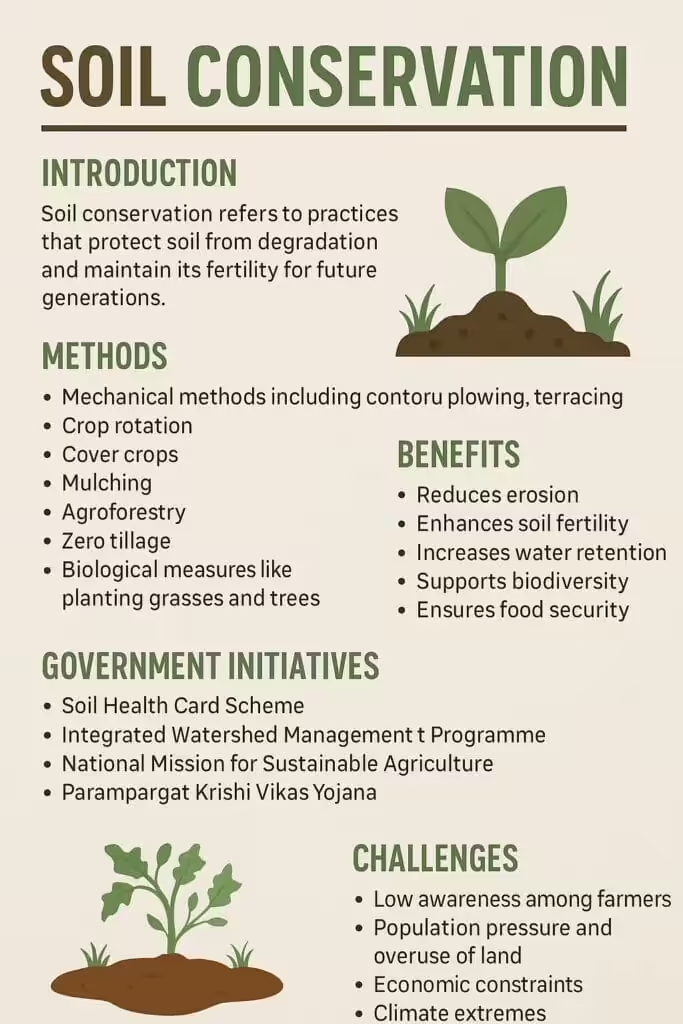
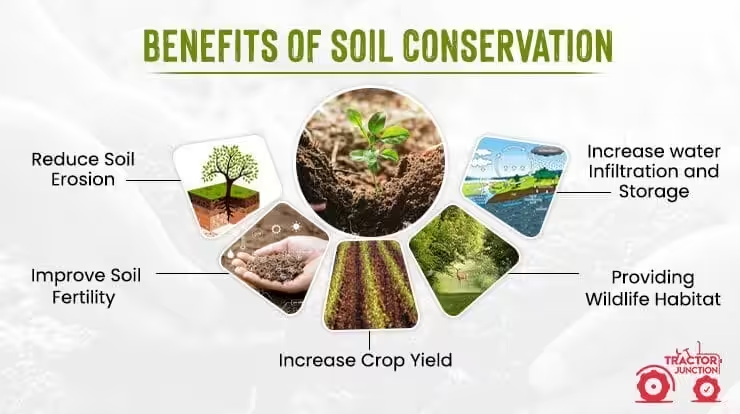
Soil Conservation:
Major schemes for soil protection:
- National Mission on Natural Farming (NMNF): Aims to improve soil health and restore ecosystems through natural farming practices, as a restructured form of the earlier Bharatiya Prakritik Krishi Paddhati (BPKP).
- Watershed Development Component of PMKSY-WDC: A part of the Pradhan Mantri Krishi Sinchayee Yojana, this program focuses on restoring degraded land and promoting sustainable land use.
- National Mission for Sustainable Agriculture (NMSA): This is an umbrella program that includes a specific focus on Soil Health Management (SHM) to make agriculture more productive, sustainable, and climate-resilient.
- Rashtriya Krishi Vigyan Yojana (RKVY): Aims to protect topsoil, improve soil fertility, and enhance crop production and productivity in watershed areas.
- Paramparagat Krishi Vikas Yojana (PKVY): Promotes organic farming to improve soil health and the organic matter content of the soil.
- National Afforestation Program and Green India Mission: These programs contribute to the goal of restoring degraded land and enhancing forest cover, which indirectly helps in soil conservation.
- Soil Health Card Scheme: Soil health card provides information to farmers on nutrient status of their soil along with recommendation on appropriate dosage of nutrients to be applied for improving soil health and its fertility.
Source: https://anantamias.com/current-affairs/climate-change-and-carbon-in-soil/
Currency Distribution

Context:
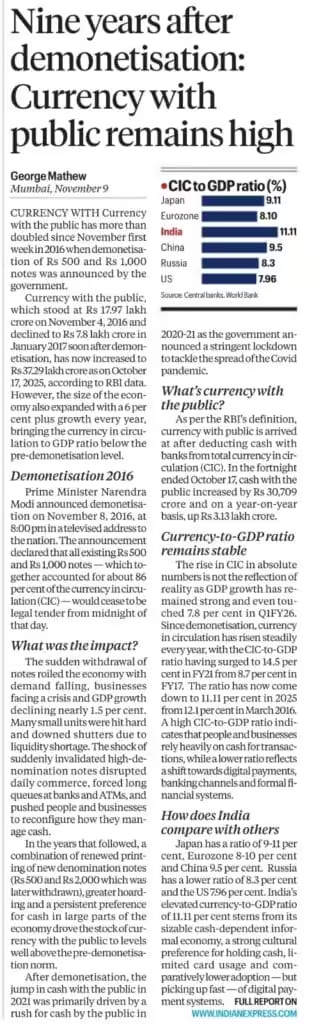
Nine years after the 2016 demonetisation drive — when ₹500 and ₹1,000 notes were invalidated — currency with the public has more than doubled, according to the Reserve Bank of India (RBI) data. Despite the government’s push for a cashless economy and digital payments, the currency-in-circulation (CIC) and currency-to-GDP ratio remain significantly high.
UPSC Relevance:
Economics (Prelims)
UPSC PYQ:
Q. Which one of the following links all the ATMs in India? (2018)
(a) Indian Banks’ Association
(b) National Securities Depository Limited
(c) National Payments Corporation of India
(d) Reserve Bank of India
Key Data Highlights:
| Indicator | 2016 (Pre-Demonetisation) | 2017 (Post-Demonetisation) | 2025 (Latest) |
|---|---|---|---|
| Currency with Public | ₹17.97 lakh crore | ₹7.8 lakh crore | ₹37.29 lakh crore |
| CIC-to-GDP Ratio | 12.1% | 8.7% (FY17) | 11.1% (FY25) |
Currency to GDP Ratio:
The currency to GDP ratio is the value of currency in circulation divided by the country’s gross domestic product. A higher ratio can indicate a larger role for cash in the economy, while a lower ratio may suggest greater use of digital payments.
The value of banknotes in circulation to GDP ratio continues to see a decline as the same fell to 11.11% in FY25 compared to 11.5% in FY24, according to the RBI annual report.

Reasons for High Cash Usage:
- Large informal sector (~85% of employment).
- Cash-driven rural economy and low financial inclusion in parts of India.
- Cultural preference for liquidity and cash security.
- Slow adoption of formal credit and banking systems.
- Festive seasons and elections often increase cash in circulation.
Implications for the Economy
- Government and RBI will likely focus on further promoting digital payments, financial literacy, and rural connectivity.
- High CIC/GDP ratio limits formalisation of the economy.
- Reflects partial success of demonetisation’s goals of curbing black money and boosting digital payments.
- Suggests a hybrid cash-digital economy, not a fully cashless one.
Prelims Pointers:
- Currency in Circulation (CIC) = Notes & coins issued by RBI minus currency held by banks.
- “Currency with the public” is the total currency in circulation (CIC) minus the cash held by banks.
Source: https://anantamias.com/current-affairs/currency-distribution/
Prelims Nuggets
Malabar Naval Exercise
- The annual Malabar naval exercise, aimed at strengthening interoperability, is set to commence in the Northern Pacific’s Guam.
- The Indian Navy has deployed its guided missile frigate, INS Sahyadri, for the mega exercise, which is hosted by the US.
- Participants: It is a multilateral naval exercise involving India, the United States, Japan, and Australia as permanent partners (often referred to as the Quad nations).
- Origin: Started in 1992 as a bilateral exercise between the navies of India and the US off the Malabar Coast.
- Japan became a permanent partner in 2015.
- Australia re-joined in 2020, making it a quadrilateral exercise.
- Location: It is generally held alternately in the Indian Ocean and the Pacific Ocean each year.
Ayni Airbase, Tajikistan

- India quietly began withdrawing its military personnel and equipment from the Ayni airbase, near Dushanbe, Tajikistan, in 2022, ending a two-decade presence.
- Initial Purpose (1990s): India first deployed personnel to support the Northern Alliance in Afghanistan against the Taliban.
- Later Use (2021): The base was used to evacuate Indians after the Taliban regained control of Afghanistan.
- Renovation: Built during the Soviet era, the base was in poor condition. India spent approximately $80 million on its renovation under a 2002 agreement, largely carried out by the Border Roads Organisation.
- Official Reason: India stated the facility was handed over after the bilateral agreement for its development concluded in 2022.
- Geopolitical Pressure (Understood): It is understood that the Tajik government was reluctant to renew the lease due to pressure from Russia and China.
- Strategic Location: The base’s location, about 20 km from Afghanistan’s Wakhan Corridor (which borders Pakistan-occupied Kashmir and China’s Xinjiang province), gave India strategic heft and supported its aim to expand influence in resource-rich Central Asia.
India’s Other Overseas Presence
- Agaléga Islands (Mauritius): India and Mauritius jointly inaugurated an airstrip and a jettybuilt by India in 2024.
- The upgraded airstrip can now support the larger P-8I maritime reconnaissance aircraft.
- Bhutan: India maintains a military training team that trains the Royal Bhutan Army (RBA) and the Royal Bodyguard of Bhutan (RBG).
- Global Context:
- India currently does not have a functional overseas military base elsewhere.
- China has an official overseas military base in Djibouti.
- The US has over a hundred overseas military bases/installations globally.
India’s First Customised Indoor Air Quality (IAQ) Scale

- Developers: A research team from BITS Pilani Hyderabad’s MMNE Lab.
- Goal: To create a simple, customised IAQ scale to help households understand indoor air health risks.
- Customization: The scale is designed specifically for India’s unique geographical, climate, population, and economic conditions.
- Four Weighted Parameters:
- Pollution Concentration: 59.5%
- Exposure Time: 25.9%
- Ventilation Efficiency: 9.8%
- Enclosure Size: 4.4%
- Score Range: The resulting score ranges from 22 (most severe) to 100 (best quality).
- Difference from Air Purifiers: Unlike high-end air purifiers that only measure particulate matter and humidity, this proposed sensor system aims to measure all critical pollutants required for a comprehensive IAQ estimate.
- Common Indoor Pollutants Identified:
- PM 2.5 and PM 10,
- carbon monoxide (CO), and
- Volatile Organic Compounds (VOCs) (from paints, cleaners, fuels).
- Benzene was identified as the most dangerous pollutant, associated with adverse health effects like cancer (WHO). It is found in petroleum products, motor fuels, and aromatic disinfectants.
- Mold (often from moisture in bathrooms and kitchens), dust mites, pet dander, and pollen.
- Radon: A radioactive gas that seeps in from the soil through cracks in a home’s foundation.
- Pesticides: Used for pest control.
- Secondhand smoke: Tobacco smoke from cigarettes.
- Unexpected Sources:
- Aromatic disinfectants are a source of Benzene.
- Incomplete burning of incense sticks in low oxygen settings produces Carbon Monoxide.
- Decaying organic waste releases methane (a powerful climate-warming gas and fire risk) and foul-smelling gases indoors.
- Fine particulate matter (PM 2.5 and PM 10 ) can rise above safe limits during routine cooking and cleaning activities.
- The Problem of Indoor Air Pollution (IAP)
- Indoor air can be two to five times more polluted than outdoor air due to trapped pollutants like construction dust.
- Despite high exposure, India currently lacks monitoring and regulations for indoor air quality.
- Health Impacts: Poor IAQ is linked to Sick Building Syndrome (headaches, fatigue) and serious conditions like asthma, COPD, cardiovascular disease, and cancer. Women and infants are the most vulnerable due to longer indoor exposure and cooking emissions.
- Simple, impactful steps to reduce IAP include:
- Improving ventilation (opening windows during low-pollution hours).
- Using exhaust fans during cooking.
- Reducing incense burning.
- Segregating organic (wet) waste to prevent methane release.
- Regular dusting, using indoor greenery, and minimizing synthetic air fresheners/harsh chemicals.
Senna Spectabilis

- Senna spectabilis, also known by common names like Calceolaria shower or Golden Shower, has become a major Invasive Alien Species (IAS) in parts of South India, causing severe ecological harm.
- Native to: Tropical areas of South and Central America (e.g., Brazil, Colombia, Peru).
- Introduced to India: It was introduced in the 1980s mainly for purposes like shade, beautification, and as a source of firewood in forest areas.
- Misleading Appearance: Its bright yellow flowers and resemblance to Kerala’s state flower (Cassia fistula) contributed to its early popularity among forestry officials.
- Location of Invasion: It has spread rapidly across the Nilgiri Biosphere Reserve (NBR), which is a critical wildlife corridor, affecting protected areas in Kerala, Karnataka, and Tamil Nadu. Key affected reserves include:
- Wayanad Wildlife Sanctuary (Kerala)
- Bandipur Tiger Reserve (Karnataka)
- Mudumalai Tiger Reserve (Tamil Nadu)
- Sathyamangalam Tiger Reserve (Tamil Nadu)
- Impact on Biodiversity:
- It forms dense, sterile thickets and its extensive, dense foliage chokes out native tree and grass species by preventing sunlight from reaching the forest floor.
- It hinders the germination and growth of native species, leading to a decline in biodiversity.
- It is reported to alter the chemical composition of the soil, making it unsuitable for other plants.
- Impact on Wildlife:
- It wipes out the food base for herbivores (like deer and gaur) by suppressing grasses and native shrubs.
- This loss of food often forces large mammals like elephants and tigers to move into human settlements, intensifying human-wildlife conflict.
- Aggressive Spread:
- It has a very fast growth rate as a single tree can produce thousands of viable seeds per season (up to 6,000 seeds/season), which remain viable for nearly a decade.
- Native mammals, notably the Asian elephant, have been identified as a major disperser of its seeds, which facilitates its spread over large areas.
GRAP Measures for Air Pollution in Delhi-NCR
- The Graded Response Action Plan (GRAP) is an emergency response framework to combat escalating air pollution levels in the Delhi-National Capital Region (NCR). It mandates progressively stricter anti-pollution measures based on the Air Quality Index (AQI) forecasts.
- Role of CAQM : The primary authority responsible for the implementation and enforcement of GRAP in the Delhi-NCR region is the Commission for Air Quality Management (CAQM).
- The CAQM is the apex body that develops, notifies, and monitors the implementation of GRAP.
- Its Sub-Committee on GRAP meets frequently to review air quality forecasts (provided by IMD/IITM) and issue necessary orders for invoking the various stages, often aiming to activate measures at least three days in advance of the projected AQI level.
- Implementing Agencies: Enforcement is carried out by numerous state-level and local agencies in Delhi and the NCR states, including:
- Delhi Pollution Control Committee (DPCC) and State Pollution Control Boards (SPCBs) of NCR states (Haryana, UP, Rajasthan).
- Municipal Corporations/Urban Local Bodies.
- Traffic Police and Transport Departments.

Source: https://anantamias.com/current-affairs/prelims-nuggets-5/