Daily Digest
UPSC · Civil Services Examination
Current Affairs · Saturday, 13 June 2026
Current affairs curated and edited by Anantam IAS faculty — pulled from The Hindu, PIB, IDSA, Foreign Affairs and the ministries. Read, annotate, revise.
Old Rajinder Nagar · Delhi 110005 · anantamias.com
Amrit Bharat Station Scheme: Reimagining India’s Railway Stations
Why in News?
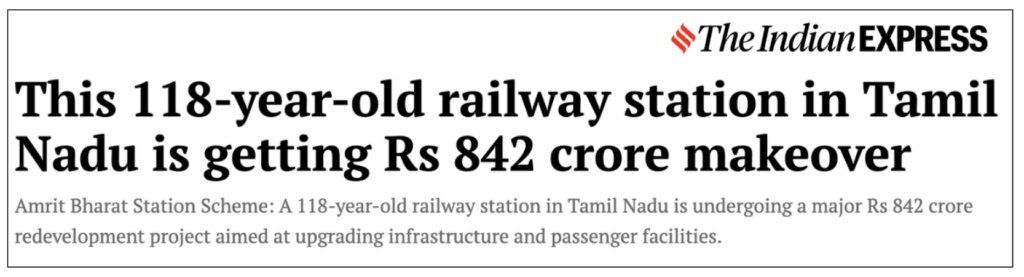
118-year-old Chennai Egmore railway station is getting a Rs 842-crore makeover, with a new multi-level parking block already opened and arrival-departure concourses under construction on both sides of the station. The terminal building, opened on 11 June 1908, is being upgraded while its heritage facade is retained.
Egmore is one of more than 1,300 stations being rebuilt under the Amrit Bharat Station Scheme (ABSS), the Ministry of Railways’ flagship station-redevelopment programme that turns ageing stations into modern, accessible, multimodal hubs and long-term city centres.
- Project cost pegged at Rs 842 crore, with a target completion window of about 36 months.
- Scope includes G+3 station buildings on the Gandhi-Irwin and Poonamallee Road sides, new concourses, foot-over-bridges and a multi-level car park.
- Total built-up area of roughly 1,35,400 sq m, integrating the station with the city on both sides.
- ABSS was launched by the Ministry of Railways in 2022; foundation stones for the first 508 stations were laid in August 2023.
- The heritage Egmore terminal facade is conserved even as the precinct is rebuilt as a transport hub.
The development matters in the context of:
- Why this matters for urban mobility: stations are being reimagined as multimodal interchanges linking rail, metro, bus and last-mile transport.
- Why this matters for heritage: ABSS bundles conservation of colonial-era railway architecture with modern passenger amenities.
- Why this matters for infrastructure financing: large station portfolios raise questions of funding, phasing and asset monetisation.
UPSC Relevance
Prelims Relevance:
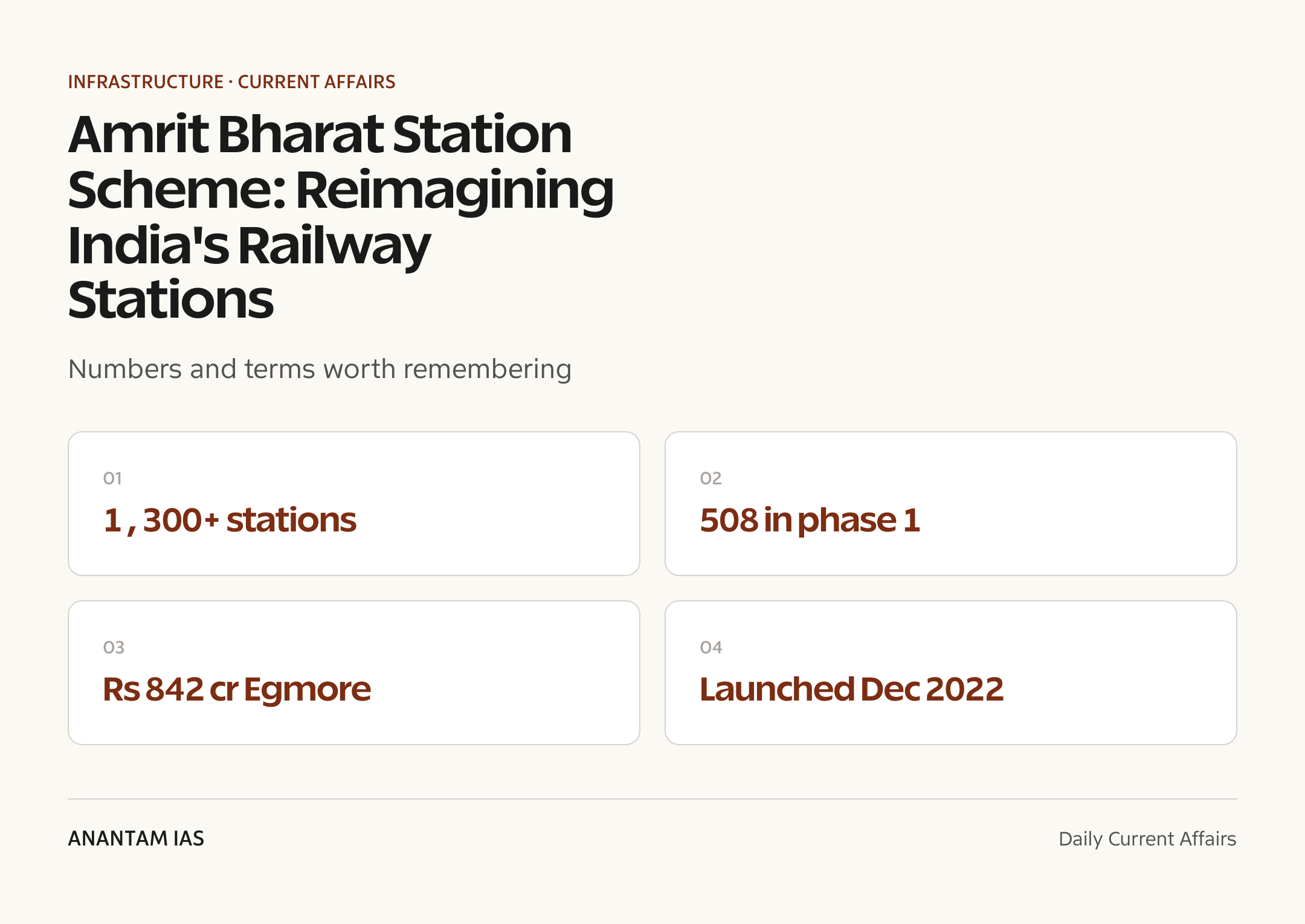
- Amrit Bharat Station Scheme was launched in 2022 by the Ministry of Railways. It is a long-term plan to improve railway stations across India in a step-by-step manner. Under this scheme, detailed plans are made for each station and the work is done in phases, based on what each station needs.
- First phase: 508 stations, foundation stones laid in 2023
- Overall coverage: more than 1,300 stations (around 1,309) across all states
- Core features: roof plazas, city integration on both sides, multimodal integration
- Accessibility: amenities for Divyangjan (persons with disabilities)
- Long-term goal: developing each station as a city centre
- Sustainability: green buildings, ballastless tracks, energy-efficient design
- Chennai Egmore terminal opened on 11 June 1908; revamp cost Rs 842 crore
- ABSS replaces and subsumes earlier station-redevelopment efforts under Indian Railways.
Mains Relevance
GS Paper 3
- Infrastructure: station redevelopment as part of Railway modernisation and the National Infrastructure Pipeline.
- Investment models, financing, and phasing of large public infrastructure portfolios.
GS Paper 1
- Conservation of built heritage (colonial-era railway architecture) amid rapid urban redevelopment.
GS Paper 2
- Inclusive public infrastructure: accessibility and Divyangjan-friendly design as a governance commitment.
Essay
- Infrastructure is the spine of a developing economy; how India rebuilds its stations is a test of that ambition.
- Preserving heritage while modernising: can old and new coexist in India’s public spaces?
Background and Context
What is the Amrit Bharat Station Scheme?
ABSS is the umbrella programme for the continuous, long-term redevelopment of India’s railway stations.
- Launched by the Ministry of Railways in December 2022, it consolidated earlier station-upgrade schemes into a single framework and sits within the broader story of Indian Railways reform.
- It covers more than 1,300 stations (about 1,309) selected across every state, ranging from major terminals to district-level junctions.
- The first tranche of 508 stations began with the laying of foundation stones by the Prime Minister in 2023.
- It follows a master-planning approach: stations are upgraded in phases based on feasibility and footfall rather than a single big-bang rebuild, complementing the network-wide planning logic of PM Gati Shakti.
Core design principles
The scheme rethinks a station as a public hub, not merely a place to board trains.
- Roof plazas over the tracks create air-conditioned waiting concourses, retail, food courts and kids’ play areas.
- Multimodal integration links the station to metro, city bus, auto and taxi stands for seamless last-mile transfer.
- Stations are connected to the city on both sides, opening up access and easing congestion at a single entrance.
- Aesthetic facades, landscaping and improved signage aim for a consistent, world-class look.
- Each station is envisaged as a future city centre with commercial and civic activity around it.
Accessibility and sustainability
Inclusive, green design is built into the brief, not bolted on.
- Dedicated amenities for Divyangjan include ramps, tactile paths, accessible toilets and lifts.
- Wider concourses, escalators and clearer wayfinding improve flow for the elderly and for families.
- Energy-efficient lighting, water recycling and green-building norms target a lower operating footprint.
- Ballastless tracks at upgraded stations reduce maintenance and improve ride quality.
Chennai Egmore: the news hook
The Egmore makeover shows how a heritage terminal is being folded into the scheme.
- The terminal building opened on 11 June 1908, making it about 118 years old, and is a recognised piece of colonial railway architecture.
- Redevelopment cost at Rs 842 crore, with a multi-level car park already commissioned.
- New G+3 station buildings are rising on both the Gandhi-Irwin Road and Poonamallee Road sides, with separate arrival and departure concourses.
- Built-up area of roughly 1,35,400 sq m is being added while the historic facade is conserved.
- It demonstrates the ABSS balance: modern hub functionality wrapped around a protected heritage shell.
Heritage conservation in railway architecture
India’s stations are among its most-used heritage assets, and ABSS treats them as such.
- Terminals like Egmore, Chhatrapati Shivaji Maharaj Terminus in Mumbai and others embody Indo-Saracenic and Victorian styles.
- The scheme’s brief retains and restores heritage facades rather than demolishing them.
- Conservation keeps living heritage in active public use, blending old frontages with new concourses behind.
- It signals a shift from purely functional upgrades toward an identity-aware redevelopment of public space.
Financing and the bigger picture
Rebuilding 1,300-plus stations is a long, capital-heavy commitment.
- The first 508 stations alone carried a combined outlay of over Rs 24,470 crore.
- Station redevelopment sits within wider Railway modernisation and the National Infrastructure Pipeline.
- Commercial development of station land and air rights is one avenue to part-fund the rebuilds, echoing the asset-monetisation debate around the National Monetisation Pipeline.
- Phasing, contractor capacity and timely completion remain the practical challenges across such a large portfolio.
Way Forward
Deliver on time and on budget
- Tighten project monitoring so flagship rebuilds like Egmore meet their 36-month windows without cost overruns.
- Build contractor and design capacity to run hundreds of station projects in parallel.
Make multimodal real
- Co-plan station redevelopment with state metro, bus and city-transport agencies so the multimodal promise is physical, not notional.
- Integrate fare, ticketing and pedestrian links across modes at the redeveloped hub.
Conserve while modernising
- Embed heritage experts in the design loop wherever a station has architectural value.
- Treat the city centre vision as an opportunity for inclusive, well-regulated commercial use, not just retail.
Conclusion
The Rs 842-crore Chennai Egmore rebuild is a single, visible instance of a much larger bet: the Amrit Bharat Station Scheme aims to convert more than 1,300 ageing stations into modern, accessible, multimodal hubs that double as city centres.
Its success will be judged less by glossy roof plazas than by on-time delivery, genuine multimodal connectivity and the care with which heritage facades like Egmore’s are preserved. For UPSC, ABSS is a clean case study in linking infrastructure modernisation, urban mobility, accessibility and heritage in one programme.
UPSC Practice Questions
Prelims MCQ 1
With reference to the Amrit Bharat Station Scheme (ABSS), consider the following statements:
- It is implemented by the Ministry of Railways.
- It covers more than 1,300 railway stations across India.
- It mandates amenities for Divyangjan and roof plazas as part of its design brief.
How many of the above statements are correct?
(a) Only one (b) Only two (c) All three (d) None
Answer: (c) All three
Explanation:
ABSS is a Ministry of Railways scheme covering 1,300-plus stations, with Divyangjan amenities, multimodal integration and roof plazas built into its design principles. All three statements are correct.
Prelims MCQ 2
The Amrit Bharat Station Scheme is most directly associated with which sector?
(a) Rural drinking-water supply
(b) Railway station redevelopment
(c) Urban housing for the poor
(d) Renewable-energy generation
Answer: (b) Railway station redevelopment
Explanation:
ABSS, launched in December 2022, is the Ministry of Railways’ programme for redeveloping railway stations into modern multimodal hubs; the other options are unrelated schemes.
UPSC Mains Questions
- The Amrit Bharat Station Scheme reimagines railway stations as city centres rather than mere transit points. Examine its design principles and the challenges in delivering such a large station-redevelopment portfolio on time. (250 words)
- Modernising public infrastructure often collides with the need to preserve built heritage. Using the redevelopment of heritage railway terminals as an example, discuss how India can balance the two. (250 words)
- Discuss the role of multimodal integration in India’s urban mobility, drawing on recent railway station-redevelopment efforts. (150 words)
Sources: Indian Express and PIB, Ministry of Railways.
Frequently Asked Questions
What is the Amrit Bharat Station Scheme?
It is the Ministry of Railways’ flagship programme, launched in December 2022, to redevelop railway stations across India. It reimagines stations as modern, accessible, multimodal hubs with roof plazas, improved facades and city integration on both sides, and aims to develop them as long-term city centres.
How many stations does ABSS cover?
ABSS covers more than 1,300 stations (about 1,309) selected across every state. The first phase of 508 stations began in August 2023, when foundation stones were laid, and work has since extended to many more stations in subsequent phases.
Why is Chennai Egmore in the news?
Indian Express reported a Rs 842-crore makeover of the 118-year-old Chennai Egmore station under ABSS. A multi-level car park has opened, and new G+3 buildings with concourses are being built on both sides while the heritage facade is conserved.
What are the core features of ABSS?
Key features include roof plazas over the tracks, multimodal integration with metro and bus, connection to the city on both sides, amenities for Divyangjan, energy-efficient green buildings, ballastless tracks and a long-term plan to turn each station into a city centre.
How is heritage handled under the scheme?
Where a station has architectural value, the scheme retains and restores its heritage facade rather than demolishing it. New concourses and buildings rise behind or beside the historic frontage, keeping living heritage like the Egmore terminal in active public use.
Who funds and builds these stations?
Indian Railways funds the redevelopment, with the first 508 stations alone carrying an outlay of over Rs 24,470 crore. Work is executed by appointed contractors under master plans, and commercial use of station land and air rights is one avenue to part-fund the rebuilds.
Source: https://anantamias.com/current-affairs/amrit-bharat-station-scheme-2026/
Coal Exchanges: Why India Is Moving to Market-Based Coal Trading
Why in News?
The Ministry of Coal has notified the Coal Exchange Rules, 2026, creating the legal scaffolding for organised coal exchanges where producers and buyers can trade on a common electronic platform. A Hindu editorial titled the move long overdue, arguing that transparent market-based price discovery for India’s most-used fuel is decades behind the rest of the energy economy.
The rules flow from the Mines and Minerals (Development and Regulation) Amendment Act, 2025, which inserted the concept of a Mineral Exchange and empowered the Centre to promote competitive trading of minerals, including coal and its processed forms. They mark the most structural shift in coal marketing since the 2020 commercial-mining auctions ended the old state monopoly on commercial sales.
- Coal Exchange Rules, 2026 notified and gazetted on June 4, 2026 by the Ministry of Coal.
- Legal basis is the MMDR Amendment Act, 2025, which created the Mineral Exchange concept.
- The Coal Controller Organisation (CCO) was designated in December 2025 as the authority to register and regulate exchanges.
- Exchange registrations are granted for a 25-year term.
- Design shifts coal from a one-to-many seller model to a many-to-many competitive marketplace.
- Commercial and captive miners gain direct access to a wider pool of buyers.
The development matters in the context of:
- Coal still supplies roughly three-quarters of India’s electricity generation, so its pricing shapes power tariffs across the grid.
- Price discovery has long been administered or auction-driven rather than continuous and market-cleared.
- An exchange parallels the maturing of power exchanges and the gas exchange, completing the energy-trading architecture.


UPSC Relevance
Prelims Relevance
- Coal Exchange Rules, 2026 — notified by the Ministry of Coal, June 2026.
- MMDR Amendment Act, 2025 — introduced the Mineral Exchange concept.
- Coal Controller Organisation (CCO) — registering and regulating authority for exchanges.
- Coal India Limited (CIL) — Maharatna PSU, dominant domestic producer.
- Commercial coal mining auctions began in 2020 under the MMDR and CMSP Acts.
- SHAKTI scheme (2017) — transparent allocation of coal linkages to power plants.
- Power exchanges such as the Indian Energy Exchange (IEX) trade electricity contracts.
- Indian Gas Exchange (IGX) — the country’s gas-trading platform.
- Coal sector nationalised in the 1970s; CIL set up in 1975.
- Exchange registration term is fixed at 25 years.
Mains Relevance
GS Paper 3
- Infrastructure and energy: how market-based price discovery improves efficiency in the coal supply chain.
- Liberalisation of a state-dominated sector — from monopoly to commercial mining to organised exchange trading.
- Energy-transition tension: deepening coal markets even as India targets net-zero by 2070.
GS Paper 2
- Role of regulatory bodies (CCO) and the Centre-State sharing of coal royalties and revenues in a federal economy.
Essay
- Markets versus the state: who should price a strategic public resource?
- Reform by design — building institutions before crises force them.
Background and Context
From Nationalisation to a State Monopoly
India’s coal economy began as a tightly controlled public enterprise, and that legacy still frames every reform.
- Coal mines were nationalised across 1971–73; Coal India Limited (CIL) was incorporated in 1975 as the holding company.
- For decades, CIL set notified prices administratively, with supply rationed through Fuel Supply Agreements (FSAs).
- Private mining was permitted only for captive use — a plant could mine coal for its own boilers, not to sell.
- The result was a one-to-many market: a dominant seller, administered prices, and little continuous price signal — the backdrop to India’s wider coal sector reforms.

The 2020 commercial mining break:
The first big structural opening came when the captive-only rule was scrapped.
- In 2020, the government auctioned coal blocks for commercial mining, ending CIL’s monopoly on commercial sales.
- Backed by the MMDR Act and the Coal Mines (Special Provisions) Act, bidders bid a revenue share to the State.
- Captive miners were later allowed to sell surplus output in the open market, blurring the captive-commercial line.
- These reforms widened the seller base but still lacked a neutral, transparent trading venue.
How is coal allocated today?
Multiple parallel channels move coal from the pithead to the plant, each with its own pricing logic.
- Linkages: long-term supply commitments, with power-sector linkages auctioned transparently under the SHAKTI scheme of 2017.
- E-auctions: CIL sells a slice of output through spot and forward e-auctions, often at a premium over notified prices.
- Captive and commercial blocks: producers consume or sell their own mined coal.
- Imports: coastal and blending demand is met by seaborne coal priced off global indices.

What does a coal exchange change?
The exchange model layers a continuous, neutral marketplace on top of these channels.
- It converts a one-to-many model into a many-to-many platform where many sellers meet many buyers.
- Standardised contracts and electronic matching enable transparent, market-driven price discovery in near real time.
- The Coal Controller Organisation (CCO) registers and regulates exchanges, with registrations valid for 25 years.
- Smaller buyers and merchant power plants get access without locking into long-term linkages.
The energy-market parallel:
Coal is the last big energy commodity to get its own exchange, and the templates already exist.
- Power exchanges such as the Indian Energy Exchange (IEX) already clear day-ahead and term electricity contracts.
- The Indian Gas Exchange (IGX) brought spot gas trading and price discovery to natural gas.
- A coal exchange completes the trio, letting fuel and power markets send consistent signals.
- Transparent coal prices feed directly into power tariffs, since coal-fired plants generate the bulk of the grid.
The energy-transition tension
Deepening coal markets sit awkwardly beside India’s decarbonisation pledges, and the editorial flags this.
- India has pledged net-zero by 2070 and a steep rise in non-fossil capacity, yet coal still anchors baseload power.
- Efficient coal pricing can lower power costs in the near term but risks entrenching fossil dependence.
- Carbon costs and a just transition for coal-belt workers are not priced into an exchange by design.
- A liquid coal market could, paradoxically, make it easier to retire inefficient plants by exposing true fuel costs.
Risks and open questions
An exchange is a tool, not a cure — its credibility depends on liquidity, oversight and fair access.
- Thin volumes could let a few large sellers dominate, defeating the price-discovery goal.
- Logistics — railway rakes and evacuation infrastructure — must keep pace, or contracts cannot be honoured.
- Quality grading and dispute settlement need robust, independent standards.
- Centre-State coordination matters, since coal royalties are a major revenue source for mining States.
Way Forward
Build liquidity early
- Mandate that a meaningful share of CIL and commercial output routes through the exchange to seed volumes.
- Onboard merchant power plants, cement and steel buyers to broaden participation.
Strengthen the plumbing
- Align rake availability and logistics so traded contracts are physically deliverable.
- Set transparent quality grading, settlement and grievance mechanisms under the CCO.
Keep the transition in view
- Use the price transparency to identify and phase out the least-efficient plants.
- Pair market reform with a just-transition plan for coal-dependent districts and workers.
Conclusion
A coal exchange finally gives India’s most-used fuel the kind of transparent, continuous pricing that electricity and gas already enjoy. It completes a reform arc that runs from nationalisation, through commercial mining, to an open marketplace.
The payoff — lower transaction costs, fairer access and clearer signals — depends on liquidity, logistics and credible regulation. Done well, it could even sharpen India’s energy transition by exposing the true cost of coal-fired power.
UPSC Practice Questions
Prelims MCQ 1
With reference to the Coal Exchange Rules, 2026, consider the following statements:
- They derive their legal authority from the MMDR Amendment Act, 2025.
- The Coal Controller Organisation is designated to register and regulate coal exchanges.
- A coal exchange registration, once granted, is valid for a 25-year period.
How many of the above statements are correct?
(a) Only one (b) Only two (c) All three (d) None
Answer: (c) All three
Explanation:
The 2026 Rules flow from the MMDR Amendment Act, 2025 (which created the Mineral Exchange concept); the CCO is the registering and regulating authority; and registrations are granted for 25 years.
Prelims MCQ 2
Which of the following is correctly matched as an energy-trading platform in India?
(a) IEX — natural gas spot trading (b) IGX — electricity day-ahead market (c) Coal Controller Organisation — regulator for coal exchanges (d) SHAKTI — a commodity exchange for imported coal
Answer: (c) Coal Controller Organisation — regulator for coal exchanges
Explanation:
The CCO regulates coal exchanges. IEX trades electricity (not gas), IGX trades gas (not electricity), and SHAKTI is a coal-linkage allocation scheme, not an exchange.
UPSC Mains Questions
- India’s coal sector has moved from a nationalised monopoly to commercial mining and now to organised exchanges. Trace this reform arc and assess how market-based price discovery can improve efficiency in the coal supply chain. (250 words)
- A coal exchange deepens fossil-fuel markets even as India pledges net-zero by 2070. Examine whether transparent coal pricing helps or hinders the energy transition. (250 words)
- Discuss the institutional and logistical prerequisites — liquidity, regulation, evacuation infrastructure and Centre-State coordination — that will determine whether India’s coal exchanges succeed. (150 words)
Sources: Ministry of Coal and The Hindu (editorial).
Frequently Asked Questions
What is a coal exchange?
A coal exchange is an electronic marketplace where many sellers and many buyers trade coal under standardised contracts, allowing transparent, market-driven price discovery. India notified the Coal Exchange Rules, 2026, in June 2026 to set up such platforms, regulated by the Coal Controller Organisation, moving beyond the older system of administered prices, linkages and one-off e-auctions.
How is this different from the SHAKTI scheme?
SHAKTI, launched in 2017, is a policy for transparently allocating long-term coal linkages to power plants. A coal exchange is a continuous trading venue for spot and term coal contracts. SHAKTI assigns supply commitments; the exchange lets buyers and sellers transact freely and discover prices in near real time, complementing rather than replacing linkages.
Does the exchange end Coal India’s role?
No. Coal India Limited remains the dominant domestic producer. The exchange simply gives CIL, commercial miners and captive producers a neutral platform to sell, and gives buyers wider access. CIL’s notified prices, linkages and e-auctions continue, but the exchange adds a transparent market layer on top of them.
Why does coal pricing matter for power tariffs?
Coal-fired plants generate the bulk of India’s electricity, so the price of coal is a major component of the cost of power. More transparent and competitive coal pricing can lower input costs for generators, sharpen the signal of which plants are efficient, and ultimately influence the tariffs that distribution companies and consumers pay.
How does this relate to power and gas exchanges?
It completes India’s energy-trading architecture. Power exchanges such as the Indian Energy Exchange already clear electricity contracts, and the Indian Gas Exchange trades natural gas. A coal exchange brings the same transparency to the fuel that underpins much of the grid, so fuel and power markets can send consistent price signals.
What are the main risks?
Thin trading volumes could let a few large sellers dominate prices, defeating the purpose. Physical delivery depends on railway rakes and evacuation infrastructure keeping pace. Quality grading and dispute settlement need credible standards, and because coal royalties fund mining States, Centre-State coordination is essential for the system to work fairly.
Source: https://anantamias.com/current-affairs/coal-exchanges-power-market-reform-2026/
Great Nicobar Project: Coral Translocation and the Development-vs-Ecology Debate
Why in News?
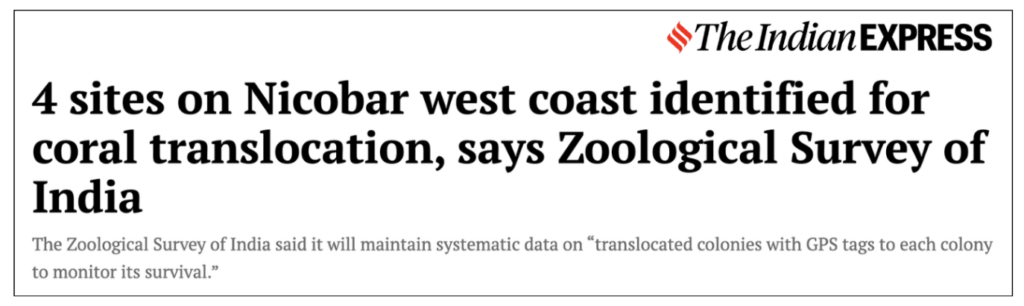
The Zoological Survey of India (ZSI) has identified four new sites on the west coast of Great Nicobar Island to which coral colonies and Giant Clams threatened by the proposed transhipment port at Galathea Bay will be relocated, according to biodiversity-committee minutes that the Andaman and Nicobar Islands Integrated Development Corporation (ANIIDCO) made public recently.
- ZSI reported the four translocation sites to the biodiversity committee overseeing the project’s environmental management plan; each relocated colony is to carry a GPS tag to track its survival.
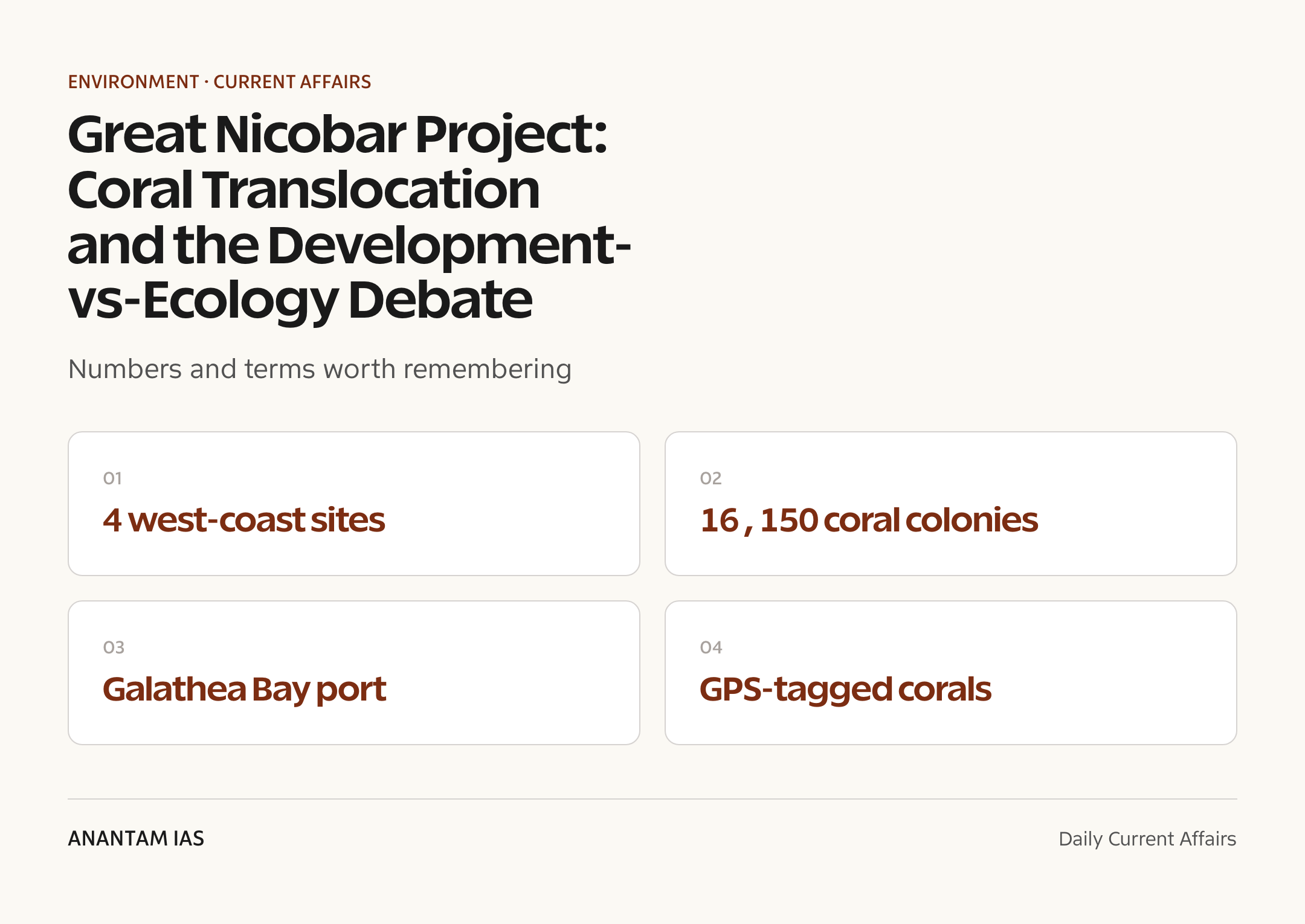
- Environmental clearance conditions require moving an estimated 16,150 coral colonies out of the Galathea Bay impact zone before port work proceeds.
- A National Green Tribunal direction stressed coral-reef protection and monitoring as a condition of the project going forward.
Separately, Congress leader and former environment minister Jairam Ramesh wrote to Defence Minister Rajnath Singh, urging the government to reconsider rejecting an expansion of the existing INS Baaz airbase in favour of a new greenfield civilian-cum-military airport, on ecological grounds.
- Ramesh argues expanding INS Baaz at Campbell Bay would cause far less ecological damage than the greenfield airport at Gandhi Nagar–Shastri Nagar, which needs felling forested hills and reclaiming coastline.
The development matters in the context of:
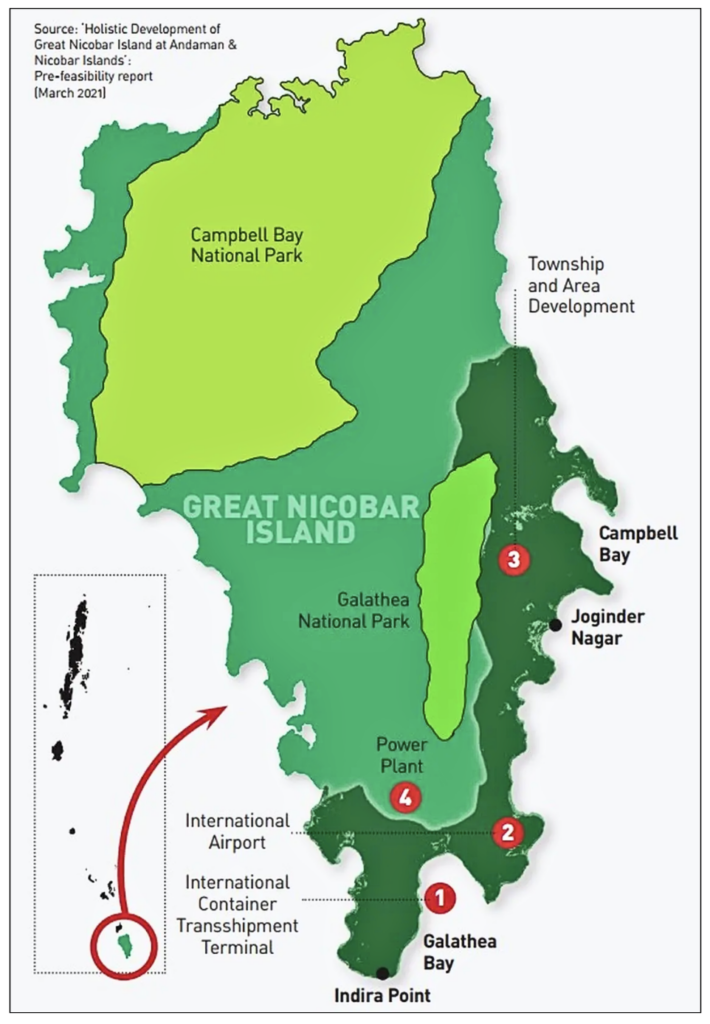
- The Great Nicobar Development Project bundles a mega transhipment port, an international airport, a township and a power plant on one of India’s most biodiverse and strategically located islands.
- It sits at the heart of a classic development-versus-ecology trade-off — strategic infrastructure on the Malacca approaches against irreplaceable rainforest, reefs and tribal reserves.
UPSC Relevance
Prelims Relevance
- Great Nicobar Island is the southernmost island of the Andaman and Nicobar chain; Indira Point is India’s southernmost land tip.
- Galathea Bay is a key nesting beach for the Leatherback turtle (Dermochelys coriacea), the world’s largest sea turtle.
- The Nicobar Megapode (Megapodius nicobariensis) is an endemic mound-building bird found on these islands.
- Shompen and Nicobarese are the two tribal groups of Great Nicobar; the Shompen are a Particularly Vulnerable Tribal Group (PVTG).
- Coral translocation physically moves reef colonies to a new substrate; success depends on light, water flow, temperature and reduced transplant stress.
- Giant Clams (Tridacna) are listed under Schedule I of the Wildlife (Protection) Act, 1972, and CITES Appendix II.
- The Zoological Survey of India (ZSI), under the environment ministry, is the nodal body for faunal survey and identification.
- The project lies in a Coastal Regulation Zone (CRZ); the most protected ecologically sensitive stretch is classed ICRZ-1A.
- The Great Nicobar Biosphere Reserve includes the Galathea National Park and Campbell Bay National Park.
- Environmental clearance for such projects flows from the EIA Notification, 2006, under the Environment (Protection) Act, 1986.
Mains Relevance
GS Paper 3
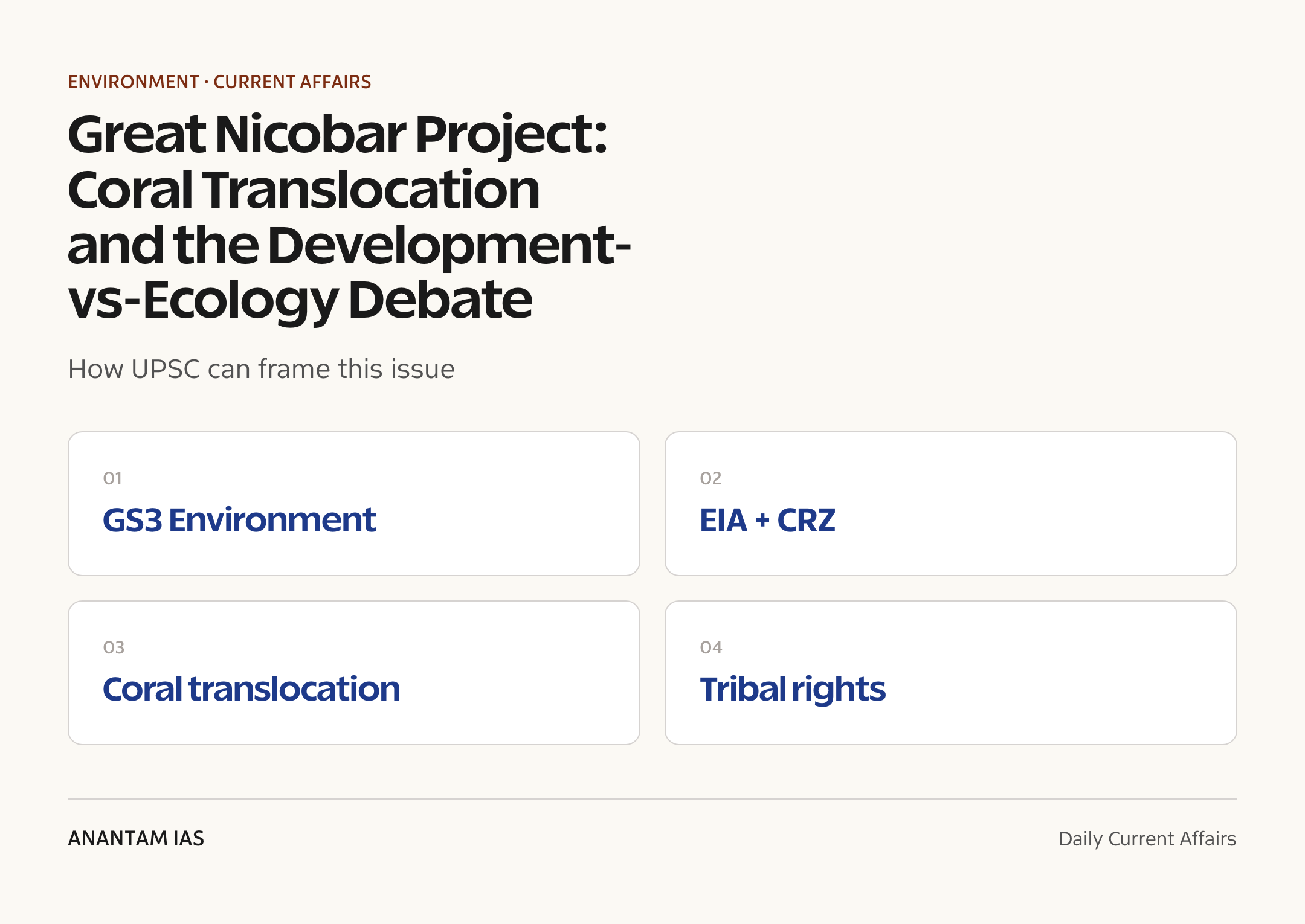
- Coral-reef ecology and the scientific limits of translocation as a biodiversity-offset tool.
- Balancing strategic infrastructure with conservation under the EIA 2006 and CRZ regimes.
GS Paper 2
- Rights and consent of PVTGs such as the Shompen, under the Forest Rights Act and PESA-style protections.
- Institutional accountability — the role of expert committees, the NGT and impact-assessment processes.
Essay
- Development and conservation need not be adversaries, but the burden of proof lies on the disruptor.
- What we lose when we trade an irreplaceable ecosystem for a replaceable asset.
Background and Context
What is the Great Nicobar Project?
The project is a single mega-development reshaping the island’s southern tip.
- It comprises an International Container Transhipment Terminal at Galathea Bay, a greenfield airport, a power plant and a township, steered by NITI Aayog and executed through ANIIDCO (see our explainer on the Great Nicobar Island Project).
- The port is pitched to capture transhipment traffic on the Malacca Strait sea lane that India currently cedes to Colombo, Singapore and Klang.
- Great Nicobar’s location near the Indo-Pacific chokepoints gives the project a strong strategic-infrastructure rationale.
- Critics counter that it disturbs the primary rainforest, a biosphere reserve and tribal reserves that took millennia to form.
Galathea Bay and the coral question
The port site overlaps a living reef, forcing a large coral-relocation exercise.
- Surveys logged about 20,668 coral colonies across a roughly 10-hectare study area at Galathea Bay.
- Clearance conditions require translocating an estimated 16,150 colonies, with several thousand more still under observation for relocation decisions.
- ZSI has now picked four sites on the island’s west coast as recipient reefs and is procuring survey equipment and manpower for the move.
- Giant Clams are to be shifted alongside the corals, and every relocated colony will be GPS-tagged to monitor survival.
Why is coral translocation hard?
Moving a reef is not the same as saving it; the science is uncertain.
- Corals are colonial animals living in symbiosis with zooxanthellae algae; transplant stress can trigger bleaching and death (see our notes on India’s coral atoll territory).
- Recipient sites must match the donor reef in depth, light, temperature and water flow, or survival rates fall sharply.
- Independent reef biologists have publicly questioned whether thousands of colonies can be moved at scale without heavy mortality.
- Long-term monitoring of GPS-tagged colonies is essential, but offsets rarely recreate the structural complexity of an intact reef.
Leatherbacks, megapodes and other wildlife
Galathea Bay is among India’s most important nesting habitats.
- The bay is a globally significant nesting beach for the endangered Leatherback turtle; recent Wildlife Institute of India surveys logged scores of nests.
- The endemic Nicobar Megapode, which incubates eggs in mounds of warm decaying vegetation, has dozens of monitored nesting mounds on the island.
- Tracking covers saltwater crocodiles, the Nicobar long-tailed macaque and the giant Robber Crab.
- Conservation field stations have been set up at Campbell Bay and elsewhere on the island for megapode and macaque studies.
Tribal reserves and the Shompen
The island is home to two indigenous groups whose consent is contested.
- The Shompen are a small, semi-nomadic forest-dwelling PVTG; the Nicobarese are a larger settled community (more on India’s Particularly Vulnerable Tribal Groups).
- Activists and anthropologists argue that the project encroaches on tribal reserve land and that genuine free, prior and informed consent was not obtained.
- Protections under the Forest Rights Act, 2006 and the special status of A&N tribal reserves are central to the legal dispute.
- Past relocations of island communities make the question of displacement and cultural survival especially sensitive.
The INS Baaz Airbase Row:
A fresh argument has opened over how to add air capacity with the least damage.
- INS Baaz, commissioned at Campbell Bay in 2012, is the southernmost air station, whose runway was recently lengthened to about 4,500 feet.
- Jairam Ramesh proposes extending that runway to around 10,000 feet as a less destructive alternative to the new greenfield airport.
- The greenfield airport at Gandhi Nagar–Shastri Nagar, designated dual-use by the Home Ministry in 2022, would need to cut forested hills and use the ICRZ-1A coastline.
- The Defence Ministry has reportedly favoured the greenfield option; Ramesh says distinguished naval voices back the INS Baaz route instead.
The regulatory and legal frame
Several environmental laws and forums govern the project.
- Clearance rests on the EIA Notification, 2006, and the CRZ Notification, 2019, with the most sensitive stretch protected as ICRZ-1A (see our guide to the Coastal Regulation Zone).
- The National Green Tribunal has examined the project and issued directions, including on coral-reef protection, while allowing it to proceed.
- A high-powered committee and the biodiversity committee under ANIIDCO monitor mitigation, with periodic minutes placed in the public domain.
- Compliance with offset and monitoring conditions, rather than the clearance itself, is now the live battleground.
Way Forward
Make offsets verifiable
- Publish open, time-series data on every GPS-tagged coral colony and Giant Clam, with independent third-party audits of survival rates.
- Treat translocation as an experiment with measurable success thresholds, not a box-ticking biodiversity offset.
Honour tribal rights
- Ensure documented free, prior and informed consent from the Shompen and Nicobarese and full Forest Rights Act due process before further land diversion.
- Keep the core tribal reserve and PVTG habitat off-limits to construction.
Seriously evaluate the least-damaging engineering option for air capacity — including the proposed INS Baaz runway extension — through a transparent comparative assessment, rather than defaulting to a greenfield site in primary forest and ICRZ-1A coastline.
Conclusion
The Great Nicobar Project crystallises the hardest question in India’s growth story: how to build strategic infrastructure without erasing ecosystems and communities that cannot be rebuilt.
Coral translocation and the INS Baaz debate show the test is no longer whether to develop, but whether mitigation is real, consent is genuine, and the least-damaging path is honestly chosen and independently verified.
UPSC Practice Questions
Prelims MCQ 1
With reference to the Great Nicobar Project, consider the following statements:
- Galathea Bay, the proposed port site, is an important nesting beach for the Leatherback turtle.
- The Zoological Survey of India has been tasked with translocating coral colonies threatened by the project.
- The Shompen are a Particularly Vulnerable Tribal Group living on Great Nicobar Island.
How many of the above statements are correct?
(a) Only one (b) Only two (c) All three (d) None
Answer: (c) All three
Explanation:
Galathea Bay is a key Leatherback turtle nesting site, the ZSI is undertaking the coral and Giant Clam translocation, and the Shompen are a PVTG of Great Nicobar. All three statements are correct.
Prelims MCQ 2
In the context of coral reefs, the colourful corals draw much of their nutrition from a symbiotic relationship with which of the following?
(a) Nitrogen-fixing bacteria
(b) Zooxanthellae algae
(c) Mangrove root fungi
(d) Planktonic diatoms
Answer: (b) Zooxanthellae algae
Explanation:
Reef-building corals host symbiotic zooxanthellae algae, which photosynthesise and supply most of the coral’s energy. Loss of these algae under stress causes coral bleaching.
UPSC Mains Questions
- The Great Nicobar Project illustrates the tension between strategic infrastructure and ecological conservation. Critically examine the environmental and tribal-rights concerns it raises, and suggest how such trade-offs should be governed. (250 words)
- Coral translocation is increasingly used as a biodiversity offset for coastal mega-projects. Discuss the ecological basis of coral reefs and the scientific challenges that limit the success of large-scale translocation. (250 words)
- Examine the role of impact-assessment processes, expert committees and the National Green Tribunal in ensuring that environmental clearances translate into genuine on-ground mitigation. (150 words)
Sources: Andaman and Nicobar Islands Integrated Development Corporation (ANIIDCO) and The Tribune / Indian Express.
Frequently Asked Questions
What is coral translocation in the Great Nicobar Project?
It is the physical relocation of living coral colonies and Giant Clams away from the Galathea Bay port construction zone to recipient reefs elsewhere. The Zoological Survey of India has identified four sites on Great Nicobar’s west coast and plans to GPS-tag each relocated colony to monitor its survival, as a condition of the project’s environmental clearance.
How many coral colonies are to be moved?
Environmental clearance conditions require translocating an estimated 16,150 coral colonies from the Galathea Bay impact area, drawn from roughly 20,668 colonies recorded across a 10-hectare survey zone. Several thousand more colonies remain under observation while relocation decisions are finalised by the ZSI and the monitoring committee.
Why is Galathea Bay ecologically important?
Galathea Bay is one of India’s most significant nesting beaches for the endangered Leatherback turtle, the largest living sea turtle. The surrounding waters hold dense coral reefs and Giant Clams, while the island supports the endemic Nicobar Megapode, saltwater crocodiles and other rare species, making it a globally important biodiversity site.
What is the INS Baaz controversy about?
Jairam Ramesh has urged the Defence Minister to expand the existing INS Baaz airbase at Campbell Bay, lengthening its runway, instead of building a new greenfield airport at Gandhi Nagar–Shastri Nagar. He argues the greenfield site needs felling forested hills and using highly protected ICRZ-1A coastline, causing far greater ecological damage than expanding the established base.
Who are the Shompen and Nicobarese?
They are the two indigenous communities of Great Nicobar Island. The Shompen are a small, semi-nomadic forest-dwelling Particularly Vulnerable Tribal Group, while the Nicobarese are a larger settled community. Concerns centre on whether the project encroaches on their tribal reserves and whether free, prior and informed consent was genuinely obtained.
Does the project have environmental clearance?
Yes. The project received environmental clearance under the EIA Notification, 2006, and coastal clearance under the CRZ framework, and the National Green Tribunal has allowed it to proceed while issuing directions, including on coral-reef protection. The current debate is mainly about whether the attached mitigation and monitoring conditions are being honoured in practice.
Source: https://anantamias.com/current-affairs/great-nicobar-coral-translocation-2026/
India-France Strategic Partnership: What Underpins the Ties as PM Visits Paris
Why in News?
The Prime Minister travelled to Paris for a fresh bilateral summit with the French leadership, refreshing one of India’s oldest and most trusted strategic relationships and reviewing progress across its full spectrum of cooperation.
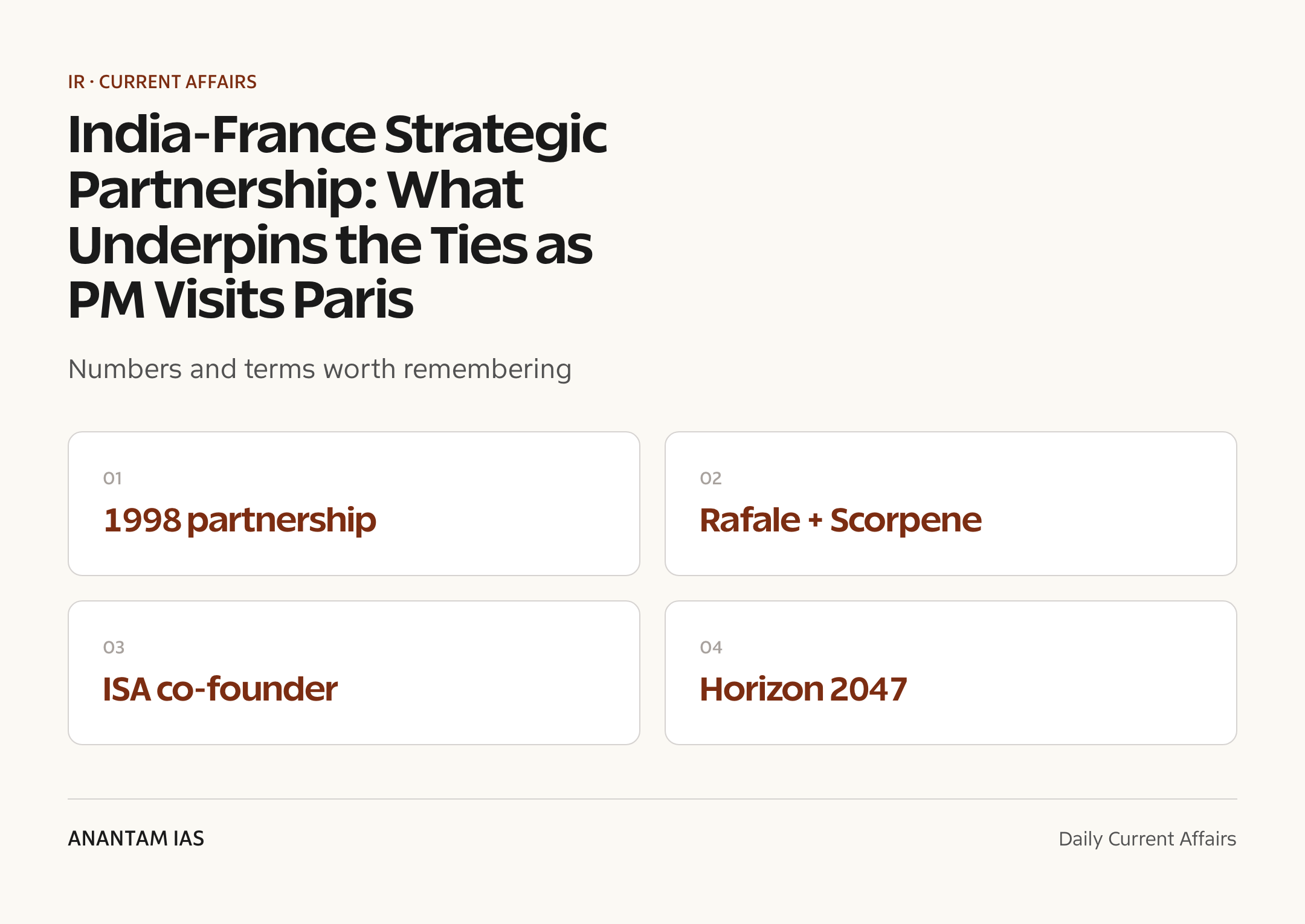
France was the first country with which India signed a Strategic Partnership agreement in 1998, soon after the Pokhran-II nuclear tests, when Paris broke from the Western consensus and chose engagement over sanctions.
- The relationship rests on a long-term roadmap, Horizon 2047, adopted in 2023 to mark a century of partnership leading up to India’s centenary of independence.
- France is among India’s top arms suppliers, having sold the Rafale fighter, Scorpene submarines and earlier Mirage 2000 jets.
- Both countries are co-founders of the International Solar Alliance (ISA), launched at the 2015 Paris climate conference.
- France has consistently backed India’s bid for permanent membership of a reformed UN Security Council and entry into export-control regimes.
The development matters in the context of:
- France is a resident power in the Indo-Pacific, with island territories such as Reunion and a large exclusive economic zone, making it a natural maritime partner for India.
- Unlike many Western capitals, Paris has rarely linked defence and technology cooperation with India to political conditions, building durable strategic trust.
UPSC Relevance
Prelims Relevance
- India-France Strategic Partnership signed in 1998 — India’s first such partnership.
- Horizon 2047 roadmap (adopted 2023) — long-term India-France cooperation framework.
- International Solar Alliance — co-launched by India and France in 2015; headquartered at Gurugram.
- Rafale (Dassault), Scorpene submarines (Naval Group, Project-75), Mirage 2000 — French-origin platforms in Indian service.
- CNES is France’s space agency; it partners with ISRO on missions like Megha-Tropiques, SARAL/AltiKa and TRISHNA.
- Varuna (navy), Garuda (air force) and Shakti (army) are the three India-France bilateral military exercises.
- France is a P5 member of the UN Security Council and supports India’s permanent seat.
- France backed India’s entry into the MTCR, Wassenaar Arrangement and Australia Group, and supports NSG membership.
Mains Relevance
GS Paper 2
- India-France ties are a model of a strategic autonomy-friendly partnership in a multipolar world.
- Significance of France in India’s Indo-Pacific strategy and defence indigenisation push.
GS Paper 3
- Defence cooperation and ‘Make in India’ technology transfer through French platforms.
- Civil nuclear and space cooperation as drivers of high-technology self-reliance.
Essay
- Trust as the currency of durable international partnerships in a multipolar world.
Background and Context
Why France is a trusted partner
The relationship is built on convergence and a consistent refusal by Paris to apply external pressure on Delhi.
- France did not impose sanctions after the Pokhran-II tests in 1998 and instead pushed for dialogue, unlike the United States and several others.
- It became the first Western power to sign a formal Strategic Partnership with India in the same year.
- Both are strategically autonomous democracies wary of a single dominant pole, which aligns their worldviews.
- France has rarely conditioned defence or nuclear cooperation on India’s internal politics, a key source of strategic trust.
The defence pillar
Defence is the most visible strand, spanning aircraft, submarines and a growing ‘Make in India’ agenda.
- Dassault Rafale jets serve in the Indian Air Force, with a follow-on order of Rafale-Marine for the Navy’s carriers.
- Scorpene-class submarines are built at Mazagon Dock under Project-75 with France’s Naval Group, with additional units agreed.
- Earlier inductions include the Mirage 2000 fighter and the Jaguar engines, embedding French technology in India’s fleet.
- The two armed forces hold three bilateral exercises — Varuna (naval), Garuda (air) and Shakti (army).
- Co-development and technology transfer — including aero-engine and submarine-tech talks — anchor India’s defence indigenisation drive.
Civil nuclear and space
High-technology cooperation extends from atomic energy to Earth observation and human spaceflight.
- France’s EDF is the technology partner for the proposed Jaitapur nuclear plant in Maharashtra — envisaged among the world’s largest, with six EPR reactors.
- ISRO and France’s space agency CNES have a decades-long partnership, including the Megha-Tropiques and SARAL/AltiKa satellites.
- The upcoming TRISHNA mission will study land-surface temperature and the water cycle for climate research.
- France has supported India’s Gaganyaan human-spaceflight programme, including flight-physiology and mission-support cooperation.
Indo-Pacific and maritime convergence
France is a resident Indo-Pacific power, giving the partnership a strong maritime and strategic dimension.
- French island territories such as Reunion and New Caledonia give Paris a permanent presence and a vast exclusive economic zone in the region.
- India and France run a trilateral with the UAE and have explored maritime coordination with Australia.
- Shared goals include freedom of navigation, a rules-based order and keeping sea lanes open against coercion.
- Logistics and information-sharing arrangements let the two navies operate together across the Indian Ocean Region.
Trade, climate and diaspora
Beyond hard security, the relationship spans clean energy, mobility and people-to-people links.
- India and France co-founded the International Solar Alliance at the 2015 Paris climate summit to scale up solar deployment.
- France is a significant European source of foreign direct investment into India across infrastructure, energy and aerospace.
- A migration and mobility partnership eases the movement of students and skilled professionals, including post-study work pathways.
- Counter-terrorism cooperation is institutionalised, with shared concern over cross-border terrorism and intelligence exchange.
The Horizon 2047 roadmap
A long-term blueprint adopted in 2023 sets the agenda toward India’s centenary of independence.
- Horizon 2047 organises cooperation around security and sovereignty, the planet, and people-to-people ties.
- It targets deeper defence co-production, expanded space links and joint work on clean energy and critical technologies.
- Companion frameworks cover the Indo-Pacific and a ‘roadmap on cyber security and digital technology’.
- The roadmap frames France as a durable partner in India’s pursuit of strategic autonomy in a multipolar order.
Way Forward
Deepen co-production
- Convert platform purchases into genuine technology transfer and joint manufacturing under ‘Make in India’, especially in aero-engines and submarines.
- Sustain a stable industrial pipeline so Indian firms can absorb high-end defence technology.
Operationalise the Indo-Pacific
- Move trilaterals with the UAE and partners from declarations to regular joint patrols, exercises and capacity-building for smaller states.
- Coordinate on maritime-domain awareness across the Indian Ocean.
Close the gap between ambition and delivery on the Jaitapur nuclear project and large trade flows, so that the strategic warmth translates into commercial and energy outcomes commensurate with the partnership’s depth.
Conclusion
The India-France relationship shows how shared belief in strategic autonomy and a multipolar world can sustain trust across changing governments and global shocks.
A fresh summit refreshes a high-yield bilateral whose real test now is execution — turning the Horizon 2047 vision into delivered platforms, plants and patrols rather than headline agreements.
UPSC Practice Questions
Prelims MCQ 1
With reference to India-France defence and technology cooperation, consider the following statements:
- France was the first country with which India signed a Strategic Partnership agreement.
- Scorpene-class submarines are built in India in cooperation with France’s Naval Group.
- CNES is the French agency that partners with ISRO on space missions.
How many of the above statements are correct?
(a) Only one (b) Only two (c) All three (d) None
Answer: (c) All three
Explanation:
India signed its first Strategic Partnership with France in 1998. Scorpene submarines are built at Mazagon Dock with Naval Group under Project-75. CNES is France’s space agency and a long-standing ISRO partner.
Prelims MCQ 2
The International Solar Alliance, co-founded by India and France, was launched on the sidelines of which event?
(a) The 2015 Paris Climate Conference (COP21)
(b) The 2002 Johannesburg Earth Summit
(c) The 2009 Copenhagen Climate Conference
(d) The 1992 Rio Earth Summit
Answer: (a) The 2015 Paris Climate Conference (COP21)
Explanation:
The ISA was launched by India and France at COP21 in Paris in 2015 to promote solar energy deployment; it is headquartered in Gurugram, India.
UPSC Mains Questions
- The India-France partnership is often described as one founded on strategic trust. Examine the factors that have made France a durable strategic partner for India, and assess the main pillars of this cooperation. (250 words)
- Discuss how the India-France relationship advances India’s goals of strategic autonomy, defence indigenisation and a stable Indo-Pacific. What challenges constrain the realisation of its full potential? (250 words)
- How do long-term roadmaps such as Horizon 2047 shape the trajectory of India’s strategic partnerships? Illustrate with the India-France example. (150 words)
Sources: Indian Express Explained and Ministry of External Affairs.
Frequently Asked Questions
When did India and France become strategic partners?
India and France signed a Strategic Partnership in 1998, India’s first such agreement with any country. It came soon after the Pokhran-II nuclear tests, when France chose engagement over sanctions, setting the tone for a relationship built on strategic trust and a shared belief in a multipolar world.
What is the Horizon 2047 roadmap?
Horizon 2047 is a long-term India-France cooperation roadmap adopted in 2023, looking ahead to India’s centenary of independence in 2047. It organises the partnership around security and sovereignty, the planet, and people-to-people ties, with deeper defence co-production, expanded space links and joint work on clean energy and critical technologies.
Which French defence platforms does India operate?
India operates the Dassault Rafale fighter (with Rafale-Marine for the Navy), Scorpene-class submarines built under Project-75 with Naval Group, and earlier inductions such as the Mirage 2000 jet. Defence ties increasingly emphasise technology transfer and co-production under Make in India rather than outright purchases.
How do India and France cooperate in space?
ISRO and France’s space agency CNES have a decades-long partnership covering joint satellites such as Megha-Tropiques and SARAL/AltiKa, the upcoming TRISHNA climate-observation mission, and support for India’s Gaganyaan human-spaceflight programme. Space is one of the highest-technology strands of the relationship.
Why is France important to India’s Indo-Pacific strategy?
France is a resident Indo-Pacific power, with island territories such as Reunion and a vast exclusive economic zone in the region. This makes it a natural maritime partner for India in upholding freedom of navigation, a rules-based order and open sea lanes, including through trilaterals with partners like the UAE.
What are the three India-France military exercises?
The two countries hold three bilateral military exercises: Varuna between their navies, Garuda between their air forces, and Shakti between their armies. These exercises build interoperability and reinforce the defence dimension of the strategic partnership.
Source: https://anantamias.com/current-affairs/india-france-strategic-partnership-2026/
PM Research Chair Scheme: Anchoring Top Talent in Indian Research

Why in News?
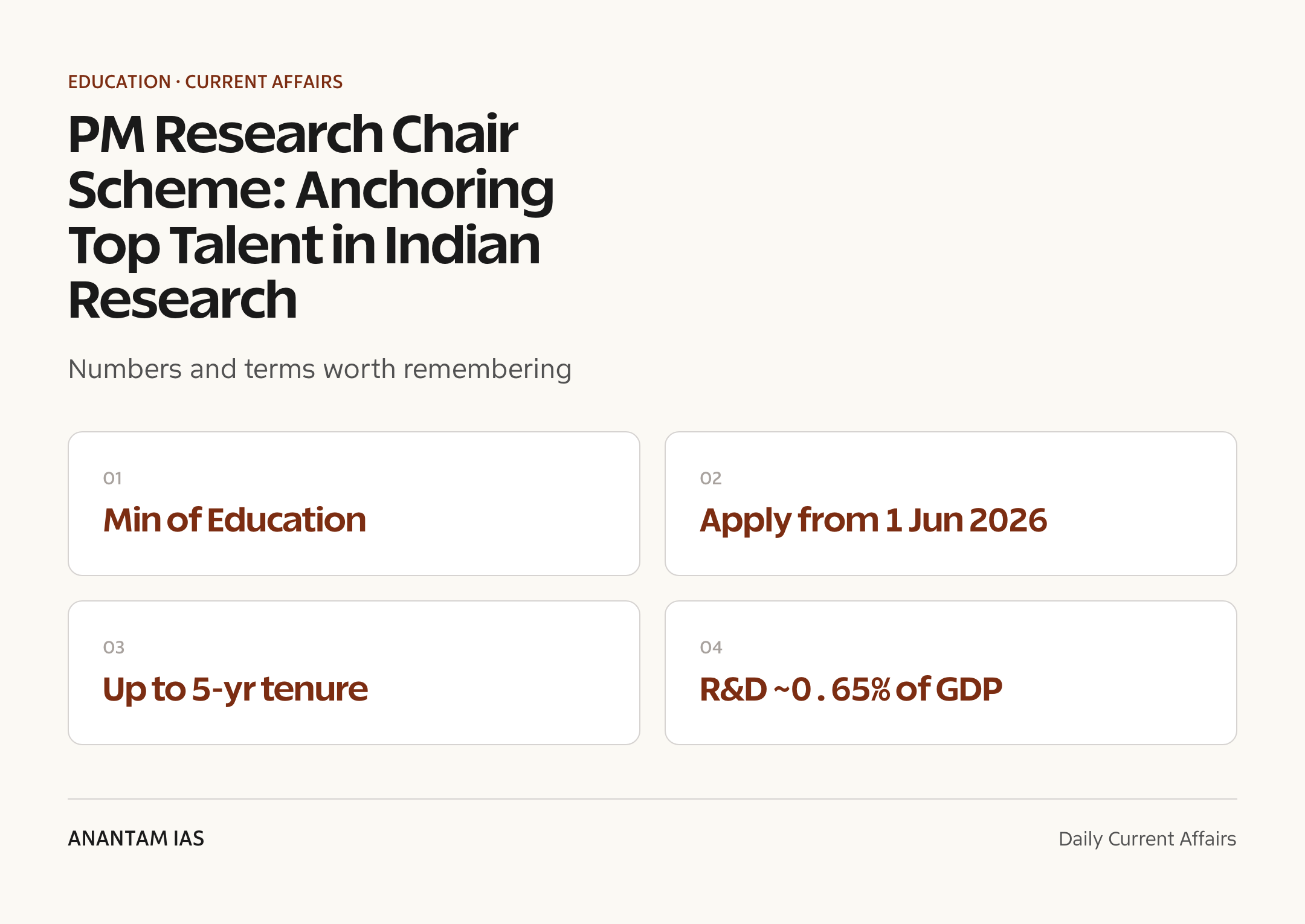
The Department of Higher Education, Ministry of Education, has opened applications for the Prime Minister Research Chair (PMRC) Scheme 2026, a flagship effort to attract and anchor world-class researchers in premier Indian institutions. Applications opened on 1 June 2026 through the dedicated portal pmrc.education.gov.in, for both individual fellows and host institutions.
The scheme’s headline aim is to reverse brain drain by drawing accomplished Indian-origin scientists and technology leaders working abroad into the country’s research pipeline, plugging them into top-ranked universities and national laboratories to lead cutting-edge work.
- Conceptualised, funded and administered by the Department of Higher Education, Ministry of Education.
- Applications opened 1 June 2026 on the portal pmrc.education.gov.in for fellows and host institutions alike.
- Three engagement tiers: Young Research Fellows, Senior Research Fellows and Research Chairs.
- Selection is overseen by an Empowered Committee chaired by the Principal Scientific Adviser to the Government of India.
- Engagement runs for a tenure of up to five years, with terms set on proposal and performance.
The development matters in the context of:
- Sits within the wider push to lift India’s gross expenditure on R&D (GERD), long stuck near 0.65% of GDP, well below major economies.
- Complements the Anusandhan National Research Foundation (ANRF) and the research thrust of the National Education Policy (NEP) 2020.
- Distinct from the older Prime Minister’s Research Fellowship (PMRF), which funds doctoral scholars rather than senior chairs.
UPSC Relevance
Prelims Relevance
- PMRC is run by the Department of Higher Education, Ministry of Education (not a science ministry).
- Three categories: Young Research Fellows, Senior Research Fellows, and Research Chairs.
- Targets Indian-origin researchers and professionals working abroad.
- Host eligibility tied to NIRF rankings — Top 100 Overall/Engineering or Top 50 Research.
- Seven designated Lead Hubs include IISc Bengaluru and several IITs.
- Selection via an Empowered Committee under the Principal Scientific Adviser.
- Engagement tenure of up to five years.
- Do not confuse with PMRF (a doctoral fellowship) or the ANRF (the apex research-funding body).
- ANRF was set up under the ANRF Act, 2023, subsuming the erstwhile SERB.
- India’s R&D spending is roughly 0.65% of GDP.
Mains Relevance
GS Paper 3
- Measures to strengthen India’s research and development ecosystem and raise R&D intensity.
- Role of brain gain and diaspora talent in advancing critical and emerging technologies.
GS Paper 2
- Government schemes and institutional design for higher education and skilled-talent retention, including NEP 2020 goals.
Essay
- Can talent return reverse a nation’s brain drain, or must opportunity be built at home first?
- Science as the engine of self-reliance: investing in minds, not only machines.
Background and Context
What does the PMRC Scheme set out to do?
The scheme is a talent-anchoring instrument, not a research grant alone.
- Aims to attract, incentivise and retain world-class Indian-origin scientists, technologists and academics.
- Places them in premier government higher-education institutions and national research laboratories.
- The goal is to seed cutting-edge research in critical technology sectors and build durable research leadership.
- Framed explicitly as a brain-gain measure to slow the outflow of high-skilled talent.
Three tiers of engagement
The scheme is built around a career-stage ladder of fellowships.
- Young Research Fellows — early-career scientists and postdoctoral scholars ready to seed new projects.
- Senior Research Fellows — mid-career researchers and industry experts with deep field expertise.
- Research Chairs — internationally recognised academic leaders, lab heads and technology pioneers.
- Each tier carries fellowship support, a research grant and institutional backing, scaled to seniority.
Host Institutions and Lead Hubs
Only the country’s top-ranked institutions can host a chair.
- Eligible hosts must rank in the Top 100 NIRF Overall or Engineering, or Top 50 NIRF Research categories.
- Seven designated Lead Hubs include IISc Bengaluru, IIT Delhi, IIT Bombay, IIT Madras, IIT Kanpur, IIT Hyderabad and IIT (ISM) Dhanbad.
- Hosts must offer world-class laboratories, advanced infrastructure and research-leadership roles.
- The design steers top talent toward institutions best placed to absorb and amplify it.
Governance and selection
A high-level committee guards quality and fit.
- Administered end-to-end by the Department of Higher Education, Ministry of Education.
- Selection is overseen by an Empowered Committee chaired by the Principal Scientific Adviser.
- Engagement runs up to a tenure of five years, fixed on the strength of the proposal and performance.
- Benefits typically bundle relocation assistance, a research grant and access to advanced facilities.
Why it matters: India’s R&D gap
The scheme answers a long-standing structural weakness in how India funds knowledge.
- India’s gross expenditure on R&D (GERD) hovers near 0.65% of GDP, far below research leaders such as South Korea, Israel and the United States, which spend several times more.
- Private-sector R&D is thin, so the state, public laboratories and academia still carry the bulk of the research load.
- High-skilled emigration has long drained STEM talent to better-funded labs abroad, with leading Indian-origin researchers heading global universities and corporate labs.
- Anchoring senior researchers at home can compound into spillovers — mentoring younger scholars, filing patents, founding start-ups and lifting the global standing of host institutions.
- A single accomplished chair can seed an entire research group, multiplying the public investment over the engagement period.
Likely benefits and risks
The promise is large, but execution risks are real.
- On the upside, the scheme can raise research quality, deepen industry-academia links and signal that India values frontier science.
- Relocation support, advanced laboratories and leadership roles lower the friction for talent considering a return.
- Risks include the pull of better-funded labs abroad, bureaucratic delays in procurement and hiring, and uneven absorptive capacity across institutions.
- If grants are one-off and tenures short, gains may not outlast the cohort unless the wider ecosystem keeps pace.
- Concentrating chairs in a handful of Lead Hubs could widen the gap between elite institutions and the rest.
How PMRC fits the policy stack?
It is one piece of a larger research-reform architecture.
- Aligns with the research and innovation thrust of the National Education Policy (NEP) 2020.
- Complements the Anusandhan National Research Foundation (ANRF), the apex body under the ANRF Act, 2023 that funds and seeds research.
- Sits alongside, but is distinct from, the doctoral-level Prime Minister’s Research Fellowship (PMRF).
- Addresses chronic weaknesses in India’s higher education sector, where research depth has lagged teaching load.
- Reinforces the broader science, technology and innovation policy goals and the Atmanirbhar Bharat ambition in deep tech.
Way Forward:
Make the offer competitive
- Match international peers on research grants, lab time and administrative freedom, not just salary.
- Cut red tape on procurement, hiring and ethics clearances so returning chairs can move fast.
Build a deeper bench
- Use chairs as mentors to grow home-grown talent, linking PMRC to PMRF and ANRF pipelines.
- Track outcomes — publications, patents, students trained and spin-offs — to justify scaling the scheme.
Sustained funding matters more than a one-off cohort: raising overall R&D intensity toward global norms is the real test of whether talent stays.
Conclusion
The PMRC Scheme reframes India’s talent story from loss to return, betting that distinguished researchers will come home if given world-class platforms and the freedom to lead.
Its success will hinge less on the prestige of a chair and more on whether India’s wider research ecosystem — funding, institutions and incentives — can keep that talent productive for the long haul.
UPSC Practice Questions
Prelims MCQ 1
With reference to the Prime Minister Research Chair (PMRC) Scheme, consider the following statements:
- It is administered by the Department of Higher Education under the Ministry of Education.
- Host institutions are selected on the basis of their NIRF rankings.
- It primarily funds doctoral students pursuing PhDs at IITs and IISc.
How many of the above statements are correct?
(a) Only one (b) Only two (c) All three (d) None
Answer: (b) Only two
Explanation:
Statements 1 and 2 are correct. Statement 3 is wrong — PMRC anchors senior/distinguished researchers as chairs and fellows; the doctoral-funding scheme is the separate Prime Minister’s Research Fellowship (PMRF).
Prelims MCQ 2
The ‘Anusandhan National Research Foundation (ANRF)’, sometimes seen alongside the PMRC Scheme, is best described as:
(a) A doctoral fellowship for engineering students
(b) The apex body to seed, fund and coordinate research in India, set up under the ANRF Act, 2023
(c) A ranking framework for higher-education institutions
(d) A scheme to fund foreign universities setting up campuses in India
Answer: (b) The apex body to seed, fund and coordinate research in India, set up under the ANRF Act, 2023
Explanation:
The ANRF was created under the ANRF Act, 2023, to fund and promote research across universities and laboratories, subsuming the earlier Science and Engineering Research Board (SERB).
UPSC Mains Questions
- India’s gross expenditure on R&D remains around 0.65% of GDP. Examine how talent-anchoring schemes such as the PM Research Chair (PMRC) Scheme can strengthen the country’s research and development ecosystem, and the constraints they face.
- “Reversing brain drain requires building opportunity at home, not merely offering grants.” Critically analyse this statement in the context of India’s efforts to attract Indian-origin researchers.
- Discuss how the PMRC Scheme, NEP 2020 and the Anusandhan National Research Foundation together aim to reshape India’s higher-education and research landscape.
Sources: PIB, Ministry of Education and PIB, Ministry of Education (Press Release).
Frequently Asked Questions
What is the PM Research Chair (PMRC) Scheme?
It is a flagship initiative of the Department of Higher Education, Ministry of Education, that invites accomplished Indian-origin researchers and professionals working abroad to take up research chairs and fellowships at India’s top institutions, with the aim of reversing brain drain and strengthening the country’s research base.
Who can apply under the scheme?
The scheme has three tiers — Young Research Fellows for early-career scientists, Senior Research Fellows for mid-career experts, and Research Chairs for internationally recognised academic leaders and lab heads. Both individual researchers and eligible host institutions apply, with applications opening on 1 June 2026.
Which institutions can host a PMRC chair?
Host institutions must rank among the Top 100 in NIRF Overall or Engineering, or the Top 50 in NIRF Research. Seven designated Lead Hubs include IISc Bengaluru and IITs at Delhi, Bombay, Madras, Kanpur, Hyderabad and ISM Dhanbad.
How is PMRC different from PMRF?
The Prime Minister’s Research Fellowship (PMRF) supports doctoral scholars pursuing PhDs, while the PM Research Chair Scheme anchors senior and distinguished researchers as chairs and fellows. They target very different career stages within the research ecosystem.
How does the scheme relate to India’s R&D spending?
India’s gross expenditure on R&D is roughly 0.65% of GDP, below leading economies. By anchoring high-calibre researchers in top institutions, PMRC aims to lift the quality and output of domestic research and complement bodies such as the Anusandhan National Research Foundation.
Who oversees selection under PMRC?
Selection is guided by an Empowered Committee chaired by the Principal Scientific Adviser to the Government of India. The engagement runs for a tenure of up to five years, with terms decided on the strength of the proposal and performance.
Source: https://anantamias.com/current-affairs/pm-research-chair-pmrc-scheme-2026/
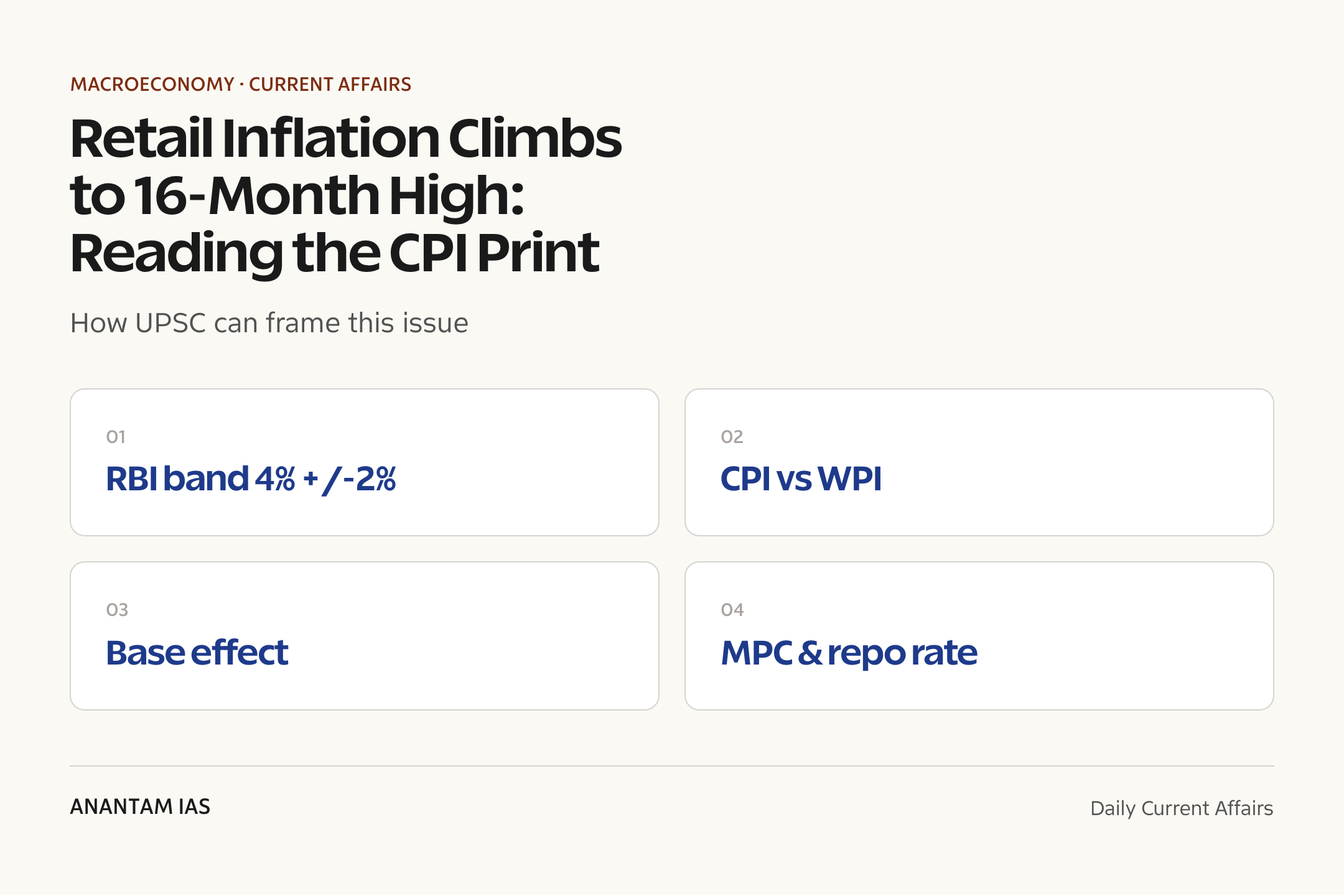
Retail Inflation Climbs to 16-Month High: Reading the CPI Print
Why in News?
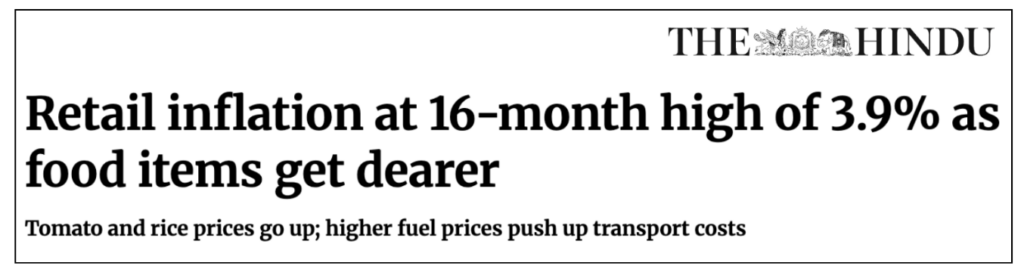
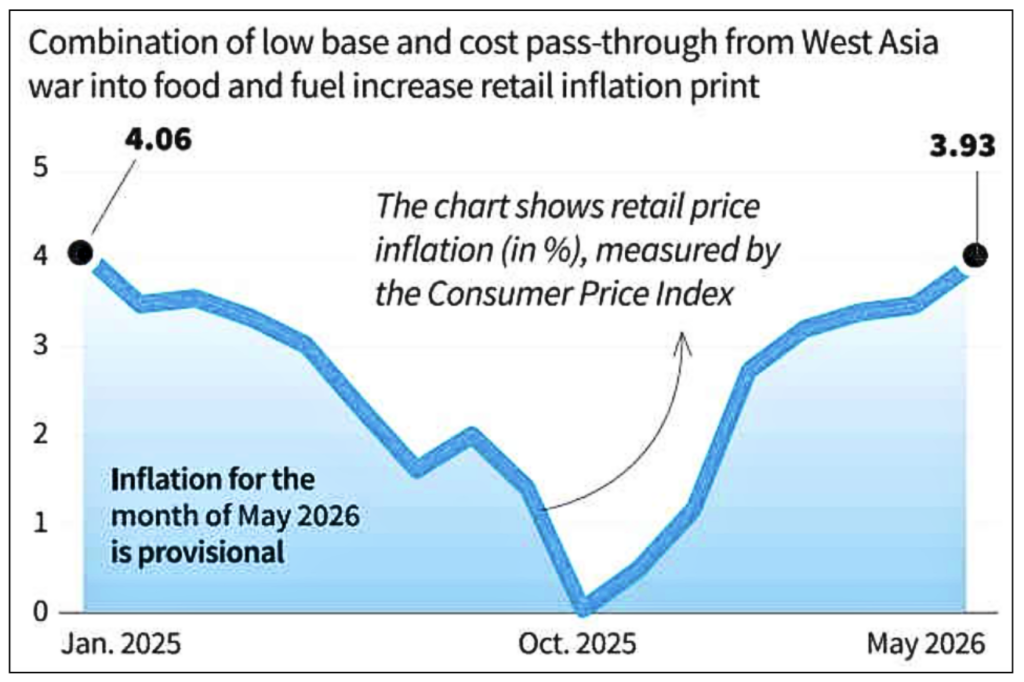
Official Consumer Price Index data released on June 12, 2026, showed India’s retail inflation rising to a 16-month high of 3.9% in May 2026, up from 3.48% in April. The Hindu reported the uptick was driven by costlier food items.
The headline number stays inside the Reserve Bank of India‘s tolerance band but reverses several months of cooling, putting the focus back on the food basket and the trajectory of the Monetary Policy Committee‘s repo rate.
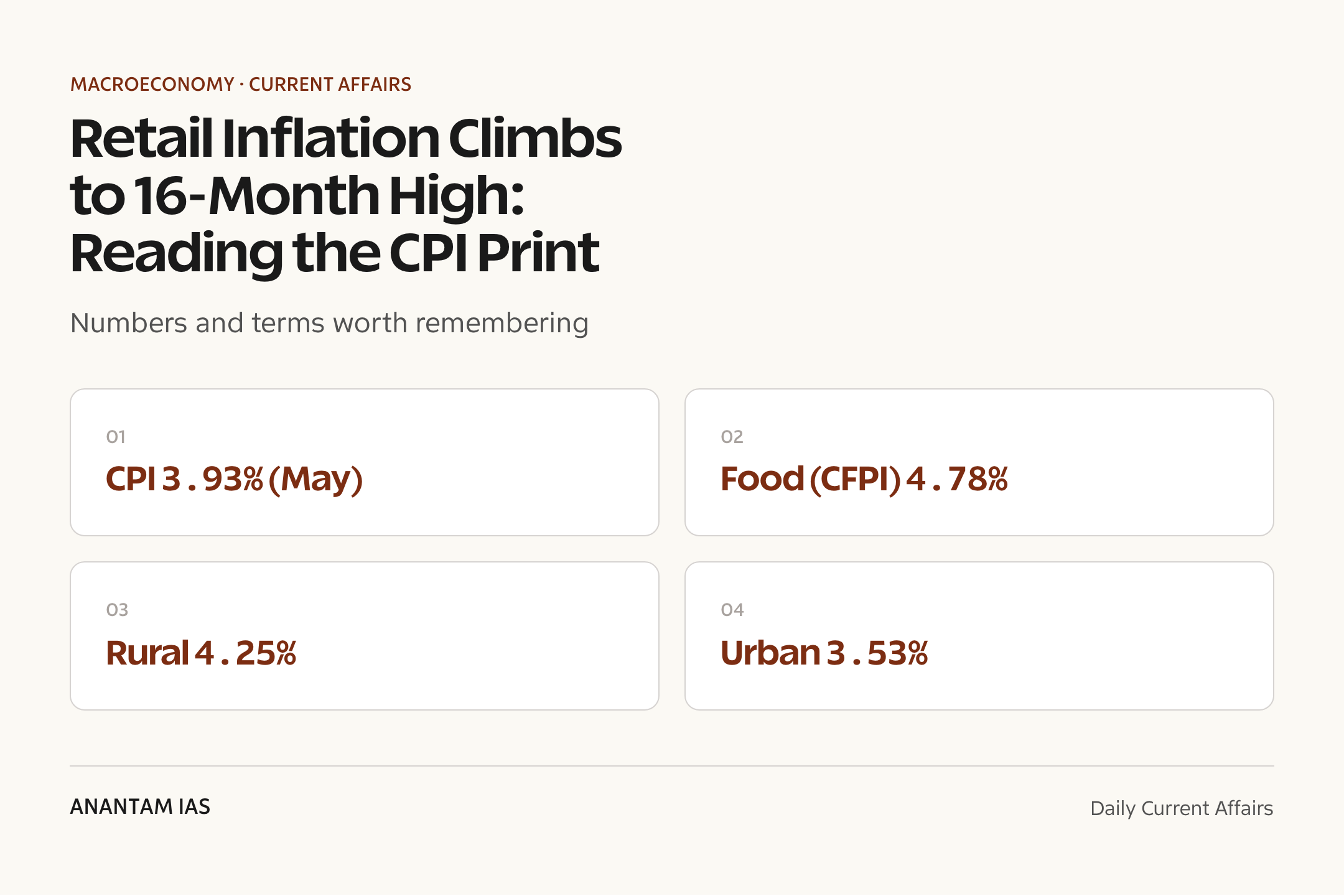
- Headline CPI inflation at 3.93% (provisional) in May 2026 versus 3.48% in April — the highest reading in roughly 16 months.
- All-India food inflation (CFPI) climbed to 4.78% from 4.20% the previous month.
- Rural inflation ran hotter at 4.25% against urban at 3.53%.
- Housing inflation stood at 2.12% year-on-year, a sub-component tracked only for the urban index.
- Data compiled and released by the National Statistical Office (NSO) under the Ministry of Statistics and Programme Implementation (MoSPI).
- Firming retail fuel prices added an estimated upward push to the headline print.
The development matters in the context of:
- Inflation is the price-stability anchor of India’s flexible inflation targeting framework, so every monthly print feeds directly into rate expectations.
- A move toward the 4% target midpoint from sub-4% readings signals the disinflation phase may be plateauing, not deepening.
UPSC Relevance
Prelims Relevance
- CPI (Combined) base year is 2012; released by NSO/MoSPI monthly.
- CFPI = Consumer Food Price Index, the food sub-index of CPI.
- Food and beverages carry the largest weight (~45.86%) in CPI-Combined.
- WPI (base 2011-12) is released by the Office of the Economic Adviser, Ministry of Commerce and Industry; it has no services and no retail margins.
- RBI’s flexible inflation target: 4% CPI with a +/- 2% band (2%-6%).
- The Monetary Policy Committee (MPC) is a six-member body; the RBI Governor has a casting vote.
- Repo rate is the RBI’s primary policy lever for transmission to lending rates.
- Base effect: a low year-ago price level mechanically lifts the current inflation rate.
- Core inflation strips out volatile food and fuel.
- Inflation-targeting mandate flows from the amended RBI Act, 1934 (2016) via the Finance Act, 2016.
Mains Relevance
GS Paper 3
- Examine why food inflation drives India’s headline CPI more than core inflation, and the policy limits of monetary tools against supply-side food shocks.
- Evaluate the flexible inflation-targeting framework: has the 4% +/- 2% band balanced growth and price stability?
GS Paper 2
- Discuss the institutional design of the MPC and the accountability mechanism when inflation breaches the band for three consecutive quarters.
Essay
- Price stability versus growth: the perennial trade-off in a developing economy.
Background and Context
What the May 2026 print actually says
The headline number rose but stayed comfortably within the target band.
- CPI-Combined inflation at 3.93% in May, up 45 basis points from April’s 3.48%.
- The reading is the highest in about 16 months, reversing a multi-month softening trend.
- Still below the 4% target midpoint, so it does not breach the RBI’s tolerance band.
- The rise is broad-based across the food basket rather than one outlier, with fuel adding pressure.
How CPI is built and who measures it
The Consumer Price Index tracks the retail cost of a fixed consumption basket.
- Compiled by the NSO under MoSPI; the current base year is 2024. See our primer on the Consumer Price Index.
- Measures price change for a representative consumption basket of goods and services households actually buy.
- Reported separately for Rural, Urban and Combined; the Combined series is the RBI’s target metric.
- Food and beverages dominate the weight (~45.86%), which is why food swings move the headline so sharply.
- Other groups: housing (urban only), fuel and light, clothing, health, transport, education, miscellaneous.
CPI versus WPI — the two inflation gauges
Aspirants must keep the retail and wholesale measures distinct.
- CPI is retail-level, household-facing, services-inclusive, and the RBI’s policy anchor.
- WPI is wholesale, producer-facing, goods-only, with no services and no retail margins.
- WPI weights manufactured products heavily; CPI weights food heavily — so they can diverge for months, as seen when India’s wholesale inflation hit a 42-month high earlier in 2026.
- The RBI shifted to CPI as the nominal anchor after the Urjit Patel Committee (2014).
The food index and the base effect
Food prices and statistical base effects together explain most of the move.
- CFPI rose to 4.78% from 4.20%, leading the headline higher.
- Vegetables, edible oils and protein items are the usual swing factors in India’s food basket.
- A base effect — last year’s low prices — can inflate the year-on-year rate even without fresh price rises.
- Because monetary policy cannot grow more onions, food-led inflation is largely a supply-side problem.
Flexible inflation targeting and the RBI’s band
India’s monetary framework is built around a legally mandated CPI target.
- Statutory target: 4% CPI inflation with a +/- 2% tolerance band (2% to 6%).
- Mandate flows from the 2016 amendment to the RBI Act, 1934 and the Finance Act, 2016.
- The Monetary Policy Committee (MPC) — six members, three from RBI and three appointed by the Centre — votes on the policy rate.
- A breach for three consecutive quarters triggers a written report from the RBI to the government.
- The repo rate is the main transmission lever; a hardening print narrows room to cut.
Why a 16-month high matters for policy
The number reframes the rate-cut debate even while staying within the band.
- A move back toward the 4% midpoint suggests disinflation is plateauing.
- It keeps the MPC data-dependent rather than pre-committed to further easing, much like the April 2026 decision to hold the repo at 5.25%.
- Core inflation (ex food and fuel) is the cleaner read on demand-side pressure.
- Persistent food spikes can de-anchor inflation expectations, a key RBI worry.
Way Forward
Supply-side management
- Strengthen buffer stocks, cold chains and market intelligence for volatile vegetables and pulses.
- Calibrate trade levers (export curbs, duty cuts) on edible oils and key food items to smooth spikes.
Monetary calibration
- Keep the MPC data-dependent, weighing core inflation and the durability of food shocks before any rate move.
- Improve monetary transmission so repo changes pass through to lending and deposit rates.
Sustained price stability needs both arms working together: the RBI manages demand-side and expectations, while the government and states tackle the supply bottlenecks that drive India’s food-heavy basket.
Conclusion
The May 2026 print is a reminder that India’s headline inflation lives and dies by its food basket. A 16-month high that still sits below the 4% midpoint is a warning flag, not an alarm bell.
For policy, the message is patience: the MPC can stay within its band while watching whether food-led pressure is transient or sticky. For aspirants, the durable lesson is the machinery behind the number — CPI versus WPI, the food index, the base effect, and the RBI’s flexible inflation-targeting mandate.
UPSC Practice Questions
Prelims MCQ 1
With reference to the Consumer Price Index (CPI) in India, consider the following statements:
- The CPI (Combined) is released monthly by the National Statistical Office under MoSPI.
- Food and beverages carry the single largest weight in the CPI (Combined) basket.
- The CPI is the metric targeted under India’s flexible inflation-targeting framework.
How many of the above statements are correct?
(a) Only one (b) Only two (c) All three (d) None
Answer: (c) All three
Explanation:
CPI-Combined is released by the NSO (MoSPI) monthly, food and beverages have the largest weight (~45.86%), and CPI-Combined is the RBI’s targeted metric after the Urjit Patel Committee. All three are correct.
Prelims MCQ 2
Which of the following correctly distinguishes the Wholesale Price Index (WPI) from the Consumer Price Index (CPI)?
(a) WPI includes services while CPI excludes them
(b) WPI is released by the RBI while CPI is released by MoSPI
(c) WPI covers only goods at the wholesale level while CPI covers goods and services at the retail level
(d) WPI is the metric targeted by the RBI’s Monetary Policy Committee
Answer: (c) WPI covers only goods at the wholesale level while CPI covers goods and services at the retail level
Explanation:
WPI is goods-only and wholesale-level (released by the Office of the Economic Adviser, Ministry of Commerce); CPI is retail-level and includes services. The RBI targets CPI, not WPI.
UPSC Mains Questions
- Food prices repeatedly drive India’s headline retail inflation, yet the chief policy lever is monetary. Examine why food-led inflation poses a structural challenge to inflation targeting and what supply-side measures can address it.
- Critically evaluate India’s flexible inflation-targeting framework since 2016. Has the 4% +/- 2% tolerance band achieved a credible balance between price stability and growth?
Sources: The Hindu and MoSPI (NSO) CPI release.
Frequently Asked Questions
What was India’s retail inflation in May 2026?
Retail inflation measured by the Consumer Price Index rose to about 3.9% (3.93% provisional) in May 2026, up from 3.48% in April. The Hindu reported it as a 16-month high, driven mainly by costlier food items, though the reading stayed below the RBI’s 4% target midpoint.
What is the difference between CPI and WPI?
CPI tracks retail prices households pay and includes services, with food carrying the heaviest weight. WPI tracks wholesale prices of goods only, with no services and no retail margins. The RBI targets CPI, not WPI, which is why the two indices can move differently for months at a time.
What is the RBI’s inflation target band?
Under India’s flexible inflation-targeting framework, the RBI must keep CPI inflation at 4%, with a tolerance band of plus or minus 2% — so a range of 2% to 6%. The mandate flows from the 2016 amendment to the RBI Act, 1934. A reading of 3.9% is within this band.
What is the CFPI?
The Consumer Food Price Index, or CFPI, is the food sub-index of the CPI. It isolates inflation in the food basket, which dominates India’s CPI weight at roughly 45.86%. In May 2026 the CFPI rose to 4.78% from 4.20%, the main reason the headline number firmed up.
Why does food inflation matter so much for India?
Because food and beverages make up nearly half the CPI basket, swings in vegetable, oil and protein prices move the headline number sharply. Food inflation is largely a supply-side problem that monetary policy cannot fix directly, which complicates the RBI’s job of steering inflation.
What is a base effect in inflation data?
A base effect is when the year-ago price level distorts the current year-on-year inflation rate. If prices were unusually low last year, even modest current prices can show as high inflation, and vice versa. It explains part of the May 2026 uptick without implying fresh price pressure across the board.
Source: https://anantamias.com/current-affairs/retail-inflation-16-month-high-may-2026/
Student Suicides as a Systemic Issue: The Supreme Court Task Force Report
Why in News?
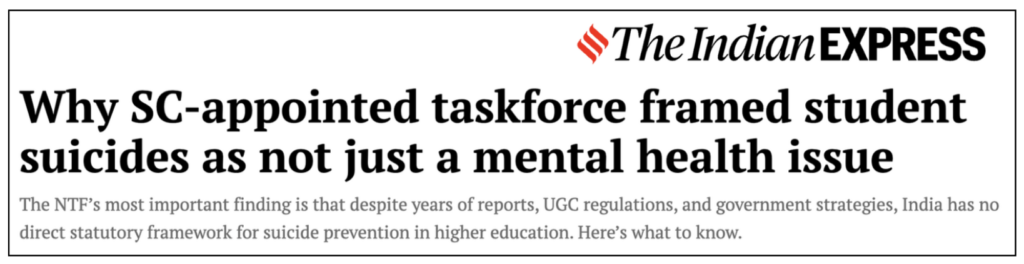
The Indian Express reported on the recommendations of the Supreme Court-mandated National Task Force (NTF) on student mental health, whose findings have reframed the debate on student suicides.
The 12-member body, chaired by former apex-court judge Justice S. Ravindra Bhat, was set up to look beyond individual tragedy and locate the problem in how India runs its schools, colleges and coaching ecosystem.
Acting on the NTF’s work, the Court issued time-bound Article 142 directions to Higher Education Institutions in early 2026, treating student suicides as an ‘iceberg of student distress’ rooted in systemic and institutional failure rather than only in private illness.
- The NTF was constituted following a March 2025 order in a case over two IIT Delhi student deaths, where families alleged caste-based discrimination by faculty and staff.
- NCRB‘s Accidental Deaths and Suicides in India report records over 13,000 student suicides in 2022, roughly 7.6% of all suicides — a figure the Court called the visible tip of a much larger problem.
- The bench issued time-bound directions under Article 142, covering scholarship-backlog clearance, vacancy-filling, confidentiality protocols and well-being audits.
- The Court directed NCRB to separately record school and college student suicides and to strengthen centralised data collection.
- Coaching clusters in Kota, Chennai and elsewhere were flagged as concentrated zones of academic-pressure distress.
The development matters in the context of:
- The order shifts accountability from the grieving student to the institution, the regulator and the State.
- It links campus mental health to Article 21 (life and dignity) and Article 15 (non-discrimination).
- Why this matters now: it lands alongside UGC draft regulations on ragging, harassment and caste/gender/disability discrimination.
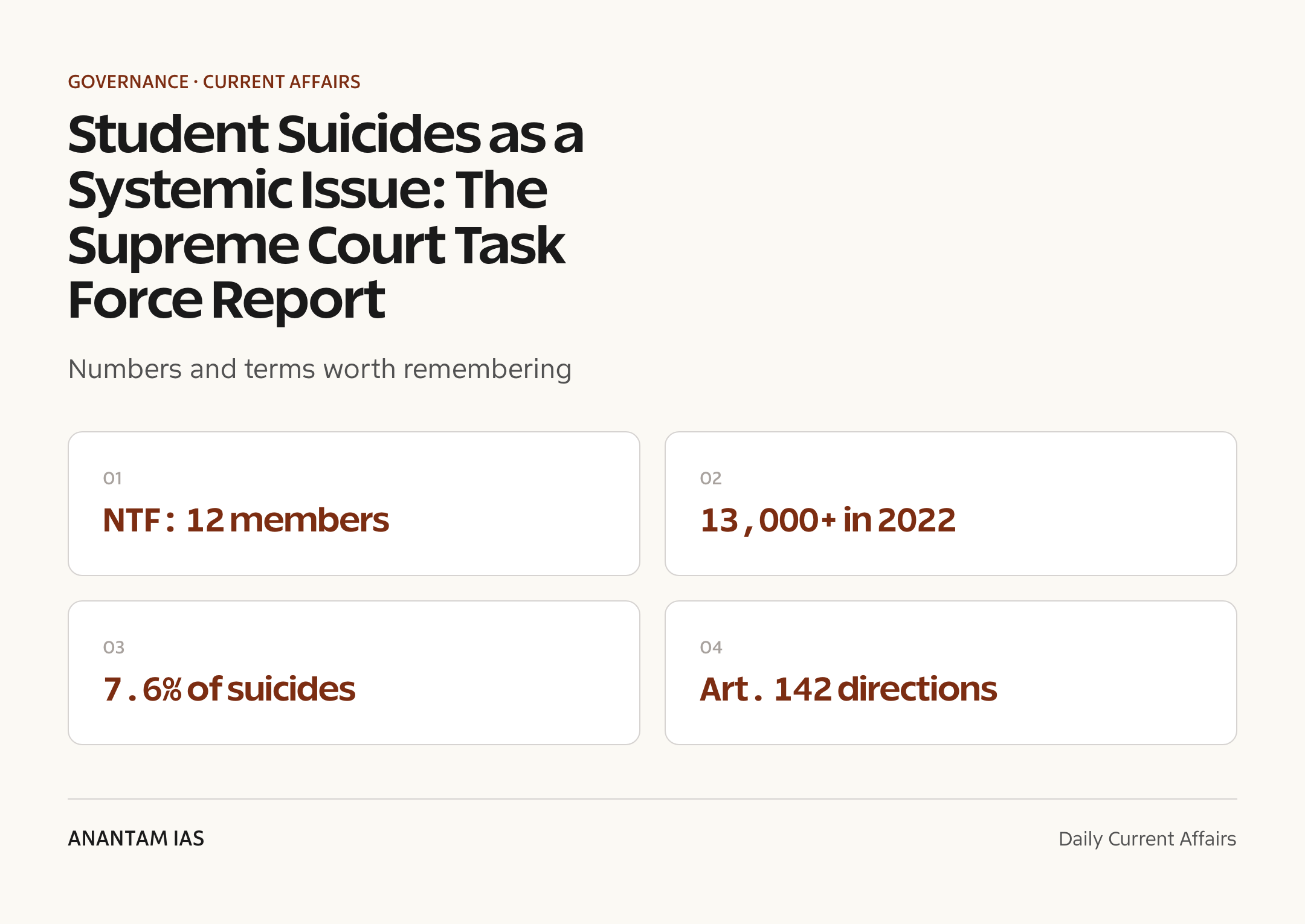
UPSC Relevance
Prelims Relevance
- National Task Force (NTF) on student mental health — Supreme Court-constituted, chaired by Justice S. Ravindra Bhat (former SC judge), 12 members.
- Article 142 — Supreme Court’s power to pass any order necessary for ‘complete justice’.
- NCRB — National Crime Records Bureau; publishes the Accidental Deaths and Suicides in India (ADSI) report.
- ADSI 2022: student suicides crossed 13,000, about 7.6% of total suicides.
- Mental Healthcare Act, 2017 — decriminalised attempt to suicide (Section 115); recognises right to mental healthcare.
- Article 21 right to life and dignity; Article 15 bar on caste/sex/place discrimination.
- UGC draft regulations on prevention of ragging, sexual harassment and discrimination.
- NEP 2020 emphasises on counsellors, reduced exam pressure and socio-emotional learning.
Mains Relevance
GS Paper 2
- Role of the judiciary in directing executive action on welfare via Article 142; accountability of regulators (UGC/AICTE) and institutions.
- Governance of the coaching industry and the regulatory gap in student-welfare standards.
GS Paper 1
- Social issue: how academic competition, caste and exclusion shape vulnerability among the young.
GS Paper 4
- Institutional ethics — duty of care of teachers and administrators towards students.
Essay
- ‘Education without empathy is mere instruction’ — the human cost of an over-competitive system.
- When success is measured only by ranks, what do we lose?
Background and Context
From private tragedy to systemic failure
The core shift in the report is conceptual — it moves the lens from the individual to the institution.
- Earlier framing treated each death as a personal mental-health crisis to be managed clinically and quietly.
- The NTF instead locates causes in structural pressure — relentless ranking, fee burdens, discrimination and weak grievance redress (building on the earlier National Task Force on student mental health).
- The Court’s ‘iceberg of distress’ metaphor signals that recorded deaths are a fraction of a wider crisis of anxiety, dropout and self-harm.
- Responsibility is placed on the State, regulators and institutions — not on the student or family alone.

Why the Task Force was set up
The trigger was litigation over campus deaths, where discrimination was alleged.
- In early 2025, the Supreme Court directed Delhi Police to register FIRs in the deaths of two IIT Delhi students whose families alleged caste-based discrimination.
- The Court constituted the National Task Force under Justice S. Ravindra Bhat to study and prevent suicides in Higher Educational Institutions.
- It marks a continuation of the apex court’s Article 21 jurisprudence — reading dignity and a supportive environment into the right to life.
- The proceedings drew submissions from students, NGOs, regulators and institutions across the country.
The data behind the alarm
The Court leaned heavily on the official suicide record to establish scale.
- NCRB‘s ADSI 2022 recorded over 13,000 student suicides — about 7.6% of all suicides that year.
- Existing data does not distinguish school from college students, blurring policy targeting — the Court ordered this gap fixed.
- Coaching hubs such as Kota draw lakhs of aspirants for JEE and NEET and have seen repeated suicide clusters.
- Under-reporting and stigma mean the true burden is widely held to exceed the recorded numbers, mirroring India’s wider mental-health treatment gap.
Coaching, competition and exclusion
Three intertwined drivers run through the findings.
- Coaching-industry pressure — long hours, hostel isolation and a high-stakes single-exam culture concentrate stress in young aspirants.
- Academic competition — rank-obsessed evaluation and parental expectation turn ordinary setbacks into perceived life failures.
- Caste and identity-based discrimination — exclusion, slurs and unequal treatment of marginalised students are recognised as direct stressors.
- Financial stress from fees, loans and delayed scholarships compounds the burden, especially for first-generation learners.
What did the Court direct?
The bench translated findings into enforceable, time-bound directions under Article 142.
- Clear scholarship backlogs and fill critical vacancies (counsellors, faculty) within set deadlines.
- Build campus mental-health services with confidentiality SOPs and student-feedback systems.
- Mandate faculty sensitisation on academic, financial, social and discrimination-related stressors.
- Improve data — NCRB to separate school/college figures and strengthen centralised tracking.
- Conduct periodic institutional well-being audits as a standard of accountability.
The regulatory backdrop
The directions intersect with parallel policy and law.
- UGC draft regulations target ragging, sexual harassment and discrimination on caste, gender and disability grounds.
- The Mental Healthcare Act, 2017, already decriminalised attempt to suicide and guarantees a right to mental healthcare.
- NEP 2020 calls for trained counsellors, socio-emotional learning and reduced rote-exam pressure.
- Consumer-protection action against misleading coaching advertisements reflects a wider push to regulate the coaching market.
Significance and the criticism
The report is praised as a paradigm shift, but it faces real limits.
- It constitutionalises student well-being, tying it to dignity and non-discrimination rather than charity.
- Critics note the Court has been cautious in naming caste squarely as a cause, risking a dilution of the discrimination angle.
- Enforcement depends on under-resourced regulators and institutions with thin counselling capacity.
- Directions risk becoming box-ticking compliance unless backed by funding, trained staff and culture change.
Way Forward
Regulate the coaching ecosystem
- Enforce welfare standards — counsellor ratios, cooling-off periods and limits on punitive ranking displays.
- Operationalise the Guidelines for Regulation of Coaching Centres with state-level monitoring.
Build real campus capacity
- Fill counsellor and faculty vacancies; fund a confidential, stigma-free mental-health service in every institution.
- Replace one-off awareness drives with embedded socio-emotional support under NEP 2020.
Tackle discrimination head-on
- Make anti-discrimination cells effective and time-bound; act on caste and identity-based complaints.
- Publish anonymised well-being audit findings to drive accountability.
Fix the evidence base: disaggregated, timely NCRB data and a dedicated registry would let policy target the highest-risk groups instead of treating distress as a uniform clinical condition.
Conclusion
The National Task Force report matters because it changes the question. The issue is no longer only why a particular student could not cope, but why so many institutions, regulators and an entire coaching economy keep producing the conditions for despair.
Whether the Article 142 directions translate into safer campuses will depend on funding, trained counsellors and the will to name discrimination plainly. For UPSC, the case is a clean illustration of judicial governance meeting social justice — and of the limits of court orders without administrative follow-through.
UPSC Practice Questions
Prelims MCQ 1
With reference to the Supreme Court’s National Task Force on student mental health, consider the following statements:
- It was constituted by the Supreme Court and is chaired by a former judge of the Court.
- It was set up following a case involving alleged caste-based discrimination at an IIT.
- Its directions were issued by the Court under Article 142 of the Constitution.
How many of the above statements are correct?
(a) Only one (b) Only two (c) All three (d) None
Answer: (c) All three
Explanation:
The NTF is Supreme Court-constituted and chaired by former SC judge Justice S. Ravindra Bhat; it followed a case over alleged caste discrimination in IIT Delhi student deaths, and the Court issued time-bound directions under Article 142.
Prelims MCQ 2
The ‘Accidental Deaths and Suicides in India’ (ADSI) report, cited by the Court on student suicides, is published by which body?
(a) Ministry of Health and Family Welfare
(b) National Crime Records Bureau (
c) National Statistical Office
(d) University Grants Commission
Answer: (b) National Crime Records Bureau
Explanation:
The ADSI report is published annually by the National Crime Records Bureau (NCRB) under the Ministry of Home Affairs; its 2022 edition recorded over 13,000 student suicides.
UPSC Mains Questions
- The Supreme Court’s National Task Force reframes student suicides as a systemic rather than purely individual problem. Examine the structural drivers it identifies and assess whether Article 142 directions can deliver meaningful change.
- Discuss the regulatory gaps in India’s coaching industry and higher-education institutions that contribute to student distress. What governance reforms would you recommend?
- ‘Student well-being is a constitutional concern, not a matter of charity.’ In the light of recent judicial intervention, critically analyse the link between campus mental health, Article 21 and Article 15.
Sources: Indian Express (Explained) and Supreme Court Observer.
Frequently Asked Questions
What is the Supreme Court’s National Task Force on student suicides?
It is a 12-member body the Supreme Court constituted to study and prevent suicides in higher educational institutions. Chaired by former apex-court judge Justice S. Ravindra Bhat, it examines causes beyond individual mental illness and recommends institutional, regulatory and data reforms, which the Court has converted into enforceable directions.
Why is the report called a paradigm shift?
Because it reframes student suicides as a systemic and structural failure rather than a private mental-health crisis. It places responsibility on coaching ecosystems, institutions, regulators and the State, and links student well-being to constitutional dignity under Article 21 instead of treating each death as an isolated personal tragedy.
What does the NCRB data show on student suicides?
The National Crime Records Bureau’s Accidental Deaths and Suicides in India report for 2022 recorded over 13,000 student suicides, about 7.6% of all suicides that year. The Court treated this as the visible tip of a wider crisis and asked the NCRB to record school and college students separately.
What is Article 142 and why does it matter here?
Article 142 lets the Supreme Court pass any order needed to do ‘complete justice’ in a case. The Court used it to issue time-bound, binding directions to institutions and regulators — covering scholarships, vacancies, counselling services, faculty sensitisation and well-being audits — without waiting for fresh legislation.
How does caste discrimination feature in the issue?
The Task Force was prompted by deaths of IIT Delhi students whose families alleged caste-based discrimination. The findings recognise exclusion, bias and unequal treatment of marginalised students as direct stressors, though critics argue the Court has been cautious about naming caste squarely as a cause.
What reforms are needed beyond the court order?
Enforceable coaching-centre welfare standards, filled counsellor and faculty vacancies, funded and confidential campus mental-health services, effective anti-discrimination cells, and disaggregated NCRB data. Without funding, trained staff and culture change, the directions risk becoming compliance box-ticking rather than real protection.
Source: https://anantamias.com/current-affairs/sc-task-force-student-suicides-2026/
Faster Fertiliser Approvals: Reforming the Subsidy and Innovation Pipeline
Why in News?
The Centre is reported to be reworking the approval process for new fertilisers, with the aim of clearing specialty and nano products far faster under the Fertiliser (Control) Order, 1985 (FCO), the regulation that lists every fertiliser legally sold in India.
The push matters because India’s fertiliser-subsidy bill remains one of the largest line items in the Union Budget, and faster approvals are being framed as a route to cheaper, more efficient and less import-dependent nutrients.
- Any new fertiliser must first be notified in the Schedule of the FCO, 1985 before it can be manufactured, imported or sold; the proposal is to shorten this notification timeline.
- The reform targets specialty fertilisers (water-soluble, fortified, customised) and nano formulations such as Nano Urea and Nano DAP.
- The backdrop is a fertiliser-subsidy outlay that runs into lakhs of crore annually, dominated by urea.
- India stays heavily import-dependent for DAP, phosphates and potash (MOP), exposing the bill to global price and currency swings.
- The Department of Fertilizers, under the Ministry of Chemicals and Fertilizers, administers both the FCO clearances and the subsidy regime.
The development matters in the context of:
- Faster clearances sit at the intersection of fiscal management (cutting the subsidy bill), soil health (balanced nutrition) and Atmanirbhar Bharat (reducing import reliance).
- It also tests whether new-technology fertilisers can be regulated for efficacy and safety without slowing innovation.
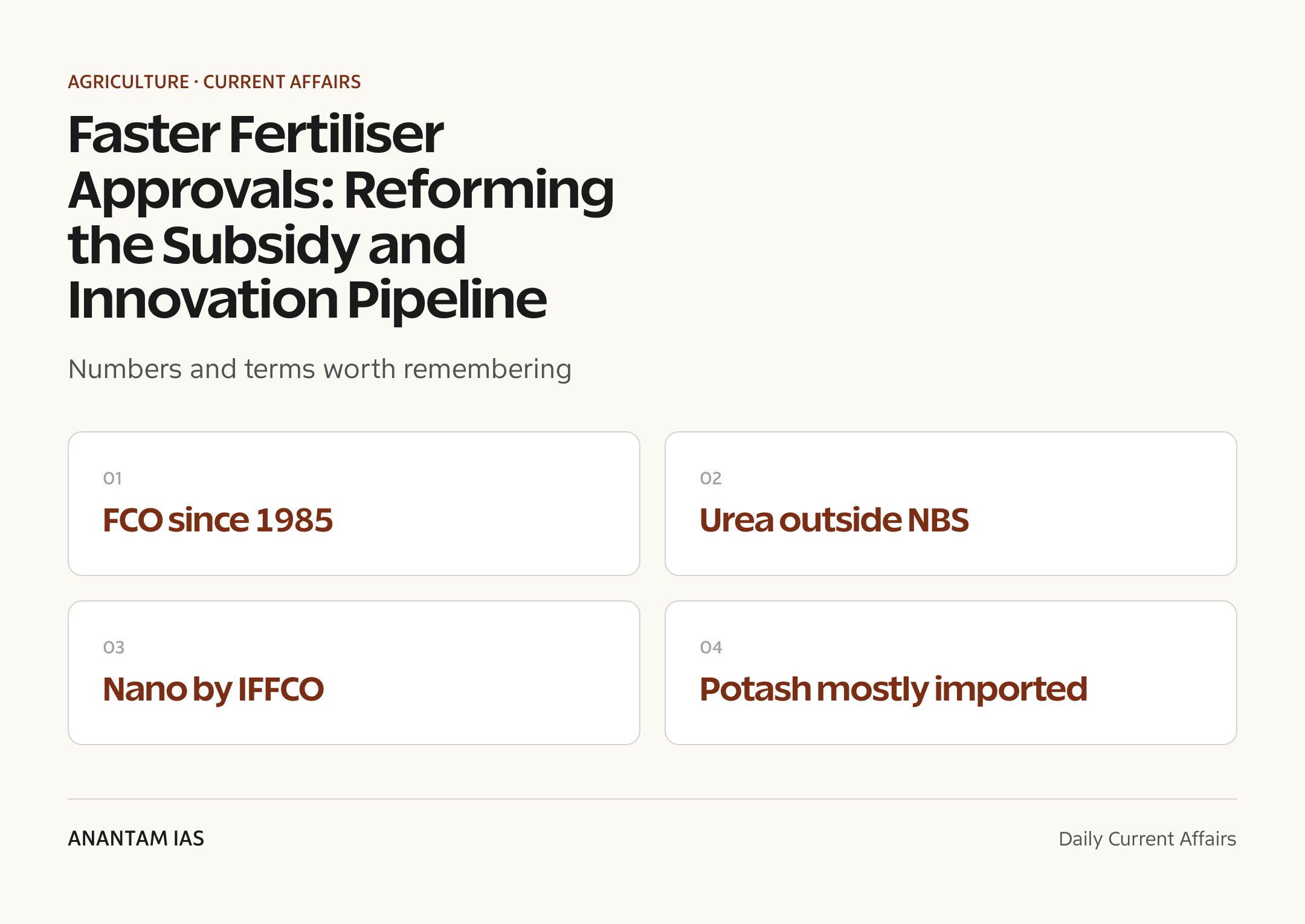
UPSC Relevance
Prelims Relevance
- Fertiliser (Control) Order, 1985 — issued under the Essential Commodities Act, 1955
- Department of Fertilizers, Ministry of Chemicals and Fertilizers
- Nutrient-Based Subsidy (NBS) — applies to P and K fertilisers (DAP, MOP, complexes)
- Urea is OUTSIDE NBS — sold at a statutory Maximum Retail Price (MRP) with subsidy to producers
- Neem-coated urea — mandatory; curbs diversion to non-agricultural use
- Nano Urea and Nano DAP — developed by IFFCO; sold in liquid form
- DBT in fertilisers — subsidy released to companies on PoS sale, not direct cash to farmers
- Import dependence: India imports most of its potash (MOP) and a large share of DAP/raw phosphates
- Soil Health Card Scheme — promotes balanced, soil-test-based fertilisation
- One Nation One Fertiliser (PMBJP ‘Bharat’ brand) — single-brand bagging
Mains Relevance
GS Paper 3
- Examine how the fertiliser-subsidy structure distorts nutrient use and stresses public finances.
- Evaluate specialty and nano fertilisers as tools for input-use efficiency and import substitution.
GS Paper 2
- Assess regulatory reform of fertiliser approvals as a governance and ease-of-doing-business question.
Essay
- Feeding a nation without exhausting its soil — the politics of cheap inputs.
- Innovation versus regulation: when faster clearances meet public safety.
Background and Context
The FCO, 1985 — the gatekeeper
Every fertiliser sold in India must clear one statutory hurdle.
- The Fertiliser (Control) Order, 1985 is issued under the Essential Commodities Act, 1955 and is administered by the Department of Fertilizers.
- A product can be manufactured, imported or sold only after it is notified in the FCO Schedule, with defined specifications, tolerance limits and labelling.
- Historically, getting a genuinely new product notified has been slow, requiring field-trial data and inter-ministerial sign-off — a friction the reform seeks to ease.
- The order also fixes quality standards and penalties for substandard or spurious stock, so any fast-track must still protect efficacy and farmer safety.
How the subsidy is structured
India runs two parallel and unequal regimes for nutrients.
- Urea sits outside NBS: it carries a government-fixed Maximum Retail Price (MRP), with the gap to cost paid as subsidy to manufacturers — keeping urea artificially cheap.
- Phosphatic and potassic fertilisers (DAP, MOP, NPK complexes) fall under the Nutrient-Based Subsidy (NBS), where a fixed per-kg subsidy is set on each nutrient (N, P, K, S) and MRP is broadly decontrolled.
- The result is a price distortion: cheap urea encourages over-application of nitrogen, skewing the ideal N:P:K balance and degrading soil.
- Direct Benefit Transfer (DBT) in fertilisers routes subsidy to companies through Point-of-Sale (PoS) machines on actual retail sale, rather than as cash to farmers.
Why the bill is so heavy
Subsidy size is driven less by policy choice than by global markets.
- The fertiliser-subsidy outlay is among the largest non-merit-leaning subsidies in the budget, running into lakhs of crore in recent years.
- India imports a large share of DAP and raw phosphates and almost all of its potash (MOP), so the bill rises and falls with global prices, freight and the rupee.
- Geopolitical shocks and concentrated supply (potash from a few countries) add a supply-security risk.
- Holding urea MRP fixed while input costs swing means the fisc absorbs the volatility.
Specialty and nano fertilisers
The reform’s real targets are newer, more efficient products.
- Specialty fertilisers — water-soluble, fortified or customised blends — deliver nutrients precisely (fertigation, foliar) and suit micro-irrigation.
- Nano Urea and Nano DAP, developed by IFFCO, are sold as liquids that claim higher nutrient-use efficiency and far lower volume than conventional bags; the wider promise and limits are covered in our note on nano fertilisers in India.
- Smaller, lighter products promise lower logistics and bagging costs and, potentially, a lighter subsidy load if they substitute for granular urea and DAP.
- Because a single 500 ml bottle is pitched as replacing a 45 kg bag, the products also fit the One Nation One Fertiliser drive toward simpler, single-brand distribution.
- Faster FCO notification would let such products reach farmers sooner — but independent agronomic evidence on field efficacy is still being debated, so subsidy backing should follow proof, not precede it.
Soil health and balanced fertilisation
Cheap nitrogen has a long-run cost in the field.
- Decades of subsidised urea have pushed the N:P:K ratio away from agronomically recommended levels in many regions.
- Imbalance lowers soil organic carbon, micronutrient availability and ultimately yield response per kg of fertiliser.
- The Soil Health Card Scheme and neem-coated urea (mandatory, to slow nitrogen release and curb diversion to industry) are the main corrective tools.
- Restoring soil carbon and structure also draws on practices covered in our note on conservation agriculture — minimum tillage, residue cover and rotation alongside balanced nutrition.
- Promoting specialty and nano products is partly a soil-health play: less bulk nitrogen, more targeted, lower-loss nutrition.
Governance and the ease-of-doing-business angle
Approval reform is also a regulatory-state story.
- A predictable, time-bound FCO clearance reduces regulatory uncertainty for manufacturers and start-ups working on new nutrients.
- The challenge is balancing speed with scrutiny — fast-tracking must not let unproven or unsafe products into the market.
- It links to the broader One Nation One Fertiliser move (single ‘Bharat’ brand) and DBT digitisation as part of fertiliser-sector reform.
- Digitised sale data through PoS machines, like the wider e-technology in agriculture stack, makes targeted, leakage-free subsidy delivery feasible.
- Clearer rules also support Atmanirbhar Bharat goals of domestic production and reduced import reliance.
Way Forward
Reform the price signal
- Move urea gradually toward the NBS framework so all nutrients face comparable economics and the N:P:K imbalance corrects.
- Cap or rationalise the open-ended subsidy by tying it to balanced-use incentives.
Time-bound, evidence-based clearance
- Set statutory timelines for FCO notification while keeping mandatory field-efficacy and safety trials.
- Publish independent agronomic data on nano fertilisers before scaling subsidy support.
Cut import dependence
- Diversify potash and phosphate sourcing, build buffer stocks and back domestic and alternative-nutrient capacity.
Pair input reform with the Soil Health Card, micro-irrigation and extension so farmers actually shift to balanced, efficient nutrition rather than defaulting to cheap urea.
Conclusion
Faster fertiliser approvals look like a narrow administrative tweak, but they sit on top of one of India’s hardest policy knots — a subsidy that keeps urea cheap, skews soil nutrition and exposes the budget to global prices.
If the fast-track is paired with genuine price reform, honest efficacy testing and a serious push on soil health, specialty and nano products could ease both the fiscal and the agronomic burden. Without those, quicker clearances risk speeding products to market without fixing the underlying distortion.
UPSC Practice Questions
Prelims MCQ 1
With reference to fertiliser policy in India, consider the following statements:
- Urea is covered under the Nutrient-Based Subsidy (NBS) scheme.
- Every new fertiliser must be notified under the Fertiliser (Control) Order, 1985 before sale.
- Direct Benefit Transfer in fertilisers releases subsidy to companies on actual retail sale through Point-of-Sale machines.
How many of the above statements are correct?
(a) Only one (b) Only two (c) All three (d) None
Answer: (b) Only two
Explanation:
Statement 1 is wrong: urea is OUTSIDE NBS, sold at a fixed MRP with subsidy to producers; NBS covers P and K fertilisers. Statements 2 and 3 are correct — FCO notification is mandatory, and fertiliser DBT pays companies on PoS sale, not cash to farmers.
Prelims MCQ 2
Nano Urea and Nano DAP, often discussed in India’s fertiliser reforms, were developed primarily by which entity?
(a) FCI (b) IFFCO (c) NABARD (d) ICAR alone
Answer: (b) IFFCO
Explanation:
Nano Urea and Nano DAP were developed and commercialised by IFFCO (Indian Farmers Fertiliser Cooperative), sold as liquid fertilisers claiming higher nutrient-use efficiency.
UPSC Mains Questions
- The Indian fertiliser-subsidy regime keeps urea artificially cheap while leaving phosphatic and potassic nutrients under a separate framework. Discuss how this dual structure distorts nutrient use and stresses public finances, and suggest reforms.
- Faster approval of specialty and nano fertilisers is being pitched as a route to efficiency and import substitution. Critically examine the promise and the risks of fast-tracking new-technology fertilisers under the Fertiliser (Control) Order, 1985.
- Examine the link between cheap nitrogenous fertilisers, soil-health degradation and balanced fertilisation in India, and evaluate the policy tools available to correct the imbalance.
Sources: Indian Express (Explained) and Department of Fertilizers, Ministry of Chemicals and Fertilizers.
Frequently Asked Questions
What is the Fertiliser (Control) Order, 1985?
It is a regulation issued under the Essential Commodities Act, 1955 and administered by the Department of Fertilizers. It lists every fertiliser legally sold in India, fixes their specifications, quality standards and labelling, and requires any new product to be notified in its Schedule before it can be manufactured, imported or sold.
Why does the government want faster fertiliser approvals?
Slow notification under the FCO delays new specialty and nano products from reaching farmers. Faster, time-bound clearances aim to encourage innovation, support more efficient nutrient use, reduce import dependence and ease the large subsidy bill, while still keeping safety and efficacy checks in place.
How is urea subsidy different from NBS?
Urea is sold at a government-fixed Maximum Retail Price, with the gap to production cost paid as subsidy to manufacturers, so it stays artificially cheap. Phosphatic and potassic fertilisers fall under the Nutrient-Based Subsidy, where a fixed per-kg subsidy is set on each nutrient and the retail price is broadly decontrolled.
What are specialty and nano fertilisers?
Specialty fertilisers are water-soluble, fortified or customised blends suited to fertigation and foliar use. Nano fertilisers such as Nano Urea and Nano DAP, developed by IFFCO, are liquids that claim higher nutrient-use efficiency and far lower volume than conventional granular bags, which could cut logistics and subsidy costs.
Why is India’s fertiliser-subsidy bill so large?
India imports a large share of DAP and raw phosphates and almost all of its potash, so the bill rises with global prices, freight and the rupee. Holding urea’s retail price fixed while input costs swing means the government absorbs the volatility, pushing the subsidy into lakhs of crore each year.
How does cheap urea affect soil health?
Subsidised urea encourages over-application of nitrogen, skewing the ideal N:P:K balance. Over time this lowers soil organic carbon and micronutrient availability and reduces yield response per kilogram of fertiliser. Tools like neem-coated urea, the Soil Health Card Scheme and a shift to balanced nutrition aim to correct this.
Source: https://anantamias.com/current-affairs/specialty-fertilisers-approval-reform-2026/