Daily Digest
UPSC · Civil Services Examination
Current Affairs · Tuesday, 30 June 2026
Current affairs curated and edited by Anantam IAS faculty — pulled from The Hindu, PIB, IDSA, Foreign Affairs and the ministries. Read, annotate, revise.
Old Rajinder Nagar · Delhi 110005 · anantamias.com
NIIF Additional Investment: Cabinet Deepens Infrastructure Capital
Why in News?
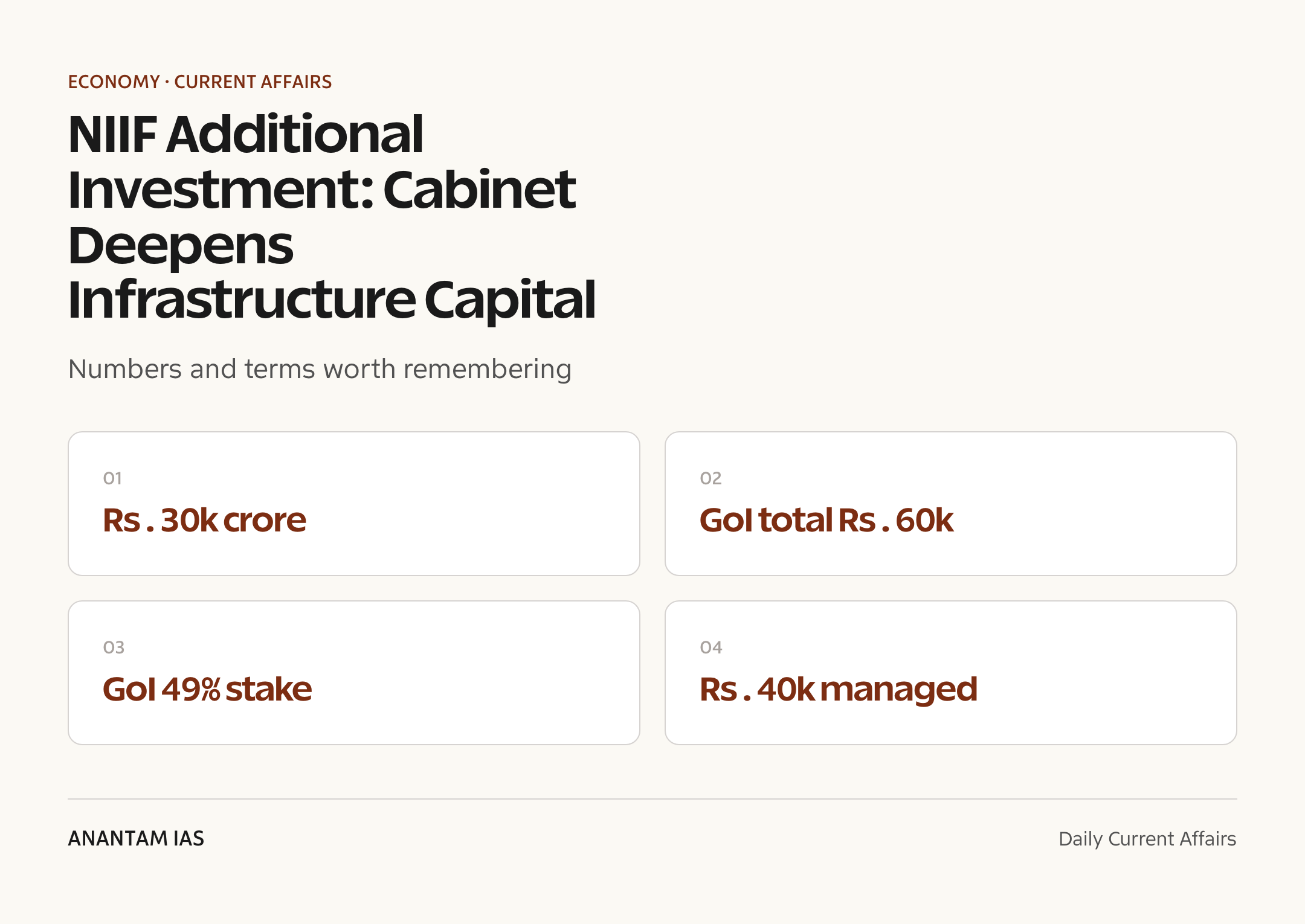
The Union Cabinet approved an additional Rs. 30,000 crore Government of India investment commitment towards new and upcoming funds of the National Investment and Infrastructure Fund.
PIB confirmed that the decision takes the Government of India’s total commitment to NIIF to Rs. 60,000 crore, with the new allocation aimed at deepening infrastructure investment and drawing institutional capital into India.
- PIB released the decision on 29 June 2026 through the Ministry of Finance.
- The added commitment is meant for new and upcoming NIIF funds, especially the next infrastructure-focused fund.
- NIIF Infrastructure Fund II is proposed with a target corpus close to Rs. 30,000 crore.
- The Government of India is a 49% shareholder in NIIF, according to PIB.
- NIIF currently manages capital commitments of about Rs. 40,000 crore across its funds and investment strategies.
- PIB said NIIF has returned close to Rs. 12,000 crore to investors through large portfolio exits.
The development matters in the context of:
- Infrastructure finance needs patient capital because roads, ports, energy, digital networks and urban systems need long construction periods and long payback cycles.
- Sovereign-anchored funds can reduce investor hesitation by placing public capital as a signal of policy continuity and governance comfort.
- NIIF sits at the intersection of public investment, private institutional capital, PPP design and long-term economic capacity building.
- The decision connects with wider priorities such as Gati Shakti, Digital India, energy transition, e-mobility and urban infrastructure.
UPSC Relevance
Prelims Relevance
- NIIF stands for National Investment and Infrastructure Fund.
- NIIFL professionally runs and manages NIIF, as stated by PIB.
- The Government of India is a 49% shareholder in NIIF.
- The new Cabinet-approved commitment is Rs. 30,000 crore.
- After this approval, total Government of India commitment to NIIF stands at Rs. 60,000 crore.
- NIIF Infrastructure Fund II is proposed as the successor to the first flagship infrastructure fund.
- NIIF’s operational strategies include infrastructure, private markets, growth equity and climate investments in the India-Japan business corridor.
- PIB listed transportation, energy, digital infrastructure, urban infrastructure and e-mobility as focus areas for the next fund.
- NIIF has attracted investors such as sovereign wealth funds, pension funds, multilateral development institutions and domestic financial institutions.
Mains Relevance
GS Paper 3
- Indian economy: role of long-term capital in infrastructure-led growth.
- Infrastructure: financing gaps, PPP design, asset monetisation and institutional capital.
- Investment model: using public commitment to crowd in private and global capital.
GS Paper 2
- Governance: professional fund management, public accountability and public-private coordination.
- Policy implementation: linking fund strategy with national programmes such as Gati Shakti and Digital India.
Essay
- Public capital as a bridge between development needs and market confidence.
- Infrastructure as the hidden foundation of productivity, jobs and regional integration.
- State capacity in a market economy: steering, de-risking and crowding in investment.
Background and Context
What is NIIF?
NIIF is important because it is designed as a sovereign-anchored platform rather than a routine budgetary spending window.
- National Investment and Infrastructure Fund is India’s sovereign-anchored fund for infrastructure and other nationally important sectors.
- NIIFL professionally manages the fund platform, which helps separate investment decisions from day-to-day departmental spending.
- The Government of India holds a 49% shareholder position in NIIF, giving it a strong anchor role while leaving space for other investors.
- PIB said NIIF currently manages capital commitments of about Rs. 40,000 crore across funds and strategies.
- For a wider economy lens, read Anantam’s Indian Economy page with this topic.
What did the Cabinet approve?
The approval expands the sovereign commitment behind NIIF and gives the platform room to create new fund strategies.
- The Cabinet approved an additional Rs. 30,000 crore Government of India investment commitment.
- This raises the total Government of India commitment to Rs. 60,000 crore.
- The commitment will support new and upcoming funds under the NIIF platform.
- PIB stated that the allocation will be used for setting up NIIF Infrastructure Fund II.
- The second infrastructure-focused fund is proposed to have a target corpus close to Rs. 30,000 crore.
Why Infrastructure Fund II matters
Infrastructure Fund II matters because it gives NIIF a successor vehicle for large, long-term assets.
- Infrastructure Fund II is proposed as the successor to NIIF’s first flagship infrastructure fund.
- PIB said the first infrastructure fund had a corpus of Rs. 16,000 crore and created platforms across key sectors.
- The next fund is expected to invest in transportation, energy, digital infrastructure and emerging areas.
- Emerging areas named by PIB include urban infrastructure and e-mobility.
- The design supports long-horizon assets that often struggle to find quick private finance because returns are spread over many years.
How NIIF crowds in capital
The policy logic is that public capital can improve confidence and attract larger pools of institutional money.
- PIB said NIIF has raised capital from sovereign wealth funds, pension funds, multilateral development institutions and domestic financial institutions.
- Named institutional investors include ADIA, AustralianSuper, CPP Investments, Ontario Teachers’ Pension Plan, PSP Investments and Temasek.
- Multilateral and development-linked investors named by PIB include AIIB, New Development Bank, Asian Development Bank, JBIC and the U.S. International Development Finance Corporation.
- Domestic financial institutions listed by PIB include Axis Bank, HDFC Group, ICICI Bank, Kotak Mahindra Life Insurance and State Bank of India.
- The main exam point: sovereign anchoring can reduce perceived risk, but fund performance and governance still decide whether private money keeps coming.
Sectors and policy alignment
The Cabinet decision is not only a fund-management story; it is linked to national infrastructure and industrial priorities.
- PIB said NIIF funds have deployed capital across transportation, energy transition, healthcare, digital infrastructure, electric mobility, affordable housing, manufacturing and technology.
- These investments are aligned with Gati Shakti, Digital India, Make in India, COP commitments, FAME and PM E-DRIVE.
- The first infrastructure fund built platforms across roads, ports and logistics, airports, renewables, smart meters and power transmission.
- Digital infrastructure matters because productivity, fintech, governance delivery and market access now depend on reliable networks.
- Link the topic with public finance basics from Anantam’s Government Budgeting in India explainer.
Governance and advisory role
NIIF also matters as a policy-support institution, not just as an investor.
- PIB said NIIF assists central government departments and state entities on new PPP initiatives and investment ideas.
- Its advisory role includes support on PPP structures, monetisation and sector-specific investment frameworks.
- PIB specifically mentioned work linked to the Maritime Development Fund and the Research Development and Innovation Fund.
- This connects to a larger governance question: how public agencies design investable projects rather than only announce spending targets.
- The mission economy idea is useful here: public institutions can shape markets when they set clear missions and credible delivery rules. See Anantam’s Mission Economy explainer.
Benefits and cautions
The approval has a clear growth case, but it also needs careful project selection and transparent outcomes.
- Growth benefits can come through better transport, energy, urban systems, digital networks and manufacturing support.
- Job creation can be direct through construction and operations, and indirect through supply chains and improved logistics.
- Fiscal prudence still matters because public capital should not simply absorb risks that private investors avoid for sound reasons.
- Governance safeguards should focus on professional due diligence, conflict management, exit discipline and public reporting.
- For Mains, balance the argument: NIIF can crowd in capital, but it cannot substitute for land, contract enforcement, regulatory clarity and project preparation.
Way Forward
Improve project pipelines
- Build a stronger project preparation pipeline with clear land, approvals, demand forecasts and risk-sharing before funds commit capital.
- Use Gati Shakti data and state-level infrastructure plans to prioritise projects with high economic spillovers.
- Prepare investable urban, e-mobility and digital infrastructure projects instead of leaving them as broad policy ideas.
Strengthen governance
- Maintain professional fund management with transparent mandates, measurable performance and clear separation from routine departmental spending.
- Publish periodic information on sector exposure, exits, returns, climate alignment and job-linked outcomes.
- Use independent review for large investments where public money plays a catalytic role.
Link capital with reforms
- Pair NIIF investments with PPP reform, faster dispute resolution and stable concession design.
- Use the fund platform to pull capital into energy transition, urban infrastructure, logistics and digital public infrastructure.
- Coordinate with states because infrastructure delivery depends heavily on local approvals, utilities and execution capacity.
Conclusion
The NIIF additional investment is a major infrastructure-financing signal because it turns public commitment into a platform for larger institutional capital.
For exam answers, treat the decision as a case study in public capital crowding in private investment, not as a simple expenditure announcement.
The real test will be whether NIIF Infrastructure Fund II can combine commercial discipline, transparent governance and high-quality assets that support growth, jobs and long-term productivity.
UPSC Practice Questions
Prelims MCQ 1
With reference to the National Investment and Infrastructure Fund, consider the following statements:
- The Government of India is a 49% shareholder in NIIF.
- The Cabinet-approved additional commitment takes total GoI commitment to NIIF to Rs. 60,000 crore.
- NIIF Infrastructure Fund II is proposed as a successor to NIIF’s first flagship infrastructure fund.
How many of the above statements are correct?
(a) Only one (b) Only two (c) All three (d) None
Answer: (c) All three
Explanation:
PIB stated all three points: GoI’s 49% shareholding, total GoI commitment of Rs. 60,000 crore after the new approval, and Infrastructure Fund II as the successor to the first flagship infrastructure fund.
Prelims MCQ 2
Which of the following best describes the core policy purpose of the latest Cabinet approval on NIIF?
(a) To convert NIIF into a departmental budget scheme (b) To support new NIIF funds and catalyse institutional capital for infrastructure (c) To restrict NIIF investments only to central government highways (d) To replace all PPP projects with direct public works
Answer: (b) To support new NIIF funds and catalyse institutional capital for infrastructure
Explanation:
The approval provides an additional Rs. 30,000 crore GoI commitment for new and upcoming NIIF funds, with the stated aim of accelerating infrastructure investment and catalysing institutional capital.
UPSC Mains Questions
- The Cabinet’s additional Rs. 30,000 crore commitment to NIIF reflects the changing role of the State in infrastructure finance. Discuss how sovereign-anchored funds can crowd in private capital while preserving fiscal discipline and public accountability.
- Infrastructure financing in India needs more than budgetary outlay. Examine the role of NIIF-like institutions in project preparation, PPP design, institutional investment and long-term economic productivity.
- Public capital can de-risk markets, but it can also create moral hazard if governance is weak. Analyse this statement in the context of NIIF and infrastructure investment.
Sources: PIB, Ministry of Finance and The Hindu Economy.
Frequently Asked Questions
What did Cabinet approve?
The Cabinet approved an additional Rs. 30,000 crore Government of India investment commitment towards new and upcoming NIIF funds. PIB said this takes the total Government of India commitment to NIIF to Rs. 60,000 crore.
What is NIIF?
NIIF is the National Investment and Infrastructure Fund. PIB describes it as India’s sovereign-anchored fund, professionally run and managed by NIIFL, with the Government of India as a 49% shareholder.
Why is NIIF important?
NIIF matters because infrastructure projects need patient capital, professional fund management and investor confidence. A sovereign anchor can help draw pension funds, sovereign wealth funds, development institutions and domestic financial institutions into Indian infrastructure.
What is Infrastructure Fund II?
NIIF Infrastructure Fund II is the proposed second infrastructure-focused fund. PIB said it will be the successor to the first flagship infrastructure fund and is proposed to have a target corpus close to Rs. 30,000 crore.
Which sectors may benefit?
PIB named transportation, energy, digital infrastructure, urban infrastructure and e-mobility as focus areas. It also linked NIIF’s broader work with Gati Shakti, Digital India, Make in India, COP commitments, FAME and PM E-DRIVE.
What is the Mains angle?
The key Mains angle is infrastructure finance: how public capital can crowd in private institutional money while protecting governance, transparency and fiscal prudence. It also connects with PPPs, asset monetisation and long-term productivity.
Source: https://anantamias.com/current-affairs/niif-additional-investment-infrastructure-fund/
SUMAN Roadmap 2030: Maternal and Newborn Health Push
Why in News?
PIB reported that the Union Health Minister launched the SUMAN Roadmap 2030 during the 16th Conference of the Central Council of Health and Family Welfare.
The roadmap is framed as a national strategy to strengthen maternal and newborn healthcare and accelerate India’s progress toward the health-related Sustainable Development Goals by 2030.
- The roadmap focuses on the continuum from pregnancy to childbirth and newborn care.
- It places maternal and neonatal outcomes inside a measurable 2030 public-health frame.
- The launch at CCHFW matters because State participation is central to health delivery.
- The policy hook is not one hospital scheme; it is a system-wide service-quality agenda.
The development matters in the context of:
- Maternal mortality and neonatal mortality are classic GS2 themes because they test equity, primary care, public finance, and local delivery.
- A roadmap format lets aspirants connect schemes, institutions, data systems, frontline workers, and accountability in one answer.
- The issue also links health rights with gender justice because maternal health outcomes reflect nutrition, transport, income, and social barriers.
UPSC Relevance
Prelims Relevance
- SUMAN stands for Surakshit Matritva Aashwasan and focuses on assured, dignified, and respectful maternal and newborn services.
- CCHFW is a forum for Centre-State discussion on health policy priorities.
- SDG 3 covers good health and well-being, including maternal and newborn health targets.
- Continuum of care covers antenatal, intrapartum, postnatal, and newborn services.
- Respectful maternity care includes dignity, consent, non-discrimination, and safe clinical practice.
- High-risk pregnancy tracking is a key administrative tool for reducing avoidable complications.
- Frontline workers such as ASHAs, ANMs, and Anganwadi workers are central to last-mile health delivery.
Mains Relevance
GS Paper 2
- Health as a welfare obligation and service-delivery challenge
- Centre-State coordination in a federal health system
- Gender justice through safer maternal care
GS Paper 3
- Use of data systems and emergency transport in public health
- Human-resource and infrastructure constraints in district health systems
Essay
- Public health is a measure of social justice
- A welfare state is judged at the last mile
- Women-centered development as nation-building
Background and Context
What SUMAN Roadmap 2030 Signals
The roadmap turns maternal and newborn care into a time-bound governance agenda rather than a loose welfare promise.
- SUMAN Roadmap 2030 is important because it creates a strategic frame for safe pregnancy, safe delivery, and early newborn care.
- Maternal health is not limited to institutional delivery; it includes nutrition, counselling, antenatal check-ups, blood availability, referral, emergency care, and postnatal follow-up.
- Newborn health needs early breastfeeding support, thermal care, infection prevention, timely referral, and care for low-birth-weight babies.
- Roadmap design helps administrators align targets, service standards, training needs, data systems, and district-level monitoring.
- Exam value lies in treating this as a health-governance case study: a rights promise becomes meaningful only when services are reliable.
Why Maternal Health Remains A Core Governance Test
Maternal outcomes reveal how well a public system protects women at moments of high medical and social vulnerability.
- Pregnancy risk can rise because of anaemia, hypertension, diabetes, malnutrition, adolescent pregnancy, poor birth spacing, and delayed care-seeking.
- Access barriers include distance from facilities, transport gaps, out-of-pocket expenses, shortage of specialists, and social discrimination.
- Quality of care matters as much as facility availability because unsafe delivery practices or disrespectful care can push families away from public institutions.
- Referral systems are crucial when primary facilities cannot manage complications and must move patients quickly to higher centres.
- Accountability must track not just registrations or check-ups, but outcomes, grievance redress, respectful treatment, and avoidable delays.
The SDG And Human Development Link
The roadmap is also a human-development intervention because survival, nutrition, education, and productivity begin early.
- SDG 3 pushes countries to reduce maternal and newborn deaths through prevention, clinical care, and universal access.
- Maternal survival affects families directly because a mother’s death or severe illness can deepen poverty, affect child nutrition, and reduce household resilience.
- Newborn survival depends on early care; preventable deaths often reflect gaps in delivery-room quality, infection control, and timely referral.
- Life-cycle approach links adolescent girls’ nutrition, maternal anaemia, antenatal care, institutional delivery, newborn care, and early childhood development.
- Social justice comes in because poorer, rural, tribal, and migrant women often face the sharpest barriers.
Federal Delivery Challenge
Health is delivered through States, so the roadmap must work across uneven local capacity.
- Centre-State coordination is needed for standards, funding, digital reporting, training, and monitoring.
- District health systems need functional labour rooms, blood-storage links, emergency transport, trained staff, and referral protocols.
- Human resources remain a persistent constraint because specialists, nurses, midwives, and lab support are not evenly distributed.
- Data quality matters because weak reporting can hide maternal near-misses, newborn complications, and facility-level failures.
- Local adaptation is needed because hilly, tribal, urban-slum, coastal, and conflict-affected areas have different access problems.
Respectful And Rights-Based Care
A maternal-health roadmap must protect dignity along with clinical safety.
- Respectful maternity care includes privacy, informed consent, birth companionship where allowed, non-abusive behaviour, and non-discrimination.
- Rights-based health treats women as citizens with entitlements, not as passive beneficiaries of a scheme.
- Grievance systems are important because informal payments, denial of services, or poor behaviour can defeat an otherwise well-funded programme.
- Community trust grows when frontline workers, facilities, and emergency systems respond consistently.
- Public accountability should include social audits, district reviews, maternal death reviews, and transparent corrective action.
Answer Writing Hook
In Mains, SUMAN Roadmap 2030 is best used as a compact example of welfare delivery with measurable outcomes.
- Use it in health answers to show how India links SDG targets with national and State-level implementation.
- Use it in gender answers to show that maternal health is not only a medical topic but also a dignity and equality issue.
- Use it in governance answers to discuss service standards, district monitoring, digital health records, and last-mile accountability.
- Balanced critique: a roadmap needs staff, facilities, financing, transport, data quality, and respectful care to work.
- Way-forward framing: integrate nutrition, anaemia control, emergency transport, maternal death review, and newborn follow-up.
Implementation Risks To Track
The roadmap will be judged by whether it improves services in districts with weak health capacity, not by the launch alone.
- Financing risk matters because maternal and newborn care needs recurring spending on staff, drugs, diagnostics, transport, blood access, and facility maintenance.
- Data risk matters because under-reporting of maternal near-misses, neonatal complications, or referral delays can make a district look better than it is.
- Equity risk matters because tribal women, migrant women, adolescents, and women in remote habitations may remain outside routine facility-based planning.
- Behavioural risk matters because families must trust frontline workers and public facilities before they seek timely antenatal, delivery, and postnatal care.
- Governance risk matters because a roadmap without district review, grievance redress, and corrective action can become a reporting exercise.
Way Forward
Strengthen District Delivery
- Ensure functional labour rooms, blood access, referral transport, and emergency obstetric care in high-burden districts.
- Track maternal near-misses and newborn complications, not only institutional delivery numbers.
Protect Dignity
- Train staff in respectful maternity care and grievance redress.
- Use community feedback to detect denial of services, informal payments, and discrimination.
Integrate Data And Frontline Care
- Link ASHA and ANM follow-up with digital tracking for high-risk pregnancies.
- Use health data to prioritise hard-to-reach blocks and vulnerable groups.
Conclusion
SUMAN Roadmap 2030 gives aspirants a current example of how India is trying to move from scheme announcements to outcome-driven health governance.
Its success will depend on whether States can translate standards into reliable district services, safe referrals, respectful care, and timely follow-up.
For UPSC, the best takeaway is clear: maternal and newborn health is a test of public health capacity, gender justice, and last-mile accountability at the same time.
UPSC Practice Questions
Prelims MCQ 1
With reference to SUMAN Roadmap 2030, consider the following statements:
- It relates to maternal and newborn healthcare.
- It is linked with progress toward health-related SDG targets.
- It removes the role of States in maternal health service delivery.
How many of the above statements are correct?
(a) Only one (b) Only two (c) All three (d) None
Answer: (b) Only two
Explanation:
Statements 1 and 2 are correct. Statement 3 is incorrect because State health systems are central to service delivery.
Prelims MCQ 2
Which of the following best describes respectful maternity care?
(a) A cash-transfer-only approach for pregnant women (b) Care that protects dignity, consent, privacy, and non-discrimination during pregnancy and childbirth (c) A programme limited to vaccination of newborns (d) A private insurance product for maternity expenses
Answer: (b) Care that protects dignity, consent, privacy, and non-discrimination during pregnancy and childbirth
Explanation:
Respectful maternity care is about the quality and dignity of care, not only clinical procedures or cash support.
UPSC Mains Questions
- Maternal and newborn health outcomes reflect the quality of governance at the last mile. Discuss with reference to SUMAN Roadmap 2030.
- How can India combine rights-based maternal care with district-level health-system strengthening? Suggest practical measures.
- Public-health roadmaps succeed only when they are backed by staff, data, and accountability. Analyse in the context of maternal health.
Source: PIB, Ministry of Health and Family Welfare.
Frequently Asked Questions
What is SUMAN Roadmap 2030?
It is a strategic framework launched by the Health Ministry to strengthen maternal and newborn healthcare and align service delivery with 2030 health goals.
Why is it important for UPSC?
It connects GS2 themes of health, gender justice, welfare delivery, Centre-State coordination, and outcome-based governance.
What does maternal health include?
It includes antenatal care, safe delivery, emergency obstetric care, respectful treatment, referral, postnatal care, and nutrition support.
How is newborn care linked?
Newborn survival depends on safe delivery, early breastfeeding, infection prevention, thermal care, referral, and follow-up for vulnerable babies.
What is the main implementation challenge?
The main challenge is turning national standards into reliable district services across uneven health infrastructure and staff capacity.
How can answers use this topic?
Use it as a current example of health-system reform, gender justice, SDG-linked planning, and last-mile accountability.
Source: https://anantamias.com/current-affairs/suman-roadmap-2030-maternal-newborn-health/
National Ambulance Services 2026: Emergency Transport Standards
Why in News?
PIB confirmed that Union Health Minister J. P. Nadda unveiled the Operational Guidelines on National Ambulance Services, 2026 on 29 June 2026.
The Ministry of Health and Family Welfare has framed the guidelines as the first national framework for planning, operating and monitoring ambulance services across States and Union Territories.
- The guidelines seek timely, safe and quality emergency medical transport for every citizen.
- They cover ambulance categorisation, population-based fleet deployment, human resource norms and equipment specifications.
- They require ambulances to conform to AIS-125 standards for safety and quality.
- They promote Integrated Command and Dispatch Centres with GPS tracking, digital call management and real-time dashboards.
- They envisage progressive integration with the unified emergency response number 112.
The development matters in the context of:
- For GS2 governance, the issue links public health delivery with federal coordination, standards, accountability and grievance redress.
- For public health, ambulance response is the bridge between the patient, first aid, referral care and hospital treatment.
UPSC Relevance
Prelims Relevance
- National Ambulance Services, 2026: operational framework issued by the Ministry of Health and Family Welfare.
- AIS-125: ambulance safety and vehicle standard named in the PIB release.
- Integrated Command and Dispatch Centres: digital centres for ambulance coordination.
- 112: unified emergency response number mentioned for progressive integration.
- Emergency Medical Technicians: frontline trained personnel for pre-hospital care.
- GIS-based mapping: mapping of health facilities, referral centres, ambulance stations and risk locations.
- Pre-hospital care: care before the patient reaches a health facility.
- States and Union Territories: implementation space for ambulance planning and monitoring.
Mains Relevance
GS Paper 2
- Public health service delivery through standard setting, trained personnel and grievance redress.
- Centre-State coordination in health because ambulance operations depend on state systems but need national norms.
- Digital governance through GPS tracking, call management, dashboards, GIS mapping and intelligent dispatch.
GS Paper 3
- Technology in disaster and emergency response through real-time routing and command centres.
- Infrastructure planning for rural, remote and difficult-to-reach areas.
Essay
- Public services work best when standards, technology and accountability move together.
- Emergency care as a test of state capacity.
Background and Context
What NAS 2026 Tries to Standardise
The guidelines create a common operational vocabulary for a service that is often experienced locally but governed through many layers.
- PIB said the guidelines provide a comprehensive national framework for planning, operating and monitoring ambulance services across States and Union Territories.
- Ambulance categorisation matters because basic transport, emergency response and advanced life support cannot be treated as the same service.
- Population-based fleet deployment moves planning beyond ad hoc vehicle purchase and links ambulance placement to public need.
- Human resource norms address who should staff the vehicle, who should coordinate dispatch and what training should support the service.
- Equipment specifications, medicines and consumables are included so the ambulance becomes a care unit, not only a transport vehicle.
- AIS-125 compliance is the core vehicle-standard point in the release; it links ambulance services to uniform safety and quality norms.
Why Ambulances Are A Governance Issue
Ambulance services sit at the point where a citizen’s health emergency meets the state’s capacity to respond quickly.
- Pre-hospital care begins before admission; timely stabilisation can decide whether referral to the right facility saves life and function.
- Referral systems need coordination because the nearest facility may not be the most appropriate facility for trauma, critical care or specialist support.
- Quality assurance is named in the framework, making ambulance response measurable instead of leaving it to local practice alone.
- Performance monitoring allows governments to track response quality, not just count vehicles on paper.
- Grievance redressal matters because emergency services must remain answerable when delays, denials or poor response occur.
- Equity is central: rural, remote and difficult-to-reach areas need planned coverage rather than dependence on market access or district discretion.
Digital Command And Dispatch
The technology layer is important because response time depends on coordination, information and routing as much as vehicle availability.
- Integrated Command and Dispatch Centres are proposed as the coordination backbone for emergency response.
- GPS-enabled tracking helps dispatch teams know where ambulances are and match the nearest available vehicle to the case.
- Digital call management creates a record of incoming emergency requests and reduces dependence on fragmented local phone systems.
- Structured triage protocols help classify urgency so that the right ambulance and facility can be selected.
- Intelligent dispatch connects call data, vehicle location and facility readiness to reduce avoidable delay.
- Real-time dashboards can support supervisors with live monitoring instead of delayed manual reporting.
- 112 integration is planned progressively, which is significant because citizens benefit from a common emergency access point.
GIS Mapping And Evidence-Based Deployment
The framework links ambulance planning to spatial and demand data, which is the difference between a visible service and a responsive service.
- GIS-based mapping is proposed for healthcare facilities, referral centres, ambulance stations and accident-prone areas.
- High-risk locations and traffic density can help planners decide where ambulances should be stationed during different hours or seasons.
- Bed availability and critical care preparedness matter because transport without destination planning can simply shift delay from road to hospital gate.
- Emergency call trends can identify recurring pressure points in urban corridors, highways and remote blocks.
- Referral patterns show whether patients are being sent to the right level of care or being moved repeatedly.
- Population distribution keeps equity visible, especially where sparse settlement makes response costlier but need no less urgent.
Training, Safety And Infection Control
Ambulance reform is not only about more vehicles; it is also about the people, protocols and safety systems inside each response.
- Emergency Medical Technicians are specifically mentioned for competency-based training, making skills a core part of the framework.
- Medicines and consumables need standard lists so that response quality does not vary sharply across districts.
- Infection prevention and control became more visible after pandemic-era emergency transport lessons and is included in the operational framework.
- Vehicle maintenance protocols protect service reliability because breakdowns in emergency transport directly affect patient outcomes.
- Patient stabilisation during transport depends on trained staff, working equipment and clear protocols, not only quick driving.
- Safe transport includes the patient, crew and receiving facility because emergency vehicles can become vectors of poor care if hygiene and handover fail.
UPSC Linkages
For exam use, NAS 2026 should be placed under health governance, digital public systems and last-mile service delivery.
- GS Paper 2 can use this case for issues relating to health services, governance, accountability and cooperative federalism.
- GS Paper 3 can connect it to technology in emergency response, disaster readiness and data-driven infrastructure planning.
- Prelims may test the terms AIS-125, ICDC, 112, EMT, GIS mapping and pre-hospital care.
- Mains answers should avoid treating ambulances as a narrow transport issue; the better frame is emergency medical response architecture.
- Case-study value lies in showing how standards, digital systems and monitoring can improve everyday state capacity.
Way Forward
Build State-Level Implementation Plans
- Each State and Union Territory should translate the national framework into district fleet plans, staffing plans and referral maps.
- Implementation should prioritise rural, remote and difficult-to-reach areas where emergency access is weakest.
Make Data Publicly Useful
- Dashboards should track response time, call handling, vehicle uptime, grievance disposal and referral outcomes.
- Data should support course correction without exposing patient identity or sensitive health information.
Strengthen People And Protocols
- Emergency Medical Technicians need periodic competency checks, not one-time training.
- Ambulance crews need clear triage, infection-control and handover protocols across public and private receiving facilities.
Integrate Emergency Access
- Progressive integration with 112 should be backed by public awareness, multilingual call handling and state-level coordination.
- Command centres should link ambulance location with facility readiness, so transport decisions match the patient’s actual need.
Conclusion
The National Ambulance Services 2026 guidelines matter because they treat emergency transport as part of health governance, not as a vehicle scheme. PIB’s release points to a more complete model: standards, fleet planning, trained personnel, command centres, GPS tracking, GIS mapping, monitoring and grievance redress.
The real test will be implementation by States and Union Territories. If NAS 2026 leads to better response times, safer vehicles, trained crews and smarter referral decisions, it can become a practical example of how digital systems and public health capacity can meet at the citizen’s doorstep.
UPSC Practice Questions
Prelims MCQ 1
With reference to the Operational Guidelines on National Ambulance Services, 2026, consider the following statements:
- They were unveiled by the Union Health Minister on 29 June 2026.
- They require all ambulances to conform to AIS-125 standards.
- They envisage progressive integration with the unified emergency response number 112.
How many of the above statements are correct?
(a) Only one (b) Only two (c) All three (d) None
Answer: (c) All three
Explanation:
PIB stated all three points: the 29 June 2026 unveiling, AIS-125 compliance and progressive integration with 112.
Prelims MCQ 2
Which one of the following best describes Integrated Command and Dispatch Centres in the NAS 2026 framework?
(a) Centres for ambulance coordination, tracking and dispatch (b) District hospitals for trauma surgery (c) Manufacturing units for AIS-125 ambulances (d) Training colleges for medical graduates
Answer: (a) Centres for ambulance coordination, tracking and dispatch
Explanation:
The PIB release links ICDCs with GPS-enabled tracking, digital call management, structured triage, intelligent dispatch and real-time dashboards.
UPSC Mains Questions
- Ambulance services are often treated as transport, but NAS 2026 frames them as emergency medical response systems. Discuss the governance gains and implementation challenges of such a national framework.
- Examine how GPS tracking, GIS mapping, command centres and real-time dashboards can improve public health delivery while raising concerns of capacity, privacy and inter-agency coordination.
- Discuss the role of national operational standards in improving health-sector equity across rural, remote and difficult-to-reach regions.
Source: PIB, Ministry of Health and Family Welfare.
Frequently Asked Questions
What is NAS 2026?
NAS 2026 refers to the Operational Guidelines on National Ambulance Services, 2026, issued by the Ministry of Health and Family Welfare. PIB described it as the first national framework for planning, operating and monitoring ambulance services across States and Union Territories.
Who unveiled the guidelines?
PIB confirmed that Union Health Minister J. P. Nadda unveiled the guidelines on 29 June 2026. The release came from the Ministry of Health and Family Welfare and focused on strengthening emergency healthcare delivery.
Why is AIS-125 important?
AIS-125 is the ambulance standard named in the PIB release. Requiring ambulances to conform to it supports uniform safety, vehicle quality and emergency medical transport standards across different jurisdictions.
What are ICDCs?
Integrated Command and Dispatch Centres are coordination hubs for ambulance response. The guidelines link them with GPS tracking, digital call management, structured triage, intelligent dispatch and real-time monitoring dashboards.
How does 112 fit in?
The guidelines envisage progressive integration of ambulance services with the unified emergency response number 112. This can make access simpler for citizens and help states coordinate emergency calls through a common response pathway.
Why is this relevant for UPSC?
The topic links GS2 health governance, cooperative federalism, digital command systems, emergency response, service delivery and accountability. It also gives a compact example of how public health infrastructure can be standardised nationally while being implemented locally.
Source: https://anantamias.com/current-affairs/national-ambulance-services-guidelines-2026/
Aarogya Setu 2.0: Digital Health Stack Expands
Why in News?
PIB confirmed that Union Health Minister J.P. Nadda launched Aarogya Setu 2.0 and a set of digital health initiatives on 29 June 2026 to strengthen India’s Digital Public Infrastructure for Health.
The launch brings citizen apps, health registries, claims exchange, digital clinics and open-network services closer to the Ayushman Bharat Digital Mission architecture.
- Aarogya Setu 2.0 was described by PIB as a revamped application for mothers, children, youth, elderly persons and patients with chronic illnesses.
- ABDM has crossed 90 crore ABHA accounts and more than 100 crore linked health records, according to PIB.
- The new initiatives include Unified Health Interface, Drug Registry, Ayushman Sarathi, eSushrut@Clinic and National Health Claims Exchange.
- National Health Authority and NRCeS are key institutional anchors for several components.
- PIB said the stack aims to improve accessibility, efficiency and continuity of care through interoperable health information exchange.
The development matters in the context of:
- Health is a State subject, so adoption by States and Union Territories decides the practical impact of national digital rails.
- Digital public infrastructure in health follows India’s wider DPI model in identity, payments and public-service delivery.
- Interoperability is the core governance issue: citizens should not be locked into one app, hospital platform or insurer system.
- Data protection, consent, cyber security and exclusion risks need equal attention as digital service delivery expands.
UPSC Relevance
Prelims Relevance
- ABHA is the health account layer of ABDM and links a person’s health records across participating systems.
- UHI is the service layer of ABDM for discovery and access to verified digital health services.
- NHA develops and maintains ABDM’s core gateway and operates PM-JAY-linked digital systems.
- HPR and HFR are ABDM registries for verified health professionals and facilities.
- Drug Registry creates a single source of truth for medicines with standardized codes.
- CDSCO and NRCeS collaborated on the Drug Registry, using standards such as SNOMED CT.
- Ayushman Sarathi is a PM-JAY WhatsApp chatbot with secure API-based access to beneficiary services.
- e-RaktKosh is linked to UHI for real-time blood bank discovery.
Mains Relevance
GS Paper 2
- Governance: digital public infrastructure, cooperative federalism and last-mile service delivery in health.
- Social justice: access for PM-JAY beneficiaries, elderly persons, women, frontline workers and patients in underserved areas.
- Accountability: consent, privacy, grievance redress and trust in verified public digital systems.
GS Paper 3
- Science and Technology: open protocols, health data standards, APIs, AI in health and digital registries.
- Economic infrastructure: health claims exchange, insurance integration and efficiency gains in public spending.
Essay
- Digital public infrastructure as a welfare multiplier
- Technology can widen access only when trust and inclusion are built in
- Health systems in the age of data, consent and interoperability
Background and Context
What Was Launched
PIB framed the launch as a package for a more connected, accessible and citizen-centric health ecosystem.
- Aarogya Setu 2.0: a revamped citizen-facing app meant to bring several health services into one access point.
- Ayushman App: the PM-JAY-linked digital route for beneficiary identity and service access.
- Ayushman Sarathi: a WhatsApp chatbot for PM-JAY services, grievance support and beneficiary information.
- Unified Health Interface: an open network through which citizens can discover and access verified health services across platforms.
- Drug Registry: a standardized digital reference for medicines across health systems.
- eSushrut@Clinic, NHCX, Insurance Plan FHIR Object Creator, Common LOINC Codes for India and Bharat Health Terminology Service complete the standards-and-service layer.
Aarogya Setu 2.0 And ABDM
The news marks a shift from a standalone emergency-era app toward a broader health-service gateway.
- Aarogya Setu 2.0 is expected to help citizens access a range of health services through one familiar digital interface.
- ABDM provides the national architecture around health IDs, registries, consent-based data sharing and interoperable services.
- ABHA accounts and linked health records are the scale indicators: PIB cited over 90 crore accounts and more than 100 crore linked records.
- Continuity of care improves when a patient can carry digital records across doctors, hospitals, cities and schemes.
- Women were specifically highlighted by PIB because digital records can help them keep track of health information while moving across care points.
Unified Health Interface
UHI is the open-network layer that lets different health apps and verified providers connect without platform lock-in.
- UHI operates through open protocols on ABDM’s core gateway, developed and maintained by the National Health Authority.
- Interoperability: citizens and providers can use any UHI-enabled platform instead of depending on the same private or public app.
- Fair discoverability: verified doctors, facilities and services can be found on the network without size or geography becoming the main barrier.
- Verification: only providers credentialed through ABDM registries such as HPR and HFR can participate.
- Live services include blood bank discovery, PM-JAY hospital search, Jan Aushadhi Kendra discovery, ambulance discovery and booking, and doctor consultations.
Drug Registry And Health Standards
The Drug Registry addresses a classic health-data problem: the same medicine being recorded in different names and formats.
- Drug Registry is a single source of truth for medicines in India under ABDM.
- CDSCO and NRCeS Pune collaborated on the platform, with alignment to international standards such as SNOMED CT.
- 123,000+ branded drugs, 10,000+ generic drugs and 29,000+ substances are covered, according to PIB.
- Search fields include generic name, brand name, substance and manufacturer.
- Open APIs allow hospital management systems, e-prescription platforms, doctor-facing apps and ABDM-compliant solutions to integrate the registry.
Ayushman Sarathi
Ayushman Sarathi brings PM-JAY beneficiary services into WhatsApp, making access less dependent on offices and call centres.
- Ayushman Sarathi is a PM-JAY WhatsApp chatbot developed by the National Health Authority.
- PM-JAY beneficiaries can check eligibility, apply for or download Ayushman Card, redo eKYC and link Aadhaar.
- Card controls include lock or unlock features and access to the Ayushman Vaya Vandana Card for the 70-plus age group.
- Service support includes wallet balance, treatment history, nearby empanelled hospitals, grievances, call-back requests and discharge feedback.
- 24×7 access is available by sending Hi on WhatsApp to +91 72908 23838, as stated by PIB.
Governance Significance
The package matters because it joins welfare delivery, standards, data exchange and citizen interfaces in one expanding public stack.
- Centre-State coordination is essential because health is a State subject while national platforms supply policy direction and digital infrastructure.
- Frontline workers such as ASHA and Anganwadi workers can gain when paperwork and duplicate data entry reduce.
- Insurance workflows can become faster through NHCX and standard digital claims exchange.
- Primary healthcare can improve when records, referrals, consultations and medicines are digitally traceable.
- AYUSH integration was flagged by PIB as part of a wider whole-of-government approach to health services.
Risks And Safeguards
Digital health can help only when the system protects rights, avoids exclusion and remains clinically useful.
- Privacy: health data is sensitive, so consent, purpose limitation and data minimisation must be strictly followed.
- Cyber security: registries, claims exchanges and health records create high-value targets for breaches.
- Digital divide: poor connectivity, language barriers, disability access and low digital literacy can exclude vulnerable users.
- Data quality: wrong codes, duplicate records or incomplete histories can harm clinical decisions.
- Trust: citizens need clear grievance redress, audit trails and visible controls over who accesses their records.
Way Forward
Build Consent And Trust
- Consent dashboards should let users see, approve and revoke access to health records in simple language.
- Audit trails must show when a record was accessed, by whom and for what purpose.
- Privacy-by-design should cover every app, API, registry and claims workflow linked to ABDM.
Make States Equal Partners
- State health departments need funding, training and change-management support to adopt national digital rails.
- Public hospitals and primary health centres should get hardware, connectivity and help-desk support before compliance targets are pushed.
- Local languages and assisted access through frontline workers are needed for inclusive use.
Improve Clinical Usefulness
- Doctors should see fewer clicks, cleaner records and better referral information, not a heavier reporting burden.
- Drug Registry and terminology standards should be embedded into e-prescriptions, pharmacy systems and hospital software.
- UHI services should expand with strong verification so citizens can trust discovery results.
Conclusion
Aarogya Setu 2.0 is important not because it is another app, but because it sits inside a larger ABDM-linked stack of identity, registries, standards and open networks.
The real test is implementation: whether States, hospitals, doctors, insurers and citizens can use these platforms without friction, exclusion or loss of trust.
For public policy, the launch is a useful case study in how digital public infrastructure can move from payments and identity into health, where the stakes are more personal and the safeguards must be stronger.
UPSC Practice Questions
Prelims MCQ 1
With reference to the Unified Health Interface, consider the following statements:
- It is the service layer of the Ayushman Bharat Digital Mission.
- It allows only one official government app to offer digital health services.
- Verified providers credentialed through ABDM registries can participate in the network.
How many of the above statements are correct?
(a) Only one (b) Only two (c) All three (d) None
Answer: (b) Only two
Explanation:
Statements 1 and 3 are correct. PIB says UHI is ABDM’s service layer and relies on verified providers through ABDM registries. Statement 2 is wrong because UHI is based on open protocols across compatible applications.
Prelims MCQ 2
Which institution developed Ayushman Sarathi, the PM-JAY WhatsApp chatbot?
(a) Indian Council of Medical Research (b) National Health Authority (c) Central Drugs Standard Control Organization (d) National Medical Commission
Answer: (b) National Health Authority
Explanation:
PIB stated that Ayushman Sarathi was developed by the National Health Authority under the Ministry of Health and Family Welfare.
UPSC Mains Questions
- Digital public infrastructure in health can improve access, portability and efficiency, but it also raises concerns around privacy, exclusion and federal implementation. Discuss with reference to the recent ABDM-linked digital health initiatives.
- Open networks such as the Unified Health Interface can reduce platform lock-in in healthcare. Examine the governance conditions needed to make such networks trustworthy, inclusive and clinically useful.
- Health is a State subject, but digital health platforms are increasingly being built at the national level. Analyze the opportunities and tensions this creates for cooperative federalism in India.
Sources: PIB, Ministry of Health and Family Welfare and PIB, Unified Health Interface.
Frequently Asked Questions
What is Aarogya Setu 2.0?
Aarogya Setu 2.0 is the revamped version of the earlier citizen app, now positioned by PIB as a wider digital health access point. It is linked to India’s ABDM ecosystem and is meant to help different groups, including mothers, children, elderly persons and chronic-care patients, access health services more smoothly.
What is UHI in digital health?
The Unified Health Interface is the ABDM service layer. It lets citizens search for and access verified health services through any UHI-compatible app. Its key idea is interoperability: patients and providers should be able to connect without being locked into the same platform.
Why is the Drug Registry important?
The Drug Registry standardizes medicine-related information across health systems. PIB says it includes branded drugs, generic drugs and substances, with search by generic name, brand name, substance and manufacturer. This helps e-prescriptions, hospital systems and digital health apps speak a common data language.
What can Ayushman Sarathi do?
Ayushman Sarathi gives PM-JAY beneficiaries 24×7 WhatsApp access to services such as eligibility check, Ayushman Card application and download, eKYC, Aadhaar linking, card lock or unlock, treatment history, hospital search, grievances, call-back requests and discharge feedback.
How does this help governance?
The package can reduce paperwork, improve portability of records, speed up claims and make public health services easier to discover. For governance, the gain comes from joining citizen interfaces, verified registries, standards, claims systems and service networks in one interoperable public stack.
What are the main concerns?
The main concerns are privacy, cyber security, digital exclusion, data quality and trust. Health data is sensitive, so consent, audit trails, simple grievance redress and strong safeguards are as important as service expansion.
Source: https://anantamias.com/current-affairs/aarogya-setu-2-digital-health-initiatives/
IIP Growth May 2026: Output PPI Changes the Series
Why in News?
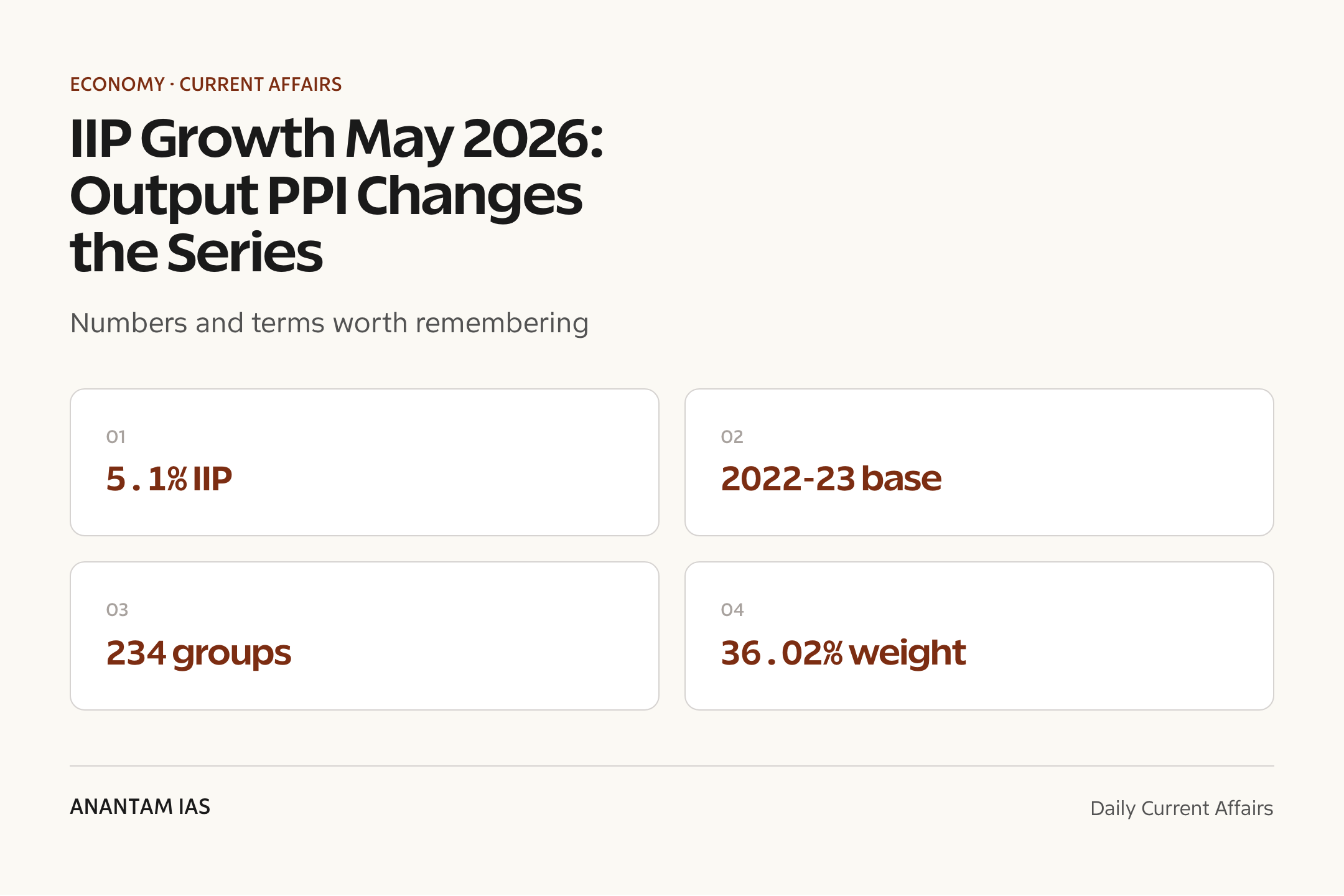
PIB confirmed that India’s Index of Industrial Production recorded 5.1% year-on-year growth in May 2026, with the Quick Estimate rising to 122.7 from 116.7 in May 2025.
The bigger policy-relevant update is the methodology shift: MoSPI revised the 2022-23 IIP series by adopting Output PPI as the deflator for item groups where output is collected in value terms.
- MoSPI said the revised Output PPI-based IIP supersedes the earlier WPI-based 2022-23 series released on 1 June 2026.
- Output Producer Price Index was released by DPIIT with base year 2022-23 on 15 June 2026.
- The deflator switch affects 234 of 463 IIP item groups, equal to 36.02% of the total IIP weight.
- Sector-wise May growth was -1.6% in Mining and Quarrying, 5.5% in Manufacturing, 9.9% in Electricity and Gas Supply, and 5.5% in Water Supply, Sewerage and Waste Management.
- The Hindu reported the May print as a five-month high, while PIB remains the primary source for the final numbers and methodology note.
The development matters in the context of:
- IIP is a high-frequency indicator of industrial output and feeds into near-term readings of the production cycle.
- Deflator choice matters because value-based production data must be converted into real output after removing price effects.
- Output PPI can align industrial volume estimation more closely with producer-level prices than WPI for relevant item groups.
- This change links monthly factory data with larger debates on national income accounting, GDP deflator, and the measurement of real growth.
UPSC Relevance
Prelims Relevance
- IIP stands for Index of Industrial Production and tracks changes in industrial output over time.
- MoSPI releases the All India IIP and the May 2026 Quick Estimate.
- Base year 2022-23 is the base for the new IIP series cited in the PIB release.
- Output PPI replaced WPI as deflator for value-based item groups in the revised 2022-23 series.
- 234 of 463 item groups are value-based item groups affected by the deflator change.
- Manufacturing carries the largest sectoral weight in the IIP basket and grew 5.5% in May 2026.
- Capital Goods grew 12.9% under use-based classification in May 2026.
- June 2026 IIP is scheduled for release on 28 July 2026.
Mains Relevance
GS Paper 3
- Industrial growth indicators, manufacturing performance, and data quality in macroeconomic policy.
- Role of IIP, PPI, WPI, and deflators in measuring real output.
GS Paper 2
- Institutional coordination between MoSPI, DPIIT, source agencies, and technical advisory processes.
- Governance of official statistics and public trust in revised data series.
Essay
- What gets measured well gets governed better.
- Data reforms and the credibility of economic policymaking.
- Industrial transformation in a changing price environment.
Background and Context
What IIP Measures
The Index of Industrial Production is a short-term volume indicator for the industrial sector.
- IIP measures the change in industrial output relative to a base year, so it captures physical or real production rather than nominal sales value.
- The May 2026 release uses 2022-23=100 as the base, making 122.7 the Quick Estimate for the General Index.
- It covers Mining and Quarrying, Manufacturing, Electricity and Gas Supply, and Water Supply, Sewerage and Waste Management.
- For students, link IIP with sectors of the economy: it is mainly about the industrial or secondary-sector production cycle.
- A rising IIP may indicate stronger industrial activity, but it must be read with inflation, employment, capacity use, trade data, and sector-specific shocks.
Why Output PPI Matters
The Output PPI shift is important because many IIP items are reported in value terms, not direct physical quantities.
- Value-based production data mixes price change and real quantity change, so statisticians need a deflator to estimate real output.
- WPI captures wholesale price movements, while Output PPI is designed to capture prices received by producers for their output.
- PIB stated that Output PPI gives a more granular price structure and improves estimation of real output for value-based items.
- The switch applies to 234 item groups, representing 36.02% of the total index weight, so it is not a cosmetic change.
- The concept is close to the logic of a deflator: remove price effects before judging real production growth.
- For exam answers, the key distinction is simple: nominal value can rise because prices rise, while real output should rise only when production volume rises.
May 2026 Sector Signals
The May print shows broad support from manufacturing and power, while mining was weak.
- General IIP grew 5.1% year-on-year in May 2026, with the index at 122.7 against 116.7 in May 2025.
- Manufacturing grew 5.5%, and 16 of 23 manufacturing industry groups recorded positive growth.
- Electricity and Gas Supply grew 9.9%, giving the headline number an important infrastructure and power-cycle support.
- Mining and Quarrying contracted 1.6%, reminding us that a single headline index may hide opposite sectoral movements.
- Water Supply, Sewerage and Waste Management grew 5.5%, a smaller but syllabus-relevant part of the revised basket.
Manufacturing Contributors
PIB identified three manufacturing groups as the top positive contributors in May 2026.
- Motor vehicles, trailers and semi-trailers grew 14.5%, with passenger cars, auto components, and commercial vehicles contributing significantly.
- Electrical equipment grew 20.8%, supported by items such as switching apparatus, small transformers, UPS, and solid-state drives.
- Basic metals grew 4.6%, with HR coils, HR plates, and bars and rods contributing to output growth.
- These groups matter for investment demand, construction, supply chains, and the broader manufacturing recovery debate.
- For Mains answers, avoid treating manufacturing as one block; split it into autos, electrical equipment, basic metals, and sectoral bottlenecks.
Use-Based Classification
Use-based IIP shows whether growth is coming from inputs, investment goods, construction, or consumption.
- Primary Goods grew 2.6%, pointing to moderate growth in basic input categories.
- Capital Goods grew 12.9%, the strongest use-based growth rate in the PIB highlights for May 2026.
- Intermediate Goods grew 5.8%, while Infrastructure and Construction Goods grew 5.9%.
- Consumer Durables grew 7.2%, while Consumer Non-durables grew 3.6%.
- PIB said the top three positive contributors by use-based classification were Intermediate Goods, Capital Goods, and Primary Goods.
Governance of Statistical Revisions
The deflator change is also a governance issue because official statistics shape policy, markets, and academic analysis.
- MoSPI said the revised release supersedes the earlier WPI-based 2022-23 IIP series, so users should use the PPI-based series for analysis and policy work.
- DPIIT released the Output PPI series on 15 June 2026, after which MoSPI examined its implications for IIP compilation.
- PIB noted the change is aligned with international best practices and the Technical Advisory Committee recommendation for base revision.
- Major changes in an index series are easier to accommodate during base-year revision, because weights, products, classifications, and methods are being updated together.
- The release also notes updated source-agency data since April 2022 and a revision in the electricity index to address a sub-sectoral weight issue.
- This makes the release a useful case study in statistical governance: revision is acceptable when the method, reason, and replacement series are publicly explained.
Way Forward
Improve Data Transparency
- MoSPI should keep public metadata clear on which item groups use physical quantity data and which use value-based data.
- Revision notes should explain deflator changes, source-agency updates, and sectoral weight fixes in simple tables for users.
Strengthen PPI Ecosystem
- Output PPI needs timely, granular, and stable price collection so that the revised IIP series remains credible.
- Coordination between MoSPI, DPIIT, and source agencies should be institutionalized through routine quality checks.
Read IIP With Other Indicators
- Policy analysis should read IIP with GDP, PMI, GST collections, capacity use, exports, and credit data.
- Students should avoid one-number answers: sectoral and use-based splits usually carry the real analytical insight.
Conclusion
The May 2026 IIP release is not only about 5.1% industrial growth. Its durable exam value lies in the switch from WPI to Output PPI for value-based item groups in the 2022-23 series.
For Prelims, remember the institutions, dates, base year, affected item groups, and sectoral growth rates. For Mains, use this case to discuss data credibility, real output measurement, and the role of statistical reforms in economic policymaking.
UPSC Practice Questions
Prelims MCQ 1
With reference to the May 2026 IIP release, consider the following statements:
- The IIP Quick Estimate for May 2026 stood at 122.7 against 116.7 in May 2025.
- MoSPI adopted Output PPI as deflator for value-based item groups in the revised 2022-23 IIP series.
- The deflator switch affects 234 of the 463 item groups in the IIP basket.
How many of the above statements are correct?
(a) Only one (b) Only two (c) All three (d) None
Answer: (c) All three
Explanation:
All three statements match the PIB release. The General Index rose to 122.7, Output PPI replaced WPI for value-based item groups, and 234 of 463 item groups are affected.
Prelims MCQ 2
Which use-based category recorded the highest year-on-year growth in the May 2026 IIP highlights cited by PIB?
(a) Primary Goods (b) Capital Goods (c) Consumer Durables (d) Infrastructure and Construction Goods
Answer: (b) Capital Goods
Explanation:
Capital Goods grew 12.9% in May 2026, higher than Primary Goods at 2.6%, Consumer Durables at 7.2%, and Infrastructure and Construction Goods at 5.9%.
UPSC Mains Questions
- The revision of IIP with Output PPI as deflator shows that growth measurement is as important as growth itself. Discuss the significance of deflators, base-year revisions, and data transparency in Indian macroeconomic policymaking.
- May 2026 IIP growth was supported by manufacturing, electricity, and capital goods, while mining contracted. Analyze how sectoral and use-based IIP data should be used to assess the health of India’s industrial economy.
- Official statistics require both technical accuracy and public trust. Examine this statement using the 2022-23 IIP series revision as an example.
Sources: PIB, Ministry of Statistics and Programme Implementation and The Hindu Economy.
Frequently Asked Questions
What is IIP?
IIP, or Index of Industrial Production, is a short-term indicator that measures changes in industrial output relative to a base year. It tracks sectors such as mining, manufacturing, electricity and gas supply, and water-related services.
What changed in May 2026 IIP?
MoSPI reported 5.1% IIP growth for May 2026 and revised the 2022-23 IIP series by using Output PPI instead of WPI as the deflator for value-based item groups.
Why does Output PPI matter?
Output PPI captures producer-level output prices. For item groups where production is collected in value terms, it helps remove price effects more precisely and improves the estimation of real industrial output.
How many IIP groups are affected?
The Output PPI deflator affects 234 out of 463 item groups in the IIP basket. PIB said these groups account for 36.02% of the total index weight.
Which sector led May growth?
Electricity and Gas Supply grew 9.9%, while Manufacturing grew 5.5%. Mining and Quarrying contracted 1.6%, so the headline 5.1% growth came with mixed sectoral signals.
Why is this relevant for UPSC?
It links GS3 Economy themes such as industrial growth, statistical systems, national income accounting, deflators, base-year revision, and data governance. It can appear in both Prelims facts and Mains analytical questions.
Source: https://anantamias.com/current-affairs/iip-growth-may-2026-output-ppi-deflator/
DRDO Financial Powers 2026: Faster Defence R&D Execution
Why in News?
PIB confirmed that Raksha Mantri Rajnath Singh released the Delegation of Financial Powers to DRDO 2026 in New Delhi on June 29, 2026.
The revised framework is meant to speed up strategic R&D projects, improve accountability, and move systems, platforms, and technologies from the R&D ecosystem into the Defence Forces faster.
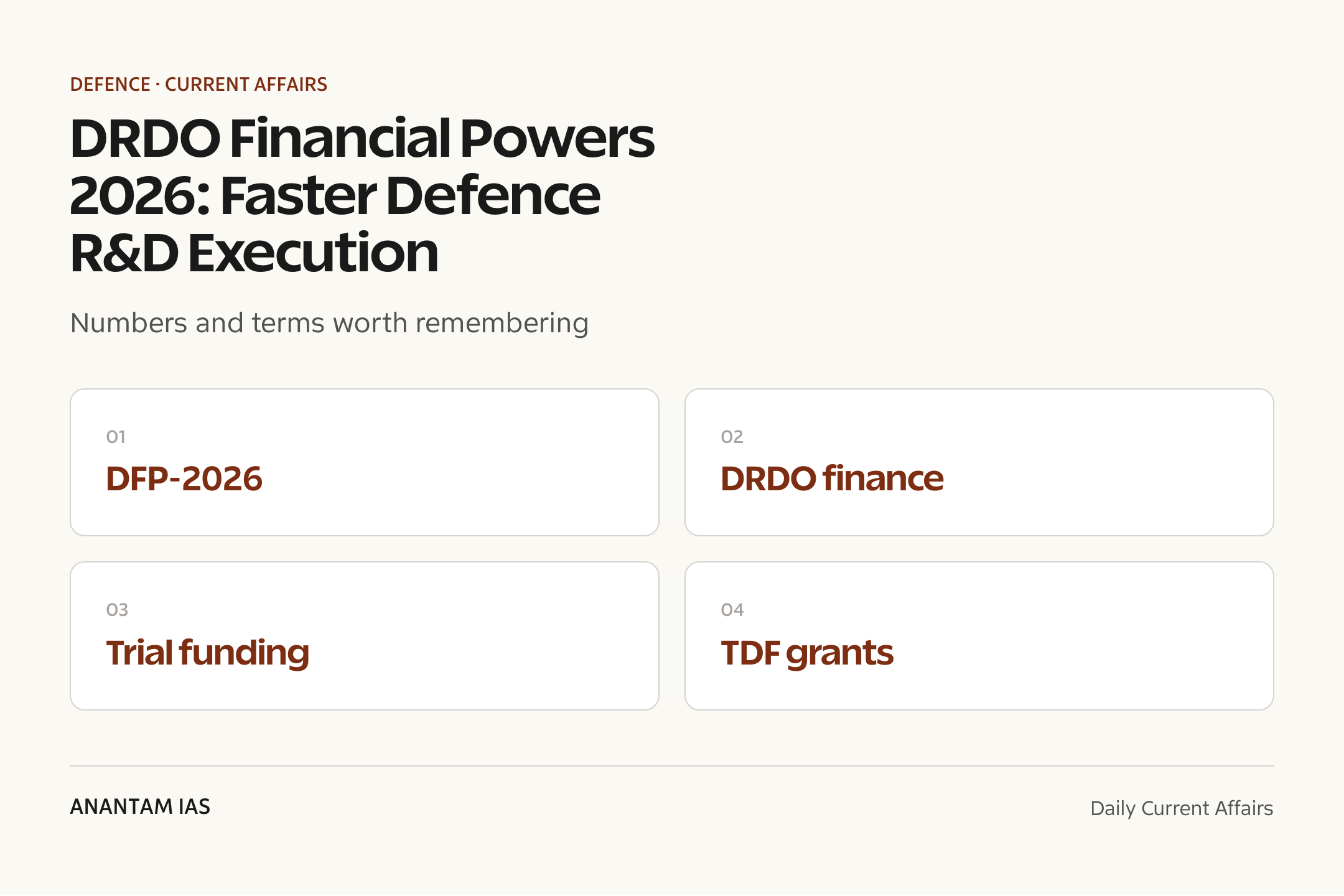
- DFP-2026 updates financial delegation within the Department of Defence R&D and DRDO-linked project structures.
- It creates dedicated financial provisions for trial campaigns, tests, and evaluation activities.
- It authorises sanctioning of pre-project R&D initiatives, reducing the delay before a formal project begins.
- It separates financial powers for grants-in-aid linked to Extra-Mural Research Projects, DIA-CoEs, and the Technology Development Fund.
- PIB said the reform supports Aatmanirbhar Bharat and stronger defence preparedness.
The development matters in the context of:
- Defence R&D often suffers when trial funding, testing authority, and early-stage approval move slower than the technology cycle.
- DRDO-industry-academia collaboration needs predictable funding authority because prototypes, field trials, and design improvements are iterative.
- Internal security and external defence now depend on faster induction of missiles, sensors, drones, cyber tools, and electronic systems.
- Procurement reform is not only about buying weapons; it also shapes how quickly indigenous technology becomes deployable capability.
UPSC Relevance
Prelims Relevance
- DRDO works under the Department of Defence R&D in the Ministry of Defence.
- DFP-2026 refers to the revised delegation of financial powers for DRDO-related R&D execution.
- Extra-Mural Research supports research outside DRDO labs, including academic and specialist institutions.
- Defence Innovation Accelerator-Centres of Excellence link defence innovation with institutions, industry, and startups.
- Technology Development Fund supports development of defence technologies by industry, especially MSMEs and startups.
- Trial campaigns, tests, and evaluation activities are key stages before induction of a defence system.
- Aatmanirbhar Bharat in defence means domestic design, development, production, and supply-chain resilience.
- GS3 Science and Technology connects this topic with indigenous defence technology, innovation, and security.
Mains Relevance
GS Paper 3
- Internal security: Faster R&D execution can reduce capability gaps in surveillance, air defence, missiles, drones, and electronic warfare.
- Science and technology: DFP-2026 shows how institutional finance rules affect innovation outcomes, not just lab capacity.
- Defence indigenisation: Delegated powers can support quicker movement from prototype to production and induction.
GS Paper 2
- Governance: The reform tests the balance between functional autonomy, financial accountability, audit discipline, and outcome-based administration.
- Public institutions: DRDO’s link with academia and industry raises questions about grant design, transparency, and collaboration models.
Essay
- Self-reliance is built through institutions, not slogans alone.
- Speed and accountability can coexist when rules define authority clearly.
- Technology sovereignty depends on research finance, talent, testing infrastructure, and procurement confidence.
Background and Context
What DFP-2026 Changes
The core reform is administrative: give DRDO-linked decision-makers clearer authority to fund critical stages of R&D.
- Delegation of Financial Powers means specified officers or bodies can approve defined expenditure without routing every decision to the top.
- DFP-2026 focuses on strategic R&D execution, where delays in approvals can slow tests, vendor work, design iterations, and field validation.
- PIB described it as a reform for efficiency, accountability, and timely execution, not as a new weapon system or new organisation.
- Functional empowerment is the key phrase: the reform aims to let the right level approve the right expenditure at the right project stage.
- Accountability remains central because delegated powers work only when expenditure heads, schedules, and competent authorities are clearly defined.
Why DRDO Needs Faster Financial Authority
Defence technology moves through uncertain stages, so rigid finance channels can become a bottleneck before the science itself fails.
- Strategic R&D involves design, simulation, prototype fabrication, field trials, redesign, user feedback, and production readiness.
- Trial campaigns need travel, range access, instrumentation, test assets, specialist support, and repeated evaluation windows.
- Pre-project R&D matters because early feasibility work often decides whether a full project deserves sanction.
- Defence systems such as missiles, radars, UAVs, electronic warfare suites, and sensors need fast iteration after test data.
- Procurement speed at the R&D stage can directly shape operational readiness because delayed testing delays induction.
Link With Aatmanirbhar Bharat
The reform supports defence self-reliance by improving the route between laboratory work, industry capacity, and military use.
- Aatmanirbhar Bharat in defence requires domestic design and development, not only local assembly of imported technology.
- DRDO supplies the institutional backbone for many indigenous platforms, but induction needs production partners and user confidence.
- Industry collaboration becomes stronger when funding decisions for tests, prototypes, and technology development are predictable.
- Academia can contribute advanced research in materials, propulsion, AI, cyber systems, quantum technologies, and electronics.
- Self-reliance improves when promising technologies do not remain trapped between proof-of-concept and field-ready systems.
- Students can connect this to Science and Technology preparation because defence R&D is a high-yield current-affairs area.
Grant Schedules And Innovation Channels
PIB highlighted clearer segregation of financial powers for major defence innovation and research grant channels.
- Extra-Mural Research Projects allow defence-linked research to be supported beyond DRDO’s own labs.
- Defence Innovation Accelerator-Centres of Excellence connect defence needs with universities, innovation hubs, and technology ecosystems.
- Technology Development Fund supports defence technology development, especially where industry can build usable systems.
- Separate schedules reduce ambiguity over which authority can approve which grant or expenditure category.
- Grant clarity is important for startups and research teams because uncertain approvals can break project timelines and cash flow.
Internal Security And Strategic Preparedness
The GS3 value lies in linking financial delegation with capability development and national security outcomes.
- Internal security now overlaps with drones, encrypted communications, border surveillance, cyber tools, and electronic warfare.
- External defence needs indigenous air defence, long-range strike, naval systems, space support, and secure communications.
- Critical systems are useful only after they clear trials, tests, evaluation, production, and user induction.
- DFP-2026 tries to shorten the administrative distance between R&D output and Defence Forces’ use.
- This theme also links with recent defence technology notes such as DRDO’s ballistic missile defence test and air-defence preparedness.
Governance Risks To Watch
Delegation can improve speed, but it must be backed by transparent process, audit discipline, and measurable project outcomes.
- Financial autonomy can fail if powers are unclear, duplicated, or used without milestones.
- Audit discipline matters because strategic urgency cannot become a shield for weak documentation.
- Vendor selection and research grants need safeguards against favouritism, poor peer review, and fragmented project ownership.
- User feedback from the armed forces must be built into testing so R&D does not drift away from operational needs.
- Outcome tracking should focus on trial completion, prototype maturity, transfer of technology, production readiness, and induction.
How To Use This In Answers
For Mains, DFP-2026 is best used as a governance example inside a larger defence modernisation answer.
- Institutional reform example: Use it to show that capability development needs better rules, not only higher budgets.
- Science-to-security link: Connect the reform with how lab research becomes deployable technology through testing, evaluation, and production.
- Public finance angle: Delegation should be presented as controlled decentralisation, where speed is paired with audit and defined schedules.
- Indigenisation example: Cite DRDO, industry, academia, Extra-Mural Research, DIA-CoEs, and TDF as parts of one defence innovation chain.
- Balanced critique: Add that faster sanctions alone cannot fix weak project management, delayed trials, user-service mismatch, or production bottlenecks.
Way Forward
Make Delegation Outcome-Linked
- Tie delegated approvals to defined milestones such as feasibility proof, prototype readiness, trial completion, and user evaluation.
- Use project dashboards inside the Ministry of Defence to track delays, cost changes, trial status, and technology maturity.
- Publish broad non-sensitive performance indicators so Parliament and citizens can assess reform outcomes without exposing classified details.
- Map each financial approval to a project stage so reviewers can see whether spending helped a trial, prototype, grant, or induction pathway.
Strengthen Innovation Interfaces
- Give industry and academia predictable grant timelines, clear eligibility rules, and standard reporting formats.
- Support MSMEs and startups through faster test access, intellectual property clarity, and realistic procurement pathways after successful trials.
- Build stronger links between DRDO labs, service headquarters, private manufacturers, and testing ranges.
- Create a clearer route for successful prototypes to move from grant support to limited series production and user trials.
Protect Accountability
- Keep audit trails strong even when approval authority is pushed downward.
- Separate technical evaluation from financial approval where conflict of interest may arise.
- Use post-project reviews to identify why some projects miss timelines, fail trials, or do not reach induction.
- Require lessons-learned notes after major tests so repeated delays in materials, ranges, vendors, or user feedback are not normalised.
Conclusion
DFP-2026 is an institutional reform with direct security relevance: it tries to make DRDO’s R&D pipeline faster without abandoning financial discipline.
For UPSC, the issue is not the finance rule alone. The exam angle is how governance design shapes defence innovation, self-reliance, industry collaboration, and timely military preparedness.
The reform will matter most if delegated powers translate into tested systems, cleaner collaboration, faster induction, and stronger accountability across the defence R&D ecosystem.
UPSC Practice Questions
Prelims MCQ 1
With reference to the Delegation of Financial Powers to DRDO 2026, consider the following statements:
- It was released by the Raksha Mantri on June 29, 2026.
- It includes dedicated financial provisions for trial campaigns, tests, and evaluation activities.
- It creates a new armed force under the Ministry of Defence.
How many of the above statements are correct?
(a) Only one (b) Only two (c) All three (d) None
Answer: (b) Only two
Explanation:
Statements 1 and 2 are correct as per PIB. Statement 3 is incorrect because DFP-2026 is a financial delegation framework for DRDO-related R&D execution, not a new armed force.
Prelims MCQ 2
Which one of the following is most directly associated with grants and technology development support mentioned in DFP-2026?
(a) Technology Development Fund (b) Finance Commission (c) Inter-State Council (d) National Disaster Response Force
Answer: (a) Technology Development Fund
Explanation:
PIB referred to clear segregation of financial powers for grants-in-aid linked to Extra-Mural Research Projects, DIA-CoEs, and Technology Development Fund projects.
UPSC Mains Questions
- DFP-2026 shows that defence preparedness depends as much on institutional finance rules as on scientific capability. Discuss with reference to DRDO, strategic R&D execution, trials, and defence indigenisation.
- Examine how clearer financial delegation can improve collaboration among DRDO, industry, academia, and the armed forces. What accountability safeguards are needed when speed becomes an explicit objective?
- Defence self-reliance requires faster movement from prototype to induction. Analyse the role of procurement reform, testing infrastructure, and technology development funds in achieving this goal.
Sources: PIB, Ministry of Defence and Indian Express.
Frequently Asked Questions
What is DFP-2026?
DFP-2026 is the Delegation of Financial Powers to DRDO 2026. PIB described it as a revised framework to improve efficiency, accountability, and timely execution of strategic defence R&D projects within the Department of Defence R&D.
Who released DFP-2026?
Raksha Mantri Rajnath Singh released DFP-2026 on June 29, 2026, in New Delhi. PIB said the reform is meant to support faster production and induction of systems, platforms, and technologies into the Defence Forces.
Why is it important for UPSC?
It connects GS3 internal security, science and technology, and defence indigenisation. It also has a GS2 governance angle because it deals with delegation, accountability, audit discipline, and public-sector institutional reform.
How does it help Aatmanirbhar Bharat?
The framework can support self-reliance by reducing administrative delay in trials, pre-project R&D, grants, and technology development. Faster approvals can help indigenous systems move from labs and industry partners to military users.
What are DIA-CoEs?
Defence Innovation Accelerator-Centres of Excellence are defence innovation channels that connect research institutions, innovation ecosystems, and defence needs. DFP-2026 gives clearer financial treatment to grants linked with such projects.
What risks should be watched?
The main risks are weak documentation, poor outcome tracking, unclear authority, and rushed approvals without technical discipline. Delegation works best when financial powers are linked with milestones, audits, and user evaluation.
Source: https://anantamias.com/current-affairs/drdo-financial-powers-delegation-2026/
TRL Compass Platform: Standardising Technology Readiness
Why in News?
PIB reported that the Office of the Principal Scientific Adviser, with the Data Security Council of India, launched the TRL Compass Platform on 29 June 2026.
The platform adapts the globally used nine-level Technology Readiness Level scale to India’s research and innovation ecosystem so projects can be assessed more consistently.
- The launch was chaired by the Principal Scientific Adviser to the Government of India.
- TRL Compass aims to create a common national standard for assessing technology maturity.
- It is relevant for public funding, innovation governance, research translation, and industry adoption.
- The platform also signals stronger attention to cyber and data-security collaboration through DSCI.
The development matters in the context of:
- Many Indian research projects struggle to move from lab proof to field deployment.
- A shared TRL scale can reduce confusion between invention, prototype, pilot, and deployable technology.
- The topic fits GS3 because it links science policy, public funding, innovation ecosystems, and technology governance.
UPSC Relevance
Prelims Relevance
- TRL means Technology Readiness Level, a scale used to judge maturity of a technology.
- Nine-level TRL scale generally runs from basic principles to proven operational use.
- OPSA is the Office of the Principal Scientific Adviser to the Government of India.
- DSCI is the Data Security Council of India.
- Public-funded innovation needs evaluation before grants, pilots, procurement, or scale-up.
- Technology transfer depends on maturity, validation, standards, and user acceptance.
- Innovation governance includes assessment, funding, risk management, and accountability.
Mains Relevance
GS Paper 3
- Science and technology policy
- Research-to-market translation
- Public funding for innovation
- Cyber and data-security ecosystem
GS Paper 2
- Institutional coordination across government, academia, and industry
- Evidence-based public expenditure in technology programmes
Essay
- Innovation needs institutions as much as ideas
- From laboratory to society
- Science policy as development policy
Background and Context
What TRL Compass Does
TRL Compass is a technology-assessment tool, not a new research grant by itself.
- Technology Readiness Level gives policymakers and funders a way to ask how mature a technology really is.
- Early TRL stages usually indicate basic principles, concept formulation, or laboratory validation.
- Higher TRL stages indicate prototype demonstration, relevant-environment testing, system integration, and operational readiness.
- TRL Compass matters because different agencies often use different language for the same maturity stage.
- Common vocabulary helps reduce overclaiming, underfunding, duplication, and premature procurement.
Why Technology Maturity Assessment Matters
A research idea can be scientifically promising and still be far from deployment.
- Proof of concept shows feasibility under limited conditions; it does not mean the system is ready for users.
- Prototype testing exposes reliability, safety, cost, manufacturability, and performance problems.
- Pilot deployment checks whether a technology works in field conditions with real users and constraints.
- Public funding should match maturity: early research needs grants, while mature technologies may need pilots, standards, or procurement support.
- Bad assessment can waste money by scaling immature tools or by abandoning ideas before they are tested properly.
India's Innovation Translation Problem
India has strong research islands, but translation from lab to usable product remains uneven.
- Research institutions often generate papers, patents, and prototypes, but market or public-sector adoption needs a different pathway.
- Startups may struggle to prove maturity to ministries, investors, regulators, or procurement bodies.
- Government missions in defence, health, agriculture, space, climate, and digital governance need validated technologies.
- TRL assessment can help identify whether the next step is more research, field testing, certification, manufacturing support, or procurement.
- Innovation ecosystems become stronger when scientists, funders, industry, and users use the same maturity language.
Governance And Public Money
A common readiness scale can improve the way public money is allocated and reviewed.
- Funding decisions become clearer when agencies know whether they are supporting basic research, applied development, pilot work, or scaling.
- Milestone-based grants can use TRL movement to measure whether a project is progressing.
- Audit and review improve when claims of readiness are backed by evidence rather than promotional language.
- Risk management is stronger because technical, financial, ethical, and security risks differ by maturity stage.
- Procurement caution matters because buying a low-readiness technology for public service can harm citizens and waste funds.
Data Security Council Link
The DSCI collaboration widens the platform’s relevance to cyber, digital, and data-intensive innovation.
- Digital technologies often mature differently from hardware systems because software can be iterated quickly but security risks remain high.
- Data-security review is important when AI, cybersecurity, health data, financial technology, or public digital infrastructure is involved.
- Trustworthy innovation needs privacy, security testing, standards, and responsible deployment.
- Cyber ecosystem benefits when readiness assessment includes not just functionality but resilience, compliance, and abuse risks.
- Public-interest technology must be mature enough for scale and safe enough for citizens.
How To Use It In UPSC Answers
TRL Compass is a compact example for science-policy answers that need an institutional detail.
- Science policy example: cite it when arguing that India needs better pathways from research to deployment.
- Governance example: use it to show how common standards improve funding and accountability.
- Startup ecosystem example: connect it to clearer proof of maturity for deep-tech ventures.
- Defence and health examples: show how high-risk sectors need validated technologies before scale.
- Critical view: a platform will work only if ministries, funders, labs, and industry actually adopt it.
Practical Risks In Readiness Scoring
A readiness platform can improve decisions only if scoring is credible, evidence-based, and accepted by users.
- Overstatement risk arises when project teams describe a prototype as deployable before it has passed field conditions, safety checks, or user testing.
- Understatement risk can also hurt innovation if evaluators are too conservative and keep mature technologies trapped in pilot mode.
- Sector variation matters because a software tool, medical device, battery material, and defence sensor cannot be assessed with identical evidence.
- Independent review improves trust when readiness claims are tested by domain experts, users, and security or standards bodies.
- User acceptance must be part of assessment because a technically mature tool can still fail if field users find it unsafe, slow, costly, or hard to integrate.
- Evidence trail should record tests, failures, redesigns, and field feedback so readiness scores are not based on claims alone.
- Adoption risk remains if ministries continue using old funding formats and do not connect TRL scores with grants, pilots, or procurement.
Way Forward
Adopt Across Agencies
- Use the TRL Compass scale in grant calls, mission documents, public procurement pilots, and review meetings.
- Train evaluators so TRL scores are evidence-based and comparable.
Link With Funding
- Match funding type to maturity stage: basic grants, prototype funds, pilot support, and scale-up procurement.
- Use milestone reviews without punishing genuine research uncertainty.
Add Safety Filters
- Include cybersecurity, privacy, ethics, standards, and user testing in maturity assessment.
- Build sector-specific readiness checklists for health, defence, climate, and digital public infrastructure.
Conclusion
TRL Compass matters because innovation does not fail only for lack of ideas; it often fails because the system cannot judge readiness clearly.
A common readiness language can help India spend public funds better, support startups more intelligently, and move useful technologies from labs to society.
For UPSC, this is a strong example of science governance: institutions, standards, evidence, and accountability shape whether research becomes public value.
UPSC Practice Questions
Prelims MCQ 1
With reference to Technology Readiness Levels, consider the following statements:
- They are used to assess maturity of a technology.
- Higher levels usually indicate closer readiness for operational use.
- They are limited only to agricultural technologies.
How many of the above statements are correct?
(a) Only one (b) Only two (c) All three (d) None
Answer: (b) Only two
Explanation:
Statements 1 and 2 are correct. TRL assessment is not limited to agriculture.
Prelims MCQ 2
TRL Compass was launched by which institutional office, as reported by PIB?
(a) Office of the Principal Scientific Adviser (b) Election Commission of India (c) Finance Commission (d) National Human Rights Commission
Answer: (a) Office of the Principal Scientific Adviser
Explanation:
PIB reported the launch by the Office of the Principal Scientific Adviser, with DSCI collaboration.
UPSC Mains Questions
- Technology readiness assessment can improve the translation of public-funded research into usable innovation. Discuss with reference to TRL Compass.
- India’s deep-tech ecosystem needs common standards, patient capital, and accountable public funding. Analyse.
- How can the government balance innovation speed with safety, audit, and public-interest safeguards?
Source: PIB, Office of Principal Scientific Adviser.
Frequently Asked Questions
What is TRL Compass?
It is a platform to standardise Technology Readiness Level assessment across sectors in India’s innovation ecosystem.
Who launched it?
PIB reported that the Office of the Principal Scientific Adviser launched it with the Data Security Council of India.
What is a TRL scale?
It is a maturity scale that helps judge whether a technology is at concept, prototype, pilot, or operational stage.
Why is this useful?
It helps funders, ministries, labs, startups, and users speak the same language about technology maturity.
How does it help governance?
It can improve grant decisions, milestone reviews, procurement caution, and accountability for public-funded innovation.
What is the UPSC angle?
The topic fits GS3 science and technology, innovation policy, public funding, and research-to-market translation.
Source: https://anantamias.com/current-affairs/trl-compass-platform-technology-readiness/
CBSE Language Policy: Flexibility in Three-Language Rule
Why in News?
The Hindu reported that CBSE relaxed parts of the three-language policy for Classes 7, 8, and 9 and allowed two foreign language options.
The report also noted that the current batch of Class 10 would not have to follow the new language-policy requirement, making this a live education-governance issue.
- The topic sits at the intersection of NEP 2020, school curriculum design, and language choice.
- It affects students, teachers, textbook planning, school capacity, and State-level sensitivities.
- Language policy is exam-relevant because it raises equality, access, identity, and federalism questions.
- The immediate issue is implementation flexibility, not a rejection of multilingual education.
The development matters in the context of:
- The three-language formula has long been linked with national integration and multilingual competence.
- Implementation becomes difficult when schools lack qualified teachers for particular languages.
- Language policy can become politically sensitive because education sits in the Concurrent List and States have distinct linguistic identities.
UPSC Relevance
Prelims Relevance
- CBSE is a national school board under the Ministry of Education’s broad administrative ecosystem.
- NEP 2020 supports multilingualism and mother-tongue or home-language learning where possible.
- Three-language formula seeks multilingual learning but has been implemented unevenly across States.
- Education is in the Concurrent List of the Seventh Schedule.
- Article 350A asks every State and local authority to provide facilities for instruction in mother tongue at primary stage for children belonging to linguistic minority groups.
- Linguistic minorities are protected through constitutional and institutional safeguards.
- Curriculum change needs teacher availability, textbooks, assessment design, and transition time.
Mains Relevance
GS Paper 2
- Education policy implementation
- Language rights and inclusion
- Centre-State coordination
- NEP 2020 and school reform
GS Paper 1
- Indian society, linguistic diversity, and cultural identity
Essay
- Language as identity and opportunity
- Education reform needs empathy
- Unity through diversity
Background and Context
What The CBSE Relaxation Means
The development is best understood as an implementation adjustment within a broader multilingual education framework.
- CBSE relaxation gives schools and students more flexibility during transition to a revised language-learning framework.
- Classes 7 to 9 are affected because middle-school curriculum planning shapes later board-exam readiness.
- Foreign language options can help schools that already offer such courses, but they also raise questions of equity across school types.
- Class 10 exemption reduces disruption for a batch already close to board-level assessment.
- Policy lesson: education reform needs phased implementation, clear communication, and capacity checks.
NEP 2020 And Multilingualism
The NEP supports multilingual learning, but it also recognises the practical challenge of implementation.
- NEP 2020 treats language as a tool for cognitive development, cultural confidence, and better early learning.
- Mother-tongue learning is especially important in early grades because children learn concepts faster in familiar languages.
- Multilingual competence can widen cultural understanding and improve communication across India.
- School systems need trained language teachers, textbooks, assessment tools, and timetable space.
- Flexibility matters because a uniform rule can create unequal burdens when school capacity differs sharply.
Federal And Linguistic Sensitivities
Language policy in India is never only pedagogical; it carries identity and federal meaning.
- Education in the Concurrent List means both Union and States shape the field through policies, laws, boards, and institutions.
- Linguistic diversity is central to Indian society, and policy choices can be read as respect or pressure.
- Southern and northeastern States, Hindi-speaking States, and linguistically mixed urban areas may face different concerns.
- Minority-language rights require attention because children should not be disadvantaged by language background.
- Consultation with States, schools, parents, teachers, and subject experts can reduce avoidable friction.
Equity And School Capacity
A language choice looks simple on paper but can deepen inequality if schools differ in resources.
- Private urban schools may offer more language options, including foreign languages, because they have stronger staffing and fee capacity.
- Government and rural schools may struggle to add teachers quickly for additional language subjects.
- Teacher availability is the central bottleneck because language learning needs sustained classroom interaction.
- Assessment pressure can make students treat language as a scoring burden rather than a learning opportunity.
- Equity lens asks whether the same rule creates different burdens for first-generation learners, migrants, and low-income students.
Implementation Lessons
The CBSE move is a reminder that policy success depends on transition design.
- Phasing protects students from sudden curriculum shocks.
- Teacher training must precede full implementation because language quality cannot be created by notification alone.
- Textbook planning needs time, especially for less commonly offered languages.
- Digital resources can support but cannot replace classroom teachers and community language exposure.
- Monitoring should track student load, learning outcomes, and school readiness rather than only compliance.
How To Use This In Answers
This is a useful example for education answers that need balance instead of slogan-level support or opposition.
- Pro-reform point: multilingualism supports cognition, cultural respect, and national integration.
- Practical caution: school capacity, teacher supply, and student transition must shape timelines.
- Federal point: language policy must respect State diversity and local sensitivities.
- Equity point: options should not become privileges available only to resource-rich schools.
- Answer conclusion: flexibility is not weakness; in education governance, flexibility can protect fairness.
Risks In A Uniform Roll-Out
A uniform language mandate can create unequal effects when schools and households begin from different positions.
- Teacher shortage can make a formal option meaningless if schools cannot provide consistent instruction across the academic year.
- Student burden rises when language requirements are added without reducing other curriculum pressure or giving transition time.
- Urban-rural divide can widen if well-funded schools offer attractive language combinations while smaller schools offer only what staffing allows.
- Migrant children need special care because home language, school language, and State language may all differ.
- Bridge support is needed for students who shift boards, move cities, or enter CBSE schools after studying a different language combination.
- Parent communication matters because unclear rules can create anxiety about board eligibility, subject choice, and future academic pathways.
- Implementation audits should check whether schools actually teach the offered languages, or merely list them on paper to satisfy board requirements.
- Teacher-sharing models across nearby schools, online support for rare languages, and district-level language resource pools can reduce the gap between policy choice and classroom reality.
- Assessment design should reward real language learning and communication, not rote grammar drills that punish first-generation learners.
Way Forward
Phase The Reform
- Give schools clear timelines and transition rules for each grade.
- Avoid sudden changes for board-exam batches or students close to assessment milestones.
Build Capacity
- Invest in language-teacher recruitment, training, and shared digital resources.
- Support government and rural schools so choice does not become unequal.
Respect Diversity
- Consult States and language communities before major curriculum changes.
- Protect mother-tongue learning and linguistic-minority safeguards.
Conclusion
CBSE’s language-policy relaxation shows the difference between policy intent and classroom feasibility.
India can promote multilingual learning without creating unfair burdens if it gives schools time, teachers, material support, and flexible pathways.
For UPSC, the issue is a neat case study in education governance, linguistic diversity, and cooperative federalism.
UPSC Practice Questions
Prelims MCQ 1
With reference to education and language policy in India, consider the following statements:
- Education is in the Concurrent List.
- NEP 2020 supports multilingualism.
- Article 350A relates to instruction in mother tongue for linguistic minority children at primary stage.
How many of the above statements are correct?
(a) Only one (b) Only two (c) All three (d) None
Answer: (c) All three
Explanation:
All three statements are correct and are relevant to language-policy debates.
Prelims MCQ 2
Which of the following is the best governance concern in implementing a three-language policy?
(a) Only the colour of textbooks (b) Availability of trained teachers and transition time (c) Eliminating State consultation (d) Removing all language assessment
Answer: (b) Availability of trained teachers and transition time
Explanation:
Teacher capacity, materials, and phased transition are central to implementation.
UPSC Mains Questions
- Language policy in education must balance national integration, local identity, and implementation capacity. Discuss with reference to recent CBSE flexibility.
- Examine the equity challenges in implementing multilingual education across schools with unequal resources.
- How can cooperative federalism help India implement NEP 2020 language goals without creating avoidable social friction?
Source: The Hindu.
Frequently Asked Questions
What did CBSE relax?
The reported relaxation concerns the implementation of the three-language policy for Classes 7, 8, and 9, with more flexibility in language options.
Why is this a UPSC topic?
It connects education policy, NEP 2020, language diversity, federalism, school capacity, and equity in learning.
What is the three-language formula?
It is a multilingual education approach that encourages students to learn more than one language, but its implementation differs across States.
Why is implementation difficult?
Schools need trained teachers, textbooks, assessment design, timetable space, and transition time.
What is the federal angle?
Education is in the Concurrent List, and language choices are closely tied to State identity and linguistic rights.
What is the balanced view?
Multilingualism is valuable, but policy must be flexible, well-resourced, and sensitive to local contexts.
Source: https://anantamias.com/current-affairs/cbse-three-language-policy-relaxation/
Delhi EV Policy: Two-Wheeler Transition and Urban Mobility
Why in News?
Indian Express Explained reported on Delhi’s electric-vehicle policy debate and why the shift matters when two-wheelers form a large share of the city’s vehicle base.
The issue is important for UPSC because transport emissions, affordability, charging networks, and urban air quality sit together in the clean-mobility transition.
- Two-wheelers are central to mass mobility because they are widely used by workers, students, delivery riders, and low-income households.
- EV policy is not only about cars; it must address the vehicle categories that dominate everyday trips.
- Delhi’s air-pollution burden makes clean transport a governance priority.
- The policy challenge is to speed up transition without making mobility unaffordable.
The development matters in the context of:
- Urban transport is a GS3 environment issue and a GS2 governance issue.
- Two-wheeler electrification can cut tailpipe emissions but needs reliable charging, battery safety, financing, and service networks.
- Clean mobility is also an economic question because households and gig workers are sensitive to upfront costs.
UPSC Relevance
Prelims Relevance
- EV means electric vehicle, powered by an electric motor and battery rather than an internal combustion engine.
- FAME has been a major Union-level support framework for electric mobility.
- Tailpipe emissions are direct exhaust emissions from vehicles; EVs have none during use.
- Life-cycle emissions include electricity generation, battery production, use, and disposal.
- Charging infrastructure includes home charging, public chargers, workplace chargers, and battery-swapping stations.
- Battery safety includes thermal management, certification, standards, and safe disposal.
- Modal shift means changing from private motorised trips to public transport, walking, cycling, or cleaner shared mobility.
Mains Relevance
GS Paper 3
- Air pollution and climate co-benefits
- Energy transition and battery supply chains
- Urban transport and environmental regulation
GS Paper 2
- Urban governance, affordability, and policy design
- Centre-State-local coordination in mobility planning
Essay
- Clean air is a governance promise
- Technology transitions must be just
- Cities shape the future of climate action
Background and Context
Why Two-Wheelers Matter
A clean-mobility policy cannot focus only on cars when two-wheelers shape daily urban movement.
- Two-wheelers are affordable, flexible, and widely used for short trips in dense cities.
- Delivery and gig work depend heavily on two-wheelers, so operating cost and charging time directly affect livelihoods.
- Urban emissions from large vehicle fleets add to particulate pollution, nitrogen oxides, and public-health stress.
- EV transition in the two-wheeler segment can produce visible air-quality gains if the grid, batteries, and charging ecosystem improve.
- Policy design must recognise that the most common vehicle category can deliver the largest everyday behavioural shift.
Clean Transport And Air Pollution
Delhi’s EV push must be read against the city’s recurring air-quality crisis.
- Tailpipe pollution is only one part of Delhi’s air crisis, but it is one part that transport policy can directly reduce.
- Electric two-wheelers remove local exhaust emissions during use and can reduce noise pollution.
- Grid emissions mean EVs are cleaner when electricity becomes more renewable and distribution losses are controlled.
- Congestion remains a problem even with EVs; cleaner vehicles cannot replace better public transport and street design.
- Health co-benefits include reduced exposure for pedestrians, traffic police, street vendors, and commuters.
Affordability And Adoption Barriers
A technology transition works only when ordinary users can afford and trust it.
- Upfront cost remains a barrier even when running costs are lower over time.
- Financing can help households and delivery workers move to EVs without high initial burden.
- Battery replacement creates long-term cost anxiety, especially for high-use riders.
- Range anxiety is real for users who cannot charge at home or who travel across the National Capital Region.
- After-sales service and repair networks are needed so users do not treat EVs as risky purchases.
Charging And Battery Ecosystem
Charging infrastructure is the physical backbone of two-wheeler electrification.
- Home charging works for some users but excludes renters, informal settlements, and those without parking access.
- Public charging needs safe locations, transparent pricing, interoperability, and reliable electricity supply.
- Battery swapping can reduce downtime for commercial riders if standards and safety are strong.
- Fire safety depends on certified batteries, thermal management, quality control, and user awareness.
- End-of-life management matters because battery recycling and disposal affect environmental sustainability.
Governance Trade-Offs
The hardest choices are not technical; they involve incentives, equity, enforcement, and coordination.
- Subsidies can accelerate adoption but must avoid benefiting only higher-income consumers.
- Mandates can work when supply chains, charging, and finance are ready; rushed mandates can trigger resistance.
- Public transport must remain central because replacing every petrol two-wheeler with an electric one still leaves congestion.
- Urban local bodies need a role in charger siting, parking, permits, and street management.
- NCR coordination is important because commuters and vehicles cross Delhi’s borders daily.
How To Frame It In Mains
Use Delhi’s EV policy as a case study in just transition for cities.
- Environmental angle: EVs cut local exhaust emissions and support clean-air goals.
- Economic angle: lower running costs can help workers, but purchase finance and battery risk need support.
- Governance angle: charging, safety, data, incentives, and public transport must move together.
- Equity angle: renters, gig workers, low-income households, and informal settlements need targeted support.
- Balanced answer: EVs are necessary but not sufficient; cities also need buses, metro integration, walking, cycling, and demand management.
Policy Design Questions
The two-wheeler transition depends on the details of incentives, charging, safety, and user trust.
- Targeting question: should incentives prioritise delivery riders, low-income commuters, women users, or older high-polluting vehicles first?
- Infrastructure question: how will renters, street-parked vehicles, and dense market areas access safe charging without creating new fire or traffic risks?
- Finance question: can banks, non-bank lenders, and platform companies lower upfront cost without trapping workers in expensive debt?
- Safety question: how will regulators ensure certified batteries, safe chargers, repair quality, and proper battery recycling?
- Power-distribution question: can local grids handle clustered charging demand in markets, residential lanes, delivery hubs, and metro feeder points?
- Demand-management question: will the policy reduce unnecessary private trips or only replace petrol congestion with electric congestion?
- Worker-protection question: will delivery riders receive fair financing, charging access, insurance support, and downtime protection during the shift?
- Equity question: will low-income riders get reliable support for purchase, repairs, and safe charging, or will the benefits mainly flow to users with private parking and better credit access?
- Mobility question: how will EV adoption be linked with buses, metro feeder services, cycling lanes, and parking policy so the city does not only electrify congestion?
Way Forward
Make Adoption Affordable
- Use targeted incentives, low-cost credit, and support for commercial two-wheeler users.
- Protect low-income commuters from abrupt cost shocks.
Build Charging Trust
- Expand safe public charging and battery-swapping points.
- Create clear standards for batteries, chargers, safety, and service quality.
Keep Public Transport Central
- Pair EV policy with bus and metro integration.
- Use EVs to complement, not replace, sustainable urban mobility planning.
Conclusion
Delhi’s EV-policy debate matters because two-wheelers are not a side category; they are central to how many Indians move through cities.
A good policy should reduce pollution while protecting affordability, safety, and charging access for ordinary users.
For UPSC, the larger lesson is that clean mobility is a governance transition involving technology, finance, urban planning, and social equity.
UPSC Practice Questions
Prelims MCQ 1
With reference to electric two-wheelers, consider the following statements:
- They have no tailpipe emissions during use.
- Their life-cycle emissions can depend on the electricity mix.
- They remove the need for urban public transport.
How many of the above statements are correct?
(a) Only one (b) Only two (c) All three (d) None
Answer: (b) Only two
Explanation:
Statements 1 and 2 are correct. EVs do not remove the need for public transport.
Prelims MCQ 2
Which of the following is a key barrier to electric two-wheeler adoption?
(a) Battery cost and charging access (b) Absence of any urban pollution concern (c) Ban on all two-wheelers in India (d) No role for finance
Answer: (a) Battery cost and charging access
Explanation:
Upfront cost, battery risk, charging access, and service support are major adoption issues.
UPSC Mains Questions
- Electric two-wheeler adoption can reshape urban mobility, but only if the transition is affordable and well-governed. Discuss.
- Clean transport policy must address charging infrastructure, public transport, and equity together. Analyse with reference to Delhi.
- How can Indian cities balance EV adoption with broader goals of congestion reduction and air-quality improvement?
Source: Indian Express Explained.
Frequently Asked Questions
Why do two-wheelers matter?
They are widely used for daily mobility and work, so electrifying them can affect pollution, costs, and urban transport behaviour.
Are EVs pollution-free?
They have no tailpipe emissions during use, but life-cycle emissions depend on electricity generation, battery production, and disposal.
What is the affordability issue?
EVs may be cheaper to run, but upfront cost, finance, battery replacement, and repair access affect adoption.
Why is charging important?
Users need reliable home, workplace, public, or swapping options to trust electric mobility.
What is the governance challenge?
Delhi must coordinate incentives, safety standards, charger siting, public transport, and NCR movement.
What is the UPSC takeaway?
EV policy is a clean-air, urban-governance, energy-transition, and equity issue in one topic.
Source: https://anantamias.com/current-affairs/delhi-ev-policy-two-wheelers-shift/
Bengal Preventive Detention Bill: Liberty and Public Order
Why in News?
The Hindu reported that West Bengal passed a Bill on preventive detention and legal curbs, with provisions allowing detention to prevent anti-social activity.
The development is important for UPSC because preventive detention sits at the uneasy boundary between public order and personal liberty.
- Preventive detention is detention based on anticipated harm, not punishment after conviction.
- The issue raises questions about Article 21, due process, legal aid, judicial review, and executive discretion.
- Public-order laws often become controversial because they can be used against political or social dissent.
- The Mains angle is not whether order matters; it is how a constitutional democracy limits coercive power.
The development matters in the context of:
- India’s Constitution permits preventive detention but surrounds it with procedural safeguards.
- States can legislate on public order, but such laws remain subject to fundamental rights and judicial scrutiny.
- Aspirants should connect the topic with liberty, proportionality, legal aid, and accountability.
UPSC Relevance
Prelims Relevance
- Article 21 protects life and personal liberty except according to procedure established by law.
- Article 22 contains safeguards relating to arrest and preventive detention.
- Preventive detention is forward-looking detention to prevent an anticipated act.
- Punitive detention follows conviction or trial for an alleged offence.
- Public order is a State List subject under the Seventh Schedule.
- Advisory boards are part of the constitutional safeguard structure in preventive detention.
- Judicial review can test legality, mala fides, procedural violation, and rights infringement.
Mains Relevance
GS Paper 2
- Fundamental rights and personal liberty
- Public order and State police powers
- Judicial review of preventive detention
- Legal aid and access to counsel
GS Paper 4
- Ethical limits of coercive State power
- Balance between security and dignity
Essay
- Security without liberty becomes fear
- Rule of law and the State
- Freedom as a constitutional habit
Background and Context
What Preventive Detention Means
Preventive detention is one of the strongest powers a government can exercise over a person.
- Preventive detention allows the State to detain a person to prevent a future act considered harmful to public order or security.
- Punitive detention is different because it follows an alleged offence, investigation, trial, and punishment process.
- Executive satisfaction often plays a large role, which is why procedural safeguards matter deeply.
- Constitutional anxiety comes from the fact that a person can lose liberty without ordinary criminal conviction.
- Exam framing: treat preventive detention as a constitutional exception that must remain narrow, reviewed, and accountable.
Public Order Versus Personal Liberty
The State has a duty to maintain order, but liberty cannot depend only on executive comfort.
- Public order covers community peace and security beyond ordinary individual disputes.
- Personal liberty under Article 21 demands fairness, reasonableness, and legal process.
- Proportionality asks whether a coercive measure is suitable, necessary, and balanced against rights.
- Vague grounds can make detention laws vulnerable because citizens must know why liberty is being restricted.
- Overbreadth is dangerous when terms such as anti-social activity are not tightly defined.
Article 22 Safeguards
The Constitution permits preventive detention but does not give the State a blank cheque.
- Communication of grounds is important so the detainee can make an effective representation.
- Representation to the appropriate authority is a key safeguard against arbitrary detention.
- Advisory board review creates an institutional check on prolonged detention.
- Time limits and statutory procedures must be followed strictly.
- Judicial scrutiny may examine procedural violations, non-application of mind, mala fide action, and constitutional limits.
Legal Access And Fairness
Restrictions on legal access are especially sensitive because they affect the ability to challenge detention.
- Legal aid is tied to meaningful justice, especially for poor or politically vulnerable detainees.
- Access to counsel helps a detainee understand grounds, prepare representation, and challenge illegal custody.
- Fair procedure is part of Article 21 after the expansion of due-process principles in Indian constitutional law.
- Secrecy claims may be allowed in limited security contexts, but they must not destroy the ability to contest detention.
- Rule of law requires that even strong public-order powers remain reviewable.
Risk Of Misuse
Preventive detention laws have a long history of being challenged for overuse and political misuse.
- Political dissent can be chilled if broad detention powers are used against critics, organisers, or protestors.
- Marginalised groups may face higher risk when policing is discretionary and legal support is weak.
- Routine use of preventive detention can weaken ordinary criminal procedure and investigation standards.
- Democratic accountability needs transparent reporting, legislative scrutiny, and periodic review of detentions.
- Judicial vigilance is central because liberty lost through preventive detention cannot be fully restored later.
How To Write A Balanced Answer
A good answer accepts the need for order but insists on constitutional guardrails.
- Start with the State duty: governments must protect citizens from violence, organised crime, and serious threats.
- Add the liberty principle: extraordinary powers must remain narrow, reasoned, and reviewable.
- Use constitutional anchors: Articles 21 and 22, advisory boards, representation, and judicial review.
- Suggest safeguards: precise definitions, time limits, legal aid, periodic review, data disclosure, and compensation for illegal detention.
- Conclude with rule of law: public order cannot become executive convenience.
Tests Courts May Apply
Judicial review of preventive detention is limited in some respects, but it is still a vital liberty safeguard.
- Procedural compliance is the first test: detention orders must follow the statute and constitutional safeguards strictly.
- Communication of grounds is crucial because a detainee cannot make an effective representation without knowing the basis of detention.
- Non-application of mind can arise when authorities copy material mechanically or ignore relevant facts.
- Live link between the alleged threat and detention matters because stale or vague material weakens the case for preventive custody.
- Periodic review matters because a detention that looked justified on day one may lose legal basis if circumstances change.
- Compensation debate becomes relevant when illegal detention causes loss of liberty, reputation, income, or family stability.
- Least-restrictive means should be considered because ordinary criminal law, bonds, surveillance, or targeted restrictions may sometimes address the risk without detention.
- Legislative oversight can strengthen accountability when the executive must periodically disclose broad detention statistics, review outcomes, and reasons for extended use without exposing sensitive case details.
- Mala fide action remains open to challenge where detention appears to target political activity, criticism, or lawful dissent rather than genuine public-order risk.
Way Forward
Tighten Definitions
- Define grounds of detention precisely and avoid vague catch-all phrases.
- Require reasoned written orders and clear communication of grounds.
Protect Legal Access
- Ensure timely representation, legal aid, and advisory-board review.
- Allow secrecy only in narrowly justified cases with safeguards.
Strengthen Accountability
- Publish anonymised detention data and review outcomes.
- Provide remedies where detention is found illegal or mala fide.
Conclusion
Preventive detention is constitutionally permitted, but it remains an exceptional power because it restricts liberty before conviction.
A democracy can maintain public order without weakening the rule of law if detention powers are precise, time-bound, reviewed, and open to challenge.
For UPSC, the Bengal Bill is a live case to discuss the balance between State security powers and constitutional liberty.
UPSC Practice Questions
Prelims MCQ 1
With reference to preventive detention in India, consider the following statements:
- It is detention to prevent an anticipated act.
- Article 22 contains safeguards relating to preventive detention.
- Public order is in the Union List.
How many of the above statements are correct?
(a) Only one (b) Only two (c) All three (d) None
Answer: (b) Only two
Explanation:
Statements 1 and 2 are correct. Public order is a State List subject.
Prelims MCQ 2
Which principle is most relevant when assessing a broad preventive detention law?
(a) Proportionality and procedural fairness (b) Complete absence of judicial review (c) Punishment without law (d) Removal of all legal aid
Answer: (a) Proportionality and procedural fairness
Explanation:
Preventive detention must be tested against rights, procedure, proportionality, and safeguards.
UPSC Mains Questions
- Preventive detention tests the limits of constitutional democracy. Discuss with reference to personal liberty and public order.
- How should Indian law balance Article 21 protections with the State’s responsibility to prevent serious threats to public order?
- Legal aid and judicial review are essential safeguards against arbitrary detention. Analyse.
Source: The Hindu.
Frequently Asked Questions
What is preventive detention?
It is detention meant to prevent an anticipated harmful act, unlike punitive detention after conviction or trial.
Which Articles are relevant?
Articles 21 and 22 are central because they deal with personal liberty, procedure, and safeguards in detention cases.
Why is it controversial?
It allows loss of liberty without ordinary criminal conviction, which creates risk of misuse and rights violation.
Can courts review detention?
Yes. Courts can examine legality, procedural compliance, mala fides, non-application of mind, and constitutional limits.
What is the public-order angle?
States have power over public order, but that power must still respect fundamental rights and due process.
What safeguards are needed?
Precise grounds, legal aid, advisory review, time limits, data transparency, and remedies for illegal detention are important.
Source: https://anantamias.com/current-affairs/bengal-preventive-detention-bill-legal-curbs/
Baaz Battalions: Army’s Surveillance-Centric Border Units
Why in News?
The Hindu reported that the Indian Army is set to raise Baaz Battalions as part of a surveillance boost.
The topic is important for UPSC because it links border management, drones, sensor networks, battlefield awareness, and technology-led force restructuring.
- Surveillance-centric units reflect the growing role of unmanned systems and sensors in military operations.
- Border security now depends on real-time information, not only troop presence.
- The development fits GS3 internal security and science-technology applications in defence.
- The Mains angle is how India can integrate technology without weakening human judgement, training, and coordination.
The development matters in the context of:
- Modern borders face infiltration, drones, smuggling, cyber-enabled coordination, and rapid mobilisation risks.
- Surveillance units can improve early warning if they are linked with command systems and field response.
- Technology works best when paired with doctrine, training, maintenance, and inter-agency coordination.
UPSC Relevance
Prelims Relevance
- Baaz Battalions refer to reported Army units focused on surveillance capabilities.
- ISR means intelligence, surveillance, and reconnaissance.
- UAVs and drones are unmanned platforms used for observation, targeting support, and logistics in some contexts.
- Electro-optical sensors can assist day and night observation depending on configuration.
- Border management includes fencing, patrolling, surveillance, intelligence, roads, and local coordination.
- Network-centric warfare uses connected sensors, shooters, and command systems.
- Internal security includes border management, insurgency, terrorism, and critical infrastructure protection.
Mains Relevance
GS Paper 3
- Border management and internal security
- Use of drones and sensors
- Defence modernisation and indigenous technology
- Civil-military and inter-agency coordination
GS Paper 2
- Security governance and institutional capacity
- Centre-State coordination in border regions where needed
Essay
- Security in the age of sensors
- Technology and human judgement
- Preparedness as deterrence
Background and Context
Why Surveillance Units Matter
Modern military preparedness depends on seeing early, deciding fast, and responding precisely.
- Surveillance-centric units can create dedicated capacity for observation, tracking, and early warning.
- Border threats increasingly include drones, tunnels, infiltration attempts, smuggling networks, and rapid tactical movement.
- ISR capability helps commanders understand terrain, movement, weather, and threat patterns before committing troops.
- Dedicated battalions can reduce ad hoc dependence on scattered equipment and improve training focus.
- Baaz as a surveillance idea signals sharper attention to the information layer of security.
Technology Stack Behind Border Surveillance
A surveillance battalion is useful only when platforms, sensors, data links, and analysts work together.
- Drones can provide flexible aerial observation over difficult terrain and sensitive zones.
- Ground sensors can detect movement, vibration, heat signatures, or other indicators depending on deployment.
- Optical systems such as cameras and thermal imagers can support day-night monitoring.
- Communication links must move data securely from sensors to command posts.
- Data fusion is crucial because raw video or alerts become useful only after analysis and prioritisation.
Operational Advantages
Better surveillance changes both prevention and response.
- Early warning gives forces more time to verify, intercept, or reinforce.
- Force protection improves when patrols know terrain and threat movement before exposure.
- Precision response reduces blind deployment and lowers the risk of escalation based on incomplete information.
- Terrain coverage improves in mountains, deserts, riverine stretches, and forested areas where physical patrols face limits.
- Deterrence improves when adversaries know movement is more likely to be detected.
Risks And Constraints
Technology-led surveillance has limits that must be built into planning.
- Weather and terrain can degrade drones, sensors, and communication systems.
- Electronic warfare can jam, spoof, or disrupt unmanned and networked systems.
- Maintenance burden is high because sensors, batteries, optics, and data links need regular servicing.
- Information overload can slow decisions if units lack trained analysts and clear alert protocols.
- Human judgement remains essential because not every signal is a threat and not every threat is visible.
Internal Security Link
The relevance goes beyond conventional war because many internal-security challenges begin at borders.
- Infiltration control depends on intelligence, surveillance, terrain dominance, and quick reaction.
- Drone smuggling for narcotics, arms, or surveillance has become a major border-management concern.
- Counter-terror operations benefit when sensor data is integrated with human intelligence and local policing.
- Critical infrastructure near borders needs monitoring against sabotage or hostile reconnaissance.
- Inter-agency coordination is needed with border forces, intelligence agencies, police, and civil administration.
Answer Writing Hook
Baaz Battalions can be used as a current example of security modernisation.
- Use in border answers to show the shift from manpower-only control to technology-enabled monitoring.
- Use in defence-tech answers to discuss drones, sensors, secure communication, and data fusion.
- Add constraints: terrain, jamming, maintenance, procurement, interoperability, and training.
- Add governance: clear command responsibility, privacy safeguards in civilian areas, and coordination with other agencies.
- Conclusion line: surveillance creates advantage only when it is tied to response capacity.
Procurement And Doctrine Issues
Raising a surveillance unit is only the first step; equipment, doctrine, and sustainment decide whether it works.
- Procurement planning must avoid buying isolated devices that cannot communicate with each other or with existing command systems.
- Interoperability is essential because drones, ground sensors, night-vision devices, radios, and command dashboards must share usable information.
- Doctrine should define who verifies an alert, who authorises response, and how surveillance data is stored or shared.
- Maintenance contracts are as important as acquisition because batteries, optics, rotors, software, and encrypted links degrade under field conditions.
- Terrain-specific deployment is needed because deserts, forests, high mountains, riverine stretches, and built-up border areas demand different sensors and flight profiles.
- Data discipline is needed because surveillance feeds can overwhelm commanders unless alerts are filtered, tagged, archived, and escalated through clear protocols.
- Civil interface matters in inhabited border zones where surveillance must support security without creating avoidable friction with local communities.
- Training realism is essential because operators must practise with poor weather, low visibility, jamming, false alarms, battery failure, and fast-changing tactical situations.
- Command responsibility should be clear because a surveillance alert has value only when the chain of verification, decision, and field response is fast and accountable.
- Evaluation metrics should track detection quality, false alarms, response time, equipment uptime, night performance, operator fatigue, terrain reliability, mission readiness, and lessons from field exercises.
- Indigenous ecosystem can help if user feedback from border units reaches startups, public labs, and defence manufacturers quickly.
Way Forward
Integrate Systems
- Connect drones, sensors, patrols, and command centres through secure networks.
- Build standard operating procedures for alerts and escalation.
Train Specialists
- Create dedicated training for drone pilots, sensor operators, analysts, and maintenance crews.
- Develop doctrine for using surveillance in different terrains.
Protect Resilience
- Plan for jamming, cyber risks, weather disruption, and equipment failure.
- Use indigenous systems where feasible to reduce dependence and improve maintenance.
Conclusion
Baaz Battalions show that border security is moving toward a sensor-rich and information-led model.
The real value will come from integration: drones, sensors, analysts, secure communications, field commanders, and quick-response units must work as one chain.
For UPSC, the issue is a strong example of internal security modernisation where technology improves preparedness but cannot replace training, doctrine, and judgement.
UPSC Practice Questions
Prelims MCQ 1
With reference to military surveillance, consider the following statements:
- ISR stands for intelligence, surveillance, and reconnaissance.
- Drones can support border observation.
- Surveillance systems remove the need for trained personnel.
How many of the above statements are correct?
(a) Only one (b) Only two (c) All three (d) None
Answer: (b) Only two
Explanation:
Statements 1 and 2 are correct. Surveillance systems still need trained operators, analysts, and commanders.
Prelims MCQ 2
Which of the following is a major limitation of surveillance-heavy border systems?
(a) Weather, jamming, and maintenance challenges (b) Complete absence of data (c) No relevance to internal security (d) Ban on all drones
Answer: (a) Weather, jamming, and maintenance challenges
Explanation:
Sensor and drone systems must be resilient against terrain, weather, electronic warfare, and maintenance constraints.
UPSC Mains Questions
- Technology-led surveillance can strengthen border management, but it must be integrated with training and response capacity. Discuss.
- Drones and sensors are changing internal security. Examine the opportunities and risks for India.
- How can India build resilient surveillance systems for difficult border terrains while avoiding overdependence on technology?
Source: The Hindu.
Frequently Asked Questions
What are Baaz Battalions?
They are reported Army units focused on strengthening surveillance capability, especially through technology-led monitoring.
Why are they important?
They show a shift toward drones, sensors, ISR, and faster situational awareness in border management.
What is ISR?
ISR stands for intelligence, surveillance, and reconnaissance, a core function in modern security operations.
What are the risks?
Weather, jamming, cyber disruption, maintenance gaps, information overload, and weak integration can reduce effectiveness.
How does this fit GS3?
It connects internal security, defence technology, border management, and science-technology applications.
What is the key takeaway?
Surveillance helps only when it is linked with trained people, secure networks, command decisions, and quick response.
Source: https://anantamias.com/current-affairs/army-baaz-battalions-surveillance-boost/
Legal Metrology Reform: Improvement Notice Before Penalty
Why in News?
PIB reported that the Department of Consumer Affairs introduced an Improvement Notice mechanism under the Legal Metrology Act framework.
The reform allows specified first-time procedural or regulatory mistakes to be corrected before penalty proceedings, linking consumer protection with trust-based governance.
- The mechanism was brought through the Jan Vishwas amendment framework.
- It is presented as an ease-of-doing-business reform while retaining consumer protection.
- Legal metrology affects packaged commodities, measurements, weights, declarations, and market fairness.
- The governance issue is how to distinguish minor procedural lapses from deliberate consumer harm.
The development matters in the context of:
- Compliance reform is a recurring GS2 and GS3 theme because regulation affects both citizens and businesses.
- Trust-based governance tries to reduce fear of penalty for small first-time errors.
- Consumer protection must not be weakened because measurement fraud directly affects ordinary buyers.
UPSC Relevance
Prelims Relevance
- Legal Metrology Act, 2009 regulates weights, measures, and related declarations.
- Improvement notice gives a chance to correct specified first-time procedural non-compliance before penalty action.
- Jan Vishwas reforms aim to reduce unnecessary criminalisation and compliance burden.
- Packaged commodities require declarations such as quantity, price, manufacturer details, and other prescribed information.
- Consumer protection depends on accurate weights, measures, and truthful declarations.
- Ease of doing business includes simpler compliance, predictable enforcement, and lower fear of harassment.
- Trust-based governance means regulation relies more on correction and risk-based enforcement where appropriate.
Mains Relevance
GS Paper 2
- Regulatory governance and citizen-centric administration
- Consumer rights and accountability
- Decriminalisation of minor compliance lapses
GS Paper 3
- Ease of doing business
- Formalisation and compliance costs
- Market fairness
Essay
- Regulation should protect, not paralyse
- Trust and accountability in governance
- Consumer rights in a market economy
Background and Context
What The Improvement Notice Does
The reform creates a correction window before penalty action for specified first-time procedural mistakes.
- Improvement notice does not erase regulation; it changes the first response to certain minor lapses.
- First-time procedural errors may include correctable mistakes where there is no clear fraud or consumer injury.
- Penalty action remains available if the business fails to correct the deficiency or commits serious violations.
- Trust-based governance asks regulators to guide compliance rather than punish every small error immediately.
- Consumer protection remains the test: correction must not become an excuse for cheating buyers.
Why Legal Metrology Matters
Weights, measures, and declarations are small details with large consumer-rights consequences.
- Accurate measurement ensures that consumers receive the quantity they pay for.
- Packaged commodity declarations help buyers compare price, quantity, date, and manufacturer details.
- Market trust depends on common standards for weighing, measuring, and labelling.
- Small businesses often face compliance complexity, especially when rules are technical and inspections are frequent.
- Regulatory clarity helps honest businesses comply while allowing strict action against deception.
Jan Vishwas And Decriminalisation
The improvement-notice mechanism fits a wider move to reduce harsh treatment of minor compliance lapses.
- Jan Vishwas reforms aim to shift selected minor offences from criminal punishment toward civil or corrective approaches.
- Compliance burden can discourage entrepreneurship when minor technical errors trigger disproportionate penalties.
- Regulatory trust grows when businesses know that honest mistakes can be corrected transparently.
- Risk-based enforcement lets regulators focus stronger action on repeat offenders, fraud, and consumer harm.
- Administrative efficiency improves when inspectors and departments spend less time on low-risk cases.
Consumer Protection Safeguards
A correction-first approach must be paired with safeguards so consumer rights are not diluted.
- Fraudulent conduct should not receive leniency under the cover of procedural correction.
- Repeat violations need escalating penalties because repeated non-compliance shows disregard for law.
- Clear categories are needed so inspectors know which errors qualify for improvement notices.
- Time-bound correction protects consumers by ensuring that notices do not become indefinite delays.
- Public grievance systems should remain active for consumers affected by short weight, false declarations, or misleading labels.
Ease Of Doing Business Angle
The reform supports enterprise by making compliance more predictable and less punitive for honest errors.
- Micro and small enterprises can face high compliance anxiety when rules are complex and penalties are immediate.
- Predictable enforcement reduces discretion and lowers the risk of harassment.
- Correction pathway encourages businesses to fix errors quickly rather than fight every notice.
- Formalisation improves when smaller businesses see regulation as manageable.
- Economic governance improves when consumer protection and business confidence are treated together.
How To Use It In Answers
This is a compact example for regulatory reform questions.
- Governance point: move from penalty-first administration to compliance assistance for minor lapses.
- Economic point: reduce fear and cost for honest businesses, especially MSMEs.
- Consumer point: preserve strict action against fraud, repeat violations, and deceptive practices.
- Rule-of-law point: publish clear criteria, timelines, and appeal mechanisms.
- Balanced conclusion: trust-based governance needs both empathy and enforcement.
Design Safeguards
The improvement-notice model will work only if it is clear, trackable, and resistant to misuse.
- Clear classification is needed so inspectors can separate a correctable labelling omission from short weight, tampering, or deliberate deception.
- Digital notices can reduce discretion by recording the defect, correction deadline, evidence uploaded, and final compliance status.
- Appeal mechanism gives businesses a route to challenge wrongful notices while still protecting consumers from delay tactics.
- Consumer complaints should override leniency where buyers report real loss, false declarations, or repeat conduct by the same trader.
- Public dashboards can show categories of notices, correction rates, and repeat violations without exposing sensitive business data.
- Graded penalties should distinguish clerical errors, delayed correction, repeated non-compliance, and intentional fraud.
- MSME outreach is important because small traders often need plain-language compliance guides rather than only inspection notices.
- Third-party verification can be useful in higher-risk sectors where corrected labels, weights, or declarations must be checked before products continue in the market.
- Consumer awareness must run beside business reform because buyers should know how to read quantity declarations, maximum retail price, complaint details, and correction notices.
- Repeat-offender tracking can prevent misuse of leniency by firms that correct one notice but continue the same pattern elsewhere through related outlets, branches, or brands.
- Inspector training is needed because trust-based regulation fails if field officials apply old penalty habits or use notices as bargaining tools.
Way Forward
Define Eligible Lapses
- Clearly list which first-time procedural errors qualify for improvement notices.
- Exclude fraud, consumer injury, and repeat violations from leniency.
Make It Time-Bound
- Set clear correction deadlines and digital tracking.
- Escalate to penalty if compliance is not completed.
Protect Consumers
- Keep grievance systems active and accessible.
- Use risk-based inspections for sectors with higher consumer-harm potential.
Conclusion
Improvement notice is a useful regulatory reform because it treats honest first-time procedural mistakes differently from deliberate consumer harm.
The reform can reduce compliance fear and support ease of doing business if it is transparent, time-bound, and backed by strict action against fraud.
For UPSC, it is a neat example of trust-based governance where the State tries to balance business confidence with consumer rights.
UPSC Practice Questions
Prelims MCQ 1
With reference to the improvement notice mechanism under legal metrology reform, consider the following statements:
- It gives a correction opportunity for specified first-time procedural non-compliance.
- It is linked with reducing compliance burden.
- It removes all consumer-protection penalties permanently.
How many of the above statements are correct?
(a) Only one (b) Only two (c) All three (d) None
Answer: (b) Only two
Explanation:
Statements 1 and 2 are correct. Penalties are not permanently removed for all violations.
Prelims MCQ 2
Legal metrology primarily concerns which of the following?
(a) Weights, measures, and related declarations (b) Election scheduling (c) Wildlife census only (d) Inter-State river tribunals
Answer: (a) Weights, measures, and related declarations
Explanation:
Legal metrology regulates weights, measures, packaged commodity declarations, and related consumer-market standards.
UPSC Mains Questions
- Trust-based governance can reduce compliance burden, but it must not weaken consumer protection. Discuss with reference to legal metrology reform.
- How can India distinguish honest procedural mistakes from deliberate market deception in regulatory enforcement?
- Decriminalisation of minor business lapses can improve economic governance. Examine the safeguards needed.
Source: PIB, Department of Consumer Affairs.
Frequently Asked Questions
What is improvement notice?
It is a correction opportunity for specified first-time procedural non-compliance before penalty action begins.
Which law is involved?
The reform is linked with the Legal Metrology Act framework and the Jan Vishwas amendment approach.
Why does legal metrology matter?
It protects consumers by ensuring accurate weights, measures, and truthful declarations in markets.
Does this weaken consumer rights?
It should not. Serious fraud, repeat violations, and consumer harm still need strict enforcement.
How does it help businesses?
It reduces fear of immediate penalties for honest technical mistakes and supports predictable compliance.
What is the UPSC angle?
It links GS2 governance, GS3 economy, consumer protection, decriminalisation, and ease of doing business.
Source: https://anantamias.com/current-affairs/legal-metrology-improvement-notice-mechanism/