Why in News?
The Union Cabinet approved an additional Rs. 30,000 crore Government of India investment commitment towards new and upcoming funds of the National Investment and Infrastructure Fund.
PIB confirmed that the decision takes the Government of India’s total commitment to NIIF to Rs. 60,000 crore, with the new allocation aimed at deepening infrastructure investment and drawing institutional capital into India.
- PIB released the decision on 29 June 2026 through the Ministry of Finance.
- The added commitment is meant for new and upcoming NIIF funds, especially the next infrastructure-focused fund.
- NIIF Infrastructure Fund II is proposed with a target corpus close to Rs. 30,000 crore.
- The Government of India is a 49% shareholder in NIIF, according to PIB.
- NIIF currently manages capital commitments of about Rs. 40,000 crore across its funds and investment strategies.
- PIB said NIIF has returned close to Rs. 12,000 crore to investors through large portfolio exits.
The development matters in the context of:
- Infrastructure finance needs patient capital because roads, ports, energy, digital networks and urban systems need long construction periods and long payback cycles.
- Sovereign-anchored funds can reduce investor hesitation by placing public capital as a signal of policy continuity and governance comfort.
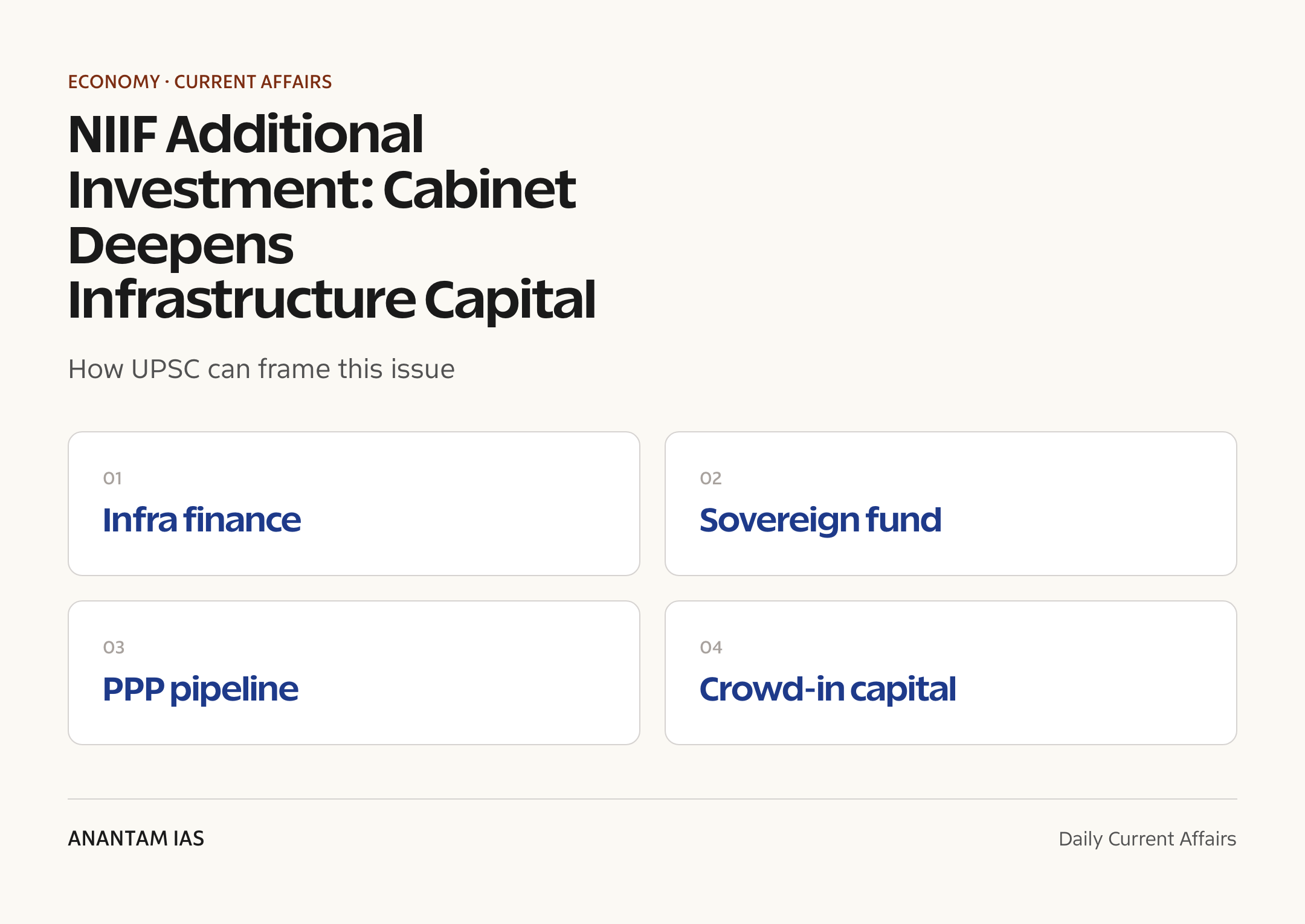
- NIIF sits at the intersection of public investment, private institutional capital, PPP design and long-term economic capacity building.
- The decision connects with wider priorities such as Gati Shakti, Digital India, energy transition, e-mobility and urban infrastructure.

UPSC Relevance
Prelims Relevance
- NIIF stands for National Investment and Infrastructure Fund.
- NIIFL professionally runs and manages NIIF, as stated by PIB.
- The Government of India is a 49% shareholder in NIIF.
- The new Cabinet-approved commitment is Rs. 30,000 crore.
- After this approval, total Government of India commitment to NIIF stands at Rs. 60,000 crore.
- NIIF Infrastructure Fund II is proposed as the successor to the first flagship infrastructure fund.
- NIIF’s operational strategies include infrastructure, private markets, growth equity and climate investments in the India-Japan business corridor.
- PIB listed transportation, energy, digital infrastructure, urban infrastructure and e-mobility as focus areas for the next fund.
- NIIF has attracted investors such as sovereign wealth funds, pension funds, multilateral development institutions and domestic financial institutions.
Mains Relevance
GS Paper 3
- Indian economy: role of long-term capital in infrastructure-led growth.
- Infrastructure: financing gaps, PPP design, asset monetisation and institutional capital.
- Investment model: using public commitment to crowd in private and global capital.
GS Paper 2
- Governance: professional fund management, public accountability and public-private coordination.
- Policy implementation: linking fund strategy with national programmes such as Gati Shakti and Digital India.
Essay
- Public capital as a bridge between development needs and market confidence.
- Infrastructure as the hidden foundation of productivity, jobs and regional integration.
- State capacity in a market economy: steering, de-risking and crowding in investment.
Background and Context
What is NIIF?
NIIF is important because it is designed as a sovereign-anchored platform rather than a routine budgetary spending window.
- National Investment and Infrastructure Fund is India’s sovereign-anchored fund for infrastructure and other nationally important sectors.
- NIIFL professionally manages the fund platform, which helps separate investment decisions from day-to-day departmental spending.
- The Government of India holds a 49% shareholder position in NIIF, giving it a strong anchor role while leaving space for other investors.
- PIB said NIIF currently manages capital commitments of about Rs. 40,000 crore across funds and strategies.
- For a wider economy lens, read Anantam’s Indian Economy page with this topic.
What did the Cabinet approve?
The approval expands the sovereign commitment behind NIIF and gives the platform room to create new fund strategies.
- The Cabinet approved an additional Rs. 30,000 crore Government of India investment commitment.
- This raises the total Government of India commitment to Rs. 60,000 crore.
- The commitment will support new and upcoming funds under the NIIF platform.
- PIB stated that the allocation will be used for setting up NIIF Infrastructure Fund II.
- The second infrastructure-focused fund is proposed to have a target corpus close to Rs. 30,000 crore.
Why Infrastructure Fund II matters
Infrastructure Fund II matters because it gives NIIF a successor vehicle for large, long-term assets.
- Infrastructure Fund II is proposed as the successor to NIIF’s first flagship infrastructure fund.
- PIB said the first infrastructure fund had a corpus of Rs. 16,000 crore and created platforms across key sectors.
- The next fund is expected to invest in transportation, energy, digital infrastructure and emerging areas.
- Emerging areas named by PIB include urban infrastructure and e-mobility.
- The design supports long-horizon assets that often struggle to find quick private finance because returns are spread over many years.
How NIIF crowds in capital
The policy logic is that public capital can improve confidence and attract larger pools of institutional money.
- PIB said NIIF has raised capital from sovereign wealth funds, pension funds, multilateral development institutions and domestic financial institutions.
- Named institutional investors include ADIA, AustralianSuper, CPP Investments, Ontario Teachers’ Pension Plan, PSP Investments and Temasek.
- Multilateral and development-linked investors named by PIB include AIIB, New Development Bank, Asian Development Bank, JBIC and the U.S. International Development Finance Corporation.
- Domestic financial institutions listed by PIB include Axis Bank, HDFC Group, ICICI Bank, Kotak Mahindra Life Insurance and State Bank of India.
- The main exam point: sovereign anchoring can reduce perceived risk, but fund performance and governance still decide whether private money keeps coming.
Sectors and policy alignment
The Cabinet decision is not only a fund-management story; it is linked to national infrastructure and industrial priorities.
- PIB said NIIF funds have deployed capital across transportation, energy transition, healthcare, digital infrastructure, electric mobility, affordable housing, manufacturing and technology.
- These investments are aligned with Gati Shakti, Digital India, Make in India, COP commitments, FAME and PM E-DRIVE.
- The first infrastructure fund built platforms across roads, ports and logistics, airports, renewables, smart meters and power transmission.
- Digital infrastructure matters because productivity, fintech, governance delivery and market access now depend on reliable networks.
- Link the topic with public finance basics from Anantam’s Government Budgeting in India explainer.
Governance and advisory role
NIIF also matters as a policy-support institution, not just as an investor.
- PIB said NIIF assists central government departments and state entities on new PPP initiatives and investment ideas.
- Its advisory role includes support on PPP structures, monetisation and sector-specific investment frameworks.
- PIB specifically mentioned work linked to the Maritime Development Fund and the Research Development and Innovation Fund.
- This connects to a larger governance question: how public agencies design investable projects rather than only announce spending targets.
- The mission economy idea is useful here: public institutions can shape markets when they set clear missions and credible delivery rules. See Anantam’s Mission Economy explainer.
Benefits and cautions
The approval has a clear growth case, but it also needs careful project selection and transparent outcomes.
- Growth benefits can come through better transport, energy, urban systems, digital networks and manufacturing support.
- Job creation can be direct through construction and operations, and indirect through supply chains and improved logistics.
- Fiscal prudence still matters because public capital should not simply absorb risks that private investors avoid for sound reasons.
- Governance safeguards should focus on professional due diligence, conflict management, exit discipline and public reporting.
- For Mains, balance the argument: NIIF can crowd in capital, but it cannot substitute for land, contract enforcement, regulatory clarity and project preparation.
Way Forward
Improve project pipelines
- Build a stronger project preparation pipeline with clear land, approvals, demand forecasts and risk-sharing before funds commit capital.
- Use Gati Shakti data and state-level infrastructure plans to prioritise projects with high economic spillovers.
- Prepare investable urban, e-mobility and digital infrastructure projects instead of leaving them as broad policy ideas.
Strengthen governance
- Maintain professional fund management with transparent mandates, measurable performance and clear separation from routine departmental spending.
- Publish periodic information on sector exposure, exits, returns, climate alignment and job-linked outcomes.
- Use independent review for large investments where public money plays a catalytic role.
Link capital with reforms
- Pair NIIF investments with PPP reform, faster dispute resolution and stable concession design.
- Use the fund platform to pull capital into energy transition, urban infrastructure, logistics and digital public infrastructure.
- Coordinate with states because infrastructure delivery depends heavily on local approvals, utilities and execution capacity.
Conclusion
The NIIF additional investment is a major infrastructure-financing signal because it turns public commitment into a platform for larger institutional capital.
For exam answers, treat the decision as a case study in public capital crowding in private investment, not as a simple expenditure announcement.
The real test will be whether NIIF Infrastructure Fund II can combine commercial discipline, transparent governance and high-quality assets that support growth, jobs and long-term productivity.
UPSC Practice Questions
Prelims MCQ 1
With reference to the National Investment and Infrastructure Fund, consider the following statements:
- The Government of India is a 49% shareholder in NIIF.
- The Cabinet-approved additional commitment takes total GoI commitment to NIIF to Rs. 60,000 crore.
- NIIF Infrastructure Fund II is proposed as a successor to NIIF’s first flagship infrastructure fund.
How many of the above statements are correct?
(a) Only one (b) Only two (c) All three (d) None
Answer: (c) All three
Explanation:
PIB stated all three points: GoI’s 49% shareholding, total GoI commitment of Rs. 60,000 crore after the new approval, and Infrastructure Fund II as the successor to the first flagship infrastructure fund.
Prelims MCQ 2
Which of the following best describes the core policy purpose of the latest Cabinet approval on NIIF?
(a) To convert NIIF into a departmental budget scheme (b) To support new NIIF funds and catalyse institutional capital for infrastructure (c) To restrict NIIF investments only to central government highways (d) To replace all PPP projects with direct public works
Answer: (b) To support new NIIF funds and catalyse institutional capital for infrastructure
Explanation:
The approval provides an additional Rs. 30,000 crore GoI commitment for new and upcoming NIIF funds, with the stated aim of accelerating infrastructure investment and catalysing institutional capital.
UPSC Mains Questions
- The Cabinet’s additional Rs. 30,000 crore commitment to NIIF reflects the changing role of the State in infrastructure finance. Discuss how sovereign-anchored funds can crowd in private capital while preserving fiscal discipline and public accountability.
- Infrastructure financing in India needs more than budgetary outlay. Examine the role of NIIF-like institutions in project preparation, PPP design, institutional investment and long-term economic productivity.
- Public capital can de-risk markets, but it can also create moral hazard if governance is weak. Analyse this statement in the context of NIIF and infrastructure investment.
Sources: PIB, Ministry of Finance and The Hindu Economy.
Frequently Asked Questions
What did Cabinet approve?
The Cabinet approved an additional Rs. 30,000 crore Government of India investment commitment towards new and upcoming NIIF funds. PIB said this takes the total Government of India commitment to NIIF to Rs. 60,000 crore.
What is NIIF?
NIIF is the National Investment and Infrastructure Fund. PIB describes it as India’s sovereign-anchored fund, professionally run and managed by NIIFL, with the Government of India as a 49% shareholder.
Why is NIIF important?
NIIF matters because infrastructure projects need patient capital, professional fund management and investor confidence. A sovereign anchor can help draw pension funds, sovereign wealth funds, development institutions and domestic financial institutions into Indian infrastructure.
What is Infrastructure Fund II?
NIIF Infrastructure Fund II is the proposed second infrastructure-focused fund. PIB said it will be the successor to the first flagship infrastructure fund and is proposed to have a target corpus close to Rs. 30,000 crore.
Which sectors may benefit?
PIB named transportation, energy, digital infrastructure, urban infrastructure and e-mobility as focus areas. It also linked NIIF’s broader work with Gati Shakti, Digital India, Make in India, COP commitments, FAME and PM E-DRIVE.
What is the Mains angle?
The key Mains angle is infrastructure finance: how public capital can crowd in private institutional money while protecting governance, transparency and fiscal prudence. It also connects with PPPs, asset monetisation and long-term productivity.
Tell Google you want more of this.
Add Anantam IAS as a preferred sourceOne tap, and this site shows up more often in your own Top Stories, AI Overviews and AI Mode. Remove it any time.