
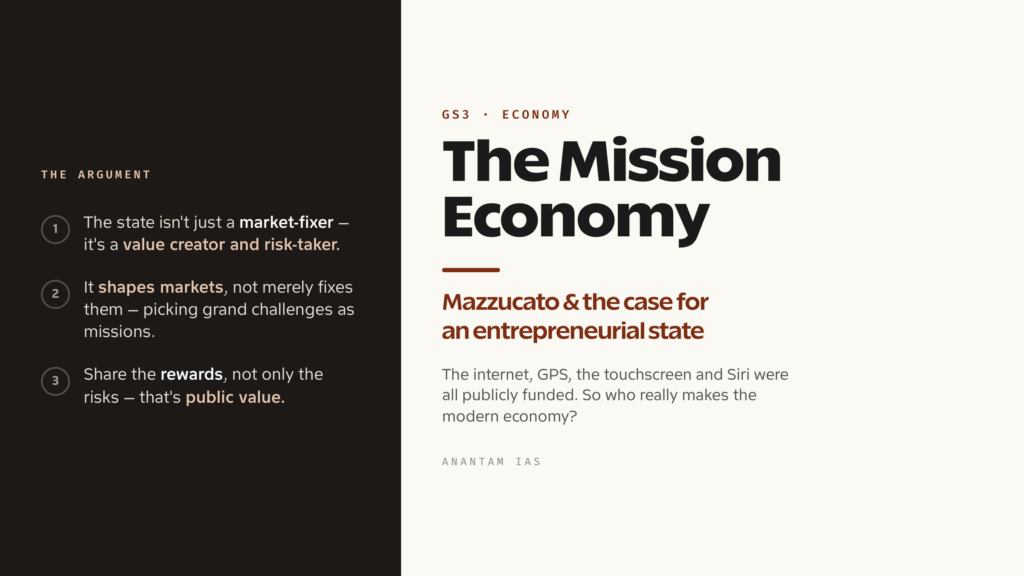
Pick up your phone and you are holding an argument about who really makes the modern economy. The internet that connects it, the GPS that locates it, the multi-touch screen you swipe, the voice assistant you talk to, even the lithium-ion battery that powers it — none of these were dreamed up in a Silicon Valley garage. Each one was funded into existence by a government agency, mostly the US military’s research arm DARPA, decades before any company turned it into a product. Apple’s genius, as the economist Mariana Mazzucato likes to put it, was to package brilliantly what the public sector had already paid to invent. That single observation is the seed of one of the most influential economic ideas of the last decade — the claim that the state is not a clumsy bystander to innovation but its boldest investor.
Mazzucato builds this into a full theory across two books, The Entrepreneurial State (2013) and Mission Economy (2021), and it has quietly reshaped how governments from the European Union to India now talk about industrial policy. For a UPSC aspirant the idea is gold, because it cuts across the economy, science-and-technology and governance papers at once. It reframes the oldest question in development economics — what should the state actually do? — and it gives you a sharp, quotable lens for everything from India’s semiconductor push to its digital public infrastructure. So it is worth understanding properly, not as a slogan but as an argument with real claims, real evidence and real critics.
What the Mission Economy Actually Argues
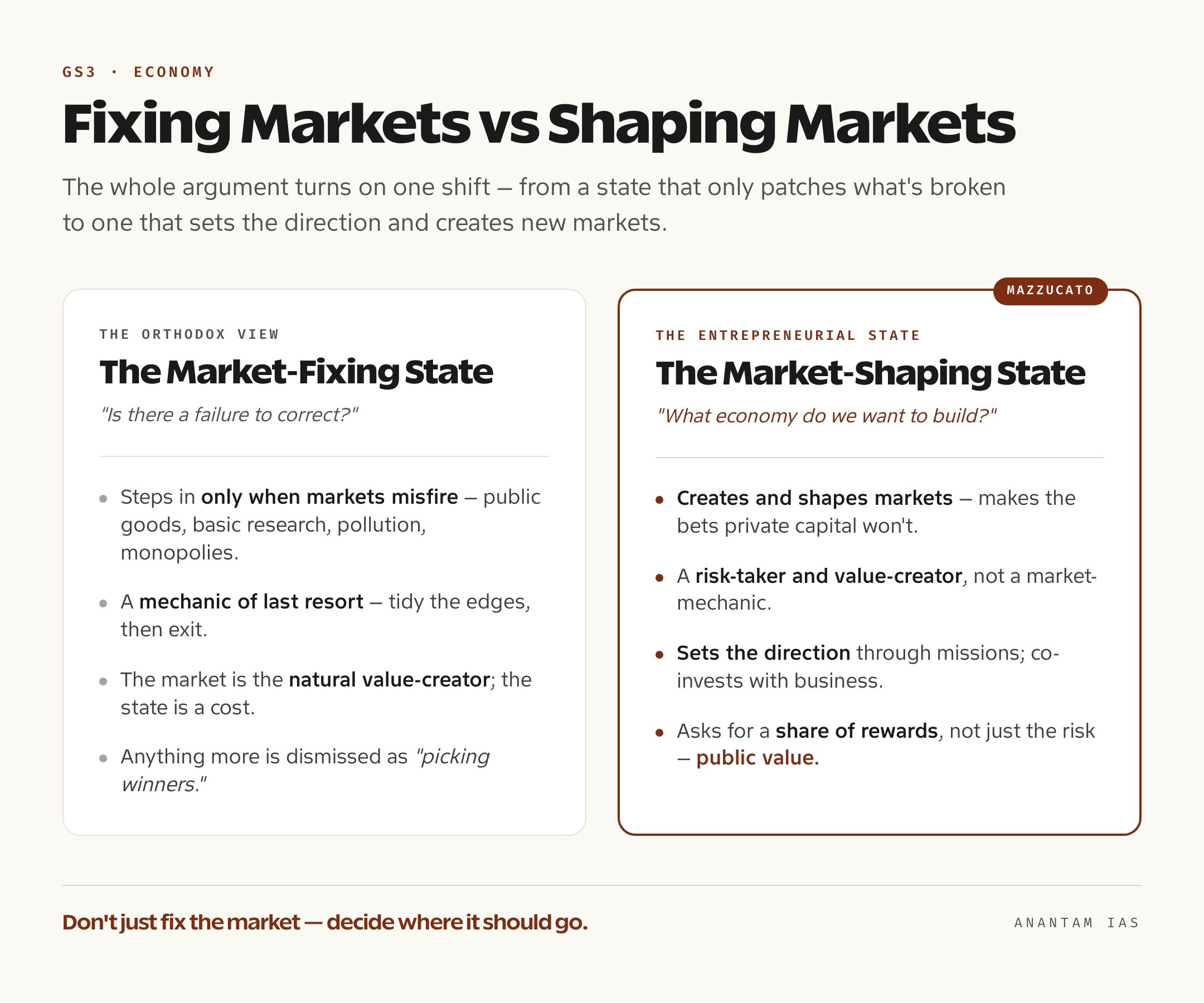
Start with the orthodoxy Mazzucato is pushing against, because the whole theory is built as a rebuttal. Mainstream economics has long justified government intervention through the idea of market failure. On this view the market is the natural value-creator, and the state should step in only when markets misfire — to fund basic research that firms won’t, to fix pollution and other spillovers, to break up monopolies, to provide public goods no private seller will. The state, in other words, is a mechanic of last resort: it tidies up the edges and then gets out of the way. Anything more is “picking winners,” a phrase deployed to end the conversation.
Mazzucato’s counter is that this picture gets the history backwards. The state, she argues, has not merely fixed markets — it has created and shaped them. It made the bets no private investor would touch because they were too uncertain, too long-term or too far from profit, and only later did firms move in once the technology was proven and the risk had been absorbed by the taxpayer. Drawing on heterodox economists like Schumpeter, Keynes and Karl Polanyi, she says the right question is not whether the state should intervene but in which direction it should steer. A market-fixing state asks “is there a failure to correct?” A market-shaping state asks “what kind of economy do we want, and how do we build it?” That shift — from fixing to shaping — is the conceptual core of her work, and it is the line examiners reward you for naming.
From this follows her second big move, the idea of public value. National accounting, she points out, treats government as a cost — a deadweight financed by the productive private sector. She turns this on its head: when the state takes risks and creates new markets, it is creating value, not just spending it, and it deserves a fair share of the rewards. If public money funded the foundational science behind a blockbuster drug or a smartphone, she asks, why does the entire upside flow to private shareholders while the state keeps only the downside? Her answer is that governments should structure deals — through conditions on grants, equity stakes, or reinvestment requirements — so that the risks and the rewards of innovation are socialised together, not privatised on the upside and socialised on the downside. Public value is the moral and accounting frame that holds the whole entrepreneurial-state argument up.


The Moonshot: Innovation Aimed at a Mission
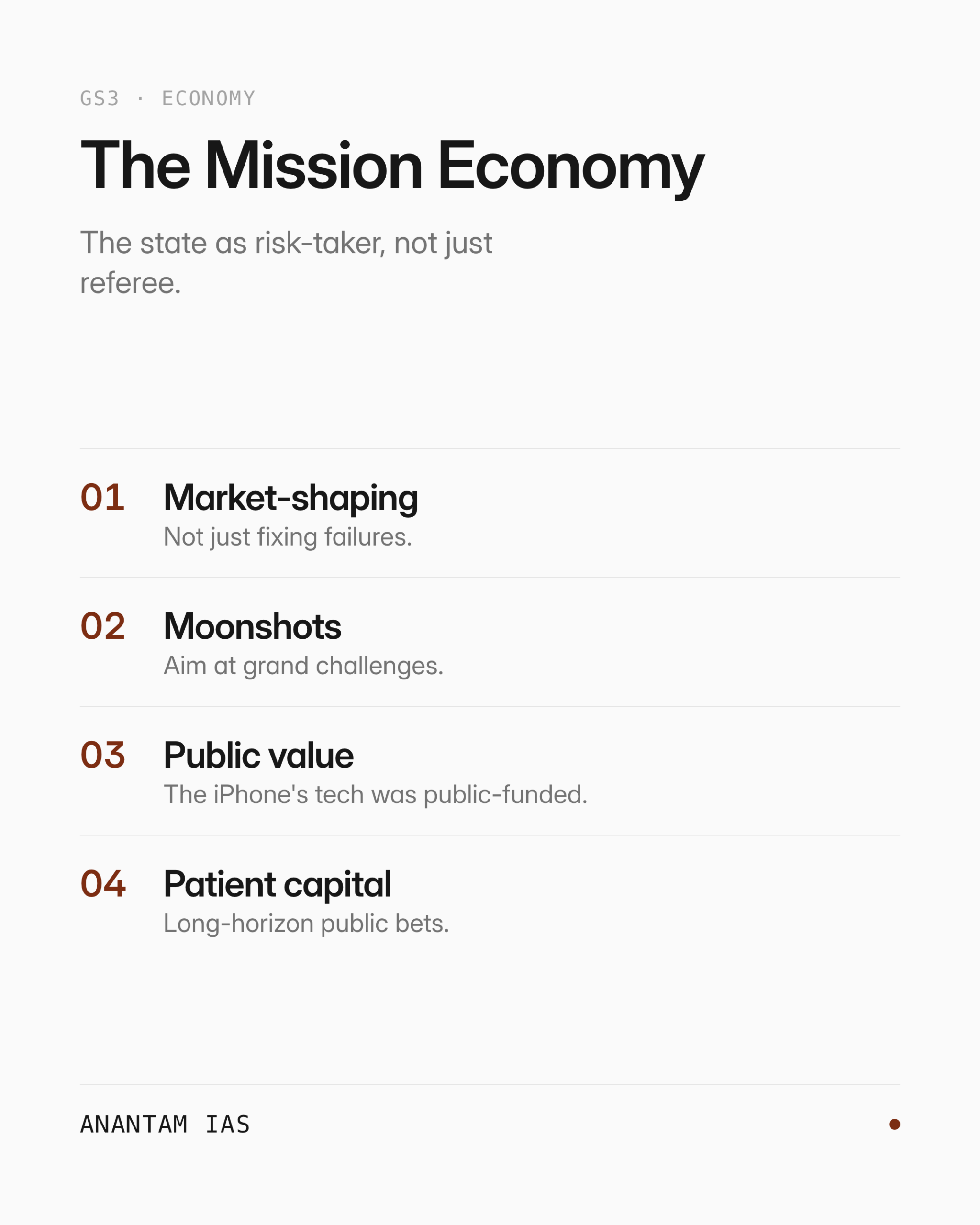
If The Entrepreneurial State is the diagnosis, Mission Economy is the prescription, and its central metaphor is the moon landing. In the 1960s the United States set itself an outrageous goal — put a person on the moon and bring them back safely within the decade — and then bent the whole machinery of government and industry toward it. Mazzucato’s point is not nostalgia for the space race. It is that Apollo shows what an ambitious, mission-oriented state can pull off when it picks a clear destination and organises public agencies, private contractors and universities around reaching it. The spending threw off enormous spillovers — advances in materials, computing, software and management that seeded entire later industries. The moonshot, she argues, is a template we have forgotten how to use.
So she asks governments to do for today’s grand challenges what NASA did for the moon. Pick the biggest problems of the age — climate change, an ageing and unhealthy population, the digital divide — and treat each as a mission: a concrete, time-bound, measurable goal that cuts across sectors. A mission like “carbon-neutral cities by 2030” is deliberately not a sector. It pulls in energy, construction, transport, software, finance and behaviour change all at once, forcing innovation across the economy rather than in one silo. The state’s job, on this model, is to set the direction, take the early risk, and use every tool it has — research grants, public procurement, regulation, state investment banks — to crowd private effort in behind the mission. The European Union has already absorbed this thinking: its Horizon Europe research programme is organised around five named missions, from beating cancer to climate-adaptation and clean oceans, a design Mazzucato herself helped shape as an adviser.
Two features make a mission different from old-style central planning, and both matter in an answer. First, it is outcome-oriented, not output-oriented — government fixes the destination but stays agnostic about the route, inviting many firms to experiment and letting the best solutions win, which keeps competition alive inside a directed framework. Second, it works through partnership rather than command — the state shapes and co-invests but does not nationalise. The aim is a different kind of public-private partnership, one where the state is an active, risk-taking partner that shares in the rewards, not a passive funder of guaranteed corporate profits. That is what separates a mission economy from both the night-watchman state and the old command economy.
Where the Critics Push Back
A theory this influential attracts sharp criticism, and an answer that nods to both sides reads far stronger than a one-sided hymn. The most common objection is selection bias. Yes, the state funded the internet and GPS — but it also funded Concorde, a string of failed national champions and countless dead-end research programmes that never paid off. Critics argue Mazzucato counts the public sector’s hits and quietly forgets its misses, and that “the state invented the iPhone” overstates the case: turning a pile of publicly funded components into a product people actually want is itself a colossal, risky, value-creating act that markets, not ministries, performed. Government funded the ingredients; Apple, and the market, made the meal.
The deeper worry is about directionality and capture. Once you license the state to “pick directions” rather than just fix failures, you hand politicians and bureaucrats the power to steer huge sums toward favoured technologies and firms. Sceptics fear this is an open door to cronyism, lobbying and politically convenient white elephants — the very “picking winners” problem the market-failure framework was designed to avoid. They also question whether most states have the capability Mazzucato assumes: the skilled, well-paid, mission-driven civil service that ran Apollo is not what many governments actually have, and a mission run by a weak or corrupt bureaucracy can waste public money at industrial scale. Mazzucato’s reply is that these are arguments for building state capacity and designing accountable, well-governed missions — not for pretending the state plays no creative role. Whether you find that convincing is exactly the kind of judgement a good Mains conclusion makes.
There is also a public-finance critique. If the state is to share in the rewards of innovation, through equity or royalties, who decides how much, and does that chill private investment? And measuring “public value” is genuinely hard — value, her critics note, is contested and political, not something an economist can simply compute. None of this sinks the theory, but it sets the honest boundaries an examiner wants you to see: the entrepreneurial state is a powerful corrective to market-fundamentalism, not a blank cheque.
The India Angle: A State That Has Always Built Markets
For an Indian aspirant the mission economy is not an imported curiosity — it describes something India has been doing for seventy years, and is now doing more deliberately than ever. India’s development story is full of entrepreneurial-state moments. ISRO turned a poor country into a space power and built a launch and satellite industry largely from public effort. The CSIR network of national laboratories seeded pharmaceuticals, agriculture and materials research. The Green Revolution was a state-orchestrated mission in all but name — public research institutes, public procurement and public extension bending the farm economy toward food security. India did not wait for Mazzucato to tell it that the state can shape markets; it has been living the argument.
What is new is the explicit “mission mode.” Today’s government runs a whole portfolio of national missions that read like a page from Mission Economy — pick a grand challenge, set a hard target and a deadline, and orient research, regulation and procurement toward it. The India Semiconductor Mission, backed by an outlay of around ₹76,000 crore, is a textbook market-shaping bet: chip-making is too capital-heavy and uncertain for Indian private capital to attempt alone, so the state is absorbing the early risk to bring an entire industry into being. The National Green Hydrogen Mission, with an outlay near ₹19,744 crore and a target of five million tonnes of green-hydrogen capacity a year by 2030, is a classic cross-sectoral mission pulling in energy, industry and exports at once. The National Quantum Mission, at ₹6,003.65 crore over 2023 to 2031, is the state taking a long-horizon bet on a technology no Indian firm would fund to maturity on its own.
And India has arguably produced the most striking public-value experiment of the digital age: its Digital Public Infrastructure, or DPI — the Aadhaar identity layer, the UPI payments rail and the data-sharing stack often called India Stack. Here the state did not just fix a market failure; it built foundational public rails, kept them open and low-cost, and let thousands of private firms innovate on top. UPI now carries the world’s largest volume of real-time digital payments, and that ecosystem of private fintech sits on a platform the public sector created and governs. It is close to a perfect illustration of Mazzucato’s thesis — public value created by a shaping state, with the rewards spread across the whole economy rather than captured by a single platform owner. The cautions travel too: India’s missions still struggle with execution, bureaucratic capacity and the risk of subsidy capture, which is precisely why the critics’ warnings belong in the same answer as the praise.
For Your Mains Answer
This is a versatile topic for GS Paper 3, which covers the Indian economy, the role of the state, growth and development, science and technology, and the mobilisation of resources. It is the ideal conceptual frame for any question on industrial policy, the state’s role in innovation, public-sector enterprises, or India’s national missions. It also serves GS Paper 2 on governance and the role of government, and gives the Essay paper a rich, quotable spine on themes of the state, the market, self-reliance and public purpose. The skill examiners reward is theory plus example: name the concept, then anchor it in the iPhone and in an Indian mission.
How to Build the Answer
Move in a clean arc. Open by contrasting the two views of the state — market-fixer versus market-shaper. Explain the entrepreneurial-state claim with the iPhone evidence (DARPA, GPS, touchscreen, Siri). Introduce public value — risks and rewards should be shared, not privatised on the upside. Bring in the mission/moonshot idea with the Apollo template and a grand-challenge example. Then turn to critiques — selection bias, capture, state capacity. Finally localise: ISRO, CSIR, the Green Revolution, and today’s semiconductor, green-hydrogen and quantum missions plus DPI. Close with a balanced verdict. That arc — fix-versus-shape, evidence, public value, missions, critique, India, judgement — fits almost any state-and-innovation question.
Common Mistakes to Avoid
Don’t reduce Mazzucato to “the government invented the iPhone” — the sharper, defensible claim is that the state funded the foundational technologies and absorbed the early risk. Don’t confuse a mission with old-style central planning; stress that missions are outcome-oriented and work through partnership and competition, not command. Don’t present the theory as uncontested — leaving out the capture and capacity critiques costs you the higher band. And don’t treat this as a foreign idea; the strongest answers root it in ISRO, the Green Revolution and India’s current national missions.
A Compact Answer Spine
Market-failure view = state fixes broken markets and exits → Mazzucato’s flip = state creates and shapes markets, takes the risk private capital won’t (iPhone: internet, GPS, touchscreen, Siri, battery all publicly funded) → public value = socialise risks and rewards, not just losses → mission/moonshot = pick grand challenges, set time-bound cross-sectoral goals, steer innovation toward them (Apollo, Horizon Europe) → critiques = selection bias, cronyism/capture, weak state capacity, contested value → India = ISRO, CSIR, Green Revolution, plus semiconductor (₹76,000 cr), green hydrogen (₹19,744 cr), quantum (₹6,003 cr) missions and DPI/UPI → verdict = a powerful corrective to market-fundamentalism, but only as good as the state’s capacity and accountability.
Diagram or Flowchart Idea
Draw a simple two-column contrast — “Market-Fixing State” (correct failures, provide public goods, then exit) versus “Market-Shaping State” (set direction, take early risk, create markets, share rewards) — with an arrow of “missions” running across both. Beside it, a small chain showing a publicly funded technology (e.g. GPS) flowing into a private product (the smartphone). Two clean visuals like these carry the whole argument at a glance.
A Balanced-Conclusion Line
A line that lands the marks: “Mazzucato’s mission economy rescues the state from the role of a mere market-mechanic and restores it as a co-creator of value — but its promise depends entirely on a capable, accountable bureaucracy, which is why India’s missions must pair bold direction with hard execution and transparent risk-reward sharing.”
How to Use Data Without Cramming
You need only a handful of anchors, not a database: the publicly funded iPhone technologies (internet, GPS, touchscreen, Siri, lithium-ion battery); the two book titles and years (The Entrepreneurial State, 2013; Mission Economy, 2021); and three Indian mission outlays — semiconductor ~₹76,000 crore, green hydrogen ~₹19,744 crore, quantum ~₹6,003 crore. Attribute them plainly — “as Mazzucato argues,” “the Cabinet’s mission outlay” — rather than scattering numbers loose.
Frequently Asked Questions
What is the mission economy in simple terms?
It is an idea from the economist Mariana Mazzucato that governments should set bold, society-wide “missions” — like reaching net-zero or curing a disease — and then steer innovation across the whole economy toward them, the way the US organised industry and science around the 1960s moon landing. The state’s role is to pick a clear direction, take the early risk that private capital avoids, and co-invest with business rather than merely correcting market failures from the sidelines.
What does Mazzucato mean by an “entrepreneurial state”?
She means that the state has historically been the boldest risk-taker and value-creator in the economy, not a passive market-fixer. Her flagship evidence is the smartphone: the internet, GPS, the multi-touch screen, the Siri voice assistant and the lithium-ion battery were all funded into existence by public agencies — chiefly the US military research arm DARPA — long before private firms turned them into products. The state, she argues, made the markets that business later profited from.
What is the difference between fixing markets and shaping markets?
Fixing markets is the traditional view: the state intervenes only to correct specific failures — funding basic research, curbing pollution, providing public goods — and then withdraws. Shaping markets is Mazzucato’s alternative: the state actively sets a direction, creates entirely new markets, and uses procurement, grants and regulation to pull private effort behind a chosen mission. The first asks “what’s broken?”; the second asks “what kind of economy do we want to build?”
How does the mission economy apply to India?
India has long run an entrepreneurial state — ISRO, the CSIR labs and the Green Revolution were all state-orchestrated missions. Today it is explicit: national missions in semiconductors (~₹76,000 crore), green hydrogen (~₹19,744 crore) and quantum technology (~₹6,003 crore) are textbook market-shaping bets on industries private capital won’t attempt alone, while India’s Digital Public Infrastructure — Aadhaar, UPI and the wider India Stack — shows the state building open public rails on which private firms innovate, spreading the rewards across the economy.
Practice Questions
Prelims MCQs
- The concept of the “Entrepreneurial State,” which argues that the state is a value creator and risk-taker rather than only a market-fixer, is most associated with which economist?
(a) Amartya Sen
(b) Mariana Mazzucato
(c) Thomas Piketty
(d) Raghuram Rajan
Answer: (b) The idea comes from Mariana Mazzucato’s books The Entrepreneurial State (2013) and Mission Economy (2021). - In Mazzucato’s analysis, which set of core smartphone technologies is cited as originally publicly funded?
(a) The internet, GPS, the touchscreen and the voice assistant
(b) The camera, the SIM card and Bluetooth alone
(c) Only the operating system and the app store
(d) None — all were privately developed
Answer: (a) She traces the internet, GPS, the multi-touch screen, Siri and the lithium-ion battery to public agencies such as DARPA, the US military, the CIA and the Department of Energy. - The distinction between a “market-fixing” and a “market-shaping” state primarily refers to which difference?
(a) The size of the government budget
(b) Whether the state only corrects market failures or also sets direction and creates new markets
(c) The tax rate on corporations
(d) Whether the central bank is independent
Answer: (b) A market-fixing state corrects failures and exits; a market-shaping state actively directs innovation and creates markets. - The “moonshot” or mission-oriented approach advocated in Mission Economy draws its central inspiration from which historical effort?
(a) The Marshall Plan
(b) The Bretton Woods system
(c) The US Apollo moon-landing programme
(d) The Manhattan Project’s secrecy model
Answer: (c) Mazzucato uses the Apollo programme as the template for organising public and private effort around a single ambitious, time-bound goal. - Which of the following best illustrates Mazzucato’s idea of “public value” through a market-shaping state in India?
(a) A private bank issuing credit cards
(b) Digital Public Infrastructure such as Aadhaar and UPI, on which private firms build services
(c) A foreign company setting up a retail chain
(d) A stock-market index fund
Answer: (b) India’s DPI is public rails built and governed by the state, with private innovation layered on top and the rewards spread widely — a near-textbook case of public-value creation.
Mains Practice Questions
- “The state is not merely a fixer of market failures but a creator and shaper of markets.” Critically examine this proposition with reference to Mariana Mazzucato’s idea of the entrepreneurial state. (15 marks, 250 words)
- Explain the “mission-oriented” or moonshot approach to innovation. How is it different from both the night-watchman state and old-style central planning? (15 marks, 250 words)
- India’s national missions in semiconductors, green hydrogen and quantum technology have been described as examples of a market-shaping state. Discuss, highlighting both the rationale and the risks of such state-led bets. (15 marks, 250 words)
- Distinguish between socialising only the risks and socialising both the risks and the rewards of public investment in innovation. Why is this distinction central to the idea of public value? (10 marks, 150 words)
- “An entrepreneurial state is only as good as its administrative capacity.” In the light of critiques of mission-oriented policy, evaluate the conditions under which India’s mission-mode government can succeed. (15 marks, 250 words)
Tell Google you want more of this.
Add Anantam IAS as a preferred sourceOne tap, and this site shows up more often in your own Top Stories, AI Overviews and AI Mode. Remove it any time.