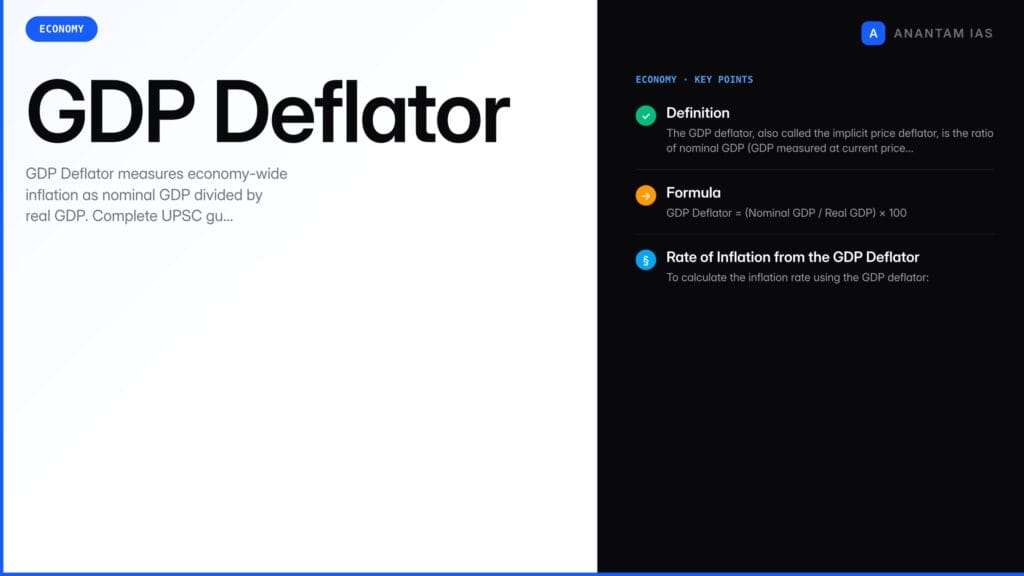
The GDP deflator is a price index that measures the average change in prices of all goods and services produced in an economy over a given period. Unlike the Consumer Price Index (CPI) or the Wholesale Price Index (WPI), which track a fixed basket of commodities, the GDP deflator covers every item included in GDP, from agricultural produce and manufactured goods to financial services and government expenditure. For UPSC aspirants, it is a high-yield concept in Indian Economy because it connects national income accounting, inflation measurement, and monetary policy.
Definition
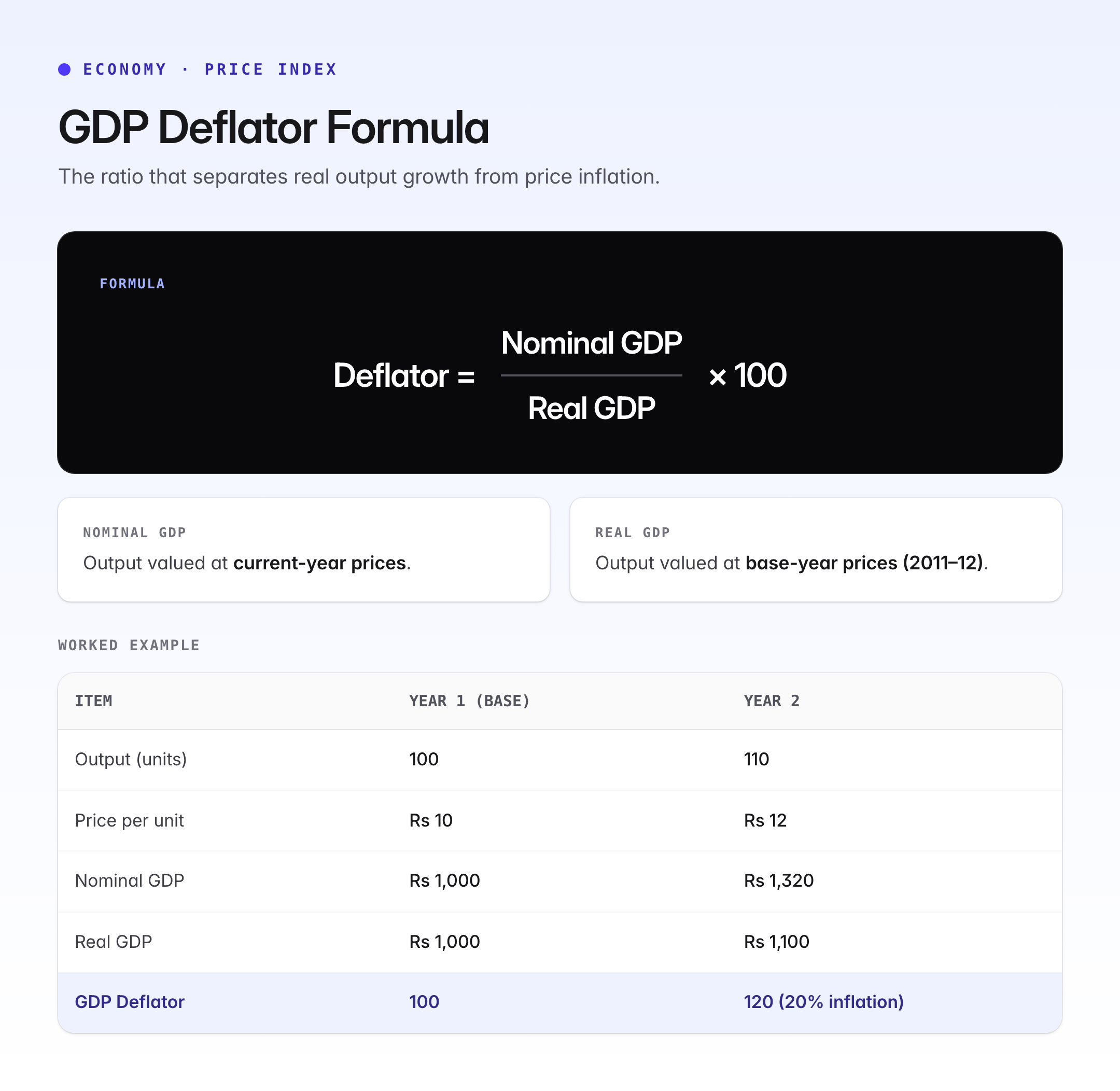
The GDP deflator, also called the implicit price deflator, is the ratio of nominal GDP (GDP measured at current prices) to real GDP (GDP measured at constant, base-year prices), multiplied by 100. It captures how much of the change in nominal GDP is due to price changes rather than real output changes.
Formula
GDP Deflator = (Nominal GDP / Real GDP) × 100
Where:
- Nominal GDP is the market value of all final goods and services produced in a year, valued at that year's prices.
- Real GDP is the same output valued at the prices of a chosen base year (currently 2011–12 in India).
A simple worked example clarifies the mechanics.
| Item | Year 1 (Base Year) | Year 2 |
|---|---|---|
| Output of good X | 100 units | 110 units |
| Price of good X | Rs 10 | Rs 12 |
| Nominal GDP | 100 × 10 = Rs 1,000 | 110 × 12 = Rs 1,320 |
| Real GDP (at Year 1 prices) | Rs 1,000 | 110 × 10 = Rs 1,100 |
| GDP Deflator | (1,000 / 1,000) × 100 = 100 | (1,320 / 1,100) × 100 = 120 |
The deflator rose from 100 to 120, indicating 20% inflation between Year 1 and Year 2 across the full economy.
Rate of Inflation from the GDP Deflator
To calculate the inflation rate using the GDP deflator:
Inflation Rate = [(Deflator_current − Deflator_previous) / Deflator_previous] × 100
Using the above example: [(120 − 100)/100] × 100 = 20%.
How It Differs from CPI and WPI
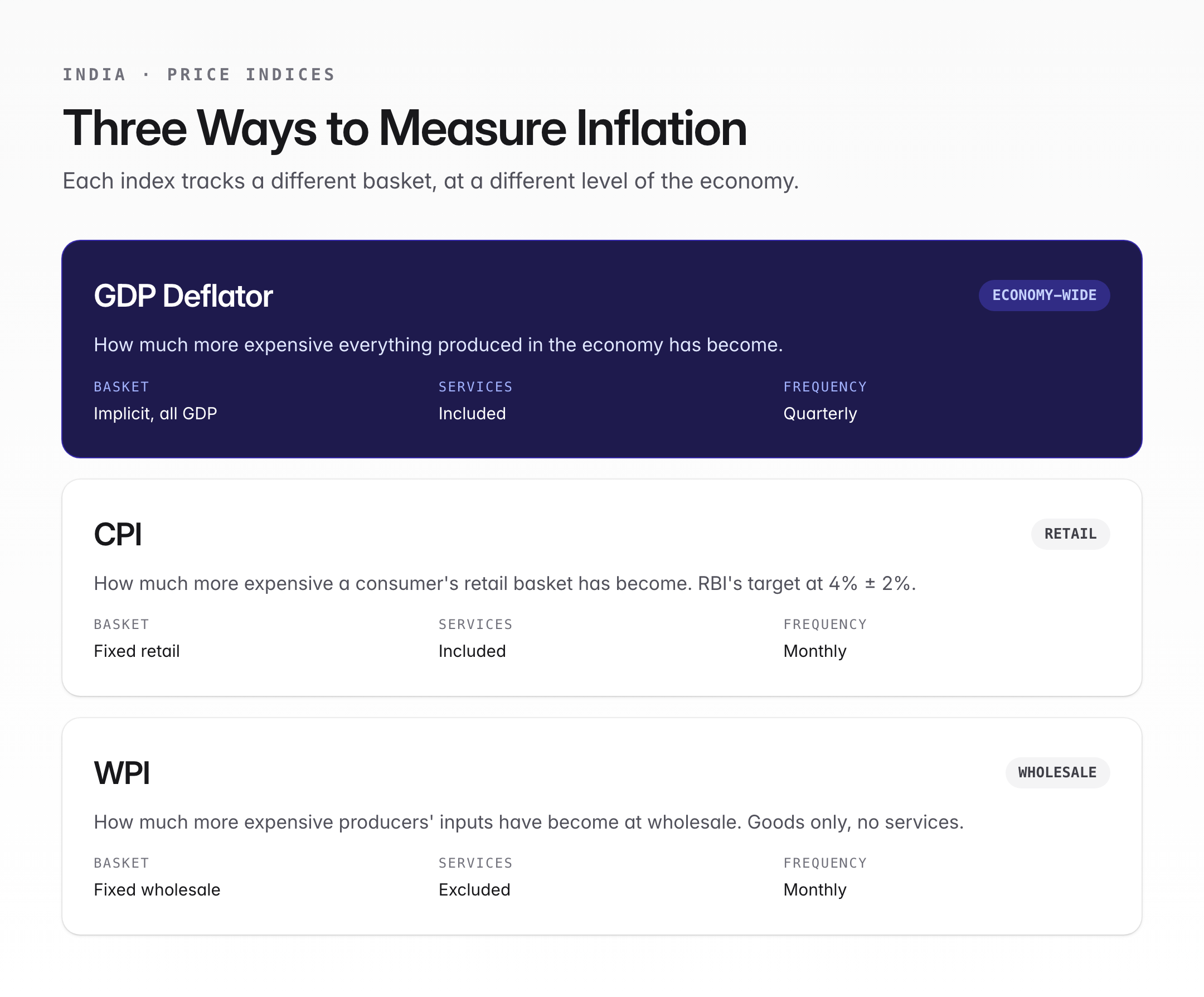
India tracks multiple price indices, each with different coverage, weights, and policy uses.
| Feature | GDP Deflator | CPI | WPI |
|---|---|---|---|
| Coverage | All final goods and services in GDP | Retail basket of goods and services | Wholesale basket of goods only (no services) |
| Basket | Implicit, changes with output mix | Fixed basket (revised periodically) | Fixed basket (revised periodically) |
| Weights | Variable — current-year quantities | Fixed (Laspeyres index) | Fixed (Laspeyres index) |
| Services included | Yes | Yes | No |
| Imports included | No (only domestic production) | Yes (consumed imports) | Yes |
| Base year (India) | 2011–12 | 2012 (CPI-Combined) | 2011–12 |
| Released by | MoSPI (NSO) | NSO (CPI-C), Labour Bureau (CPI-IW/AL/RL) | Office of the Economic Adviser, DPIIT |
| Frequency | Quarterly (with GDP) | Monthly | Monthly |
| Used for | Deflating GDP; broad inflation | Headline inflation, RBI policy target | Industry, wholesale transactions |
Since April 2014, the Reserve Bank of India targets CPI-Combined (CPI-C) under the flexible inflation targeting framework set at 4% +/- 2%. The GDP deflator is not directly targeted but is a cross-check on inflation trends across the whole economy.
Advantages of the GDP Deflator
- Broadest coverage. It reflects price movements in every sector included in GDP, including services and government spending that CPI/WPI may under-represent.
- Variable weights. Its weights change with the composition of output, automatically reflecting structural change in the economy.
- No fixed basket bias. It is not distorted by the outdated basket problem that affects CPI and WPI between revisions.
- Useful for national accounting. Essential for converting nominal to real GDP and for computing real growth.
Limitations of the GDP Deflator
- Less timely. Available only when quarterly or annual GDP data are released, unlike monthly CPI/WPI.
- Excludes imported inflation. Imports are subtracted from GDP, so imported price shocks (oil, edible oils) do not directly enter the deflator.
- Poor guide to household cost of living. Because it includes capital goods, defence, and exports, it does not map cleanly to consumer welfare.
- Revisions. GDP data are revised multiple times, so the deflator also gets revised.
- Masking sectoral pressure. A low headline deflator can hide divergence between goods (deflation) and services (inflation).
Uses of the GDP Deflator
| Use | Why it matters |
|---|---|
| Converting nominal to real GDP | Needed to separate price change from real growth. |
| Measuring economy-wide inflation | Complement to CPI/WPI. |
| International comparisons | Allows comparison of real output across countries. |
| Fiscal analysis | Used in estimating real tax revenue, real subsidies, and real fiscal deficit. |
| Long-term trend analysis | Smoother and broader than narrow basket indices. |
| Deflating wages and incomes | Used by researchers to assess real earnings over time. |
GDP Deflator in India: Trend and Context
India's GDP deflator has historically tracked between WPI and CPI, depending on the weight of goods versus services in nominal GDP.
- Under high commodity price phases (e.g., 2010–13), the deflator rose strongly, close to double digits.
- During the commodity bust and disinflation (2014–16), the deflator fell sharply, reflecting WPI deflation.
- Post-pandemic (2021–23), the deflator rose sharply, tracking global supply-chain and energy price shocks.
- Service-sector inflation has been relatively stable, keeping the deflator below CPI in some years.
The Ministry of Statistics and Programme Implementation (MoSPI) releases the deflator along with GDP estimates through the National Statistical Office (NSO).
Quick Revision Table
| Concept | Key point |
|---|---|
| Formula | (Nominal GDP / Real GDP) × 100 |
| Base year (India) | 2011–12 |
| Who releases it | NSO under MoSPI |
| What it covers | All final goods and services in GDP |
| What it excludes | Imports |
| Weights | Variable, current-year quantities (Paasche-like) |
| Frequency | Quarterly and annual with GDP |
| Index type | Implicit price deflator |
Comparison in One Line
- CPI — how much more expensive a consumer's basket has become.
- WPI — how much more expensive producers' inputs have become at wholesale.
- GDP deflator — how much more expensive everything produced in the economy has become.
UPSC Relevance
The GDP deflator is a classic Prelims question, usually framed as "which of the following statements about the GDP deflator is/are correct?" Aspirants must know the formula, that it is released by the NSO under MoSPI, the 2011–12 base year, and the difference between CPI, WPI, and the deflator. In Mains GS Paper III, it is relevant to questions on inflation targeting, monetary policy transmission, the NSO revisions controversy, and national income measurement. The deflator is useful in discussing why RBI uses CPI-C rather than the deflator for its 4% target, and how the deflator can help diagnose the nature of inflation (cost-push versus demand-pull). For Economic Survey and Budget preparation, aspirants should track the deflator's movement alongside nominal GDP growth, because nominal GDP growth is central to fiscal arithmetic (tax buoyancy, fiscal deficit ratios). In Essay writing, the deflator is a strong example of how statistical choices shape economic narratives and public perception.
Tell Google you want more of this.
Add Anantam IAS as a preferred sourceOne tap, and this site shows up more often in your own Top Stories, AI Overviews and AI Mode. Remove it any time.