Why in News?
PIB confirmed that Union Health Minister J. P. Nadda unveiled the Operational Guidelines on National Ambulance Services, 2026 on 29 June 2026.
The Ministry of Health and Family Welfare has framed the guidelines as the first national framework for planning, operating and monitoring ambulance services across States and Union Territories.
- The guidelines seek timely, safe and quality emergency medical transport for every citizen.
- They cover ambulance categorisation, population-based fleet deployment, human resource norms and equipment specifications.
- They require ambulances to conform to AIS-125 standards for safety and quality.
- They promote Integrated Command and Dispatch Centres with GPS tracking, digital call management and real-time dashboards.
- They envisage progressive integration with the unified emergency response number 112.
The development matters in the context of:
- For GS2 governance, the issue links public health delivery with federal coordination, standards, accountability and grievance redress.
- For public health, ambulance response is the bridge between the patient, first aid, referral care and hospital treatment.
UPSC Relevance
Prelims Relevance
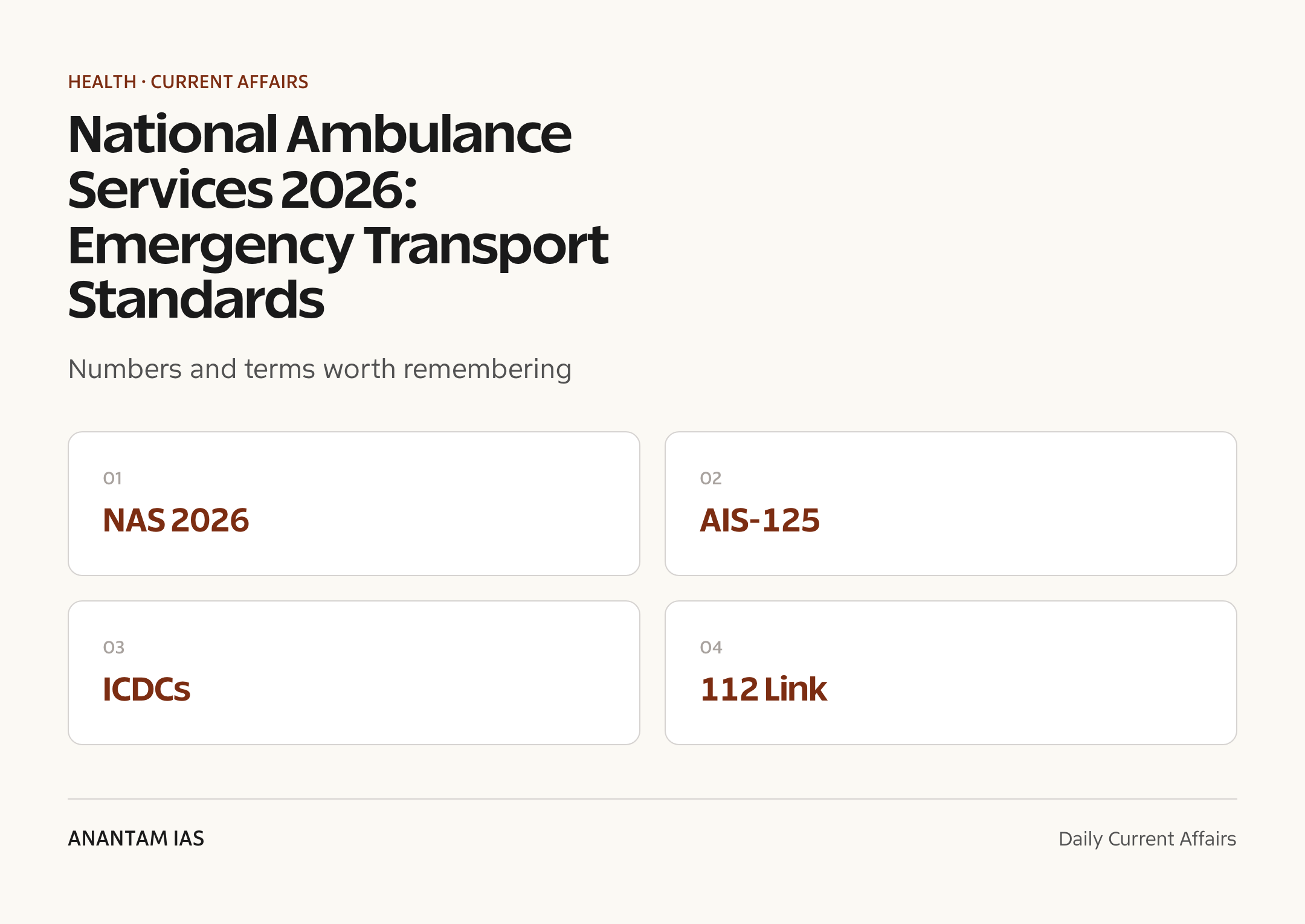
- National Ambulance Services, 2026: operational framework issued by the Ministry of Health and Family Welfare.
- AIS-125: ambulance safety and vehicle standard named in the PIB release.
- Integrated Command and Dispatch Centres: digital centres for ambulance coordination.
- 112: unified emergency response number mentioned for progressive integration.
- Emergency Medical Technicians: frontline trained personnel for pre-hospital care.
- GIS-based mapping: mapping of health facilities, referral centres, ambulance stations and risk locations.
- Pre-hospital care: care before the patient reaches a health facility.
- States and Union Territories: implementation space for ambulance planning and monitoring.
Mains Relevance
GS Paper 2
- Public health service delivery through standard setting, trained personnel and grievance redress.
- Centre-State coordination in health because ambulance operations depend on state systems but need national norms.
- Digital governance through GPS tracking, call management, dashboards, GIS mapping and intelligent dispatch.
GS Paper 3
- Technology in disaster and emergency response through real-time routing and command centres.
- Infrastructure planning for rural, remote and difficult-to-reach areas.
Essay
- Public services work best when standards, technology and accountability move together.
- Emergency care as a test of state capacity.
Background and Context
What NAS 2026 Tries to Standardise
The guidelines create a common operational vocabulary for a service that is often experienced locally but governed through many layers.
- PIB said the guidelines provide a comprehensive national framework for planning, operating and monitoring ambulance services across States and Union Territories.
- Ambulance categorisation matters because basic transport, emergency response and advanced life support cannot be treated as the same service.
- Population-based fleet deployment moves planning beyond ad hoc vehicle purchase and links ambulance placement to public need.
- Human resource norms address who should staff the vehicle, who should coordinate dispatch and what training should support the service.
- Equipment specifications, medicines and consumables are included so the ambulance becomes a care unit, not only a transport vehicle.
- AIS-125 compliance is the core vehicle-standard point in the release; it links ambulance services to uniform safety and quality norms.
Why Ambulances Are A Governance Issue
Ambulance services sit at the point where a citizen’s health emergency meets the state’s capacity to respond quickly.
- Pre-hospital care begins before admission; timely stabilisation can decide whether referral to the right facility saves life and function.
- Referral systems need coordination because the nearest facility may not be the most appropriate facility for trauma, critical care or specialist support.
- Quality assurance is named in the framework, making ambulance response measurable instead of leaving it to local practice alone.
- Performance monitoring allows governments to track response quality, not just count vehicles on paper.
- Grievance redressal matters because emergency services must remain answerable when delays, denials or poor response occur.
- Equity is central: rural, remote and difficult-to-reach areas need planned coverage rather than dependence on market access or district discretion.
Digital Command And Dispatch
The technology layer is important because response time depends on coordination, information and routing as much as vehicle availability.
- Integrated Command and Dispatch Centres are proposed as the coordination backbone for emergency response.
- GPS-enabled tracking helps dispatch teams know where ambulances are and match the nearest available vehicle to the case.
- Digital call management creates a record of incoming emergency requests and reduces dependence on fragmented local phone systems.
- Structured triage protocols help classify urgency so that the right ambulance and facility can be selected.
- Intelligent dispatch connects call data, vehicle location and facility readiness to reduce avoidable delay.
- Real-time dashboards can support supervisors with live monitoring instead of delayed manual reporting.
- 112 integration is planned progressively, which is significant because citizens benefit from a common emergency access point.
GIS Mapping And Evidence-Based Deployment
The framework links ambulance planning to spatial and demand data, which is the difference between a visible service and a responsive service.
- GIS-based mapping is proposed for healthcare facilities, referral centres, ambulance stations and accident-prone areas.
- High-risk locations and traffic density can help planners decide where ambulances should be stationed during different hours or seasons.
- Bed availability and critical care preparedness matter because transport without destination planning can simply shift delay from road to hospital gate.
- Emergency call trends can identify recurring pressure points in urban corridors, highways and remote blocks.
- Referral patterns show whether patients are being sent to the right level of care or being moved repeatedly.
- Population distribution keeps equity visible, especially where sparse settlement makes response costlier but need no less urgent.
Training, Safety And Infection Control
Ambulance reform is not only about more vehicles; it is also about the people, protocols and safety systems inside each response.
- Emergency Medical Technicians are specifically mentioned for competency-based training, making skills a core part of the framework.
- Medicines and consumables need standard lists so that response quality does not vary sharply across districts.
- Infection prevention and control became more visible after pandemic-era emergency transport lessons and is included in the operational framework.
- Vehicle maintenance protocols protect service reliability because breakdowns in emergency transport directly affect patient outcomes.
- Patient stabilisation during transport depends on trained staff, working equipment and clear protocols, not only quick driving.
- Safe transport includes the patient, crew and receiving facility because emergency vehicles can become vectors of poor care if hygiene and handover fail.
UPSC Linkages
For exam use, NAS 2026 should be placed under health governance, digital public systems and last-mile service delivery.
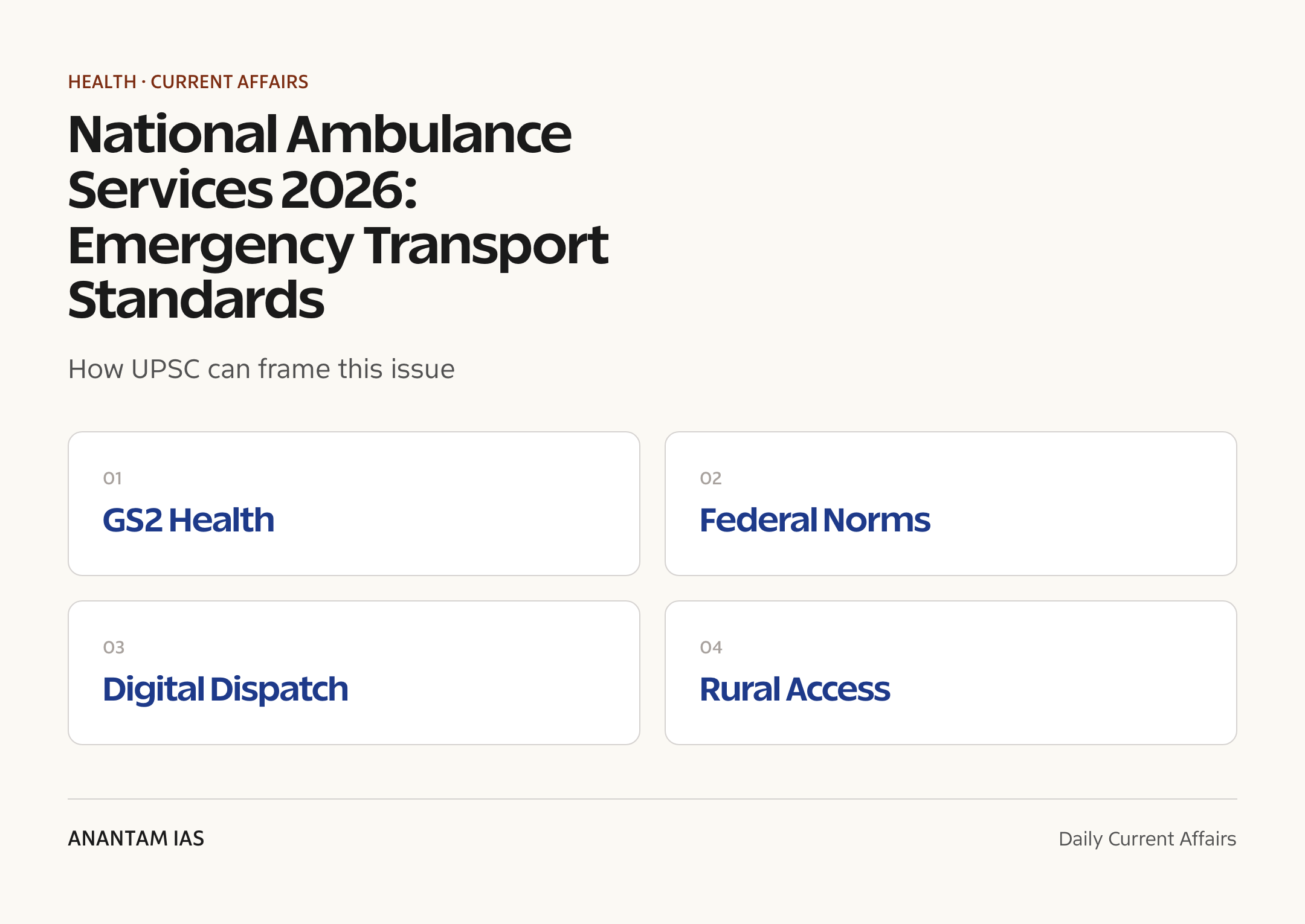
- GS Paper 2 can use this case for issues relating to health services, governance, accountability and cooperative federalism.
- GS Paper 3 can connect it to technology in emergency response, disaster readiness and data-driven infrastructure planning.
- Prelims may test the terms AIS-125, ICDC, 112, EMT, GIS mapping and pre-hospital care.
- Mains answers should avoid treating ambulances as a narrow transport issue; the better frame is emergency medical response architecture.
- Case-study value lies in showing how standards, digital systems and monitoring can improve everyday state capacity.
Way Forward
Build State-Level Implementation Plans
- Each State and Union Territory should translate the national framework into district fleet plans, staffing plans and referral maps.
- Implementation should prioritise rural, remote and difficult-to-reach areas where emergency access is weakest.
Make Data Publicly Useful
- Dashboards should track response time, call handling, vehicle uptime, grievance disposal and referral outcomes.
- Data should support course correction without exposing patient identity or sensitive health information.
Strengthen People And Protocols
- Emergency Medical Technicians need periodic competency checks, not one-time training.
- Ambulance crews need clear triage, infection-control and handover protocols across public and private receiving facilities.
Integrate Emergency Access
- Progressive integration with 112 should be backed by public awareness, multilingual call handling and state-level coordination.
- Command centres should link ambulance location with facility readiness, so transport decisions match the patient’s actual need.
Conclusion
The National Ambulance Services 2026 guidelines matter because they treat emergency transport as part of health governance, not as a vehicle scheme. PIB’s release points to a more complete model: standards, fleet planning, trained personnel, command centres, GPS tracking, GIS mapping, monitoring and grievance redress.
The real test will be implementation by States and Union Territories. If NAS 2026 leads to better response times, safer vehicles, trained crews and smarter referral decisions, it can become a practical example of how digital systems and public health capacity can meet at the citizen’s doorstep.
UPSC Practice Questions
Prelims MCQ 1
With reference to the Operational Guidelines on National Ambulance Services, 2026, consider the following statements:
- They were unveiled by the Union Health Minister on 29 June 2026.
- They require all ambulances to conform to AIS-125 standards.
- They envisage progressive integration with the unified emergency response number 112.
How many of the above statements are correct?
(a) Only one (b) Only two (c) All three (d) None
Answer: (c) All three
Explanation:
PIB stated all three points: the 29 June 2026 unveiling, AIS-125 compliance and progressive integration with 112.
Prelims MCQ 2
Which one of the following best describes Integrated Command and Dispatch Centres in the NAS 2026 framework?
(a) Centres for ambulance coordination, tracking and dispatch (b) District hospitals for trauma surgery (c) Manufacturing units for AIS-125 ambulances (d) Training colleges for medical graduates
Answer: (a) Centres for ambulance coordination, tracking and dispatch
Explanation:
The PIB release links ICDCs with GPS-enabled tracking, digital call management, structured triage, intelligent dispatch and real-time dashboards.
UPSC Mains Questions
- Ambulance services are often treated as transport, but NAS 2026 frames them as emergency medical response systems. Discuss the governance gains and implementation challenges of such a national framework.
- Examine how GPS tracking, GIS mapping, command centres and real-time dashboards can improve public health delivery while raising concerns of capacity, privacy and inter-agency coordination.
- Discuss the role of national operational standards in improving health-sector equity across rural, remote and difficult-to-reach regions.
Source: PIB, Ministry of Health and Family Welfare.
Frequently Asked Questions
What is NAS 2026?
NAS 2026 refers to the Operational Guidelines on National Ambulance Services, 2026, issued by the Ministry of Health and Family Welfare. PIB described it as the first national framework for planning, operating and monitoring ambulance services across States and Union Territories.
Who unveiled the guidelines?
PIB confirmed that Union Health Minister J. P. Nadda unveiled the guidelines on 29 June 2026. The release came from the Ministry of Health and Family Welfare and focused on strengthening emergency healthcare delivery.
Why is AIS-125 important?
AIS-125 is the ambulance standard named in the PIB release. Requiring ambulances to conform to it supports uniform safety, vehicle quality and emergency medical transport standards across different jurisdictions.
What are ICDCs?
Integrated Command and Dispatch Centres are coordination hubs for ambulance response. The guidelines link them with GPS tracking, digital call management, structured triage, intelligent dispatch and real-time monitoring dashboards.
How does 112 fit in?
The guidelines envisage progressive integration of ambulance services with the unified emergency response number 112. This can make access simpler for citizens and help states coordinate emergency calls through a common response pathway.
Why is this relevant for UPSC?
The topic links GS2 health governance, cooperative federalism, digital command systems, emergency response, service delivery and accountability. It also gives a compact example of how public health infrastructure can be standardised nationally while being implemented locally.
Tell Google you want more of this.
Add Anantam IAS as a preferred sourceOne tap, and this site shows up more often in your own Top Stories, AI Overviews and AI Mode. Remove it any time.