Daily Digest
UPSC · Civil Services Examination
Current Affairs · Friday, 31 July 2026
Current affairs curated and edited by Anantam IAS faculty — pulled from The Hindu, PIB, IDSA, Foreign Affairs and the ministries. Read, annotate, revise.
Old Rajinder Nagar · Delhi 110005 · anantamias.com
Gaza Disarmament Agreement: Trump Announces a Deal on Hamas Weapons
Why in News?
US President Donald Trump announced on July 30, 2026 that the Board of Peace had reached what he called an agreement for the complete disarmament of Hamas and other armed groups in Gaza. The Hindu reported the announcement, while Associated Press noted that neither Hamas nor Israel immediately issued an unambiguous public confirmation accepting the announced terms.
Trump said implementation would proceed in phases: weapons would be surrendered and military infrastructure dismantled; Israeli forces would withdraw as verified disarmament advanced; and an International Stabilization Force (ISF) would support a new Palestinian police force and a technocratic administration. The central exam point is the gap between a political announcement and verified implementation: no complete public text, agreed timetable or independently tested compliance mechanism was immediately available.
- The announcement covers Hamas and other armed groups, making the proposal broader than a weapons handover by one organisation.
- US and Board of Peace officials described a staged process, with police weapons expected to move first and heavy weapons, tunnels and military infrastructure addressed later.
- The proposed governance beneficiary is the National Committee for the Administration of Gaza (NCAG), a Palestinian technocratic body intended to take civilian and security responsibility.
- The ISF is expected to support weapons custody, train vetted Palestinian police, protect humanitarian operations and separate Palestinian-administered areas from Israeli forces.
- Israeli withdrawal and reconstruction are presented as reciprocal steps tied to verified decommissioning, not as unconditional or simultaneous events.
- The early reporting established an announced framework, not proof that weapons had been surrendered, tunnels dismantled or Israeli forces withdrawn.
The development matters in the context of:
- The development matters because Gaza’s transition requires three linked shifts: military disarmament, civilian-governance transfer and territorial withdrawal. Failure in one can stall the others.
- It tests whether an internationally backed arrangement can create a legitimate monopoly over the use of force without deepening insecurity for civilians or excluding Palestinian political ownership.
- Humanitarian access and reconstruction depend on predictable security, but they should not become rewards withheld from civilians for the conduct of armed actors.
- For India, the issue affects West Asian stability, energy and shipping security, diaspora welfare and New Delhi’s support for a negotiated two-state solution.

UPSC Relevance
Prelims Relevance
- UN Security Council Resolution 2803 (2025) endorsed the Comprehensive Plan to End the Gaza Conflict and provided the international framework for transitional governance and security arrangements.
- The Board of Peace is the transitional oversight body referenced in the Gaza framework; it is distinct from a standing organ of the United Nations.
- The NCAG is a Palestinian technocratic administration intended to handle day-to-day civilian governance in Gaza during the transition.
- The ISF is a temporary international security mechanism envisaged to support demilitarisation, protect humanitarian operations and train Palestinian police.
- Disarmament means reducing or surrendering weapons; demobilisation concerns the formal release of personnel from armed formations; reintegration helps former combatants return to civilian life.
- Decommissioning is narrower and verifiable: collecting, documenting, disabling or destroying weapons and military infrastructure through an agreed chain of custody.
- A ceasefire suspends fighting, while a peace settlement must address governance, security, rights, accountability, reconstruction and political status.
- Under the proposed sequence, Israeli withdrawal is linked to verified progress in decommissioning, while reconstruction begins in areas certified as demilitarised.
- The principle of one authority, one law and one weapon seeks to prevent parallel armed command structures under the transitional administration.
- The Gaza framework should be studied with the powers and limits of the UN Security Council, including the difference between political endorsement and operational enforcement.
Mains Relevance
GS Paper 2
- Examine how internationally supervised transitional governance can move a territory from ceasefire to legitimate civilian administration.
- Assess the role and limits of the UNSC, Board of Peace, mediating States and Palestinian institutions in creating an implementable settlement.
- Discuss India’s interests through its two-state position, humanitarian diplomacy, Gulf partnerships, Israel ties and strategic autonomy.
GS Paper 3
- Use the case to explain disarmament, demobilisation and reintegration as distinct but connected post-conflict security tasks.
- Analyse verification problems involving hidden stockpiles, tunnel networks, fragmented armed groups and chain-of-custody records.
- Connect security-sector reform with policing legitimacy, humanitarian protection and the prevention of renewed armed mobilisation.
Essay
- A ceasefire becomes peace only when institutions replace armed uncertainty with legitimate, accountable authority.
- Verification can turn reciprocal promises into trust, but it cannot substitute for political consent and justice.
- Post-conflict reconstruction is not only the rebuilding of structures; it is the rebuilding of public legitimacy.
Background and Context
From Ceasefire to the Disarmament Question
The announced agreement addresses the hardest unresolved part of Gaza’s post-ceasefire transition.
- The Gaza conflict followed the Hamas-led attacks of October 7, 2023 and Israel’s subsequent military campaign, which caused mass civilian death, displacement and destruction.
- A US-brokered ceasefire based on the 20-point Comprehensive Plan took effect in October 2025, opening a phased process involving hostage return, Israeli redeployment, humanitarian relief and post-war governance.
- The first phase produced major hostage-related steps, but the second phase stalled over Hamas’s weapons, Israeli withdrawal, Gaza governance and reconstruction.
- In July 2026, Hamas announced that it had dissolved its Gaza government and would transfer civil functions to the NCAG. That earlier move, explained in Anantam IAS’s note on the Gaza governance transition, did not itself settle the weapons issue.
- Trump’s new announcement claims movement from a civil-administration handover to a security transition, but implementation evidence must be assessed separately.
- For analytical clarity, students should mark the status of each step as announced, formally accepted, operationally started or independently verified. Political statements often collapse these separate stages into one headline.

What the UN-Backed Roadmap Requires
The durable architecture predates the latest announcement and supplies the criteria by which the claim can be tested.
- The UN report on implementing Resolution 2803 records a 15-point roadmap developed by the guarantors and the High Representative for Gaza.
- It makes the NCAG the sole legitimate transitional authority for civilian governance and security, while armed factions are to hold no direct or indirect governing role.
- The core security obligation is the complete decommissioning of weapons and dismantling of military infrastructure under international verification.
- The process is reciprocal and phased: certified decommissioning unlocks corresponding Israeli withdrawal, ISF deployment, civilian authority and reconstruction.
- This sequence reduces the risk of a security vacuum, but it can also deadlock if either side disputes verification, delays its reciprocal step or changes the conditions after compliance begins.
- For UPSC answers, distinguish the roadmap, which describes the intended mechanism, from the new political announcement, which claims agreement on applying it.
- A Security Council-backed framework supplies international authority, but it does not execute itself. Consent, personnel, finance, access and enforcement capacity determine whether its institutions work on the ground.
Disarmament Is a Verification Problem
Weapons removal succeeds only when every side trusts the scope, sequence, evidence and custody process.
- A credible mechanism must define which items count as personal arms, heavy weapons, explosives, rockets, production equipment and dual-use material.
- It must record who declares stockpiles, who receives them, where they are stored, how they are disabled and who certifies destruction.
- Gaza’s tunnel network adds a distinct problem: decommissioning underground infrastructure requires mapping, access, engineering inspection and protection against reactivation.
- The framework covers other armed groups, including Palestinian Islamic Jihad, so Hamas alone cannot guarantee complete territorial compliance.
- Independent monitors need access, common reporting standards, dispute-resolution rules and the authority to identify both non-compliance and an unfulfilled reciprocal obligation.
- A declaration without a baseline inventory can produce impressive percentage claims that are impossible to audit. The better measure is verified capability removed, not weapons ceremonially displayed.
- The agreement must also settle whether individual small arms are surrendered, registered or retained temporarily. An unresolved category can preserve coercive capacity even after highly visible heavy weapons are removed.
Security Transition and Palestinian Governance
Removing an armed structure without establishing trusted security can create a vacuum rather than stability.
- The NCAG is intended to provide a technocratic bridge for services and administration, but a committee requires local access, revenue, personnel and public acceptance to govern beyond paper.
- The ISF’s proposed functions include supporting weapons custody, training a vetted Palestinian police force and protecting aid operations.
- Police legitimacy depends on civilian oversight, representative recruitment, due process and separation from partisan armed command.
- A transition that excludes the Palestinian Authority and wider Palestinian political process may manage services without resolving the question of national political representation.
- Former rank-and-file combatants need lawful pathways into civilian life. Without demobilisation and reintegration, networks may retain coercive power or regroup under new names.
- International security support should be temporary, clearly mandated and accountable. An open-ended external presence can weaken the local legitimacy it is meant to build.
- Security-sector reform should include complaints bodies, judicial review, payroll controls and a unified command. These safeguards prevent a new police service from becoming another factional force.
Humanitarian Relief, Rights and Reconstruction
Security sequencing must protect civilians while negotiations and verification continue.
- Gaza’s population needs sustained access to food, medicine, shelter, water, sanitation and health care irrespective of political delays.
- The ISF and new police will be judged partly by whether they protect humanitarian corridors and prevent diversion without creating inaccessible or coercive aid systems.
- Reconstruction should follow transparent land, procurement and beneficiary rules so that security certification does not become a tool for collective punishment or forced displacement.
- Civilian protection obligations under international humanitarian law continue during a ceasefire and transition; political agreements do not erase them.
- Rebuilding hospitals, schools, utilities and homes must accompany institutional reconstruction, including courts, municipal services and accountable financial administration.
- The political horizon remains essential: technocratic administration can manage a transition, but it cannot replace a credible path towards Palestinian self-determination and a negotiated two-state solution.
- Debris clearance and unexploded-ordnance removal are early security tasks, not secondary construction matters. Safe return, schooling and hospital repair depend on surveying, marking and clearing hazardous areas.
India's Interests and Diplomatic Space
India has reasons to support a stable transition while avoiding uncritical endorsement of an unverified announcement.
- India supports a sovereign, independent and viable Palestinian State living alongside Israel within secure and recognised borders through direct negotiations.
- New Delhi also has deep ties with Israel in defence, agriculture and technology, alongside major energy, trade and diaspora interests across the Arab Gulf.
- A stable Gaza can reduce escalation risks affecting the Red Sea, Suez-linked trade, energy prices and Indian workers across West Asia.
- India can contribute through humanitarian supplies, hospital and prosthetic support, digital public infrastructure for service delivery and training for civilian administrators when requested through a legitimate framework.
- It should press for verified reciprocity: weapons decommissioning, Israeli withdrawal, civilian protection, humanitarian access and reconstruction must all be tracked rather than selectively enforced.
- Students can connect the issue with India’s wider West Asia policy, where de-hyphenated partnerships coexist with support for Palestinian statehood.
- A balanced Indian response should welcome credible de-escalation without treating an unverified claim as a completed peace. That posture protects strategic autonomy and diplomatic credibility.
How to Build a Mains Answer
A strong answer separates the fresh claim from the institutional mechanism and the conditions for success.
- Open with the latest fact: Trump announced a phased disarmament agreement, but independent confirmation and implementation evidence remained incomplete at the time of reporting.
- Draw the sequence as weapons declaration → verified custody and destruction → ISF and police deployment → Israeli withdrawal → NCAG governance → reconstruction.
- Add three tests: who verifies compliance, how reciprocal failures are resolved and how civilians are protected during delay.
- Balance the opportunity of ending parallel armed authority against the risks of a security vacuum, externally imposed governance and conditional humanitarian access.
- Close with a rights-based political horizon, Palestinian ownership, accountable institutions and India’s support for stability with a two-state settlement.
Way Forward
Publish and Clarify the Agreement
- The parties and mediators should release an agreed public summary defining scope, timelines, reciprocal steps and verification authority.
- Public confirmation from Hamas, Israel, the NCAG and guarantor States would reduce the gap between an announcement and a shared commitment.
- Technical annexes should distinguish immediate police-weapons transfer from later treatment of heavy weapons, production capacity and tunnels.
- Rules should cover safe surrender points, treatment of former fighters, prohibited reprisals and consequences for concealed weapons so compliance carries predictable legal outcomes.
Create Independent Verification
- A multi-party mechanism should maintain weapon inventories, chain-of-custody records, inspection reports and time-stamped certification.
- The mechanism should report both Palestinian decommissioning and Israeli reciprocal compliance, including withdrawal and protection of humanitarian access.
- Disputes should go to a time-bound review panel so one contested inspection does not freeze the whole transition.
Prevent a Security Vacuum
- The ISF, NCAG and Palestinian police should deploy in matched stages before existing coercive structures disappear from an area.
- Police recruitment, training and command should follow human-rights standards and civilian oversight.
- A funded reintegration programme should offer lawful livelihoods and psychosocial support to eligible former combatants while serious crimes remain subject to due process.
- Vetting should use published criteria and an appeal process. Collective exclusion based on past civil employment could weaken services and push skilled personnel outside the new security order.
Protect Civilians During Sequencing
- Humanitarian aid should continue on the basis of need and remain insulated from tactical bargaining.
- Every transition zone needs safeguards against forced displacement, arbitrary detention, property seizure and collective penalties.
- Reconstruction contracts and land decisions should be transparent, independently audited and accessible to affected Palestinian communities.
Restore a Political Horizon
- The technocratic transition should connect to legitimate Palestinian institutions and a credible timetable for representative governance.
- Regional mediators should link short-term security arrangements to negotiations on the two-state solution, not treat Gaza as a permanently separate administrative problem.
- India should support humanitarian recovery, institution-building and consistent compliance with international law while retaining dialogue with all relevant partners.
Conclusion
Trump’s announcement is potentially important because it claims progress on the clause that had blocked Gaza’s transition: the future of Hamas’s weapons and armed infrastructure. But an announced agreement is not disarmament. The decisive evidence will be verified custody of weapons, dismantling of military capability, reciprocal Israeli withdrawal and the NCAG’s ability to govern.
A durable settlement must combine security, civilian protection, Palestinian political ownership and reconstruction. If verification applies evenly and humanitarian access remains protected, phased implementation can reduce the risk of renewed war. If the process becomes selective, opaque or externally imposed, the same sequence may reproduce mistrust under a new institutional label.
UPSC Practice Questions
Prelims MCQ 1
With reference to the proposed Gaza transition framework, consider the following statements:
- The National Committee for the Administration of Gaza is intended to exercise transitional civilian governance.
- The International Stabilization Force is envisaged as a permanent standing organ of the United Nations.
- The roadmap links verified weapons decommissioning with phased Israeli withdrawal and reconstruction.
How many of the above statements are correct?
(a) Only one (b) Only two (c) All three (d) None
Answer: (b) Only two
Explanation:
Statements 1 and 3 are correct. The NCAG is the proposed technocratic transitional authority, and the roadmap sequences decommissioning with reciprocal withdrawal and reconstruction. Statement 2 is incorrect because the ISF is a temporary Gaza-specific mechanism, not a permanent UN organ.
Prelims MCQ 2
Which one of the following best distinguishes decommissioning from demobilisation in a post-conflict process?
(a) Decommissioning concerns weapons and military infrastructure, while demobilisation concerns releasing personnel from armed formations. (b) Decommissioning creates a new constitution, while demobilisation supervises elections. (c) Decommissioning is limited to ceasefire monitoring, while demobilisation concerns humanitarian aid. (d) Decommissioning applies only to States, while demobilisation applies only to international forces.
Answer: (a) Decommissioning concerns weapons and military infrastructure, while demobilisation concerns releasing personnel from armed formations.
Explanation:
Decommissioning documents, collects, disables or destroys weapons and military infrastructure. Demobilisation formally separates personnel from armed units; reintegration then supports their return to civilian life.
UPSC Mains Questions
- An announced disarmament agreement becomes credible only when its scope, verification and reciprocal obligations are clear. Examine the institutional challenges in moving Gaza from ceasefire to a legitimate security and governance order under the proposed phased framework.
- Post-conflict disarmament cannot be separated from civilian protection, political legitimacy and reconstruction. Discuss with reference to the roles envisaged for the NCAG, International Stabilization Force, Palestinian police and international guarantors in Gaza.
- India’s West Asia policy requires simultaneous engagement with Israel, Palestine and Arab partners. Analyse how a verified Gaza transition could affect India’s diplomatic position, maritime and energy interests, diaspora welfare and support for a two-state solution.
Sources: United Nations, Report S/2026/418 and The Hindu.
Frequently Asked Questions
What did Trump announce on Gaza?
President Donald Trump said the Board of Peace had reached an agreement for the complete disarmament of Hamas and other armed groups in Gaza. He described a phased process linked to Israeli withdrawal, international security support and technocratic Palestinian governance. Early reporting did not yet establish full public confirmation or completed implementation.
Has Hamas already surrendered its weapons?
No. The announcement described an intended process, not a completed weapons handover. At the time of the first reports, no independently verified inventory, chain-of-custody record or proof of destroyed heavy weapons and tunnels had been published. Implementation and reciprocal steps remain the real test.
What is the NCAG?
The National Committee for the Administration of Gaza is a Palestinian technocratic body intended to manage civilian services and transitional governance. The UN-backed roadmap treats it as the sole legitimate transitional authority, but practical authority depends on access to Gaza, functioning institutions, reliable finance and public acceptance.
What will the stabilization force do?
The International Stabilization Force is envisaged as a temporary security mechanism. Its proposed tasks include supporting weapons custody, protecting humanitarian operations, helping train vetted Palestinian police and deploying between Palestinian-administered areas and Israeli forces as decommissioning and withdrawal proceed.
Why is verification difficult in Gaza?
Verification must cover dispersed stockpiles, rockets, explosives, production equipment, tunnels and weapons held by several armed groups. Inspectors need access, a baseline inventory, chain-of-custody records and a dispute process. They must also track reciprocal obligations such as Israeli withdrawal and protected humanitarian access.
Why does the agreement matter for India?
A durable Gaza transition could reduce risks to West Asian stability, Red Sea-linked trade, energy prices and Indian workers in the region. India also has diplomatic space to support humanitarian recovery, Palestinian statehood, ties with Israel and Arab partners, and consistent implementation of international law.
Source: https://anantamias.com/current-affairs/hamas-disarmament-gaza-agreement/
Mekedatu Project: CWC Seeks a Revised DPR on Water Use
Why in News?
The Central Water Commission (CWC) returned Karnataka’s modified Detailed Project Report for the Mekedatu Balancing Reservoir-cum-Drinking Water Project and sought a revised submission. The Hindu reported that the CWC’s letter of June 29, 2026 found the proposed consumptive use higher than the water allocation applicable to the project.
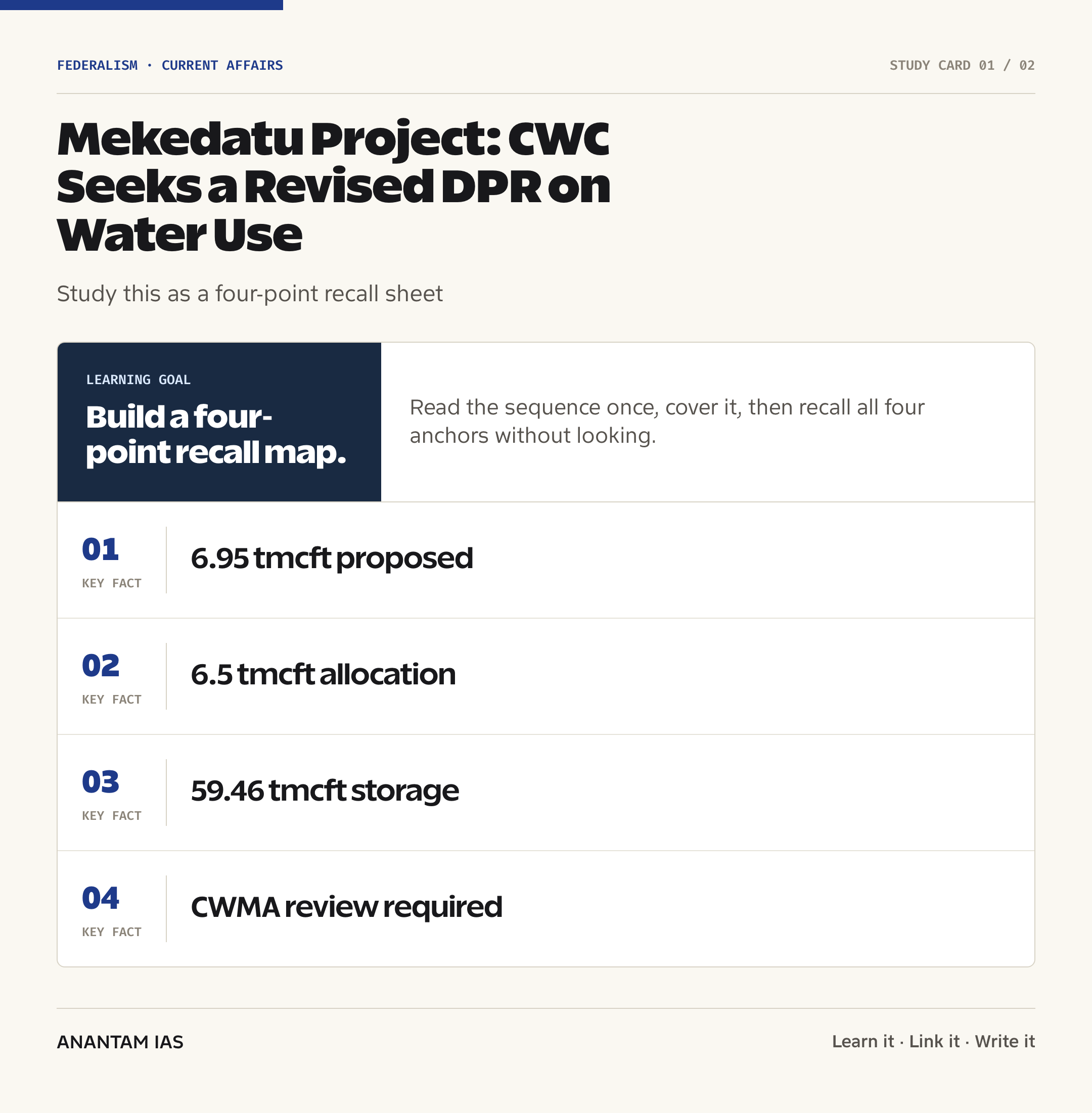
The modified scheme, submitted on April 21, 2026, raised the proposed consumptive use from 4.75 tmcft to 6.95 tmcft and added the Shivanasamudra Run-of-River Power Project with a diversion weir. The fresh scrutiny matters because project appraisal must remain consistent with the Cauvery Water Disputes Tribunal (CWDT) Award, the Supreme Court’s 2018 judgment and the operational role of the Cauvery institutions. The revision will test whether the enlarged scheme can fit within the same binding basin account.
- The CWC asked for updated details and drawings under its 2017 Guidelines for Submission, Appraisal and Acceptance of Irrigation and Multipurpose Projects.
- The proposed consumptive use in the modified scheme is 6.95 tmcft, against the earlier project claim of an additional 4.75 tmcft for Bengaluru’s drinking-water needs.
- The CWC noted that the 6.5 tmcft identified by the Supreme Court for Karnataka’s urban and rural population includes existing consumptive use; it isn’t automatically an entirely new project entitlement.
- Even if an older estimate of 2.9 tmcft is used for present consumption, the CWC reasoned that the balance available for a fresh proposal would be only 3.6 tmcft or less.
- The CWC also questioned the basis used to determine the proposed reservoir’s 59.46 tmcft live-storage capacity, requiring the design assumptions to be justified afresh.
- The request for revision isn’t final project approval or rejection. It keeps the proposal within the technical appraisal process.
The development matters in the context of:
- The development tests whether an upper-riparian State can meet a legitimate drinking-water objective without weakening scheduled downstream releases to Tamil Nadu and Puducherry.
- It shows why inter-State river disputes cannot be treated only as engineering questions: allocations, institutions, hydrological data and federal trust operate together.
- For UPSC answers, connect the case with Article 262, the Inter-State River Water Disputes Act, 1956, tribunal adjudication and cooperative federalism.
- The issue builds on the broader framework explained in Cauvery water-sharing and CWMA review and India’s water-governance architecture.
UPSC Relevance
Prelims Relevance
- Mekedatu is a location on the Cauvery in Karnataka, upstream of the inter-State measuring point at Biligundlu.
- The proposal is officially described as the Mekedatu Balancing Reservoir-cum-Drinking Water Project; its stated objectives include Bengaluru-region water supply and hydropower.
- The CWC, under the Ministry of Jal Shakti, appraises major irrigation and multipurpose project proposals from technical, hydrological and economic perspectives.
- The CWDT adjudicated the Cauvery dispute under the Inter-State River Water Disputes Act, and its award was modified by the Supreme Court judgment of February 16, 2018.
- The Union notified the Cauvery Water Management Scheme on June 1, 2018, establishing the Cauvery Water Management Authority and Cauvery Water Regulation Committee.
- The CWMA is the basin-level implementation authority, while the CWRC supports regulation, monitoring and periodic release decisions.
- A DPR is a detailed technical, financial, environmental and implementation document; permission to prepare or revise one isn’t permission to construct a dam.
- Consumptive use is the portion of withdrawn water not promptly returned to the river system because of evaporation, incorporation into products or other losses.
- Live storage is the usable reservoir volume between the minimum drawdown level and full reservoir level; it differs from gross storage.
- Under Article 262, Parliament may provide for adjudication of inter-State river-water disputes and may exclude court jurisdiction to the extent provided by law.
Mains Relevance
GS Paper 2
- Use the case to explain cooperative federalism where a Union technical body, a statutory adjudicatory outcome and an inter-State implementation authority constrain unilateral action.
- Discuss the difference between a State’s development competence and its obligation to respect adjudicated inter-State water shares.
- Evaluate whether expert institutions can reduce litigation when their decisions are transparent, data-based and time-bound.
GS Paper 3
- Examine integrated river-basin management, reservoir operation, drinking-water security, hydropower and downstream irrigation as connected planning questions.
- Show how updated hydrology, present consumption, environmental flows and climate variability should enter a DPR appraisal.
- Link water infrastructure with ecological assessment, dam safety and credible monitoring at control points such as Biligundlu.
Essay
- Rivers cross political boundaries, so water security depends as much on institutional trust as on storage capacity.
- Cooperative federalism becomes meaningful when States accept both the benefits and the constraints of a shared basin.
- Technical expertise can depoliticise a dispute only when the data, assumptions and reasons are open to scrutiny.
Background and Context
Project Design and Stated Objectives
Mekedatu is framed by Karnataka as a balancing-storage project, but its effect must be assessed across the whole Cauvery system.
- The proposed reservoir lies in Karnataka on the Cauvery, downstream of major Karnataka reservoirs and upstream of Tamil Nadu.
- Karnataka’s 2018 pre-feasibility submission described an intended gross reservoir capacity of about 67.16 tmcft, additional consumptive use for Bengaluru-region drinking water and incidental hydropower generation.
- The modified 2026 scheme cited by the CWC uses a proposed 59.46 tmcft live-storage capacity. Gross capacity and live capacity are different measures, so the figures shouldn’t be treated as a direct contradiction.
- The modified scheme also adds the Shivanasamudra Run-of-River Power Project and a diversion weir, enlarging the scope that the appraisal authorities must examine.
- A balancing reservoir can regulate seasonal flows, but storage timing and release rules determine whether it supports or harms downstream entitlements.
Cauvery Adjudication Framework
The project sits inside a legally settled allocation framework rather than an unallocated pool of water.
- The CWDT delivered its final award in 2007 after adjudicating claims involving Karnataka, Tamil Nadu, Kerala and Puducherry.
- On February 16, 2018, the Supreme Court modified the award while retaining the basin-wide structure of State shares and scheduled delivery obligations.
- The judgment recognised an additional 4.75 tmcft for Bengaluru’s drinking-water needs within Karnataka’s allocation and adjusted the inter-State distribution accordingly.
- The Union’s Cauvery Water Management Scheme, 2018 created an implementation mechanism so that adjudication could translate into reservoir operation, measurements and releases.
- Students should separate three stages: allocation by adjudication, implementation by basin institutions and technical clearance of a particular project.
Who Does What
Different institutions answer different questions, and no single procedural step substitutes for the others.
- The CWC examines project design, hydrology, water balance, storage assumptions and compliance with appraisal requirements.
- The CWMA gives basin-level oversight to the implementation of the modified award and considers whether project operation is consistent with inter-State obligations.
- The CWRC supports implementation through data review, reservoir-status assessment and recommendations on regulated releases.
- The Central Electricity Authority becomes relevant where the project includes hydropower components and associated technical design.
- Environmental and forest clearances, rehabilitation duties and dam-safety requirements remain separate legal gates even after water-resource appraisal.
- This layered arrangement is comparable to other river disputes discussed in the Mahanadi water-dispute framework.
What the Supreme Court Clarified
The Supreme Court’s November 13, 2025 order kept the expert appraisal process open while protecting downstream obligations.
- The Court rejected Tamil Nadu’s challenge at that stage as premature, because Karnataka had only been permitted to prepare a DPR and the expert process had not reached a final decision.
- It recorded that the CWC’s November 22, 2018 communication required Karnataka to consider Tamil Nadu’s objections and consult the specialised units of the CWC and CEA.
- The judgment said prior consideration by the CWMA, along with expert inputs associated with the CWRC, was necessary before the CWC took a final view on the DPR.
- It also held that Karnataka remained bound to release the water directed under the Cauvery framework, measured at Biligundlu.
- The order didn’t approve construction. It deferred to technical institutions while preserving the parties’ right to take lawful steps if a DPR is later approved.
The Water-Accounting Problem
The 2026 revision turns on the difference between an allocation, existing consumption and genuinely additional consumptive use.
- The modified scheme proposed 6.95 tmcft of consumptive use, higher than both its earlier 4.75 tmcft proposal and the 6.5 tmcft figure examined by the CWC for urban and rural population.
- The CWC stressed that the 6.5 tmcft figure includes present consumptive use; subtracting current use is necessary before estimating an additional project demand.
- Using even the older 2.9 tmcft consumption estimate leaves only 3.6 tmcft or less for a fresh proposal, according to the CWC’s reported calculation.
- The appraisal must distinguish withdrawal from consumptive use because treated return flows may re-enter the basin, while evaporation and inter-basin transfer may not.
- A credible water balance needs updated population demand, supply sources, return-flow assumptions, reservoir evaporation and normal-year as well as distress-year scenarios.
- This is an evidence question, not only a political claim. Transparent calculations let all riparian States test whether the project fits the adjudicated envelope.
Federal and Ecological Concerns
Upper-riparian development and lower-riparian security have to be reconciled through enforceable operating rules.
- Karnataka argues that a reservoir can meet Bengaluru’s drinking-water needs and regulate releases, especially when monsoon flows are high.
- Tamil Nadu fears that new upstream control could alter the timing and reliability of water reaching its delta, even when annual allocations appear unchanged.
- The Union told Parliament that the 2018 judgment doesn’t expressly require the consent of every other riparian State for any Cauvery structure. But absence of a blanket consent clause doesn’t remove award compliance, appraisal or downstream-release duties.
- Reservoir appraisal should cover forest loss, wildlife connectivity, sediment, aquatic ecology, evaporation and cumulative impacts alongside engineering benefits.
- Climate variability strengthens the case for adaptive operating rules because a design based only on average flows can fail during clustered droughts or extreme monsoons.
- The constitutional answer is neither an absolute upstream veto nor unchecked unilateral construction; it is rule-bound basin federalism backed by shared data.
Why Distress Years Change the Appraisal
A project that appears manageable in a good monsoon can become contentious when basin yield falls below the level assumed in the allocation framework.
- The Cauvery scheme requires the basin institutions to examine actual yield, reservoir storage, withdrawals and release trends at regular intervals rather than rely only on an annual average.
- During a distress year, reduced availability has to be assessed basin-wide, and the burden cannot be shifted informally to the lower riparian through delayed releases.
- A large upstream reservoir changes the State’s ability to control the timing of flows. That operational power is why a DPR needs rule curves, release priorities and measurable safeguards, not only a statement that annual shares will be protected.
- The revised DPR should model sequences of weak monsoons, not merely one isolated dry year, because low initial storage can make the next season’s drinking-water and irrigation conflict sharper.
- It should also test climate-sensitive hydrology, including more intense rainfall events, longer dry spells and changes in evaporation, while avoiding unsupported claims of permanent surplus.
- The CWMA needs authority to order corrective releases when monitoring shows deviation, and the data used for that decision should be visible to all riparian governments.
- For Mains, this converts a dam dispute into a governance lesson: resilience depends on pre-agreed rules that work when water is scarce, not only on cooperation during surplus years.
How to Frame the Issue in an Answer
A strong UPSC answer moves from the fresh fact to the institution, conflict and reform rather than narrating State positions.
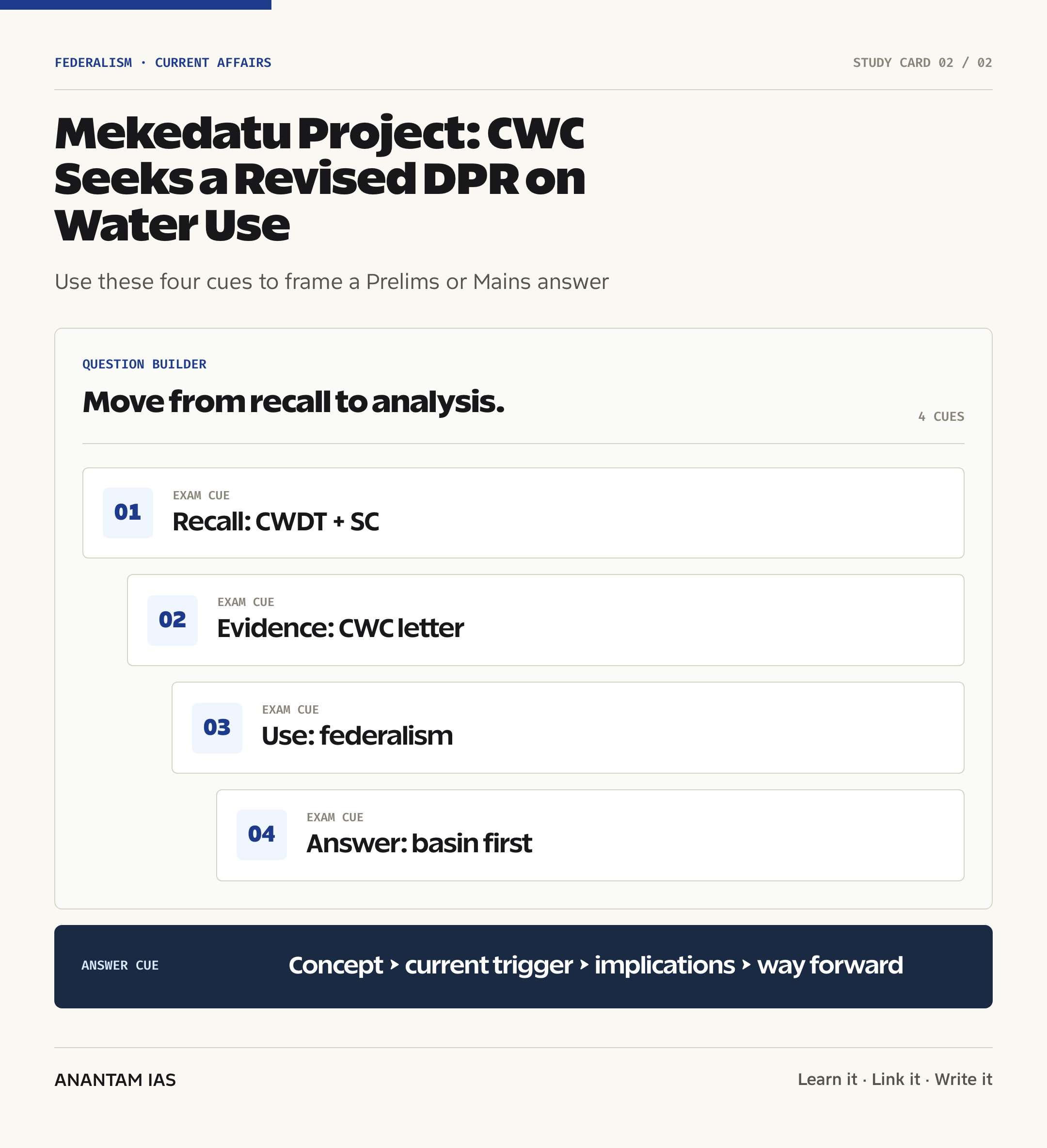
- Open with the CWC’s demand for a revised DPR because proposed consumptive use exceeded the applicable allocation logic.
- Map the governance chain as CWDT and Supreme Court allocation → CWMA and CWRC implementation → CWC technical appraisal.
- Present the competing values fairly: Bengaluru’s drinking-water need, Tamil Nadu’s scheduled releases, ecological integrity and predictable project clearance.
- Use the 2025 Supreme Court order to show that expert review and judicial remedies can coexist without the Court becoming the first-instance hydrological assessor.
- End with basin-wide data, transparent water accounting, rule-based reservoir operation and a time-bound federal consultation mechanism.
Way Forward
Revise the DPR Around an Auditable Water Balance
- Karnataka should state existing withdrawals, actual consumptive use, treated return flows and the precise additional demand attributable to the project.
- The revised document should publish the assumptions behind 59.46 tmcft live storage, including evaporation, sedimentation, dependable yield and seasonal operating levels.
- Normal, surplus and distress-year simulations should demonstrate compliance with downstream deliveries at Biligundlu.
Make Basin Institutions Data-Rich
- The CWMA and CWRC should receive near-real-time reservoir, rainfall, release, withdrawal and return-flow data through a common basin dashboard.
- Independent technical review and reasoned minutes can reduce suspicion that project appraisal is driven by political pressure.
- A public summary should explain which objections were accepted, rejected or converted into operating conditions.
Tie Approval to Enforceable Operation
- Any favourable appraisal should include a reservoir-operation rule curve consistent with the CWDT Award as modified by the Supreme Court.
- Release monitoring, audit triggers and corrective directions should be specified before construction rather than negotiated during a drought.
- Hydropower dispatch and diversion-weir operation must remain subordinate to drinking-water limits and inter-State release obligations.
Assess Cumulative Social and Ecological Costs
- The appraisal should account for forest submergence, wildlife movement, downstream ecology, local livelihoods and disaster-risk implications.
- Alternatives such as Bengaluru demand management, leakage reduction, wastewater reuse and rainwater capture should be compared with new storage.
- Project design should follow a least-cost, least-conflict water-security strategy, not assume that reservoir capacity alone solves urban scarcity.
Institutionalise Cooperative Federalism
- Karnataka, Tamil Nadu, Kerala, Puducherry and the Union should use a structured technical forum before disputes harden into emergency litigation.
- Consultation need not create an unlimited veto, but it must give every riparian access to data and a meaningful opportunity to test project assumptions.
- A basin-first approach can convert compliance from a zero-sum State contest into a shared commitment to predictable water security.
Conclusion
The CWC’s call for a revised Mekedatu DPR is a reminder that a large dam proposal must prove its water claim before its engineering promise can be accepted. Consumptive use, live storage and downstream releases are linked parts of one basin account.
The durable solution lies in cooperative, rule-bound federalism: Karnataka’s development needs deserve serious appraisal, while Tamil Nadu and Puducherry’s adjudicated flows require measurable protection. Transparent expert review can reconcile the two more effectively than slogans or recurring crisis litigation.
UPSC Practice Questions
Prelims MCQ 1
With reference to the institutional framework for the Cauvery river, consider the following statements:
- The Cauvery Water Management Authority was created under the Cauvery Water Management Scheme notified by the Union government.
- Permission to prepare a Detailed Project Report is equivalent to final permission to construct a dam.
- Biligundlu is used as an inter-State measuring point for Cauvery releases towards Tamil Nadu.
How many of the above statements are correct?
(a) Only one (b) Only two (c) All three (d) None
Answer: (b) Only two
Explanation:
Statements 1 and 3 are correct. The Union notified the Cauvery Water Management Scheme in 2018, and Biligundlu is a key measuring point. Statement 2 is incorrect because DPR preparation or revision is an appraisal stage, not construction approval.
Prelims MCQ 2
Which one of the following best describes consumptive use of water?
(a) Total water released from a reservoir in a year (b) Water withdrawn and not promptly returned to the same water system (c) Gross storage between the riverbed and dam crest (d) Water reserved only for hydroelectric generation
Answer: (b) Water withdrawn and not promptly returned to the same water system
Explanation:
Consumptive use covers the part of a withdrawal lost to evaporation, incorporation or other processes and not promptly returned. It differs from total withdrawal, live storage and non-consumptive hydropower use.
UPSC Mains Questions
- The Mekedatu project shows that inter-State river governance is not merely a question of engineering feasibility. Examine how adjudicated allocations, technical appraisal, basin institutions and transparent water accounting can reconcile urban drinking-water needs with downstream rights.
- Differentiate between permission to prepare a Detailed Project Report and final project approval in the context of inter-State rivers. Discuss how the CWC, CWMA and CWRC together can strengthen cooperative federalism in the Cauvery basin.
Sources: Supreme Court of India and The Hindu.
Frequently Asked Questions
What is the Mekedatu project?
It is Karnataka’s proposed balancing reservoir-cum-drinking water project on the Cauvery. Its stated purposes include supplying Bengaluru-region drinking water, regulating flows and generating hydropower. Because it would store water in an inter-State basin, its design and operation must remain consistent with the Cauvery allocation and downstream-release framework.
Why did CWC seek a revised DPR?
The CWC found that the modified scheme proposed 6.95 tmcft of consumptive use, while the relevant 6.5 tmcft figure includes existing use. It also questioned the basis for the 59.46 tmcft live-storage capacity and asked for updated details that comply with the CWDT Award and CWC’s appraisal guidelines.
Has Mekedatu received construction approval?
No. The current step concerns revision and appraisal of a Detailed Project Report. The Supreme Court’s 2025 order treated Tamil Nadu’s challenge as premature because no final CWC decision had been taken. Water-resource appraisal, basin-level consideration and other statutory clearances remain necessary before construction can lawfully proceed.
What is CWMA’s role?
The Cauvery Water Management Authority implements the Cauvery allocation framework as modified by the Supreme Court. It oversees basin-level compliance, reservoir operations and releases with support from the Cauvery Water Regulation Committee. Its expert assessment is central to judging whether a project can operate without disturbing adjudicated downstream entitlements.
Why is Biligundlu important?
Biligundlu is the measuring point near the Karnataka-Tamil Nadu boundary where Cauvery flows towards Tamil Nadu are monitored. The Supreme Court’s 2025 order stressed that Karnataka remains bound by release directions under the Cauvery framework and that compliance can be measured at this control point.
Does Tamil Nadu have a veto?
The Union has said the 2018 judgment doesn’t expressly require every riparian State’s consent for any Cauvery structure. That doesn’t create a free hand for Karnataka. The project still has to comply with the adjudicated allocation, undergo expert appraisal and protect scheduled releases, while affected riparians can raise objections and pursue lawful remedies.
Source: https://anantamias.com/current-affairs/mekedatu-cwc-revised-dpr/
June IIP Data: Industrial Growth Offers Only a Temporary Respite
Why in News?
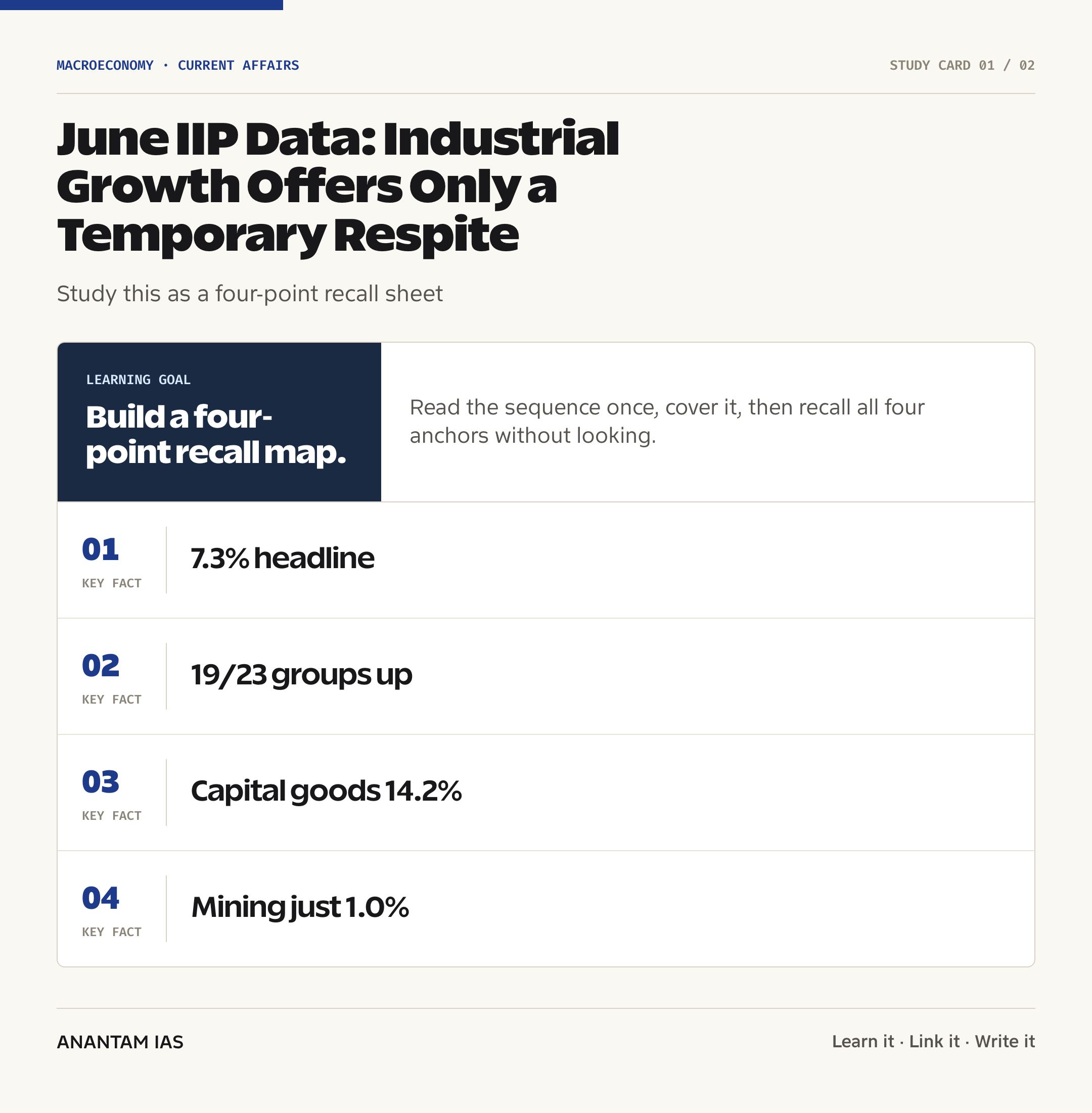
The National Statistics Office under the Ministry of Statistics and Programme Implementation released the Quick Estimates of the Index of Industrial Production for June 2026 on July 28, 2026. The general index recorded 7.3% year-on-year growth, up from the revised 5.0% recorded for May.
The headline improvement was led by Manufacturing at 7.8% and Electricity and Gas Supply at 10.6%. But Mining and Quarrying grew only 1.0%, and the pattern across industries and use-based categories shows why one strong month should be treated as a temporary respite rather than proof of a durable industrial upcycle.
- The general IIP index rose to 123.1 in June 2026 from 114.7 in June 2025.
- Sectoral growth was 1.0% in Mining, 7.8% in Manufacturing, 10.6% in Electricity and Gas Supply, and 6.1% in Water Supply, Sewerage and Waste Management.
- 19 of 23 manufacturing groups recorded positive year-on-year growth, indicating wider participation than a rise driven by only one industry.
- Capital goods grew 14.2%, the fastest among the six use-based categories, while primary goods and consumer non-durables each grew 4.9%.
- The April-June cumulative IIP grew 5.8%; mining contracted 1.4% over the same period even as manufacturing expanded 6.3%.
The development matters in the context of:
- The data matters in the context of whether India’s industrial recovery is becoming broad, investment-led and employment-supporting.
- It also tests the quality of the newly rebased 2022-23 IIP series, which expanded coverage and updated the production basket.
- A high monthly growth rate can reflect base effects, sector concentration and temporary production cycles; the level, breadth and persistence must be read together.
- For the wider macroeconomic frame, connect IIP with India’s sectoral economic structure, industrial GVA, capacity use, credit and private investment.
UPSC Relevance
Prelims Relevance
- IIP is a volume index that tracks short-term changes in industrial production relative to a base year.
- It is compiled and released by the National Statistics Office under MoSPI.
- The current series uses 2022-23 as the base year, where the index is set at 100.
- The four sectoral groups are Mining and Quarrying, Manufacturing, Electricity and Gas Supply, and Water Supply, Sewerage and Waste Management.
- Manufacturing has the largest sectoral weight at 76.062 out of 100 in the new series.
- The six use-based categories are Primary Goods, Capital Goods, Intermediate Goods, Infrastructure or Construction Goods, Consumer Durables and Consumer Non-durables.
- The new basket contains 463 item groups, including 120 newly added item groups.
- Quick Estimates are released with a 28-day lag and can be revised as source agencies submit updated production data.
Mains Relevance
GS Paper 3
- Assess the quality and durability of industrial growth through sectoral breadth, use-based demand and cumulative trends rather than the headline rate alone.
- Link capital goods and intermediate goods growth to investment demand, while using consumer categories to test the strength of household demand.
- Discuss the role of base-year revision, updated weights and better deflators in improving measurement of real industrial output.
GS Paper 2
- Use the new IIP series as an example of statistical governance, data transparency, revision policy and public trust in official institutions.
Essay
- What gets measured shapes what gets governed: statistical reform as economic infrastructure.
- Growth is durable only when its breadth, demand base and productive capacity reinforce one another.
Background and Context
What the IIP Measures
The IIP is a high-frequency indicator of changes in the physical volume of industrial production, not a complete measure of industrial welfare or value added.
- An index value above 100 means the measured output level is above the 2022-23 base-year level; it does not itself state the growth rate.
- The reported monthly growth rate compares the index with the same month a year earlier, which reduces seasonal distortion but can still carry a favourable or adverse base effect.
- The IIP tracks production, while Gross Value Added measures value created after subtracting intermediate consumption. Read the distinction alongside the GDP and GVA explainer.
- Because IIP arrives quickly, it helps policymakers and analysts assess momentum before more comprehensive national accounts and industrial survey data become available.
- The Quick Estimate is provisional. MoSPI revises it when source agencies provide more complete factory and establishment returns.
Reading the June Headline
The 7.3% headline combines sectors with sharply different weights and growth rates, so the contribution of each sector matters.
- Manufacturing, with a 76.062% weight, grew 7.8% and supplied the main weight-driven push to the general index.
- Electricity and Gas Supply grew 10.6%, with electricity itself rising 11.4% while gas supply slipped 0.1%.
- Mining and Quarrying grew only 1.0% in June and contracted 1.4% over April-June, revealing a persistent weak point beneath the headline.
- Water Supply, Sewerage and Waste Management, newly included as a separate sector in the rebased series, grew 6.1% in June.
- The overall index stood at 123.1, while cumulative April-June growth was 5.8%. A quarterly cumulative rate is a better persistence check than a single monthly print.
- The May index was updated as more production data arrived. That revision is a reminder to state whether a number is a Quick Estimate or a revised estimate.
Manufacturing: Broad Improvement, Uneven Strength
Manufacturing growth was fairly broad, but the fastest industries and the laggards point to an uneven recovery.
- 19 of 23 NIC two-digit groups expanded over June 2025, a useful breadth signal that supports the headline.
- Electrical equipment grew 34.0%, motor vehicles, trailers and semi-trailers grew 17.5%, and food products grew 10.8%; MoSPI identified them as the top positive contributors.
- A high growth rate is not the same as a high contribution. Contribution also depends on an industry’s weight and absolute change in the index.
- Wearing apparel contracted 6.9%, wood products fell 7.4%, refined petroleum products declined 0.5%, and chemicals slipped 0.3%.
- The mix suggests strength in equipment, vehicles and selected intermediate industries, but does not show a uniform rise across labour-intensive and consumption-facing manufacturing.
- For a prior-month comparison and the deflator change, the June 30 current-affairs digest records the May 2026 IIP release.
Use-Based Categories and the Demand Signal
Use-based classification reorganises industrial items by their economic purpose and helps separate investment, production-chain and consumption signals.
- Capital goods grew 14.2% in June and 14.0% over April-June, consistent with a strong investment-related production signal.
- Intermediate goods grew 9.3% in June and 8.5% cumulatively, pointing to activity within production chains.
- Infrastructure and construction goods grew 7.5% in June and 6.8% over April-June, aligning with continued construction-linked demand.
- Consumer durables grew 7.7% in June and 7.2% cumulatively, while consumer non-durables grew 4.9% in June but only 1.5% cumulatively.
- Primary goods grew 4.9% in June and 2.9% cumulatively, a comparatively softer outcome.
- Capital-goods growth is encouraging but not conclusive proof of a private investment cycle. It should be checked against new orders, credit, capacity utilisation, imports and project completion.
Why the Respite May Be Temporary
A durable industrial recovery needs repeated, broad-based gains that survive base effects and translate into demand, jobs and new capacity.
- One month is not a trend. June’s 7.3% rise must be tested against the next several releases and the cumulative trajectory.
- Mining’s weak result and contractions in selected manufacturing groups show that the rebound is not uniform across the supply base.
- The gap between strong capital goods and modest cumulative consumer non-durables may indicate that investment-facing production is firmer than mass-consumption demand.
- Electricity growth can reflect weather, cooling demand and the production calendar as well as sustained industrial use, so it needs corroboration.
- A favourable base can lift year-on-year growth without an equally large sequential improvement. Compare both the index level and annual growth rate.
- The analytical test is whether the rebound expands into labour-intensive sectors, strengthens household demand and raises private capacity creation.
The 2022-23 Series and Data Quality
The new series improves relevance, but the transition also requires careful comparison and transparent revision.
- The base year moved from 2011-12 to 2022-23 to reflect newer production patterns, technologies and products.
- The basket now covers 463 item groups, compared with 407 in the old series, and includes 120 newly introduced groups.
- Coverage now separately includes gas supply and Water Supply, Sewerage and Waste Management, along with greater detail for renewable and non-renewable electricity.
- MoSPI adopted the Output Producer Price Index as the deflator for 234 item groups collected in value terms. These groups account for 36.02% of total weight.
- The June Quick Estimate used an 86.7% weighted response rate; the final May estimate used 93.1%. Greater response completeness can change later estimates.
- Because the basket, weights, coverage and methods changed, lower-level comparisons with the old series need caution. The Economic Survey explainer provides the wider policy setting for growth, investment and demand.
Way Forward
Read the Dashboard, Not One Number
- Track at least three to six months of sectoral and use-based data before declaring a durable turn.
- Cross-check IIP with industrial GVA, the Index of Core Industries, capacity utilisation, credit, exports, GST activity and employment.
- Separate growth, contribution and weight in Mains answers; the fastest-growing group need not be the largest contributor.
Broaden the Industrial Recovery
- Improve logistics, reliable power, technology adoption and access to finance for MSMEs and labour-intensive industries.
- Support productive investment without mistaking temporary tax or inventory effects for structural competitiveness.
- Strengthen household purchasing power and job creation so that consumer demand can reinforce investment-led production.
Deepen Statistical Credibility
- Publish clear revision tables, response rates and methodological notes with every release.
- Expand digital reporting and source-agency coordination to improve timeliness, completeness and comparability.
- Explain breaks in series and avoid mechanical lower-level linking where changed baskets make comparison unreliable.
Build a Balanced Mains Answer
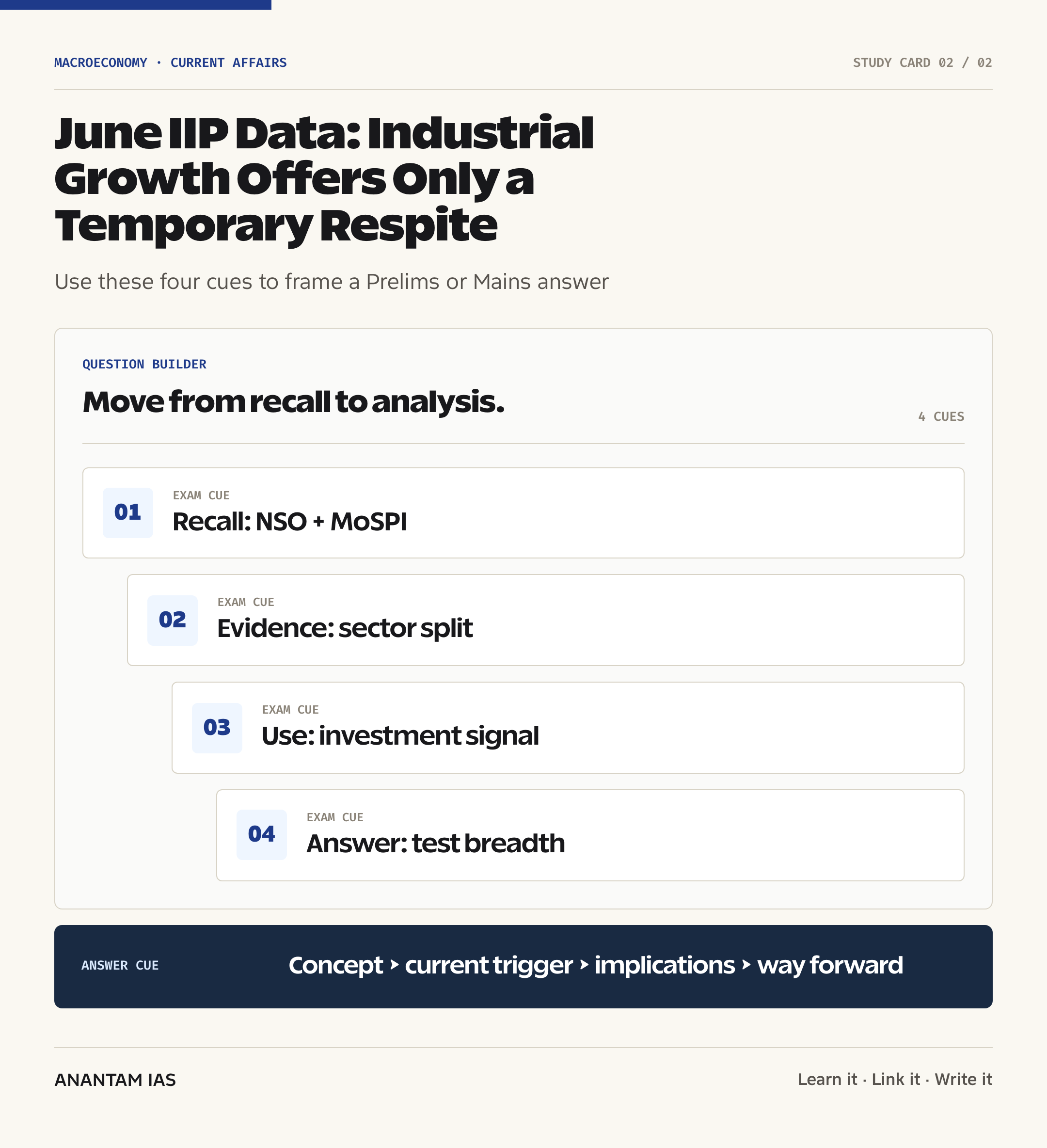
- Open with the 7.3% headline, qualify it with the 5.8% cumulative rate, and then split the evidence into sectoral and use-based signals.
- Place the positive case, including manufacturing breadth and capital goods, against the cautions of weak mining, uneven industries and revisions.
- Close with the test of persistence, breadth, jobs and private capacity rather than predicting a boom or slowdown from one print.
Conclusion
June’s 7.3% IIP growth is a welcome improvement, especially because manufacturing expanded across 19 of 23 groups and capital goods remained strong. It offers evidence of industrial momentum, not a licence to read the economy through one headline.
The stronger judgment is conditional: industrial recovery becomes durable when it persists across months, spreads to mining and labour-intensive manufacturing, supports consumer demand, and converts investment signals into productive capacity and jobs. Until those tests are met, the June print is best treated as a respite that still needs confirmation.
UPSC Practice Questions
Prelims MCQ 1
With reference to India’s Index of Industrial Production, consider the following statements:
- It is compiled by the National Statistics Office under the Ministry of Statistics and Programme Implementation.
- The current series uses 2022-23 as its base year.
- Manufacturing carries the largest sectoral weight in the index.
How many of the above statements are correct?
(a) Only one (b) Only two (c) All three (d) None
Answer: (c) All three
Explanation:
All three statements are correct. The NSO under MoSPI compiles IIP; the current base is 2022-23; and Manufacturing has the largest sectoral weight at 76.062.
Prelims MCQ 2
Which one of the following use-based categories recorded the fastest year-on-year IIP growth in June 2026?
(a) Primary Goods (b) Capital Goods (c) Consumer Durables (d) Infrastructure and Construction Goods
Answer: (b) Capital Goods
Explanation:
Capital Goods grew 14.2%, compared with 4.9% for Primary Goods, 7.7% for Consumer Durables, and 7.5% for Infrastructure and Construction Goods.
UPSC Mains Questions
- June 2026 IIP growth provides encouraging evidence of manufacturing and investment momentum, but not yet proof of a durable industrial recovery. Analyze this statement using sectoral breadth, use-based classification, cumulative trends and the limits of monthly data.
- Base-year revision is not a statistical formality; it changes how an economy sees its productive structure. Discuss the significance of the 2022-23 IIP series, expanded coverage, updated item basket and improved deflation for economic policymaking.
Sources: PIB, Ministry of Statistics and Programme Implementation and The Hindu Editorial.
Frequently Asked Questions
What is the IIP?
The Index of Industrial Production is a monthly volume index that tracks changes in industrial output relative to a base year. India’s NSO compiles it from production data supplied by factories, establishments and source agencies. It is a quick indicator of industrial momentum, not the same as industrial GVA or a complete measure of economic welfare.
Who releases India’s IIP?
The National Statistics Office, which functions under the Ministry of Statistics and Programme Implementation, compiles and releases the IIP. Under the 2022-23 series, the Quick Estimate is released with a 28-day lag. The estimate can be revised as reporting agencies submit more complete production data.
What was June 2026 IIP growth?
India’s general IIP grew 7.3% year on year in June 2026, with the index rising to 123.1 from 114.7 a year earlier. Manufacturing grew 7.8%, Electricity and Gas Supply 10.6%, Water-related activities 6.1%, and Mining and Quarrying 1.0%.
Why is the recovery called temporary?
The description is a caution, not a forecast. The result covers only one month, Mining remained weak, some manufacturing groups contracted, and cumulative consumer non-durables growth was modest. A durable turn needs repeated gains across sectors, stronger household demand, employment creation and evidence that capital-goods production is becoming real productive capacity.
What does capital-goods growth show?
Capital goods grew 14.2% in June and 14.0% during April-June. This can signal demand for machinery and investment-related equipment. But it cannot by itself prove a broad private investment cycle; the reading should be checked against new orders, capacity utilisation, credit, imports, project execution and industrial GVA.
What changed in the new IIP series?
The new series uses 2022-23 as the base year, covers 463 item groups and adds newer products and activities. It separately includes gas supply and water, sewerage and waste management. MoSPI also adopted Output PPI for value-based groups to remove price effects more closely from measured production.
Source: https://anantamias.com/current-affairs/iip-june-2026-industrial-output/
Post-Facto Environmental Clearance: Supreme Court Allows a Limited Route
Why in News?
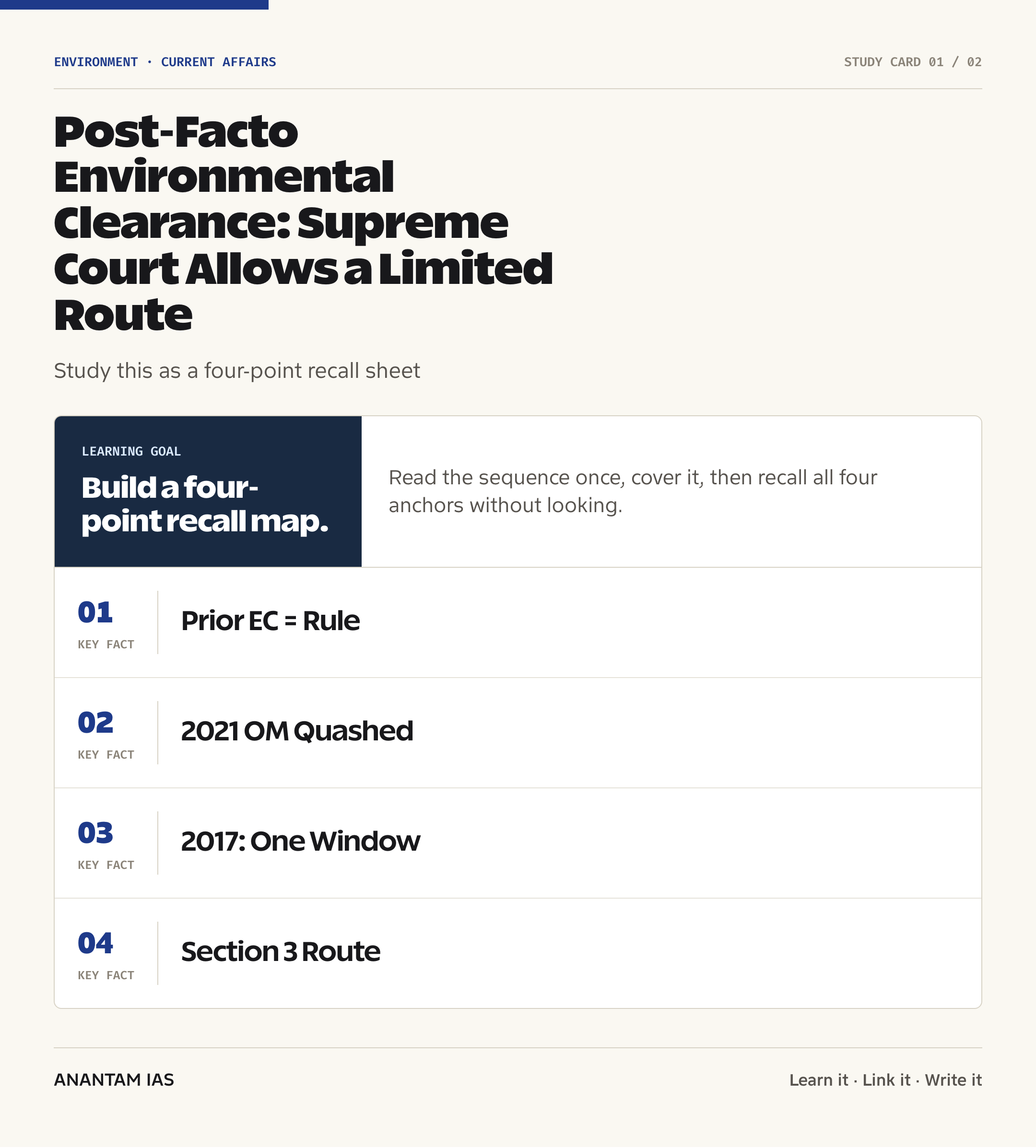
On July 29, 2026, a three-judge Supreme Court Bench led by Chief Justice Surya Kant invalidated the Environment Ministry’s 2021 Office Memorandum that had created a continuing route for projects begun without mandatory prior environmental clearance.
The Court kept prior environmental clearance as the governing rule but recognised a limited exception: the Union may frame a narrow, time-bound statutory amnesty for deserving cases involving supervening public interest, backed by deterrent liability and ecological remediation.
- The Bench also comprised Justices Joymalya Bagchi and Vipul M. Pancholi; the judgment addressed the legality of retrospective regularisation under the Environment (Protection) Act, 1986.
- The 2021 Office Memorandum was struck down because an administrative instruction could not supplant the prior-clearance regime created by the EIA Notification, 2006.
- The Court upheld the 2017 notification as a one-time, time-bound measure, while rejecting the 2021 attempt to turn that exception into an open-ended parallel route.
- Existing clearances remain open to individual legal challenge, pending applications under the earlier instruments may reach a decision, and no fresh applications can enter through the invalidated 2021 route.
- Any future relaxation must come through a valid Section 3 notification, not an Office Memorandum, and must satisfy constitutional tests of equality, proportionality and environmental protection.
The development matters in the context of:
- The ruling matters in the context of the tension between preventive environmental appraisal and the practical consequences of closing or demolishing completed public facilities.
- It also tests whether the polluter-pays principle can support remediation without reducing prior approval to a fee paid after ecological damage.
- The decision places greater responsibility on appraisal bodies, pollution control boards and public authorities to detect violations before sunk costs distort regulatory choices.
UPSC Relevance
Prelims Relevance
- Environmental clearance is a prior regulatory approval for projects listed in the Schedule to the EIA Notification, based on their likely environmental impacts.
- The EIA Notification, 2006 was issued under the Environment (Protection) Act, 1986 and requires prior clearance before specified construction, expansion or modernisation begins.
- The standard EIA process may involve screening, scoping, public consultation and appraisal, depending on the project category.
- The precautionary principle requires anticipatory action where environmental harm may be serious or irreversible, even when scientific certainty is incomplete.
- The polluter-pays principle makes the polluter bear the cost of preventing, controlling and remedying environmental damage; payment does not automatically legalise the activity.
- Section 3 of the 1986 Act empowers the Union government to take measures to protect and improve environmental quality and prevent, control or abate pollution.
- Article 21 has been judicially interpreted to include the right to a clean and healthy environment, while Article 14 controls arbitrary State classification and action.
- Article 142 empowers the Supreme Court to pass orders necessary for complete justice in a case, but it is not a general substitute for statutory compliance.
- The National Green Tribunal is a specialised statutory forum for effective and expeditious disposal of environmental cases; its role is explained in Anantam IAS notes on the NGT.
Mains Relevance
GS Paper 3
- Evaluate how prior EIA operationalises the precautionary principle by identifying alternatives, cumulative impacts and mitigation measures before irreversible commitments are made.
- Examine whether compensation, restoration and community augmentation can remedy ecological loss, and distinguish restorable damage from irreversible loss of wetlands, forests or habitats.
- Analyse the institutional weaknesses that let projects reach completion without clearance, including fragmented responsibility among appraisal committees, State authorities and pollution control boards.
GS Paper 2
- Discuss judicial review of delegated legislation and administrative instructions, especially when an Office Memorandum appears to alter a binding notification.
- Apply the tests of reasonable classification and proportionality to environmental amnesty: legitimate aim, rational connection, necessity and balanced impact on rights.
- Assess the Court’s attempt to reconcile the rule of law with public consequences through prospective relief, supervised remediation and exceptional use of Article 142.
Essay
- Public interest is not a contest between development and environment because environmental security is itself a public good.
- A narrow exception may save an essential facility, but a routine exception changes the behaviour of every future decision-maker.
Background and Context
Why Prior Clearance Is the Core Rule
Environmental appraisal is designed to influence a project before location, technology and scale become a fait accompli.
- A prior EIA allows regulators to compare site and design alternatives, estimate impacts, prescribe safeguards and reject an environmentally unacceptable proposal before capital is locked in.
- Public consultation gives affected communities an opportunity to raise livelihood, health, displacement and local-ecology concerns before the decision is made.
- Once a forest is cleared, a wetland filled or a coastline altered, later appraisal cannot recreate the lost baseline or restore the bargaining position of affected people.
- The sequencing rule is explained in Environment Impact Assessment in India: assess first, decide next and construct only after approval.
- A routine post-facto route can create a perverse incentive: begin construction, raise the social and financial cost of closure, and then seek approval as the least disruptive option.
From the 2017 Window to the 2021 Regime
The legal dispute turned on the difference between a temporary statutory relaxation and a perpetual administrative mechanism.
- The Union’s March 2017 notification offered a one-time window to projects already in violation, requiring them to disclose the default and undergo appraisal, damage assessment, remediation and penalty-related steps.
- That window was limited to existing violations and ultimately closed on April 13, 2018; it was not designed as a permanent alternative to prior clearance.
- The July 7, 2021 Office Memorandum laid down a Standard Operating Procedure for violation cases without a comparable closing date.
- Because the OM admitted later violators into regularisation, it operated as a parallel clearance track for projects that ignored the mandatory sequence.
- The Court found that an administrative OM could not amend or override the delegated legislative framework of the 2006 EIA Notification.
What the Supreme Court Held
The judgment rejected both an unlimited amnesty and an absolute claim that every completed violation must end in demolition.
- The 2021 OM failed because it was open-ended, administratively created and insufficiently differentiated between exceptional cases and ordinary commercial non-compliance.
- The prior-clearance requirement remains mandatory; post-facto approval is not an entitlement and cannot be granted merely because a project is complete or economically valuable.
- A future amnesty must be created through a valid statutory notification, identify a closed class of cases, operate for a fixed period and record why exceptional public interest justifies relaxation.
- The Court distinguished public interest from private gain; sunk private investment alone cannot become the controlling reason for forgiveness.
- Suitable relief may include refusal of the offending project portion, deterrent damages, a scientifically assessed remediation plan and monitored compliance.
- The Court also indicated that public officials responsible for allowing work without prior clearance should face effective accountability, so the State does not benefit from its own regulatory failure.
The Constitutional and Legal Tests
Any exception must survive the Constitution as well as the parent environmental statute.
- Under Article 14, the eligible class must rest on an intelligible differentia linked to the object of the scheme; a blanket category covering every violator is vulnerable to arbitrariness.
- Under Article 21, decision-makers must treat environmental quality as part of life, health and dignity rather than as an optional administrative preference.
- The proportionality test asks whether regularisation pursues a legitimate public purpose, is necessary, uses the least harmful route and does not impose excessive ecological or rights costs.
- Under the precautionary principle, uncertainty is a reason for protective assessment, not a reason to postpone scrutiny until after the project is built.
- Under the polluter-pays principle, compensation must reflect damage, unlawful benefit and restoration needs; it is not a licence fee.
- Revise the ethical foundations through Environmental Ethics notes.
Why the Limited Route Remains Controversial
A tightly worded exception can still influence incentives throughout the regulatory system.
- Project proponents may expect future rescue if large investment, employment or an essential service makes closure politically and socially costly.
- A completed project’s impact assessment is structurally weaker because alternatives are no longer equal; demolition is compared with continuation instead of comparing locations before construction.
- Environmental compensation is difficult to calculate when harm is cumulative, long-term, dispersed across communities or linked to ecosystem services without a simple market price.
- Prospective invalidation protects reliance interests and avoids abrupt disruption, but it may leave affected communities to challenge earlier clearances one project at a time.
- The reduced reliance on criminal sanctions after the Jan Vishwas amendments makes meaningful monetary penalties, restoration bonds and official accountability even more important for deterrence.
A Better Answer-Building Framework
UPSC answers should avoid a binary environment-versus-development frame and test the quality of the exception.
- Start with the rule: prior EC is mandatory because prevention, alternatives and public participation cannot be fully reconstructed after construction.
- Acknowledge the hard case: immediate demolition of a hospital, pollution-treatment facility or essential public project may create fresh social and environmental costs.
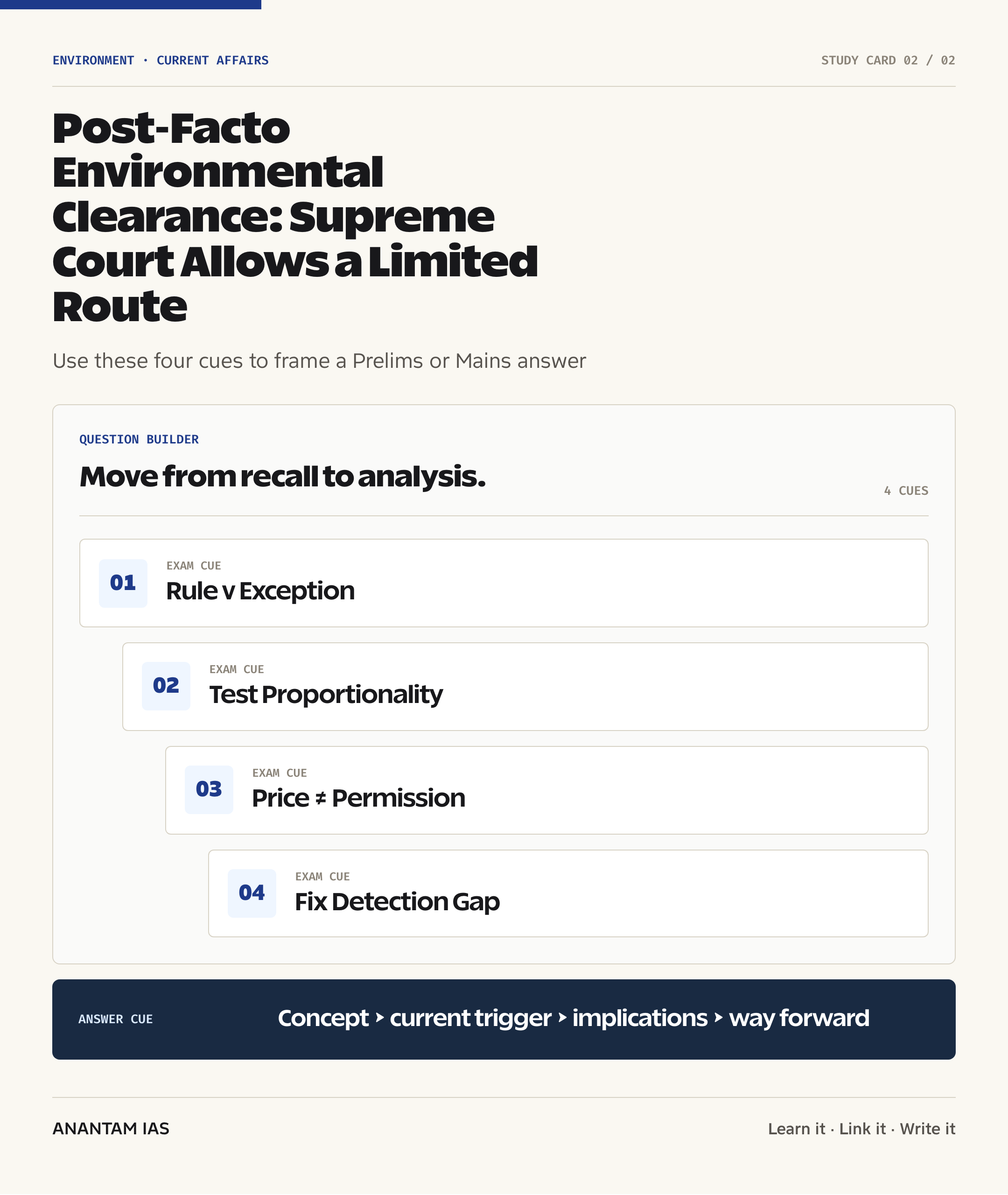
- Apply four filters: exceptional public purpose, no deliberate evasion, scientifically feasible remediation and no less harmful alternative.
- Demand process safeguards: public disclosure, independent damage assessment, a reasoned order, time limits, judicial or NGT review and personal accountability for enabling officials.
- End with the principle that regularisation must repair a rare governance failure, not create a predictable business strategy of build first, seek permission later.
Way Forward
Prevent violations before construction
- Integrate project-registration, land-use, building-permission, mining, factory and pollution-board databases so an authority cannot issue a downstream approval when prior EC is missing.
- Require geotagged progress reporting and risk-based inspections for listed sectors, with automatic alerts to the SEIAA or MoEFCC when physical work begins before approval.
- Publish responsibility matrices naming the public officers who must detect and stop an unauthorised project at each stage.
Make any amnesty genuinely exceptional
- Define a closed eligibility date, narrow project class and objective public-interest threshold; exclude deliberate concealment, repeated offenders and projects causing irreversible ecological loss.
- Use an independent committee to test alternatives, assess damage and publish reasons before any post-facto decision.
- Protect public participation by giving affected communities access to the violation report, remediation plan and a meaningful hearing.
Link liability to restoration and deterrence
- Calculate compensation from ecological damage, unlawful economic benefit and restoration cost, rather than applying a low standard tariff.
- Use restoration bonds, milestone-based monitoring and third-party audits, with closure triggered by non-compliance.
- Fix disciplinary and financial responsibility on officials whose action or inaction allowed a project to become a fait accompli.
Strengthen review and transparency
- Create a public register of every violation case, appraisal record, penalty, remediation milestone and compliance report.
- Preserve effective access to the NGT and constitutional courts so affected people can test classification, science and proportionality.
- Audit whether the exception is shrinking or becoming the new normal.
Conclusion
The Supreme Court’s middle path keeps prior environmental clearance as the legal rule while recognising that a completed project may sometimes present a harder remedial choice than simple closure.
Its legitimacy will depend on implementation. A narrow, reasoned and supervised exception can address an unusual public-interest failure; a recurring amnesty would weaken the precautionary principle and reward strategic non-compliance.
The lasting reform is not a better post-facto form. It is a regulatory system that identifies violations early, hears affected communities before decisions harden, and makes both project proponents and public officials answer for preventable ecological harm.
UPSC Practice Questions
Prelims MCQ 1
With reference to environmental clearance in India, consider the following statements:
- The EIA Notification, 2006 requires prior environmental clearance for listed projects and activities.
- The 2017 relaxation was designed as a one-time, time-bound window for existing violation cases.
- An Office Memorandum cannot override the prior-clearance requirement contained in delegated legislation.
How many of the above statements are correct?
(a) Only one (b) Only two (c) All three (d) None
Answer: (c) All three
Explanation:
All three are correct. The 2006 notification makes prior EC the rule; the 2017 measure had a limited window; and the Supreme Court rejected the open-ended 2021 administrative mechanism for displacing that legal framework.
Prelims MCQ 2
Which environmental-law principle most directly supports assessment before potentially irreversible harm occurs?
(a) Polluter-pays principle (b) Precautionary principle (c) Public-trust doctrine (d) Absolute-liability principle
Answer: (b) Precautionary principle
Explanation:
The precautionary principle calls for anticipatory protective action when serious or irreversible environmental harm is possible. Polluter pays addresses the costs of prevention and remediation, but payment after damage cannot recreate a prior appraisal.
UPSC Mains Questions
- The Supreme Court’s 2026 ruling on post-facto environmental clearance preserves prior appraisal as the rule but permits a narrow statutory amnesty in exceptional public-interest cases. Examine whether proportionality can reconcile environmental rule of law with the consequences of closing completed public projects.
- Post-facto environmental clearance is not merely delayed paperwork; it alters alternatives, public participation and regulatory incentives. Discuss the institutional reforms needed to prevent projects from becoming a fait accompli before environmental scrutiny begins.
Sources: Supreme Court of India; Environment (Protection) Act, 1986 and The Hindu; The Indian Express.
Frequently Asked Questions
What is post-facto environmental clearance?
It is an environmental approval sought after a project has begun construction, expanded or started operations without the required prior clearance. It reverses the normal EIA sequence because regulators assess an existing project rather than a proposal. The Supreme Court said this cannot become a routine alternative to prior appraisal.
Did the Supreme Court permit all retrospective clearances?
No. The Court struck down the open-ended 2021 Office Memorandum and kept prior clearance as the rule. It allowed only the possibility of a narrow, time-bound statutory amnesty for exceptional projects serving a compelling public interest, supported by reasoned classification, deterrent liability and supervised ecological remediation.
Why was the 2021 Office Memorandum invalid?
The 2021 OM created a continuing administrative mechanism for violation cases. The Court held that an Office Memorandum could not override or supplant the prior-clearance regime established through the EIA Notification, 2006. Its open-ended coverage also failed to distinguish exceptional public-interest cases from ordinary non-compliance.
How is the 2017 notification different?
The 2017 notification offered a one-time route for projects already in violation, with a limited application window that ended in April 2018. The Court treated its closed period and statutory form as materially different from the 2021 OM, which attempted to maintain a perpetual route through an administrative instruction.
Can paying compensation legalise environmental harm?
Not by itself. The polluter-pays principle requires the polluter to bear prevention, damage and restoration costs, but it is not a licence to pollute. A valid exceptional remedy must still consider irreversible harm, alternatives, public participation, deterrent damages, remediation feasibility and the legality of the project.
What should a UPSC answer emphasise?
Begin with prior EC and the precautionary principle. Then acknowledge the difficult case of completed essential public infrastructure. Test any exception through public purpose, proportionality, scientific remediation, independent appraisal, transparency and accountability. Conclude that an amnesty must correct a rare failure, not encourage build-first behaviour.
Source: https://anantamias.com/current-affairs/post-facto-environmental-clearance-supreme-court/