Why in News?
The Central Water Commission (CWC) returned Karnataka’s modified Detailed Project Report for the Mekedatu Balancing Reservoir-cum-Drinking Water Project and sought a revised submission. The Hindu reported that the CWC’s letter of June 29, 2026 found the proposed consumptive use higher than the water allocation applicable to the project.
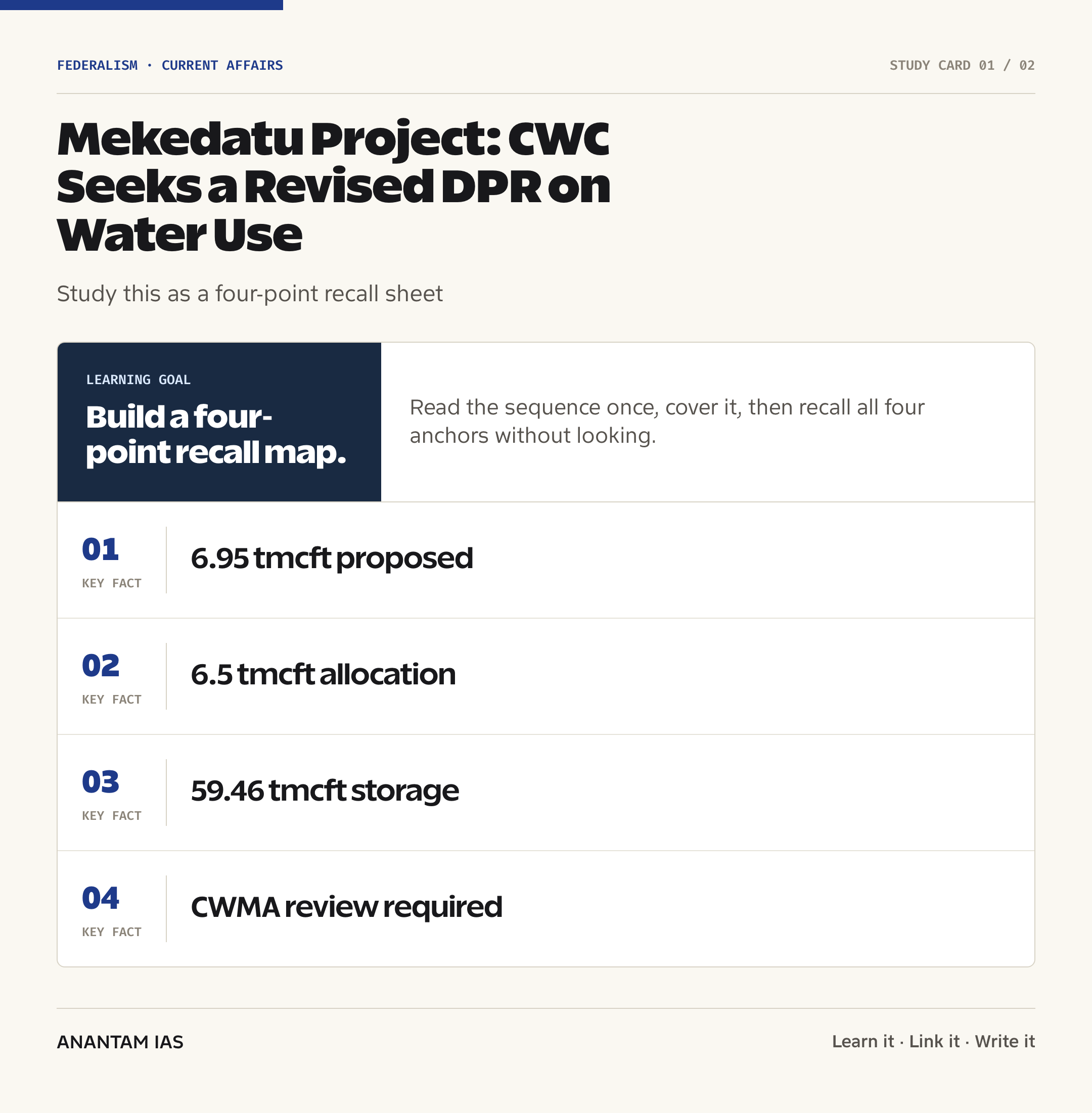
The modified scheme, submitted on April 21, 2026, raised the proposed consumptive use from 4.75 tmcft to 6.95 tmcft and added the Shivanasamudra Run-of-River Power Project with a diversion weir. The fresh scrutiny matters because project appraisal must remain consistent with the Cauvery Water Disputes Tribunal (CWDT) Award, the Supreme Court’s 2018 judgment and the operational role of the Cauvery institutions. The revision will test whether the enlarged scheme can fit within the same binding basin account.
- The CWC asked for updated details and drawings under its 2017 Guidelines for Submission, Appraisal and Acceptance of Irrigation and Multipurpose Projects.
- The proposed consumptive use in the modified scheme is 6.95 tmcft, against the earlier project claim of an additional 4.75 tmcft for Bengaluru’s drinking-water needs.
- The CWC noted that the 6.5 tmcft identified by the Supreme Court for Karnataka’s urban and rural population includes existing consumptive use; it isn’t automatically an entirely new project entitlement.
- Even if an older estimate of 2.9 tmcft is used for present consumption, the CWC reasoned that the balance available for a fresh proposal would be only 3.6 tmcft or less.
- The CWC also questioned the basis used to determine the proposed reservoir’s 59.46 tmcft live-storage capacity, requiring the design assumptions to be justified afresh.
- The request for revision isn’t final project approval or rejection. It keeps the proposal within the technical appraisal process.
The development matters in the context of:
- The development tests whether an upper-riparian State can meet a legitimate drinking-water objective without weakening scheduled downstream releases to Tamil Nadu and Puducherry.
- It shows why inter-State river disputes cannot be treated only as engineering questions: allocations, institutions, hydrological data and federal trust operate together.
- For UPSC answers, connect the case with Article 262, the Inter-State River Water Disputes Act, 1956, tribunal adjudication and cooperative federalism.
- The issue builds on the broader framework explained in Cauvery water-sharing and CWMA review and India’s water-governance architecture.
UPSC Relevance
Prelims Relevance
- Mekedatu is a location on the Cauvery in Karnataka, upstream of the inter-State measuring point at Biligundlu.
- The proposal is officially described as the Mekedatu Balancing Reservoir-cum-Drinking Water Project; its stated objectives include Bengaluru-region water supply and hydropower.
- The CWC, under the Ministry of Jal Shakti, appraises major irrigation and multipurpose project proposals from technical, hydrological and economic perspectives.
- The CWDT adjudicated the Cauvery dispute under the Inter-State River Water Disputes Act, and its award was modified by the Supreme Court judgment of February 16, 2018.
- The Union notified the Cauvery Water Management Scheme on June 1, 2018, establishing the Cauvery Water Management Authority and Cauvery Water Regulation Committee.
- The CWMA is the basin-level implementation authority, while the CWRC supports regulation, monitoring and periodic release decisions.
- A DPR is a detailed technical, financial, environmental and implementation document; permission to prepare or revise one isn’t permission to construct a dam.
- Consumptive use is the portion of withdrawn water not promptly returned to the river system because of evaporation, incorporation into products or other losses.
- Live storage is the usable reservoir volume between the minimum drawdown level and full reservoir level; it differs from gross storage.
- Under Article 262, Parliament may provide for adjudication of inter-State river-water disputes and may exclude court jurisdiction to the extent provided by law.
Mains Relevance
GS Paper 2
- Use the case to explain cooperative federalism where a Union technical body, a statutory adjudicatory outcome and an inter-State implementation authority constrain unilateral action.
- Discuss the difference between a State’s development competence and its obligation to respect adjudicated inter-State water shares.
- Evaluate whether expert institutions can reduce litigation when their decisions are transparent, data-based and time-bound.
GS Paper 3
- Examine integrated river-basin management, reservoir operation, drinking-water security, hydropower and downstream irrigation as connected planning questions.
- Show how updated hydrology, present consumption, environmental flows and climate variability should enter a DPR appraisal.
- Link water infrastructure with ecological assessment, dam safety and credible monitoring at control points such as Biligundlu.
Essay
- Rivers cross political boundaries, so water security depends as much on institutional trust as on storage capacity.
- Cooperative federalism becomes meaningful when States accept both the benefits and the constraints of a shared basin.
- Technical expertise can depoliticise a dispute only when the data, assumptions and reasons are open to scrutiny.
Background and Context
Project Design and Stated Objectives
Mekedatu is framed by Karnataka as a balancing-storage project, but its effect must be assessed across the whole Cauvery system.
- The proposed reservoir lies in Karnataka on the Cauvery, downstream of major Karnataka reservoirs and upstream of Tamil Nadu.
- Karnataka’s 2018 pre-feasibility submission described an intended gross reservoir capacity of about 67.16 tmcft, additional consumptive use for Bengaluru-region drinking water and incidental hydropower generation.
- The modified 2026 scheme cited by the CWC uses a proposed 59.46 tmcft live-storage capacity. Gross capacity and live capacity are different measures, so the figures shouldn’t be treated as a direct contradiction.
- The modified scheme also adds the Shivanasamudra Run-of-River Power Project and a diversion weir, enlarging the scope that the appraisal authorities must examine.
- A balancing reservoir can regulate seasonal flows, but storage timing and release rules determine whether it supports or harms downstream entitlements.
Cauvery Adjudication Framework
The project sits inside a legally settled allocation framework rather than an unallocated pool of water.
- The CWDT delivered its final award in 2007 after adjudicating claims involving Karnataka, Tamil Nadu, Kerala and Puducherry.
- On February 16, 2018, the Supreme Court modified the award while retaining the basin-wide structure of State shares and scheduled delivery obligations.
- The judgment recognised an additional 4.75 tmcft for Bengaluru’s drinking-water needs within Karnataka’s allocation and adjusted the inter-State distribution accordingly.
- The Union’s Cauvery Water Management Scheme, 2018 created an implementation mechanism so that adjudication could translate into reservoir operation, measurements and releases.
- Students should separate three stages: allocation by adjudication, implementation by basin institutions and technical clearance of a particular project.
Who Does What
Different institutions answer different questions, and no single procedural step substitutes for the others.
- The CWC examines project design, hydrology, water balance, storage assumptions and compliance with appraisal requirements.
- The CWMA gives basin-level oversight to the implementation of the modified award and considers whether project operation is consistent with inter-State obligations.
- The CWRC supports implementation through data review, reservoir-status assessment and recommendations on regulated releases.
- The Central Electricity Authority becomes relevant where the project includes hydropower components and associated technical design.
- Environmental and forest clearances, rehabilitation duties and dam-safety requirements remain separate legal gates even after water-resource appraisal.
- This layered arrangement is comparable to other river disputes discussed in the Mahanadi water-dispute framework.
What the Supreme Court Clarified
The Supreme Court’s November 13, 2025 order kept the expert appraisal process open while protecting downstream obligations.
- The Court rejected Tamil Nadu’s challenge at that stage as premature, because Karnataka had only been permitted to prepare a DPR and the expert process had not reached a final decision.
- It recorded that the CWC’s November 22, 2018 communication required Karnataka to consider Tamil Nadu’s objections and consult the specialised units of the CWC and CEA.
- The judgment said prior consideration by the CWMA, along with expert inputs associated with the CWRC, was necessary before the CWC took a final view on the DPR.
- It also held that Karnataka remained bound to release the water directed under the Cauvery framework, measured at Biligundlu.
- The order didn’t approve construction. It deferred to technical institutions while preserving the parties’ right to take lawful steps if a DPR is later approved.
The Water-Accounting Problem
The 2026 revision turns on the difference between an allocation, existing consumption and genuinely additional consumptive use.
- The modified scheme proposed 6.95 tmcft of consumptive use, higher than both its earlier 4.75 tmcft proposal and the 6.5 tmcft figure examined by the CWC for urban and rural population.
- The CWC stressed that the 6.5 tmcft figure includes present consumptive use; subtracting current use is necessary before estimating an additional project demand.
- Using even the older 2.9 tmcft consumption estimate leaves only 3.6 tmcft or less for a fresh proposal, according to the CWC’s reported calculation.
- The appraisal must distinguish withdrawal from consumptive use because treated return flows may re-enter the basin, while evaporation and inter-basin transfer may not.
- A credible water balance needs updated population demand, supply sources, return-flow assumptions, reservoir evaporation and normal-year as well as distress-year scenarios.
- This is an evidence question, not only a political claim. Transparent calculations let all riparian States test whether the project fits the adjudicated envelope.
Federal and Ecological Concerns
Upper-riparian development and lower-riparian security have to be reconciled through enforceable operating rules.
- Karnataka argues that a reservoir can meet Bengaluru’s drinking-water needs and regulate releases, especially when monsoon flows are high.
- Tamil Nadu fears that new upstream control could alter the timing and reliability of water reaching its delta, even when annual allocations appear unchanged.
- The Union told Parliament that the 2018 judgment doesn’t expressly require the consent of every other riparian State for any Cauvery structure. But absence of a blanket consent clause doesn’t remove award compliance, appraisal or downstream-release duties.
- Reservoir appraisal should cover forest loss, wildlife connectivity, sediment, aquatic ecology, evaporation and cumulative impacts alongside engineering benefits.
- Climate variability strengthens the case for adaptive operating rules because a design based only on average flows can fail during clustered droughts or extreme monsoons.
- The constitutional answer is neither an absolute upstream veto nor unchecked unilateral construction; it is rule-bound basin federalism backed by shared data.
Why Distress Years Change the Appraisal
A project that appears manageable in a good monsoon can become contentious when basin yield falls below the level assumed in the allocation framework.
- The Cauvery scheme requires the basin institutions to examine actual yield, reservoir storage, withdrawals and release trends at regular intervals rather than rely only on an annual average.
- During a distress year, reduced availability has to be assessed basin-wide, and the burden cannot be shifted informally to the lower riparian through delayed releases.
- A large upstream reservoir changes the State’s ability to control the timing of flows. That operational power is why a DPR needs rule curves, release priorities and measurable safeguards, not only a statement that annual shares will be protected.
- The revised DPR should model sequences of weak monsoons, not merely one isolated dry year, because low initial storage can make the next season’s drinking-water and irrigation conflict sharper.
- It should also test climate-sensitive hydrology, including more intense rainfall events, longer dry spells and changes in evaporation, while avoiding unsupported claims of permanent surplus.
- The CWMA needs authority to order corrective releases when monitoring shows deviation, and the data used for that decision should be visible to all riparian governments.
- For Mains, this converts a dam dispute into a governance lesson: resilience depends on pre-agreed rules that work when water is scarce, not only on cooperation during surplus years.
How to Frame the Issue in an Answer
A strong UPSC answer moves from the fresh fact to the institution, conflict and reform rather than narrating State positions.
- Open with the CWC’s demand for a revised DPR because proposed consumptive use exceeded the applicable allocation logic.
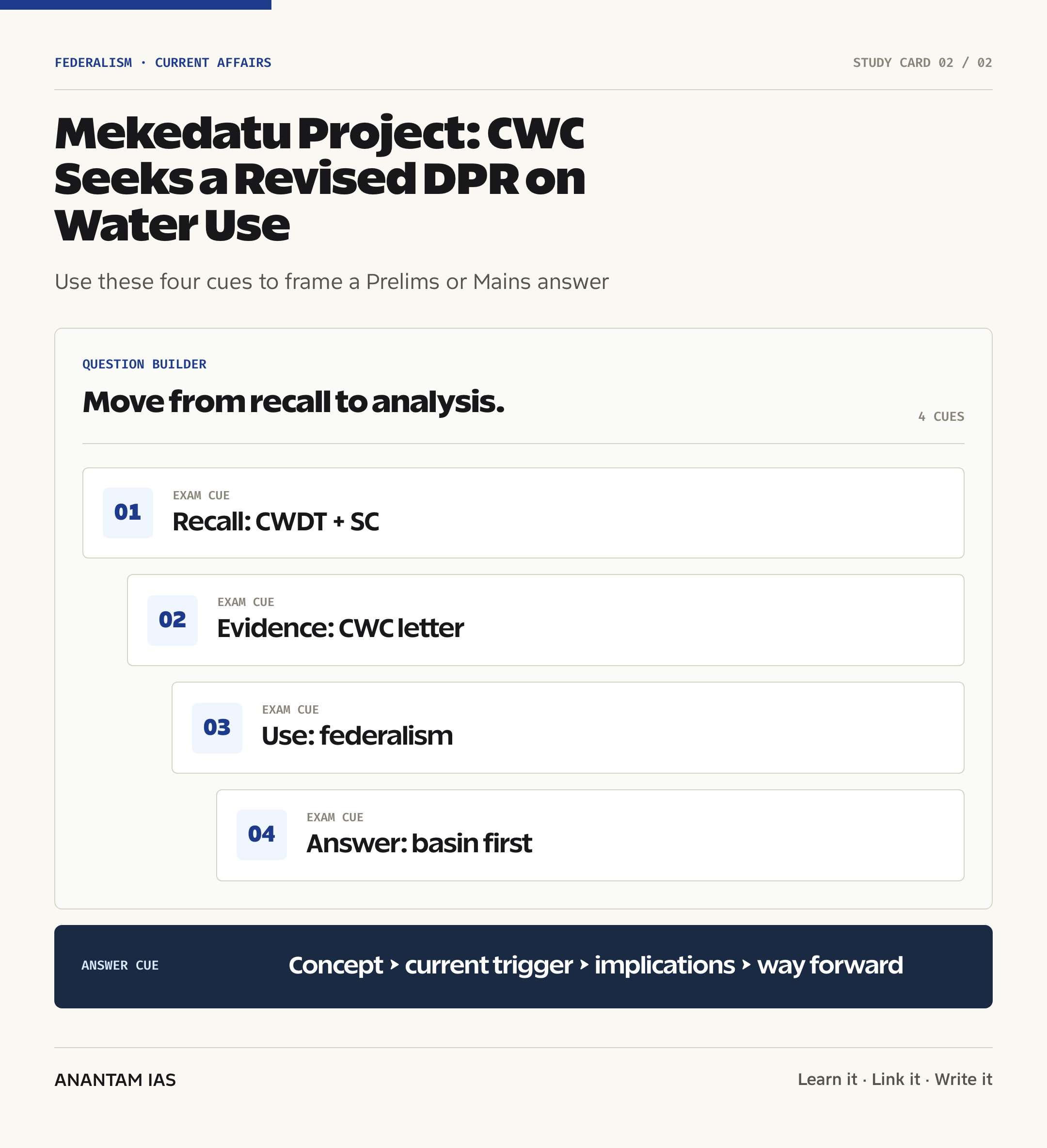
- Map the governance chain as CWDT and Supreme Court allocation → CWMA and CWRC implementation → CWC technical appraisal.
- Present the competing values fairly: Bengaluru’s drinking-water need, Tamil Nadu’s scheduled releases, ecological integrity and predictable project clearance.
- Use the 2025 Supreme Court order to show that expert review and judicial remedies can coexist without the Court becoming the first-instance hydrological assessor.
- End with basin-wide data, transparent water accounting, rule-based reservoir operation and a time-bound federal consultation mechanism.
Way Forward
Revise the DPR Around an Auditable Water Balance
- Karnataka should state existing withdrawals, actual consumptive use, treated return flows and the precise additional demand attributable to the project.
- The revised document should publish the assumptions behind 59.46 tmcft live storage, including evaporation, sedimentation, dependable yield and seasonal operating levels.
- Normal, surplus and distress-year simulations should demonstrate compliance with downstream deliveries at Biligundlu.
Make Basin Institutions Data-Rich
- The CWMA and CWRC should receive near-real-time reservoir, rainfall, release, withdrawal and return-flow data through a common basin dashboard.
- Independent technical review and reasoned minutes can reduce suspicion that project appraisal is driven by political pressure.
- A public summary should explain which objections were accepted, rejected or converted into operating conditions.
Tie Approval to Enforceable Operation
- Any favourable appraisal should include a reservoir-operation rule curve consistent with the CWDT Award as modified by the Supreme Court.
- Release monitoring, audit triggers and corrective directions should be specified before construction rather than negotiated during a drought.
- Hydropower dispatch and diversion-weir operation must remain subordinate to drinking-water limits and inter-State release obligations.
Assess Cumulative Social and Ecological Costs
- The appraisal should account for forest submergence, wildlife movement, downstream ecology, local livelihoods and disaster-risk implications.
- Alternatives such as Bengaluru demand management, leakage reduction, wastewater reuse and rainwater capture should be compared with new storage.
- Project design should follow a least-cost, least-conflict water-security strategy, not assume that reservoir capacity alone solves urban scarcity.
Institutionalise Cooperative Federalism
- Karnataka, Tamil Nadu, Kerala, Puducherry and the Union should use a structured technical forum before disputes harden into emergency litigation.
- Consultation need not create an unlimited veto, but it must give every riparian access to data and a meaningful opportunity to test project assumptions.
- A basin-first approach can convert compliance from a zero-sum State contest into a shared commitment to predictable water security.
Conclusion
The CWC’s call for a revised Mekedatu DPR is a reminder that a large dam proposal must prove its water claim before its engineering promise can be accepted. Consumptive use, live storage and downstream releases are linked parts of one basin account.
The durable solution lies in cooperative, rule-bound federalism: Karnataka’s development needs deserve serious appraisal, while Tamil Nadu and Puducherry’s adjudicated flows require measurable protection. Transparent expert review can reconcile the two more effectively than slogans or recurring crisis litigation.
UPSC Practice Questions
Prelims MCQ 1
With reference to the institutional framework for the Cauvery river, consider the following statements:
- The Cauvery Water Management Authority was created under the Cauvery Water Management Scheme notified by the Union government.
- Permission to prepare a Detailed Project Report is equivalent to final permission to construct a dam.
- Biligundlu is used as an inter-State measuring point for Cauvery releases towards Tamil Nadu.
How many of the above statements are correct?
(a) Only one (b) Only two (c) All three (d) None
Answer: (b) Only two
Explanation:
Statements 1 and 3 are correct. The Union notified the Cauvery Water Management Scheme in 2018, and Biligundlu is a key measuring point. Statement 2 is incorrect because DPR preparation or revision is an appraisal stage, not construction approval.
Prelims MCQ 2
Which one of the following best describes consumptive use of water?
(a) Total water released from a reservoir in a year (b) Water withdrawn and not promptly returned to the same water system (c) Gross storage between the riverbed and dam crest (d) Water reserved only for hydroelectric generation
Answer: (b) Water withdrawn and not promptly returned to the same water system
Explanation:
Consumptive use covers the part of a withdrawal lost to evaporation, incorporation or other processes and not promptly returned. It differs from total withdrawal, live storage and non-consumptive hydropower use.
UPSC Mains Questions
- The Mekedatu project shows that inter-State river governance is not merely a question of engineering feasibility. Examine how adjudicated allocations, technical appraisal, basin institutions and transparent water accounting can reconcile urban drinking-water needs with downstream rights.
- Differentiate between permission to prepare a Detailed Project Report and final project approval in the context of inter-State rivers. Discuss how the CWC, CWMA and CWRC together can strengthen cooperative federalism in the Cauvery basin.
Sources: Supreme Court of India and The Hindu.
Frequently Asked Questions
What is the Mekedatu project?
It is Karnataka’s proposed balancing reservoir-cum-drinking water project on the Cauvery. Its stated purposes include supplying Bengaluru-region drinking water, regulating flows and generating hydropower. Because it would store water in an inter-State basin, its design and operation must remain consistent with the Cauvery allocation and downstream-release framework.
Why did CWC seek a revised DPR?
The CWC found that the modified scheme proposed 6.95 tmcft of consumptive use, while the relevant 6.5 tmcft figure includes existing use. It also questioned the basis for the 59.46 tmcft live-storage capacity and asked for updated details that comply with the CWDT Award and CWC’s appraisal guidelines.
Has Mekedatu received construction approval?
No. The current step concerns revision and appraisal of a Detailed Project Report. The Supreme Court’s 2025 order treated Tamil Nadu’s challenge as premature because no final CWC decision had been taken. Water-resource appraisal, basin-level consideration and other statutory clearances remain necessary before construction can lawfully proceed.
What is CWMA’s role?
The Cauvery Water Management Authority implements the Cauvery allocation framework as modified by the Supreme Court. It oversees basin-level compliance, reservoir operations and releases with support from the Cauvery Water Regulation Committee. Its expert assessment is central to judging whether a project can operate without disturbing adjudicated downstream entitlements.
Why is Biligundlu important?
Biligundlu is the measuring point near the Karnataka-Tamil Nadu boundary where Cauvery flows towards Tamil Nadu are monitored. The Supreme Court’s 2025 order stressed that Karnataka remains bound by release directions under the Cauvery framework and that compliance can be measured at this control point.
Does Tamil Nadu have a veto?
The Union has said the 2018 judgment doesn’t expressly require every riparian State’s consent for any Cauvery structure. That doesn’t create a free hand for Karnataka. The project still has to comply with the adjudicated allocation, undergo expert appraisal and protect scheduled releases, while affected riparians can raise objections and pursue lawful remedies.
Tell Google you want more of this.
Add Anantam IAS as a preferred sourceOne tap, and this site shows up more often in your own Top Stories, AI Overviews and AI Mode. Remove it any time.