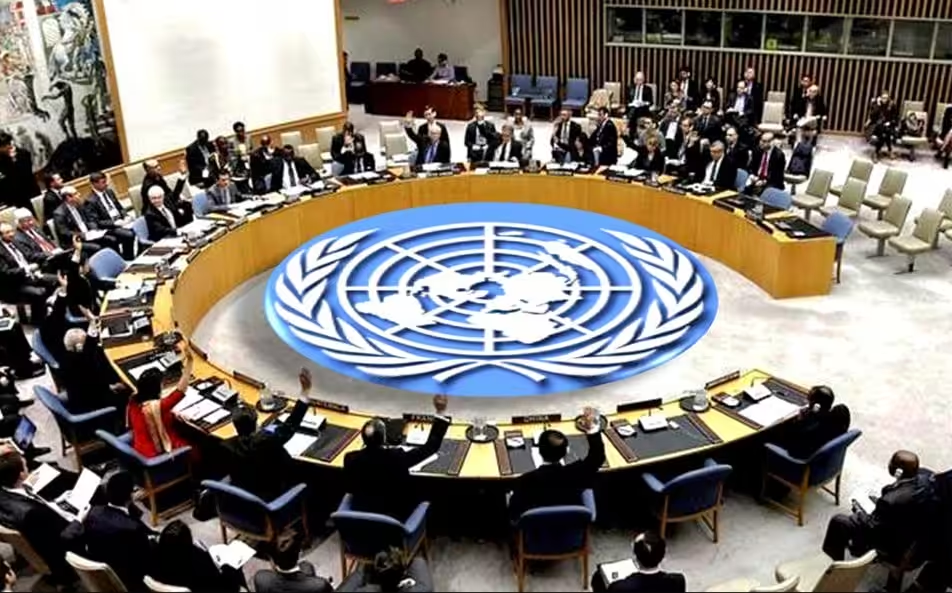
Why in News:
Raising concerns over the ongoing “humanitarian crisis” in Gaza at the United Nations Security Council, India said that a cease-fire is a “must”, as is the release of all hostages a clear shift from previous stand of India where it abstained from voting on a UNGA resolution calling for immediate ceasefire by Israel in Gaza.
UPSC relevance: GS II
- Important International institutions, agencies and fora their structure, mandate.
Prelims PYQ 2009
The Security Council of UN consists of 5 permanent members, and the remaining 10 members are elected by the General Assembly for a term of
(a) 1 year
(b) 2 years
(c) 3 years
(d) 5 years
Mandate
- All members of the United Nations agree to accept and carry out the decisions of the Security Council. While other organs of the United Nations make recommendations to member states, only the Security Council has the power to make decisions that member states are then obligated to implement under the Charter.
- Established as a principal organ of the UN under the UN Charter.
- It gives primary responsibility for maintaining international peace and security to the Security Council, which may meet whenever peace is threatened.
Functions and Powers of the UNSC
- to elect the Judges of the International Court of Justice.
- to maintain international peace and security in accordance with the principles and purposes of the United Nations;
- to investigate any dispute or situation which might lead to international friction;
- to recommend methods of adjusting such disputes or the terms of settlement;
- to formulate plans for the establishment of a system to regulate armaments;
- to determine the existence of a threat to the peace or act of aggression and to recommend what action should be taken;
- to call on Members to apply economic sanctions and other measures not involving the use of force to prevent or stop aggression;
- to take military action against an aggressor;
- to recommend the admission of new Members;
- to exercise the trusteeship functions of the United Nations in “strategic areas”;
- to recommend to the General Assembly the appointment of the Secretary-General and, together with the Assembly,
Members
A representative of each of its members must be present at all times at UN Headquarters so that the Security Council can meet at any time as the need arises.
The Council is composed of 15 Members:
- Five permanent members: China, France, Russian Federation, the United Kingdom, and the United States.
- Ten non-permanent members elected for two-year terms by the General Assembly (with end of term year):
Provisions of the Veto Power:
- Abstention vs. Veto: A permanent member’s abstention from a vote does not block a resolution from being passed, allowing it to pass if it receives the required nine affirmative votes from other members.
- ‘Concurring Votes’ of Permanent Members: Article 27(3) mandates that for non-procedural matters, the affirmative vote of nine members must include the “concurring votes” of the permanent members. This means that if any of the five permanent members vote against a resolution, it cannot be adopted, effectively blocking it.
- Substantive vs. Procedural Matters: Decisions on procedural matters only require an affirmative vote of any nine members, without the requirement of permanent member concurrence while the non procedural or substantive matters require concurring votes.
- No Formal Veto in Charter: Although commonly referred to as the “veto power,” the term “veto” is not explicitly mentioned in the UN Charter. Instead, the power is derived from the requirement of “concurring votes” of the permanent members. Due to this requirement, the veto power is also known as the ‘Great Power Unanimity’ Principle’ or the ‘great power veto’.
Challenges faced by UNSC today as the rules based liberal world order crumbles:
- Veto Power and P5 Dominance: The veto power held by the five permanent members (P5) can obstruct action, especially when a P5 member is involved in a conflict or supports a party to it, leading to paralysis and questions about the Council’s impartiality.
- Internal Divisions and Geopolitical Rivalries: Disagreements among member states, driven by national interests and geopolitical rivalries, hamper the Council’s ability to act decisively and promptly. Global issues like the COVID-19 pandemic and ongoing conflicts have highlighted instances where a lack of unity among nations undermines the promise of collective action.
- Erosion of Legitimacy: The perceived double standards and uneven application of the veto can weaken public confidence in the UNSC and the broader UN system.
- Evolving Threats to Global Security: The UNSC must adapt to a wide range of contemporary challenges, including climate change, pandemics, terrorism, transnational organized crime, and the implications of new technologies like artificial intelligence.
- Capability-Expectations Gap: There’s often a mismatch betweenwhat the UNSC isexpected to achieve and the resources or political will available to support its mandates, particularly in areas like peacekeeping and conflict prevention.
India’s stand on UNSC reforms:
Addressing Veto Power: While India’s exact position on the veto is flexible, it acknowledges the need to address the veto power in a reformed Council and has shown willingness to engage in discussions on its future scope and limits.
- Urgent and Time-Bound Reform: India has consistently called for concrete, early, and time-bound reforms to the UNSC, emphasizing the need for progress beyond just discussions.
- India is actively engaged in discussions and negotiations, both bilaterally and multilaterally, including through its membership in the G4 nations (India, Japan, Brazil, Germany) and the L.69 Group of developing countries, to achieve these reforms.
- Expansion of Membership: India strongly supports expanding both permanent and non-permanent categories of membership to reflect contemporary global realities and ensure equitable representation, particularly for underrepresented regions.
- Permanent Membership for India: A central pillar of India’s position is its bid for permanent membership in the UNSC, arguing it possesses the credentials and contributions to merit such a role.
- Opposition to Religious-based Seats: India, along with other G4 nations, opposes proposals to introduce new parameters like religious affiliation for new permanent seats, advocating for a democratic and inclusive election process for new members.
- Emphasis on Text-Based Negotiations: India pushes for moving from general statements to text-based negotiations with clearly defined timelines and milestones to facilitate concrete progress on UNSC reforms.
Consider the following statements about the United Nations Security Council:
- The United Nations Security Council has 15 members, out of which five are permanent members.
- Its sessions are held only in New York.
- The presidency of the Security Council changes every month.
How many of the above statements are incorrect?
(A) Only one
(B) Only two
(C) All three
(D) None of these
Tell Google you want more of this.
Add Anantam IAS as a preferred sourceOne tap, and this site shows up more often in your own Top Stories, AI Overviews and AI Mode. Remove it any time.