Why in News?
US President Donald Trump announced on July 30, 2026 that the Board of Peace had reached what he called an agreement for the complete disarmament of Hamas and other armed groups in Gaza. The Hindu reported the announcement, while Associated Press noted that neither Hamas nor Israel immediately issued an unambiguous public confirmation accepting the announced terms.
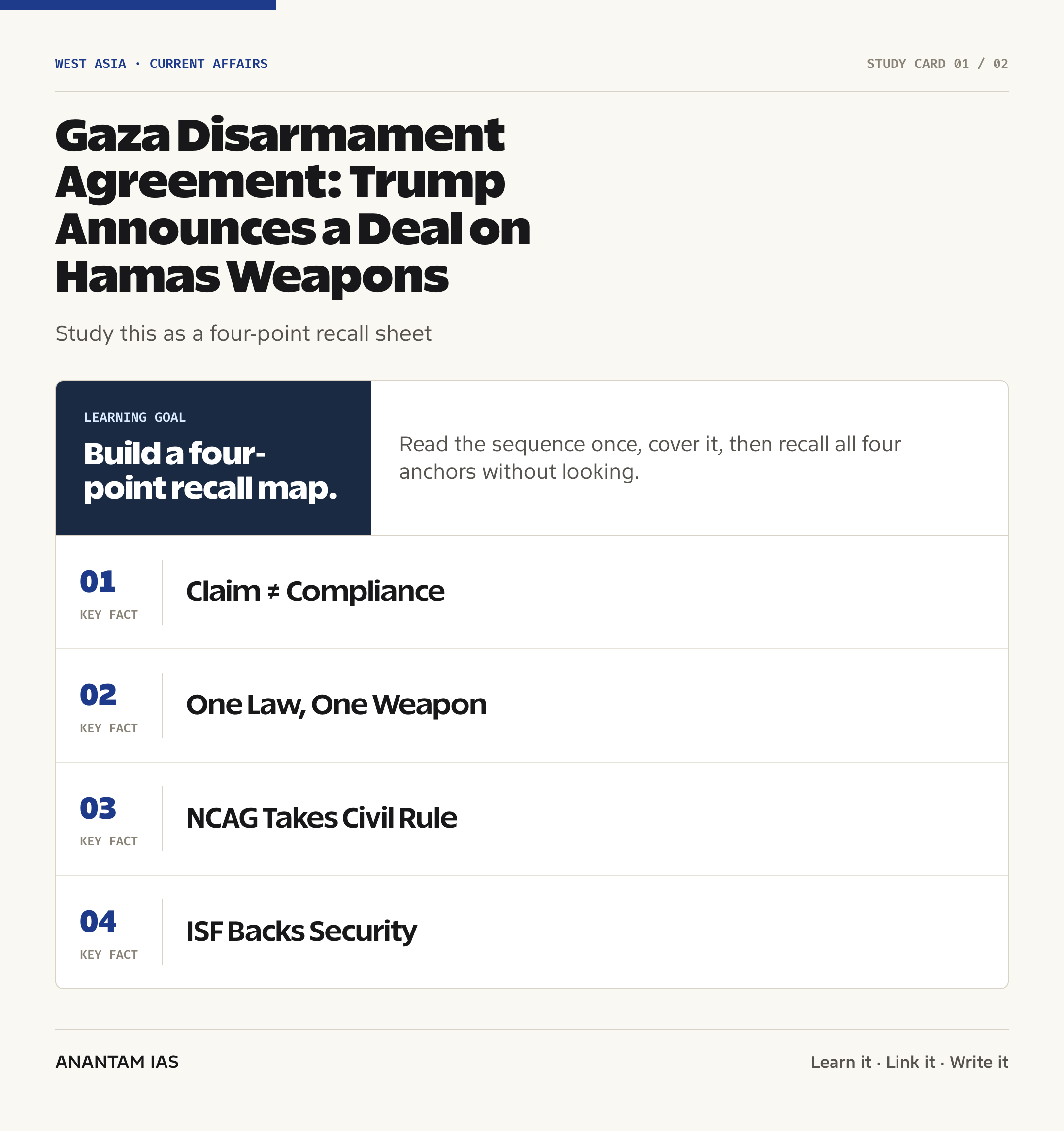
Trump said implementation would proceed in phases: weapons would be surrendered and military infrastructure dismantled; Israeli forces would withdraw as verified disarmament advanced; and an International Stabilization Force (ISF) would support a new Palestinian police force and a technocratic administration. The central exam point is the gap between a political announcement and verified implementation: no complete public text, agreed timetable or independently tested compliance mechanism was immediately available.
- The announcement covers Hamas and other armed groups, making the proposal broader than a weapons handover by one organisation.
- US and Board of Peace officials described a staged process, with police weapons expected to move first and heavy weapons, tunnels and military infrastructure addressed later.
- The proposed governance beneficiary is the National Committee for the Administration of Gaza (NCAG), a Palestinian technocratic body intended to take civilian and security responsibility.
- The ISF is expected to support weapons custody, train vetted Palestinian police, protect humanitarian operations and separate Palestinian-administered areas from Israeli forces.
- Israeli withdrawal and reconstruction are presented as reciprocal steps tied to verified decommissioning, not as unconditional or simultaneous events.
- The early reporting established an announced framework, not proof that weapons had been surrendered, tunnels dismantled or Israeli forces withdrawn.
The development matters in the context of:
- The development matters because Gaza’s transition requires three linked shifts: military disarmament, civilian-governance transfer and territorial withdrawal. Failure in one can stall the others.
- It tests whether an internationally backed arrangement can create a legitimate monopoly over the use of force without deepening insecurity for civilians or excluding Palestinian political ownership.
- Humanitarian access and reconstruction depend on predictable security, but they should not become rewards withheld from civilians for the conduct of armed actors.
- For India, the issue affects West Asian stability, energy and shipping security, diaspora welfare and New Delhi’s support for a negotiated two-state solution.
UPSC Relevance
Prelims Relevance
- UN Security Council Resolution 2803 (2025) endorsed the Comprehensive Plan to End the Gaza Conflict and provided the international framework for transitional governance and security arrangements.
- The Board of Peace is the transitional oversight body referenced in the Gaza framework; it is distinct from a standing organ of the United Nations.
- The NCAG is a Palestinian technocratic administration intended to handle day-to-day civilian governance in Gaza during the transition.
- The ISF is a temporary international security mechanism envisaged to support demilitarisation, protect humanitarian operations and train Palestinian police.
- Disarmament means reducing or surrendering weapons; demobilisation concerns the formal release of personnel from armed formations; reintegration helps former combatants return to civilian life.
- Decommissioning is narrower and verifiable: collecting, documenting, disabling or destroying weapons and military infrastructure through an agreed chain of custody.
- A ceasefire suspends fighting, while a peace settlement must address governance, security, rights, accountability, reconstruction and political status.
- Under the proposed sequence, Israeli withdrawal is linked to verified progress in decommissioning, while reconstruction begins in areas certified as demilitarised.
- The principle of one authority, one law and one weapon seeks to prevent parallel armed command structures under the transitional administration.
- The Gaza framework should be studied with the powers and limits of the UN Security Council, including the difference between political endorsement and operational enforcement.
Mains Relevance
GS Paper 2
- Examine how internationally supervised transitional governance can move a territory from ceasefire to legitimate civilian administration.
- Assess the role and limits of the UNSC, Board of Peace, mediating States and Palestinian institutions in creating an implementable settlement.
- Discuss India’s interests through its two-state position, humanitarian diplomacy, Gulf partnerships, Israel ties and strategic autonomy.
GS Paper 3
- Use the case to explain disarmament, demobilisation and reintegration as distinct but connected post-conflict security tasks.
- Analyse verification problems involving hidden stockpiles, tunnel networks, fragmented armed groups and chain-of-custody records.
- Connect security-sector reform with policing legitimacy, humanitarian protection and the prevention of renewed armed mobilisation.
Essay
- A ceasefire becomes peace only when institutions replace armed uncertainty with legitimate, accountable authority.
- Verification can turn reciprocal promises into trust, but it cannot substitute for political consent and justice.
- Post-conflict reconstruction is not only the rebuilding of structures; it is the rebuilding of public legitimacy.
Background and Context
From Ceasefire to the Disarmament Question
The announced agreement addresses the hardest unresolved part of Gaza’s post-ceasefire transition.
- The Gaza conflict followed the Hamas-led attacks of October 7, 2023 and Israel’s subsequent military campaign, which caused mass civilian death, displacement and destruction.
- A US-brokered ceasefire based on the 20-point Comprehensive Plan took effect in October 2025, opening a phased process involving hostage return, Israeli redeployment, humanitarian relief and post-war governance.
- The first phase produced major hostage-related steps, but the second phase stalled over Hamas’s weapons, Israeli withdrawal, Gaza governance and reconstruction.
- In July 2026, Hamas announced that it had dissolved its Gaza government and would transfer civil functions to the NCAG. That earlier move, explained in Anantam IAS’s note on the Gaza governance transition, did not itself settle the weapons issue.
- Trump’s new announcement claims movement from a civil-administration handover to a security transition, but implementation evidence must be assessed separately.
- For analytical clarity, students should mark the status of each step as announced, formally accepted, operationally started or independently verified. Political statements often collapse these separate stages into one headline.
What the UN-Backed Roadmap Requires
The durable architecture predates the latest announcement and supplies the criteria by which the claim can be tested.
- The UN report on implementing Resolution 2803 records a 15-point roadmap developed by the guarantors and the High Representative for Gaza.
- It makes the NCAG the sole legitimate transitional authority for civilian governance and security, while armed factions are to hold no direct or indirect governing role.
- The core security obligation is the complete decommissioning of weapons and dismantling of military infrastructure under international verification.
- The process is reciprocal and phased: certified decommissioning unlocks corresponding Israeli withdrawal, ISF deployment, civilian authority and reconstruction.
- This sequence reduces the risk of a security vacuum, but it can also deadlock if either side disputes verification, delays its reciprocal step or changes the conditions after compliance begins.
- For UPSC answers, distinguish the roadmap, which describes the intended mechanism, from the new political announcement, which claims agreement on applying it.
- A Security Council-backed framework supplies international authority, but it does not execute itself. Consent, personnel, finance, access and enforcement capacity determine whether its institutions work on the ground.
Disarmament Is a Verification Problem
Weapons removal succeeds only when every side trusts the scope, sequence, evidence and custody process.
- A credible mechanism must define which items count as personal arms, heavy weapons, explosives, rockets, production equipment and dual-use material.
- It must record who declares stockpiles, who receives them, where they are stored, how they are disabled and who certifies destruction.
- Gaza’s tunnel network adds a distinct problem: decommissioning underground infrastructure requires mapping, access, engineering inspection and protection against reactivation.
- The framework covers other armed groups, including Palestinian Islamic Jihad, so Hamas alone cannot guarantee complete territorial compliance.
- Independent monitors need access, common reporting standards, dispute-resolution rules and the authority to identify both non-compliance and an unfulfilled reciprocal obligation.
- A declaration without a baseline inventory can produce impressive percentage claims that are impossible to audit. The better measure is verified capability removed, not weapons ceremonially displayed.
- The agreement must also settle whether individual small arms are surrendered, registered or retained temporarily. An unresolved category can preserve coercive capacity even after highly visible heavy weapons are removed.
Security Transition and Palestinian Governance
Removing an armed structure without establishing trusted security can create a vacuum rather than stability.
- The NCAG is intended to provide a technocratic bridge for services and administration, but a committee requires local access, revenue, personnel and public acceptance to govern beyond paper.
- The ISF’s proposed functions include supporting weapons custody, training a vetted Palestinian police force and protecting aid operations.
- Police legitimacy depends on civilian oversight, representative recruitment, due process and separation from partisan armed command.
- A transition that excludes the Palestinian Authority and wider Palestinian political process may manage services without resolving the question of national political representation.
- Former rank-and-file combatants need lawful pathways into civilian life. Without demobilisation and reintegration, networks may retain coercive power or regroup under new names.
- International security support should be temporary, clearly mandated and accountable. An open-ended external presence can weaken the local legitimacy it is meant to build.
- Security-sector reform should include complaints bodies, judicial review, payroll controls and a unified command. These safeguards prevent a new police service from becoming another factional force.
Humanitarian Relief, Rights and Reconstruction
Security sequencing must protect civilians while negotiations and verification continue.
- Gaza’s population needs sustained access to food, medicine, shelter, water, sanitation and health care irrespective of political delays.
- The ISF and new police will be judged partly by whether they protect humanitarian corridors and prevent diversion without creating inaccessible or coercive aid systems.
- Reconstruction should follow transparent land, procurement and beneficiary rules so that security certification does not become a tool for collective punishment or forced displacement.
- Civilian protection obligations under international humanitarian law continue during a ceasefire and transition; political agreements do not erase them.
- Rebuilding hospitals, schools, utilities and homes must accompany institutional reconstruction, including courts, municipal services and accountable financial administration.
- The political horizon remains essential: technocratic administration can manage a transition, but it cannot replace a credible path towards Palestinian self-determination and a negotiated two-state solution.
- Debris clearance and unexploded-ordnance removal are early security tasks, not secondary construction matters. Safe return, schooling and hospital repair depend on surveying, marking and clearing hazardous areas.
India's Interests and Diplomatic Space
India has reasons to support a stable transition while avoiding uncritical endorsement of an unverified announcement.
- India supports a sovereign, independent and viable Palestinian State living alongside Israel within secure and recognised borders through direct negotiations.
- New Delhi also has deep ties with Israel in defence, agriculture and technology, alongside major energy, trade and diaspora interests across the Arab Gulf.
- A stable Gaza can reduce escalation risks affecting the Red Sea, Suez-linked trade, energy prices and Indian workers across West Asia.
- India can contribute through humanitarian supplies, hospital and prosthetic support, digital public infrastructure for service delivery and training for civilian administrators when requested through a legitimate framework.
- It should press for verified reciprocity: weapons decommissioning, Israeli withdrawal, civilian protection, humanitarian access and reconstruction must all be tracked rather than selectively enforced.
- Students can connect the issue with India’s wider West Asia policy, where de-hyphenated partnerships coexist with support for Palestinian statehood.
- A balanced Indian response should welcome credible de-escalation without treating an unverified claim as a completed peace. That posture protects strategic autonomy and diplomatic credibility.
How to Build a Mains Answer
A strong answer separates the fresh claim from the institutional mechanism and the conditions for success.
- Open with the latest fact: Trump announced a phased disarmament agreement, but independent confirmation and implementation evidence remained incomplete at the time of reporting.
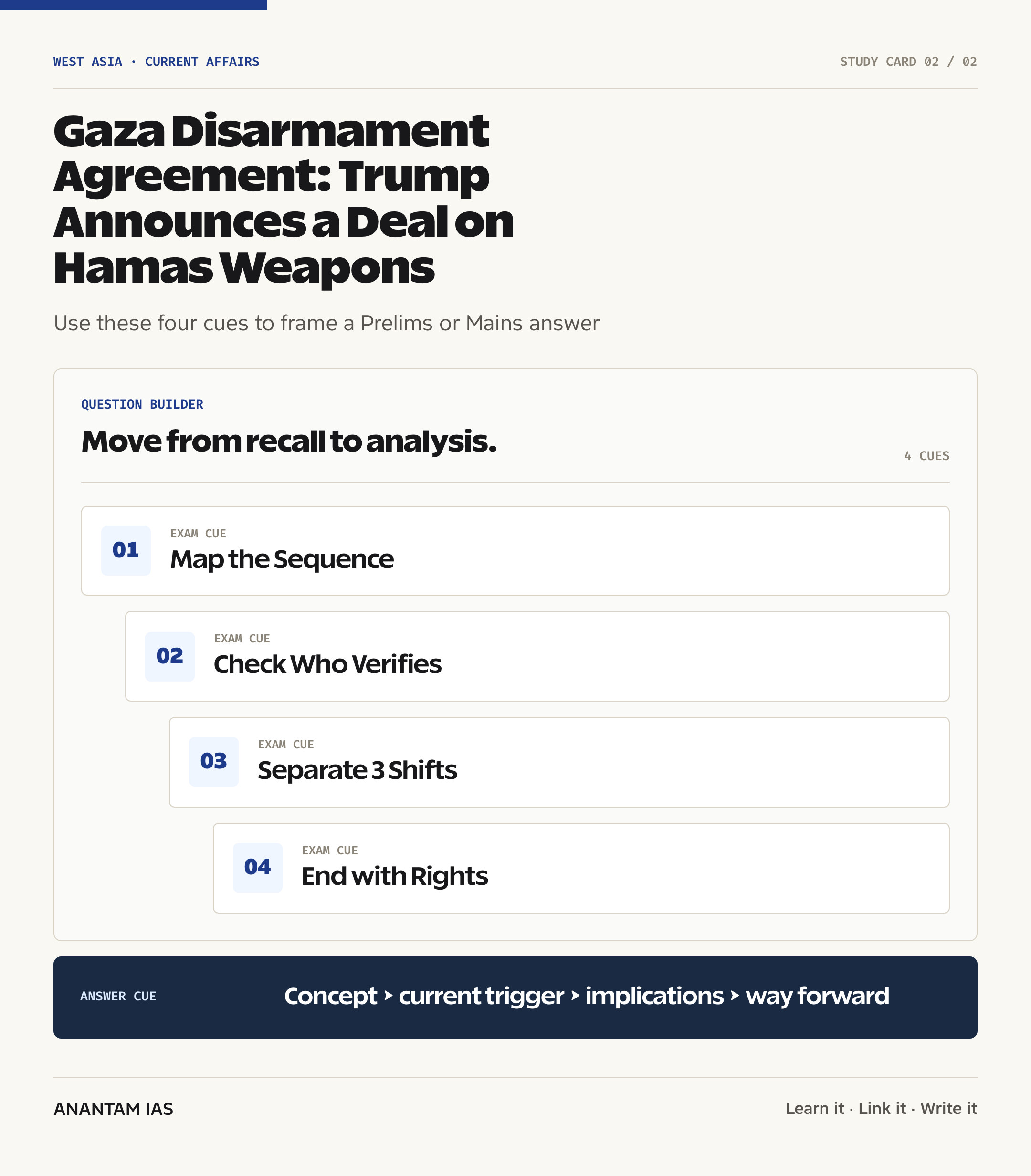
- Draw the sequence as weapons declaration → verified custody and destruction → ISF and police deployment → Israeli withdrawal → NCAG governance → reconstruction.
- Add three tests: who verifies compliance, how reciprocal failures are resolved and how civilians are protected during delay.
- Balance the opportunity of ending parallel armed authority against the risks of a security vacuum, externally imposed governance and conditional humanitarian access.
- Close with a rights-based political horizon, Palestinian ownership, accountable institutions and India’s support for stability with a two-state settlement.
Way Forward
Publish and Clarify the Agreement
- The parties and mediators should release an agreed public summary defining scope, timelines, reciprocal steps and verification authority.
- Public confirmation from Hamas, Israel, the NCAG and guarantor States would reduce the gap between an announcement and a shared commitment.
- Technical annexes should distinguish immediate police-weapons transfer from later treatment of heavy weapons, production capacity and tunnels.
- Rules should cover safe surrender points, treatment of former fighters, prohibited reprisals and consequences for concealed weapons so compliance carries predictable legal outcomes.
Create Independent Verification
- A multi-party mechanism should maintain weapon inventories, chain-of-custody records, inspection reports and time-stamped certification.
- The mechanism should report both Palestinian decommissioning and Israeli reciprocal compliance, including withdrawal and protection of humanitarian access.
- Disputes should go to a time-bound review panel so one contested inspection does not freeze the whole transition.
Prevent a Security Vacuum
- The ISF, NCAG and Palestinian police should deploy in matched stages before existing coercive structures disappear from an area.
- Police recruitment, training and command should follow human-rights standards and civilian oversight.
- A funded reintegration programme should offer lawful livelihoods and psychosocial support to eligible former combatants while serious crimes remain subject to due process.
- Vetting should use published criteria and an appeal process. Collective exclusion based on past civil employment could weaken services and push skilled personnel outside the new security order.
Protect Civilians During Sequencing
- Humanitarian aid should continue on the basis of need and remain insulated from tactical bargaining.
- Every transition zone needs safeguards against forced displacement, arbitrary detention, property seizure and collective penalties.
- Reconstruction contracts and land decisions should be transparent, independently audited and accessible to affected Palestinian communities.
Restore a Political Horizon
- The technocratic transition should connect to legitimate Palestinian institutions and a credible timetable for representative governance.
- Regional mediators should link short-term security arrangements to negotiations on the two-state solution, not treat Gaza as a permanently separate administrative problem.
- India should support humanitarian recovery, institution-building and consistent compliance with international law while retaining dialogue with all relevant partners.
Conclusion
Trump’s announcement is potentially important because it claims progress on the clause that had blocked Gaza’s transition: the future of Hamas’s weapons and armed infrastructure. But an announced agreement is not disarmament. The decisive evidence will be verified custody of weapons, dismantling of military capability, reciprocal Israeli withdrawal and the NCAG’s ability to govern.
A durable settlement must combine security, civilian protection, Palestinian political ownership and reconstruction. If verification applies evenly and humanitarian access remains protected, phased implementation can reduce the risk of renewed war. If the process becomes selective, opaque or externally imposed, the same sequence may reproduce mistrust under a new institutional label.
UPSC Practice Questions
Prelims MCQ 1
With reference to the proposed Gaza transition framework, consider the following statements:
- The National Committee for the Administration of Gaza is intended to exercise transitional civilian governance.
- The International Stabilization Force is envisaged as a permanent standing organ of the United Nations.
- The roadmap links verified weapons decommissioning with phased Israeli withdrawal and reconstruction.
How many of the above statements are correct?
(a) Only one (b) Only two (c) All three (d) None
Answer: (b) Only two
Explanation:
Statements 1 and 3 are correct. The NCAG is the proposed technocratic transitional authority, and the roadmap sequences decommissioning with reciprocal withdrawal and reconstruction. Statement 2 is incorrect because the ISF is a temporary Gaza-specific mechanism, not a permanent UN organ.
Prelims MCQ 2
Which one of the following best distinguishes decommissioning from demobilisation in a post-conflict process?
(a) Decommissioning concerns weapons and military infrastructure, while demobilisation concerns releasing personnel from armed formations. (b) Decommissioning creates a new constitution, while demobilisation supervises elections. (c) Decommissioning is limited to ceasefire monitoring, while demobilisation concerns humanitarian aid. (d) Decommissioning applies only to States, while demobilisation applies only to international forces.
Answer: (a) Decommissioning concerns weapons and military infrastructure, while demobilisation concerns releasing personnel from armed formations.
Explanation:
Decommissioning documents, collects, disables or destroys weapons and military infrastructure. Demobilisation formally separates personnel from armed units; reintegration then supports their return to civilian life.
UPSC Mains Questions
- An announced disarmament agreement becomes credible only when its scope, verification and reciprocal obligations are clear. Examine the institutional challenges in moving Gaza from ceasefire to a legitimate security and governance order under the proposed phased framework.
- Post-conflict disarmament cannot be separated from civilian protection, political legitimacy and reconstruction. Discuss with reference to the roles envisaged for the NCAG, International Stabilization Force, Palestinian police and international guarantors in Gaza.
- India’s West Asia policy requires simultaneous engagement with Israel, Palestine and Arab partners. Analyse how a verified Gaza transition could affect India’s diplomatic position, maritime and energy interests, diaspora welfare and support for a two-state solution.
Sources: United Nations, Report S/2026/418 and The Hindu.
Frequently Asked Questions
What did Trump announce on Gaza?
President Donald Trump said the Board of Peace had reached an agreement for the complete disarmament of Hamas and other armed groups in Gaza. He described a phased process linked to Israeli withdrawal, international security support and technocratic Palestinian governance. Early reporting did not yet establish full public confirmation or completed implementation.
Has Hamas already surrendered its weapons?
No. The announcement described an intended process, not a completed weapons handover. At the time of the first reports, no independently verified inventory, chain-of-custody record or proof of destroyed heavy weapons and tunnels had been published. Implementation and reciprocal steps remain the real test.
What is the NCAG?
The National Committee for the Administration of Gaza is a Palestinian technocratic body intended to manage civilian services and transitional governance. The UN-backed roadmap treats it as the sole legitimate transitional authority, but practical authority depends on access to Gaza, functioning institutions, reliable finance and public acceptance.
What will the stabilization force do?
The International Stabilization Force is envisaged as a temporary security mechanism. Its proposed tasks include supporting weapons custody, protecting humanitarian operations, helping train vetted Palestinian police and deploying between Palestinian-administered areas and Israeli forces as decommissioning and withdrawal proceed.
Why is verification difficult in Gaza?
Verification must cover dispersed stockpiles, rockets, explosives, production equipment, tunnels and weapons held by several armed groups. Inspectors need access, a baseline inventory, chain-of-custody records and a dispute process. They must also track reciprocal obligations such as Israeli withdrawal and protected humanitarian access.
Why does the agreement matter for India?
A durable Gaza transition could reduce risks to West Asian stability, Red Sea-linked trade, energy prices and Indian workers in the region. India also has diplomatic space to support humanitarian recovery, Palestinian statehood, ties with Israel and Arab partners, and consistent implementation of international law.
Tell Google you want more of this.
Add Anantam IAS as a preferred sourceOne tap, and this site shows up more often in your own Top Stories, AI Overviews and AI Mode. Remove it any time.