Context:
India’s trade deficit (the gap between imports and exports) widened sharply by 93% in September 2025, as imports rose faster than exports. The total trade deficit reached $16.6 billion, compared to $8.6 billion in September 2024.
UPSC Relevance:
Balance of payment(Economy)
UPSC PYQ:
Q1. Consider the following actions which the Government can take: (2011)
- Devaluing the domestic currency.
- Reduction in the export subsidy.
- Adopting suitable policies which attract greater FDI and more funds from FIIs.
Which of the above action/actions can help in reducing the current account deficit?
(a) 1 and 2
(b) 2 and 3
(c) 3 only
(d) 1 and 3
Sectoral Performance:
1. Merchandise Trade (Goods):
- Exports: Rose 3.02% to $220.12 billion.
- Imports: Rose 4.53% to $375.11 billion.
- Despite U.S. tariffs (50%) on Indian goods, exports to the U.S. grew 6.7% to $36.4 billion.
2. Services Trade:
- Exports: Fell 5.5% to $30.8 billion in September.
- Reason: Weak global demand in IT, consulting, and financial services.
- Cumulative (April–Sept): Exports grew 6.12% to $193.18 billion, while imports stayed almost flat.
Balance of Payment:
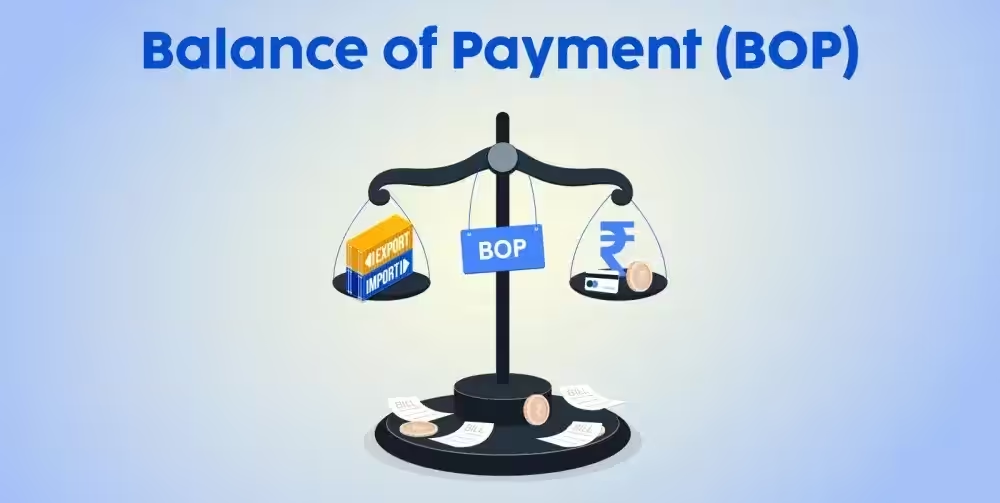
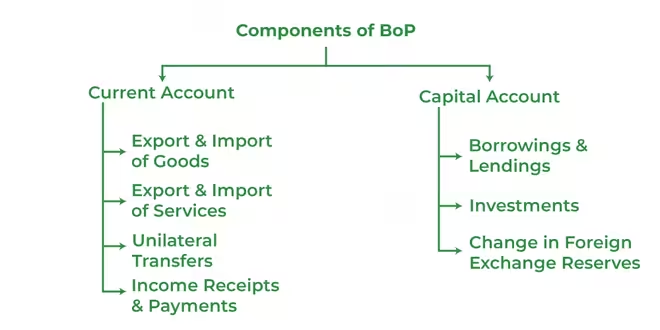
Balance of Payments (BoP) statistics systematically summaries the economic transactions of an economy with the rest of the World (i.e.transactions between resident & non resident entities) during a given period. It comprises of current and capital & financial accounts.
Reason Behind Trade Deficit:
- High Import
- Role of global market dynamics: In recent times, India has seen a drop in the exports of these articles, causing a trade deficit in the Indian economy.
- Impact of exchange rates: Changes in the exchange rate of a country can also cause a trade deficit.
Impact:
- Effects on employment: trade deficit on the economy is the effect on employment.
- Influence on currency value: When a country faces a constant trade deficit it leads to a fiscal deficit which requires the country to attract more foreign investment than usual. As a result, it causes currency inflation, which leads to a dip in currency value.
- Implications for economic growth: A temporary trade deficit may bring positive outcomes such as increased foreign investment, increased customer satisfaction and higher international spending in the country. On the other hand, a long-term trade deficit can lead to a loss of economy, loss of jobs, and increased outflow in comparison to inflow.
Tell Google you want more of this.
Add Anantam IAS as a preferred sourceOne tap, and this site shows up more often in your own Top Stories, AI Overviews and AI Mode. Remove it any time.