Introduction
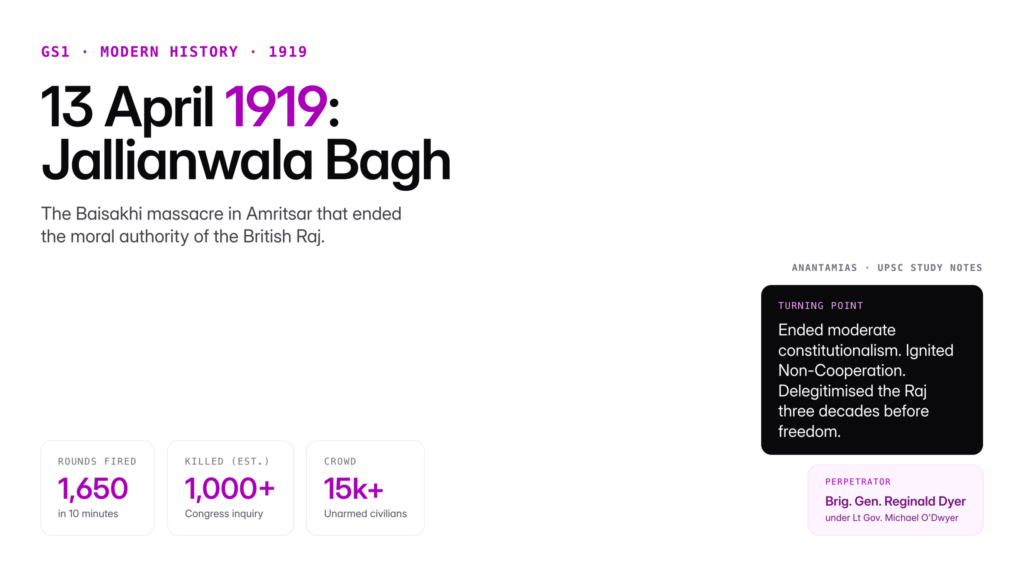
On the afternoon of 13 April 1919, a peaceful Baisakhi gathering inside a walled garden in Amritsar turned into one of the darkest chapters of British rule in India. Brigadier General Reginald Dyer marched a detachment of fifty riflemen into Jallianwala Bagh, sealed the only narrow exit, and ordered ten minutes of continuous fire on an unarmed crowd of men, women and children. Official British figures placed the dead at 379, but Indian estimates and later inquiries, including a 2019 Amritsar district study, push the toll well above 1,000 with over 1,500 wounded.
The massacre did not just claim lives. It shattered the moral authority of the Raj, radicalised a generation of moderates, pushed Mahatma Gandhi from reformist cooperation to full non-cooperation, and turned the name “Jallianwala Bagh” into shorthand for colonial brutality. For UPSC aspirants, 13 April 1919 is a pivot point in the Modern History syllabus — the hinge where the constitutional phase of the freedom struggle ended and the mass mobilisation phase began.
Quick Facts at a Glance
| Parameter | Detail |
|---|---|
| Date | 13 April 1919 (Baisakhi day) |
| Location | Jallianwala Bagh, Amritsar, Punjab |
| Ordered by | Brig. Gen. Reginald Edward Harry Dyer |
| Troops deployed | 50 riflemen (Gurkha and Baluchi), 40 Khukri-armed |
| Rounds fired | 1,650 |
| Duration of firing | About 10 minutes |
| Official British toll | 379 dead, 1,200 wounded |
| Indian National Congress estimate | Over 1,000 dead |
| Inquiry | Hunter Commission (1919-20) |
| Governor of Punjab | Sir Michael O’Dwyer |
| Viceroy | Lord Chelmsford |
| Immediate trigger | Protest against Rowlatt Act, arrest of Kitchlew and Satyapal |
Background and Historical Context
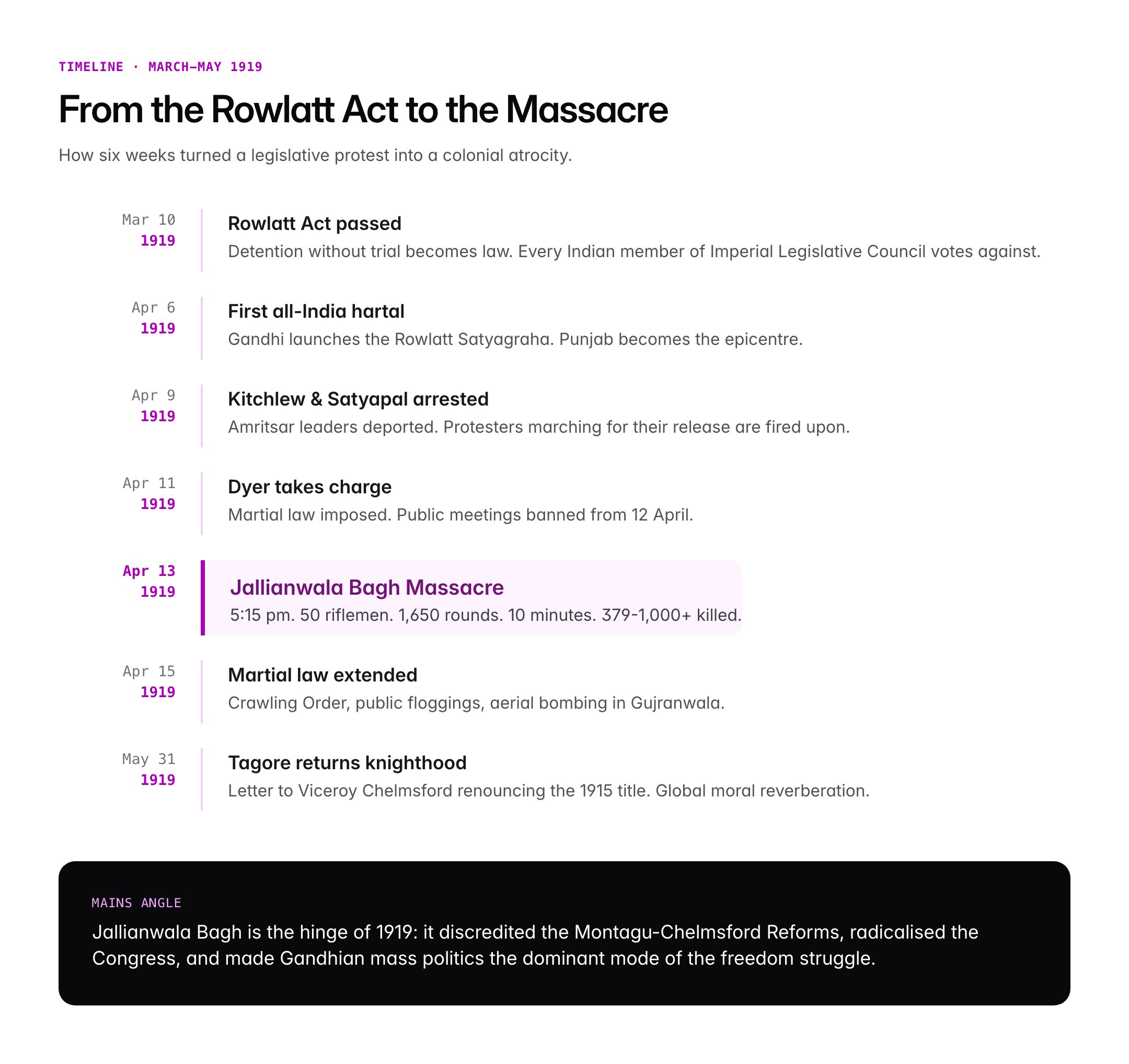
The immediate backdrop to 13 April 1919 was the Rowlatt Act, passed in March 1919 on the recommendation of the Sedition Committee chaired by Justice Sidney Rowlatt. The Act empowered the government to detain any person without trial for up to two years, suspend habeas corpus, and try political cases in camera without juries. Indian moderates and extremists alike denounced it as the “Black Act”. Every Indian member of the Imperial Legislative Council voted against it, yet it passed on the strength of official British votes.
Gandhi responded with his first all-India Satyagraha, calling for a hartal on 6 April 1919. Punjab, already bled white by First World War recruitment, crop failures and influenza, became the epicentre of protest. On 9 April, local leaders Dr Saifuddin Kitchlew and Dr Satyapal were arrested in Amritsar and deported. Crowds marching to the Deputy Commissioner’s residence to demand their release were fired upon. Violence erupted: banks were burned, a railway guard and three Europeans were killed, and a missionary, Marcella Sherwood, was assaulted.
General Reginald Dyer arrived on 11 April and took charge. On 12 April he banned all public meetings. On the morning of 13 April, the prohibition was read out in parts of the city, but reached few of the pilgrims streaming in from surrounding villages for the Baisakhi festival and the annual Amritsar horse and cattle fair. A political meeting had been called at Jallianwala Bagh, a roughly 6-7 acre open ground ringed by houses and a 10-foot brick wall with only one main narrow entrance and a few blocked or too-small exits.
The crowd that afternoon, estimated between 15,000 and 25,000, included families, farmers, devotees returning from the Golden Temple and political listeners. Around 5:15 pm, Dyer marched in with 90 soldiers (50 armed with rifles, 40 with khukris), two armoured cars that could not enter the narrow lane, and without any warning to disperse, ordered fire. When ammunition fell to about 1,650 rounds expended, he ordered ceasefire and withdrew, offering no medical aid. A curfew trapped the wounded through the night.
Key Events and Timeline
The Ten Minutes of Firing
Dyer’s troops were positioned on a raised platform. He personally directed fire at the thickest parts of the crowd and at those trying to scale the walls or escape through the narrow alleys. A well inside the Bagh, today preserved as the Martyrs’ Well, filled with 120 bodies of those who jumped in to escape bullets. Eyewitnesses testified that firing was precise and deliberate, not a panicked response.
The Crawling Order and Martial Law
Between 13 April and the end of May, Dyer and O’Dwyer imposed humiliating martial law in Punjab. In the lane where Marcella Sherwood had been attacked, Dyer issued the infamous Crawling Order: Indians using that street had to crawl on their bellies. Public floggings, dismounting orders for Indians passing Europeans, and salaaming compulsions were standard. Aerial bombing was used in Gujranwala on 14 April, killing 12.
Immediate Political Reaction
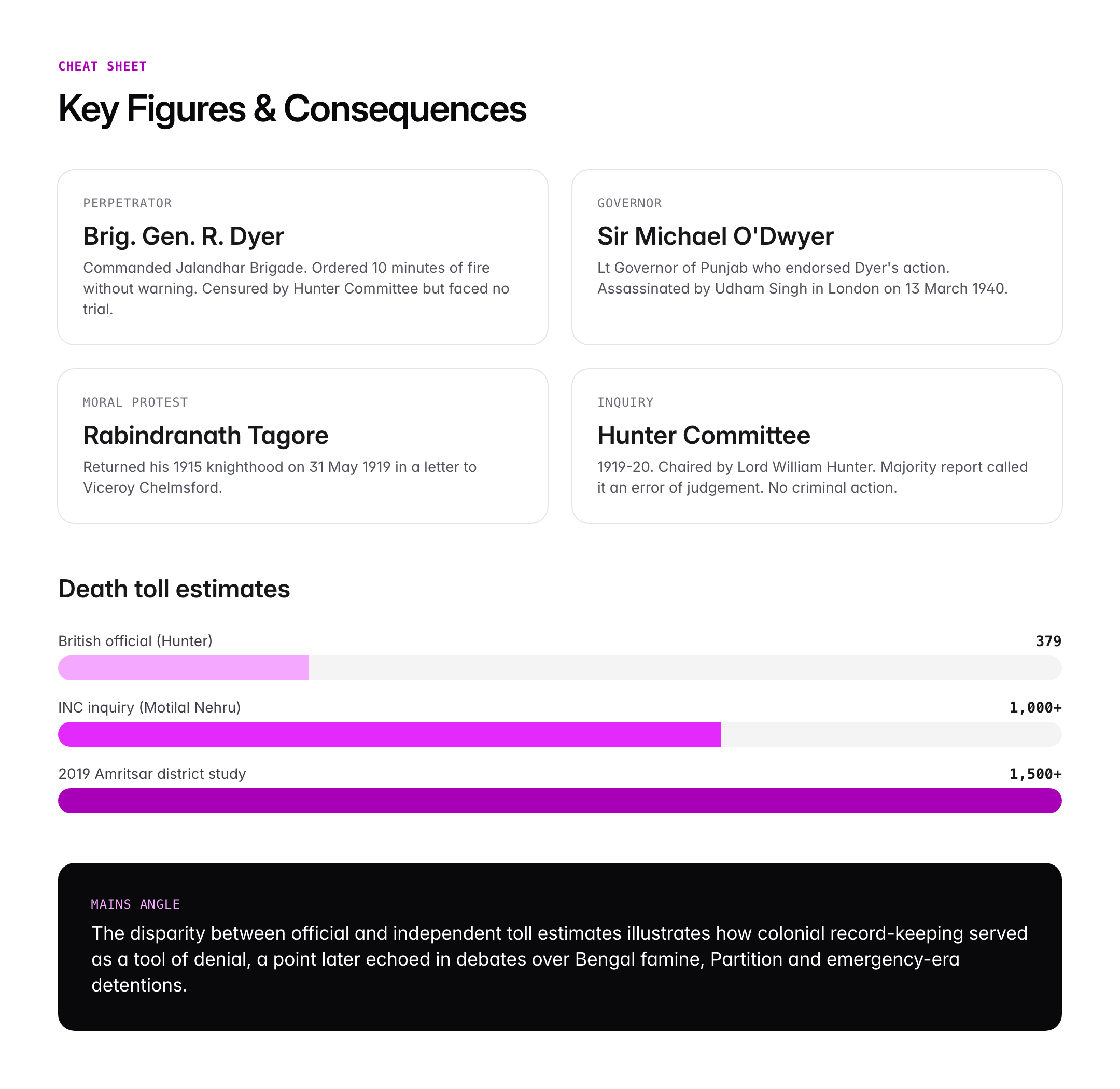
Rabindranath Tagore renounced his knighthood in a searing letter to the Viceroy on 31 May 1919. Sir Shankaran Nair resigned from the Viceroy’s Executive Council. Gandhi called off the Rowlatt Satyagraha on 18 April, admitting a “Himalayan blunder” in launching mass action without adequate training in non-violence, then began preparations for the Non-Cooperation Movement of 1920-22. Motilal Nehru and C.R. Das led the Indian National Congress inquiry, which concluded Dyer had committed a monstrous and deliberate act.
The Hunter Committee
The government-appointed Hunter Committee (Disorders Inquiry Committee), chaired by Lord William Hunter, reported in March 1920. The majority report censured Dyer for an “error of judgement” but recommended no criminal or disciplinary action. Dyer was relieved of command, retired on half-pay, and returned to Britain, where the House of Lords voted in his favour and readers of the Morning Post raised 26,000 pounds for him. He died in 1927. Udham Singh, who was present as a teenager in 1919, assassinated Michael O’Dwyer in London on 13 March 1940, twenty-one years later.
Significance for UPSC and General Knowledge
- Jallianwala Bagh is the classic Prelims and Mains anchor date for the 1919-20 turning point: Rowlatt Act, Montagu-Chelmsford Reforms, and the launch of Non-Cooperation.
- It ended the Moderate-Extremist debate by proving constitutional agitation alone could not move the Raj.
- It integrated the Khilafat question with Indian nationalism, because Punjabi Muslims, Hindus and Sikhs died together in the Bagh.
- It generated India’s first mass-scale, cross-class political consensus against British rule.
- The Hunter Committee exposed the institutional impunity of the colonial state and became a case study in administrative ethics (GS4).
- The 2013 David Cameron “deeply shameful” statement and the 2019 Theresa May “regret” (without apology) remain live points for GS2 India-UK relations.
Political Contributions and Aftermath
The political aftermath of 13 April 1919 rewired Indian nationalism. Before the massacre, the Indian National Congress was still largely a petitioning body. By December 1920 at the Nagpur session, Congress adopted the Non-Cooperation Movement as its principal programme, restructured itself into a mass organisation with provincial committees along linguistic lines, and accepted Gandhi’s leadership unambiguously. Membership dues were slashed to four annas, opening the organisation to peasants, workers and women for the first time.
The massacre also catalysed the merger of the Khilafat and Swaraj movements. The shared experience of Punjab atrocities, along with Muslim anger over the Treaty of Sevres dismembering the Ottoman Caliphate, produced Hindu-Muslim unity not seen before. Between 1920 and early 1922, students boycotted government colleges, lawyers gave up practice, foreign cloth was burned and elections to the reformed councils of the Government of India Act 1919 were largely boycotted. Even the 1919 reforms, the Montagu-Chelmsford scheme with its dyarchy in the provinces, arrived politically stillborn because of Amritsar.
Internationally, the events undermined British liberal self-image. Winston Churchill, then Secretary of State for War, called Dyer’s action “monstrous” in the House of Commons on 8 July 1920. Yet the fact that Dyer faced no criminal trial, kept his pension and was feted in Britain laid bare the racial double standard of empire and was used by Jawaharlal Nehru and others throughout the 1930s to discredit gradualist constitutional reform. The massacre and the response to it effectively delegitimised the Raj a full twenty-eight years before it ended.
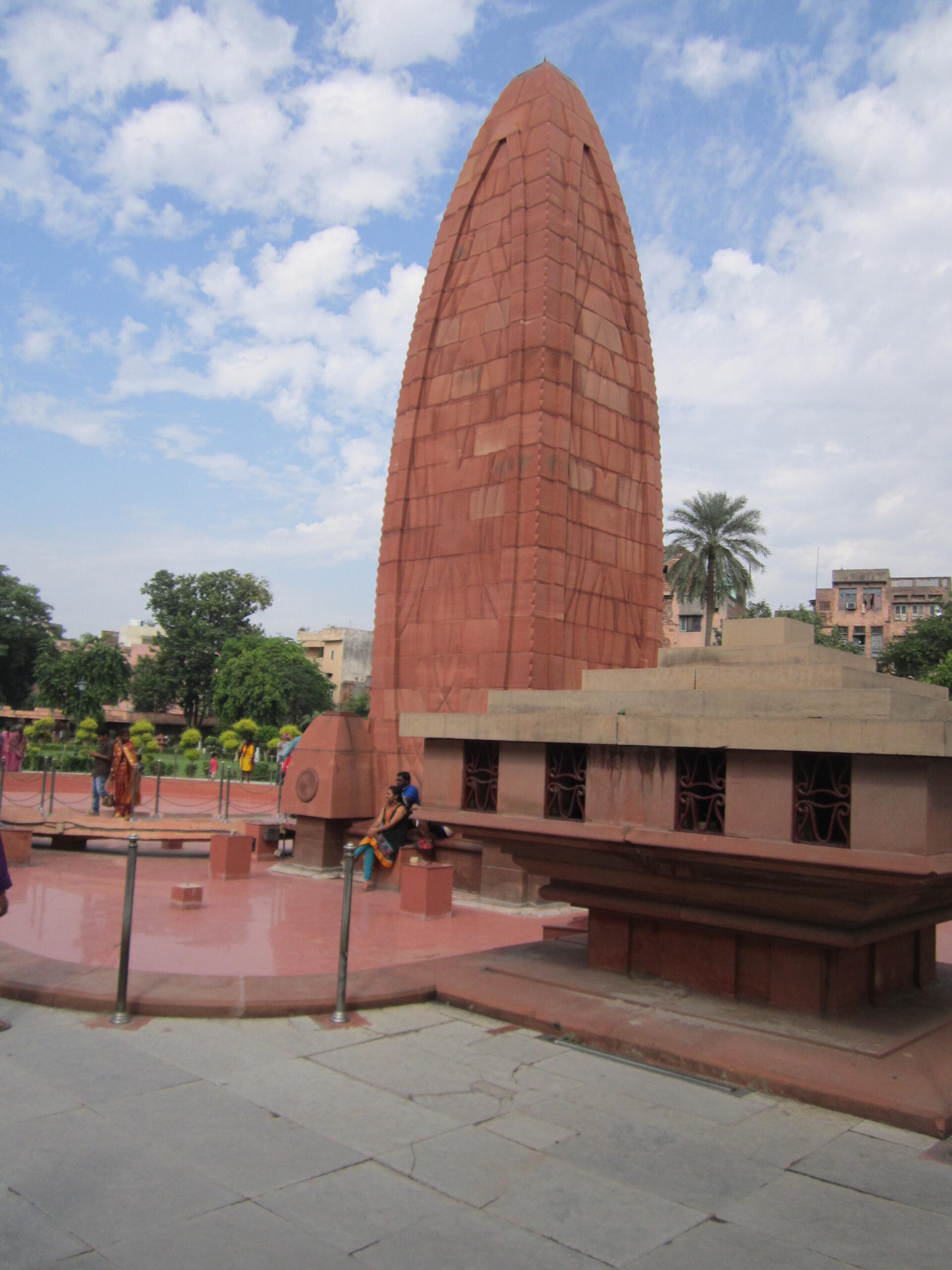
Jallianwala Bagh also entered cultural memory. Udham Singh’s 1940 assassination of O’Dwyer made him a folk hero. Bhagat Singh, a child in 1919, said the massacre turned him towards revolution. The site was acquired by a Congress-led memorial trust in 1920 for Rs 5,65,000 raised by public subscription. The Jallianwala Bagh National Memorial Act 1951 put the site under a statutory trust chaired by the Prime Minister. The current memorial, redesigned by architect Benoy Behari Mukherjee, was inaugurated by Rajendra Prasad on 13 April 1961.
Comparative Perspective
| Incident | Year | Deaths (approx) | Context | British Response |
|---|---|---|---|---|
| Jallianwala Bagh | 1919 | 379-1000+ | Rowlatt Act protest | Dyer censured, retired, no trial |
| Chauri Chaura | 1922 | 22 police | Non-Cooperation protest | 172 Indians hanged/transported |
| Qissa Khwani Bazaar | 1930 | 200-400 | Civil Disobedience, Peshawar | Garhwali troops refused orders |
| Hijli Jail firing | 1931 | 2 killed | Political prisoners | Inquiry, no prosecution |
| Chittagong | 1930-33 | 80+ | Surya Sen uprising | Mass executions and deportations |
The Jallianwala Bagh case stands apart because the victims were unarmed, the shooting premeditated, and the perpetrator publicly defended by the British establishment. This combination turned a local atrocity into a global symbol of colonial violence and fed into twentieth-century international law debates on state use of force against civilians.
Controversies and Debates
The historiography of 13 April 1919 is still contested on three fronts. First, the death toll. The Hunter Committee accepted 379, the Congress inquiry claimed more than 1,000, and a 2019 study by Amritsar district officials combining hospital records, family accounts and British despatches arrived at a figure exceeding 1,500. The exact number will likely never be known because the colonial administration did not attempt a complete count and many bodies were removed overnight by families fearing reprisals.
Second, the question of apology. The UK has expressed “regret” (Theresa May, 2019) and called the massacre “deeply shameful” (David Cameron, 2013), but no formal state apology has been tendered. Successive Indian governments have periodically raised the issue. Critics argue that an apology risks opening a legal floodgate; defenders say it is a minimum moral duty a century on.
Third, the legacy of Dyer. Revisionist British historians occasionally argue Dyer acted out of genuine fear of a second 1857-style uprising. Mainstream scholarship, backed by Dyer’s own testimony before the Hunter Committee — where he stated that he would have used the armoured car’s machine guns had the lane been wider, and that he wished to “produce a moral effect” — treats the action as deliberate collective punishment and an act of terror.
Prelims Pointers
- Jallianwala Bagh Massacre took place on 13 April 1919, Baisakhi day.
- Ordered by Brig. Gen. Reginald Dyer; Punjab Governor was Sir Michael O’Dwyer.
- Viceroy at the time was Lord Chelmsford.
- 1,650 rounds were fired in approximately 10 minutes.
- Official British death toll was 379; Congress estimate crossed 1,000.
- The event occurred during protest against the Rowlatt Act of March 1919.
- Dr Saifuddin Kitchlew and Dr Satyapal were the arrested Amritsar leaders.
- Rabindranath Tagore returned his knighthood on 31 May 1919.
- The Hunter Committee (Disorders Inquiry Committee) was chaired by Lord William Hunter.
- Michael O’Dwyer was assassinated by Udham Singh on 13 March 1940 at Caxton Hall, London.
- The Jallianwala Bagh National Memorial Act was passed in 1951.
- The memorial was inaugurated by President Rajendra Prasad on 13 April 1961.
Mains Practice Questions
Q1. The Jallianwala Bagh massacre was less an aberration than a logical expression of the colonial state’s racial assumptions. Critically examine. (15 marks, 250 words)
- Situate the massacre within the Rowlatt Act, martial law, aerial bombing in Gujranwala and the Crawling Order as components of a racialised system.
- Use the Hunter Committee’s mild censure and the Morning Post fund for Dyer to show institutional backing for racial violence.
- Balance with counter-evidence: Churchill’s condemnation, Labour Party criticism, and internal British dissent.
Q2. Discuss how the events of 13 April 1919 reshaped the ideology and organisation of the Indian National Congress. (10 marks, 150 words)
- Trace the shift from moderate constitutionalism to Gandhian mass politics via Nagpur session 1920.
- Highlight Congress restructuring: linguistic provinces, four-anna membership, women’s entry.
- Link to Non-Cooperation Movement, Khilafat-Congress alliance and the delegitimisation of the Montagu-Chelmsford reforms.
Conclusion
13 April 1919 is one of those compressed dates in Indian history where a single afternoon does the work of a decade. The Rowlatt Act gave the colonial state new repressive powers; Jallianwala Bagh showed how casually those powers would be used against Indians; and the feeble Hunter Committee confirmed that no institution within the Raj would check such abuse. The massacre therefore marks the moment the moral contract of imperial rule broke in the minds of an Indian generation.
For UPSC preparation, Jallianwala Bagh is not a standalone event. It sits at the intersection of Rowlatt Satyagraha, Khilafat, Non-Cooperation, the Government of India Act 1919 and the rise of revolutionary nationalism in Bhagat Singh’s Punjab. Understanding 13 April 1919 is to understand why the Indian freedom struggle after 1920 could no longer be managed by petitions, durbars or dyarchy, and why the demand for full Swaraj became irreversible.
Frequently Asked Questions
What happened on 13 April 1919?
On 13 April 1919, Baisakhi day, Brig. Gen. Reginald Dyer ordered British Indian troops to fire on an unarmed crowd gathered at Jallianwala Bagh in Amritsar protesting the Rowlatt Act and the arrest of local leaders. About 1,650 rounds were fired in roughly 10 minutes, killing at least 379 people by British count and well over 1,000 by Indian estimates.
Why is the Jallianwala Bagh Massacre important for UPSC?
It is a pivotal Modern History event linking the Rowlatt Act, Montagu-Chelmsford Reforms and the Non-Cooperation Movement. UPSC frequently asks about its causes, the Hunter Committee, Tagore’s renunciation of knighthood, and its role in transforming Indian nationalism from moderate petitioning to Gandhian mass politics.
Who was General Dyer and what happened to him?
Brigadier General Reginald Edward Harry Dyer commanded the Jalandhar Brigade and personally ordered the firing. The Hunter Committee censured him for an error of judgement. He was relieved of command and retired on half-pay but faced no criminal trial. The House of Lords supported him and he died in 1927.
How is 13 April 1919 related to the Rowlatt Act?
The Rowlatt Act of March 1919 allowed detention without trial and triggered the first all-India Satyagraha. Amritsar leaders Kitchlew and Satyapal were arrested for leading protests, sparking violence. General Dyer used the Rowlatt-era martial law regime to ban public meetings and then to massacre those who gathered at Jallianwala Bagh.
Who returned his knighthood in protest against the massacre?
Rabindranath Tagore renounced his 1915 knighthood on 31 May 1919 in a letter to Viceroy Lord Chelmsford, calling it incongruous to wear honours from a regime inflicting such humiliations on his countrymen. It remains one of the most famous acts of moral protest in the history of the Indian freedom movement.
Who killed Michael O’Dwyer and why?
Udham Singh, present at Jallianwala Bagh as a teenager in 1919, shot Sir Michael O’Dwyer, the former Lt Governor of Punjab who had endorsed Dyer’s action, at Caxton Hall, London on 13 March 1940, twenty-one years after the massacre. Udham Singh was hanged in July 1940 and is remembered as Shaheed Udham Singh.
What was the Hunter Committee?
The Hunter Committee, formally the Disorders Inquiry Committee, was set up in October 1919 under Lord William Hunter to investigate the Punjab disturbances. Its 1920 majority report censured Dyer for an error of judgement but recommended no criminal action. The Indian members’ minority report was far more critical, and Congress ran a parallel inquiry led by Motilal Nehru.
Has the United Kingdom apologised for Jallianwala Bagh?
No formal state apology has been issued. Queen Elizabeth II called it a distressing example in 1997, David Cameron in 2013 termed it deeply shameful, and Theresa May expressed regret in 2019 on the centenary. The Indian government and civil society have repeatedly asked for a full apology, but UK governments have declined, citing legal complications.
Tell Google you want more of this.
Add Anantam IAS as a preferred sourceOne tap, and this site shows up more often in your own Top Stories, AI Overviews and AI Mode. Remove it any time.