UPSC CSE 2026 · Start Here
Start Here: A Beginner’s Guide to UPSC Civil Services Preparation
Five lakh aspirants apply each year; roughly a thousand make it. The gap is rarely intelligence — it is a clear-eyed understanding of what the exam tests and how to prepare without burning out. This is the orientation guide we wish every first-time UPSC aspirant had.
Stage 1 · May/June
Preliminary Exam
Stage 2 · Sept/Oct
Main Exam
Stage 3 · Jan–Apr
Personality Test
§1 · The structure
UPSC CSE is three sequential filters — not one exam
You must clear each stage to advance to the next. Understanding what each filter actually tests — before you start — is the single biggest predictor of finishing the marathon.
Stage 1 · Preliminary Examination
GS Paper-I (200 marks, ranks you) + CSAT Paper-II (200 marks, qualifying only at 33%). Pure MCQs with negative marking. Tests breadth and elimination skill, not depth. See the 2026 Prelims analysis for what a real paper looks like.
Stage 2 · Main Examination
Seven papers count for ranking — Essay, four GS papers, two Optional papers; two language papers are qualifying only. Hand-written, three hours each. Tests structured thinking and writing a 250-word answer in eight minutes. See the answer-writing guide.
Stage 3 · Personality Test (Interview)
A board at Dholpur House, Delhi. Not a viva — an intelligent conversation built around your DAF (Detailed Application Form). Tests judgement, not knowledge. See the interview preparation guide.
§2 · What you study
The syllabus — not as scary as it looks
Two-thirds of the UPSC syllabus is material you have already met in school; the remaining third needs genuine first-time study. Knowing the split lets you spend your hours where they matter.
✓ What you probably already know
- NCERT-level history, geography, civics, economics (Class 6–12)
- Basic political structure — Parliament, Constitution, Fundamental Rights
- School-level physics, chemistry, biology fundamentals
- Basic maths and data interpretation (Class 10 level, for CSAT)
- General English reading comprehension
- Awareness of current events, if you read the news
→ What you need to learn fresh
- Indian Polity in depth — doctrine, case law, governance
- Indian Economy — monetary policy, fiscal mechanisms, schemes
- Environment & Ecology — biodiversity, climate frameworks
- International Relations — groupings, India’s diplomacy
- Indian society — caste, gender, urbanisation, social justice
- Ethics, Integrity & Aptitude (GS-IV) — case studies, philosophy
- Your chosen Optional — cover-to-cover, university level
- Mains answer-writing technique — structure, timing, presentation
Full map: UPSC Syllabus 2026 — Prelims + Mains · UPSC Exam Pattern
§3 · The plan
12-month preparation roadmap
A realistic timeline for a fresh aspirant starting from scratch. Adjust by 3–6 months either way based on your starting point — but don’t compress under 9 months or stretch beyond 18.
Months 1–2 · Foundation
NCERT consolidation + Optional selection
- Read Class 6–12 NCERTs in History, Geography, Polity, Economy, Science
- Start reading The Hindu or Indian Express editorials daily
- Pick your Optional subject (see §4)
- Subscribe to a quality current-affairs source — ours is free
Months 3–6 · Depth
Standard textbooks + first Optional pass
- Laxmikanth (Polity) · Spectrum (Modern History) · G.C. Leong (Geography) · Ramesh Singh (Economy) · Shankar IAS (Environment)
- Complete the first reading of your Optional
- Build a monthly current-affairs compilation habit
- Begin weekly Mains answer-writing — treat it as a skill, not a test
Months 7–9 · Prelims focus
Revision + MCQ practice + mocks
- Second/third reading of GS sources — revision over new books
- Daily MCQ practice — 50+ questions a day
- Weekly full-length Prelims mock under exam conditions
- Begin CSAT prep if you’re weak — especially Reading Comprehension
Months 10–12 · Mains
Answer writing & Optional refinement
- Daily Mains answer writing — 5–10 questions a day
- Weekly essay practice in 1.5 hours
- Optional consolidation — last 10 years’ PYQs
- Full-length Mains test series — at least 8 tests; daily Ethics case studies
Post-Mains · Interview
DAF deep-dive + mocks
- Rest for two weeks first — you need it
- Build a DAF question bank — 200+ likely questions across the key fields
- 6–10 mock interviews across diverse boards
- Full guide: UPSC Interview Preparation 2026
⚡ Want a structured programme?
The GS Foundation 2027 Batch
Prelims + Mains + Optional + Interview in one integrated programme, taught by ex-Rau’s IAS officers and UPSC rank-holders.
See the GS Foundation 2027 Batch →§4 · The biggest choice
Choosing your optional subject
The Optional carries 500 of the 1,750 Mains marks. Picked well, it carries you; picked badly, it sinks you. Don’t pick the one your friend picked.
How to choose
- Interest first. You will read this subject for 18+ months. Pick something you can read past 9 PM.
- Background fit. A degree in the subject is a head-start but never required — many top rankers pick non-graduation optionals.
- Resource availability. Check book lists, mentorship, and peer groups before committing.
- Score predictability. Some optionals are volatile; PSIR, Sociology, Anthropology and Geography are widely seen as stable.
- GS overlap. Optionals that overlap with GS (PSIR, History, Geography, Sociology) save preparation time.
Popular optionals — quick overview
| Optional | Why aspirants pick it | Watch out for |
|---|---|---|
| PSIR | Heavy GS-II + GS-III overlap; clear syllabus; abundant material | Highly competitive — toppers crowd here |
| Sociology | Short syllabus; readable for non-graduates; helps Essay & GS-I | Theory-heavy — rote memorisation is penalised |
| Anthropology | Short syllabus; scientific framework; predictable scoring | Limited resources outside Delhi/Hyderabad |
| Geography | Visual + factual; full GS-I overlap; map-based | Volatile scoring; map work is non-trivial |
| History | Largely GS-I overlap; ancient-to-modern coverage | Longest optional syllabus; heavy reading load |
| Public Administration | GS-II overlap; concise theory base | Scoring crashed post-2013; recovery uneven |
| Law | Strong fit with an LLB; high scoring when written well | Statutory knowledge non-Law grads struggle with |
| Literature (any language) | Can score very high (350+); rewards creative writing | Genuine literary background needed; high variance |
§5 · What to avoid
Seven mistakes that derail aspirants
Compiled from years of debriefing failed and successful candidates. Most aspirants commit at least three of these in their first attempt.
- Starting with too many booksBuying ten reference books in week one — you’ll read three properly. Pick one standard text per subject and finish it before adding another. Fix: one source per subject; multiple readings beat multiple books.
- Ignoring answer writing until after PrelimsBy then you have four months and no skill. Answer writing is a craft, not a tap you turn on. Fix: write 1–2 Mains answers a week from month 3.
- Not reading the newspaper dailyCurrent affairs is 30–40% of GS-I and bleeds into every Mains paper. A weekly compilation doesn’t build the muscle a daily habit does. Fix: 45 minutes of editorial reading daily, non-negotiable.
- Comparing your journey with toppersTopper interviews look effortless because they’re edited. Run your own race. Fix: keep a journal; compare you to past-you, not past-toppers.
- Studying 14 hours a day and burning out by month 4UPSC rewards consistency over intensity. Fix: pace for a marathon — build in sleep, exercise, and one rest day a week.
- Ignoring CSAT until the last minuteQualifying-only (33%) tempts aspirants to treat it as a formality — in 2023 it eliminated more candidates than GS-I did. Fix: 1 hour of CSAT daily from month 7, comprehension especially.
- Not taking mock tests seriouslyYou become ready by taking mocks — test-taking is itself a skill. Fix: at least 25 full-length Prelims mocks + 8 Mains mocks before the real exam.
§6 · Free resources
Free resources to start with
Everything below is free — no signup, no paywall. Bookmark this page and revisit it as you progress.
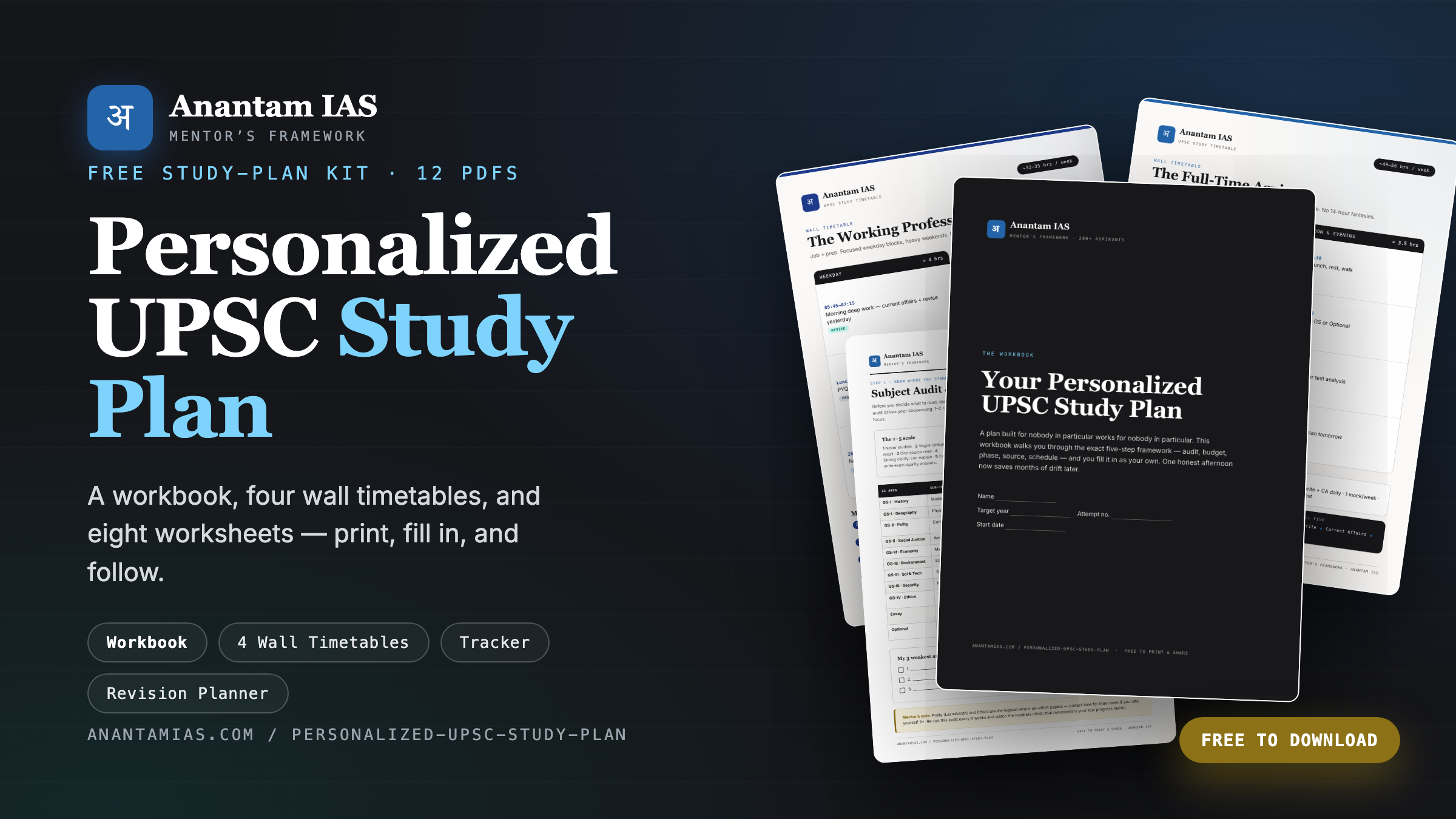
Personalized Study-Plan Kit
Workbook, four wall timetables and worksheets — 12 free PDFs to plan with.
SyllabusUPSC Syllabus 2026
Complete syllabus map across all stages, with topic-wise breakdowns.
PatternUPSC Exam Pattern
Stage-by-stage marks, durations, negative marking, and eligibility.
DailyDaily Current Affairs (free)
Hand-picked, UPSC-angled current affairs every day, with archive PDFs.
Practice343+ Prelims MCQs
Practice in the multi-statement format UPSC actually uses, by subject.
CSATCSAT Complete Guide
Paper-II strategy, formula sheet, 60-day plan, topic-wise practice.
MainsMains Answer Writing
How to structure a 150/250-word answer — templates and time discipline.
EssayEssay Strategy & Framework
The 250-mark essay paper — frameworks, top-scoring essays, the one rule.
InterviewInterview Preparation 2026
DAF deep-dive, question categories, mock strategy, costly mistakes.
AnalysisPrelims 2026 Analysis
Subject distribution, cut-off forecast, and year-on-year trends.
ToppersUPSC Result 2026 + Toppers
Latest cut-offs, toppers’ interview marks, and the events calendar.
§7 · Why Anantam IAS
Why aspirants choose Anantam IAS
- Faculty who have cleared UPSC themselvesEx-Rau’s IAS officers and rank-holders — not career-coaching staff.
- 9,000+ aspirants taught340+ ranks delivered across the last decade.
- One integrated programmePrelims, Mains, Optional and Interview — one syllabus, one mentor team, one continuous journey.
- Personalised mentorshipWeekly one-on-one time with a senior mentor — the actual faculty, not a junior TA.
- Honest feedbackIf you’re not ready for an attempt, or your Optional choice is wrong, we’ll tell you. No course-selling theatrics.
- Free resources firstEverything in §6 is free — you only pay when you want intensive, structured help.
§8 · FAQ
Beginner questions, answered
Can I crack UPSC without coaching?
Yes — many rank-holders are self-prepared. Coaching is one option, not a requirement. Self-preparation works if you have access to standard resources, can self-discipline 6–8 hours of daily study, and have a peer group or mentor for occasional feedback. What coaching buys you is structure, a calibrated test series, and someone to flag blind spots you cannot see.
How long does UPSC preparation take?
12 to 18 months for a fresh full-time aspirant starting from scratch; 18 to 24 months if you are preparing while working. Faster than 12 months risks under-coverage; longer than 24 months risks burnout. The biggest variable is your starting base.
Can I crack UPSC while working a full-time job?
Yes, but it demands brutal time management. Plan for 18–24 months, study 3–4 hours on weekdays and 8–10 hours on weekends, and sacrifice most social commitments for the duration. The working aspirants who succeed tend to have a supportive family, a job without frequent travel, and a clear cut-off attempt.
What is the best age to start UPSC preparation?
Final-year college or just after graduation is the most common start — you are 21–22 with 6–8 attempts before the upper age limit (32 General, 35 OBC, 37 SC/ST). But there is no single best age; aspirants clearing at 28, 30, even 35 are common. Start when you have genuinely decided on the path.
How much does UPSC preparation cost?
Self-preparation: ₹15,000–₹40,000 for books, current-affairs subscriptions, and a basic test series over 12–18 months. Full classroom coaching: ₹1.5–3 lakh for a one-year programme in Delhi. Online coaching sits in between (₹40,000–₹1 lakh). Budget for the opportunity cost of full-time preparation too.
Which optional subject scores highest?
Score consistency varies year to year. PSIR, Anthropology and Sociology have shown consistent 300+ scores across recent cycles; literature optionals can produce 350+ scorers but with high variance. Pick on genuine interest and resource availability, not on last year’s topper trend.
Should I move to Delhi for UPSC preparation?
Not necessary, but it has marginal benefits — Old Rajinder Nagar / Mukherjee Nagar offer peer-group and faculty density useful for motivation and doubt-clearing. The downsides are cost of living and an anxiety-amplifying bubble. With good online coaching and self-discipline, you can prepare anywhere.
How do I stay motivated during UPSC preparation?
Three things help: realistic milestones (daily targets, weekly scores, monthly completions); a small accountability group of 3–4 peers; and one hour of a hobby or physical activity daily. Motivation fluctuates — the system carries you, not the spike. Most rank-holders have at least one attempt that did not clear.
Next step
From orientation to selection
You now know the structure, the plan, and the pitfalls. The next year is about consistent execution — and the right faculty, peer group, and feedback loop make the difference between attempting six times and clearing in one.