Introduction
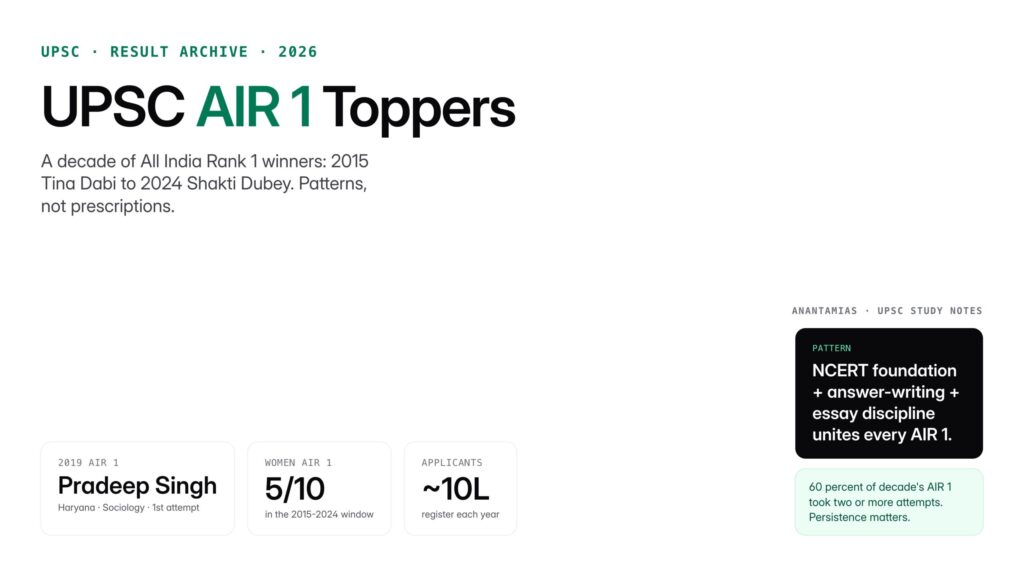
The Civil Services Examination conducted by the Union Public Service Commission is arguably the most demanding public recruitment test in India. Each year, roughly ten lakh candidates register, a few thousand reach the Main Examination, and only around a thousand clear the final list. At the pinnacle of this list is the All India Rank 1 holder, the topper who is celebrated, analysed and often emulated across coaching institutes and media cycles. The 2019 UPSC topper in particular, Pradeep Singh, drew enormous attention because he reached AIR 1 from rural Haryana on his fourth attempt, having already cleared the exam once and joined the IRS.
This guide compiles the year-wise list of UPSC CSE toppers (AIR 1) from 2015 to 2025, along with their home states, optional subjects and educational backgrounds. For serious aspirants, toppers’ profiles are not a script to copy but a statistical pattern to study. The goal is to identify what is signal (consistency, answer-writing, integrated preparation) and what is noise (specific coaching, specific optional, specific schedule).
Quick Facts at a Glance
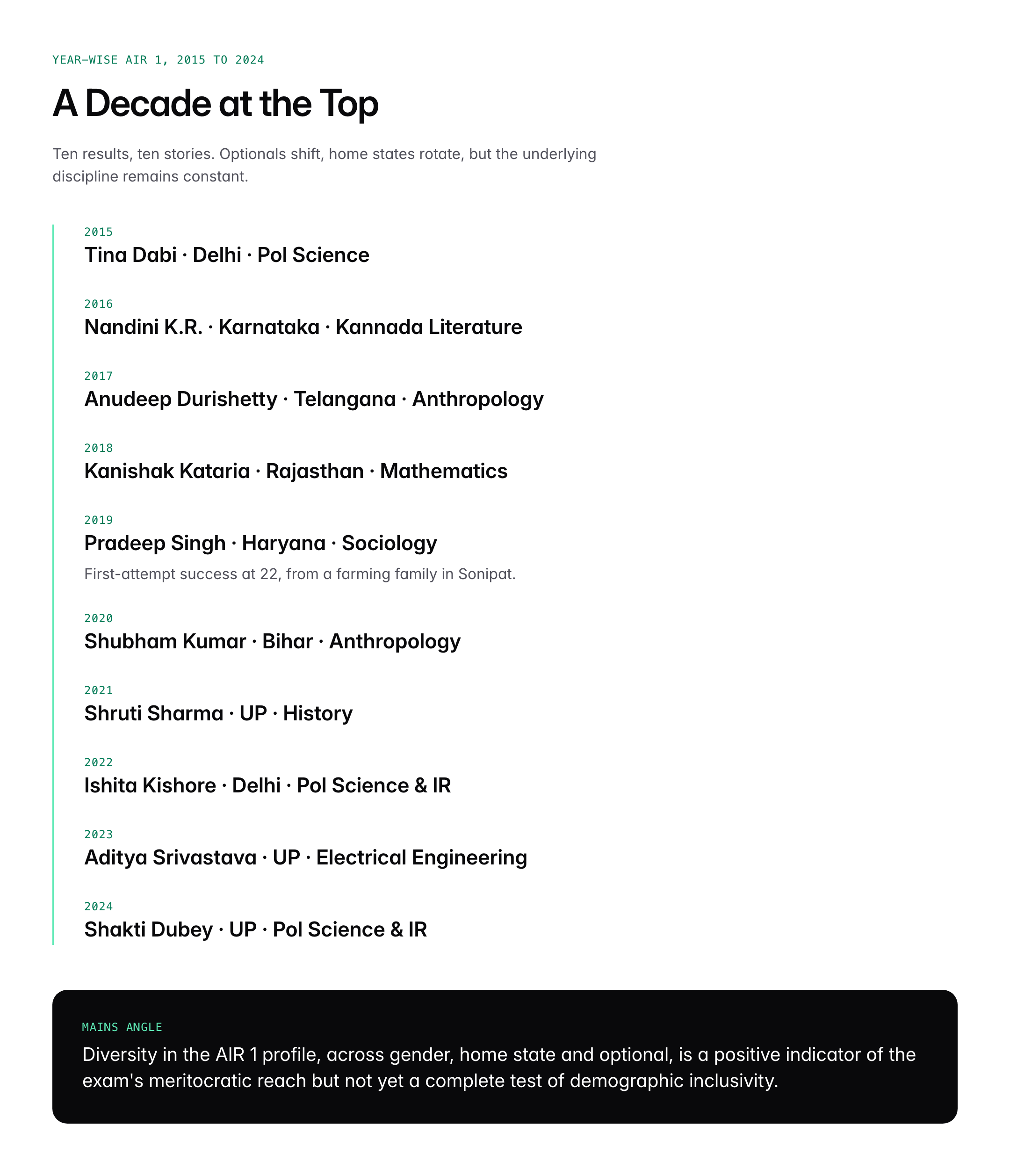
| Year | AIR 1 | Home State | Optional | Background |
|---|---|---|---|---|
| 2015 | Tina Dabi | Delhi | Political Science and IR | LSR, DU |
| 2016 | Nandini K.R. | Karnataka | Kannada Literature | M.Tech |
| 2017 | Anudeep Durishetty | Telangana | Anthropology | BITS Pilani |
| 2018 | Kanishak Kataria | Rajasthan | Mathematics | IIT Bombay |
| 2019 | Pradeep Singh | Haryana | Public Administration | B.E. Computer Science, DCRUST Murthal |
| 2020 | Shubham Kumar | Bihar | Anthropology | IIT Bombay |
| 2021 | Shruti Sharma | Uttar Pradesh | History | St. Stephen’s |
| 2022 | Ishita Kishore | Delhi | Political Science and IR | SRCC |
| 2023 | Aditya Srivastava | Uttar Pradesh | Electrical Engineering | IIT Kanpur |
| 2024 | Shakti Dubey | Uttar Pradesh | Political Science and IR | Allahabad University |
| 2025 | Anuj Agnihotri | Rajasthan | Medical Science | MBBS, AIIMS Jodhpur |
Background and Historical Context
The Civil Services Examination in its current pattern began after the Kothari Commission recommendations of 1974. The three-stage structure of Preliminary, Main and Personality Test, combined with a cadre-allocation formula, has remained broadly unchanged. Over the decades the toppers list reflects larger social trends: the gradual rise of women at the top, the dominance of engineering graduates, and the spread of successful candidates from beyond metro cities to tier 2 and tier 3 towns.
The 2015 result was a landmark. Tina Dabi became AIR 1 at the age of 22, among the youngest women to top the exam. 2016 saw Nandini K.R. top with Kannada Literature as optional, underscoring that regional-language optionals can win at the highest level. In 2017 Anudeep Durishetty reached AIR 1 at his fifth attempt, breaking the myth that toppers always succeed young.
The 2018 result pushed engineers back into focus with Kanishak Kataria, an IIT Bombay graduate who had worked at Samsung Korea. The 2019 UPSC topper Pradeep Singh, a first-generation aspirant from Sonipat, represented the small-town Bharat narrative; he cleared on his fourth attempt with Public Administration, having already joined the IRS after an earlier selection.
From 2020 onwards, the list continues to shift. Shubham Kumar (2020) was an IIT Bombay civil engineer; Shruti Sharma (2021) came from a History background and signalled humanities’ revival; Ishita Kishore (2022), Aditya Srivastava (2023) and Shakti Dubey (2024) complete a trio of strong results across optional and educational mixes.
The 2019 IAS topper list, the broader top 10, included Jatin Kishore (AIR 2), Pratibha Verma (AIR 3), Himanshu Jain, Jeydev C.S., Vishakha Yadav, Ganesh Kumar Baskar, Abhishek Saraf, Ravi Jain and Sanjita Mohapatra. Of these, the top three automatically secure IAS allocation by convention.
Key Features of Recent Toppers’ Profiles
Educational Backgrounds
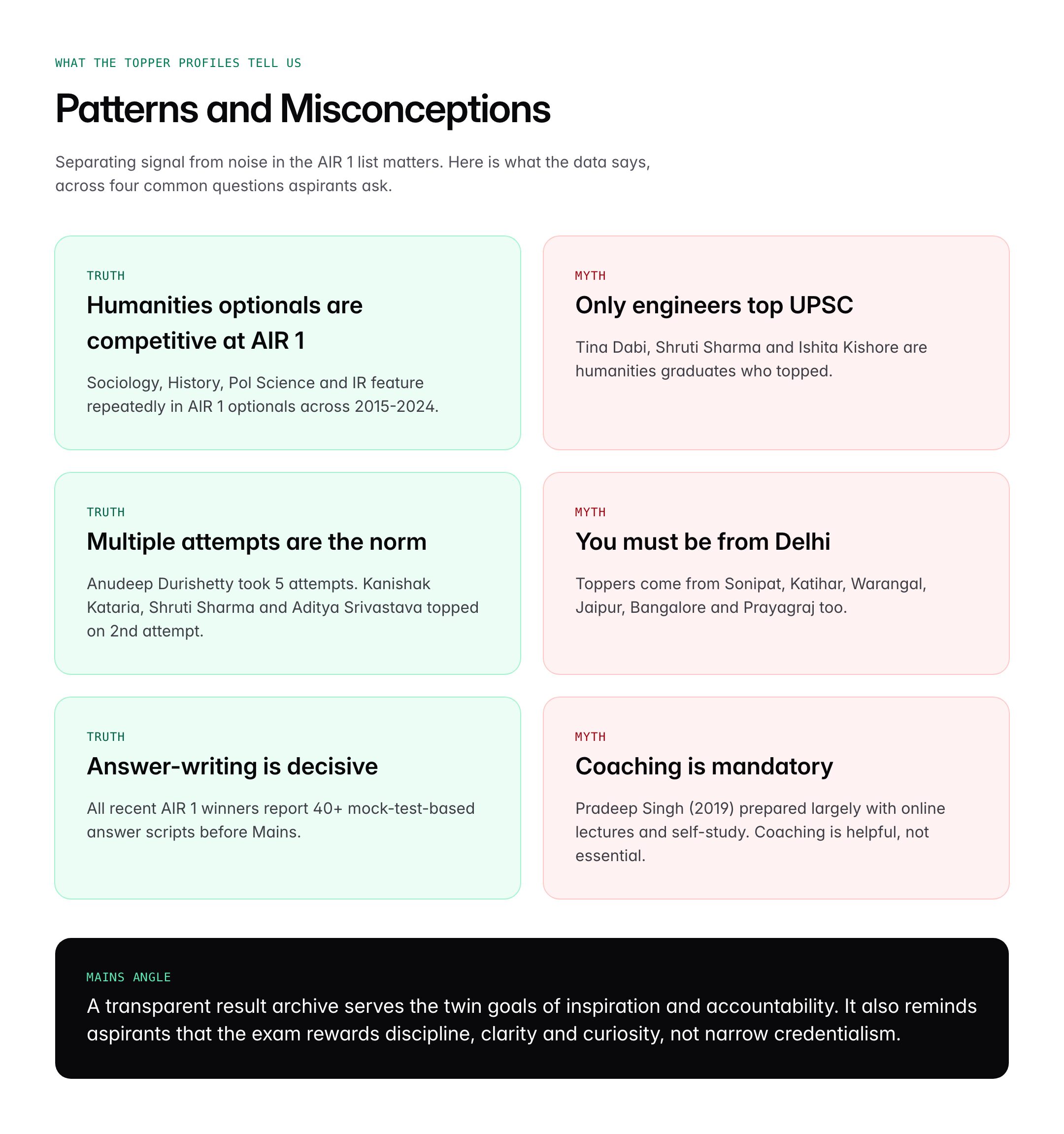
Engineers still dominate numerically but no longer exclusively. From 2015 to 2025, at least five AIR 1 winners are from engineering (Kataria, Shubham, Aditya, among others) while humanities graduates like Shruti Sharma and Ishita Kishore prove that any stream can reach the top.
Optional Subjects
Sociology, Political Science, Anthropology and History account for most of the AIR 1 optionals in the decade under review. The signal is that the optional should align with the candidate’s genuine interest and access to quality material, not with perceived scoring. Pradeep Singh, the 2019 UPSC topper, took Public Administration, an optional often chosen for its overlap with GS 2 and the essay paper.
Attempts Profile
Only three of the last ten AIR 1 winners cleared in their first attempt. Most took two to five attempts. Anudeep Durishetty (2017) took five attempts including two selections before AIR 1. The takeaway is that persistence and iterative improvement count more than raw first-attempt success.
Home-State Diversity
Toppers have come from Delhi, Karnataka, Telangana, Rajasthan, Haryana, Bihar, Uttar Pradesh and Kerala in the last decade. UP leads in absolute numbers, but the list is genuinely pan-Indian.
Gender Representation
Women AIR 1 winners include Tina Dabi, Nandini K.R., Shruti Sharma, Ishita Kishore and Shakti Dubey, five out of ten years. The larger Top 25 list consistently has 30 to 40 percent women, a rise from barely 10 percent three decades ago.
Significance for UPSC and General Knowledge
- Year-wise topper lists are commonly asked at interview-prep and general-awareness levels.
- Toppers’ optionals and answer scripts (shared on MyGov or institute websites) offer a free benchmarking tool.
- Topper demographics inform policy conversations on the inclusivity of the civil services.
- Multiple attempts are normal; nearly 60 percent of AIR 1 winners in the last decade took more than one attempt.
- The shift to humanities optionals by top rankers has reshaped the coaching market.
- The 2019 IAS topper list shows the opposite of the first-attempt myth: repeat attempts, not beginner luck, produce most AIR 1 finishes.
Detailed Analysis: Lessons From Toppers
Looking across ten years of AIR 1 profiles, four patterns stand out. First, reading NCERTs cover to cover is near-universal. Every major topper credits Class 6 to 12 NCERTs for building a foundation in polity, history, geography and economy before moving to standard references.
Second, answer-writing practice is the unanimous differentiator. Pradeep Singh described writing two full-length Mains mocks weekly for six months. Shruti Sharma wrote over 40 sectional tests during History optional preparation. The pattern holds for engineers and humanities graduates alike.
Third, the integrated approach to current affairs has replaced separate compartmentalisation. Toppers read a single newspaper (usually The Hindu or Indian Express), one monthly compilation, and an economic survey plus budget in full. They relate each current event to GS 1, 2, 3, 4 or Essay, rather than filing it under a single paper.
Fourth, essay writing is treated as a full-paper strategy from Day 1, not an afterthought. The Essay paper has the highest marks-per-effort ratio in the final list. Toppers write one essay per week minimum and review against topper copies.
Beyond these, soft skills matter in the Personality Test. Interviews with recent AIR 1 winners reveal an emphasis on DAF (Detailed Application Form) ownership; every hobby, graduation subject and internship listed must be defensible with five minutes of structured content.
Finally, the role of mentorship and peer review is underappreciated. The 2019 UPSC topper has publicly credited discussion groups with friends and online answer-evaluation platforms for continuous calibration.

Comparative Perspective
| Topper | Attempt | Age at AIR 1 | Optional | Common Theme |
|---|---|---|---|---|
| Tina Dabi (2015) | 1st | 22 | Pol Science | Humanities graduate |
| Kanishak Kataria (2018) | 1st | 26 | Mathematics | IIT + corporate break |
| Pradeep Singh (2019) | 4th | — | Public Administration | Already an IRS officer when he took AIR 1 |
| Shruti Sharma (2021) | 2nd | 26 | History | Humanities revival |
| Aditya Srivastava (2023) | 3rd | 25 | Electrical Engineering | Engineer with tech optional |
| Anuj Agnihotri (2025) | 3rd | 26 | Medical Science | Doctor, cleared on self-study without coaching |
Each year’s AIR 1 is often framed in the media as a new profile, yet the underlying study habits are similar. Daily study of 8 to 10 hours during preparation peak, iterative mock-test cycles, and essay or answer-writing discipline consistently show up.
Challenges and Criticisms
The toppers list is frequently criticised on three grounds. First, it can create a halo effect that distorts preparation strategies; aspirants replicate the optional or schedule of a topper without honestly assessing their own strengths.
Second, the list has not yet achieved full demographic representation. Scheduled Caste, Scheduled Tribe and OBC toppers are under-reported relative to population share. While ST-category rank 1 topper Srushti Deshmukh achieved AIR 5 in 2018 and the category toppers are celebrated separately, the headline AIR 1 remains dominated by candidates from better-resourced backgrounds.
Third, the over-indexing on toppers by coaching institutes has commercial consequences. A successful aspirant can command crore-level endorsements, which creates perverse incentives in the prep market.
Finally, the idea that the AIR 1 is the best civil servant is itself debatable. Administrative performance in the field often depends on empathy, collaboration and political acumen that an exam cannot measure. Critics argue for lateral entry, behavioural assessment and longer probation to complement the ranking system.
Prelims Pointers
- UPSC is a constitutional body under Article 315 of the Indian Constitution.
- The Civil Services Examination has three stages: Preliminary, Main and Personality Test.
- The Kothari Commission of 1974 designed the current three-stage pattern.
- Pradeep Singh was the AIR 1 of UPSC CSE 2019.
- The 2019 IAS topper list top 3 were Pradeep Singh, Jatin Kishore and Pratibha Verma.
- Shruti Sharma (AIR 1, 2021) had History as her optional.
- Aditya Srivastava (AIR 1, 2023) is an IIT Kanpur electrical engineering graduate.
- Shakti Dubey (AIR 1, 2024) is from Uttar Pradesh with Political Science optional.
- UPSC results are declared on the commission’s official website upsc.gov.in.
- The maximum age for general-category CSE candidates is 32 years.
- Number of attempts for general category is 6.
- The LBSNAA at Mussoorie trains IAS and other All India Service officers.
Mains Practice Questions
Q1. The Civil Services Examination of India has evolved in its demographic composition over the last decade. Discuss the factors driving this change.
- Introduction: context of CSE as a social mobility ladder.
- Body: rise of women, small-town aspirants, humanities optionals, coaching democratisation via online content.
- Conclusion: continuing gaps and reform priorities.
Q2. The reliance of aspirants on topper schedules and optional choices is widely criticised. Suggest a more scientific approach to CSE preparation.
- Introduction: peer-benchmarking as a cognitive shortcut.
- Body: individualised diagnosis, strengths-based optional, answer-writing feedback loops, mental health balance.
- Conclusion: exam preparation as a structured learning project.
Conclusion
The UPSC CSE toppers list from 2015 to 2025 tells a story of changing India. Tina Dabi opened the decade, Pradeep Singh represented the small-town rise in 2019, and Shakti Dubey closed 2024 with a strong Uttar Pradesh humanities profile. Each AIR 1 story has unique ingredients but shares common discipline: NCERT foundation, answer-writing practice, integrated current affairs and iterative self-review.
For aspirants, the list is a resource, not a recipe. Use it to benchmark, not to copy. Match the optional to genuine interest, the schedule to personal rhythm, and the preparation intensity to life circumstances. The goal is not to become the next year’s topper in profile, but to join the final list with the most authentic version of your own preparation.
Frequently Asked Questions
Who was the 2019 UPSC topper?
The 2019 UPSC Civil Services Examination topper was Pradeep Singh from Sonipat, Haryana. He secured All India Rank 1 on his fourth attempt, with Public Administration as his optional subject and 1072 marks in total. He had already cleared the exam once, taking AIR 260 in 2018, and was serving as an IRS officer when he topped. He holds a computer science engineering degree from DCRUST, Murthal.
Why is the UPSC toppers list important for UPSC aspirants?
The toppers list is valuable because it reveals patterns in optional subject choice, answer-writing style, and preparation duration. Aspirants study topper interviews, DAFs and marksheets to benchmark their own preparation. It also provides role models across gender, language and regional backgrounds, which matters for motivation during the multi-year preparation cycle.
How is the 2019 IAS topper list related to the broader UPSC result?
The 2019 IAS topper list refers to the top 10 rankers of the UPSC CSE 2019 who were allocated the Indian Administrative Service. These ten include Pradeep Singh (AIR 1), Jatin Kishore, Pratibha Verma and others. IAS allocation depends on final rank, cadre preference and category, but the top 100 or so usually secure IAS.
Who was the AIR 1 of UPSC 2023 and 2024?
Aditya Srivastava from Lucknow, Uttar Pradesh, was AIR 1 of UPSC CSE 2023 with Electrical Engineering as his optional. Shakti Dubey, from Prayagraj, Uttar Pradesh, was declared AIR 1 of UPSC CSE 2024 with Political Science and International Relations as her optional.
Which optional subjects have helped recent UPSC toppers?
Over the last decade, Sociology, Anthropology, Political Science and IR, History and Mathematics have frequently appeared among AIR 1 winners’ optionals. Literature-based optionals like Kannada have also succeeded. The choice depends on the candidate’s academic foundation and comfort with the subject matter rather than any single winning formula.
How many attempts does it typically take to top UPSC?
Historical data shows that about 60 percent of AIR 1 winners in the last decade cleared in their second attempt or later. Anudeep Durishetty took five attempts before topping in 2017. Tina Dabi cleared at first attempt; Pradeep Singh needed four. The statistical norm is one to three attempts to the final list.
Where do most UPSC toppers come from?
Toppers in recent years have come from Uttar Pradesh, Delhi, Bihar, Karnataka, Telangana, Rajasthan, Haryana and Kerala. Uttar Pradesh leads in absolute numbers, followed by Delhi. However, the spread is genuinely pan-Indian and includes many first-generation aspirants from small towns and rural backgrounds.
Can an engineering graduate clear UPSC with an engineering optional?
Yes. Aditya Srivastava topped UPSC 2023 with Electrical Engineering as his optional. Kanishak Kataria (AIR 1, 2018) used Mathematics. Engineering optionals reward deep technical preparation and are viable if the candidate has strong undergraduate foundations, recent practice and access to solved answer-writing references.
Tell Google you want more of this.
Add Anantam IAS as a preferred sourceOne tap, and this site shows up more often in your own Top Stories, AI Overviews and AI Mode. Remove it any time.