Introduction
Air transport in India has emerged from a colonial-era novelty into one of the fastest growing aviation markets in the world. In just over nine decades, from J.R.D. Tata’s maiden Karachi to Bombay flight of 1932 to the 150-plus operational airports of today, Indian civil aviation has become a critical driver of mobility, trade, tourism and employment. For an aspirant preparing the General Studies Paper III economy section, understanding the structure of air transport is essential because it intersects with infrastructure, public-private partnerships, regional connectivity and logistics competitiveness.
The sector is also politically and strategically significant. Airports anchor urban economic zones, aviation fuel taxation affects state finances, and airspace management has implications for both security and environmental policy. This note maps the regulators, the major airports, the flagship UDAN scheme, and the broader economic footprint that makes aviation one of the sunrise sectors identified by the Government of India.
Quick Facts at a Glance
| Parameter | Data Point |
|---|---|
| First commercial flight | 18 February 1911, Allahabad to Naini (airmail) |
| Primary regulator | Directorate General of Civil Aviation (DGCA) |
| Economic regulator | Airports Economic Regulatory Authority (AERA) |
| Safety investigator | Aircraft Accident Investigation Bureau (AAIB) |
| Ministry | Ministry of Civil Aviation (MoCA) |
| Operational airports (2025) | 159 (including 33 international) |
| Flagship RCS scheme | UDAN, launched 2016 |
| Passenger traffic (FY24) | 376 million (domestic + international) |
| Position globally | 3rd largest domestic aviation market |
Background and Historical Context
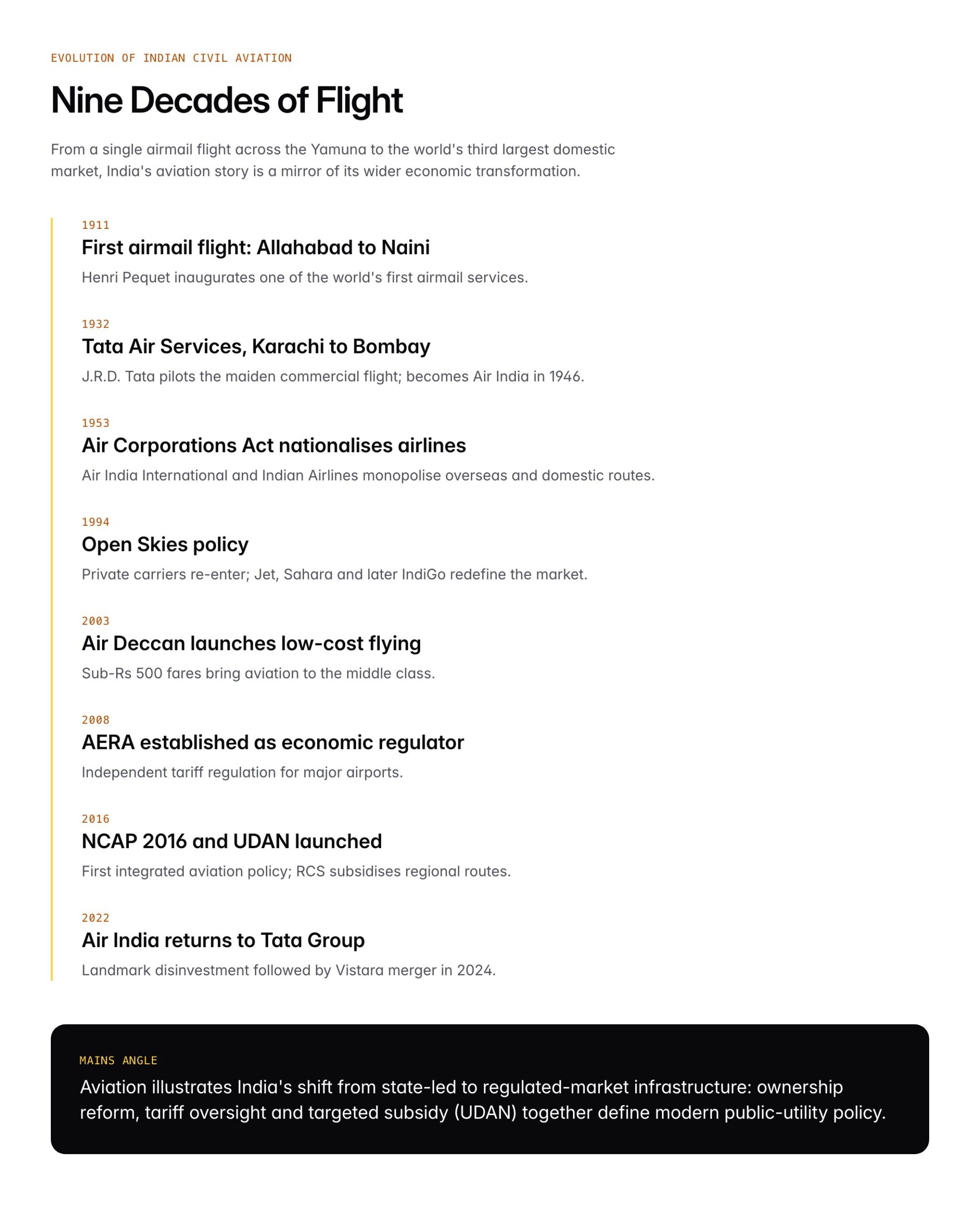
India’s tryst with the skies began in 1911 when Henri Pequet flew mail across the Yamuna from Allahabad to Naini, making it one of the earliest airmail services in the world. The commercial birth of Indian aviation, however, is dated to 15 October 1932, when Tata Air Services carried mail from Karachi to Bombay, a route piloted personally by J.R.D. Tata. Tata Airlines became Air India in 1946.
After independence, the Air Corporations Act of 1953 nationalised the industry, creating Air India International for overseas operations and Indian Airlines for domestic and neighbouring routes. This era was marked by a monopoly model where the state carrier defined both network and fares, and private airlines were effectively crowded out.
The Air Corporations Act was repealed in 1994, ushering in the Open Skies policy. Private carriers such as Jet Airways, Sahara, Air Deccan and later IndiGo and SpiceJet expanded fleet size and route density. Low-cost carriers democratised flying; the Air Deccan launch in 2003 brought a sub-Rs 500 ticket into the popular imagination.
The new millennium also saw regulatory maturation. The Airports Authority of India was formed in 1995 by merging the National Airports Authority and International Airports Authority. AERA was established in 2008 to regulate tariffs and service quality at major airports. Privatisation of Delhi and Mumbai airports under build-operate-transfer concessions between 2006 and 2008 created benchmarks for later brownfield and greenfield public-private partnership airports at Hyderabad, Bangalore, Kannur and Navi Mumbai.
Key Features of India’s Air Transport System
Regulatory Architecture
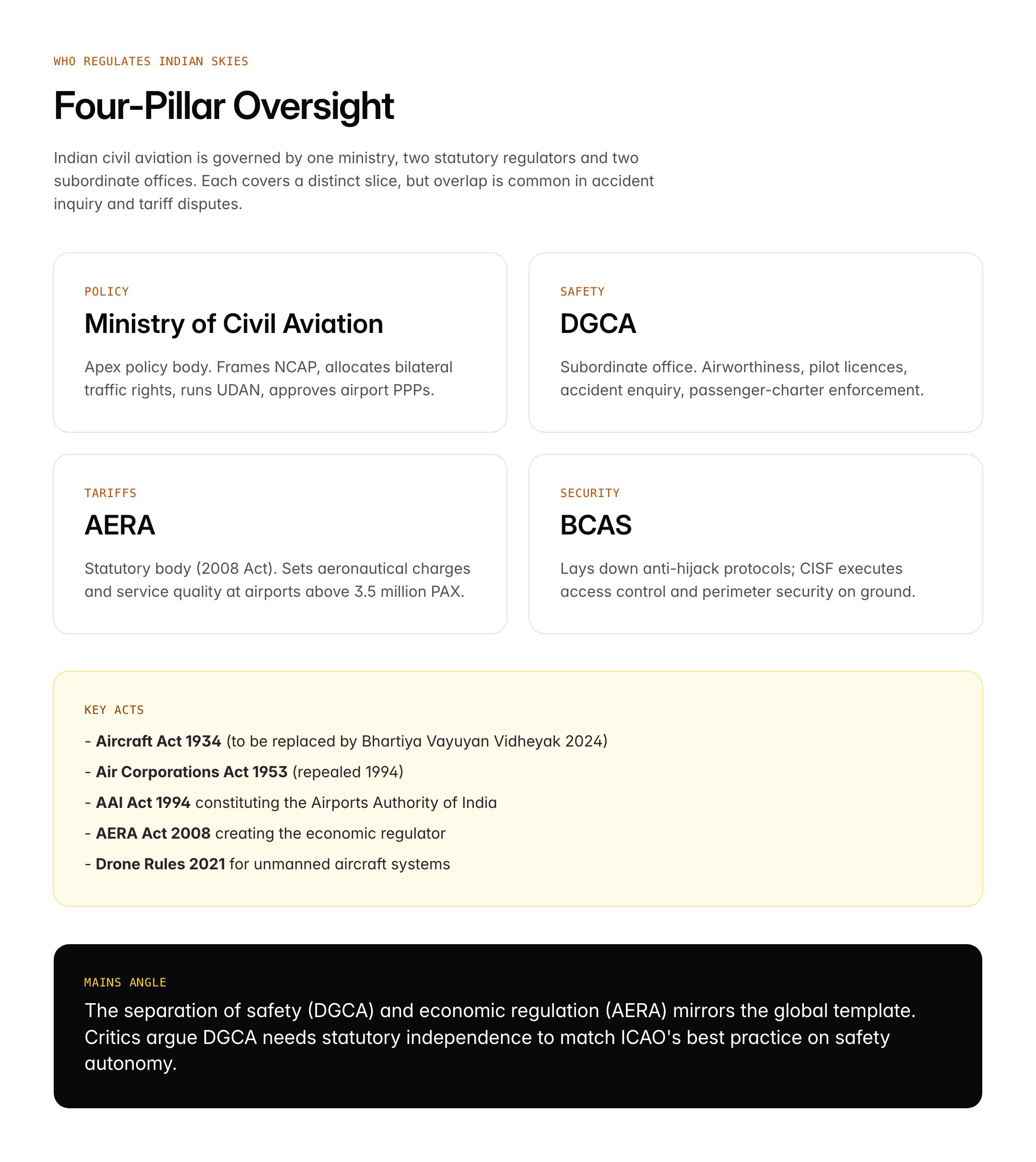
The Ministry of Civil Aviation (MoCA) is the apex policy body. Under it, three statutory bodies share responsibility. The DGCA handles airworthiness, licensing, air-safety oversight and accident inquiries at a technical level. AERA sets tariff caps and service-quality standards for airports handling more than 3.5 million annual passengers. Bureau of Civil Aviation Security (BCAS) lays down anti-hijack and access-control protocols and is the point of contact with CISF, which physically secures airports.
Airport Network
Airports are classified as international, customs, domestic and civil enclaves at defence airfields. As of 2025, there are 159 operational airports. The Airports Authority of India owns most of them, but traffic is concentrated at a handful of PPP airports. Delhi IGIA is the busiest, followed by Mumbai, Bangalore, Hyderabad, Chennai and Kolkata. The largest greenfield pipeline includes Navi Mumbai, Jewar (Noida), Mopa (Goa), Bhogapuram (AP) and Hirasar (Rajkot).
Carriers and Fleet
IndiGo dominates with roughly 60 percent market share, followed by Air India group (Air India, AI Express, Vistara-merged), Akasa Air and SpiceJet. Total commercial fleet crossed 800 aircraft in 2024, with aggregate orders of over 1,700 units, the largest order book in commercial aviation history.
UDAN and Regional Connectivity
Launched in 2016 as part of the National Civil Aviation Policy, the Ude Desh ka Aam Naagrik (UDAN) scheme caps fares on half the seats of RCS flights at around Rs 2,500 per hour of flight and uses a viability gap funding mechanism financed by a levy on trunk routes. UDAN has operationalised over 570 routes and revived 80-plus unserved and underserved airports, heliports and water aerodromes.
Cargo and MRO
Air cargo moves nearly 35 percent of India’s trade by value despite handling a tiny share of tonnage. Dedicated air freight stations, transshipment hubs at Hyderabad and Nagpur and the emergence of express carriers are expanding the cargo base. MRO (maintenance, repair and overhaul) was liberalised in 2020 with GST cut to 5 percent and equal tax treatment for domestic and foreign MROs.
Significance for UPSC and General Knowledge
- Air transport contributes roughly 5 percent to India’s GDP when direct, indirect and induced effects are counted (IBEF, 2024).
- The sector supports about 8 million jobs directly and indirectly.
- UDAN is a recurring Prelims and Mains question because it combines federalism, viability gap funding and last-mile connectivity.
- Aviation figures in the PM Gati Shakti master plan for integrated logistics and in the National Logistics Policy for cost reduction to 8 percent of GDP.
- Climate obligations under ICAO’s CORSIA (Carbon Offsetting and Reduction Scheme for International Aviation) and SAF (Sustainable Aviation Fuel) targets are emerging Paper 3 environment-economy crossovers.
- The 2023 Vistara-Air India merger and Tata’s re-acquisition of Air India are landmark corporate-governance case studies.
Detailed Analysis: Economic Significance of Air Transport
Aviation is a force multiplier for adjacent sectors. Every direct job in the airline industry generates roughly six indirect and induced jobs in ground handling, hospitality, retail, insurance, MRO and catering, according to IATA estimates. India’s rising middle class, coupled with falling real ticket prices, has driven compound annual growth in domestic passenger traffic of nearly 12 percent since 2015, briefly interrupted by the pandemic but fully recovered by FY23.
Tourism is the biggest visible beneficiary. Over 80 percent of foreign tourist arrivals come by air, and states with strong aviation links such as Goa, Kerala, Rajasthan and Maharashtra dominate inbound tourism receipts. Domestic religious tourism has been transformed by UDAN routes to Ayodhya, Amritsar, Shirdi and Tirupati.
Trade competitiveness is the second major channel. High-value, low-volume exports like pharmaceuticals, electronics, perishables and precious stones depend on air cargo to meet just-in-time demand. The Krishi UDAN 2.0 scheme (2021) provides full waiver of landing, parking and navigation charges for agricultural produce on 58 routes, improving farm-gate realisation for hill-state horticulture.
Fiscal revenues flow through customs duties, GST on tickets, airport development fees, passenger service fees and state VAT on aviation turbine fuel. Yet ATF taxation is also the sector’s biggest drag: state VAT ranges from 1 to 30 percent and ATF is outside GST, inflating operating costs which are over 35 percent fuel-linked. Bringing ATF under GST remains a major policy ask.
Investment flow is another lens. FDI up to 100 percent is allowed under the automatic route for greenfield airports and up to 74 percent in scheduled passenger airlines (100 percent for NRIs). Cumulative FDI inflows crossed USD 3.8 billion by 2024 (DPIIT data).
Comparative Perspective
| Metric | India | China | United States |
|---|---|---|---|
| Annual domestic passengers | 376 million | 600 million | 820 million |
| Operational airports | 159 | 254 | ~5,000 public-use |
| Domestic market share leader | IndiGo (~60%) | China Southern (~22%) | American (~18%) |
| Aviation’s share of GDP | ~5% | ~7% | ~5% |
| ATF under GST/VAT | Outside GST | Standardised VAT | No ATF tax, excise only |
India’s aviation market is still under-penetrated compared with peer economies. With fewer than 0.3 trips per capita annually against China’s 0.5 and the US’s 2.5, the headroom is vast. Fleet induction, airport capacity and policy reform on fuel taxation will decide whether India closes the gap by 2035.
Challenges and Criticisms
Despite growth, structural weaknesses persist. The most cited is the high cost of operation. Aviation turbine fuel is heavily taxed at state level, airport charges are among the highest globally post privatisation, and the rupee’s depreciation raises lease rentals since over 90 percent of aircraft are leased in dollars. A string of airline failures, from Kingfisher in 2012 to Jet Airways in 2019 and Go First in 2023, underscores the margin pressure.
Airport concentration is another issue. Top six airports handle over 65 percent of domestic passenger traffic, creating congestion and resilience risks. Tier 2 and 3 airport utilisation remains uneven, and several UDAN routes have been discontinued for lack of demand after the three-year subsidy period.
Environmental criticism is growing. Aviation contributes approximately 2 to 3 percent of global CO2 emissions and India’s absolute emissions are rising even as intensity per passenger-km falls. Sustainable aviation fuel penetration is less than 1 percent.
Consumer protection also remains thin. The DGCA’s passenger charter on cancellation, delay and lost-baggage compensation is often honoured in breach. Finally, skill gaps persist: India imports a significant share of pilots and senior MRO engineers despite having the world’s largest pilot training ecosystem by intake.
Prelims Pointers
- DGCA is headquartered in New Delhi and is a subordinate office of MoCA, not a statutory body.
- AERA was established under the AERA Act 2008 and is a statutory body.
- UDAN is funded through a Regional Connectivity Fund financed by a small levy on certain domestic trunk-route tickets.
- The National Civil Aviation Policy 2016 is the first integrated civil aviation policy of India.
- Krishi UDAN 2.0 was launched in 2021 by the Ministry of Civil Aviation in association with eight central ministries.
- India is a contracting state of the ICAO’s 1944 Chicago Convention.
- DigiYatra offers facial-recognition-based contactless boarding at select Indian airports.
- The Bhartiya Vayuyan Vidheyak 2024 seeks to replace the Aircraft Act, 1934.
- Jewar Airport in Uttar Pradesh will become India’s largest greenfield airport on commissioning.
- Drones are regulated under the Drone Rules 2021; DGCA issues Unique Identification Numbers.
- CORSIA begins a mandatory phase from 2027 for international flights.
- India’s first water aerodrome operates under UDAN at Sabarmati, Ahmedabad.
Mains Practice Questions
Q1. Discuss the role of the UDAN scheme in promoting regional air connectivity in India. Critically evaluate its performance.
- Introduction: define UDAN under NCAP 2016, flagship of regional connectivity with VGF.
- Body: route operationalisation, airport revival, Krishi and International UDAN; gaps in post-subsidy sustainability, airport readiness, viability.
- Conclusion: measured optimism, need for convergence with Gati Shakti and tourism circuits.
Q2. Examine the economic significance of civil aviation in India. What structural reforms are needed to make Indian aviation globally competitive?
- Introduction: GDP, employment, trade, tourism linkages.
- Body: ATF under GST, airport capacity expansion, MRO hub ambition, green transition, consumer protection.
- Conclusion: aviation as an enabler of the 5-trillion economy vision.
Conclusion
Air transport is no longer a luxury service in India; it is core infrastructure on par with highways, railways and ports. The policy arc from the Air Corporations Act monopoly of 1953 to the Open Skies era of 1994 and the UDAN push of 2016 illustrates how deregulation and targeted subsidy can coexist. The challenges, fuel taxation, environmental pressures and airline fragility, are real but tractable.
For UPSC aspirants, the sector is a microcosm of Indian economic governance: federal revenue tensions, PPP design, environmental regulation, consumer protection, and global cooperation through ICAO. Mastering aviation equips candidates to handle a spread of Prelims facts and Mains analytical questions with equal facility.
Frequently Asked Questions
What is air transport in the Indian context?
Air transport refers to the movement of passengers, cargo and mail by aircraft through a network of scheduled and non-scheduled services, regulated by the Directorate General of Civil Aviation (DGCA) under the Ministry of Civil Aviation. In India it comprises 159 operational airports, over 800 commercial aircraft and a mix of full-service and low-cost carriers.
Why is air transport important for UPSC preparation?
Civil aviation is a recurring topic in GS Paper 3 infrastructure, GS Paper 2 governance and the economic survey. UDAN, privatisation of airports, ATF taxation, the Air India disinvestment and CORSIA obligations all appear in Prelims and Mains. The sector also links to tourism, trade logistics and environment, making it a high-yield area.
How is air transport related to the UDAN scheme?
UDAN (Ude Desh ka Aam Naagrik) is the Regional Connectivity Scheme launched in 2016 under the National Civil Aviation Policy. It subsidises airlines through viability gap funding financed by a levy on trunk-route tickets, caps a portion of fares at about Rs 2,500 per flight hour, and has revived more than 80 unserved airports.
Who regulates air transport in India?
The Directorate General of Civil Aviation (DGCA) handles technical and safety regulation. The Airports Economic Regulatory Authority (AERA) sets tariffs and service standards at major airports. The Bureau of Civil Aviation Security (BCAS) sets security norms and the Ministry of Civil Aviation makes policy.
What are the major airports in India?
Delhi’s Indira Gandhi International Airport is the busiest, followed by Mumbai’s Chhatrapati Shivaji Maharaj International Airport, Kempegowda Airport in Bangalore, Rajiv Gandhi Airport in Hyderabad, Chennai International Airport and Netaji Subhash Chandra Bose Airport in Kolkata. Jewar, Navi Mumbai, Mopa and Bhogapuram are upcoming greenfield airports.
How does air transport contribute to the Indian economy?
Aviation contributes roughly 5 percent to GDP through direct, indirect and induced effects and supports nearly 8 million jobs. It enables over 80 percent of inbound tourism, carries around 35 percent of trade by value, and pushes investment into airports, MRO facilities and urban infrastructure around aerotropolises.
What is the difference between DGCA and AERA?
DGCA is a technical safety regulator dealing with airworthiness, pilot licensing and accident investigation; it is a subordinate office of the Ministry of Civil Aviation. AERA is an economic regulator established under the AERA Act 2008, and its mandate is to determine aeronautical tariffs, service quality and user development fees at major airports.
What are the main challenges facing Indian aviation?
High aviation turbine fuel taxation outside GST, concentration of traffic at six metro airports, airline financial fragility, rising carbon emissions, shortage of senior technical personnel and weak enforcement of passenger-protection rules are the principal challenges. The merger of Air India and Vistara and the Bhartiya Vayuyan Vidheyak 2024 aim to address some of these.