Introduction
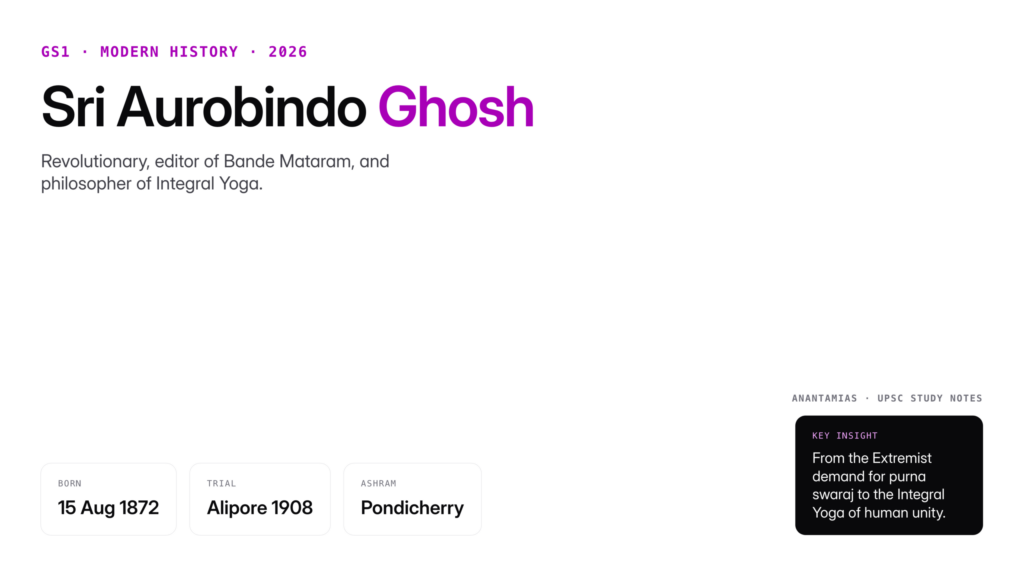
Sri Aurobindo Ghosh stands as one of the most extraordinary figures of modern India, a man who moved seamlessly from fiery political rebellion to deep spiritual realisation. Born in 1872, he was among the earliest leaders to openly demand complete independence from British rule, long before such language became mainstream in the Indian National Congress. His editorials in Bande Mataram, his involvement in the revolutionary underground of Bengal, and his trial in the Alipore Bomb Case made him a household name in the first decade of the twentieth century.
Yet the same Aurobindo who authored some of the most incendiary political writing of the Swadeshi era walked away from active politics after 1910 and settled in Pondicherry, where he evolved a sweeping spiritual vision known as Integral Yoga. For UPSC aspirants, his life is a rare case study that links the extremist phase of nationalism, the cultural renaissance of Bengal, and India’s modern philosophical traditions. Understanding Aurobindo Ghosh is essential for GS1 Modern History and Indian Culture, and for Essay and Ethics papers that probe the relationship between action and inner transformation.
Quick Facts at a Glance
| Field | Detail |
|---|---|
| Full name | Aurobindo Ghose (Sri Aurobindo) |
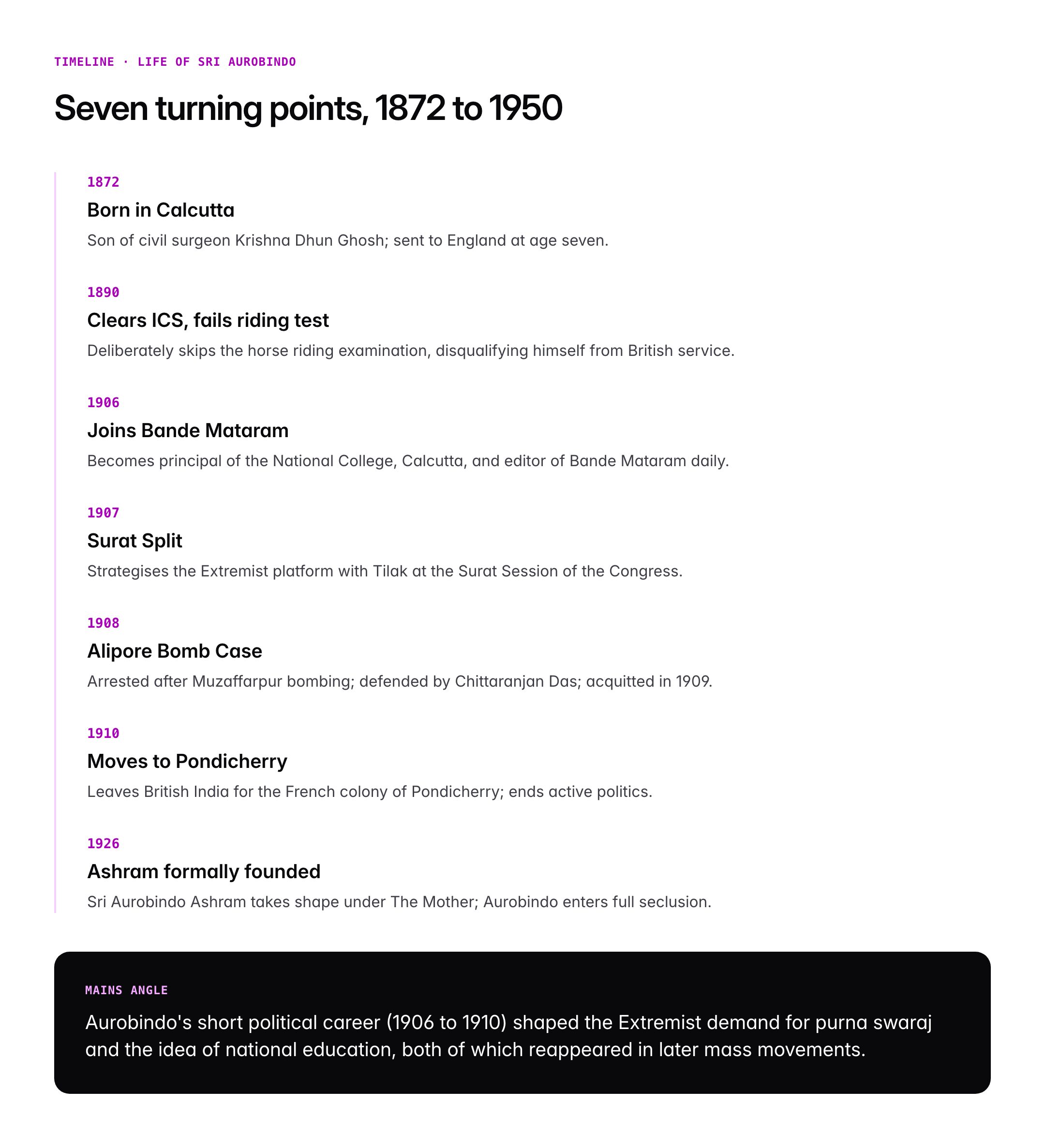
| Born | 15 August 1872, Calcutta, Bengal Presidency |
| Died | 5 December 1950, Pondicherry |
| Education | St. Paul’s School (London), King’s College, Cambridge |
| Civil Service | Qualified ICS but disqualified on riding test |
| Political phase | 1906 to 1910 |
| Key newspaper | Bande Mataram (English daily) |
| Major case | Alipore Bomb Case, 1908 to 1909 |
| Spiritual home | Sri Aurobindo Ashram, Pondicherry (from 1910) |
| Collaborator | Mirra Alfassa, known as The Mother |
| Signature philosophy | Integral Yoga, Supramental consciousness |
| Major works | The Life Divine, Essays on the Gita, Savitri |
Background and Historical Context
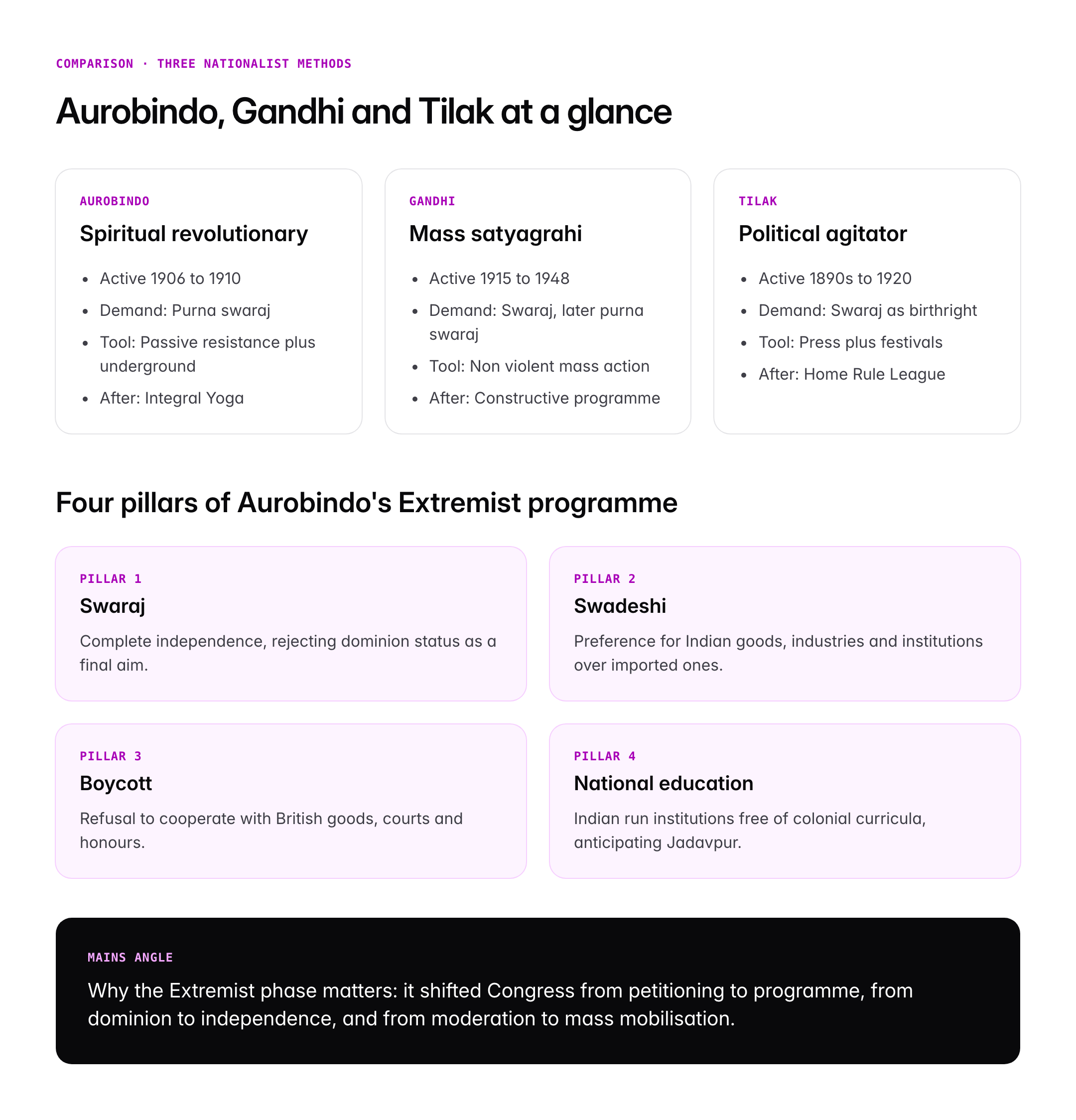
Aurobindo was born into the Ghosh family of Konnagar, Bengal, to Krishna Dhun Ghosh, a civil surgeon deeply anglicised in taste, and Swarnalata Devi, daughter of the reformer Rajnarayan Basu. His father sent the seven year old Aurobindo and his brothers to England in 1879 with strict instructions that they receive a thoroughly European upbringing and have no contact with Indian culture. The boys were placed with a clergyman in Manchester and later moved to St. Paul’s School in London and King’s College, Cambridge, where Aurobindo won prizes in classics and wrote precocious poetry.
The paradox of his youth is that this cultural distancing from India produced one of the most powerful Indian nationalists of his generation. While in England he joined a secret society called the Lotus and Dagger, read the speeches of Irish nationalists, and began to see the British Empire as an unjust political order. He cleared the Indian Civil Service examination in 1890 but deliberately skipped the riding test, ensuring disqualification. In 1893 he returned to India and joined the Baroda State service under the Gaekwad, spending thirteen relatively quiet years as an administrator, professor of English and French, and private tutor to the royal family.
The turning point was the partition of Bengal in 1905 by Lord Curzon. The Swadeshi and Boycott movement electrified young Bengal, and Aurobindo joined the new National College in Calcutta as its first principal, resigning from Baroda. He became the most influential voice of the Extremist or Garam Dal within the Congress, alongside Bal Gangadhar Tilak, Lala Lajpat Rai and Bipin Chandra Pal. The demand he placed before the nation was unambiguous, purna swaraj, complete independence, at a time when moderate Congress leaders still sought dominion status.
Key Features of His Life and Thought
Revolutionary and Editor
As editor of Bande Mataram from 1906, Aurobindo transformed the English press of Calcutta. His editorials argued that passive resistance was not timidity but disciplined political war, and that freedom was the natural birthright of a civilisation as old as India. His brother Barindra Kumar Ghosh ran the Manicktolla Garden revolutionary group, which manufactured bombs and trained young men in arms. When the Muzaffarpur bomb attack on Magistrate Kingsford on 30 April 1908 was traced back to this group, police raided the garden and arrested Aurobindo along with thirty four others.
The Alipore Bomb Case
The Alipore Bomb Case (1908 to 1909) was one of the longest political trials of colonial India. Aurobindo was defended by Chittaranjan Das, whose closing speech remains a masterpiece of Indian courtroom oratory. Aurobindo was eventually acquitted, but the year of solitary confinement in Alipore Jail changed him. He later wrote in his Uttarpara Speech that in his cell he had experienced the presence of Krishna and received a mandate to work for a deeper, spiritual freedom of India and humanity.
Move to Pondicherry
In 1910, warned of fresh sedition charges, Aurobindo moved first to Chandernagore and then to the French colony of Pondicherry, where he lived for the rest of his life. In 1926 he withdrew into complete seclusion, leaving the outward running of the Sri Aurobindo Ashram to Mirra Alfassa, known as The Mother. From 1926 to his death in 1950, he devoted himself to writing and what he called the descent of the Supramental consciousness.
Integral Yoga
Integral Yoga is Aurobindo’s central spiritual contribution. Unlike classical yogas that seek liberation by turning away from life, Integral Yoga aims to transform life itself. It integrates the path of knowledge, devotion and works, and posits a further stage of evolution in which the Supramental force descends into matter. Humanity, in his view, is a transitional species, not a final one.
Major Writings
His principal works include The Life Divine, a philosophical treatise on the nature of reality, Essays on the Gita, The Synthesis of Yoga, The Human Cycle, The Ideal of Human Unity, and the epic poem Savitri, running to nearly 24,000 lines, which he revised until weeks before his death.
Significance for UPSC and General Knowledge
- Aurobindo is the bridge figure between the Extremist political phase and the cultural and spiritual renaissance of modern India.
- His 1907 article series Doctrine of Passive Resistance anticipates later non cooperation methods, though with a more militant edge.
- He articulated purna swaraj almost two decades before the Lahore Congress Resolution of 1929.
- His philosophical work is routinely cited in GS4 Ethics as an example of inner transformation linked to public duty.
- His birthday, 15 August, coincides with India’s Independence Day, a fact he considered providential.
- UNESCO celebrated his 150th birth anniversary in 2022, and the Government of India constituted a high level committee to mark the occasion.
Detailed Analysis of His Political Contributions
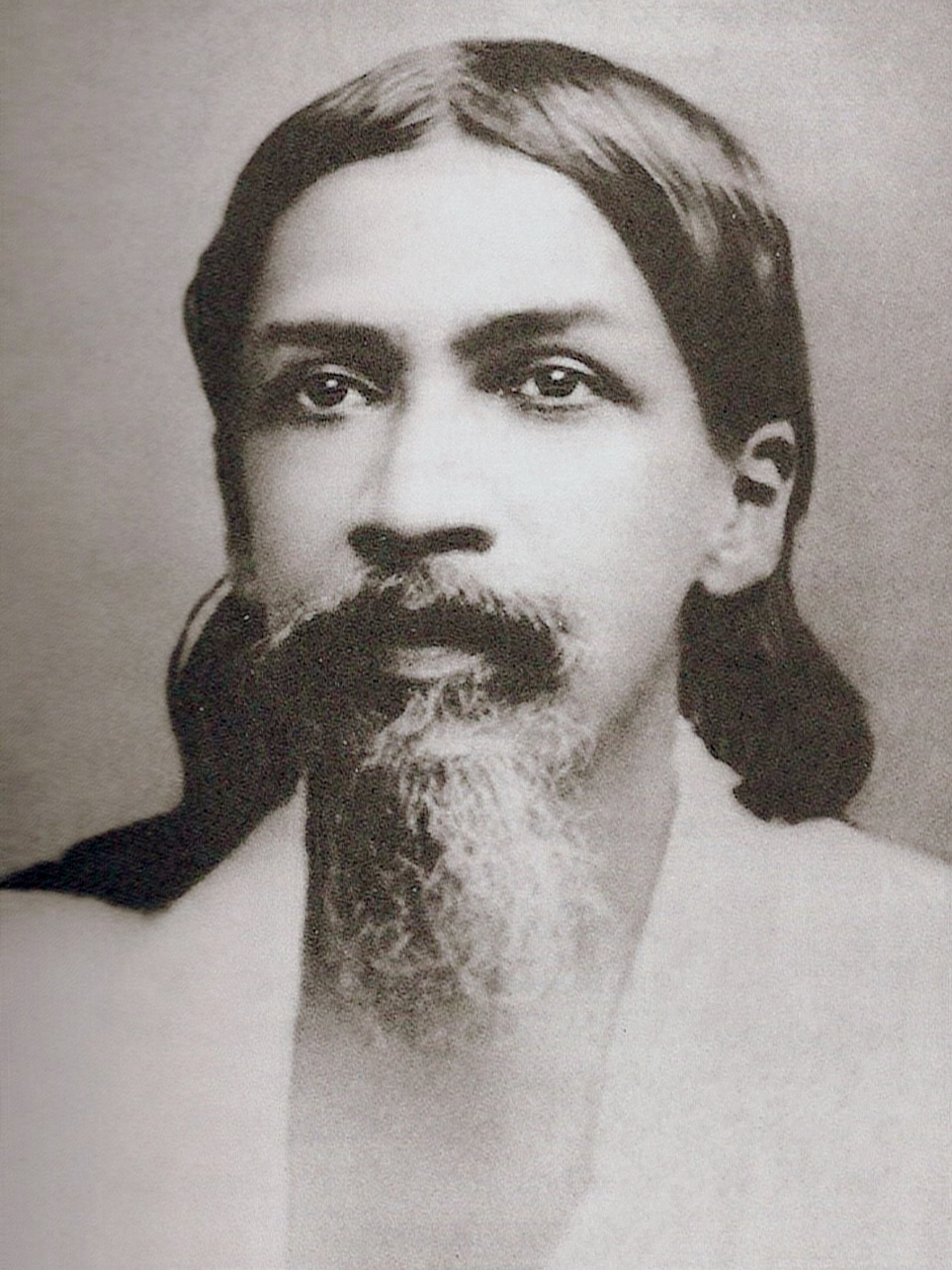
Aurobindo’s active political career lasted barely four years, from 1906 to 1910, yet his influence on the trajectory of Indian nationalism was disproportionate. At the Surat Session of the Congress in 1907, when the Moderate and Extremist factions split, Aurobindo was the chief strategist of the Extremist bloc alongside Tilak. He authored the political programme that was placed before the session, demanding swaraj, swadeshi, boycott and national education as the four pillars of the movement. The Moderates, led by Pherozshah Mehta and Gopal Krishna Gokhale, treated these demands as impractical, but within two decades each of them had become mainstream.
His journalism in Bande Mataram effectively created the template for Indian political writing in English. Where earlier newspapers like The Hindu and The Tribune argued for reform within the colonial framework, Bande Mataram treated independence as a non negotiable starting point. The British authorities prosecuted Aurobindo for sedition in 1907, the first of several such cases. The prosecution failed on a technicality, but the trial turned him into a national figure.
On the educational front, Aurobindo’s leadership of the National College in Calcutta, later renamed Jadavpur University, helped institutionalise the idea that Indians must educate themselves outside British controlled universities. The National Council of Education, of which he was a founding member, was a direct precursor to later swadeshi educational experiments by Rabindranath Tagore and Madan Mohan Malaviya.
His final contribution before withdrawal was to link political independence with cultural confidence. In essays like The Renaissance in India and The Foundations of Indian Culture, he argued that Indian civilisation had a unique spiritual core and that political freedom without cultural self respect would be hollow. This argument, though written between 1915 and 1920 after his withdrawal, shaped the cultural nationalism of the next generation, including figures as varied as K. M. Munshi, Ananda Coomaraswamy and later Jayaprakash Narayan.
Comparative Perspective
| Dimension | Aurobindo Ghosh | Mahatma Gandhi | Bal Gangadhar Tilak |
|---|---|---|---|
| Years active in politics | 1906 to 1910 | 1915 to 1948 | 1890s to 1920 |
| Core demand | Purna swaraj | Initially dominion, later purna swaraj | Swaraj is my birthright |
| Method | Passive resistance plus revolutionary underground | Satyagraha, strict non violence | Mass politics, press agitation |
| Faction | Extremist | Independent, later Congress leadership | Extremist |
| Legacy | Integral Yoga, spiritual evolution | Non violence, constructive programme | Mass political mobilisation |
Compared with Gandhi, Aurobindo was willing to accept revolutionary violence as a legitimate political tool in the 1906 to 1910 phase, though he later withdrew from all political action. Compared with Tilak, he supplied a philosophical and spiritual foundation that Tilak’s more pragmatic politics did not attempt. The difference with Vivekananda, often paired with him, is that Vivekananda worked almost wholly in the cultural and religious field, whereas Aurobindo moved from active political revolution to spiritual practice.
Controversies and Debates
Aurobindo’s legacy is not without debate. Historians like Sumit Sarkar and Peter Heehs have argued over how far he was personally involved in the revolutionary underground, particularly the Manicktolla group run by his brother. Heehs’s 2008 biography The Lives of Sri Aurobindo triggered a bitter legal and ideological controversy within the Ashram community, with some devotees seeking to ban the book in India.
A second debate concerns his withdrawal in 1910. Critics, including early Communist writers, argued that his retreat to Pondicherry deprived the national movement of one of its sharpest intellects at a crucial moment. Sympathetic scholars respond that his later writings on human unity, the psychology of social development and the evolution of consciousness have had a longer and deeper impact than a continued political career would have produced.
A third area of contention is the relationship between his thought and later right wing cultural nationalism. While Aurobindo’s emphasis on Indian civilisational confidence is sometimes invoked by Hindutva writers, his own position rejected narrow religious nationalism and insisted on human unity as the final goal.
Prelims Pointers
- Sri Aurobindo was born on 15 August 1872 in Calcutta.
- He cleared the Indian Civil Service examination but was disqualified on the horse riding test.
- He served in the Baroda State administration from 1893 to 1906.
- He became the first principal of the National College, Calcutta, in 1906.
- He edited the English daily Bande Mataram from 1906.
- The Alipore Bomb Case was conducted between 1908 and 1909.
- Chittaranjan Das was his defence counsel in the Alipore Bomb Case.
- His famous Uttarpara Speech was delivered in 1909.
- He moved to Pondicherry, then under French rule, in 1910.
- Sri Aurobindo Ashram was formally founded in 1926 under Mirra Alfassa, The Mother.
- His epic poem Savitri runs to nearly 24,000 lines.
- He died on 5 December 1950 in Pondicherry.
Mains Practice Questions
- Discuss the role of Sri Aurobindo Ghosh in the Extremist phase of the Indian National Movement. How did his vision of swaraj differ from that of the Moderates?
- Argue that Aurobindo articulated purna swaraj decades before Lahore 1929, using Bande Mataram editorials as evidence.
- Contrast his four pillar programme of swaraj, swadeshi, boycott and national education with Moderate petitioning.
- Conclude by noting his transition from political action to civilisational and spiritual concerns.
- Aurobindo’s Integral Yoga links personal transformation with social evolution. Examine this proposition in the context of contemporary Indian society.
- Define Integral Yoga as a synthesis of knowledge, devotion and action aimed at transforming life, not escaping it.
- Link his idea of human unity to current debates on pluralism, civic ethics and sustainable development.
- Conclude that his framework complements constitutional values like fraternity and dignity.
Conclusion
Sri Aurobindo Ghosh remains one of the most original minds produced by modern India. The arc of his life, from a thoroughly anglicised childhood in England to the extremist leadership of the Swadeshi movement, and finally to the seclusion of Pondicherry, resists any simple label. He was at once revolutionary, poet, philosopher, yogi and educationist, and his writings continue to find readers far beyond the community of his direct followers.
For the UPSC aspirant, the takeaway is not merely factual recall of dates and events but an understanding of how Indian nationalism, at its deepest, was never a purely political project. It carried within it a question about the kind of civilisation India wished to become. Aurobindo’s answer, that political independence must be matched by inner freedom and a vision of human unity, is still unfinished business. His thought remains relevant wherever questions of freedom, duty and the future of humanity are taken seriously.
Frequently Asked Questions
Who was Sri Aurobindo Ghosh?
Sri Aurobindo Ghosh (1872 to 1950) was an Indian nationalist, philosopher and yogi. He led the Extremist faction of the Indian National Congress during the Swadeshi movement, edited Bande Mataram, faced the Alipore Bomb Case, and later settled in Pondicherry where he developed Integral Yoga and founded the Sri Aurobindo Ashram with The Mother.
Why is Aurobindo Ghosh important for UPSC preparation?
He is central to GS1 Modern History because he articulated purna swaraj long before Lahore 1929, led the Bengal Extremists, and was tried in the landmark Alipore Bomb Case. His philosophical writings also feature in GS4 Ethics and the Essay paper, especially on themes of inner transformation and human unity.
How is Aurobindo Ghosh related to Mahatma Gandhi?
Both demanded Indian independence but differed in method and timing. Aurobindo led the Extremist wing between 1906 and 1910, accepting militant resistance, and then withdrew from politics in 1910, five years before Gandhi returned to India. Gandhi went on to build the mass satyagraha movement that Aurobindo never led.
What was the Alipore Bomb Case?
The Alipore Bomb Case was a 1908 to 1909 trial following the Muzaffarpur bombing by Khudiram Bose and Prafulla Chaki. Aurobindo Ghosh, his brother Barindra Kumar Ghosh and 34 others were charged with conspiracy. Chittaranjan Das defended Aurobindo, who was finally acquitted after over a year in Alipore Jail.
What is Integral Yoga?
Integral Yoga is Aurobindo’s spiritual system that integrates the classical yogas of knowledge, devotion and action. Unlike paths that seek liberation from life, Integral Yoga aims to transform life itself, bringing what he called the Supramental consciousness into matter, with humanity viewed as a transitional stage in evolution.
Why did Aurobindo move to Pondicherry?
In 1910, warned of fresh sedition prosecution by British authorities, Aurobindo took refuge in the French colonial town of Pondicherry where British law did not apply. What began as political asylum evolved into a four decade spiritual residence, culminating in the founding of the Sri Aurobindo Ashram in 1926.
What are the major works of Sri Aurobindo?
His major works include The Life Divine, a philosophical treatise on reality, Essays on the Gita, The Synthesis of Yoga, The Human Cycle, The Ideal of Human Unity, and the epic poem Savitri of nearly 24,000 lines. His political journalism is collected in Bande Mataram and Karmayogin.
What is the significance of 15 August in Aurobindo’s life?
15 August 1872 is Aurobindo’s birth date, and 15 August 1947 is India’s Independence Day. Aurobindo himself regarded this coincidence as providential, interpreting it in his Independence Day message of 1947 as confirmation that his spiritual mission and India’s political freedom were linked.
Tell Google you want more of this.
Add Anantam IAS as a preferred sourceOne tap, and this site shows up more often in your own Top Stories, AI Overviews and AI Mode. Remove it any time.