Introduction
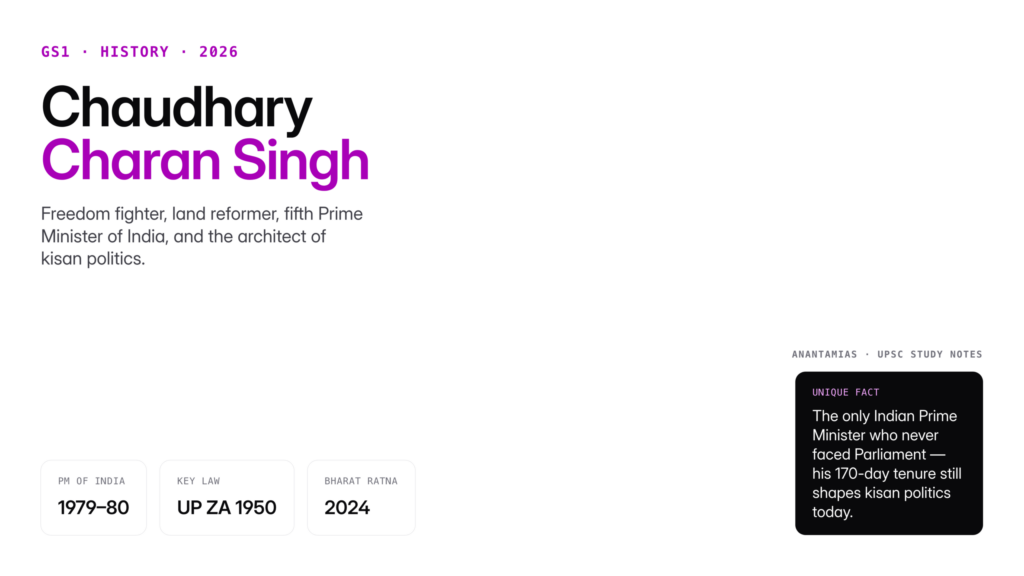
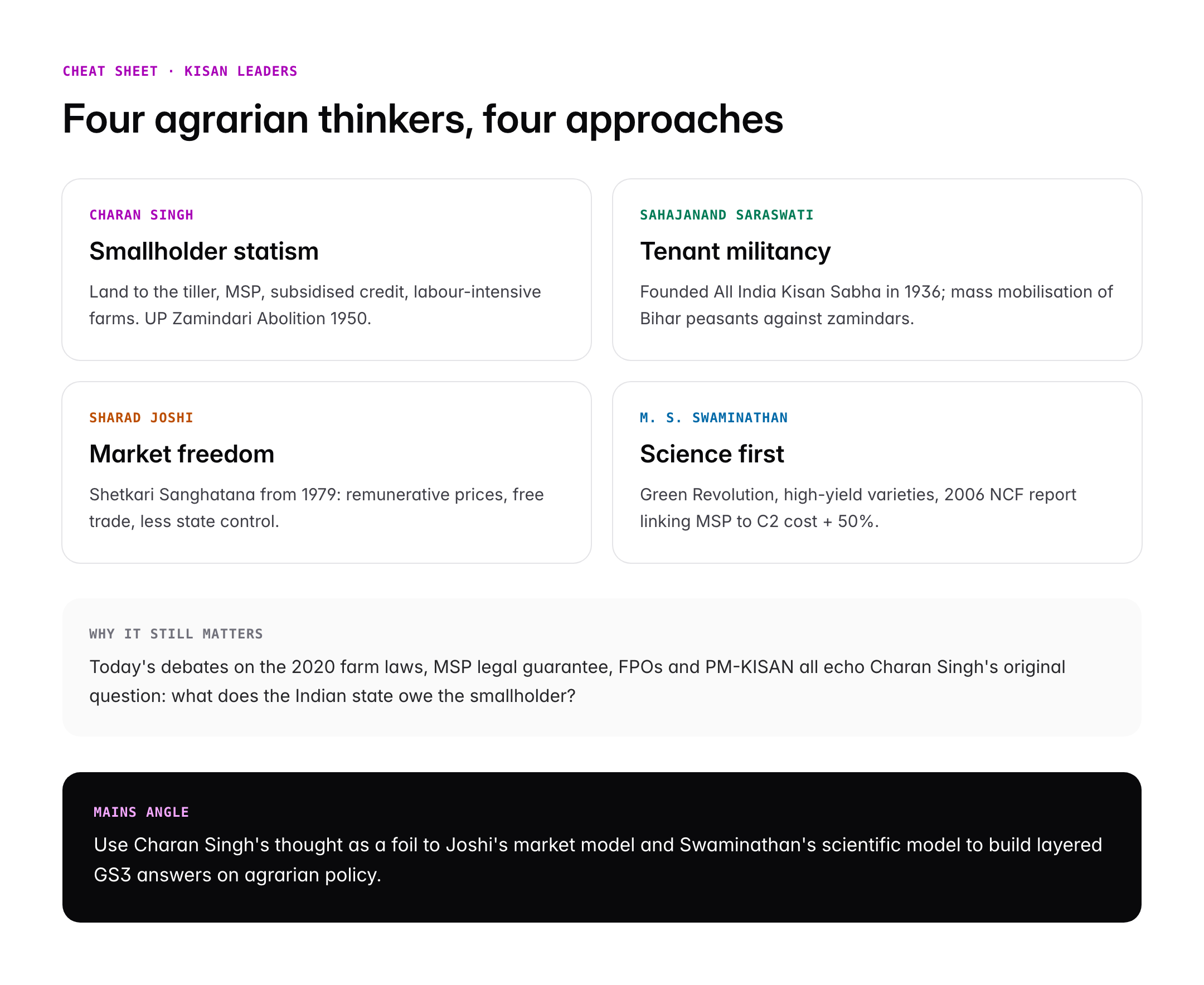
Chaudhary Charan Singh occupies a unique place in independent India’s history. He served as India’s fifth Prime Minister from July 1979 to January 1980, was twice Chief Minister of Uttar Pradesh, piloted some of the country’s boldest land reform laws, and built a political constituency around the Indian farmer that no leader before or since has quite matched. In 2024, seventy-seven years after independence, the Government of India conferred on him the Bharat Ratna, placing his legacy beside those of Sardar Patel and B. R. Ambedkar.
For UPSC aspirants, Charan Singh is indispensable. His career cuts across Modern Indian History, the Constitution-making generation, post-Independence agrarian reform, coalition politics of the Janata phase, and the political economy of rural India. Understanding him means understanding how the Green Revolution, zamindari abolition, and the middle-peasant caste mobilisation reshaped North India.
Quick Facts at a Glance
| Attribute | Detail |
|---|---|
| Born | 23 December 1902, Noorpur, Meerut district, United Provinces |
| Died | 29 May 1987, New Delhi |
| Prime Minister of India | 28 July 1979 to 14 January 1980 |
| Chief Minister of Uttar Pradesh | 1967 to 1968 and 1970 |
| Party founded | Bharatiya Kranti Dal (1967), Bharatiya Lok Dal (1974) |
| Key law | UP Zamindari Abolition and Land Reforms Act, 1950 |
| Famous work | India’s Poverty and its Solution (1964) |
| Bharat Ratna | 2024 (posthumous) |
| Farmer’s Day (Kisan Diwas) | 23 December, his birth anniversary |
Background and Historical Context
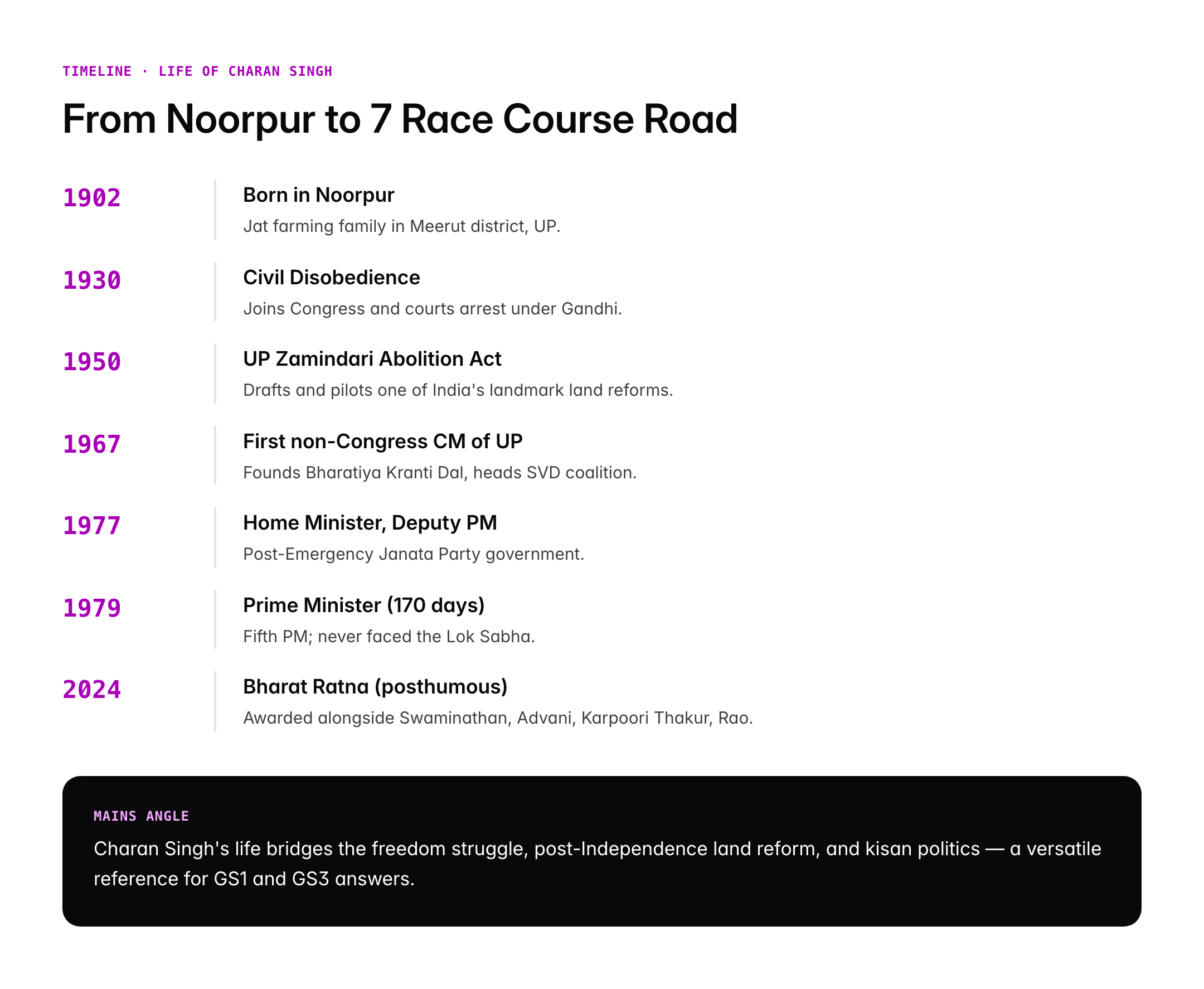
Chaudhary Charan Singh was born into a modest Jat farmer family in Noorpur village of Meerut district in 1902, when the United Provinces were still under direct British rule and agrarian distress was widespread. Educated in Meerut and at Agra College, he trained in law and began practice at Ghaziabad in 1928. The Civil Disobedience Movement of 1930 pulled him into the Indian National Congress, and he was jailed several times by the British, including during the Quit India Movement of 1942.
Post-Independence, he was elected to the UP Legislative Assembly and joined the Govind Ballabh Pant ministry. It was here that he drafted and piloted the landmark UP Zamindari Abolition and Land Reforms Act, 1950, one of India’s most important pieces of post-colonial agrarian legislation. The law dismantled the zamindari system inherited from the Mughal-British revenue structure and transferred land to those who tilled it, creating a class of owner-cultivators across western and central UP.
Through the 1950s and early 1960s Charan Singh served in various UP cabinets, consistently championing the smallholder against both landlord and the emerging industrial lobby. His 1964 book, India’s Poverty and its Solution, argued against Nehru’s heavy-industry-first model and advocated small and labour-intensive farms as the foundation of Indian development. This economic view was philosophically Gandhian but empirically agrarian, and it set him apart from the Congress mainstream.
By 1967 his differences with Congress were too sharp to bridge. He walked out with a group of MLAs, formed the Bharatiya Kranti Dal, and became Uttar Pradesh’s first non-Congress Chief Minister, heading a broad coalition known as the Samyukta Vidhayak Dal. He later merged his party into the Bharatiya Lok Dal in 1974 and played a central role in forming the Janata Party after the Emergency, serving as Home Minister and Deputy Prime Minister under Morarji Desai from 1977 to 1979.
Key Features: Biography and Public Life
Early Life and Freedom Struggle
Born to a farmer family in a landlocked western UP village, Chaudhary Charan Singh grew up witnessing recurrent famine and indebtedness among cultivators. He earned an MA and LL.B. from Agra College and set up legal practice in Ghaziabad. Drawn by Mahatma Gandhi’s call, he joined the Civil Disobedience Movement in 1930, and was subsequently imprisoned in 1940 during the Individual Satyagraha and again in 1942 during Quit India, spending nearly two years in prison.
Legislative Work in Uttar Pradesh
Elected from Chhaprauli in 1937 and repeatedly thereafter, Charan Singh entered the UP cabinet under G. B. Pant and later under Sampurnanand and C. B. Gupta. His most enduring work was drafting the UP Zamindari Abolition and Land Reforms Act, 1950, which abolished intermediaries, granted occupancy rights to actual cultivators, and imposed ceilings on land holdings. He also pushed the Land Holdings Act, 1960 to tighten ceilings and the Consolidation of Holdings Act to fragment-proof the countryside.
Chief Minister of UP
In April 1967 Charan Singh became the first non-Congress Chief Minister of Uttar Pradesh, leading a Samyukta Vidhayak Dal coalition. He served a second term briefly in 1970. Both tenures were marked by pro-farmer policies, fiscal prudence and anti-corruption rhetoric.
National Role and Prime Ministership
After the Emergency (1975 to 1977), Charan Singh merged his Bharatiya Lok Dal into the Janata Party alliance that defeated Indira Gandhi. As Home Minister and Deputy Prime Minister under Morarji Desai, he ordered the arrest of Indira Gandhi in October 1977, a politically costly move that backfired. When the Janata government collapsed in July 1979, Charan Singh, backed by Congress (U) and external support from the Indian National Congress, became the fifth Prime Minister of India on 28 July 1979.
His tenure lasted just 170 days. Before he could even face Parliament, Congress withdrew support, and he resigned on 20 August 1979 but remained caretaker PM until Indira Gandhi returned to power in January 1980. He thus has the unique distinction of being a PM who never faced the Lok Sabha.
Post-Prime-Ministership and Legacy
Charan Singh founded the Lok Dal and later the Dalit Mazdoor Kisan Party, remaining the patriarch of North Indian kisan politics until his death on 29 May 1987. His son Ajit Singh continued the political legacy, heading the Rashtriya Lok Dal, and his grandson Jayant Chaudhary leads the party today.
Significance for UPSC and General Knowledge
- Charan Singh’s 1950 UP Zamindari Abolition Act is a textbook example of post-Independence land reform and a frequent Mains topic on agrarian restructuring.
- As India’s fifth Prime Minister, he holds the record of never having faced Parliament, a unique constitutional footnote.
- Kisan Diwas, celebrated on 23 December (his birthday), is a fixed Prelims fact and ties to MSP and farmer welfare debates.
- His 2024 Bharat Ratna placed him in the select list of posthumous awardees like Ambedkar, Rajiv Gandhi, Patel, M. S. Swaminathan, Karpoori Thakur and P. V. Narasimha Rao.
- Charan Singh’s thought anticipates current debates on small-farm viability, minimum support prices, and agricultural market reforms.
- His Janata-era role connects Emergency history, coalition politics, and centre-state tensions, linking GS Paper I and II.
Detailed Analysis: Political Contributions
Charan Singh’s political contributions can be grouped into four areas. The first is land reform. The UP Zamindari Abolition Act of 1950 freed roughly two million cultivators from rent-paying dependence, allowed them to purchase their land at low prices over ten years, and became a model that influenced laws in Bihar, Madhya Pradesh, Rajasthan and elsewhere. Ceiling laws, consolidation, and bhoodan together produced one of the largest rural land transfers outside a communist revolution in the twentieth century.
The second contribution is farmer political consciousness. Until Charan Singh, Indian politics was dominated either by the Congress elite or by caste and linguistic movements. He crafted a new identity of the kisan as a political category cutting across Jat, Yadav, Kurmi, Lodh and lower middle castes, what political scientists today call the Other Backward Classes (OBC) consolidation of North India. The subsequent rise of Mulayam Singh Yadav, Lalu Prasad Yadav and Nitish Kumar owes significant ideological debt to this imagination.
The third contribution is intellectual and policy writing. His works, particularly India’s Poverty and its Solution (1964) and Economic Nightmare of India (1981), offered a coherent critique of Nehruvian planning. He argued that India’s labour abundance made labour-intensive smallholder agriculture more efficient than mechanised large farms, and that public investment should flow to irrigation, rural credit and fertiliser rather than steel plants and heavy industry. Many of these ideas resurfaced in the New Agricultural Policy debates and are echoed in contemporary arguments for FPOs and cooperative agriculture.
The fourth contribution is anti-corruption and coalition politics. His insistence on probity cost him several positions in UP, and his principled resignations from Congress paved the way for the 1967 non-Congress governments that first shook one-party dominance. He was the prototype of the North Indian regional leader who combined ideological rigour with caste-rooted mobilisation.
Comparative Perspective
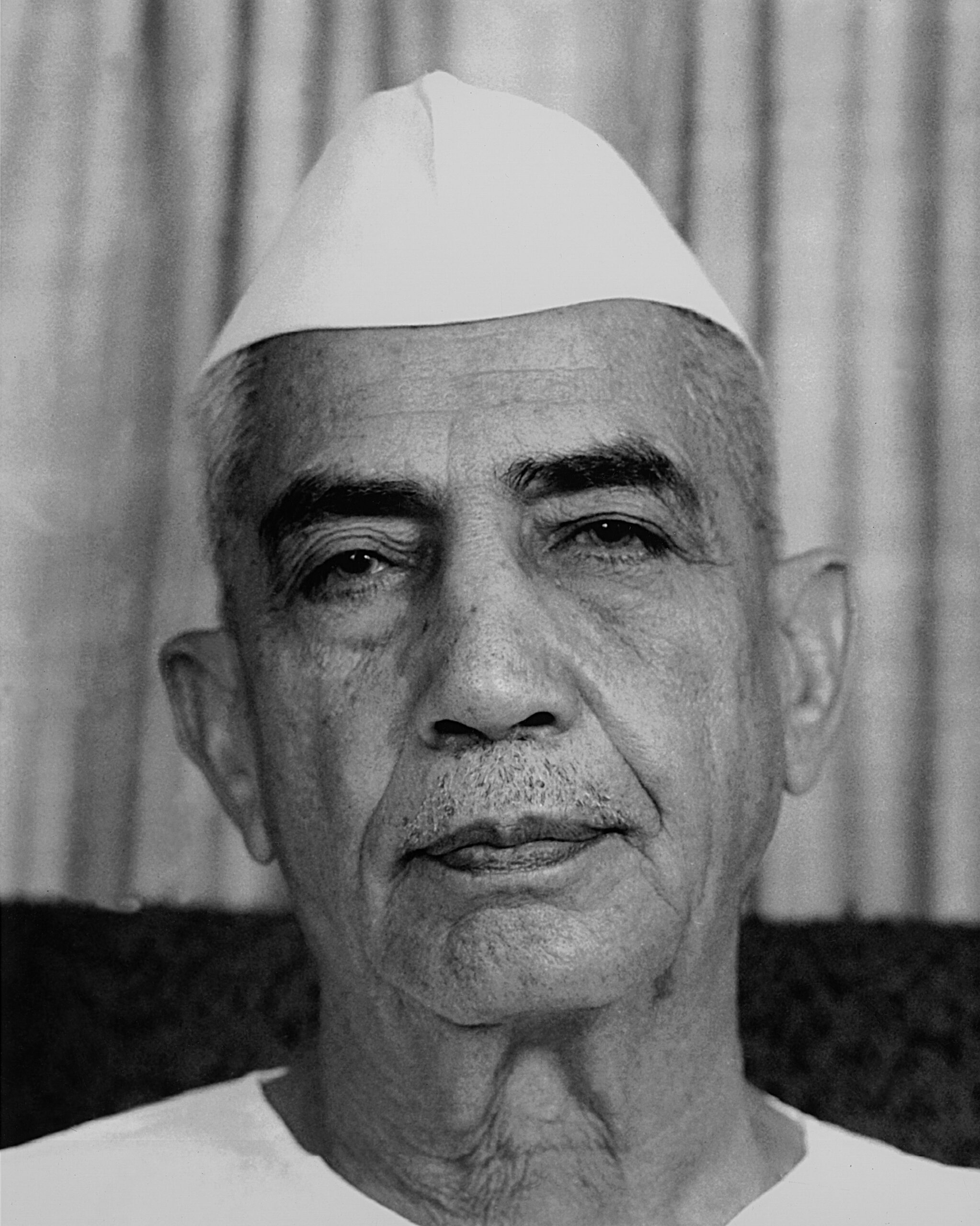
Charan Singh is best placed alongside other agrarian leaders of twentieth-century India to understand his distinctiveness.
| Leader | Core constituency | Main contribution | Era |
|---|---|---|---|
| Chaudhary Charan Singh | Western UP kisan, Jat, small OBCs | UP Zamindari Abolition, farmer movement | 1950s to 1987 |
| Sahajanand Saraswati | Bihar tenants, All India Kisan Sabha | Kisan Sabha movement | 1930s to 1950s |
| N. G. Ranga | Andhra ryots | Peasant organisation, Swatantra Party | 1930s to 1970s |
| Sharad Joshi | Maharashtra cash-crop farmers | Shetkari Sanghatana, market freedom | 1970s to 2015 |
| M. S. Swaminathan | National agronomy | Green Revolution, MSP Commission | 1960s to 2023 |
Compared with Sahajanand Saraswati, Charan Singh was more institutional and parliamentary. Compared with Sharad Joshi, he was more statist, favouring price support over market liberalisation. His balance between protection and modernisation anticipates the current debates over the 2020 farm laws, their repeal, and the Minimum Support Price question.
Controversies and Debates
Charan Singh’s career was not without controversy. His decision as Home Minister in 1977 to order the arrest of Indira Gandhi in the wake of the Shah Commission proceedings was widely criticised as politically clumsy and arguably generated sympathy that fuelled her 1980 comeback. His short-lived prime ministership of 1979, relying on Congress support that was withdrawn before he could prove his majority, is often cited as a cautionary tale on coalition-building and opportunism.
Critics have argued that his farmer politics benefited medium and large landholders more than the truly landless, and that the zamindari abolition in UP did not go far enough in redistributing ceiling surplus land to Dalits and adivasis. Feminist historians have noted that the kisan category he built was largely male-headed, and women cultivators remained structurally invisible in his framework.
The 2024 posthumous Bharat Ratna, announced alongside the awards to Karpoori Thakur and Narasimha Rao, drew both praise and questions about the political timing, though scholarly consensus holds his land-reform record alone makes the award well-deserved. Debates continue on whether his small-farm thesis is still tenable in an era of climate stress, declining land size, and the consolidation pressures of agricultural value chains.
Prelims Pointers
- Chaudhary Charan Singh was born on 23 December 1902 at Noorpur, Meerut district.
- 23 December is celebrated as Kisan Diwas (Farmer’s Day) in his honour.
- He became the fifth Prime Minister of India on 28 July 1979.
- He is the only Indian PM who never faced the Lok Sabha.
- He piloted the UP Zamindari Abolition and Land Reforms Act, 1950.
- He wrote India’s Poverty and its Solution (1964) and Economic Nightmare of India (1981).
- He founded the Bharatiya Kranti Dal in 1967 and Bharatiya Lok Dal in 1974.
- He was twice Chief Minister of Uttar Pradesh in 1967 and 1970.
- He served as Home Minister and Deputy PM in the Morarji Desai cabinet, 1977.
- He was awarded the Bharat Ratna posthumously in 2024.
- Kisan Ghat in New Delhi is his samadhi.
- His son Ajit Singh and grandson Jayant Chaudhary continued his political legacy through the RLD.
Mains Practice Questions
- “Chaudhary Charan Singh’s land reforms transformed rural Uttar Pradesh more than any other legislation of the first two decades of independence.” Discuss. (250 words)
- UP Zamindari Abolition Act, 1950: mechanism and scope.
- Consolidation and ceiling laws.
- Social outcomes: rise of owner cultivators, persistence of landless labour, gender blind spots.
- Examine the political and economic thought of Chaudhary Charan Singh in the context of contemporary Indian agrarian debates. (250 words)
- Critique of Nehruvian heavy industry model.
- Smallholder-led development and labour-intensive farming.
- Relevance to MSP, farm laws, FPOs, and climate-resilient agriculture.
Conclusion
Chaudhary Charan Singh’s life demonstrates how ideas, institutions and identity can converge in a single career. From a village in Meerut to the Prime Minister’s chair, he embodied the transition of rural India into the political mainstream. His land reforms gave land to cultivators, his writings gave voice to small farmers, and his politics gave North India an agrarian vocabulary that continues to dominate state legislatures.
For UPSC aspirants, his legacy is both a historical subject and a live policy question. The issues he raised, from farmer income to rural credit to land fragmentation, remain central to today’s discussions of MSP, the repealed farm laws, and climate-resilient agriculture. The 2024 Bharat Ratna is a fitting recognition, but it is in Mains answers and Prelims MCQs that Charan Singh’s memory will keep its most active afterlife.
Frequently Asked Questions
Who was Chaudhary Charan Singh?
Chaudhary Charan Singh (1902 to 1987) was an Indian freedom fighter, lawyer, and statesman who served as the fifth Prime Minister of India from July 1979 to January 1980 and twice as Chief Minister of Uttar Pradesh. He is remembered as the architect of UP’s 1950 Zamindari Abolition Act and as India’s foremost champion of small and marginal farmers.
Why is Chaudhary Charan Singh important for UPSC?
His career covers the freedom movement, post-Independence land reforms, Janata-era coalition politics, and India’s agrarian economic debate. He is central to GS Paper I (Modern History, Post-Independence), GS Paper II (Parliament and Prime Ministership), and GS Paper III (agriculture and land reforms), and is a common biographical subject in essay and interview rounds.
How is Chaudhary Charan Singh related to the farmers’ movement in India?
He built the modern political identity of the Indian kisan by mobilising Jats, Yadavs, Kurmis and other smallholders across North India. Through the Bharatiya Kranti Dal, Bharatiya Lok Dal and Lok Dal, he placed minimum support prices, irrigation, rural credit and fertiliser subsidies at the centre of state policy, inspiring later farmer-leaders from Mulayam Singh Yadav to Jayant Chaudhary.
When did Chaudhary Charan Singh become Prime Minister?
Charan Singh became India’s fifth Prime Minister on 28 July 1979, heading a government backed by Congress (U) and supported externally by the Indian National Congress. His tenure lasted about 170 days, ending on 14 January 1980 when Indira Gandhi returned to power. He has the unique distinction of being a Prime Minister who never faced the Lok Sabha.
What was the UP Zamindari Abolition Act of 1950?
The Uttar Pradesh Zamindari Abolition and Land Reforms Act of 1950, drafted and piloted by Charan Singh, dismantled the zamindari system inherited from colonial rule. It abolished intermediaries, vested land directly in the state, and transferred occupancy and ownership rights to actual cultivators, benefitting roughly two million tenants and becoming a model for land reform laws in other states.
Why is 23 December celebrated as Kisan Diwas?
23 December is observed as Kisan Diwas or Farmer’s Day in India to commemorate the birth anniversary of Chaudhary Charan Singh in 1902. The Government of India formally marks the day with programmes highlighting agricultural policy, farmer welfare schemes like PM-KISAN, and the contributions of the rural sector, reflecting Charan Singh’s lifelong advocacy for cultivators.
When was Chaudhary Charan Singh awarded the Bharat Ratna?
The Government of India announced the Bharat Ratna for Chaudhary Charan Singh in February 2024, seventy-seven years after independence and almost thirty-seven years after his death. The award was conferred posthumously, alongside similar honours for Karpoori Thakur, M. S. Swaminathan, L. K. Advani and P. V. Narasimha Rao, recognising his role in land reform and farmer welfare.
What are Chaudhary Charan Singh’s key writings?
His most influential works are India’s Poverty and its Solution (1964) and Economic Nightmare of India (1981). Together they argue against Nehru-era heavy-industry-led planning and advocate labour-intensive smallholder agriculture as the engine of Indian development. They remain important references in contemporary debates on agrarian policy, MSP and the viability of small farms.
Tell Google you want more of this.
Add Anantam IAS as a preferred sourceOne tap, and this site shows up more often in your own Top Stories, AI Overviews and AI Mode. Remove it any time.