Daily Digest
UPSC · Civil Services Examination
Current Affairs · Wednesday, 1 July 2026
Current affairs curated and edited by Anantam IAS faculty — pulled from The Hindu, PIB, IDSA, Foreign Affairs and the ministries. Read, annotate, revise.
Old Rajinder Nagar · Delhi 110005 · anantamias.com
VB-G RAM G Wage Rates: New Rural Job-Scheme Pay Band
Why in News?
PIB confirmed that the Centre has notified revised daily wage rates under the Viksit Bharat – Guarantee for Rozgar and Ajeevika Mission (Gramin), or VB-G RAM G Act, 2025, with effect from 1 July 2026.
Indian Express reported that the new rates replace the running MGNREGA wage schedule for rural employment, with most notified daily wages lying between Rs 300 and Rs 409, and a special Rs 450 rate for three high-altitude Gram Panchayats in Sikkim.
- The official notification creates a Rs 300 interim base wage, so no notified wage under the programme falls below that level.
- PIB said wage rates have increased across 34 States, UTs and wage regions, with the average notified wage rising from Rs 298.8 under MGNREGA to Rs 327.4 under VB-G RAM G.
- The largest percentage gains go to historically lower-wage regions, including Arunachal Pradesh and Nagaland, where PIB placed the increase at nearly 24.5 percent.
- Indian Express listed Haryana at Rs 409, Goa at Rs 406, Kerala at Rs 401, and high-altitude Sikkim Gram Panchayats at Rs 450.
- The notification matters because wage rates are only one part of the shift from MGNREGA 2005 to a new law with changed work guarantees, planning rules and fiscal design.
The development matters in the context of:
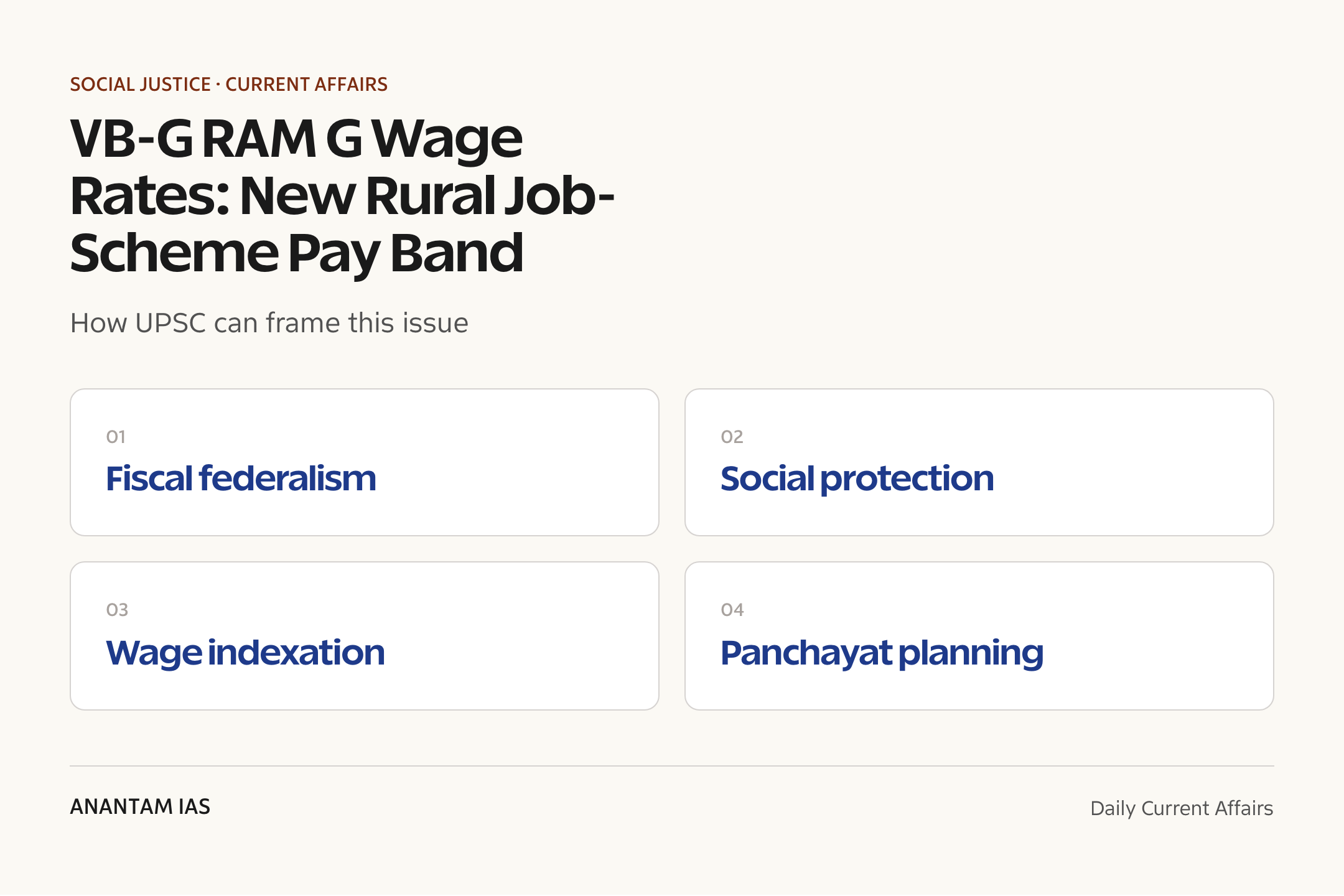
- For GS-II, the issue sits at the intersection of welfare schemes, rural livelihoods, federalism and rights-based social protection.
- For governance, the key question is whether a higher notified wage floor can coexist with timely payments, transparent work demand, and accountable Gram Panchayat planning.
- For public finance, the debate shifts from headline wage gains to Centre-State cost sharing, normative allocation and the fiscal capacity of poorer States.
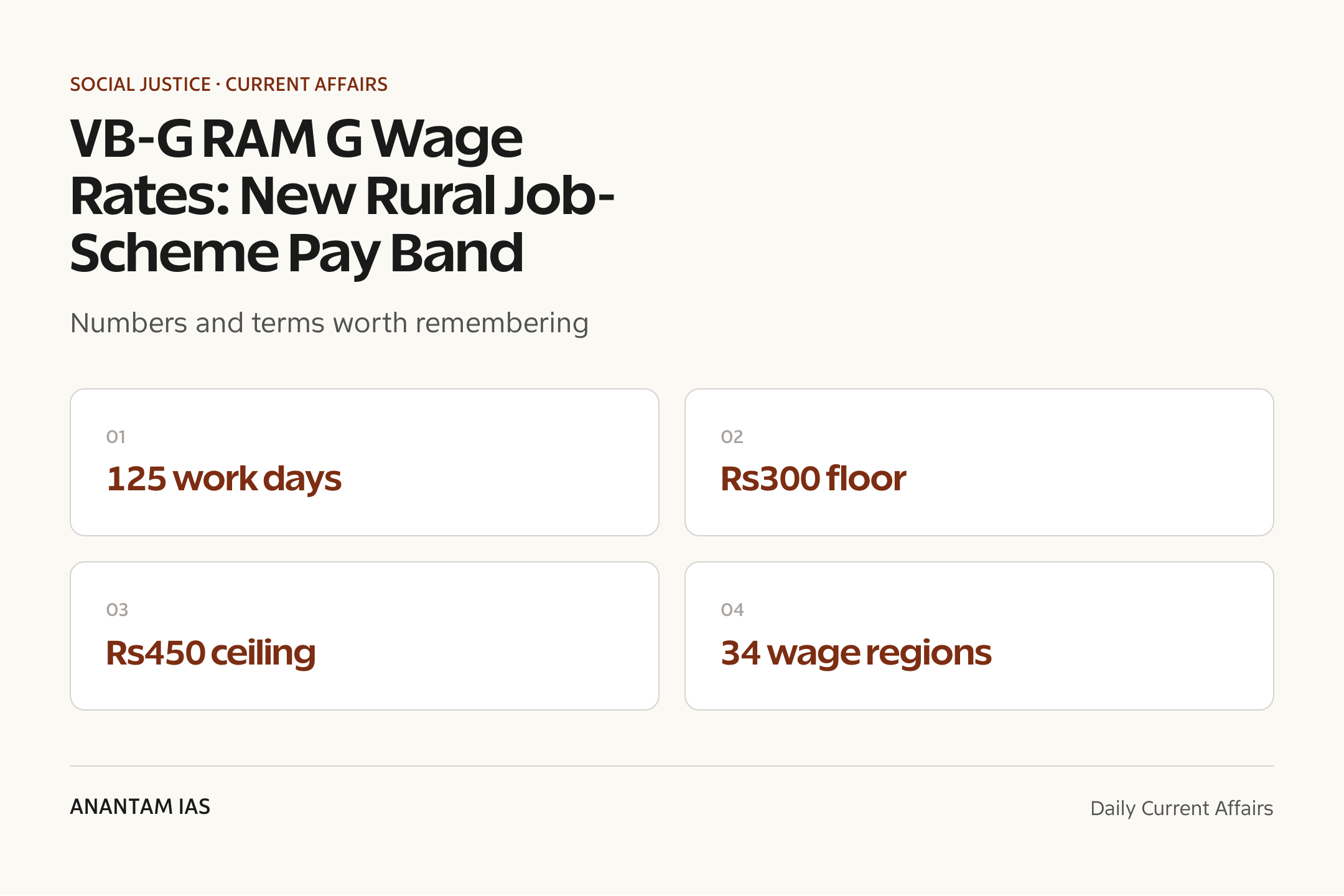
UPSC Relevance
Prelims Relevance
- VB-G RAM G stands for Viksit Bharat – Guarantee for Rozgar and Ajeevika Mission (Gramin).
- The Act came into force across rural India from 1 July 2026.
- The new law enhances the statutory wage employment guarantee from 100 days to 125 days for every eligible rural household.
- The notified wage floor is Rs 300 per day under the interim base wage rate.
- The highest standard state wage in the notification is Rs 409 for Haryana, while select Sikkim Gram Panchayats have a Rs 450 rate.
- Section 10 of the VB-G RAM G Act empowers the Centre to specify wage rates for unskilled manual work under the scheme.
- The wage rate notified under VB-G RAM G cannot be lower than the prevailing rate notified under Section 6 of MGNREGA, 2005.
- PRS notes that state schemes must align with the new law, while Gram Panchayats retain a role in identifying and planning local works.
- This topic links directly to the UPSC syllabus areas of welfare schemes, poverty, rural development and federal governance.
Mains Relevance
GS Paper 2
- Welfare schemes for vulnerable sections, especially the rural poor and landless labourers.
- Centre-State relations in the implementation and financing of centrally sponsored schemes.
- Accountability, transparency and service delivery in rights-based employment programmes.
GS Paper 3
- Inclusive growth through wage employment, rural asset creation and purchasing power.
- Agriculture-rural labour linkages, including the design choice to pause works during peak farm seasons.
GS Paper 4
- Ethics of welfare delivery: dignity of labour, fairness in wage setting and non-exclusion of eligible households.
Essay
- Social protection is strongest when it combines legal entitlement, fiscal credibility and local accountability.
- Rural development is not only income support; it is also the creation of durable community assets.
- Federalism in welfare delivery tests both constitutional design and everyday administrative trust.
Background and Context
What changed from July 2026
The wage notification operationalises the new rural employment law from the first day of July 2026.
- The VB-G RAM G Act, 2025 replaces the two-decade-old MGNREGA framework for guaranteed rural wage employment.
- The official notification applies from 1 July 2026, the same date on which the Act begins nationwide operation.
- The law increases the statutory guarantee from 100 days to 125 days of wage employment for eligible rural households.
- The Centre has framed the wage revision as a livelihood-security measure, while the exam-relevant issue is the design of a new rights-based welfare scheme.
The new wage band
The notified rates create a higher national floor and a differentiated wage band across states and wage regions.
- The notification sets a Rs 300 interim base wage, bringing 21 States, UTs and administrative units up to that floor.
- PIB placed the national average notified wage at Rs 327.4 per day, up from Rs 298.8 under the previous MGNREGA wage structure.
- Indian Express reported that Haryana has a notified wage of Rs 409, followed by Goa at Rs 406 and Kerala at Rs 401.
- Three high-altitude Gram Panchayats in Sikkim – Gnathang, Lachung and Lachen – have a special Rs 450 daily wage.
- The lowest-wage regions gain more in percentage terms, while already higher-wage States receive smaller revisions under the notified methodology.
Legal basis for wage notification
The wage-setting power is located inside the new Act, but it is tied to the earlier MGNREGA protection.
- Section 10 of the VB-G RAM G Act allows the Central Government to specify the wage rate for unskilled manual work under the scheme.
- The Centre can notify different wage rates for different areas, which explains the state-wise and region-wise wage schedule.
- The law states that the notified wage cannot be less than the wage rate notified under Section 6 of MGNREGA, 2005.
- This link to MGNREGA matters because it prevents the new law from formally lowering the wage floor during the transition.
- For Prelims, remember the institutional continuity: new law, changed guarantee period, but wage protection benchmarked against MGNREGA.
Why the design is politically sensitive
The state-level debate is not only about daily wages; it is about who pays, who plans and who bears overruns.
- PRS records that the Bill shifts implementation to a centrally sponsored scheme model, with regular States sharing costs in a 60:40 ratio.
- For North-eastern and Himalayan States, PRS lists a more favourable 90:10 Centre-State sharing pattern.
- States must bear expenditure above the Centre’s normative allocation, which can create friction if work demand exceeds the approved fiscal envelope.
- State governments also remain responsible for unemployment allowance and compensation in case of delayed wage payments.
- This makes VB-G RAM G a live case study for cooperative federalism and fiscal federalism in welfare delivery.
Planning and works under the new framework
The new law retains local planning but connects it to broader development and asset-creation priorities.
- Gram Panchayats continue to identify projects and prepare local work plans, preserving the decentralised planning logic of rural employment law.
- PRS says works will focus on water security, rural infrastructure, livelihood-related infrastructure and mitigation of extreme weather events.
- The plans are to be integrated with the PM Gati Shakti National Master Plan, linking wage employment to infrastructure planning.
- The law also requires States to announce in advance a work-pause period of up to 60 days during peak agricultural seasons.
- For Mains, this creates a tradeoff: avoid labour shortage during sowing and harvesting, but protect poor households from losing income in lean periods.
Technology and accountability layer
The law expands the monitoring toolkit, but technology can improve or weaken access depending on implementation.
- PRS lists biometric authentication, geospatial technology, mobile dashboards and weekly public disclosure systems in the law’s technology architecture.
- These tools can reduce ghost works, improve measurement and make local assets easier to audit.
- But biometric or app-based systems can also exclude workers when connectivity, device access or authentication fails.
- The governance test is not whether technology exists; it is whether the system preserves demand for work, timely wage payment and a grievance path.
- This connects VB-G RAM G with the broader debate on welfare schemes for vulnerable sections.
Way Forward
Protect the entitlement character
- Keep the legal right to demand work visible at the Gram Panchayat level through simple job-card, demand-registration and dated-receipt systems.
- Publish state-wise data on work demanded, work provided, unemployment allowance and payment delays in a worker-readable format.
- Ensure that the 125-day guarantee is not reduced to a budget ceiling in districts with high distress demand.
Make wage revision credible
- Link future wage revisions to a transparent indexation formula that reflects rural inflation and regional cost differences.
- Track whether the Rs 300 floor narrows wage disparities without pushing poorer States into arrears.
- Release state-wise payment-delay dashboards because a higher notified wage has little value if wage credit is late.
Balance federal finance and local planning
- Define the normative allocation formula clearly, with transparent demand, poverty, climate-risk and asset-deficit parameters.
- Create a consultation mechanism for States before annual allocations and before any agricultural-season work pause.
- Allow Gram Panchayat plans to remain locally grounded while aligning durable assets with water security, livelihood and resilience goals.
Conclusion
The VB-G RAM G wage notification is more than a pay revision. It marks the operational shift from MGNREGA to a new rural employment law with a higher wage floor, longer guarantee period and a more formalised development-planning architecture.
For UPSC, the core issue is the balance between social protection and fiscal federalism. A scheme can announce higher wages, but its real test lies in demand-based work, timely payment, fair cost sharing and accountable local asset creation.
UPSC Practice Questions
Prelims MCQ 1
With reference to the VB-G RAM G Act, 2025, consider the following statements:
- It enhances the statutory rural wage employment guarantee from 100 days to 125 days.
- The notified wage rate under the Act can be lower than the wage notified under Section 6 of MGNREGA, 2005.
- The Act allows different wage rates to be notified for different areas.
How many of the above statements are correct?
(a) Only one (b) Only two (c) All three (d) None
Answer: (b) Only two
Explanation:
Statements 1 and 3 are correct. Statement 2 is incorrect because the wage notified under VB-G RAM G cannot be lower than the prevailing wage notified under Section 6 of MGNREGA, 2005.
Prelims MCQ 2
Which one of the following best describes the interim base wage introduced under the VB-G RAM G wage notification?
(a) Rs 241 per day (b) Rs 298.8 per day (c) Rs 300 per day (d) Rs 409 per day
Answer: (c) Rs 300 per day
Explanation:
PIB stated that the notification introduced a Rs 300 interim base wage, ensuring that no notified wage under the programme is below Rs 300 per day.
UPSC Mains Questions
- The VB-G RAM G Act raises the rural employment guarantee to 125 days, but also changes fiscal and administrative responsibilities. Analyse its implications for social protection and Centre-State relations.
- A higher wage floor in rural employment schemes can reduce distress, but only when backed by timely payment and local accountability. Discuss in the context of the VB-G RAM G wage notification.
- Examine how Gram Panchayat planning, technology-based monitoring and wage indexation can shape the success of the new rural employment framework.
Sources: PIB, Ministry of Rural Development and Indian Express.
Frequently Asked Questions
What is VB-G RAM G?
VB-G RAM G means Viksit Bharat – Guarantee for Rozgar and Ajeevika Mission (Gramin). It is the new statutory rural employment framework that came into force from 1 July 2026 and replaces the earlier MGNREGA-based wage employment structure.
What wage floor was notified?
The Centre notified an interim base wage of Rs 300 per day. PIB said this ensures that no notified wage under the programme falls below Rs 300, while higher rates apply in several States and wage regions.
Which areas get the highest rate?
Indian Express reported a special Rs 450 daily wage for Gnathang, Lachung and Lachen Gram Panchayats in Sikkim. Among standard state rates, Haryana is listed at Rs 409, followed by Goa at Rs 406 and Kerala at Rs 401.
How is it different from MGNREGA?
The new law raises the statutory employment guarantee from 100 days to 125 days. It also changes funding design, planning architecture and technology-based monitoring while retaining key elements such as local work planning and unemployment allowance.
Why are states concerned?
The concern is fiscal and administrative. PRS notes that the scheme follows a cost-sharing model, places excess spending beyond normative allocation on States, and keeps States responsible for unemployment allowance and delayed-payment compensation.
Why is it important for UPSC?
It links GS-II social justice, welfare schemes, federalism and governance with GS-III inclusive growth. The topic also helps analyse how legal entitlements work when finance, technology, local planning and labour-market conditions interact.
Source: https://anantamias.com/current-affairs/vb-g-ram-g-wage-rates/
Uniform Civil Code Bill: West Bengal’s State-Level Test
Why in News?
The Hindu reported that the West Bengal government plans to introduce a Uniform Civil Code Bill in the State Assembly in August 2026.
The proposal matters because a State-level UCC tests the relationship between Article 44, personal laws, cultural diversity, federal competence and fundamental rights.
- Cabinet step: the State Cabinet is expected to give in-principle approval to the proposal on July 2, 2026.
- Committee: a panel led by retired Supreme Court judge Justice Ranjana Prakash Desai will study family laws in the State.
- Timeline: the committee is expected to submit its report to the State government in four weeks.
- Scope: the study covers family-law areas such as marriage, succession and live-in relationships.
- Exclusion: the Chief Minister said Adivasis, indigenous people, Kurmis and other recognised ancient tribal communities would be kept outside the proposed law.
- Political context: The Hindu reported that Opposition MLAs protested in the Assembly while the announcement was made.
The development matters in the context of:
- Article 44 directs the State to work towards a uniform civil code for citizens, but it sits in the non-justiciable Directive Principles.
- Entry 5 of the Concurrent List gives both Parliament and State Legislatures space to legislate on marriage, divorce, adoption, wills and succession.
- Article 254 becomes relevant if a State UCC conflicts with an existing central law or with Parliament’s later law on the same field.
- The issue connects gender justice, minority rights, tribal customs and cooperative federalism in one compact polity debate.
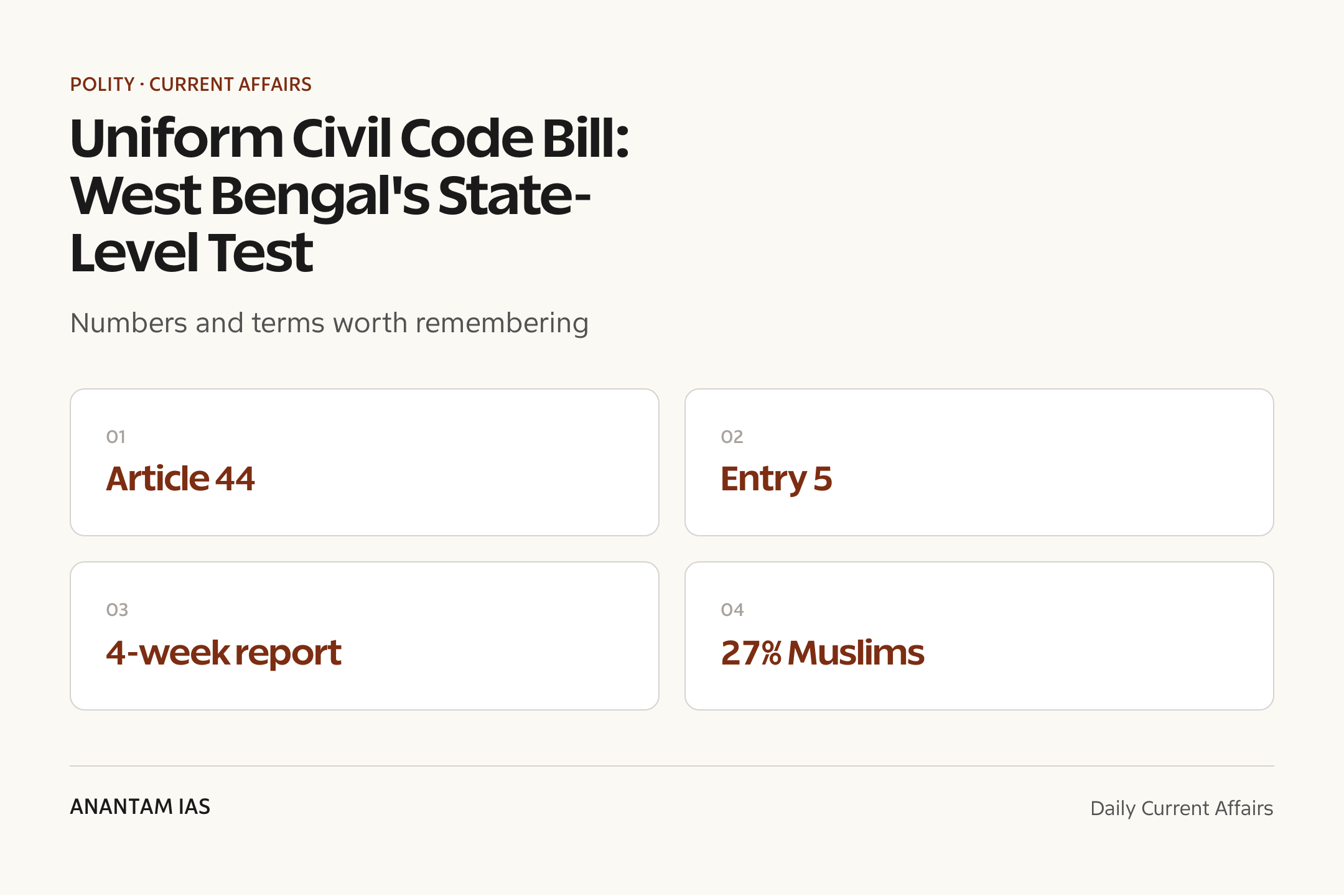
UPSC Relevance
Prelims Relevance
- Article 44 is part of the Directive Principles of State Policy, not the Fundamental Rights chapter.
- Article 37 says Directive Principles are not enforceable by courts, but are fundamental in the governance of the country.
- Entry 5 in the Concurrent List covers marriage and divorce, infants and minors, adoption, wills, intestacy, succession, joint family and partition.
- Article 246 distributes lawmaking power between Parliament and State Legislatures through the three legislative lists.
- Article 254 deals with repugnancy between State laws and parliamentary laws in Concurrent List fields.
- Article 25 protects freedom of conscience and religion, subject to public order, morality, health and other constitutional provisions.
- Fifth Schedule and Sixth Schedule protections matter when personal-law reform touches tribal customs in scheduled areas.
- Uttarakhand UCC is a useful recent comparator because it also brought questions of live-in relationships and tribal exclusions into focus.
Mains Relevance
GS Paper 2
- Constitutional morality versus community autonomy in personal-law reform.
- Centre-State relations when States legislate in Concurrent List fields.
- Judicial review of a State UCC on equality, privacy, religion and due-process grounds.
GS Paper 1
- Indian society as a plural social order with religious, regional and customary family-law practices.
- Women and social reform debates around marriage, divorce, inheritance and maintenance.
Essay
- Uniformity and diversity in a constitutional democracy.
- Reform by consent versus reform by political mandate.
Essay
- A democracy can seek equal citizenship without flattening every form of social diversity.
- Personal-law reform succeeds better when constitutional values and community consultation move together.
Background and Context
What a Uniform Civil Code Means
A UCC is about civil family matters, not criminal law.
- Uniform Civil Code usually means a common set of rules for personal matters such as marriage, divorce, adoption, guardianship, inheritance and succession.
- Personal laws in India currently vary across religious communities, customary groups and statute-specific regimes.
- Criminal law is already broadly uniform through central statutes; the UCC debate mainly concerns civil family relations.
- Uniformity does not automatically mean identical treatment in every situation; a well-drafted code may still recognise reasonable classifications.
- For UPSC framing, read the issue as a triangle of equality, religious freedom and federal competence.
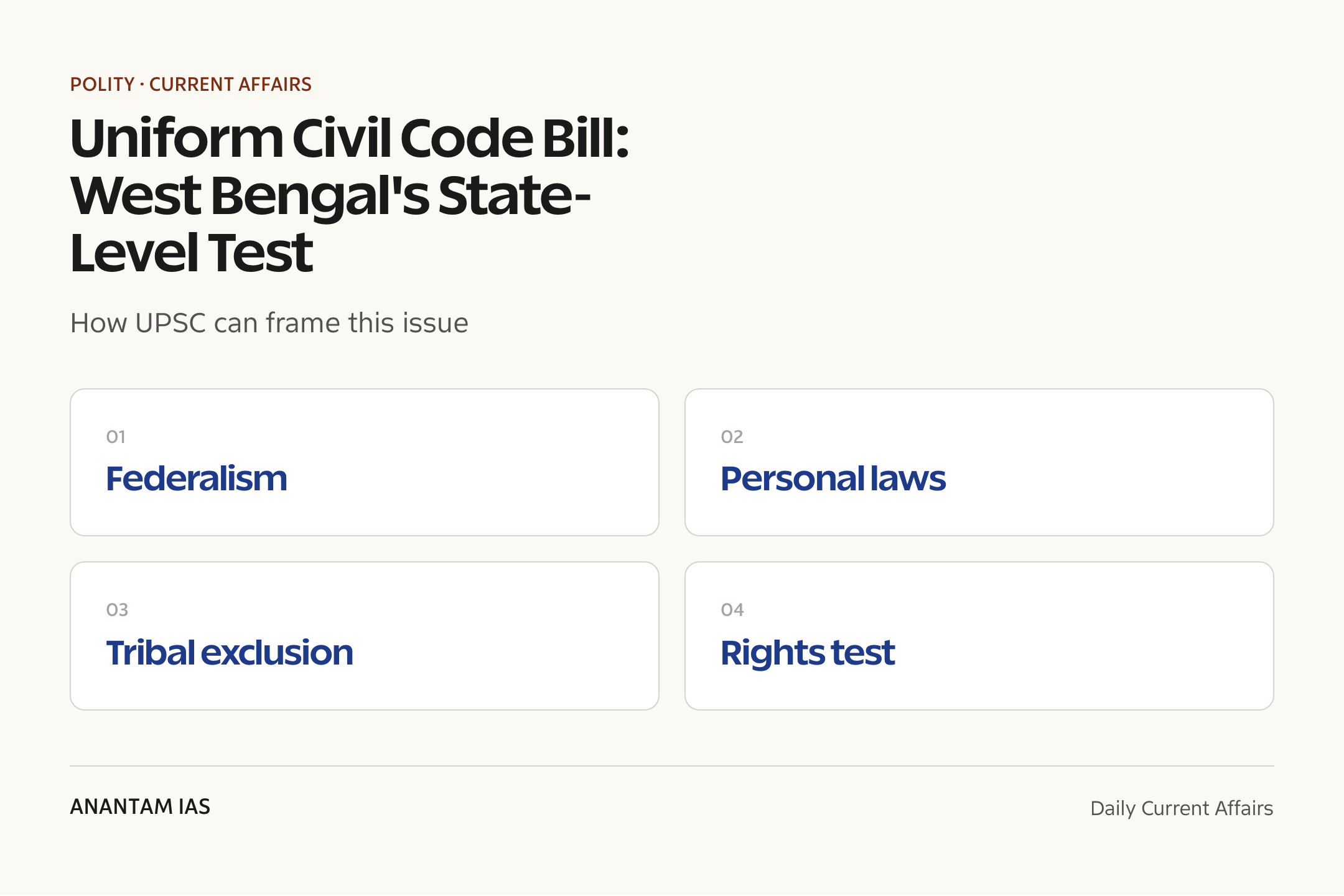
West Bengal Proposal
The reported proposal is still at the pre-legislative stage.
- The Hindu reported that the Bill is planned for the August 2026 Assembly session.
- Justice Ranjana Prakash Desai will lead a committee to examine family laws and submit a report in four weeks.
- The committee composition reported includes a retired IAS officer, legal expert, educationist, social worker and an additional secretary of the State government.
- The Chief Minister said the committee would examine marriage, succession and live-in relationships.
- Students should mark the difference between a committee announcement, a Cabinet approval, a Bill and an enacted law.
Article 44 and Directive Principles
Article 44 gives the UCC debate its constitutional anchor.
- The Legislative Department’s official Constitution text places Article 44 in the Directive Principles and says the State shall endeavour to secure a uniform civil code for citizens.
- Directive Principles are not enforceable as court commands, but they guide governance, legislation and policy choices.
- Article 37 explains this dual status: non-justiciable in courts, yet fundamental in the governance of the country.
- A UCC law still has to satisfy Fundamental Rights; a Directive Principle cannot be used as a shortcut around equality, liberty or religious freedom.
- For answer writing, cite Article 44 with Articles 14, 21, 25 and 37 instead of treating UCC as a stand-alone slogan.
State Competence and Repugnancy
A State UCC is possible only within the constitutional distribution of powers.
- Entry 5 of List III covers several personal-law subjects, so both Parliament and State Legislatures can legislate in this field.
- Article 246 gives Concurrent List competence to both levels, but that competence is subject to the Constitution’s conflict rules.
- Article 254 says a State law conflicting with a parliamentary law in a Concurrent List field may become void to the extent of repugnancy.
- A conflicting State law can still operate in that State if it is reserved for and receives Presidential assent under Article 254(2).
- Parliament can later override that State law by making another law on the same matter, so the design is federal but not fully symmetrical.
Rights and Personal Law Reform
The hardest questions are not only about competence, but about rights.
- Article 14 requires equality before law and equal protection of laws; discriminatory family-law rules can face constitutional challenge.
- Article 15 bars discrimination on grounds including religion, race, caste, sex and place of birth, which matters in gender-justice claims.
- Article 21 now carries privacy, dignity and decisional autonomy concerns, especially where marriage or live-in relationships are regulated.
- Article 25 protects religious freedom, but it is subject to public order, morality, health and other fundamental rights.
- Courts often distinguish secular activity associated with religion from essential religious practice, which is why drafting detail matters.
Tribal Exclusion and Social Diversity
The reported exclusion shows why UCC design is politically and legally delicate.
- The reported West Bengal proposal would exclude Adivasis, indigenous people, Kurmis and other recognised ancient tribal communities.
- Customary law in tribal communities can cover marriage, inheritance, kinship and land-linked family arrangements.
- A blanket UCC can trigger fears of cultural erasure, especially where customary practices are tied to identity and community governance.
- An exclusion clause can protect diversity, but it also raises the question of why uniformity is demanded for some communities and not others.
- Good Mains answers should discuss both sides: protecting tribal autonomy and avoiding selective or majoritarian reform.
Comparative State Signals
Other State examples help frame the federal experiment.
- The Chief Minister said the State would draw inspiration from Gujarat, Assam and Uttarakhand, according to The Hindu.
- Uttarakhand’s UCC has been closely watched because of its approach to live-in relationships and its exclusion of Scheduled Tribes.
- Goa’s civil code is often cited in UCC debates, but it emerged from a distinct historical and legal context.
- State-level UCCs may create legal diversity across India even while claiming to move towards uniformity.
- The exam lens is not whether UCC is good or bad in the abstract; it is whether a specific law is consultative, rights-compliant and administratively workable.
Way Forward
Use Pre-Legislative Consultation
- Publish the committee terms of reference, draft Bill and explanatory note before introduction.
- Invite structured submissions from women’s groups, minority bodies, tribal representatives, family-law scholars and district-level civil society.
- Record disagreements openly so the final Bill shows reasoned lawmaking, not only political signalling.
Draft Around Rights
- Test every clause against Articles 14, 15, 21 and 25 before it reaches the Assembly.
- Avoid intrusive provisions that weaken privacy, especially around adult relationships and household choices.
- Use gender-just reform in inheritance, maintenance and guardianship as the core, not symbolic uniformity.
Respect Federal Procedure
- Map possible conflicts with central laws on marriage, divorce, adoption and succession.
- If conflict is likely, consider the Article 254(2) route and explain why Presidential assent is being sought.
- Build administrative capacity in registration offices, legal-aid systems and family courts before enforcement.
Handle Exclusions Transparently
- Define excluded communities clearly to avoid litigation over coverage.
- Protect tribal customs through consultation, not vague carve-outs that create uncertainty.
- Review the law periodically so social reform and cultural protection remain evidence-based.
Conclusion
The West Bengal Uniform Civil Code Bill is best read as a constitutional case study in how a State tries to convert Article 44 into legislation.
For UPSC, the strong answer is balanced: support equal citizenship and gender justice, but insist on consultation, federal procedure, privacy protection and respect for India’s plural social fabric.
UPSC Practice Questions
Prelims MCQ 1
With reference to a State-level Uniform Civil Code in India, consider the following statements:
- Article 44 is part of the Directive Principles of State Policy.
- Entry 5 of the Concurrent List includes subjects such as marriage, divorce, adoption, wills and succession.
- A State law in a Concurrent List field is always void if it differs from a parliamentary law, even after Presidential assent.
How many of the above statements are correct?
(a) Only one (b) Only two (c) All three (d) None
Answer: (b) Only two
Explanation:
Statements 1 and 2 are correct. Statement 3 is incorrect because Article 254(2) allows a conflicting State law to operate in that State after Presidential assent, subject to Parliament’s later power.
Prelims MCQ 2
Which constitutional provision is most directly associated with the idea of a uniform civil code for citizens?
(a) Article 44 (b) Article 51A (c) Article 72 (d) Article 110
Answer: (a) Article 44
Explanation:
Article 44 directs the State to endeavour to secure a uniform civil code for citizens throughout the territory of India.
UPSC Mains Questions
- A State-level Uniform Civil Code can deepen both constitutional reform and federal friction. Discuss with reference to Article 44, Entry 5 of the Concurrent List and Article 254.
- Personal-law reform is not only a question of uniformity; it is also a question of equality, autonomy and cultural security. Examine in the context of proposed tribal exclusions from UCC laws.
- Directive Principles are non-justiciable, but they shape legislative priorities. Explain how this applies to Article 44 and the limits that Fundamental Rights place on any UCC.
Sources: The Hindu and Legislative Department, Ministry of Law and Justice.
Frequently Asked Questions
What did West Bengal propose?
The Hindu reported that West Bengal plans to introduce a Uniform Civil Code Bill in the Assembly in August 2026. A committee led by Justice Ranjana Prakash Desai will study State family laws and submit a report in four weeks.
Why is Article 44 central?
Article 44 is the constitutional directive that asks the State to endeavour to secure a uniform civil code for citizens. It is part of the Directive Principles, so it guides lawmaking but does not override Fundamental Rights such as equality, liberty or religious freedom.
Can a State pass UCC?
A State can legislate on many personal-law subjects because Entry 5 of the Concurrent List covers marriage, divorce, adoption, wills and succession. If the State law conflicts with a parliamentary law, Article 254 and possible Presidential assent become important.
Why are tribal exclusions debated?
Tribal communities often follow customary family and inheritance practices linked to identity, land and community governance. Excluding them can protect cultural autonomy, but it also raises a fairness question: why should uniformity apply to some communities and not others?
Does UCC violate religious freedom?
A UCC does not automatically violate religious freedom. The answer depends on drafting. Courts may uphold secular family-law reform, but any law must still pass tests under Articles 14, 21 and 25, especially where it affects dignity, privacy and religious practice.
Why mention live-in relationships?
The reported committee will also examine live-in relationships. This expands the debate beyond traditional marriage and inheritance. For Mains, it raises privacy, adult autonomy, registration burden and State interest questions under Article 21.
Source: https://anantamias.com/current-affairs/west-bengal-uniform-civil-code-bill/
Delayed Home Possession: Supreme Court Expands Buyer Remedies
Why in News?
The Supreme Court held that in a case of delayed home possession, a flat buyer does not automatically lose the right to claim compensation merely because possession was later accepted.
In T.K.A. Padmanabhan v. Abhiyan Cooperative Group Housing Society Ltd., decided on 4 June 2026, the Court also said a consumer complaint already admitted by a forum cannot be pushed into arbitration only because the buyer agreement contains an arbitration clause.
- Civil Appeal No. 10724 of 2016 arose from a housing dispute over Flat No. 232 in a cooperative group housing society in Delhi.
- The original consumer complaint was filed in 2005 before the District Consumer Forum, alleging deficiency in service because possession was delayed.
- The respondent society invoked Section 8 of the Arbitration and Conciliation Act, 1996, seeking reference of the dispute to arbitration.
- The Supreme Court set aside the District Forum, State Commission and NCDRC orders that had kept the complaint away from a merits hearing.
- The matter was restored to the District Consumer Disputes Redressal Commission, Dwarka, with an endeavour to decide it within one year.
The development matters in the context of:
- The ruling matters because many homebuyers accept possession under pressure and then face the argument that their legal claim has ended.
- It clarifies the relationship between consumer forums, private arbitration clauses and statutory housing remedies.
- It connects with the broader governance challenge of making real estate regulation faster, accessible and credible for ordinary buyers.

UPSC Relevance
Prelims Relevance
- Consumer Protection Act, 1986: Section 2(1)(d) defines consumer for services hired for consideration.
- Section 2(1)(o): service includes housing construction, bringing many builder-buyer disputes within consumer law.
- Section 3: consumer remedy is in addition to, and not in derogation of, other legal remedies.
- Section 12(4): once a complaint is admitted, it cannot be transferred to another court, tribunal or authority.
- Section 8 of Arbitration Act: enables reference to arbitration when a valid arbitration agreement exists, subject to statutory limits.
- RERA Section 18: provides refund with interest or delay interest when a promoter fails to give possession on time.
- NCDRC: National Consumer Disputes Redressal Commission is the apex consumer disputes body below the Supreme Court.
- Emaar MGF Land Ltd. v. Aftab Singh: earlier Supreme Court precedent on consumer forum jurisdiction despite arbitration clauses.
Mains Relevance
GS Paper 2
- Role of statutory remedies in protecting citizens against unequal private contracts.
- Access to justice through consumer forums and specialized tribunals.
- Judicial interpretation of welfare legislation such as the Consumer Protection Act.
GS Paper 3
- Real estate as a major part of the urban economy and household savings.
- Regulatory certainty under RERA and consumer law for housing-market trust.
Essay
- Law as a shield for the weaker party in unequal contracts.
- Urbanisation, housing dreams and the need for accountable markets.
Essay
- Access to justice matters most when the weaker party has already paid and has little bargaining power.
- Urban housing is not only a market transaction; it is tied to savings, dignity and family security.
Background and Context
What the dispute was about
The case began as an ordinary buyer grievance but raised larger questions about consumer jurisdiction.
- T.K.A. Padmanabhan became a member of the respondent cooperative housing society in January 2003 and claimed to have paid the full amount for allotment.
- The buyer was allotted Flat No. 232, and an agreement was entered into between the parties on 27 February 2004.
- On 8 August 2005, the buyer filed a consumer complaint seeking compensation for alleged delay in possession.
- The respondent society relied on an arbitration clause in the agreement and sought reference to arbitration under the 1996 Act.
- The District Forum first rejected the arbitration plea, but later referred the parties to arbitration after a High Court remand.
- The NCDRC dismissed the buyer’s revision petition, reasoning that after taking possession without protest, he had ceased to be a consumer.

Core holding of the Supreme Court
The Supreme Court restored the buyer’s complaint for a decision on merits instead of closing it at the threshold.
- The Court held that a private arbitration clause cannot defeat a statutory consumer remedy created by Parliament.
- It said the complaint was about compensation for delay, not merely delivery of possession.
- The later receipt of possession cannot by itself erase the buyer’s right to have the delay claim adjudicated.
- Questions such as whether delay occurred, who caused it, whether there was waiver and whether compensation is payable must be decided on evidence.
- The Court did not award compensation directly; it restored the matter to the Dwarka District Commission for a merits hearing.
- For aspirants, the case fits the Indian Polity theme of rights, remedies and institutional accountability.
Consumer law and arbitration
The judgment reinforces a long line of cases that treat consumer law as an additional remedy.
- Section 3 of the 1986 Act says consumer remedies are in addition to other remedies, which protects the forum choice of an aggrieved consumer.
- Section 12(4) becomes important after admission: an admitted complaint cannot be diverted to another court, tribunal or authority.
- The Court relied on precedents such as Fair Air Engineers, Thirumurugan Cooperative Agricultural Credit Society, National Seeds Corporation and Emaar MGF Land.
- The principle is not anti-arbitration; it says party autonomy in contract cannot override a specific statutory protection.
- This matters in standard-form contracts where buyers rarely negotiate clauses on forum, delay liability or dispute resolution.
- For governance answers, link this with the problem of access barriers when private contracts push citizens away from cheaper public remedies.
RERA and consumer remedies
RERA gives a sector-specific framework, while consumer law supplies an accessible adjudicatory route.
- RERA, 2016 was enacted to regulate real estate projects, improve transparency and protect the interests of allottees.
- Section 18 of RERA covers delayed possession: a buyer who exits can seek refund with interest and compensation, while a buyer who stays can claim interest for every month of delay.
- The Indian Express explained that RERA runs alongside consumer remedies rather than replacing them.
- The Supreme Court ruling is based mainly on the Consumer Protection Act, 1986, but its practical effect strengthens the broader buyer-remedy ecosystem.
- Consumer forums, RERA authorities and civil courts operate in a crowded space; exam answers should stress coordinated remedies, not forum-shopping as a cure-all.
- Related current affairs notes on governance should be read for the institutional angle rather than only the property-law detail.
Why accepting possession was not treated as waiver
The Court separated the delivery of the flat from the earlier period of alleged delay.
- A buyer may accept possession because refusing it can deepen financial loss, rental burden or family uncertainty.
- The claim for delay compensation relates to the period before actual possession, so it survives as an independent cause of action.
- The Court kept open whether the buyer accepted possession unconditionally and whether that fact affects compensation.
- The key point is procedural: such issues require a merits hearing, not dismissal at the admission or revision stage.
- This approach prevents powerful service providers from using post-delay possession as a complete defence against deficiency in service claims.
Governance and economy lens
Housing disputes are not private quarrels alone; they affect institutional trust and urban economic behaviour.
- Real estate absorbs large household savings, and delayed possession can create rent, EMI and opportunity-cost burdens.
- When remedies are slow, the deterrence value of RERA and consumer law weakens.
- When remedies remain accessible, builders and societies face stronger incentives to draft clearer timelines and honour possession commitments.
- The ruling can be used in GS2 answers on rule of law, tribunal design and citizen-centric grievance redressal.
- It also fits GS3 because predictable contract enforcement improves market confidence in a sector linked with construction, finance and urban growth.
Way Forward
Strengthen consumer forum capacity
- Fill vacancies and improve case-flow management in District Commissions so remanded consumer disputes do not remain symbolic victories.
- Use digital filing, cause-list transparency and time standards for older housing complaints.
- Publish plain-language summaries of important consumer rulings so buyers understand available remedies before limitation or documentation problems arise.
Improve real estate compliance
- Require clearer disclosure of possession timelines, force majeure clauses, delay-interest terms and refund rights in builder-buyer agreements.
- Align RERA portals with consumer fora by sharing project registration, completion and complaint-status data where legally possible.
- Treat repeated delay, misleading timelines and non-compliance with forum orders as governance risks, not isolated private disputes.
Protect buyers without weakening due process
- Preserve the right of builders or societies to present evidence on delay, waiver and responsibility.
- Ensure that compensation reflects actual delay, contractual terms, statutory standards and the conduct of both parties.
- Encourage buyers to accept possession, when necessary, with written reservation of rights so factual disputes are easier to decide later.
Conclusion
The ruling strengthens the idea that consumer protection is a public-law response to unequal bargaining power. A buyer who finally receives a delayed flat may still have a live claim for the period of delay.
For UPSC, the value of the case lies less in property law detail and more in the governance lesson: statutory remedies must remain accessible, contracts must not dilute welfare legislation and tribunals must decide citizen claims on merits.
UPSC Practice Questions
Prelims MCQ 1
With reference to T.K.A. Padmanabhan v. Abhiyan Cooperative Group Housing Society Ltd., consider the following statements:
- The Supreme Court held that an arbitration clause automatically bars a consumer forum from hearing a housing complaint.
- The Court held that accepting possession of a flat does not, by itself, extinguish a claim for compensation for delayed possession.
- The matter was restored to the District Consumer Disputes Redressal Commission, Dwarka.
How many of the above statements are correct?
(a) Only one (b) Only two (c) All three (d) None
Answer: (b) Only two
Explanation:
Statements 2 and 3 are correct. Statement 1 is incorrect because the Court said an arbitration clause cannot by itself oust the consumer forum’s statutory jurisdiction.
Prelims MCQ 2
Which provision of the Consumer Protection Act, 1986 states that consumer remedies are in addition to and not in derogation of other legal remedies?
(a) Section 2(1)(d) (b) Section 2(1)(o) (c) Section 3 (d) Section 12(4)
Answer: (c) Section 3
Explanation:
Section 3 preserves consumer remedies as additional remedies. Section 2(1)(d) defines consumer, Section 2(1)(o) defines service and Section 12(4) deals with admitted complaints.
UPSC Mains Questions
- The Supreme Court’s delayed-possession ruling shows how welfare legislation can limit unequal private contracts. Discuss with reference to consumer protection, arbitration clauses and access to justice in India’s housing market.
- Real estate disputes are both contract disputes and governance problems. Examine how RERA, consumer forums and judicial review can together improve accountability without creating procedural confusion.
- Acceptance of possession should not automatically erase a buyer’s claim for delay compensation. Critically analyse this proposition from the perspective of rule of law and market confidence.
Sources: Supreme Court of India and Indian Express Explained.
Frequently Asked Questions
What did the Supreme Court decide?
The Court held that accepting possession of a delayed flat does not by itself end the buyer’s right to seek compensation for the period of delay. It restored the complaint to the Dwarka District Commission for a merits hearing.
Was compensation awarded immediately?
No. The Supreme Court did not decide whether compensation was payable. It said issues such as actual delay, responsibility, waiver and entitlement to compensation must be examined through evidence by the consumer forum.
Why was arbitration rejected?
The Court said a private arbitration clause cannot defeat a statutory consumer remedy. Once a consumer complaint is admitted, Section 12(4) of the 1986 Act prevents shifting it to another court, tribunal or authority.
How does RERA fit here?
RERA provides sector-specific remedies for delayed possession, including refund with interest or monthly delay interest. The judgment mainly applies consumer law, but it supports the broader idea that buyer remedies survive standard-form contract clauses.
Why is this relevant for UPSC?
It links GS2 themes of rights, remedies, tribunals and access to justice with GS3 themes of real estate, household savings and market confidence. It also offers a clear example of courts protecting statutory welfare remedies.
What should homebuyers document?
Buyers should keep the agreement, payment records, promised possession date, correspondence, possession letter and any written reservation of rights. These documents help a forum decide delay, responsibility and compensation on evidence.
Source: https://anantamias.com/current-affairs/homebuyers-delayed-possession-compensation/
Indian Ocean Dipole: Monsoon Risk and Super El Nino Signals
Why in News?
The Indian Ocean Dipole is in the news after The Hindu Explained linked India’s weak 2026 southwest monsoon, IMD’s below-normal rainfall forecast and global El Nino signals to the question of whether the Indian Ocean can offset Pacific-driven dryness.
PIB reported that the India Meteorological Department expects June-September rainfall at 90% of Long Period Average with a model error of +/- 4%, while official climate agencies report El Nino conditions and a currently neutral IOD.
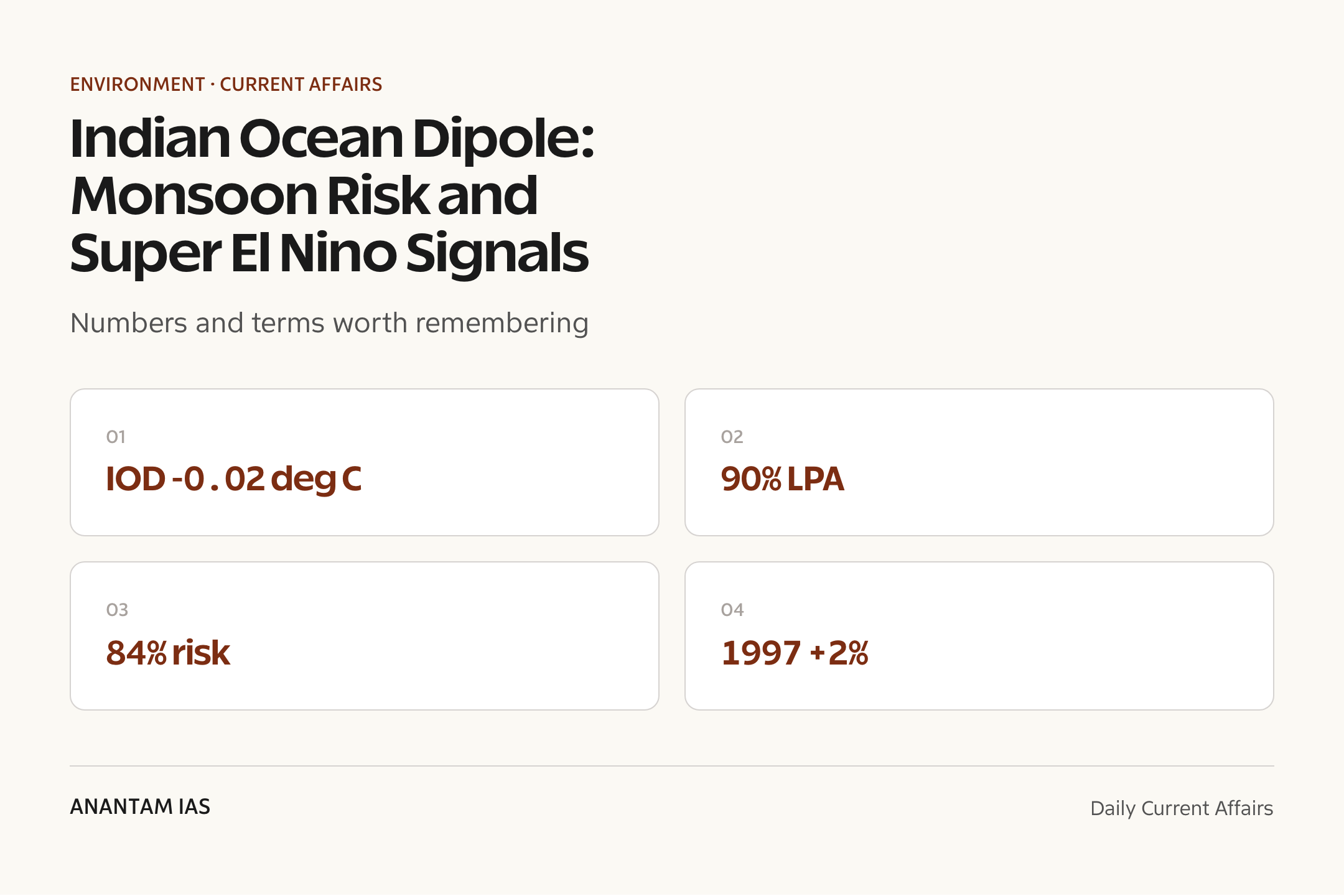
- PIB/IMD said the 2026 southwest monsoon rainfall for India is likely to be 90% of LPA, close to the deficient threshold.
- PIB said the forecast gives an 84% probability of below-normal or lower rainfall for the country as a whole.
- The Hindu reported that the monsoon was running a 40% deficit when the IOD question returned to the headlines.
- NOAA CPC has an El Nino Advisory in force and says El Nino conditions are expected to strengthen into winter 2026-27.
- Australian Bureau of Meteorology reported a neutral IOD value of -0.02 deg C as of 27 June 2026, with model spread on timing and strength.
The development matters in the context of:
- IOD conditions shape monsoon rainfall by changing sea-surface temperature contrast across the tropical Indian Ocean.
- Positive IOD can partly support Indian rainfall during some El Nino years, but it is not a guaranteed drought shield.
- Monsoon variability affects agriculture, reservoirs, hydropower, food prices and drought preparedness.
- Climate-risk governance now depends on reading ENSO, IOD, MJO and IMD early-warning products together.
UPSC Relevance
Prelims Relevance
- Indian Ocean Dipole: an east-west sea-surface temperature contrast in the tropical Indian Ocean.
- Dipole Mode Index: difference between western and eastern Indian Ocean SST anomalies.
- IOD west box: roughly 50E-70E and 10S-10N, as used by the Australian Bureau of Meteorology.
- IOD east box: roughly 90E-110E and 10S-0S, off Indonesia and Sumatra.
- Positive IOD: warmer western Indian Ocean and cooler eastern Indian Ocean.
- Negative IOD: cooler western Indian Ocean and warmer eastern Indian Ocean.
- ENSO: Pacific Ocean-atmosphere cycle covering El Nino and La Nina.
- Madden-Julian Oscillation: 30-60 day tropical cloud-rain pulse tracked through eight phases.
Mains Relevance
GS Paper 3
- Environment and climate variability: ENSO-IOD interaction, monsoon uncertainty and climate adaptation.
- Disaster management: drought preparedness, reservoir planning, heat stress and early warning.
GS Paper 1
- Physical geography: Walker circulation, sea-surface temperature anomalies and monsoon mechanism.
- Indian geography: spatially uneven rainfall and regional drought vulnerability.
GS Paper 2
- Governance: coordination among IMD, agriculture departments, disaster authorities and water managers.
Essay
- Climate uncertainty tests whether development planning can move from relief-first to preparedness-first governance.
- Monsoon dependence shows how geography continues to shape India’s economy, food security and federal policy choices.
Background and Context
Why the IOD Matters Now
The 2026 news hook is not only the IOD; it is the collision of weak monsoon performance, official rainfall forecasts and a strengthening El Nino signal.
- PIB/IMD placed the 2026 monsoon forecast at 90% of LPA, with the LPA based on 1971-2020 data at 87 cm.
- Below-normal rainfall was forecast over most parts of India, except parts of Northwest, Northeast, eastern peninsular and east-central India.
- The Hindu used the 1997 monsoon to frame the issue: despite a very strong El Nino, India ended June-September with about 2% surplus rainfall.
- Monsoon risk sits at the meeting point of monsoon in India, Indian Ocean dynamics and disaster planning.
What the Indian Ocean Dipole Is
The Indian Ocean Dipole is a periodic seesaw in sea-surface temperature anomalies across the tropical Indian Ocean.
- IOD compares the western tropical Indian Ocean near East Africa with the eastern tropical Indian Ocean near Indonesia.
- Sea-surface temperature matters because warm water supports evaporation, rising air, clouds and rainfall.
- Dipole Mode Index measures the difference between the two IOD poles; sustained departures mark positive or negative phases.
- Neutral IOD means the Indian Ocean does not provide a strong east-west push to either enhance or suppress monsoon rainfall.
Positive, Negative and Neutral Phases
Each IOD phase changes the direction of moisture convergence over the Indian Ocean basin.
- Positive IOD means warmer western Indian Ocean and cooler eastern Indian Ocean, which can support convection toward the west and moisture flow toward India.
- Negative IOD means warmer eastern Indian Ocean and cooler western Indian Ocean, often weakening the moisture support available to the Indian monsoon.
- Australian Bureau of Meteorology treats sustained values above +0.4 deg C as typical of positive IOD and below -0.4 deg C as typical of negative IOD.
- June 2026 readings were neutral; BOM reported -0.02 deg C for 27 June, while models differed on a later positive turn.
ENSO Link and Walker Circulation
The IOD cannot be understood separately from the Pacific because ENSO changes the larger tropical circulation that feeds the monsoon.
- El Nino warms the central and eastern equatorial Pacific, weakens trade winds and shifts convection away from the western Pacific-Indian Ocean sector.
- Walker circulation is the east-west tropical overturning loop; when it weakens or shifts, Indian monsoon rainfall can suffer.
- La Nina usually tilts the system in the opposite direction and is often friendlier to Indian monsoon rainfall.
- NOAA CPC reported El Nino conditions in 2026 and a 63% chance of a very strong event during November-January.
The 1997 Exception
The 1997 monsoon remains important because it shows how a strong positive IOD can sometimes soften the monsoon damage expected from El Nino.
- 1997 had one of the strongest El Nino events in the recorded Pacific dataset, yet India avoided a severe monsoon drought.
- The Hindu reported IMD’s view that the 1997 escape was an exceptional case, not a normal rule for El Nino years.
- Strong positive IOD helped convergence over the Bay of Bengal and Indian Ocean sector, countering some El Nino subsidence.
- Exam takeaway: the right answer is not El Nino equals drought; it is El Nino raises drought probability, while IOD and MJO can modulate outcomes.
Discovery and Measurement
IOD is a relatively recent formal climate concept, which makes it a high-yield Prelims fact.
- N.H. Saji and collaborators, including Indian scientists B.N. Goswami and P.N. Vinayachandran, described the IOD in a 1999 Nature paper.
- The Hindu noted that the IOD explains roughly an eighth of Indian Ocean temperature variability and can operate independently of ENSO.
- DMI regions are fixed ocean boxes, so the index is a measurable climate signal rather than a vague rainfall description.
- Forecast uncertainty remains high because IOD timing, strength and interaction with ENSO can shift within the monsoon season.
MJO and Intraseasonal Swings
Monsoon risk also depends on shorter active-break cycles, not only seasonal ENSO and IOD categories.
- Madden-Julian Oscillation is a moving tropical pulse of cloud and rainfall that cycles roughly every 30-60 days.
- Eight MJO phases are used to track where the active convective pulse sits across the tropics.
- Indian Ocean phases of the MJO can revive rainfall spells, while unfavourable phases can deepen breaks.
- Early warning needs ENSO, IOD, MJO, soil moisture and reservoir data together, especially during a weak monsoon start.
Governance and Disaster Link
IOD is an exam topic because rainfall variability becomes a governance challenge very quickly.
- Agriculture faces sowing delays, crop stress and input-risk decisions when June-July rainfall is deficient.
- Water security depends on reservoir storage, groundwater recharge and inter-state planning during weak monsoon years.
- Drought preparedness connects this topic with disaster management and district-level contingency plans.
- Climate adaptation links monsoon variability with climate change, because warmer oceans can increase extremes even when seasonal totals stay uncertain.
Way Forward
Strengthen Forecast Use
- IMD outlooks should be translated into district advisories for sowing windows, irrigation scheduling and crop substitution.
- Impact-based forecasts must state likely effects on agriculture, reservoirs, heat stress and drinking-water supply.
Prepare for Deficit and Extremes
- Drought plans should be activated early in vulnerable districts instead of waiting for end-season rainfall totals.
- Flood readiness should stay active because weak seasonal rainfall can still include short, extreme bursts.
Improve Climate Literacy
- ENSO-IOD-MJO communication should avoid deterministic claims and explain probability in simple operational language.
- Local planning should combine seasonal forecasts with soil moisture, crop stage and reservoir storage data.
Conclusion
The Indian Ocean Dipole is best read as a monsoon-risk modifier, not as a magic shield against El Nino. The 1997 case matters because it shows what is possible when a strong positive IOD appears at the right time.
For 2026, the safer exam conclusion is cautious: official sources show El Nino strengthening, IMD forecasting below-normal rainfall and IOD still neutral near the end of June. Planning should assume uncertainty, not rescue.
UPSC Practice Questions
Prelims MCQ 1
With reference to the Indian Ocean Dipole, consider the following statements:
- The Dipole Mode Index measures the difference between sea-surface temperature anomalies in the western and eastern tropical Indian Ocean.
- A positive IOD is marked by warmer eastern Indian Ocean waters off Sumatra and cooler western Indian Ocean waters.
- Sustained IOD index values above +0.4 deg C are treated by the Australian Bureau of Meteorology as typical of positive IOD conditions.
How many of the above statements are correct?
(a) Only one (b) Only two (c) All three (d) None
Answer: (b) Only two
Explanation:
Statements 1 and 3 are correct. Statement 2 reverses the phase: positive IOD means warmer western Indian Ocean and cooler eastern Indian Ocean.
Prelims MCQ 2
Which factor best explains why India’s 1997 monsoon did not become a severe drought despite a very strong El Nino?
(a) A strong negative Indian Ocean Dipole (b) A strong positive Indian Ocean Dipole (c) A permanent weakening of the Walker circulation (d) A collapse of the southwest monsoon winds
Answer: (b) A strong positive Indian Ocean Dipole
Explanation:
The 1997 exception is associated with a strong positive IOD, which helped moisture convergence toward the Indian monsoon region and offset part of the El Nino effect.
UPSC Mains Questions
- Explain how the Indian Ocean Dipole modifies the impact of El Nino on the Indian southwest monsoon. In your answer, discuss why the 1997 experience should not be treated as a routine rule.
- India’s monsoon-risk governance must move from seasonal rainfall totals to impact-based preparedness. Discuss with reference to agriculture, water security and disaster management.
- Differentiate between ENSO, IOD and MJO as climate drivers of the Indian monsoon. How should these signals be used in public communication without creating false certainty?
Sources: PIB, India Meteorological Department and The Hindu Explained; NOAA Climate Prediction Center; Australian Bureau of Meteorology.
Frequently Asked Questions
What is the Indian Ocean Dipole?
The Indian Ocean Dipole is a sea-surface temperature contrast between the western and eastern tropical Indian Ocean. A positive phase has warmer western waters and cooler eastern waters, while a negative phase has the reverse pattern. It affects convection, moisture flow and monsoon rainfall probabilities.
How does IOD affect Indian monsoon?
A positive IOD can support moisture convergence toward India and sometimes reduce the drying effect of El Nino. A negative IOD can weaken the moisture supply. But the effect depends on timing, strength and interaction with ENSO, MJO and regional weather systems.
What is the 2026 IOD status?
The Australian Bureau of Meteorology reported neutral IOD conditions as of 27 June 2026, with an IOD index of -0.02 deg C. Models suggested a possible later positive event, but with large differences in timing and strength.
Why is 1997 often mentioned?
The year 1997 had a very strong El Nino, which normally raises drought risk for India. Yet the June-September monsoon ended about 2% above normal. A strong positive IOD helped offset the Pacific signal, making it a rare but important exception.
Can IOD cancel El Nino?
Not always. A strong, timely positive IOD can soften El Nino’s impact, but it cannot be assumed to cancel it. In most years, forecasters must read IOD with ENSO, MJO, land heating, monsoon trough position and regional rainfall distribution.
Why is this important for disaster management?
A weak or uncertain monsoon affects agriculture, reservoirs, drinking-water supply, hydropower and heat stress. Early drought planning, crop advisories, reservoir management and district-level contingency plans are part of disaster preparedness when seasonal rainfall risk rises.
Source: https://anantamias.com/current-affairs/indian-ocean-dipole-monsoon-2026/
Khet Bachao Abhiyan: Punjab’s Soil-Stress Warning
Why in News?
Indian Express Explained reported that Punjab Agricultural University’s Krishi Vigyan Kendra, Langroya ran a month-long Khet Bachao Abhiyan in June 2026 across Shaheed Bhagat Singh Nagar district.
The campaign matters because Punjab’s wheat-paddy system remains central to India’s food security, but repeated cropping, imbalanced chemical fertiliser use, falling organic matter and rising input costs are turning soil health into an economic and ecological issue.
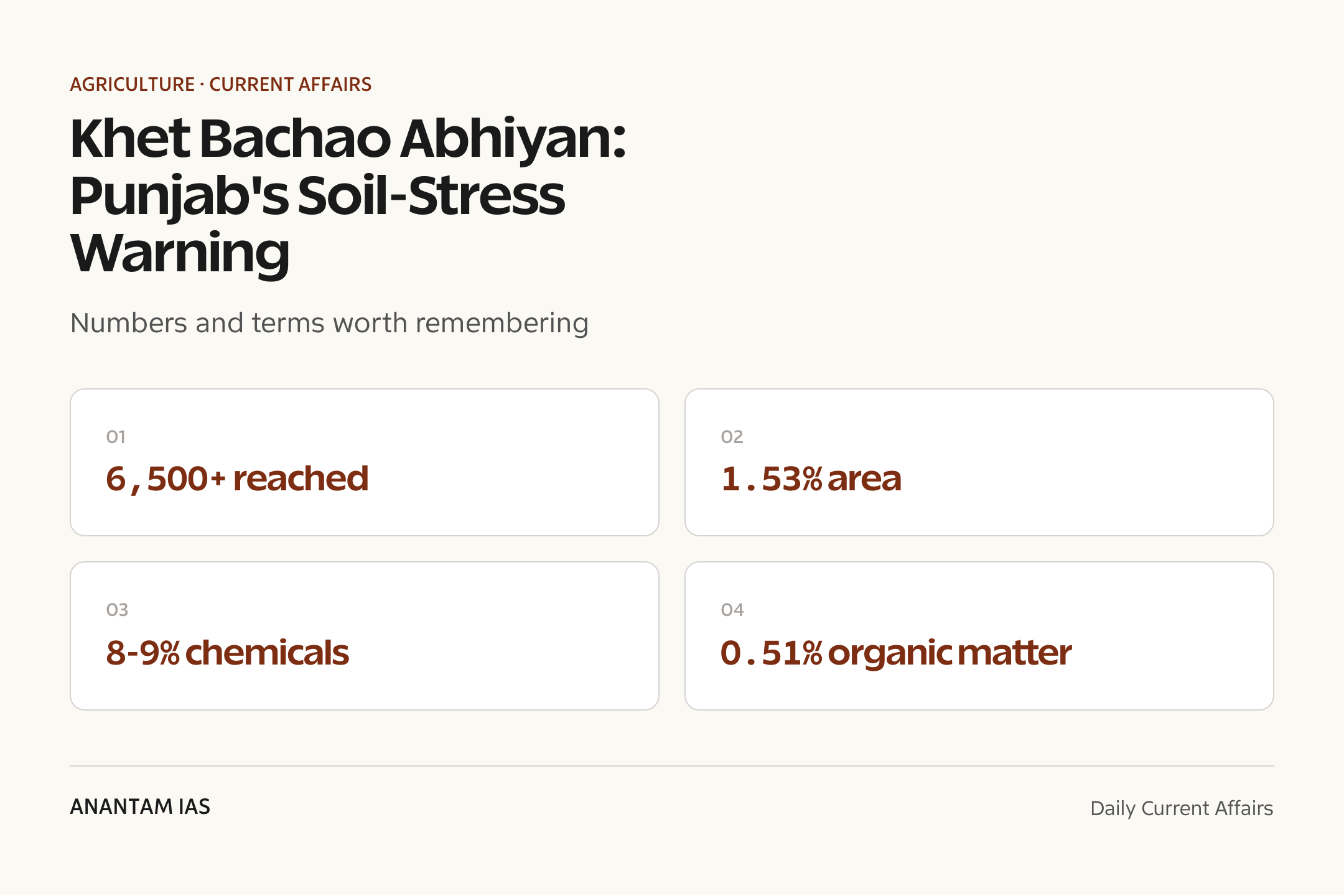
- 6,500+ stakeholders were reached, including farmers, rural women, village leaders, SHGs, FPOs, input dealers and custom hiring centres.
- KVK scientists and agriculture officials travelled village to village with the message: test the soil before applying fertilisers.
- Six specialised training programmes and a Sarpanch Sammelan were used to move the campaign beyond a one-day awareness meeting.
- Green manuring, balanced nutrient application, soil testing and lower unnecessary chemical use were presented as practical farm-level actions.
The development matters in the context of:
- Punjab has only about 1.53% of India’s area but, according to the Indian Express report, accounts for around 8-9% of national chemical usage.
- Organic matter in Punjab’s soils was reported at about 0.51%, below the 1% minimum cited by experts and far below the 3-5% international reference range cited in the report.
- Soil Health Card style advisories connect the news to a larger policy shift from blanket fertiliser use to plot-specific nutrient management.
UPSC Relevance
Prelims Relevance
- Khet Bachao Abhiyan: a Punjab Agricultural University KVK outreach campaign on soil-health restoration.
- Krishi Vigyan Kendra: district-level farm science and extension institution linked to technology demonstration and farmer training.
- Soil Health Card: a report on soil parameters and fertiliser recommendations for a farmer’s holding.
- Organic matter: improves nutrient availability, water retention, soil structure and microbial activity.
- Green manure: a crop grown and incorporated into soil to add organic matter and nutrients.
- Sunnhemp: one green-manure crop highlighted in the campaign.
- Balanced fertilisation: right nutrient, right dose, right time and crop-specific application.
- Wheat-paddy cycle: intensive cropping pattern linked to food security but also soil and groundwater stress.
Mains Relevance
GS Paper 3
- Agriculture: sustainability of the wheat-paddy system, fertiliser-use efficiency and extension services.
- Environment: soil degradation, chemical residues, declining organic carbon and water-retention stress.
- Economy: rising input costs, farm viability and public expenditure on fertiliser support.
GS Paper 2
- Governance: last-mile delivery through KVKs, panchayats, SHGs, FPOs and input dealers.
- Policy implementation: translating soil-test advisories into farmer behaviour change.
Essay
- Food security cannot be separated from soil security.
- Technology adoption succeeds only when extension reaches the field.
- Short-term yield maximisation can create long-term ecological costs.
Background and Context
Punjab's Grain Bowl Legacy
Punjab became India’s grain bowl through the Green Revolution, but the same high-input model now faces sustainability limits.
- Green Revolution agriculture expanded wheat and rice output through HYV seeds, assured irrigation, fertilisers, procurement and price support; read the wider context in Green Revolution in India.
- Wheat-paddy specialisation created a reliable procurement base for national food stocks, but it also reduced crop diversity and kept land under repeated intensive cultivation.
- Food security gains are still real, but the next policy question is whether Punjab can protect output without weakening soil, water and farm incomes.
- MSP-procurement incentives helped stabilise farmer income and public stocks, but they also made diversification harder where farmers see alternative crops as riskier.
- Exam angle: UPSC may frame this as a transition from input-intensive agriculture to resource-conserving agriculture.
What Khet Bachao Abhiyan Did
Khet Bachao Abhiyan used village outreach instead of a seminar-style campaign, making farm extension the core story.
- KVK Langroya reached more than 6,500 farmers and rural stakeholders in Shaheed Bhagat Singh Nagar district during June 2026.
- Stakeholder coverage included farmers, rural women, sarpanches, SHGs, FPOs, cooperative societies, input dealers and custom hiring centres.
- Six training programmes and a Sarpanch Sammelan helped carry soil-health messaging through village leadership and community networks.
- Core advice was simple: use soil testing, apply fertilisers in balanced quantities, avoid avoidable chemicals and rebuild organic matter.
- Rural livelihoods were also part of the campaign framing, because lower input waste and healthier soil can improve net returns even when output gains are gradual.
Soil Stress and Fertiliser Imbalance
Soil stress in the report is less visible than drought, but it can be more damaging because it slowly raises costs and lowers resilience.
- Excess and imbalance are the concern, not fertiliser use itself; nutrients are essential, but habit-based dosing can weaken soil structure and microbial activity.
- Punjab’s chemical load is disproportionate: the report notes 1.53% of national area but around 8-9% of national chemical usage.
- Organic matter was reported around 0.51% in Punjab soils, against a minimum of 1% cited by experts and an international reference range of 3-5% cited in the report.
- Farmer economics worsen when declining soil vitality forces higher spending on fertilisers and pesticides to maintain similar yields.
- Nutrient-use efficiency becomes the key policy idea: the aim is not less farming, but more output per unit of fertiliser, water and chemical input.
- Policy link: this is why Soil Health Card style advisories matter for fertiliser rationalisation.
Green Manuring and Organic Matter
Green manuring is the practical agronomy lever highlighted in the campaign for rebuilding biological soil strength.
- Sunnhemp was highlighted as a green-manure crop that can enrich soil when grown and incorporated before the main crop.
- Organic matter improves nutrient availability, water retention, soil aggregation and resilience during heat or dry spells.
- KVK Langroya was reported to be producing elite green-manure seeds and training farmers to develop their own seed stocks.
- Cost reduction is part of the message: better nutrient cycling can reduce unnecessary external inputs over time.
- Soil carbon is also a climate-resilience lens, because organic-rich soils generally hold more moisture and support better biological activity.
- Geography angle: soil-management choices vary by agro-climatic region, crop pattern, water availability and existing nutrient status.
Extension Model and Behaviour Change
Farm extension is the governance layer that decides whether soil science changes actual farm practice.
- KVKs work best when they move from lecture mode to demonstration mode, because farmers need to see cost and yield effects in local conditions.
- Input dealers matter because fertiliser and pesticide advice often reaches farmers through the market, not only through official channels.
- FPOs and SHGs can spread shared practices such as seed banks, green-manure seed production and collective training.
- Panchayats help convert individual soil-health advice into village-level campaigns, especially when sarpanches carry the message.
- Behaviour change is difficult because farmers often trust visible input application more than lab reports; demonstration plots can make the science credible.
- Indian agriculture needs this extension bridge; see the broader sectoral context in Indian Agriculture.
Food Security and Public Health Link
Soil health is not only an agronomy issue; it also affects food quality, public health and national food-security resilience.
- Chemical residues can move through the food chain when input use becomes excessive or poorly timed.
- Food quality depends on the soil in which crops grow, so soil degradation can become a nutrition and public-health concern.
- National food security depends on both output volume and production sustainability; a stressed grain bowl creates systemic risk.
- Policy framing: link this topic with sustainable agriculture, fertiliser subsidy reform, climate resilience and food security.
Way Forward
Make soil testing actionable
- Soil-test reports should be converted into crop-wise, village-language fertiliser schedules rather than left as technical documents.
- KVKs should run follow-up visits after sowing and before nutrient application so advice reaches the decision point.
Shift incentives from quantity to efficiency
- Balanced nutrients, green manure, bio-inputs and organic matter rebuilding should be linked to demonstrations that show input savings.
- Fertiliser policy should support rational use, not only cheap availability, because over-application raises both fiscal and ecological costs.
Build village-level extension networks
- Panchayats, SHGs, FPOs and input dealers should be treated as extension partners with clear, evidence-based advisories.
- Custom hiring centres can support residue management, green-manure incorporation and precision application equipment for small farmers.
Conclusion
Khet Bachao Abhiyan is a small district-level campaign, but its exam value is larger: it shows how soil health, fertiliser economics, extension services and food security meet in the field.
Punjab’s warning is not that the Green Revolution failed; it is that food-security systems need constant ecological repair. The next phase of agricultural policy must protect the field as carefully as it protects the yield.
UPSC Practice Questions
Prelims MCQ 1
With reference to Khet Bachao Abhiyan, consider the following statements:
- It was linked to Punjab Agricultural University’s Krishi Vigyan Kendra, Langroya.
- It focused only on increasing fertiliser doses to raise wheat-paddy yields.
- It used village outreach and training programmes to promote soil testing and green manuring.
How many of the above statements are correct?
(a) Only one (b) Only two (c) All three (d) None
Answer: (b) Only two
Explanation:
Statements 1 and 3 are correct. Statement 2 is incorrect because the campaign warned against excessive and imbalanced chemical use and promoted soil-test-based nutrient management.
Prelims MCQ 2
Which one of the following best explains the role of green manuring in soil management?
(a) It replaces all irrigation requirements in paddy cultivation. (b) It adds organic matter and can improve nutrient availability when incorporated into soil. (c) It is a method of removing all microbes from the soil. (d) It is used only for post-harvest grain storage.
Answer: (b) It adds organic matter and can improve nutrient availability when incorporated into soil.
Explanation:
Green-manure crops such as Sunnhemp are grown and incorporated into the soil to improve organic matter, nutrient cycling, water retention and soil resilience.
UPSC Mains Questions
- Punjab’s wheat-paddy system strengthened India’s food security, but it has also produced soil and groundwater stress. Discuss how soil-health-based extension can make Indian agriculture more sustainable without weakening farmer incomes.
- Krishi Vigyan Kendras can bridge the gap between agricultural research and farm behaviour. Examine this statement in the context of Khet Bachao Abhiyan and India’s fertiliser-use challenge.
- Soil health is both an agricultural and public-health concern. Explain with reference to chemical residues, organic matter, crop productivity and food quality.
Sources: Indian Express Explained and Soil Health Card Portal, Department of Agriculture and Farmers Welfare.
Frequently Asked Questions
What is Khet Bachao Abhiyan?
Khet Bachao Abhiyan is a Punjab Agricultural University KVK Langroya campaign reported from Shaheed Bhagat Singh Nagar district. It focused on soil testing, balanced fertiliser use, green manuring and farmer outreach to address soil fatigue in Punjab’s intensive farming system.
Why is Punjab’s soil under stress?
Punjab’s soil stress is linked to repeated wheat-paddy cultivation, excessive or imbalanced chemical use, low organic matter and rising input costs. The report notes that Punjab uses a disproportionate share of national chemicals despite having a small share of India’s area.
How does soil testing help farmers?
Soil testing tells farmers which nutrients their soil lacks and which fertilisers are actually needed. It reduces habit-based application, saves money, improves fertiliser efficiency and supports crop-specific nutrient management.
What is green manuring?
Green manuring means growing a crop such as Sunnhemp and incorporating it into the soil. It adds organic matter, improves nutrient availability, supports microbial activity and can make soil more resilient over time.
Why are KVKs important here?
Krishi Vigyan Kendras connect agricultural research with farmers through demonstrations, training and local advisories. In this campaign, the KVK model mattered because scientists and officials went village to village instead of relying only on formal meetings.
How is this relevant for GS3?
GS3 Agriculture asks how India can protect food security while reducing ecological stress. This topic connects fertiliser-use efficiency, soil health, farm-extension reform, crop diversification, input costs and public-health concerns.
Source: https://anantamias.com/current-affairs/khet-bachao-abhiyan-punjab-soil-stress/
UP Defence Corridor: Investment Push for Defence Manufacturing
Why in News?
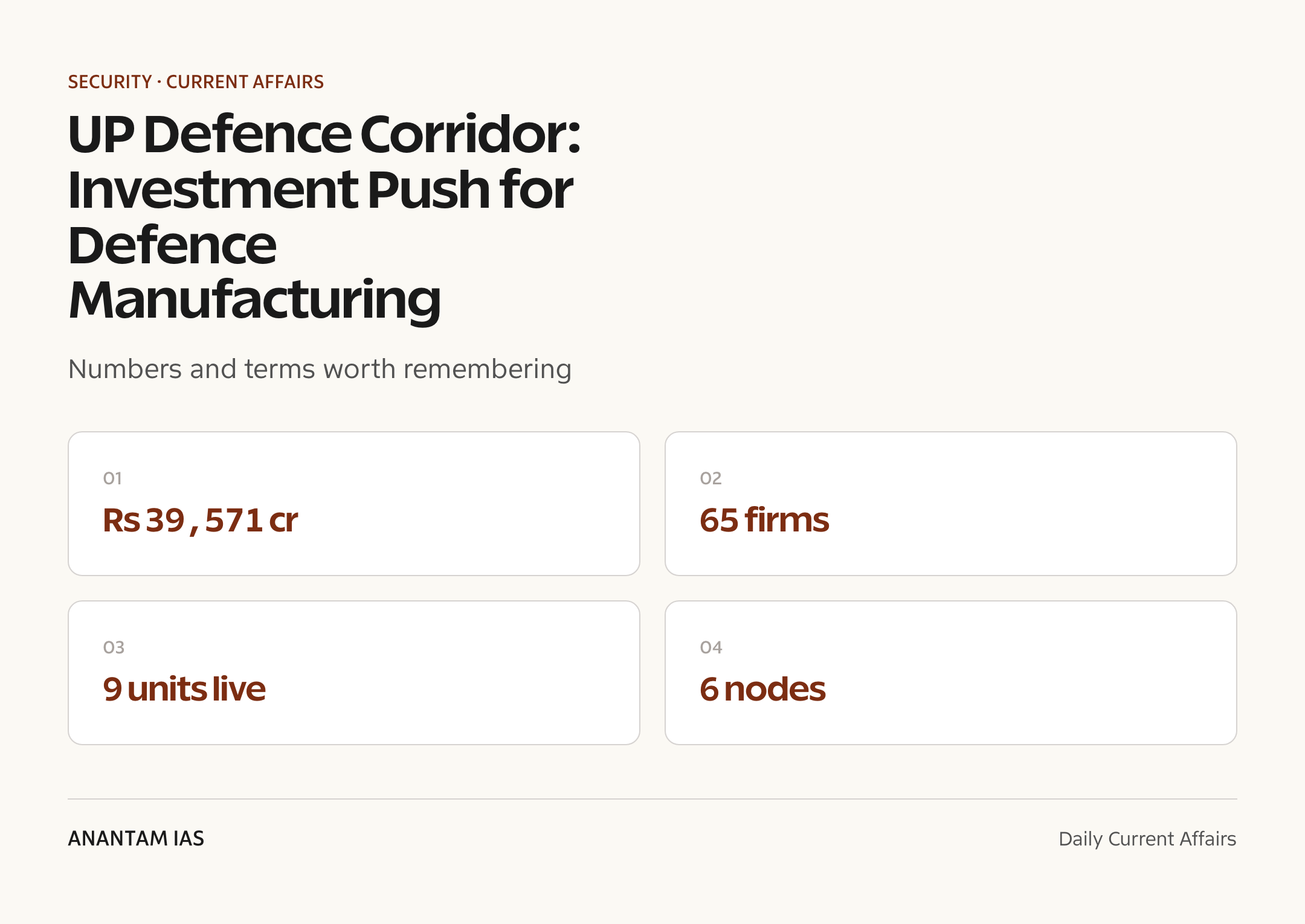
The Hindu reported on July 1, 2026 that the Uttar Pradesh Defence Industrial Corridor has attracted investment proposals worth Rs 39,571.09 crore, making it a major marker of India’s defence manufacturing push.
The report said 65 companies have secured land, nine manufacturing units are already functional, and projects worth nearly Rs 13,486 crore have been grounded with potential to generate about 15,300 jobs.
- UPDIC is spread across six nodes: Kanpur, Jhansi, Lucknow, Aligarh, Agra and Chitrakoot.
- 2,095 hectares of land have been acquired, of which 1,141.79 hectares have been allotted to industries.
- Kanpur leads the reported investment list with Rs 12,948 crore, followed by Jhansi at Rs 12,190 crore.
- Nine units are functional: three each in Kanpur, Lucknow and Aligarh.
- Adani Defence has begun operations at a Rs 1,500 crore ammunition facility in Kanpur, the largest reported corridor investment so far.
The development matters in the context of:
- Defence corridors connect internal security with industrial capacity: ammunition, small arms, ballistic protection, aerospace materials and missile assembly matter during crises.
- Regional industrial policy is central here because state land banks, expressway connectivity and incentives shape whether national defence plans convert into factory output.
- Private investment is an exam-relevant signal because India’s defence self-reliance cannot depend only on DPSUs and ordnance factories.
- MSME participation is important because defence supply chains need components, testing, tooling, electronics, textiles and precision manufacturing below the prime-contractor layer.
UPSC Relevance
Prelims Relevance
- Defence Industrial Corridors were announced in the Union Budget 2018-19 to build defence and aerospace manufacturing ecosystems.
- India has two Defence Industrial Corridors: one in Uttar Pradesh and one in Tamil Nadu.
- UPDIC was launched in August 2018 and is executed by UPEIDA as the nodal agency.
- UPDIC nodes are Aligarh, Agra, Chitrakoot, Jhansi, Kanpur and Lucknow.
- UPEIDA stands for Uttar Pradesh Expressways Industrial Development Authority.
- PIB has described the aim as catalysing indigenous production of defence and aerospace items, reducing import reliance and promoting exports.
- Offset policy has assigned a higher multiplier for investment in defence corridors, as noted in official Ministry of Defence replies.
- Defence FDI remains subject to national-security scrutiny and security clearance requirements.
Mains Relevance
GS Paper 3
- Internal security: domestic capacity in ammunition, missile systems, small arms and protective materials reduces dependence during conflict or supply-chain disruption.
- Science and technology: corridor output depends on testing, titanium casting, precision components, electronics, materials science and technology readiness.
- Industrial policy: state-led land acquisition, expressway connectivity and incentives show how infrastructure can support strategic sectors.
GS Paper 2
- Cooperative federalism: the Union sets the defence-manufacturing objective while the state handles land, local infrastructure and investment facilitation.
- Governance: procurement reform, clearances, quality certification and dispute-free land allotment affect implementation.
GS Paper 1
- Regional development: the corridor brings Bundelkhand, Kanpur, Lucknow, Aligarh and Agra into a wider industrial geography rather than keeping defence production concentrated in old centres.
Essay
- Self-reliance is not isolation: it means building trusted domestic capacity while still using global technology, capital and export markets.
- Security and development can reinforce each other when strategic manufacturing creates jobs, skills and industrial depth.
Background and Context
What the Corridor Is
The UP Defence Corridor is a state-led industrial geography built around the national goal of defence indigenisation.
- UPDIC is one of India’s two Defence Industrial Corridors, with the other located in Tamil Nadu.
- UPEIDA is the nodal state agency, which makes the corridor a case study in how expressway-led planning and defence manufacturing can be combined.
- Six nodes give the corridor a distributed structure: Aligarh, Agra, Chitrakoot, Jhansi, Kanpur and Lucknow.
- PIB has stated that the nodes were selected for their potential to create an end-to-end aerospace and defence ecosystem covering design, engineering and manufacturing.
- UP Defence and Aerospace Unit and Employment Promotion Policy provides the incentive layer through tools such as land-cost support, stamp-duty incentives and infrastructure support.
Why the Latest Numbers Matter
The current update matters because it shows a shift from announcement-heavy industrial policy to land allotment, grounded projects and operating factories.
- Rs 39,571.09 crore in investment proposals is the headline figure reported by The Hindu, well above the earlier Rs 10,000 crore per-corridor benchmark cited in official replies.
- 65 companies securing land signals investor confidence, but the exam issue is conversion: proposal, allotment, construction, production and export are different stages.
- Rs 13,486 crore in grounded projects matters because grounded investment is closer to production than MoUs or intent announcements.
- 15,300 jobs are projected, making the corridor relevant to both security and employment-led industrialisation.
- Nine operational units show early production depth, but the corridor still needs more vendors, testing labs, quality systems and skilled technicians.
Node-Wise Industrial Pattern
The node pattern shows that the corridor is not a single mega-park; it is a network of specialised manufacturing clusters.
- Kanpur leads with reported proposals of Rs 12,948 crore and hosts ammunition, ballistic materials, safety gear and defence textiles.
- Jhansi follows with Rs 12,190 crore, which keeps Bundelkhand in the corridor’s strategic geography.
- Lucknow has reported proposals of Rs 4,850.67 crore and is emerging around aerospace materials and missile-system assembly.
- Aligarh has reported proposals of Rs 4,581 crore and already has small-arms and precision-component activity.
- Chitrakoot and Agra extend the corridor beyond the biggest urban nodes, but they need logistics, skilling and supplier depth to avoid becoming only land-allotment locations.
Strategic Manufacturing Significance
For GS3, the corridor should be read as a strategic manufacturing instrument, not only as an investment story.
- Ammunition capacity is critical because wars and border crises can quickly expose stockpile and replenishment gaps.
- BrahMos Aerospace activity at Lucknow links the corridor to missile systems, an area where production quality and supply-chain security are both important.
- Titanium casting by Aerolloy Technologies shows the role of advanced materials in aircraft, engines and high-stress defence systems.
- Ballistic materials and defence textiles show why low-visibility manufacturing, not only tanks and aircraft, matters for soldier protection.
- DRDO reforms and technology-readiness systems should be read together with this corridor; revise the related notes on DRDO financial powers and TRL Compass for the wider R&D-to-production chain.
Economic and Federalism Dimensions
The corridor also tests whether defence production can become a driver of state-level industrial upgrading.
- Uttar Pradesh is using the corridor to support its broader $1 trillion economy ambition, as The Hindu noted.
- Expressway connectivity matters because heavy manufacturing needs predictable movement of components, workers, machinery and finished goods.
- MSMEs can benefit through machining, electronics, protective gear, packaging, maintenance and component supply if procurement standards are accessible.
- Skill development is a binding constraint because defence manufacturing needs welders, machinists, material specialists, quality engineers and compliance managers.
- Cooperative federalism is visible because the Union controls defence policy while the state builds industrial land, facilitation and local infrastructure.
Concerns and Governance Risks
The corridor’s success will depend on implementation quality, not only on investment announcements.
- MoU-heavy growth can overstate progress if signed proposals do not become factories, orders and exports.
- Land acquisition must remain transparent because industrial corridors often face litigation, compensation concerns and local livelihood anxieties.
- Quality certification is crucial: defence components need testing, traceability and safety standards far beyond ordinary industrial production.
- Import dependence can persist if domestic plants only assemble imported sub-systems without deep technology absorption.
- Security clearance and FDI screening are necessary because foreign capital in defence can raise national-security and supply-chain concerns.
- Operational learning from Army reforms such as Integrated Battle Groups should inform what the industry produces, not only what firms prefer to sell.
Way Forward
Move from MoUs to Production
- Track conversion ratios: proposals signed, land allotted, construction started, production begun, defence orders received and exports shipped.
- Publish node-wise dashboards so students, investors and citizens can see progress beyond headline investment totals.
- Link incentives to milestones rather than only land allotment, especially for firms that seek large plots but delay production.
Build a Supplier Ecosystem
- MSME vendor development should include standards training, design support, testing access and procurement handholding.
- Common Facility Centres and Centres of Excellence can reduce entry barriers for smaller firms that cannot afford expensive testing and prototyping infrastructure.
- Academic partnerships with IITs and technical institutes should focus on materials, electronics, propulsion, cyber-physical systems and quality assurance.
Tie Industry to Security Needs
- Armed forces feedback should shape product pipelines so the corridor supplies real capability gaps, not only showcase products.
- Technology readiness metrics should be used before scaling new systems, because premature procurement can create costly failures.
- Export controls and end-use monitoring must be built into the corridor’s growth model as firms enter sensitive global markets.
Conclusion
UP Defence Corridor is important because it joins three policy tracks: defence indigenisation, state industrial strategy and private-sector participation.
The headline investment of Rs 39,571.09 crore is encouraging, but the real test is whether the corridor produces reliable equipment, resilient supply chains, skilled jobs and export-capable firms.
For UPSC answers, use this example to show that internal security is not only about policing or border deployment; it also depends on manufacturing depth, technology absorption and governance capacity.
UPSC Practice Questions
Prelims MCQ 1
With reference to the Uttar Pradesh Defence Industrial Corridor, consider the following statements:
- It is one of the two Defence Industrial Corridors established in India.
- UPEIDA is the nodal agency for its execution.
- Its six nodes include Chennai and Hosur.
How many of the above statements are correct?
(a) Only one (b) Only two (c) All three (d) None
Answer: (b) Only two
Explanation:
Statements 1 and 2 are correct. India has Defence Industrial Corridors in Uttar Pradesh and Tamil Nadu, and UPEIDA is the nodal agency for UPDIC. Chennai and Hosur are Tamil Nadu corridor nodes, not UPDIC nodes.
Prelims MCQ 2
Which of the following best explains the strategic importance of defence industrial corridors?
(a) They replace all defence imports immediately. (b) They combine manufacturing clusters, infrastructure and private investment to deepen domestic defence capacity. (c) They are only export-promotion zones with no role in internal security. (d) They are created by state governments without any Union defence-policy link.
Answer: (b) They combine manufacturing clusters, infrastructure and private investment to deepen domestic defence capacity.
Explanation:
Defence corridors do not end imports overnight. Their importance lies in building domestic capacity through infrastructure, firms, suppliers, testing, skilling and procurement linkages.
UPSC Mains Questions
- The UP Defence Corridor shows how industrial policy can support India’s internal security architecture. Discuss with reference to defence indigenisation, private investment, regional development and supply-chain resilience.
- Investment proposals alone do not guarantee strategic autonomy. Examine the governance, technology and procurement conditions required for defence industrial corridors to become effective manufacturing ecosystems.
- Using the UP Defence Corridor as an example, analyse how cooperative federalism can help India build high-technology manufacturing capacity in strategic sectors.
Sources: PIB, Ministry of Defence and The Hindu.
Frequently Asked Questions
What is UPDIC?
UPDIC is the Uttar Pradesh Defence Industrial Corridor, a multi-node industrial corridor meant to attract defence and aerospace manufacturing. It is executed by UPEIDA and forms one of India’s two Defence Industrial Corridors.
Why is it in news?
The Hindu reported that UPDIC has attracted Rs 39,571.09 crore in investment proposals, with 65 companies securing land and nine manufacturing units already functional across Kanpur, Lucknow and Aligarh.
What are the six nodes?
UPDIC covers Aligarh, Agra, Chitrakoot, Jhansi, Kanpur and Lucknow. These nodes spread the corridor across different parts of Uttar Pradesh and connect with expressway-led industrial planning.
How does it help security?
Defence manufacturing supports security by strengthening domestic capacity in ammunition, small arms, missile systems, materials, protective gear and components. It reduces supply vulnerability during conflict or geopolitical disruption.
What is UPEIDA’s role?
UPEIDA, the Uttar Pradesh Expressways Industrial Development Authority, is the nodal agency for executing the corridor. It handles facilitation linked to land, nodes, infrastructure and investor coordination with other state agencies.
What should Mains answers stress?
Stress conversion from MoUs to production, MSME integration, testing and certification, technology absorption, procurement reform, land governance, and the link between strategic autonomy and regional industrial development.
Source: https://anantamias.com/current-affairs/up-defence-corridor-investment/
Bengal Fox Habitat: Shrinking Grasslands in Tamil Nadu
Why in News?
The Hindu reported on July 1, 2026 that Bengal fox habitat in Tamil Nadu has shrunk sharply, with Forest Department officials saying the species is now known to occur only in pockets in Dharmapuri, Tiruvannamalai, Salem, Madurai and Villupuram.
The report matters because the Bengal fox, or Vulpes bengalensis, depends on open dry grassland, scrub and fallow landscapes that often fall outside protected areas and outside the usual forest-centric idea of biodiversity conservation.
- The Hindu said sightings have become sparse in many Tamil Nadu districts where the fox earlier thrived.
- Habitat conversion through expanding agriculture, urbanisation, industrialisation and roads is the central threat identified by researchers.
- Forest Department officials said the species is now known only from pockets in five Tamil Nadu districts.
- Salem Innovation Centre has worked on awareness, research and community outreach for Bengal fox protection since 2023.
- Fox jallikattu, a local ritual in which trapped foxes are released and chased, was flagged as a stress and injury risk for the animal.
- Baseline data is weak: researchers said there is almost no robust population-trend data for the species in the State.
The development matters in the context of:
- Open natural ecosystems such as grasslands and scrublands are often treated as wastelands, making them vulnerable to plantation, agriculture, infrastructure and real-estate conversion.
- Edge species need coordination beyond forest departments because their habitat lies between forests, farms, fallows, villages and roads.
- Species recovery depends less on captive measures at first and more on securing dens, reducing dog disturbance and keeping dryland habitat intact.
- Conservation policy must move beyond charismatic forest species and cover low-density, under-studied mammals of semi-arid India.

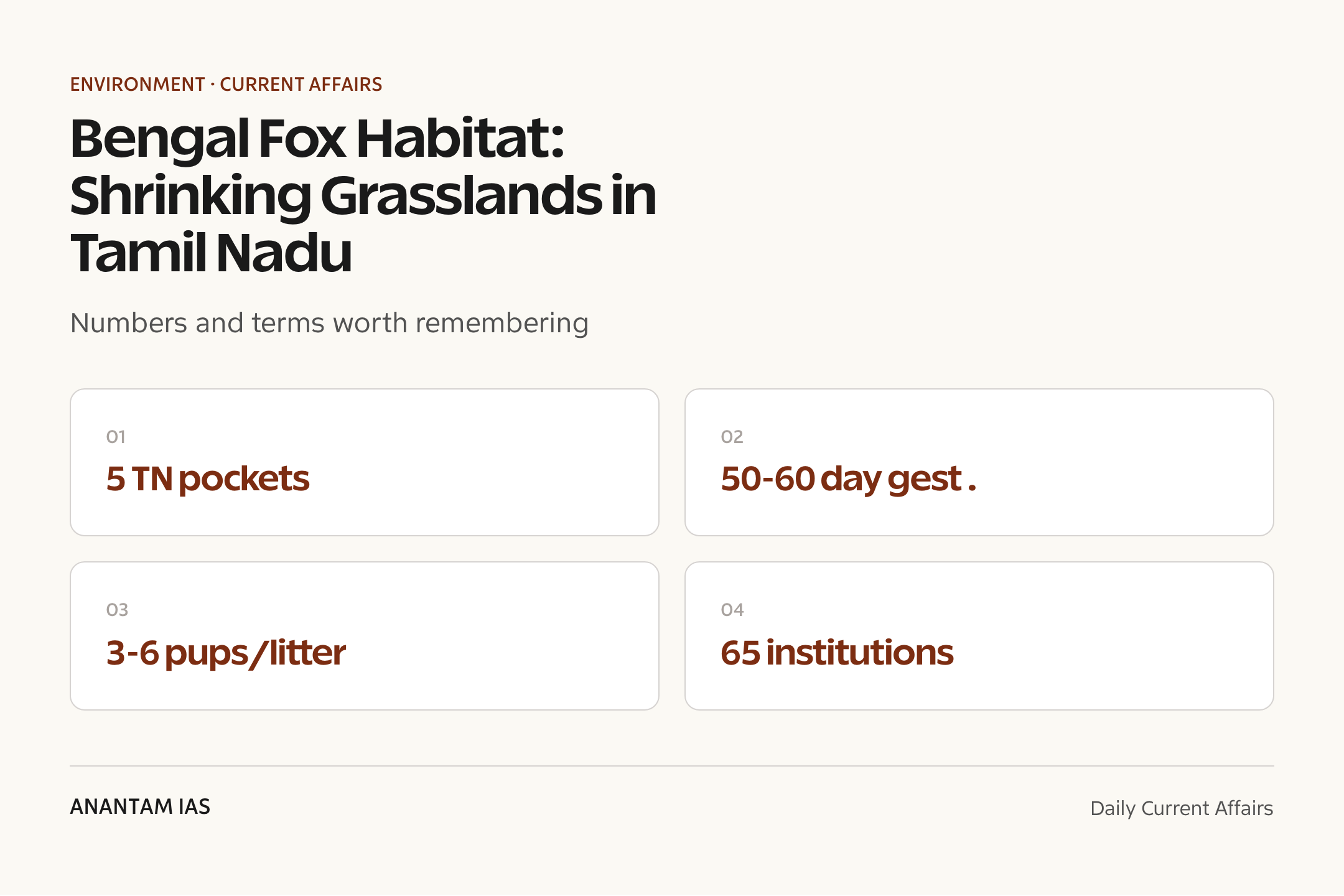
UPSC Relevance
Prelims Relevance
- Bengal fox is also called the Indian fox.
- Scientific name: Vulpes bengalensis.
- Distribution: endemic to the Indian subcontinent, from Himalayan foothills and Nepal’s Terai through southern India, with range also in Pakistan, eastern India and Bangladesh.
- Habitat: semi-arid plains, short grasslands, open scrub, dry fallows and some dryland agricultural mosaics.
- Avoided habitats: dense forests, steep terrain, tall grasslands and true deserts.
- Behaviour: largely crepuscular and nocturnal, using dens for resting and breeding.
- Breeding: The Hindu cited a 50-60 day gestation and 3-6 pups per litter in the Tamil Nadu conservation discussion.
- Conservation status: standard species references list it as Least Concern, but local decline can still occur.
- CITES: Indian populations are listed in Appendix III, as noted in standard species references.
Mains Relevance
GS Paper 3
- Environment and ecology: open natural ecosystems, habitat fragmentation, species distribution and local extinction risk.
- Biodiversity conservation: need for baseline surveys, community-led protection and protection of non-forest habitats.
GS Paper 1
- Geography: semi-arid landscapes, dryland farming, scrublands and the ecological value of grassland-fallow mosaics.
- Indian society: conservation conflicts around local ritual practices, livelihoods and changing land use.
GS Paper 2
- Governance: coordination among forest, revenue, agriculture, rural development, transport and local bodies in edge habitats.
Essay
- Conservation succeeds when policy protects quiet ecosystems, not only famous forests.
- Development becomes ecological only when land-use decisions count invisible species and local knowledge.
- Data poverty can be as damaging as funding poverty in biodiversity governance.
Background and Context
What the Report Says
The Tamil Nadu story is a local warning about a species that was once familiar in dry landscapes but is now difficult to track.
- The Hindu reported that references to the Bengal fox in Sangam literature point to its older presence in the dry, arid grasslands of south India.
- Forest Department officials said the fox is now known from pockets in Dharmapuri, Tiruvannamalai, Salem, Madurai and Villupuram.
- Researchers described the species as under-studied, with weak distribution mapping and almost no firm population-trend baseline for Tamil Nadu.
- AIWC has conducted a preliminary study to identify presence across Tamil Nadu landscapes, according to the report.
- Recent interventions by the Forest Department were reported to have stopped fox capture in recent years during fox jallikattu events.
Species Profile
The Bengal fox is an open-country canid, not a deep-forest species.
- Bengal fox, also called Indian fox, is a small canid with an elongated muzzle, pointed ears and a black-tipped bushy tail.
- Vulpes bengalensis is endemic to the Indian subcontinent and is adapted to semi-arid, flat to undulating landscapes.
- Preferred habitat includes short grasslands, scrub, thorny vegetation, dry deciduous edges, fallow land and dryland farm mosaics.
- Diet is opportunistic: insects, small mammals, reptiles, small birds and fruits help it survive in seasonally dry landscapes.
- Behaviour is mostly crepuscular and nocturnal, which makes casual sightings unreliable as a measure of population status.
Why Grasslands Are the Real Issue
The story is less about one fox and more about how India treats open natural ecosystems.
- Open natural ecosystems include grasslands, savannas, scrublands and semi-arid mosaics that support specialised plants, insects, birds and mammals.
- Policy bias often treats tree cover as the main sign of ecological health, while grasslands may be misread as empty land or degraded land.
- Habitat conversion for irrigated agriculture, urbanisation and industry can make the landscape unsuitable for Bengal fox even when some dryland farming was earlier tolerated.
- Protected-area gaps are important because many fox habitats lie outside national parks and sanctuaries; compare this with the protected-area frame in National Park vs Wildlife Sanctuary.
- Ecological value of grasslands should be read with terrestrial ecosystem basics, not only with forest-cover statistics.
Threats in Tamil Nadu
The Hindu report groups the threats as slow, cumulative and poorly recorded.
- Agricultural expansion removes grassland and scrub, especially when dryland systems shift towards irrigated agriculture.
- Urbanisation and industrialisation fragment open habitats and bring roads, lights, traffic, noise and land-value pressure.
- Road kills become more likely as rural highways expand through fox movement areas.
- Feral dogs can disturb dens, compete with foxes and bring disease risks such as rabies or canine distemper.
- Direct persecution can occur through hunting, capture or ritualised chasing; this also links to wider human-wildlife conflict debates.
- Den disturbance is especially serious because breeding success depends on safe denning sites.
Breeding and Recovery Logic
The species can rebound when disturbance is reduced, but only if its habitat and den sites remain.
- The Hindu reported that Bengal foxes form monogamous lifetime bonds.
- Breeding season was described as typically December-January, with new dens excavated or old dens reused.
- Gestation was cited at 50-60 days, with pups born between January and March.
- Litter size was cited at 3-6 offspring, making den security central to local recovery.
- Recovery potential exists if disturbance is removed and habitat remains undisturbed, but converted irrigated landscapes may not support the species.
Governance Gaps
The Bengal fox sits in a governance gap because its habitat crosses departmental boundaries.
- Forest Department action alone is insufficient where fox habitat falls on revenue land, fallows, road margins, village commons and private fields.
- Land-use planning must identify remaining grassland-scrub patches before they are absorbed into roads, layouts, plantations or high-input agriculture.
- Baseline surveys are the first governance need because managers cannot protect distribution patterns they have not mapped.
- Community custodians matter because fox habitat is often near villages; conservation plans must include local residents instead of treating them only as threats.
- Legal awareness should connect local protection to the broader Wildlife Protection Act 1972 framework.
Salem Model and Awareness
The Salem work shows how a local conservation programme can move from awareness to distribution mapping.
- Tamil Nadu government has run awareness campaigns and formed task forces since 2023 to protect the Bengal fox.
- Salem Innovation Centre focuses on research, education and community work for the species.
- First systematic map of the species in Salem division was compiled through the centre, according to the report.
- 8,500 students from 65 institutions were reached through educational outreach, as reported by The Hindu.
- Community-led conservation is the practical route because remaining habitats need local stewardship, not only policing.
Way Forward
Build a Statewide Baseline
- Tamil Nadu should conduct district-wise occupancy surveys using camera traps, sign surveys, local interviews and den mapping.
- Survey design should separate confirmed presence, probable presence and historic presence so managers can plan recovery without exaggerating certainty.
- Repeat monitoring every breeding season can show whether awareness and habitat protection are actually improving local status.
Protect Open Habitats
- Grassland-scrub patches should be mapped as ecological assets before land-use conversion approvals.
- Dryland farming mosaics should be managed differently from irrigated agriculture because the fox can tolerate some low-intensity dryland activity.
- Denning sites should receive seasonal no-disturbance buffers during breeding months.
Make Conservation Local
- Village institutions, schools, panchayats and local youth groups can report dens, reduce dog disturbance and discourage ritual capture.
- Awareness campaigns should frame the Bengal fox as part of Tamil Nadu’s dryland heritage, not as a nuisance animal.
- Road agencies should add wildlife-crossing warnings and speed-calming near known fox habitats where road kills are reported.
Conclusion
Bengal fox habitat in Tamil Nadu is a useful exam case because it shows how a species can decline without dramatic headlines, large carcass counts or a single protected-area crisis.
The main lesson is simple: grasslands, scrublands and edge habitats need the same policy seriousness that forests receive. Without baseline surveys and community-led habitat protection, local extinction can happen quietly.
UPSC Practice Questions
Prelims MCQ 1
With reference to the Bengal fox, consider the following statements:
- It is also known as the Indian fox.
- It is mainly a deep-forest species of tropical evergreen forests.
- It is adapted to semi-arid plains, short grasslands and open scrub habitats.
How many of the above statements are correct?
(a) Only one (b) Only two (c) All three (d) None
Answer: (b) Only two
Explanation:
Statements 1 and 3 are correct. The Bengal fox is an open-country canid linked to semi-arid grassland, scrub and dryland mosaics; it is not mainly a deep-forest species.
Prelims MCQ 2
Which of the following Tamil Nadu districts was reported by The Hindu as one of the remaining known pockets of Bengal fox occurrence?
(a) Salem (b) Kanyakumari (c) Thanjavur (d) Chennai
Answer: (a) Salem
Explanation:
The report named pockets in Dharmapuri, Tiruvannamalai, Salem, Madurai and Villupuram.
UPSC Mains Questions
- Bengal fox decline in Tamil Nadu shows the conservation neglect of open natural ecosystems. Discuss how grasslands and scrublands should be integrated into biodiversity planning, land-use regulation and community-led conservation.
- Edge species often live outside formal protected areas. Using the Bengal fox case, examine the governance challenges created by revenue lands, dryland agriculture, roads, feral dogs and village-level practices.
- Baseline ecological data is a precondition for conservation. Explain why species distribution mapping, population monitoring and local community reporting are important for under-studied mammals in India.
Sources: The Hindu and English Wikipedia; standard Bengal fox references.
Frequently Asked Questions
What is the Bengal fox?
The Bengal fox, also called the Indian fox, is a small canid with the scientific name Vulpes bengalensis. It is native to the Indian subcontinent and is associated mainly with semi-arid grasslands, scrublands, dry fallows and open dryland landscapes rather than dense forests.
Why is it in the news?
The Hindu reported that the Bengal fox has disappeared from many parts of Tamil Nadu and is now known only from pockets in Dharmapuri, Tiruvannamalai, Salem, Madurai and Villupuram. The report highlights habitat conversion, weak data and community-level conservation needs.
What habitat does it prefer?
The species prefers semi-arid plains, short grasslands, open scrub, fallow land and some dryland agricultural mosaics. It avoids dense forests, steep terrain, tall grasslands and true deserts. This makes grassland conservation central to its survival.
Why are grasslands neglected?
Grasslands and scrublands are often mistaken for degraded or empty land. In policy practice, tree cover receives more attention than open ecosystems. This creates conversion pressure from agriculture, roads, industry, plantations and urban expansion, even when these landscapes support specialised wildlife.
What is fox jallikattu?
Fox jallikattu is a local ritual reported in parts of Tamil Nadu where trapped foxes are released and chased by people. Communities may claim the animal is released, but conservationists warn that the practice causes stress, injury risk and direct disturbance to a declining local population.
What should Tamil Nadu do next?
The priority is a statewide baseline survey, protection of remaining grassland-scrub patches, seasonal safeguards around dens, control of feral-dog disturbance near habitats, and community-led awareness. Conservation will work better when villagers are treated as habitat custodians.
Source: https://anantamias.com/current-affairs/bengal-fox-habitat-shrinkage/
Manufacturing PMI June 2026: Factory Growth Slows
Why in News?
The Hindu reported on 1 July 2026 that India’s manufacturing PMI slowed to 54.2 in June, its second-lowest reading in four years.
S&P Global Market Intelligence and HSBC said the seasonally adjusted index fell from 55.0 in May, signalling continued factory expansion but at a slower pace.
- HSBC India Manufacturing PMI remained above the neutral 50.0 mark, so it still showed expansion over the previous month.
- New orders and output growth were among the weakest in four years, with March 2026 being the notable recent softer month.
- International sales increased at the slowest pace since March 2023, partly due to weaker demand from some European markets.
- Input-cost inflation and output-charge inflation eased, making the slowdown a mixed signal rather than a simple bad-news data point.
- Data collection for the release took place from 10-24 June 2026, giving it value as a high-frequency business survey.
The development matters in the context of:
- PMI is a survey-based early indicator, useful before official output data such as IIP and national accounts arrive.
- For GS3, the issue links industrial growth, exports, employment, inflation pressure and the limits of headline growth numbers.
- A still-expansionary reading with slower momentum helps explain why policymakers must read growth, prices and demand together, not in isolation.
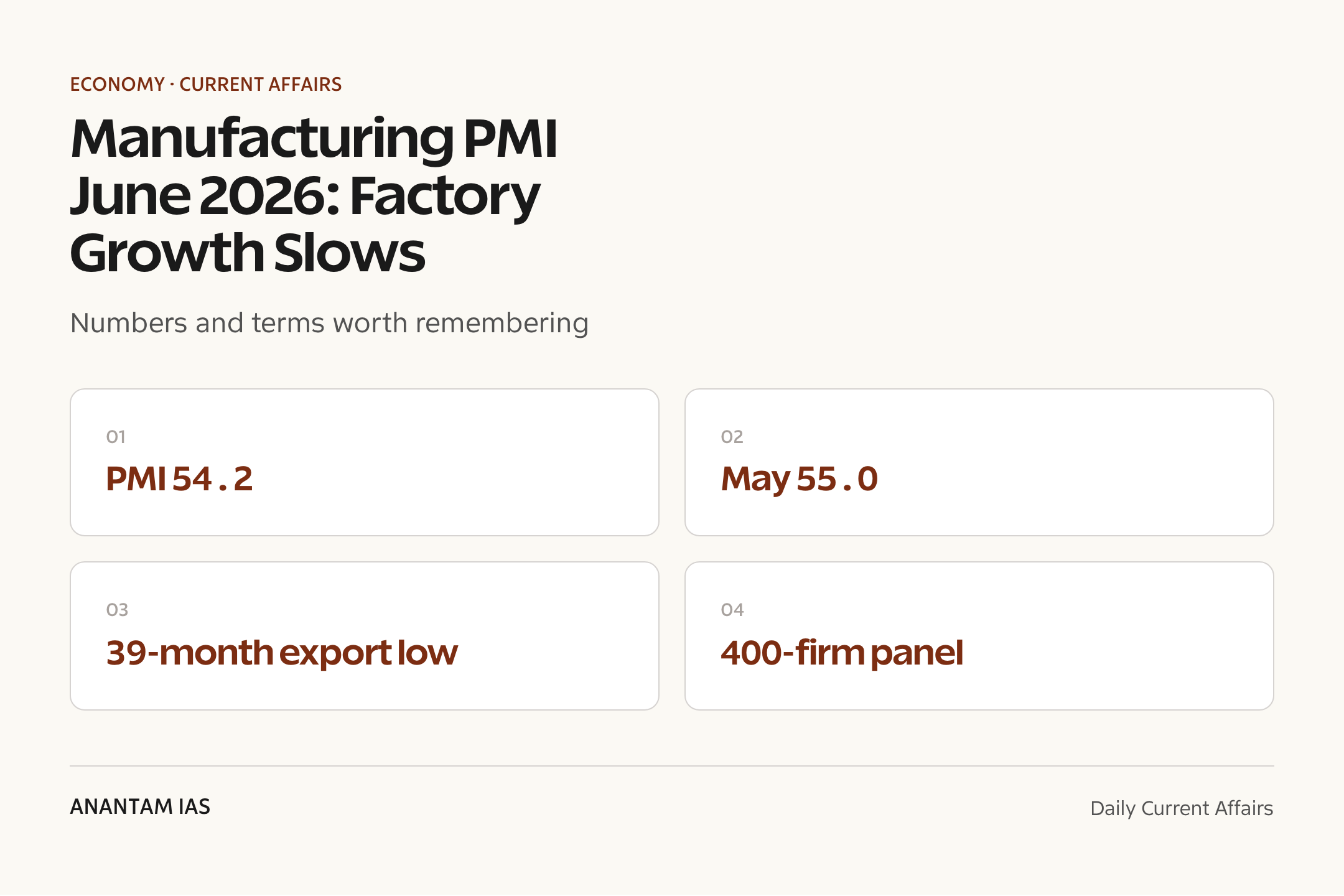
UPSC Relevance
Prelims Relevance
- PMI stands for Purchasing Managers’ Index, a diffusion index based on month-on-month business survey responses.
- A PMI reading above 50.0 indicates expansion compared with the previous month; below 50.0 indicates contraction.
- The June 2026 HSBC India Manufacturing PMI was 54.2, down from 55.0 in May.
- The headline PMI is a weighted average of new orders, output, employment, suppliers’ delivery times and stocks of purchases.
- In the PMI formula, new orders carry the highest weight at 30 percent, followed by output at 25 percent and employment at 20 percent.
- Suppliers’ delivery times are inverted in the PMI calculation so that the index moves in the same broad direction as the other components.
- The India manufacturing PMI survey is compiled by S&P Global from responses from a panel of around 400 manufacturers.
- The topic connects directly to Indian economy, industrial policy, exports and inflation monitoring.
Mains Relevance
GS Paper 3
- Indian economy: industrial growth, high-frequency indicators, demand cycles and manufacturing competitiveness.
- Inclusive growth: the link between factory expansion, employment, MSME orders and wage demand.
- External sector: export-order softness, European market demand and vulnerability of manufacturing supply chains.
- Inflation: easing input and output price pressure, and its relevance for monetary policy reading.
GS Paper 2
- Governance: evidence-based policy making through timely, credible and comparable economic indicators.
- Regulatory capacity: using survey data with official statistics instead of replacing one with the other.
Essay
- Growth numbers need interpretation, not celebration or alarm.
- Manufacturing is both an economic and employment question.
- Data-led governance works best when quick indicators are checked against ground realities.
Background and Context
What PMI Measures
PMI is a fast monthly signal of business conditions, not a direct measure of factory output.
- Purchasing managers report whether key business variables improved, worsened or stayed unchanged compared with the previous month.
- The index is called a diffusion index because it measures the spread of improvement or deterioration across firms, not the exact value of production.
- A reading above 50.0 means more firms reported improvement than deterioration after weighting; it does not mean output grew by that percentage.
- The headline manufacturing PMI combines new orders, output, employment, supplier delivery times and stocks of purchases.
- For Prelims, remember the direction rule: above 50 means expansion, below 50 means contraction and 50 is the no-change line.
June 2026 Headline Signal
The June reading showed continued expansion, but the pace of improvement weakened.
- HSBC India Manufacturing PMI fell from 55.0 in May to 54.2 in June.
- S&P Global described the June reading as the second-weakest improvement in sector health since mid-2022, with March 2026 being weaker.
- The Hindu framed the reading as the second-lowest in four years, which makes the headline important for the daily economy watch.
- Because 54.2 is still above the neutral mark, the correct interpretation is slower expansion, not outright contraction.
- The release also noted that the June reading remained close to the long-run series average, so the signal is one of cooling momentum rather than a collapse.
Demand and Output Story
The most exam-relevant part of the release is the softening of demand-led growth.
- New orders and output grew at among the weakest rates seen in four years, apart from the March 2026 dip.
- Some firms still reported better demand conditions, but others cited subdued client appetite and intense market competition.
- The slowdown was concentrated in capital goods, while consumer and intermediate goods makers saw faster growth.
- Export orders continued to rise, but the pace was the weakest in 39 months, with weaker sales to some European markets.
- Capital goods matter here because they are investment-linked; weakness in this segment can signal caution about future capacity expansion.
- This matters for inclusive growth because demand softness can affect investment, supplier payments, MSME order books and hiring plans.
Prices and Inflation Reading
The same release that showed slower growth also pointed to easier price pressure.
- Input-cost inflation eased to its slowest pace since February 2026, even though firms still reported costlier chemicals, electronics, gas, metals, petroleum products, plastics, rubber and wood.
- Output charges rose at the least pronounced pace in three months, showing that firms were more cautious about raising selling prices.
- This is useful for inflation analysis because the PMI captures price pressure at the producer level before it may pass through to consumers.
- Lower cost pressure can support margins, but weaker demand can also limit firms’ ability to expand production and employment.
- For Mains, the nuanced answer is that a lower PMI can contain both a growth warning and a price-relief signal.
Employment, Inventories and Sentiment
The labour and inventory signals show why PMI is more useful than a single output headline.
- Employment still expanded in June, but at the weakest rate recorded in 2026 so far.
- S&P Global linked weaker hiring to limited capacity pressure, with backlogs of work broadly unchanged.
- Input buying grew at the weakest pace in two-and-a-half years, showing caution in purchasing raw materials and intermediates.
- Finished-goods stocks fell, with firms citing better alignment of production and inventories with current demand.
- Business confidence slipped to a five-month low, as concerns over demand and market conditions weighed on future output expectations.
How to Use PMI Carefully
PMI is valuable because it is quick, but it must be read with other data.
- Survey data can reveal turning points faster than official statistics, especially in business sentiment, orders and hiring intentions.
- But PMI does not replace IIP, corporate results, export data, GST collections or national accounts; it complements them.
- A broad economy answer should triangulate PMI with core-sector output, bank credit, capacity utilisation and external-demand trends.
- The June 2026 reading warns that headline manufacturing expansion can hide weaker orders, softer export momentum and slower employment growth.
- Exam answers should separate level and direction: the level stayed expansionary, but the direction pointed to cooling momentum.
- This is why the UPSC syllabus economy portion rewards interpretation of indicators, not memorisation of isolated numbers.
Way Forward
Triangulate high-frequency data
- Use PMI with IIP, core-sector data, GST collections, railway freight, export figures and corporate commentary before drawing policy conclusions.
- Track sub-indices such as new orders, export orders, employment and prices because they explain the source of a headline movement.
- Improve public communication so citizens understand that a PMI above 50 shows expansion even when the reading falls from the previous month.
Support demand and competitiveness
- Focus on MSME credit, logistics reliability, export-market diversification and timely payments to suppliers where order books are weakening.
- Use industrial policy to reduce avoidable input-cost shocks in sectors exposed to metals, electronics, petroleum-linked inputs and imported intermediates.
- Strengthen skilling and apprenticeship pathways so slower hiring phases do not become a long-term manufacturing employment bottleneck.
Watch inflation without ignoring growth
- Treat easing input prices as useful relief, but avoid reading it as proof that manufacturing demand is strong.
- Monitor whether lower cost pressure passes through to output prices, margins, investment and consumer prices over the next few months.
- For policy, the balance is to protect macro stability while keeping the manufacturing investment cycle alive.
Conclusion
The June 2026 PMI does not show a manufacturing contraction. It shows slower factory expansion, weaker order momentum, softer export growth, muted hiring and easier price pressure in the same data set.
For UPSC, the lesson is methodological as much as factual. A number like 54.2 must be read through its components, its direction of change and its relation to official output, employment, inflation and external-sector data.
UPSC Practice Questions
Prelims MCQ 1
With reference to the Purchasing Managers’ Index, consider the following statements:
- A reading above 50 indicates expansion compared with the previous month.
- The headline manufacturing PMI includes new orders, output, employment, suppliers’ delivery times and stocks of purchases.
- Suppliers’ delivery times are inverted in the PMI calculation.
How many of the above statements are correct?
(a) Only one (b) Only two (c) All three (d) None
Answer: (c) All three
Explanation:
All three statements are correct. PMI is a diffusion index; above 50 signals expansion, and the manufacturing headline index uses five weighted components with suppliers’ delivery times inverted.
Prelims MCQ 2
Which one of the following best describes India’s manufacturing PMI reading for June 2026?
(a) It fell below 50, showing contraction in manufacturing activity. (b) It rose to 55.0, showing faster expansion than in May. (c) It fell to 54.2, showing continued expansion at a slower pace. (d) It stayed unchanged at 50.0, showing no change in factory activity.
Answer: (c) It fell to 54.2, showing continued expansion at a slower pace.
Explanation:
The HSBC India Manufacturing PMI fell from 55.0 in May to 54.2 in June 2026. Since it remained above 50, it indicated expansion, but at a slower pace.
UPSC Mains Questions
- India’s June 2026 manufacturing PMI shows slower expansion but softer price pressure. Discuss how policymakers should interpret high-frequency indicators when growth, employment, exports and inflation send mixed signals.
- Purchasing Managers’ Index data can reveal turning points before official output data, but it cannot replace official statistics. Examine this statement in the context of India’s manufacturing sector.
- A slower manufacturing PMI can affect MSMEs, export competitiveness and job creation. Analyse the policy steps needed to sustain factory growth without worsening inflation.
Sources: S&P Global Market Intelligence, HSBC India Manufacturing PMI and The Hindu.
Frequently Asked Questions
What was India’s June PMI?
India’s manufacturing PMI was 54.2 in June 2026, down from 55.0 in May. Since the reading stayed above 50, it still showed expansion over the previous month, but the pace of factory growth slowed.
Who releases the manufacturing PMI?
The HSBC India Manufacturing PMI is compiled by S&P Global Market Intelligence from survey responses from around 400 manufacturers. The survey asks firms about changes in orders, output, employment, inventories, supplier delivery times and prices.
Why is 50 important in PMI?
The 50.0 mark is the no-change line. A reading above 50 means expansion compared with the previous month, while a reading below 50 means contraction. A falling reading above 50 means growth is continuing, but at a slower pace.
What weakened in June 2026?
New orders, output, export orders and employment grew more slowly in June. S&P Global also reported weaker input buying, a fall in finished-goods inventories and business confidence at a five-month low.
Was there any positive signal?
Yes. Input-cost inflation and output-charge inflation eased in June. This can reduce pressure on firms and consumers, but it must be read with the demand slowdown because softer prices can also appear when firms hesitate to raise prices.
Why does PMI matter for UPSC?
PMI helps connect GS3 topics such as industrial growth, exports, employment, inflation and evidence-based economic policy. It is a useful example of why exam answers should interpret indicators, not just quote headline numbers.
Source: https://anantamias.com/current-affairs/manufacturing-pmi-june-2026/
Amarnath Yatra Security: Stricter Protocols for Pilgrims
Why in News?
The Amarnath Yatra security protocol changed ahead of the Shri Amarnathji Yatra 2026, with the Indian Express reporting tighter pilgrim movement rules from Lakhanpur, the Punjab-side entry point into Jammu and Kashmir.
The Shri Amarnathji Shrine Board says the 57-day Yatra will run from 3 July 2026 to 28 August 2026, while official notices also place the Pahalgam and Baltal axes under a No Flying Zone from 1 July 2026 till completion.
- Indian Express reported that only pilgrims reaching Lakhanpur between 6 am and 8 am would be escorted onward to Jammu under security cover.
- Pilgrims arriving after 8 am are to halt at Lakhanpur for security reasons instead of moving independently toward Jammu.
- NH-44, the Jammu-Srinagar highway, is the permitted corridor; alternate routes such as the Udhampur-Dhar road and Mughal Road are not allowed for Yatra movement.
- Designated security convoys from Jammu are mandatory, including for pilgrims travelling in private vehicles.
- Night travel has been barred, and traffic authorities have fixed cut-off timings for convoys moving toward Pahalgam and Baltal transit or base camps.
- Accommodation capacity of about 55,000 pilgrims has been arranged between Lakhanpur and Banihal in Ramban district.
The development matters in the context of:
- Internal security matters because the route passes through Jammu and Kashmir, close to sensitive border-linked corridors and highway nodes.
- High-altitude disaster management matters because the Shrine Board’s health advisory notes trekking conditions up to 14,000 ft.
- Crowd control matters because pilgrim movement, langars, medical posts, traffic timing and base-camp capacity must work as one system.
- Jammu and Kashmir governance is tested through coordination among police, traffic police, civil administration, Shrine Board, health teams and civil society groups.
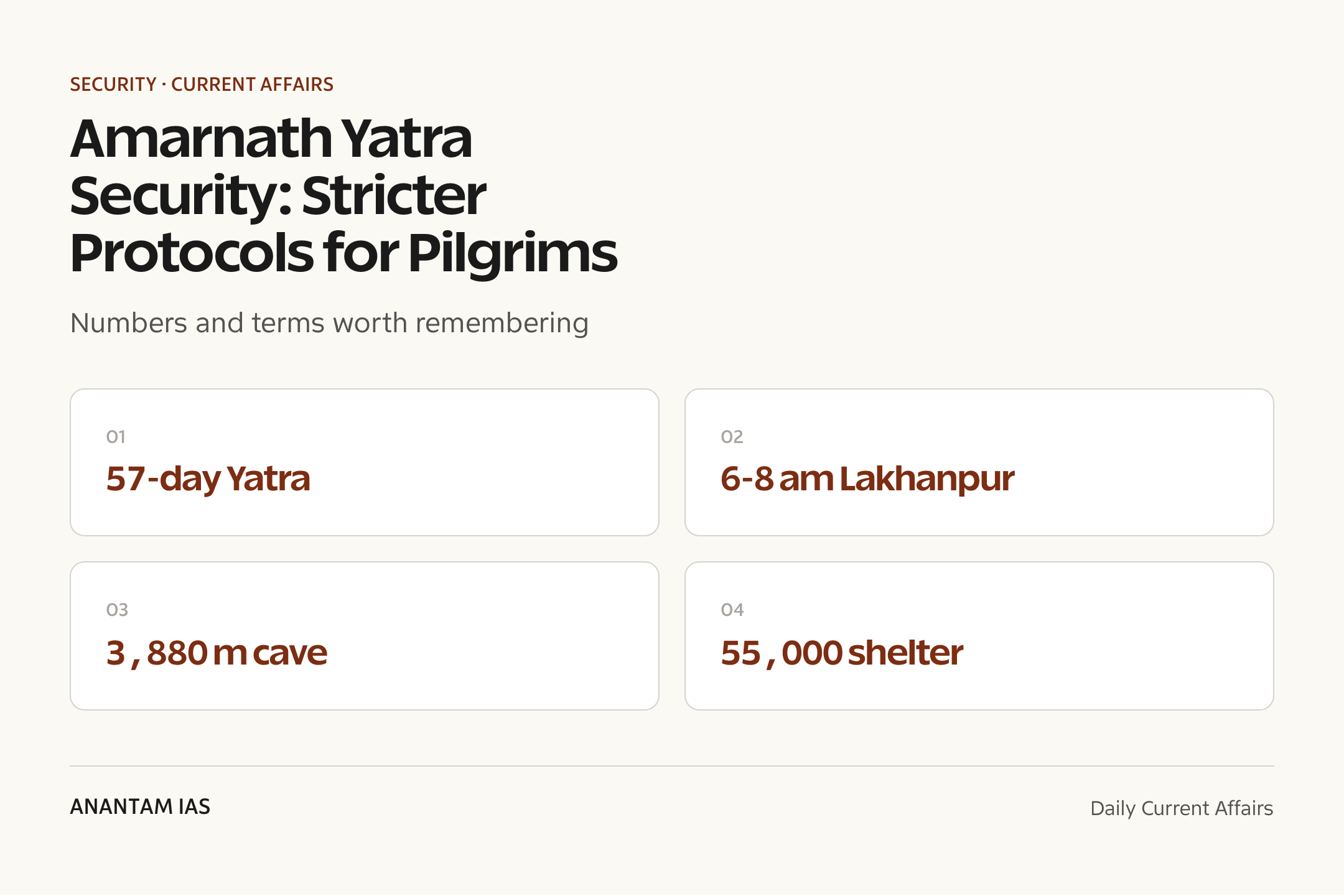
UPSC Relevance
Prelims Relevance
- Amarnath cave shrine: a high-altitude pilgrimage site in Jammu and Kashmir, reported at about 3,880 metres.
- Shri Amarnathji Shrine Board: statutory body responsible for better management of the Yatra and pilgrim facilities.
- Pahalgam route: the traditional route, reported by Indian Express as about 48 km from the Pahalgam side.
- Baltal route: the shorter and steeper route; the Shrine Board route page says Baltal to Holy Cave is about 14 km.
- Lakhanpur: key entry point into Jammu and Kashmir from the Punjab side for road-based Yatra movement.
- NH-44: the Jammu-Srinagar highway corridor used for regulated pilgrim movement.
- RFID card: mandatory identification and tracking card that registered yatris must collect before embarking on the Yatra.
- Compulsory Health Certificate: required health document; the Shrine Board says 2026 CHCs issued on or after 8 April 2026 are valid.
- No Flying Zone: official notice covers both Pahalgam and Baltal axes from 1 July 2026 till Yatra completion.
Mains Relevance
GS Paper 3
- Internal security: convoy discipline, highway protection, anti-infiltration posture and protection of vulnerable pilgrim movement.
- Disaster management: high-altitude sickness, crowd surge, weather disruptions, evacuation, medical posts and camp logistics.
GS Paper 2
- Governance: Centre-UT coordination, police-civil administration interface, service delivery and accountability in a sensitive region.
- Rights and public order: balancing freedom of pilgrimage with reasonable security restrictions and route controls.
GS Paper 1
- Geography: Himalayan terrain, altitude, road corridors, weather exposure and route vulnerability in Jammu and Kashmir.
Essay
- Faith and security show how public administration must protect both liberty and life in fragile spaces.
- Pilgrimage governance offers a useful lens on how India manages mobility, risk and diversity at scale.
Background and Context
What Changed for Pilgrims
The immediate change is tighter control over when pilgrims enter Jammu and how they move after entering the Union Territory.
- Lakhanpur timing is the first control point: pilgrims reaching between 6 am and 8 am move onward under escort, while later arrivals halt.
- Security escort converts private or scattered movement into monitored group movement, reducing exposure on sensitive stretches.
- Route restriction keeps Yatra traffic on NH-44 and blocks alternate corridors such as the Udhampur-Dhar road and Mughal Road for pilgrim movement.
- Mini-convoys between Udhampur and Banihal are to operate on a fixed schedule, according to the Indian Express report.
- Night-movement ban reduces risks linked to low visibility, difficult terrain, ambush vulnerability and emergency response delays.
Why the Security Posture Tightened
The Yatra sits at the overlap of public order, cross-border risk and mass-mobility management.
- April 22, 2025 Pahalgam attack remains a live security reference point because tourists were targeted in a high-sensitivity region.
- Cross-border infiltration concerns, reported by Indian Express through security sources, add pressure on highway and border-adjacent route management.
- International Border proximity matters because the Lakhanpur-Jammu stretch runs near the border-linked belt while feeding traffic toward Jammu city.
- Additional checkpoints near link roads joining the highway help screen movement from border-side approaches.
- Visible convoy control also reassures pilgrims and reduces panic, which is important during a crowded religious event.
Official Yatra Frame
The official frame gives students the durable facts that can be asked in Prelims and used in Mains answers.
- Shri Amarnathji Yatra 2026 is scheduled from 3 July to 28 August 2026, making it a 57-day pilgrimage.
- Shri Amarnathji Shrine Board manages the Yatra, pilgrim facilities and related administrative arrangements.
- Government Order No. 321-HOME of 2026, cited by the Shrine Board, declared both Pahalgam and Baltal axes a No Flying Zone from 1 July till completion.
- Helicopter services for pilgrim travel are unavailable in the Yatra area during SANJY 2026 because of the no-flying-zone order.
- Registered yatris must collect their RFID cards from designated counters in Jammu or Kashmir before starting the Yatra.
Route Geography
Route geography matters because every security and disaster-management decision depends on terrain, distance and chokepoints.
- Pahalgam axis is the traditional route through the Kashmir Valley side; Indian Express reports it as about 48 km to the cave.
- Baltal axis is shorter but steeper; the Shrine Board route page says Holy Cave is about 14 km from Baltal.
- Jammu to Baltal road movement follows the Jammu-Udhampur-Ramban-Banihal-Anantnag-Srinagar-Sonamarg-Baltal corridor, according to the Shrine Board route description.
- Jammu to Pahalgam is listed by the Shrine Board as about 315 km, while Jammu to Baltal is about 400 km.
- Mountain corridors create chokepoints where traffic discipline, weather warnings and medical evacuation plans become security tools.
High-Altitude Disaster Management
The Yatra is also a disaster-management case because the risk is not only terrorism; terrain and altitude can also kill.
- Shrine Board health advisory says the pilgrimage involves trekking at altitudes as high as 14,000 ft.
- High Altitude Sickness can include nausea, fatigue, dizziness, breathing difficulty, poor coordination and altered mental status.
- Medical posts every few kilometres, rest points, oxygen support and evacuation channels are part of the safety chain.
- Compulsory Health Certificate screens pilgrims before the journey, but health status can change after certification.
- Weather disruptions, landslides, cold stress and dehydration can quickly turn crowd movement into a rescue problem.
Crowd and Camp Logistics
Security plans work only when accommodation, food, sanitation, health and transport systems are synchronized.
- 55,000-pilgrim accommodation between Lakhanpur and Banihal is a buffer against late arrivals, weather holds and convoy delays.
- Base camps such as Bhagwati Nagar, Pahalgam and Baltal act as sorting points for route choice, documentation and convoy movement.
- Langars and civil society facilities reduce pressure on state capacity but need health, sanitation and crowd-flow oversight.
- Traffic cut-off timings prevent uncontrolled spillover into night travel and help keep convoys within police-monitored windows.
- RFID tracking supports accountability, missing-person response and crowd estimation without relying only on manual registers.
UPSC Link: Security Plus Governance
For UPSC, the topic should not be reduced to a pilgrimage news item; it is a compact case study in risk governance.
- Internal security connects this issue with internal security for UPSC, border management, intelligence and public-order policing.
- Disaster preparedness connects the Yatra with disaster management, especially evacuation, medical triage and crowd planning.
- Geography connects the topic with Himalayan terrain, altitude, road corridors and climate-linked hazards.
- Current affairs preparation should file it under current affairs, but answer it through the durable syllabus of GS3 and GS2.
- Exam takeaway: a good answer balances security restrictions with service delivery, pilgrim dignity and transparent communication.
Way Forward
Keep Convoy Rules Clear
- One official communication channel should publish daily timings, route holds, weather alerts and convoy instructions in simple language.
- Cut-off timings must be displayed at Lakhanpur, Jammu base camp, transit camps and registration counters to reduce confusion.
Integrate Security and Health
- Joint control rooms should combine police, traffic, health, disaster-response and Shrine Board data for real-time decisions.
- RFID dashboards should be used for crowd estimation, missing-person response and route-level pressure alerts.
Prepare for Chokepoints
- Buffer shelters between Lakhanpur and Banihal should have food, sanitation, first aid, women-friendly facilities and information desks.
- Weather-linked halt protocols should be pre-announced so pilgrims treat halts as safety measures, not administrative delay.
Protect Trust
- Security restrictions should be explained with reasons, review windows and grievance channels.
- Community volunteers and langar organisers should be trained in crowd flow, health referral and misinformation control.
Conclusion
The Amarnath Yatra security story is a useful GS3 case because the state is not only guarding a route; it is managing a moving, high-altitude, high-emotion public event in a sensitive region.
For exam answers, the balanced view is simple: stricter convoy and route controls are justified when risks are credible, but they must be paired with health care, shelter, sanitation, clear communication and respect for pilgrim dignity.
UPSC Practice Questions
Prelims MCQ 1
With reference to Shri Amarnathji Yatra 2026, consider the following statements:
- The Shrine Board says the Yatra is scheduled from 3 July 2026 to 28 August 2026.
- Official notice places both Pahalgam and Baltal axes under a No Flying Zone from 1 July 2026 till Yatra completion.
- Registered yatris are required to collect RFID cards from designated counters before embarking on the Yatra.
How many of the above statements are correct?
(a) Only one (b) Only two (c) All three (d) None
Answer: (c) All three
Explanation:
All three statements match the Shri Amarnathji Shrine Board notices on Yatra dates, no-flying-zone coverage and mandatory RFID collection.
Prelims MCQ 2
Which route-related statement about the Amarnath Yatra is correct?
(a) The Baltal route is longer but flatter than the Pahalgam route. (b) Pilgrims may use Mughal Road as an unrestricted alternate route in 2026. (c) The Shrine Board route page says the Holy Cave is about 14 km from Baltal. (d) NH-44 has been excluded from regulated pilgrim movement.
Answer: (c) The Shrine Board route page says the Holy Cave is about 14 km from Baltal.
Explanation:
The Baltal route is shorter and steeper, and the Shrine Board route page places the Holy Cave about 14 km from Baltal. The 2026 security protocol keeps movement on NH-44 and does not allow alternate routes such as Mughal Road.
UPSC Mains Questions
- Amarnath Yatra security is a test of internal security, crowd control and high-altitude disaster management. Discuss how convoy protocols, RFID tracking and route restrictions can reduce risk without weakening pilgrim dignity.
- Religious pilgrimages in sensitive border regions require a balance between freedom of movement and public order. Examine this balance with reference to the 2026 Amarnath Yatra protocols.
- The Amarnath Yatra shows why disaster management cannot be separated from geography. Explain with reference to Himalayan terrain, altitude sickness, weather disruptions and road-corridor chokepoints.
Sources: Shri Amarnathji Shrine Board and Indian Express.
Frequently Asked Questions
What changed for Amarnath pilgrims?
Pilgrims entering from Lakhanpur face stricter timing and convoy rules. Indian Express reported that only those reaching between 6 am and 8 am move onward under escort. Later arrivals halt there, and onward movement is restricted to designated convoys and the NH-44 corridor.
When is Amarnath Yatra 2026?
The Shri Amarnathji Shrine Board says the Yatra will begin on 3 July 2026 and conclude on 28 August 2026. That makes it a 57-day pilgrimage across the Pahalgam and Baltal axes in Jammu and Kashmir.
Why is Lakhanpur important?
Lakhanpur is the entry point into Jammu and Kashmir from the Punjab side for many road-based pilgrims. It has become a key security filter because pilgrims can be screened, timed and grouped before they move toward Jammu and later toward Kashmir Valley base camps.
What is the No Flying Zone?
The Shrine Board cites Government Order No. 321-HOME of 2026, which declares both the Pahalgam and Baltal axes a No Flying Zone from 1 July 2026 till Yatra completion. Helicopter services for pilgrim travel are unavailable during SANJY 2026.
How does this relate to disaster management?
The Yatra involves trekking at altitudes up to 14,000 ft, according to the Shrine Board health advisory. Risks include altitude sickness, weather disruption, dehydration, landslides, crowd pressure and evacuation delays. Security planning must work with medical, shelter and traffic planning.
What should UPSC aspirants remember?
Remember the topic as a GS3 Internal Security case with disaster-management and geography links. The key terms are convoy movement, NH-44, RFID cards, No Flying Zone, Pahalgam route, Baltal route, high-altitude sickness and Centre-UT coordination.
Source: https://anantamias.com/current-affairs/amarnath-yatra-security-2026/