Why in News?
PIB confirmed that the Centre has notified revised daily wage rates under the Viksit Bharat – Guarantee for Rozgar and Ajeevika Mission (Gramin), or VB-G RAM G Act, 2025, with effect from 1 July 2026.
Indian Express reported that the new rates replace the running MGNREGA wage schedule for rural employment, with most notified daily wages lying between Rs 300 and Rs 409, and a special Rs 450 rate for three high-altitude Gram Panchayats in Sikkim.
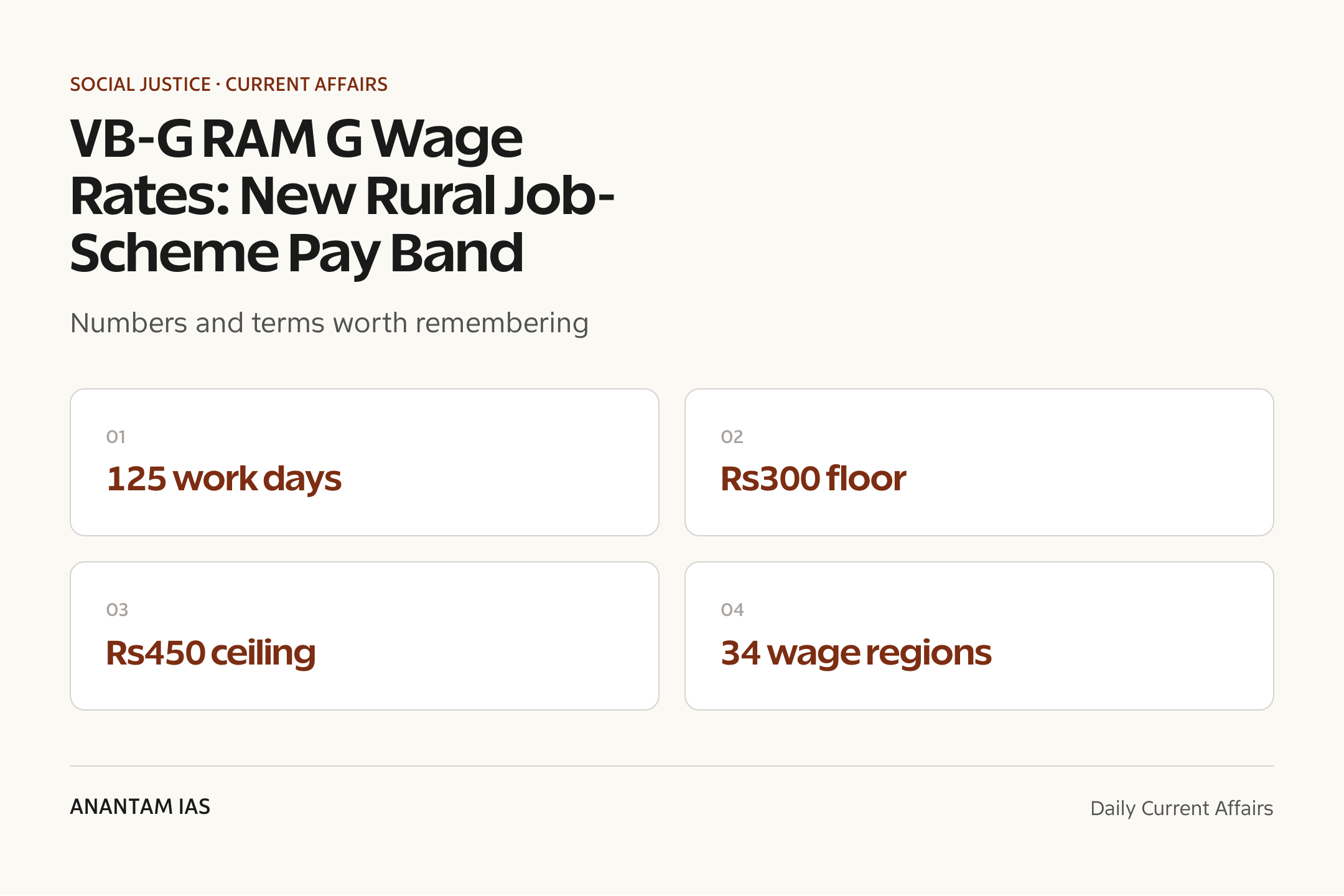
- The official notification creates a Rs 300 interim base wage, so no notified wage under the programme falls below that level.
- PIB said wage rates have increased across 34 States, UTs and wage regions, with the average notified wage rising from Rs 298.8 under MGNREGA to Rs 327.4 under VB-G RAM G.
- The largest percentage gains go to historically lower-wage regions, including Arunachal Pradesh and Nagaland, where PIB placed the increase at nearly 24.5 percent.
- Indian Express listed Haryana at Rs 409, Goa at Rs 406, Kerala at Rs 401, and high-altitude Sikkim Gram Panchayats at Rs 450.
- The notification matters because wage rates are only one part of the shift from MGNREGA 2005 to a new law with changed work guarantees, planning rules and fiscal design.
The development matters in the context of:
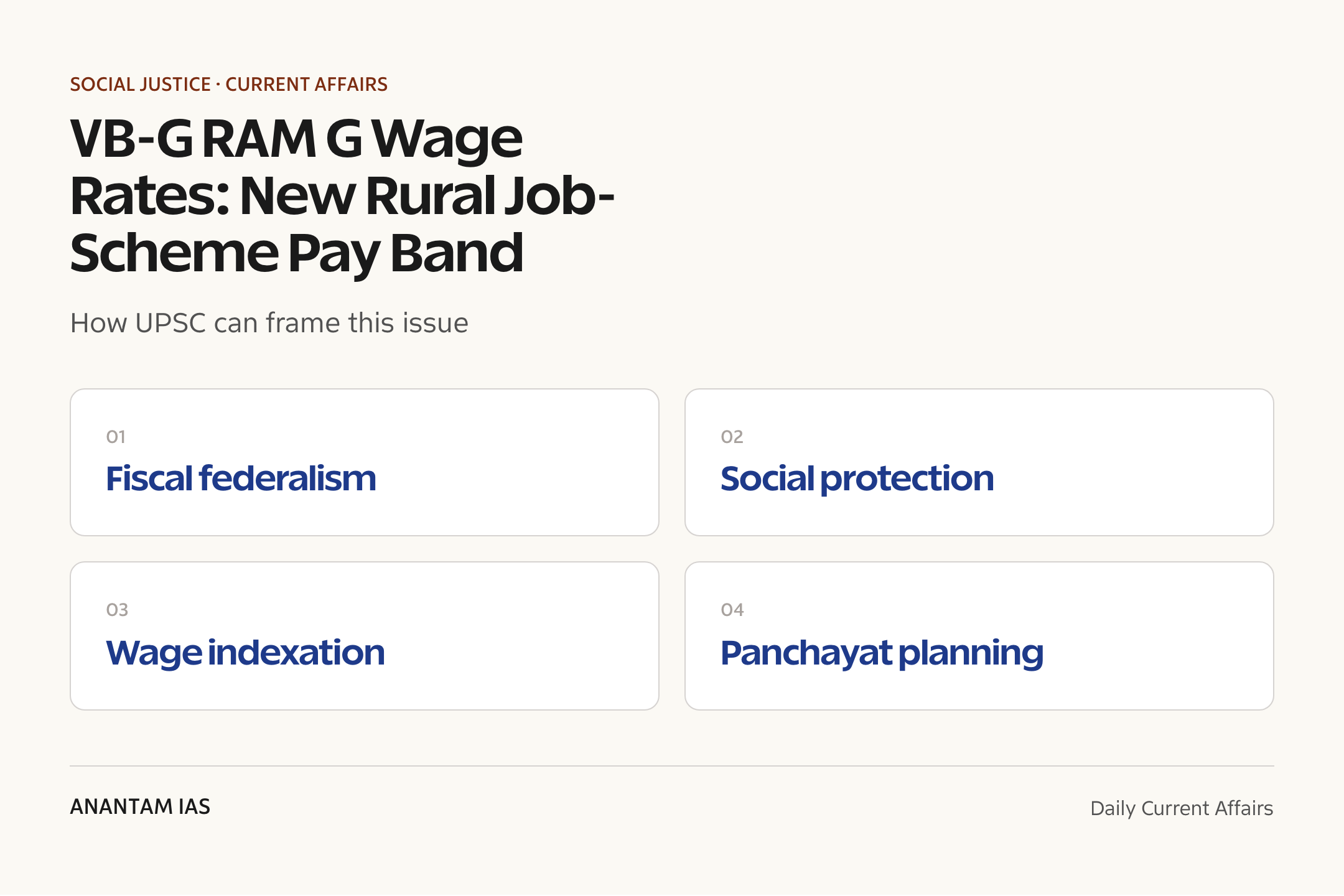
- For GS-II, the issue sits at the intersection of welfare schemes, rural livelihoods, federalism and rights-based social protection.
- For governance, the key question is whether a higher notified wage floor can coexist with timely payments, transparent work demand, and accountable Gram Panchayat planning.
- For public finance, the debate shifts from headline wage gains to Centre-State cost sharing, normative allocation and the fiscal capacity of poorer States.
UPSC Relevance
Prelims Relevance
- VB-G RAM G stands for Viksit Bharat – Guarantee for Rozgar and Ajeevika Mission (Gramin).
- The Act came into force across rural India from 1 July 2026.
- The new law enhances the statutory wage employment guarantee from 100 days to 125 days for every eligible rural household.
- The notified wage floor is Rs 300 per day under the interim base wage rate.
- The highest standard state wage in the notification is Rs 409 for Haryana, while select Sikkim Gram Panchayats have a Rs 450 rate.
- Section 10 of the VB-G RAM G Act empowers the Centre to specify wage rates for unskilled manual work under the scheme.
- The wage rate notified under VB-G RAM G cannot be lower than the prevailing rate notified under Section 6 of MGNREGA, 2005.
- PRS notes that state schemes must align with the new law, while Gram Panchayats retain a role in identifying and planning local works.
- This topic links directly to the UPSC syllabus areas of welfare schemes, poverty, rural development and federal governance.
Mains Relevance
GS Paper 2
- Welfare schemes for vulnerable sections, especially the rural poor and landless labourers.
- Centre-State relations in the implementation and financing of centrally sponsored schemes.
- Accountability, transparency and service delivery in rights-based employment programmes.
GS Paper 3
- Inclusive growth through wage employment, rural asset creation and purchasing power.
- Agriculture-rural labour linkages, including the design choice to pause works during peak farm seasons.
GS Paper 4
- Ethics of welfare delivery: dignity of labour, fairness in wage setting and non-exclusion of eligible households.
Essay
- Social protection is strongest when it combines legal entitlement, fiscal credibility and local accountability.
- Rural development is not only income support; it is also the creation of durable community assets.
- Federalism in welfare delivery tests both constitutional design and everyday administrative trust.
Background and Context
What changed from July 2026
The wage notification operationalises the new rural employment law from the first day of July 2026.
- The VB-G RAM G Act, 2025 replaces the two-decade-old MGNREGA framework for guaranteed rural wage employment.
- The official notification applies from 1 July 2026, the same date on which the Act begins nationwide operation.
- The law increases the statutory guarantee from 100 days to 125 days of wage employment for eligible rural households.
- The Centre has framed the wage revision as a livelihood-security measure, while the exam-relevant issue is the design of a new rights-based welfare scheme.
The new wage band
The notified rates create a higher national floor and a differentiated wage band across states and wage regions.
- The notification sets a Rs 300 interim base wage, bringing 21 States, UTs and administrative units up to that floor.
- PIB placed the national average notified wage at Rs 327.4 per day, up from Rs 298.8 under the previous MGNREGA wage structure.
- Indian Express reported that Haryana has a notified wage of Rs 409, followed by Goa at Rs 406 and Kerala at Rs 401.
- Three high-altitude Gram Panchayats in Sikkim – Gnathang, Lachung and Lachen – have a special Rs 450 daily wage.
- The lowest-wage regions gain more in percentage terms, while already higher-wage States receive smaller revisions under the notified methodology.
Legal basis for wage notification
The wage-setting power is located inside the new Act, but it is tied to the earlier MGNREGA protection.
- Section 10 of the VB-G RAM G Act allows the Central Government to specify the wage rate for unskilled manual work under the scheme.
- The Centre can notify different wage rates for different areas, which explains the state-wise and region-wise wage schedule.
- The law states that the notified wage cannot be less than the wage rate notified under Section 6 of MGNREGA, 2005.
- This link to MGNREGA matters because it prevents the new law from formally lowering the wage floor during the transition.
- For Prelims, remember the institutional continuity: new law, changed guarantee period, but wage protection benchmarked against MGNREGA.
Why the design is politically sensitive
The state-level debate is not only about daily wages; it is about who pays, who plans and who bears overruns.
- PRS records that the Bill shifts implementation to a centrally sponsored scheme model, with regular States sharing costs in a 60:40 ratio.
- For North-eastern and Himalayan States, PRS lists a more favourable 90:10 Centre-State sharing pattern.
- States must bear expenditure above the Centre’s normative allocation, which can create friction if work demand exceeds the approved fiscal envelope.
- State governments also remain responsible for unemployment allowance and compensation in case of delayed wage payments.
- This makes VB-G RAM G a live case study for cooperative federalism and fiscal federalism in welfare delivery.
Planning and works under the new framework
The new law retains local planning but connects it to broader development and asset-creation priorities.
- Gram Panchayats continue to identify projects and prepare local work plans, preserving the decentralised planning logic of rural employment law.
- PRS says works will focus on water security, rural infrastructure, livelihood-related infrastructure and mitigation of extreme weather events.
- The plans are to be integrated with the PM Gati Shakti National Master Plan, linking wage employment to infrastructure planning.
- The law also requires States to announce in advance a work-pause period of up to 60 days during peak agricultural seasons.
- For Mains, this creates a tradeoff: avoid labour shortage during sowing and harvesting, but protect poor households from losing income in lean periods.
Technology and accountability layer
The law expands the monitoring toolkit, but technology can improve or weaken access depending on implementation.
- PRS lists biometric authentication, geospatial technology, mobile dashboards and weekly public disclosure systems in the law’s technology architecture.
- These tools can reduce ghost works, improve measurement and make local assets easier to audit.
- But biometric or app-based systems can also exclude workers when connectivity, device access or authentication fails.
- The governance test is not whether technology exists; it is whether the system preserves demand for work, timely wage payment and a grievance path.
- This connects VB-G RAM G with the broader debate on welfare schemes for vulnerable sections.
Way Forward
Protect the entitlement character
- Keep the legal right to demand work visible at the Gram Panchayat level through simple job-card, demand-registration and dated-receipt systems.
- Publish state-wise data on work demanded, work provided, unemployment allowance and payment delays in a worker-readable format.
- Ensure that the 125-day guarantee is not reduced to a budget ceiling in districts with high distress demand.
Make wage revision credible
- Link future wage revisions to a transparent indexation formula that reflects rural inflation and regional cost differences.
- Track whether the Rs 300 floor narrows wage disparities without pushing poorer States into arrears.
- Release state-wise payment-delay dashboards because a higher notified wage has little value if wage credit is late.
Balance federal finance and local planning
- Define the normative allocation formula clearly, with transparent demand, poverty, climate-risk and asset-deficit parameters.
- Create a consultation mechanism for States before annual allocations and before any agricultural-season work pause.
- Allow Gram Panchayat plans to remain locally grounded while aligning durable assets with water security, livelihood and resilience goals.
Conclusion
The VB-G RAM G wage notification is more than a pay revision. It marks the operational shift from MGNREGA to a new rural employment law with a higher wage floor, longer guarantee period and a more formalised development-planning architecture.
For UPSC, the core issue is the balance between social protection and fiscal federalism. A scheme can announce higher wages, but its real test lies in demand-based work, timely payment, fair cost sharing and accountable local asset creation.
UPSC Practice Questions
Prelims MCQ 1
With reference to the VB-G RAM G Act, 2025, consider the following statements:
- It enhances the statutory rural wage employment guarantee from 100 days to 125 days.
- The notified wage rate under the Act can be lower than the wage notified under Section 6 of MGNREGA, 2005.
- The Act allows different wage rates to be notified for different areas.
How many of the above statements are correct?
(a) Only one (b) Only two (c) All three (d) None
Answer: (b) Only two
Explanation:
Statements 1 and 3 are correct. Statement 2 is incorrect because the wage notified under VB-G RAM G cannot be lower than the prevailing wage notified under Section 6 of MGNREGA, 2005.
Prelims MCQ 2
Which one of the following best describes the interim base wage introduced under the VB-G RAM G wage notification?
(a) Rs 241 per day (b) Rs 298.8 per day (c) Rs 300 per day (d) Rs 409 per day
Answer: (c) Rs 300 per day
Explanation:
PIB stated that the notification introduced a Rs 300 interim base wage, ensuring that no notified wage under the programme is below Rs 300 per day.
UPSC Mains Questions
- The VB-G RAM G Act raises the rural employment guarantee to 125 days, but also changes fiscal and administrative responsibilities. Analyse its implications for social protection and Centre-State relations.
- A higher wage floor in rural employment schemes can reduce distress, but only when backed by timely payment and local accountability. Discuss in the context of the VB-G RAM G wage notification.
- Examine how Gram Panchayat planning, technology-based monitoring and wage indexation can shape the success of the new rural employment framework.
Sources: PIB, Ministry of Rural Development and Indian Express.
Frequently Asked Questions
What is VB-G RAM G?
VB-G RAM G means Viksit Bharat – Guarantee for Rozgar and Ajeevika Mission (Gramin). It is the new statutory rural employment framework that came into force from 1 July 2026 and replaces the earlier MGNREGA-based wage employment structure.
What wage floor was notified?
The Centre notified an interim base wage of Rs 300 per day. PIB said this ensures that no notified wage under the programme falls below Rs 300, while higher rates apply in several States and wage regions.
Which areas get the highest rate?
Indian Express reported a special Rs 450 daily wage for Gnathang, Lachung and Lachen Gram Panchayats in Sikkim. Among standard state rates, Haryana is listed at Rs 409, followed by Goa at Rs 406 and Kerala at Rs 401.
How is it different from MGNREGA?
The new law raises the statutory employment guarantee from 100 days to 125 days. It also changes funding design, planning architecture and technology-based monitoring while retaining key elements such as local work planning and unemployment allowance.
Why are states concerned?
The concern is fiscal and administrative. PRS notes that the scheme follows a cost-sharing model, places excess spending beyond normative allocation on States, and keeps States responsible for unemployment allowance and delayed-payment compensation.
Why is it important for UPSC?
It links GS-II social justice, welfare schemes, federalism and governance with GS-III inclusive growth. The topic also helps analyse how legal entitlements work when finance, technology, local planning and labour-market conditions interact.
Tell Google you want more of this.
Add Anantam IAS as a preferred sourceOne tap, and this site shows up more often in your own Top Stories, AI Overviews and AI Mode. Remove it any time.