Why in News?
The Hindu reported on July 1, 2026 that Bengal fox habitat in Tamil Nadu has shrunk sharply, with Forest Department officials saying the species is now known to occur only in pockets in Dharmapuri, Tiruvannamalai, Salem, Madurai and Villupuram.
The report matters because the Bengal fox, or Vulpes bengalensis, depends on open dry grassland, scrub and fallow landscapes that often fall outside protected areas and outside the usual forest-centric idea of biodiversity conservation.
- The Hindu said sightings have become sparse in many Tamil Nadu districts where the fox earlier thrived.
- Habitat conversion through expanding agriculture, urbanisation, industrialisation and roads is the central threat identified by researchers.
- Forest Department officials said the species is now known only from pockets in five Tamil Nadu districts.
- Salem Innovation Centre has worked on awareness, research and community outreach for Bengal fox protection since 2023.
- Fox jallikattu, a local ritual in which trapped foxes are released and chased, was flagged as a stress and injury risk for the animal.
- Baseline data is weak: researchers said there is almost no robust population-trend data for the species in the State.
The development matters in the context of:
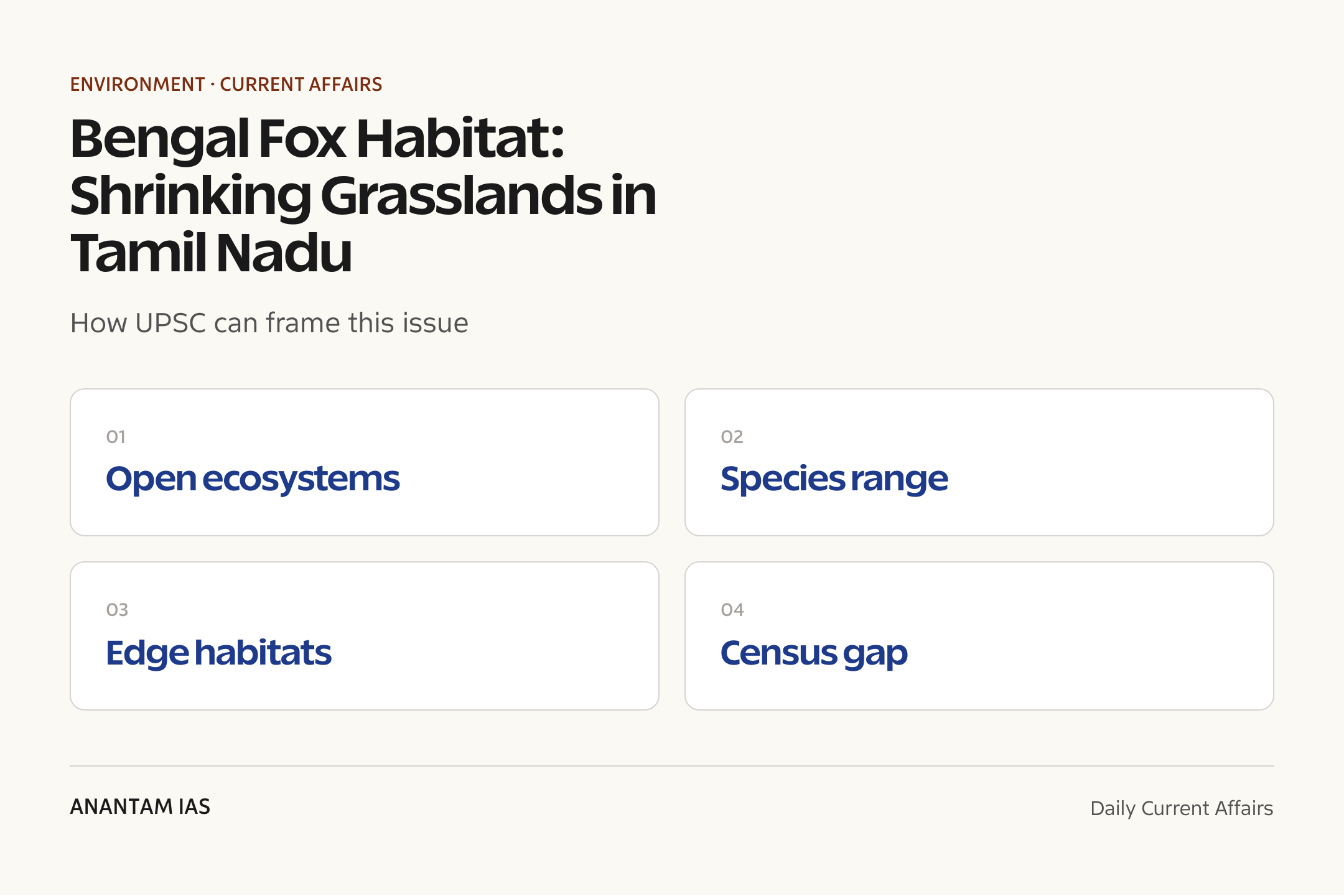
- Open natural ecosystems such as grasslands and scrublands are often treated as wastelands, making them vulnerable to plantation, agriculture, infrastructure and real-estate conversion.
- Edge species need coordination beyond forest departments because their habitat lies between forests, farms, fallows, villages and roads.
- Species recovery depends less on captive measures at first and more on securing dens, reducing dog disturbance and keeping dryland habitat intact.
- Conservation policy must move beyond charismatic forest species and cover low-density, under-studied mammals of semi-arid India.
UPSC Relevance
Prelims Relevance
- Bengal fox is also called the Indian fox.
- Scientific name: Vulpes bengalensis.
- Distribution: endemic to the Indian subcontinent, from Himalayan foothills and Nepal’s Terai through southern India, with range also in Pakistan, eastern India and Bangladesh.
- Habitat: semi-arid plains, short grasslands, open scrub, dry fallows and some dryland agricultural mosaics.
- Avoided habitats: dense forests, steep terrain, tall grasslands and true deserts.
- Behaviour: largely crepuscular and nocturnal, using dens for resting and breeding.
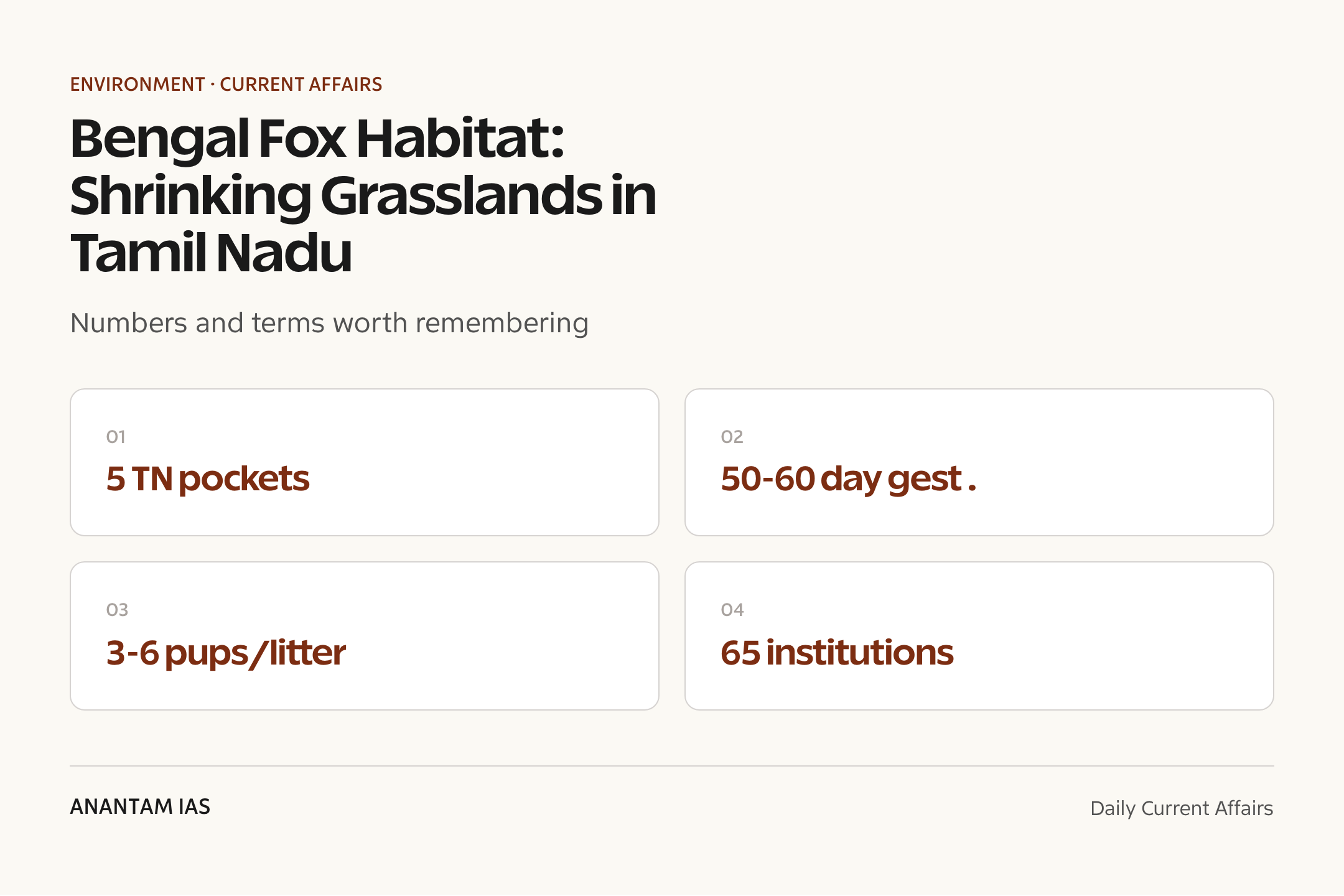
- Breeding: The Hindu cited a 50-60 day gestation and 3-6 pups per litter in the Tamil Nadu conservation discussion.
- Conservation status: standard species references list it as Least Concern, but local decline can still occur.
- CITES: Indian populations are listed in Appendix III, as noted in standard species references.
Mains Relevance
GS Paper 3
- Environment and ecology: open natural ecosystems, habitat fragmentation, species distribution and local extinction risk.
- Biodiversity conservation: need for baseline surveys, community-led protection and protection of non-forest habitats.
GS Paper 1
- Geography: semi-arid landscapes, dryland farming, scrublands and the ecological value of grassland-fallow mosaics.
- Indian society: conservation conflicts around local ritual practices, livelihoods and changing land use.
GS Paper 2
- Governance: coordination among forest, revenue, agriculture, rural development, transport and local bodies in edge habitats.
Essay
- Conservation succeeds when policy protects quiet ecosystems, not only famous forests.
- Development becomes ecological only when land-use decisions count invisible species and local knowledge.
- Data poverty can be as damaging as funding poverty in biodiversity governance.
Background and Context
What the Report Says
The Tamil Nadu story is a local warning about a species that was once familiar in dry landscapes but is now difficult to track.
- The Hindu reported that references to the Bengal fox in Sangam literature point to its older presence in the dry, arid grasslands of south India.
- Forest Department officials said the fox is now known from pockets in Dharmapuri, Tiruvannamalai, Salem, Madurai and Villupuram.
- Researchers described the species as under-studied, with weak distribution mapping and almost no firm population-trend baseline for Tamil Nadu.
- AIWC has conducted a preliminary study to identify presence across Tamil Nadu landscapes, according to the report.
- Recent interventions by the Forest Department were reported to have stopped fox capture in recent years during fox jallikattu events.
Species Profile
The Bengal fox is an open-country canid, not a deep-forest species.
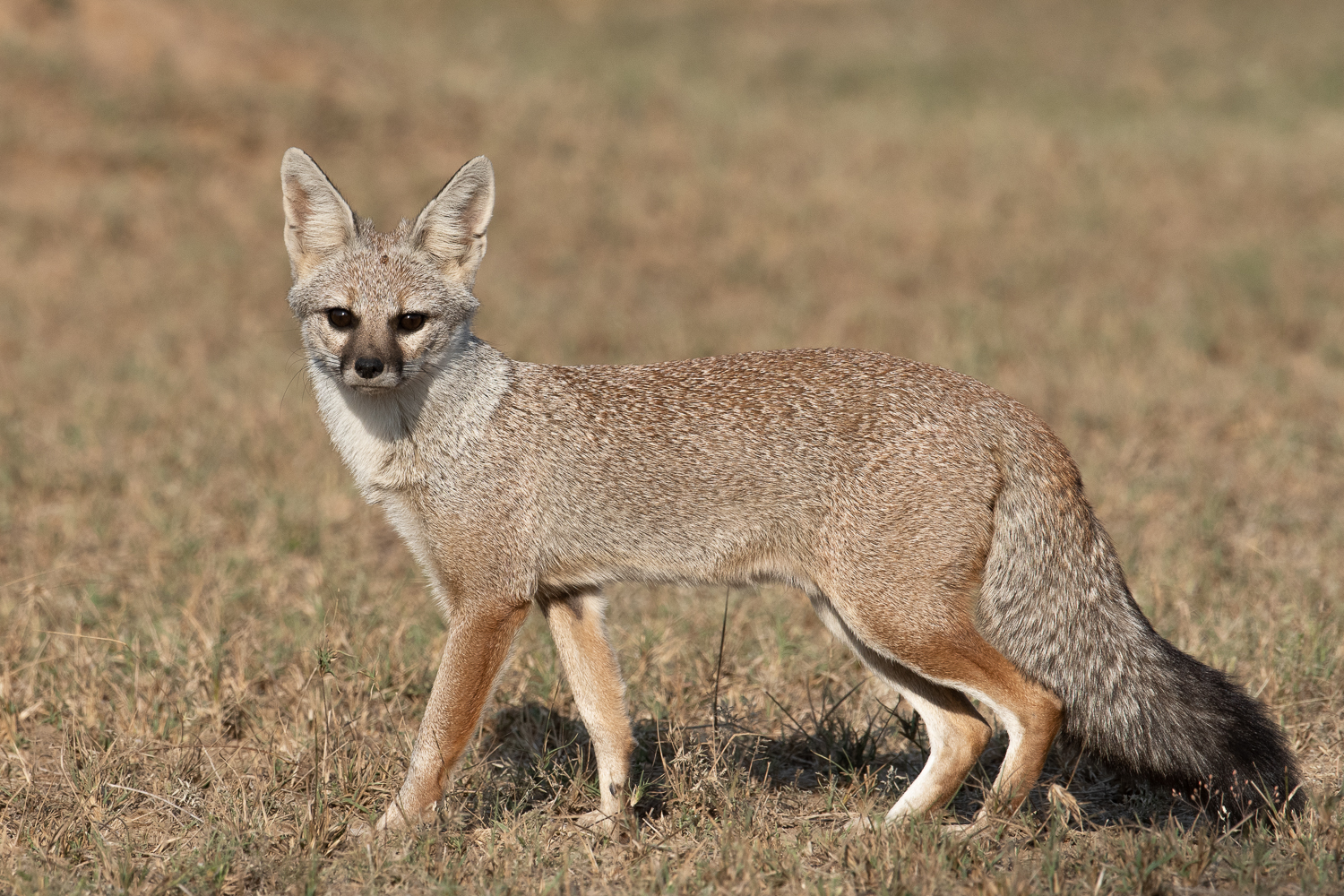
- Bengal fox, also called Indian fox, is a small canid with an elongated muzzle, pointed ears and a black-tipped bushy tail.
- Vulpes bengalensis is endemic to the Indian subcontinent and is adapted to semi-arid, flat to undulating landscapes.
- Preferred habitat includes short grasslands, scrub, thorny vegetation, dry deciduous edges, fallow land and dryland farm mosaics.
- Diet is opportunistic: insects, small mammals, reptiles, small birds and fruits help it survive in seasonally dry landscapes.
- Behaviour is mostly crepuscular and nocturnal, which makes casual sightings unreliable as a measure of population status.
Why Grasslands Are the Real Issue
The story is less about one fox and more about how India treats open natural ecosystems.
- Open natural ecosystems include grasslands, savannas, scrublands and semi-arid mosaics that support specialised plants, insects, birds and mammals.
- Policy bias often treats tree cover as the main sign of ecological health, while grasslands may be misread as empty land or degraded land.
- Habitat conversion for irrigated agriculture, urbanisation and industry can make the landscape unsuitable for Bengal fox even when some dryland farming was earlier tolerated.
- Protected-area gaps are important because many fox habitats lie outside national parks and sanctuaries; compare this with the protected-area frame in National Park vs Wildlife Sanctuary.
- Ecological value of grasslands should be read with terrestrial ecosystem basics, not only with forest-cover statistics.
Threats in Tamil Nadu
The Hindu report groups the threats as slow, cumulative and poorly recorded.
- Agricultural expansion removes grassland and scrub, especially when dryland systems shift towards irrigated agriculture.
- Urbanisation and industrialisation fragment open habitats and bring roads, lights, traffic, noise and land-value pressure.
- Road kills become more likely as rural highways expand through fox movement areas.
- Feral dogs can disturb dens, compete with foxes and bring disease risks such as rabies or canine distemper.
- Direct persecution can occur through hunting, capture or ritualised chasing; this also links to wider human-wildlife conflict debates.
- Den disturbance is especially serious because breeding success depends on safe denning sites.
Breeding and Recovery Logic
The species can rebound when disturbance is reduced, but only if its habitat and den sites remain.
- The Hindu reported that Bengal foxes form monogamous lifetime bonds.
- Breeding season was described as typically December-January, with new dens excavated or old dens reused.
- Gestation was cited at 50-60 days, with pups born between January and March.
- Litter size was cited at 3-6 offspring, making den security central to local recovery.
- Recovery potential exists if disturbance is removed and habitat remains undisturbed, but converted irrigated landscapes may not support the species.
Governance Gaps
The Bengal fox sits in a governance gap because its habitat crosses departmental boundaries.
- Forest Department action alone is insufficient where fox habitat falls on revenue land, fallows, road margins, village commons and private fields.
- Land-use planning must identify remaining grassland-scrub patches before they are absorbed into roads, layouts, plantations or high-input agriculture.
- Baseline surveys are the first governance need because managers cannot protect distribution patterns they have not mapped.
- Community custodians matter because fox habitat is often near villages; conservation plans must include local residents instead of treating them only as threats.
- Legal awareness should connect local protection to the broader Wildlife Protection Act 1972 framework.
Salem Model and Awareness
The Salem work shows how a local conservation programme can move from awareness to distribution mapping.
- Tamil Nadu government has run awareness campaigns and formed task forces since 2023 to protect the Bengal fox.
- Salem Innovation Centre focuses on research, education and community work for the species.
- First systematic map of the species in Salem division was compiled through the centre, according to the report.
- 8,500 students from 65 institutions were reached through educational outreach, as reported by The Hindu.
- Community-led conservation is the practical route because remaining habitats need local stewardship, not only policing.
Way Forward
Build a Statewide Baseline
- Tamil Nadu should conduct district-wise occupancy surveys using camera traps, sign surveys, local interviews and den mapping.
- Survey design should separate confirmed presence, probable presence and historic presence so managers can plan recovery without exaggerating certainty.
- Repeat monitoring every breeding season can show whether awareness and habitat protection are actually improving local status.
Protect Open Habitats
- Grassland-scrub patches should be mapped as ecological assets before land-use conversion approvals.
- Dryland farming mosaics should be managed differently from irrigated agriculture because the fox can tolerate some low-intensity dryland activity.
- Denning sites should receive seasonal no-disturbance buffers during breeding months.
Make Conservation Local
- Village institutions, schools, panchayats and local youth groups can report dens, reduce dog disturbance and discourage ritual capture.
- Awareness campaigns should frame the Bengal fox as part of Tamil Nadu’s dryland heritage, not as a nuisance animal.
- Road agencies should add wildlife-crossing warnings and speed-calming near known fox habitats where road kills are reported.
Conclusion
Bengal fox habitat in Tamil Nadu is a useful exam case because it shows how a species can decline without dramatic headlines, large carcass counts or a single protected-area crisis.
The main lesson is simple: grasslands, scrublands and edge habitats need the same policy seriousness that forests receive. Without baseline surveys and community-led habitat protection, local extinction can happen quietly.
UPSC Practice Questions
Prelims MCQ 1
With reference to the Bengal fox, consider the following statements:
- It is also known as the Indian fox.
- It is mainly a deep-forest species of tropical evergreen forests.
- It is adapted to semi-arid plains, short grasslands and open scrub habitats.
How many of the above statements are correct?
(a) Only one (b) Only two (c) All three (d) None
Answer: (b) Only two
Explanation:
Statements 1 and 3 are correct. The Bengal fox is an open-country canid linked to semi-arid grassland, scrub and dryland mosaics; it is not mainly a deep-forest species.
Prelims MCQ 2
Which of the following Tamil Nadu districts was reported by The Hindu as one of the remaining known pockets of Bengal fox occurrence?
(a) Salem (b) Kanyakumari (c) Thanjavur (d) Chennai
Answer: (a) Salem
Explanation:
The report named pockets in Dharmapuri, Tiruvannamalai, Salem, Madurai and Villupuram.
UPSC Mains Questions
- Bengal fox decline in Tamil Nadu shows the conservation neglect of open natural ecosystems. Discuss how grasslands and scrublands should be integrated into biodiversity planning, land-use regulation and community-led conservation.
- Edge species often live outside formal protected areas. Using the Bengal fox case, examine the governance challenges created by revenue lands, dryland agriculture, roads, feral dogs and village-level practices.
- Baseline ecological data is a precondition for conservation. Explain why species distribution mapping, population monitoring and local community reporting are important for under-studied mammals in India.
Sources: The Hindu and English Wikipedia; standard Bengal fox references.
Frequently Asked Questions
What is the Bengal fox?
The Bengal fox, also called the Indian fox, is a small canid with the scientific name Vulpes bengalensis. It is native to the Indian subcontinent and is associated mainly with semi-arid grasslands, scrublands, dry fallows and open dryland landscapes rather than dense forests.
Why is it in the news?
The Hindu reported that the Bengal fox has disappeared from many parts of Tamil Nadu and is now known only from pockets in Dharmapuri, Tiruvannamalai, Salem, Madurai and Villupuram. The report highlights habitat conversion, weak data and community-level conservation needs.
What habitat does it prefer?
The species prefers semi-arid plains, short grasslands, open scrub, fallow land and some dryland agricultural mosaics. It avoids dense forests, steep terrain, tall grasslands and true deserts. This makes grassland conservation central to its survival.
Why are grasslands neglected?
Grasslands and scrublands are often mistaken for degraded or empty land. In policy practice, tree cover receives more attention than open ecosystems. This creates conversion pressure from agriculture, roads, industry, plantations and urban expansion, even when these landscapes support specialised wildlife.
What is fox jallikattu?
Fox jallikattu is a local ritual reported in parts of Tamil Nadu where trapped foxes are released and chased by people. Communities may claim the animal is released, but conservationists warn that the practice causes stress, injury risk and direct disturbance to a declining local population.
What should Tamil Nadu do next?
The priority is a statewide baseline survey, protection of remaining grassland-scrub patches, seasonal safeguards around dens, control of feral-dog disturbance near habitats, and community-led awareness. Conservation will work better when villagers are treated as habitat custodians.
Tell Google you want more of this.
Add Anantam IAS as a preferred sourceOne tap, and this site shows up more often in your own Top Stories, AI Overviews and AI Mode. Remove it any time.