Why in News?
Indian Express Explained reported that Punjab Agricultural University’s Krishi Vigyan Kendra, Langroya ran a month-long Khet Bachao Abhiyan in June 2026 across Shaheed Bhagat Singh Nagar district.
The campaign matters because Punjab’s wheat-paddy system remains central to India’s food security, but repeated cropping, imbalanced chemical fertiliser use, falling organic matter and rising input costs are turning soil health into an economic and ecological issue.
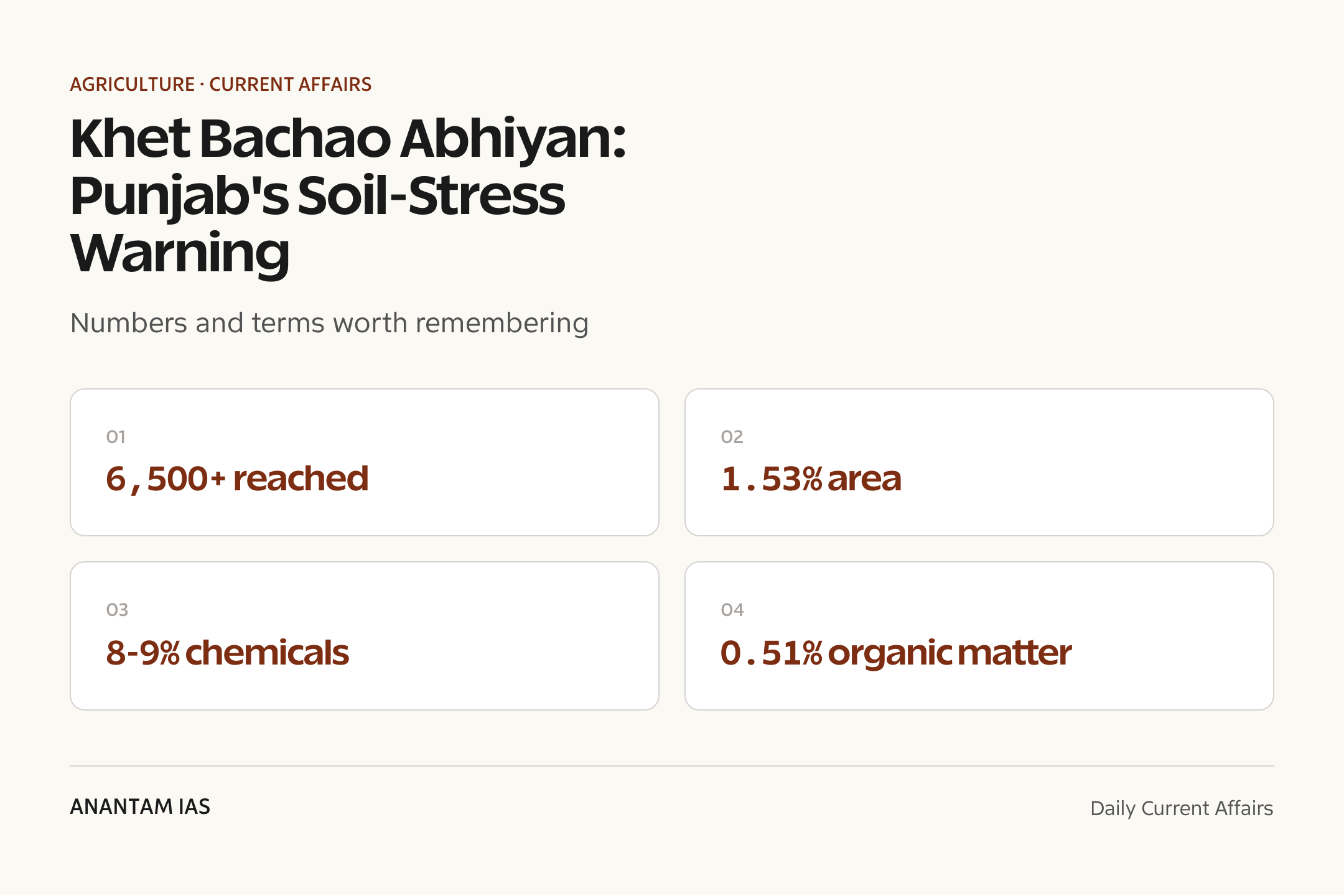
- 6,500+ stakeholders were reached, including farmers, rural women, village leaders, SHGs, FPOs, input dealers and custom hiring centres.
- KVK scientists and agriculture officials travelled village to village with the message: test the soil before applying fertilisers.
- Six specialised training programmes and a Sarpanch Sammelan were used to move the campaign beyond a one-day awareness meeting.
- Green manuring, balanced nutrient application, soil testing and lower unnecessary chemical use were presented as practical farm-level actions.
The development matters in the context of:
- Punjab has only about 1.53% of India’s area but, according to the Indian Express report, accounts for around 8-9% of national chemical usage.
- Organic matter in Punjab’s soils was reported at about 0.51%, below the 1% minimum cited by experts and far below the 3-5% international reference range cited in the report.
- Soil Health Card style advisories connect the news to a larger policy shift from blanket fertiliser use to plot-specific nutrient management.
UPSC Relevance
Prelims Relevance
- Khet Bachao Abhiyan: a Punjab Agricultural University KVK outreach campaign on soil-health restoration.
- Krishi Vigyan Kendra: district-level farm science and extension institution linked to technology demonstration and farmer training.
- Soil Health Card: a report on soil parameters and fertiliser recommendations for a farmer’s holding.
- Organic matter: improves nutrient availability, water retention, soil structure and microbial activity.
- Green manure: a crop grown and incorporated into soil to add organic matter and nutrients.
- Sunnhemp: one green-manure crop highlighted in the campaign.
- Balanced fertilisation: right nutrient, right dose, right time and crop-specific application.
- Wheat-paddy cycle: intensive cropping pattern linked to food security but also soil and groundwater stress.
Mains Relevance
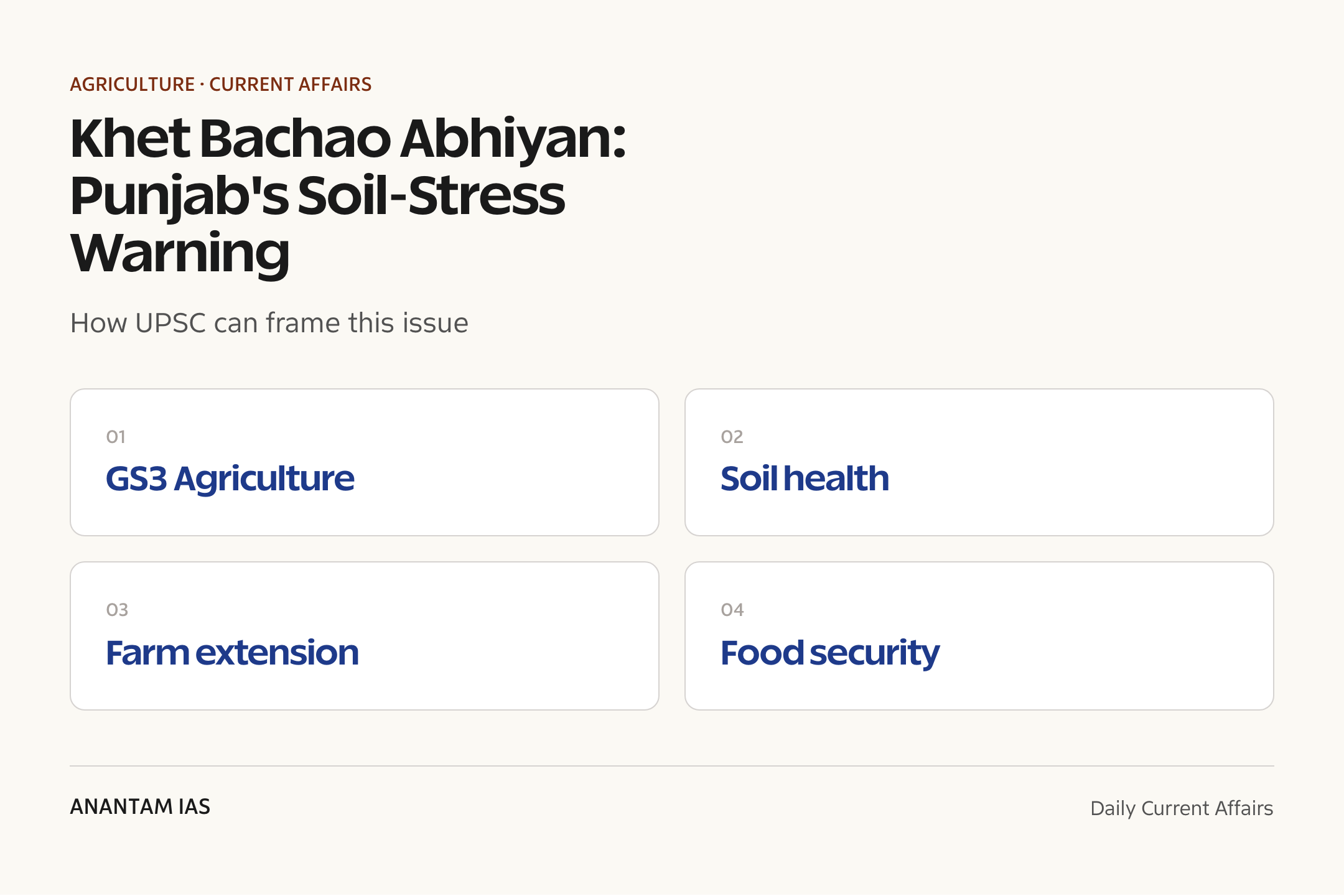
GS Paper 3
- Agriculture: sustainability of the wheat-paddy system, fertiliser-use efficiency and extension services.
- Environment: soil degradation, chemical residues, declining organic carbon and water-retention stress.
- Economy: rising input costs, farm viability and public expenditure on fertiliser support.
GS Paper 2
- Governance: last-mile delivery through KVKs, panchayats, SHGs, FPOs and input dealers.
- Policy implementation: translating soil-test advisories into farmer behaviour change.
Essay
- Food security cannot be separated from soil security.
- Technology adoption succeeds only when extension reaches the field.
- Short-term yield maximisation can create long-term ecological costs.
Background and Context
Punjab's Grain Bowl Legacy
Punjab became India’s grain bowl through the Green Revolution, but the same high-input model now faces sustainability limits.
- Green Revolution agriculture expanded wheat and rice output through HYV seeds, assured irrigation, fertilisers, procurement and price support; read the wider context in Green Revolution in India.
- Wheat-paddy specialisation created a reliable procurement base for national food stocks, but it also reduced crop diversity and kept land under repeated intensive cultivation.
- Food security gains are still real, but the next policy question is whether Punjab can protect output without weakening soil, water and farm incomes.
- MSP-procurement incentives helped stabilise farmer income and public stocks, but they also made diversification harder where farmers see alternative crops as riskier.
- Exam angle: UPSC may frame this as a transition from input-intensive agriculture to resource-conserving agriculture.
What Khet Bachao Abhiyan Did
Khet Bachao Abhiyan used village outreach instead of a seminar-style campaign, making farm extension the core story.
- KVK Langroya reached more than 6,500 farmers and rural stakeholders in Shaheed Bhagat Singh Nagar district during June 2026.
- Stakeholder coverage included farmers, rural women, sarpanches, SHGs, FPOs, cooperative societies, input dealers and custom hiring centres.
- Six training programmes and a Sarpanch Sammelan helped carry soil-health messaging through village leadership and community networks.
- Core advice was simple: use soil testing, apply fertilisers in balanced quantities, avoid avoidable chemicals and rebuild organic matter.
- Rural livelihoods were also part of the campaign framing, because lower input waste and healthier soil can improve net returns even when output gains are gradual.
Soil Stress and Fertiliser Imbalance
Soil stress in the report is less visible than drought, but it can be more damaging because it slowly raises costs and lowers resilience.
- Excess and imbalance are the concern, not fertiliser use itself; nutrients are essential, but habit-based dosing can weaken soil structure and microbial activity.
- Punjab’s chemical load is disproportionate: the report notes 1.53% of national area but around 8-9% of national chemical usage.
- Organic matter was reported around 0.51% in Punjab soils, against a minimum of 1% cited by experts and an international reference range of 3-5% cited in the report.
- Farmer economics worsen when declining soil vitality forces higher spending on fertilisers and pesticides to maintain similar yields.
- Nutrient-use efficiency becomes the key policy idea: the aim is not less farming, but more output per unit of fertiliser, water and chemical input.
- Policy link: this is why Soil Health Card style advisories matter for fertiliser rationalisation.
Green Manuring and Organic Matter
Green manuring is the practical agronomy lever highlighted in the campaign for rebuilding biological soil strength.
- Sunnhemp was highlighted as a green-manure crop that can enrich soil when grown and incorporated before the main crop.
- Organic matter improves nutrient availability, water retention, soil aggregation and resilience during heat or dry spells.
- KVK Langroya was reported to be producing elite green-manure seeds and training farmers to develop their own seed stocks.
- Cost reduction is part of the message: better nutrient cycling can reduce unnecessary external inputs over time.
- Soil carbon is also a climate-resilience lens, because organic-rich soils generally hold more moisture and support better biological activity.
- Geography angle: soil-management choices vary by agro-climatic region, crop pattern, water availability and existing nutrient status.
Extension Model and Behaviour Change
Farm extension is the governance layer that decides whether soil science changes actual farm practice.
- KVKs work best when they move from lecture mode to demonstration mode, because farmers need to see cost and yield effects in local conditions.
- Input dealers matter because fertiliser and pesticide advice often reaches farmers through the market, not only through official channels.
- FPOs and SHGs can spread shared practices such as seed banks, green-manure seed production and collective training.
- Panchayats help convert individual soil-health advice into village-level campaigns, especially when sarpanches carry the message.
- Behaviour change is difficult because farmers often trust visible input application more than lab reports; demonstration plots can make the science credible.
- Indian agriculture needs this extension bridge; see the broader sectoral context in Indian Agriculture.
Food Security and Public Health Link
Soil health is not only an agronomy issue; it also affects food quality, public health and national food-security resilience.
- Chemical residues can move through the food chain when input use becomes excessive or poorly timed.
- Food quality depends on the soil in which crops grow, so soil degradation can become a nutrition and public-health concern.
- National food security depends on both output volume and production sustainability; a stressed grain bowl creates systemic risk.
- Policy framing: link this topic with sustainable agriculture, fertiliser subsidy reform, climate resilience and food security.
Way Forward
Make soil testing actionable
- Soil-test reports should be converted into crop-wise, village-language fertiliser schedules rather than left as technical documents.
- KVKs should run follow-up visits after sowing and before nutrient application so advice reaches the decision point.
Shift incentives from quantity to efficiency
- Balanced nutrients, green manure, bio-inputs and organic matter rebuilding should be linked to demonstrations that show input savings.
- Fertiliser policy should support rational use, not only cheap availability, because over-application raises both fiscal and ecological costs.
Build village-level extension networks
- Panchayats, SHGs, FPOs and input dealers should be treated as extension partners with clear, evidence-based advisories.
- Custom hiring centres can support residue management, green-manure incorporation and precision application equipment for small farmers.
Conclusion
Khet Bachao Abhiyan is a small district-level campaign, but its exam value is larger: it shows how soil health, fertiliser economics, extension services and food security meet in the field.
Punjab’s warning is not that the Green Revolution failed; it is that food-security systems need constant ecological repair. The next phase of agricultural policy must protect the field as carefully as it protects the yield.
UPSC Practice Questions
Prelims MCQ 1
With reference to Khet Bachao Abhiyan, consider the following statements:
- It was linked to Punjab Agricultural University’s Krishi Vigyan Kendra, Langroya.
- It focused only on increasing fertiliser doses to raise wheat-paddy yields.
- It used village outreach and training programmes to promote soil testing and green manuring.
How many of the above statements are correct?
(a) Only one (b) Only two (c) All three (d) None
Answer: (b) Only two
Explanation:
Statements 1 and 3 are correct. Statement 2 is incorrect because the campaign warned against excessive and imbalanced chemical use and promoted soil-test-based nutrient management.
Prelims MCQ 2
Which one of the following best explains the role of green manuring in soil management?
(a) It replaces all irrigation requirements in paddy cultivation. (b) It adds organic matter and can improve nutrient availability when incorporated into soil. (c) It is a method of removing all microbes from the soil. (d) It is used only for post-harvest grain storage.
Answer: (b) It adds organic matter and can improve nutrient availability when incorporated into soil.
Explanation:
Green-manure crops such as Sunnhemp are grown and incorporated into the soil to improve organic matter, nutrient cycling, water retention and soil resilience.
UPSC Mains Questions
- Punjab’s wheat-paddy system strengthened India’s food security, but it has also produced soil and groundwater stress. Discuss how soil-health-based extension can make Indian agriculture more sustainable without weakening farmer incomes.
- Krishi Vigyan Kendras can bridge the gap between agricultural research and farm behaviour. Examine this statement in the context of Khet Bachao Abhiyan and India’s fertiliser-use challenge.
- Soil health is both an agricultural and public-health concern. Explain with reference to chemical residues, organic matter, crop productivity and food quality.
Sources: Indian Express Explained and Soil Health Card Portal, Department of Agriculture and Farmers Welfare.
Frequently Asked Questions
What is Khet Bachao Abhiyan?
Khet Bachao Abhiyan is a Punjab Agricultural University KVK Langroya campaign reported from Shaheed Bhagat Singh Nagar district. It focused on soil testing, balanced fertiliser use, green manuring and farmer outreach to address soil fatigue in Punjab’s intensive farming system.
Why is Punjab’s soil under stress?
Punjab’s soil stress is linked to repeated wheat-paddy cultivation, excessive or imbalanced chemical use, low organic matter and rising input costs. The report notes that Punjab uses a disproportionate share of national chemicals despite having a small share of India’s area.
How does soil testing help farmers?
Soil testing tells farmers which nutrients their soil lacks and which fertilisers are actually needed. It reduces habit-based application, saves money, improves fertiliser efficiency and supports crop-specific nutrient management.
What is green manuring?
Green manuring means growing a crop such as Sunnhemp and incorporating it into the soil. It adds organic matter, improves nutrient availability, supports microbial activity and can make soil more resilient over time.
Why are KVKs important here?
Krishi Vigyan Kendras connect agricultural research with farmers through demonstrations, training and local advisories. In this campaign, the KVK model mattered because scientists and officials went village to village instead of relying only on formal meetings.
How is this relevant for GS3?
GS3 Agriculture asks how India can protect food security while reducing ecological stress. This topic connects fertiliser-use efficiency, soil health, farm-extension reform, crop diversification, input costs and public-health concerns.
Tell Google you want more of this.
Add Anantam IAS as a preferred sourceOne tap, and this site shows up more often in your own Top Stories, AI Overviews and AI Mode. Remove it any time.