

Why in News?
The Hindu reported that the West Bengal government plans to introduce a Uniform Civil Code Bill in the State Assembly in August 2026.
The proposal matters because a State-level UCC tests the relationship between Article 44, personal laws, cultural diversity, federal competence and fundamental rights.
- Cabinet step: the State Cabinet is expected to give in-principle approval to the proposal on July 2, 2026.
- Committee: a panel led by retired Supreme Court judge Justice Ranjana Prakash Desai will study family laws in the State.
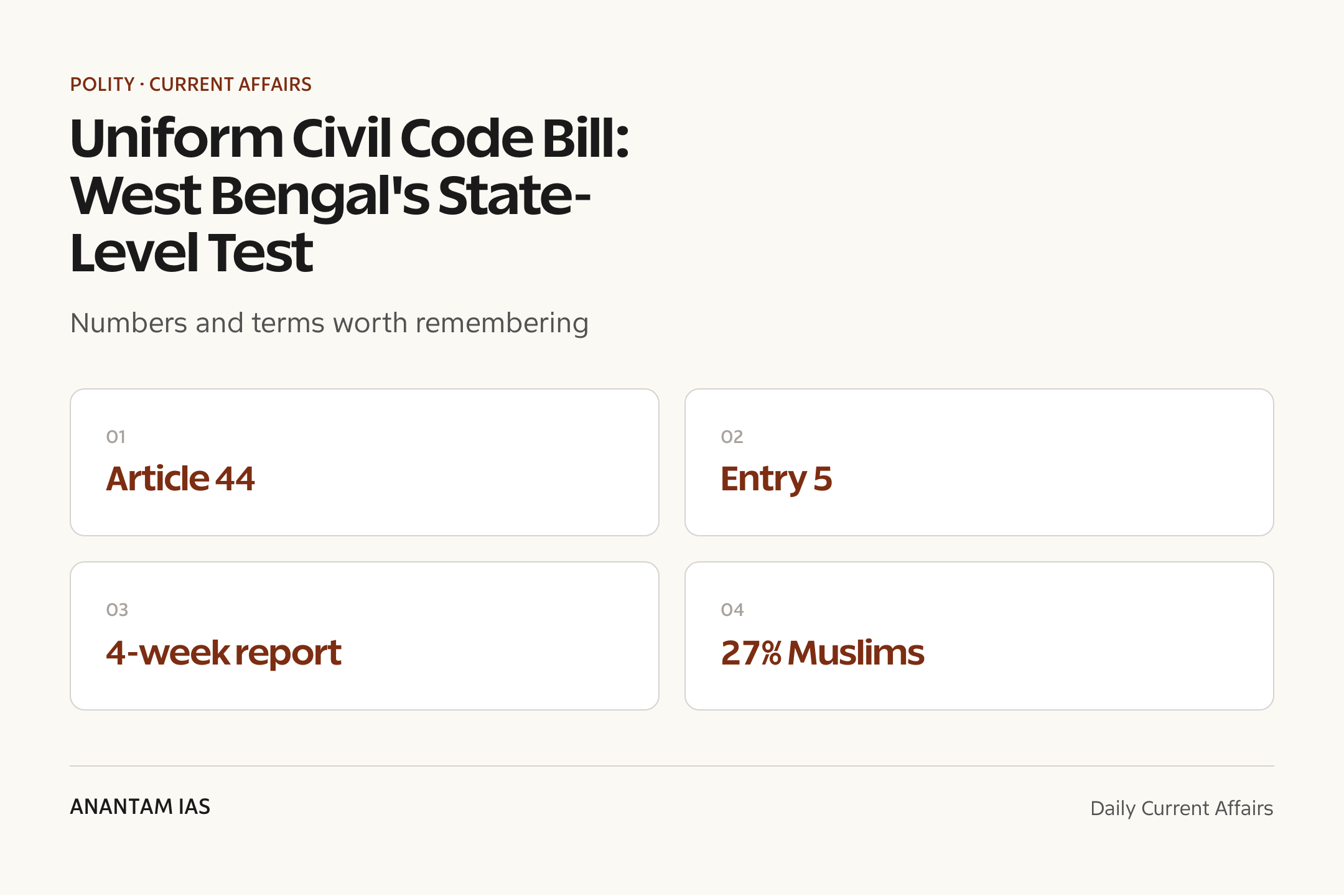
- Timeline: the committee is expected to submit its report to the State government in four weeks.
- Scope: the study covers family-law areas such as marriage, succession and live-in relationships.
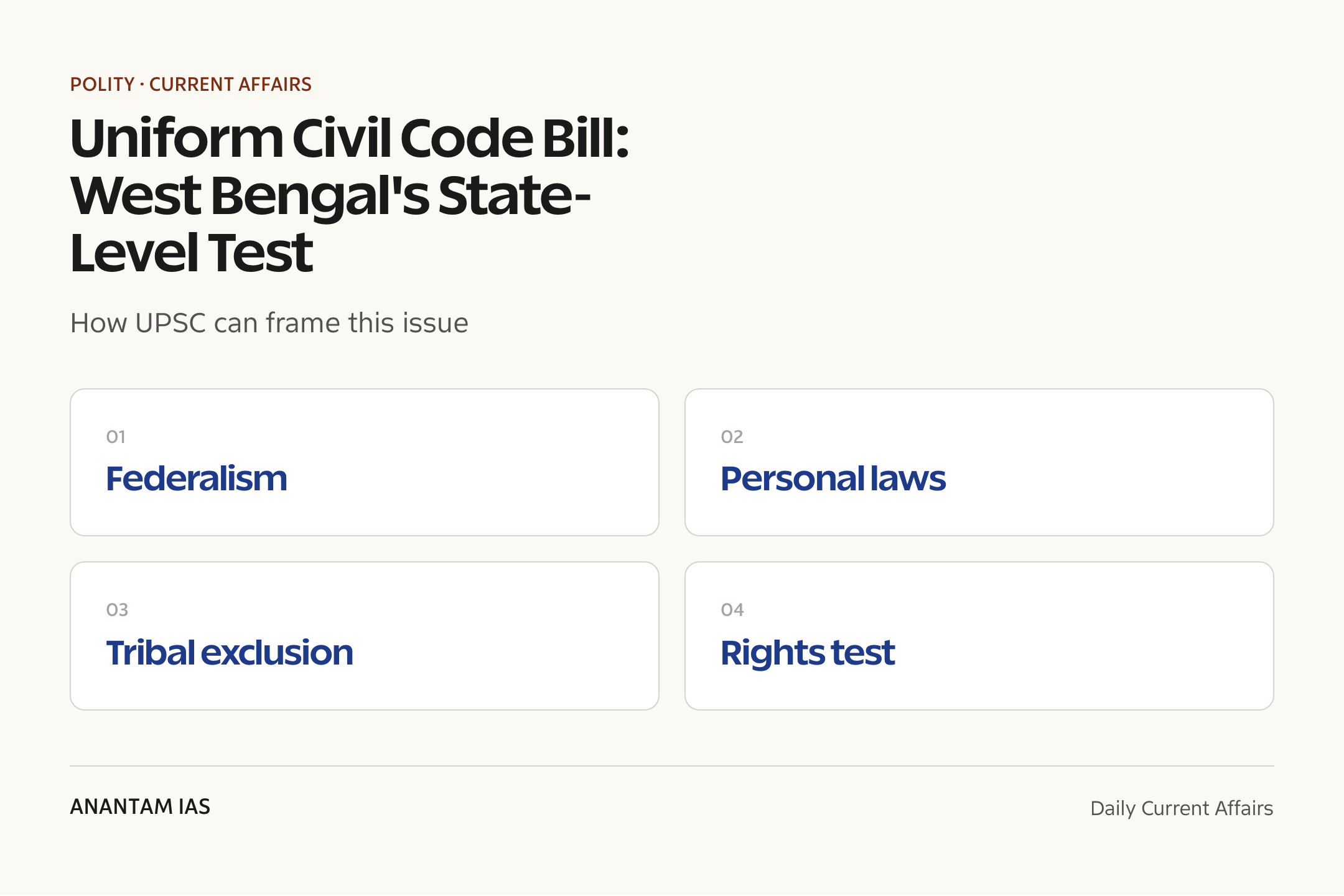
- Exclusion: the Chief Minister said Adivasis, indigenous people, Kurmis and other recognised ancient tribal communities would be kept outside the proposed law.
- Political context: The Hindu reported that Opposition MLAs protested in the Assembly while the announcement was made.
The development matters in the context of:
- Article 44 directs the State to work towards a uniform civil code for citizens, but it sits in the non-justiciable Directive Principles.
- Entry 5 of the Concurrent List gives both Parliament and State Legislatures space to legislate on marriage, divorce, adoption, wills and succession.
- Article 254 becomes relevant if a State UCC conflicts with an existing central law or with Parliament’s later law on the same field.
- The issue connects gender justice, minority rights, tribal customs and cooperative federalism in one compact polity debate.
UPSC Relevance
Prelims Relevance
- Article 44 is part of the Directive Principles of State Policy, not the Fundamental Rights chapter.
- Article 37 says Directive Principles are not enforceable by courts, but are fundamental in the governance of the country.
- Entry 5 in the Concurrent List covers marriage and divorce, infants and minors, adoption, wills, intestacy, succession, joint family and partition.
- Article 246 distributes lawmaking power between Parliament and State Legislatures through the three legislative lists.
- Article 254 deals with repugnancy between State laws and parliamentary laws in Concurrent List fields.
- Article 25 protects freedom of conscience and religion, subject to public order, morality, health and other constitutional provisions.
- Fifth Schedule and Sixth Schedule protections matter when personal-law reform touches tribal customs in scheduled areas.
- Uttarakhand UCC is a useful recent comparator because it also brought questions of live-in relationships and tribal exclusions into focus.
Mains Relevance
GS Paper 2
- Constitutional morality versus community autonomy in personal-law reform.
- Centre-State relations when States legislate in Concurrent List fields.
- Judicial review of a State UCC on equality, privacy, religion and due-process grounds.
GS Paper 1
- Indian society as a plural social order with religious, regional and customary family-law practices.
- Women and social reform debates around marriage, divorce, inheritance and maintenance.
Essay
- Uniformity and diversity in a constitutional democracy.
- Reform by consent versus reform by political mandate.
Essay
- A democracy can seek equal citizenship without flattening every form of social diversity.
- Personal-law reform succeeds better when constitutional values and community consultation move together.
Background and Context
What a Uniform Civil Code Means
A UCC is about civil family matters, not criminal law.
- Uniform Civil Code usually means a common set of rules for personal matters such as marriage, divorce, adoption, guardianship, inheritance and succession.
- Personal laws in India currently vary across religious communities, customary groups and statute-specific regimes.
- Criminal law is already broadly uniform through central statutes; the UCC debate mainly concerns civil family relations.
- Uniformity does not automatically mean identical treatment in every situation; a well-drafted code may still recognise reasonable classifications.
- For UPSC framing, read the issue as a triangle of equality, religious freedom and federal competence.
West Bengal Proposal
The reported proposal is still at the pre-legislative stage.
- The Hindu reported that the Bill is planned for the August 2026 Assembly session.
- Justice Ranjana Prakash Desai will lead a committee to examine family laws and submit a report in four weeks.
- The committee composition reported includes a retired IAS officer, legal expert, educationist, social worker and an additional secretary of the State government.
- The Chief Minister said the committee would examine marriage, succession and live-in relationships.
- Students should mark the difference between a committee announcement, a Cabinet approval, a Bill and an enacted law.
Article 44 and Directive Principles
Article 44 gives the UCC debate its constitutional anchor.
- The Legislative Department’s official Constitution text places Article 44 in the Directive Principles and says the State shall endeavour to secure a uniform civil code for citizens.
- Directive Principles are not enforceable as court commands, but they guide governance, legislation and policy choices.
- Article 37 explains this dual status: non-justiciable in courts, yet fundamental in the governance of the country.
- A UCC law still has to satisfy Fundamental Rights; a Directive Principle cannot be used as a shortcut around equality, liberty or religious freedom.
- For answer writing, cite Article 44 with Articles 14, 21, 25 and 37 instead of treating UCC as a stand-alone slogan.
State Competence and Repugnancy
A State UCC is possible only within the constitutional distribution of powers.
- Entry 5 of List III covers several personal-law subjects, so both Parliament and State Legislatures can legislate in this field.
- Article 246 gives Concurrent List competence to both levels, but that competence is subject to the Constitution’s conflict rules.
- Article 254 says a State law conflicting with a parliamentary law in a Concurrent List field may become void to the extent of repugnancy.
- A conflicting State law can still operate in that State if it is reserved for and receives Presidential assent under Article 254(2).
- Parliament can later override that State law by making another law on the same matter, so the design is federal but not fully symmetrical.
Rights and Personal Law Reform
The hardest questions are not only about competence, but about rights.
- Article 14 requires equality before law and equal protection of laws; discriminatory family-law rules can face constitutional challenge.
- Article 15 bars discrimination on grounds including religion, race, caste, sex and place of birth, which matters in gender-justice claims.
- Article 21 now carries privacy, dignity and decisional autonomy concerns, especially where marriage or live-in relationships are regulated.
- Article 25 protects religious freedom, but it is subject to public order, morality, health and other fundamental rights.
- Courts often distinguish secular activity associated with religion from essential religious practice, which is why drafting detail matters.
Tribal Exclusion and Social Diversity
The reported exclusion shows why UCC design is politically and legally delicate.
- The reported West Bengal proposal would exclude Adivasis, indigenous people, Kurmis and other recognised ancient tribal communities.
- Customary law in tribal communities can cover marriage, inheritance, kinship and land-linked family arrangements.
- A blanket UCC can trigger fears of cultural erasure, especially where customary practices are tied to identity and community governance.
- An exclusion clause can protect diversity, but it also raises the question of why uniformity is demanded for some communities and not others.
- Good Mains answers should discuss both sides: protecting tribal autonomy and avoiding selective or majoritarian reform.
Comparative State Signals
Other State examples help frame the federal experiment.
- The Chief Minister said the State would draw inspiration from Gujarat, Assam and Uttarakhand, according to The Hindu.
- Uttarakhand’s UCC has been closely watched because of its approach to live-in relationships and its exclusion of Scheduled Tribes.
- Goa’s civil code is often cited in UCC debates, but it emerged from a distinct historical and legal context.
- State-level UCCs may create legal diversity across India even while claiming to move towards uniformity.
- The exam lens is not whether UCC is good or bad in the abstract; it is whether a specific law is consultative, rights-compliant and administratively workable.
Way Forward
Use Pre-Legislative Consultation
- Publish the committee terms of reference, draft Bill and explanatory note before introduction.
- Invite structured submissions from women’s groups, minority bodies, tribal representatives, family-law scholars and district-level civil society.
- Record disagreements openly so the final Bill shows reasoned lawmaking, not only political signalling.
Draft Around Rights
- Test every clause against Articles 14, 15, 21 and 25 before it reaches the Assembly.
- Avoid intrusive provisions that weaken privacy, especially around adult relationships and household choices.
- Use gender-just reform in inheritance, maintenance and guardianship as the core, not symbolic uniformity.
Respect Federal Procedure
- Map possible conflicts with central laws on marriage, divorce, adoption and succession.
- If conflict is likely, consider the Article 254(2) route and explain why Presidential assent is being sought.
- Build administrative capacity in registration offices, legal-aid systems and family courts before enforcement.
Handle Exclusions Transparently
- Define excluded communities clearly to avoid litigation over coverage.
- Protect tribal customs through consultation, not vague carve-outs that create uncertainty.
- Review the law periodically so social reform and cultural protection remain evidence-based.
Conclusion
The West Bengal Uniform Civil Code Bill is best read as a constitutional case study in how a State tries to convert Article 44 into legislation.
For UPSC, the strong answer is balanced: support equal citizenship and gender justice, but insist on consultation, federal procedure, privacy protection and respect for India’s plural social fabric.
UPSC Practice Questions
Prelims MCQ 1
With reference to a State-level Uniform Civil Code in India, consider the following statements:
- Article 44 is part of the Directive Principles of State Policy.
- Entry 5 of the Concurrent List includes subjects such as marriage, divorce, adoption, wills and succession.
- A State law in a Concurrent List field is always void if it differs from a parliamentary law, even after Presidential assent.
How many of the above statements are correct?
(a) Only one (b) Only two (c) All three (d) None
Answer: (b) Only two
Explanation:
Statements 1 and 2 are correct. Statement 3 is incorrect because Article 254(2) allows a conflicting State law to operate in that State after Presidential assent, subject to Parliament’s later power.
Prelims MCQ 2
Which constitutional provision is most directly associated with the idea of a uniform civil code for citizens?
(a) Article 44 (b) Article 51A (c) Article 72 (d) Article 110
Answer: (a) Article 44
Explanation:
Article 44 directs the State to endeavour to secure a uniform civil code for citizens throughout the territory of India.
UPSC Mains Questions
- A State-level Uniform Civil Code can deepen both constitutional reform and federal friction. Discuss with reference to Article 44, Entry 5 of the Concurrent List and Article 254.
- Personal-law reform is not only a question of uniformity; it is also a question of equality, autonomy and cultural security. Examine in the context of proposed tribal exclusions from UCC laws.
- Directive Principles are non-justiciable, but they shape legislative priorities. Explain how this applies to Article 44 and the limits that Fundamental Rights place on any UCC.
Sources: The Hindu and Legislative Department, Ministry of Law and Justice.
Frequently Asked Questions
What did West Bengal propose?
The Hindu reported that West Bengal plans to introduce a Uniform Civil Code Bill in the Assembly in August 2026. A committee led by Justice Ranjana Prakash Desai will study State family laws and submit a report in four weeks.
Why is Article 44 central?
Article 44 is the constitutional directive that asks the State to endeavour to secure a uniform civil code for citizens. It is part of the Directive Principles, so it guides lawmaking but does not override Fundamental Rights such as equality, liberty or religious freedom.
Can a State pass UCC?
A State can legislate on many personal-law subjects because Entry 5 of the Concurrent List covers marriage, divorce, adoption, wills and succession. If the State law conflicts with a parliamentary law, Article 254 and possible Presidential assent become important.
Why are tribal exclusions debated?
Tribal communities often follow customary family and inheritance practices linked to identity, land and community governance. Excluding them can protect cultural autonomy, but it also raises a fairness question: why should uniformity apply to some communities and not others?
Does UCC violate religious freedom?
A UCC does not automatically violate religious freedom. The answer depends on drafting. Courts may uphold secular family-law reform, but any law must still pass tests under Articles 14, 21 and 25, especially where it affects dignity, privacy and religious practice.
Why mention live-in relationships?
The reported committee will also examine live-in relationships. This expands the debate beyond traditional marriage and inheritance. For Mains, it raises privacy, adult autonomy, registration burden and State interest questions under Article 21.
Tell Google you want more of this.
Add Anantam IAS as a preferred sourceOne tap, and this site shows up more often in your own Top Stories, AI Overviews and AI Mode. Remove it any time.




