Daily Digest
UPSC · Civil Services Examination
Current Affairs · Thursday, 2 July 2026
Current affairs curated and edited by Anantam IAS faculty — pulled from The Hindu, PIB, IDSA, Foreign Affairs and the ministries. Read, annotate, revise.
Old Rajinder Nagar · Delhi 110005 · anantamias.com
Delhi EV Policy: Incentives Tied to Approved Models
Why in News?
The Hindu reported that the Delhi EV Policy, 2026 will give incentives only to electric-vehicle models approved by a Model Approval Committee under the Transport Department.
The policy came into effect on July 1, 2026 and links purchase incentives, scrapping incentives, DBT delivery, model empanelment and phased electrification of high-polluting vehicle segments.
- Model Approval Committee will decide which EV models are eligible for incentives under the Delhi Electric Vehicle Policy, 2026.
- Approved models alone will qualify; the committee will assess eligibility criteria, technical standards and policy conditions.
- Two-wheeler purchase incentives apply to models priced up to Rs 2.25 lakh.
- Car scrapping incentives are limited to electric cars priced up to Rs 30 lakh ex-showroom.
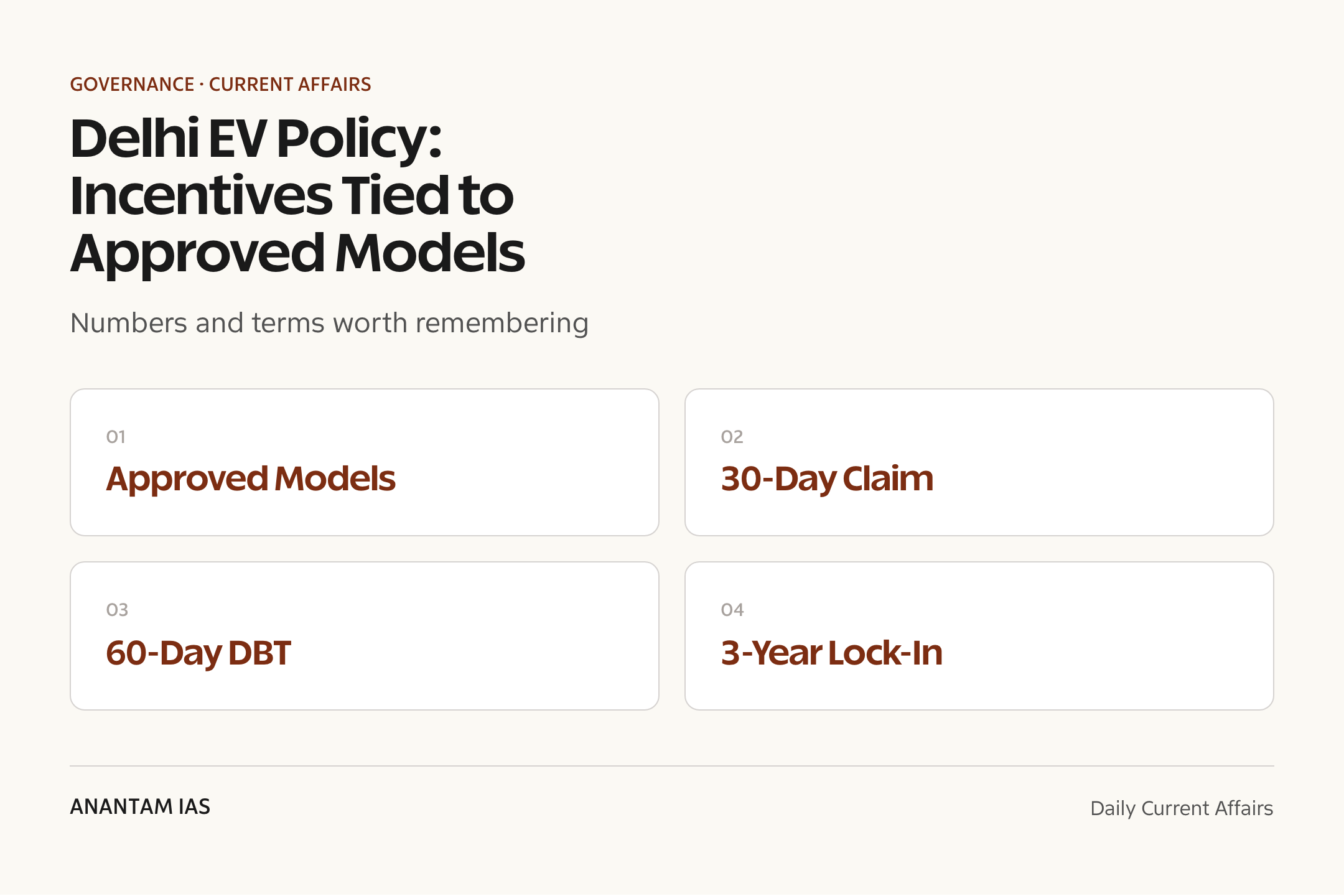
- Incentive applications must be filed within 30 days of registration, and subsidies are to be disbursed within 60 days through DBT.
- Three-year lock-in applies: vehicles availing incentives cannot be transferred or re-registered outside Delhi for three years.
The development matters in the context of:
- Subsidy design matters because public money should support models that meet safety, eligibility and technical standards.
- Urban air pollution makes Delhi’s EV push a public-health policy, not only a transport-market policy.
- Green industrial transition depends on demand incentives, charging networks, certified products and consumer trust moving together.
- State-level governance is visible here because Delhi is using policy conditions to shape markets, behaviour and environmental outcomes.
UPSC Relevance
Prelims Relevance
- Delhi EV Policy, 2026 came into effect on July 1, 2026 after notification following Cabinet approval.
- Model Approval Committee is to function under Delhi’s Transport Department for empanelment of eligible EV models.
- DBT means Direct Benefit Transfer, where subsidy support is transferred directly to eligible beneficiaries.
- Purchase incentive reduces the upfront cost of an eligible EV, usually to accelerate adoption.
- Scrapping incentive rewards replacement of older polluting vehicles with cleaner alternatives.
- Tailpipe emissions are direct exhaust emissions from vehicles; battery EVs have none during use.
- Life-cycle emissions include battery manufacturing, electricity generation, use phase and disposal or recycling.
- N1 category generally refers to goods vehicles with gross vehicle weight not exceeding 3.5 tonnes under motor vehicle classification.
- Empanelment means official listing or approval of eligible models, dealers or service providers under a scheme.
Mains Relevance
GS Paper 2
- Governance: targeted subsidies, eligibility checks, DBT, anti-leakage design and departmental accountability.
- Policy implementation: how State governments use committees, guidelines and digital systems to convert policy intent into beneficiary delivery.
GS Paper 3
- Environment: clean mobility as a response to vehicular emissions, public health and urban air pollution.
- Indian economy: EV manufacturing, approved-model markets, charging infrastructure, battery standards and green industrial transition.
Essay
- Clean air is a governance outcome, not only a technology outcome.
- Public subsidies work best when they reward standards, transparency and verified public benefit.
- Green transitions succeed when consumer trust, industry capacity and environmental goals align.
Background and Context
What Changed in the Policy
The immediate news is the shift from broad incentive promise to model-specific eligibility.
- The Hindu reported that Delhi will constitute a Model Approval Committee under the Transport Department.
- Committee approval is the gatekeeping step: only approved and empanelled models will qualify for purchase incentives.
- Technical standards and eligibility criteria become central because the policy does not treat every EV model as automatically subsidy-ready.
- Policy notification followed Cabinet approval and brought the Delhi EV Policy, 2026 into effect from July 1, 2026.
- Operational guidelines will matter in practice because buyers, dealers and manufacturers need clarity on approved models, documents and claims.
Why Approved-Model Rules Matter
A subsidy linked to approved models is a governance tool for market discipline.
- Quality control improves when government incentives are tied to tested, eligible and officially listed products.
- Consumer protection improves because buyers are less likely to depend only on dealer claims about subsidy eligibility.
- Public finance is better protected when incentives flow only after technical and eligibility checks.
- Manufacturer behaviour changes because firms have an incentive to meet standards, documentation and safety requirements.
- Market transparency becomes stronger when official lists help buyers compare eligible brands and models.
- UPSC linkage: connect this with Delhi EV Policy and two-wheeler transition for the wider mobility context.
Incentive Architecture
The policy uses both purchase support and scrapping support to shift demand.
- Purchase incentives reduce upfront cost, which is one of the biggest barriers for two-wheelers, three-wheelers and commercial users.
- Two-wheeler threshold is important: purchase incentives apply to models priced up to Rs 2.25 lakh.
- Car scrapping threshold is narrower: scrapping incentives are limited to cars priced up to Rs 30 lakh ex-showroom.
- Scrapping support links EV adoption with removal of older, more polluting internal-combustion vehicles.
- DBT delivery can reduce leakage if beneficiary identity, vehicle registration, dealer documents and bank details are verified.
- Application timeline matters because applicants must claim incentives within 30 days of registration.
DBT and Lock-In Design
The policy tries to avoid both delayed subsidy payment and misuse of subsidy-funded vehicles.
- Direct Benefit Transfer is expected within 60 days, making time-bound delivery part of the promise.
- Beneficiary targeting becomes stronger when subsidy claims are linked with Delhi registration and official records.
- Three-year lock-in prevents quick transfer or re-registration outside Delhi after receiving incentives.
- Anti-arbitrage logic is simple: public support should not become a subsidy for resale or registration-shopping outside the target jurisdiction.
- Administrative burden will rise because the Transport Department must track registration, transfer attempts and subsidy compliance.
- Digital governance can help only if databases across registration, subsidy claims and approved models are integrated.
Air-Pollution and Mobility Link
Delhi’s EV policy is best read as a clean-air intervention as much as an industrial policy.
- Vehicular pollution is a recurring part of Delhi’s air-quality problem, especially when combined with dust, industry, waste burning and seasonal factors.
- Battery EVs remove tailpipe emissions during use, which can reduce local exposure on congested roads.
- Two-wheelers and three-wheelers matter because they are high-volume urban mobility segments with everyday visibility.
- Commercial vehicles matter because high daily usage can magnify emission reductions when fleets shift to electric options.
- Public transport still remains essential; EV adoption should complement buses, metro, walking, cycling and parking reform.
- Clean-air governance can be compared with PM E-DRIVE electric buses for Centre-State clean-mobility links.
Industrial Transition Angle
Approved-model rules can shape how manufacturers, dealers and consumers behave in a new market.
- EV manufacturers need predictable demand, but they also need to satisfy safety, price and documentation conditions.
- Dealers become important intermediaries because buyers will ask whether a model is approved, subsidy-eligible and supported after sale.
- Battery ecosystem includes cells, packs, battery management systems, recycling, swapping and safe charging equipment.
- Charging infrastructure must expand along with incentives, or purchase support will not convert into sustained use.
- Green jobs can emerge in manufacturing, maintenance, software, charging operations and battery recycling.
- Risk: if approved-model lists are slow or opaque, the market can face confusion, delayed purchases and rent-seeking.
Governance Risks
The approved-model route is useful only if the approval process is credible and transparent.
- Delay risk: slow empanelment can hold back genuine buyers and compliant manufacturers.
- Opacity risk: unclear criteria can create disputes over why one model qualifies and another does not.
- Exclusion risk: small manufacturers may struggle with documentation even when their products are technically sound.
- Leakage risk: weak verification can allow subsidy claims for ineligible models, fake beneficiaries or non-compliant transfers.
- Equity risk: incentives should not mainly benefit users with private parking, better credit and higher purchasing power.
- Federal coordination matters because EV standards, batteries, road transport rules and clean-energy policy operate across Union and State layers.
How to Use It in Answers
Delhi’s approved-model rule is a compact example for both governance and environment answers.
- GS2 answer: cite it as targeted subsidy design with eligibility checks, DBT delivery and anti-misuse lock-in.
- GS3 answer: use it to show how clean mobility policy connects air pollution, battery standards and green industry.
- Policy-evaluation point: judge success by adoption, emissions impact, subsidy leakage, consumer satisfaction and charging access.
- Balanced conclusion: EV incentives are necessary, but they cannot replace public transport, enforcement against polluting vehicles and urban planning.
- Internal link: revise wider climate-policy context through adaptation finance and climate governance.
Way Forward
Publish Clear Model Lists
- Transport Department should maintain a public, searchable list of approved models, eligible variants, price limits and dealer details.
- Version control should show when a model is added, suspended or removed so buyers are not misled.
- Appeal mechanism should exist for manufacturers whose models are rejected or delayed.
Make DBT Reliable
- Subsidy dashboards should track application date, registration number, approval stage, payment status and grievance timelines.
- Data integration between registration records, bank details, approved-model lists and transfer restrictions can reduce leakage.
- Grievance redressal should be time-bound because delayed subsidies weaken trust in the policy.
Protect Equity
- Low-income commuters, gig workers and small commercial operators need finance, charging access and repair support.
- Rental housing users and street-parked vehicle owners need safe charging options beyond private garages.
- Women users can benefit if charging points, last-mile routes and service centres are safe and accessible.
Link EVs With Urban Planning
- Charging stations should be planned around workplaces, markets, residential clusters, metro stations and freight nodes.
- Public transport should remain central so the city does not merely replace petrol congestion with electric congestion.
- Air-quality monitoring should test whether EV adoption produces measurable local pollution gains.
Conclusion
Delhi EV Policy, 2026 shows that clean mobility is not only about announcing subsidies. The hard part is deciding who qualifies, how quickly support reaches them and whether the subsidy produces real public benefit.
The approved-model rule can improve standards, transparency and consumer trust if the process is fast, public and technically credible.
For UPSC, the bigger lesson is that green transition governance works when environmental goals, public finance, industrial standards and citizen delivery are designed together.
UPSC Practice Questions
Prelims MCQ 1
With reference to the Delhi EV Policy, 2026, consider the following statements:
- A Model Approval Committee under the Transport Department will determine eligible EV models for incentives.
- All EV models sold in Delhi automatically qualify for purchase incentives without empanelment.
- Vehicles availing incentives cannot be transferred or re-registered outside Delhi for three years.
How many of the above statements are correct?
(a) Only one (b) Only two (c) All three (d) None
Answer: (b) Only two
Explanation:
Statements 1 and 3 are correct. Statement 2 is incorrect because incentives are tied to approved and empanelled models.
Prelims MCQ 2
Which one of the following best explains the governance purpose of an approved-model rule in an EV subsidy policy?
(a) It removes the need for technical standards. (b) It allows incentives only for models that meet notified eligibility and technical criteria. (c) It gives incentives only to imported petrol vehicles. (d) It prevents the use of Direct Benefit Transfer.
Answer: (b) It allows incentives only for models that meet notified eligibility and technical criteria.
Explanation:
Approved-model rules help target subsidies, protect consumers and link public support with verified eligibility standards.
UPSC Mains Questions
- The Delhi EV Policy, 2026 links incentives to approved models under a committee-based system. Examine how such eligibility rules can improve transparency, consumer protection and public finance in welfare delivery.
- Electric mobility policy is both an environmental intervention and an industrial-transition strategy. Discuss with reference to State-level EV incentives, charging infrastructure and air-pollution governance.
- Subsidies can accelerate green transitions, but they also require safeguards against leakage and exclusion. Analyse using the approved-model rule under Delhi’s EV policy.
Sources: The Hindu and Switch Delhi, Transport Department.
Frequently Asked Questions
What is the approved-model rule?
It means EV incentives will apply only to models approved and empanelled by the Model Approval Committee under Delhi’s Transport Department. The rule links subsidy eligibility with technical standards, price conditions and policy criteria instead of treating every EV model as automatically eligible.
Why is a committee needed?
A committee can verify whether a vehicle model meets the notified conditions before public money is spent. This improves quality control, reduces subsidy leakage, protects buyers from misleading claims and gives manufacturers a standards-based route to eligibility.
What is the DBT timeline?
The Hindu reported that applicants must apply for incentives within 30 days of vehicle registration. Subsidies are to be disbursed within 60 days through Direct Benefit Transfer, subject to eligibility checks and policy compliance.
What is the three-year lock-in?
Vehicles receiving incentives cannot be transferred or re-registered outside Delhi for three years. This prevents buyers from taking Delhi’s subsidy and quickly shifting the vehicle out of the target jurisdiction.
How does this affect air pollution?
The policy targets electrification of two-wheelers, three-wheelers and commercial vehicles, which are important urban mobility segments. EVs remove tailpipe emissions during use, but cleaner outcomes also need charging infrastructure, renewable power and public transport integration.
What should UPSC aspirants remember?
Treat the issue as a GS2-GS3 bridge. It is about subsidy targeting, DBT, regulatory standards, clean-air policy, EV manufacturing, consumer protection and the practical governance needed for a green transition.
Source: https://anantamias.com/current-affairs/delhi-ev-policy-approved-models-incentives/
VB-G RAM G: Wage Floor and State Rollout
Why in News?
PIB said the Union Government notified revised wage rates under the VB-G RAM G Act, 2025 with effect from July 1, 2026, coinciding with the nationwide commencement of the new rural employment framework.
The Hindu reported that West Bengal also began implementation on July 1, 2026, making the wage notification a live test of rural job delivery, State capacity and the shift from the older MGNREGA system.
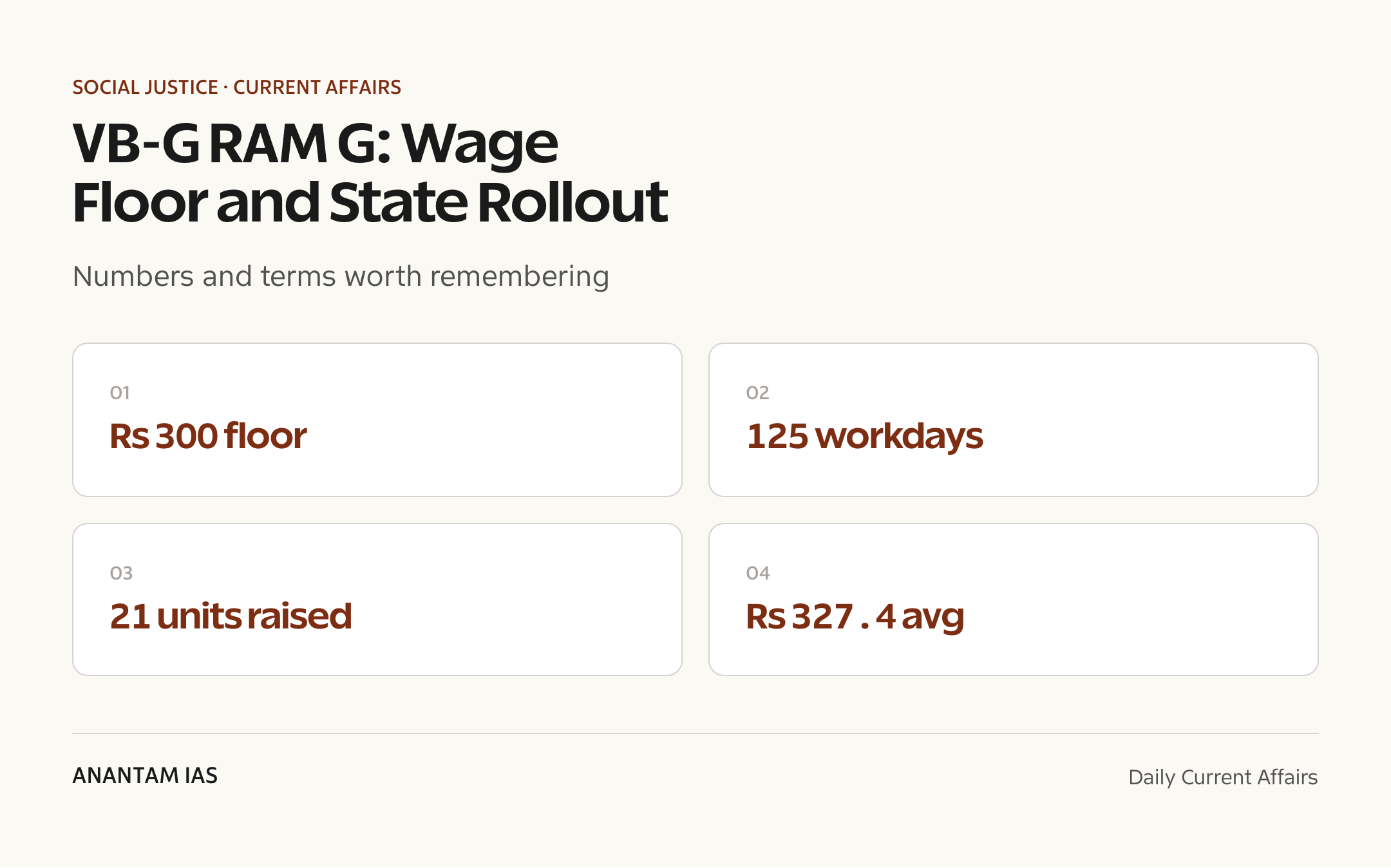
- Rs 300 interim base wage has been introduced, so no notified wage under the programme is below Rs 300 per day.
- 34 States, UTs and wage regions saw revised rates under the notification, according to PIB.
- 21 States and administrative units were brought up to the Rs 300 wage floor.
- National average notified wage rose from Rs 298.8 per day under MGNREGA to Rs 327.4 under VB-G RAM G, an increase of Rs 28.6 per day.
- West Bengal now has a notified rate of Rs 300 per day, compared with the last MGNREGA rate of Rs 260 for 2025-26 reported by Indian Express.
- State rollout is not only about wages; it also tests funding shares, panchayat capacity, unemployment allowance and compensation for delayed payments.
The development matters in the context of:
- Rural employment guarantee sits at the intersection of social justice, local governance, fiscal federalism and livelihood security.
- VB-G RAM G replaces the rights-based MGNREGA architecture with a revised statutory framework promising 125 days of work per eligible rural household.
- Wage floors affect purchasing power, inter-State equity and the credibility of welfare delivery in low-wage regions.
- West Bengal rollout is important because central MGNREGA fund releases to the State had stopped in 2022 after allegations of irregularities.
UPSC Relevance
Prelims Relevance
- VB-G RAM G Act, 2025: Viksit Bharat-Guarantee for Rozgar and Ajeevika Mission (Gramin), the new rural employment law replacing MGNREGA.
- July 1, 2026: commencement date of the Act and effective date of the revised wage notification.
- 125 days: statutory wage employment guarantee per eligible rural household under the new law.
- Rs 300 wage floor: interim base wage under the national rural employment programme.
- Section 10: empowers the Central Government to notify wage rates for unskilled manual work under the scheme.
- Section 11: links failure to provide work within 15 days with unemployment allowance, subject to statutory conditions.
- Section 22(8): unemployment allowance and delay compensation are to be borne by the State Government as prescribed.
- Viksit Gram Panchayat Plans: local planning instrument linked to works and infrastructure priorities.
- Social audit: accountability mechanism for works, payments and public disclosure.
Mains Relevance
GS Paper 2
- Social justice: rural wage employment as a livelihood safety net for poor and vulnerable households.
- Governance: transition from MGNREGA to VB-G RAM G, panchayat capacity, grievance redress and social audits.
- Federalism: 60:40 cost sharing, State budget preparedness and accountability for unemployment allowance.
GS Paper 3
- Rural economy: wage floors, purchasing power, rural demand and distress migration.
- Infrastructure creation: water security, core rural infrastructure, livelihood assets and climate-resilience works.
- Public finance: normative allocations, delayed payments and State-level fiscal capacity.
Essay
- Rights and delivery: a legal guarantee is only as strong as the funding and institutions behind it.
- Federal welfare: national promises need State capacity to become village-level outcomes.
- Dignity of labour: wage policy is also a statement about social justice.
Background and Context
What the Wage Notification Does
The notification converts the commencement of VB-G RAM G into payable wage rates across India.
- PIB confirmed that the revised rates are payable from July 1, 2026 under the VB-G RAM G Act, 2025.
- Rs 300 floor is the defining feature; States that earlier had lower notified rates have been moved to this minimum level.
- Average daily wage has risen to Rs 327.4, compared with Rs 298.8 under the earlier MGNREGA wage structure.
- Average increase exceeds 10%, according to the Ministry of Rural Development’s release.
- Low-wage States such as Uttar Pradesh, Bihar, Jharkhand, West Bengal, Assam, Arunachal Pradesh and Himachal Pradesh received larger percentage gains.
- Higher-wage regions also got revisions, with Haryana at Rs 409, Goa at Rs 406, Kerala at Rs 401 and special high-altitude gram panchayats in Sikkim at Rs 450.
Why Rs 300 Matters
A wage floor is a simple number, but it carries major social-justice and rural-demand implications.
- Income security improves most in regions where earlier rural employment wages were below Rs 300.
- Regional disparity narrows because historically lower-wage States receive larger percentage increases.
- West Bengal moves from a reported 2025-26 MGNREGA rate of Rs 260 to Rs 300 under the new framework.
- Uttar Pradesh saw a reported Rs 48 increase, while Bihar saw Rs 45 and Madhya Pradesh Rs 39 over the last MGNREGA rates.
- Purchasing power depends on real wages, local inflation and number of days actually provided, not only the notified daily rate.
- Minimum wage debate remains open because critics cited the Anoop Satpathy expert committee’s 2019 recommendation of a Rs 375 national minimum wage floor.
From MGNREGA to VB-G RAM G
The policy shift is bigger than a wage revision because the legal and fiscal design has changed.
- MGNREGA guaranteed 100 days of unskilled wage employment to rural households and became the reference point for India’s rights-based welfare model; revise the base through MGNREGA.
- VB-G RAM G promises 125 days of wage employment in a financial year to every eligible rural household whose adult members volunteer for unskilled manual work.
- Section 10 lets the Centre notify different wage rates for different areas, but the notified rate cannot be below the prevailing MGNREGA wage rate.
- Section 11 keeps an unemployment-allowance link when work is not provided within 15 days of application, subject to the Act and State rules.
- Viksit Gram Panchayat Plans connect work demand to local infrastructure planning, digital systems and aggregation at block, district and State levels.
- Policy question for Mains is whether the new design preserves a demand-based guarantee in practice or makes work more dependent on approved plans and allocations.
West Bengal as the Implementation Test
West Bengal turns the national notification into a field-level test of finance, administration and trust.
- The Hindu reported that VB-G RAM G was rolled out in West Bengal on July 1, 2026, resuming a central rural job guarantee in the State after almost four years.
- March 2022 is the key background date, when the Union Government stopped releasing MGNREGA funds to West Bengal after alleging financial irregularities under the earlier State government.
- Rs 14,000 crore was allocated in the 2026-27 West Bengal Budget for employment under VB-G RAM G.
- 60:40 sharing applies in the State, with the Union share reported at Rs 8,508 crore and the State share at Rs 5,672 crore.
- Administrative hurdles include about 2,000 non-functioning panchayats, according to the State Panchayat and Rural Development Minister cited by The Hindu.
- Implementation lesson: a statutory wage guarantee needs active panchayats, timely measurement, payment systems, grievance channels and audit capacity.
Funding and Federalism Questions
The biggest governance debate is whether States can fund and deliver the expanded guarantee without weakening entitlement quality.
- Centrally Sponsored Scheme design means the Centre and States share both cost and responsibility.
- 60:40 ratio applies for most States, while official PIB material describes enhanced support for North-Eastern and Himalayan States and full central funding for UTs without legislatures.
- State liability becomes crucial because unemployment allowance and delayed-payment compensation rest with States under the Act’s framework.
- Normative allocation can improve budget predictability, but it may create pressure if labour demand exceeds the approved financial envelope.
- PBKMS estimate in West Bengal warned that available funds may generate only about 60 days of work per active job card, against the legal promise of 125 days.
- Fiscal federalism is the exam hook: national welfare laws work only when money, rules and accountability are aligned across Union, State and local bodies.
Accountability and Worker Rights
For workers, the real guarantee is measured through work availability, wage payment, compensation and local accountability.
- Work demand must remain easy to register orally, in writing or through authorised digital channels for poor households.
- Fifteen-day rule matters because delay in providing work can trigger unemployment allowance under the statutory framework.
- Wage delay should lead to compensation where rules prescribe it, otherwise higher notified wages may not reach workers on time.
- Social audit is central to detecting fake works, poor measurement, non-payment and exclusion; revise the mechanism through Social Audit in India.
- Gram Sabha oversight links rural employment with local democracy and transparency; connect this with Panchayati Raj.
- Digital monitoring can reduce leakage, but it must not exclude workers through authentication failure, weak connectivity or poor grievance handling.
UPSC Governance Lens
The topic is useful because it combines welfare design with constitutional values and field administration.
- Article 41 directs the State to make effective provision for the right to work, education and public assistance within economic capacity; revise Part IV through Directive Principles.
- Article 43 links workers with a living wage, decent conditions and a decent standard of life.
- Antyodaya is the stated government frame, but the field test is whether the poorest households get work when they demand it.
- Durable assets under water security, rural infrastructure, livelihood infrastructure and climate-resilience works can create long-term public value.
- Rights-based welfare cannot be judged only by scheme launch; it must be judged by access, accountability, payment regularity and remedies.
- Mains answer should balance both sides: higher wage floor and 125-day promise on one side, and funding adequacy, State burden and local capacity risks on the other.
Way Forward
Protect the entitlement character
- Demand registration should remain simple, documented and accessible through Gram Panchayats and authorised digital channels.
- Work allocation must follow the statutory 15-day standard, with written reasons and remedies where work is not provided.
- Unemployment allowance should have a separate State budget line so workers are not punished for administrative failure.
Align money with the 125-day promise
- Normative allocations should be transparently calculated and revised when actual labour demand is higher than estimated.
- State shares must be provided before peak implementation periods, especially in States with large active job-card bases.
- Payment timelines need public dashboards that show work demand, work provided, wage payments, delays and compensation.
Strengthen local accountability
- Gram Panchayats need staff, technical support and functioning elected bodies to prepare realistic Viksit Gram Panchayat Plans.
- Social audits should be independent, regular and linked to recovery, correction and grievance redress.
- Digital tools should supplement field verification, not replace worker-facing accountability at the worksite and panchayat office.
Use wages as a social-justice instrument
- Wage indexation should keep pace with rural inflation so nominal gains do not shrink in real terms.
- Low-wage regions need targeted monitoring because they receive the largest relative gains and often have weaker administrative capacity.
- Worker organisations, SHGs and civil-society groups can help track whether the Rs 300 floor converts into actual paid workdays.
Conclusion
VB-G RAM G is now moving from statute to implementation. The Rs 300 wage floor is important because it gives workers in low-wage regions an immediate income anchor.
But the real test is not the headline wage. It is whether 125 days of work, timely wages, unemployment allowance and social audit remedies reach households through functioning panchayats and funded State systems.
For UPSC, read this as a classic GS2 Social Justice issue: the policy promise is national, the implementation is local, and the accountability burden is shared across levels of government.
UPSC Practice Questions
Prelims MCQ 1
With reference to the VB-G RAM G Act, 2025, consider the following statements:
- It provides for 125 days of wage employment in a financial year to eligible rural households under the scheme.
- The Central Government may notify different wage rates for different areas under the Act.
- The revised wage notification introduced an interim base wage rate of Rs 300 per day.
How many of the above statements are correct?
(a) Only one (b) Only two (c) All three (d) None
Answer: (c) All three
Explanation:
All three statements are correct. The Act expands the guarantee to 125 days, allows area-specific notified wage rates, and the 2026 wage notification introduced a Rs 300 interim base wage.
Prelims MCQ 2
Which one of the following best explains the main governance concern in the West Bengal rollout of VB-G RAM G?
(a) The scheme has no connection with rural employment. (b) The issue is limited only to the spelling of the scheme name. (c) Funding adequacy, State share, panchayat capacity and statutory compensation will affect actual delivery. (d) The wage notification applies only to urban workers.
Answer: (c) Funding adequacy, State share, panchayat capacity and statutory compensation will affect actual delivery.
Explanation:
The Bengal rollout shows that the legal guarantee depends on budget provision, functioning local institutions, timely wages and remedies for non-provision of work or delayed payments.
UPSC Mains Questions
- The VB-G RAM G wage notification introduces a national wage floor, but the success of the rural employment guarantee will depend on State capacity and local accountability. Discuss with reference to social justice and fiscal federalism.
- Compare the governance logic of MGNREGA and VB-G RAM G in terms of demand for work, wage payment, State liability, social audit and creation of durable rural assets.
- A higher notified wage does not automatically ensure livelihood security. Examine the institutional safeguards needed to convert rural employment guarantees into real workdays and timely payments.
Sources: PIB, Ministry of Rural Development and The Hindu, Indian Express.
Frequently Asked Questions
What is VB-G RAM G?
VB-G RAM G stands for Viksit Bharat-Guarantee for Rozgar and Ajeevika Mission (Gramin). It is the new rural employment law that replaces MGNREGA and promises 125 days of wage employment in a financial year to eligible rural households whose adult members volunteer for unskilled manual work.
What did the wage notification change?
The Union Government notified revised wages effective July 1, 2026. The key change is a Rs 300 interim base wage, so no notified wage under the programme is below Rs 300 per day. PIB said the national average notified wage rose from Rs 298.8 to Rs 327.4 per day.
Why is West Bengal important here?
West Bengal is a major implementation test because a central rural job guarantee resumed there after almost four years. The State has budgeted Rs 14,000 crore for VB-G RAM G, but worker groups have questioned whether the available funds can support the full 125-day promise.
How is VB-G RAM G different from MGNREGA?
VB-G RAM G raises the statutory employment guarantee from 100 to 125 days and links works with Viksit Gram Panchayat Plans, rural infrastructure and digital monitoring. The debated shift is the move toward a revised cost-sharing and allocation framework, which critics compare with MGNREGA’s demand-driven design.
Who pays unemployment allowance?
Under the Act’s framework, unemployment allowance and delayed-payment compensation are State responsibilities as prescribed. This matters because the guarantee becomes meaningful only when States budget for remedies and workers receive compensation if work or wages are delayed.
Why is this relevant for UPSC?
The issue combines GS2 themes of social justice, governance, welfare delivery, Panchayati Raj and fiscal federalism. It also helps in Mains answers on rights-based welfare, rural livelihoods, State capacity, social audit and the gap between legal entitlement and actual delivery.
Source: https://anantamias.com/current-affairs/vbg-ramg-wage-notification-implementation/
West Asia Talks: U.S.-Iran Diplomacy and Shipping Security
Why in News?
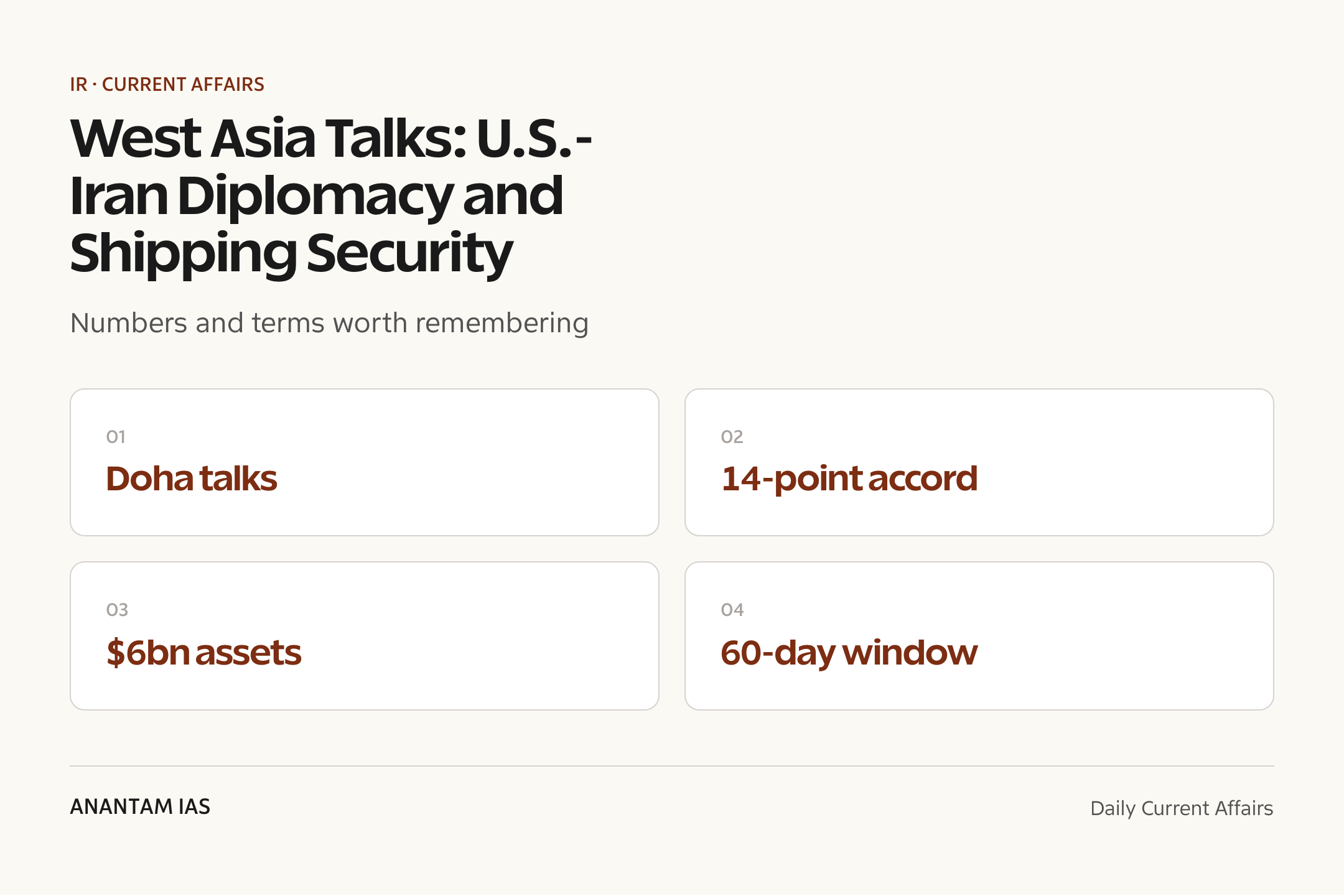
The Hindu reported that the United States and Iran held technical talks in Doha on July 1, 2026 to settle shipping flows through the Strait of Hormuz and secure a lasting ceasefire.
A linked report said Iranian President Masoud Pezeshkian claimed that $6 billion out of $12 billion in frozen Iranian assets held in Qatar would be released, even as U.S. officials said no assets had yet been released.
- Talks venue: the technical negotiations were held in Doha, with Qatar and Pakistan described as mediators.
- Immediate agenda: shipping through the Strait of Hormuz, implementation of a ceasefire, and the claimed release of frozen Iranian assets.
- Negotiation frame: the talks build on a reported 14-point interim accord signed last month, with 60 days set aside for a permanent peace deal.
- Shipping risk: The Hindu reported that Iranian attacks and threats had stopped cargo ships and tankers moving through the strait during the recent crisis.
- Energy link: the report noted that about a fifth of all traded oil and natural gas passed through the strait in peacetime.
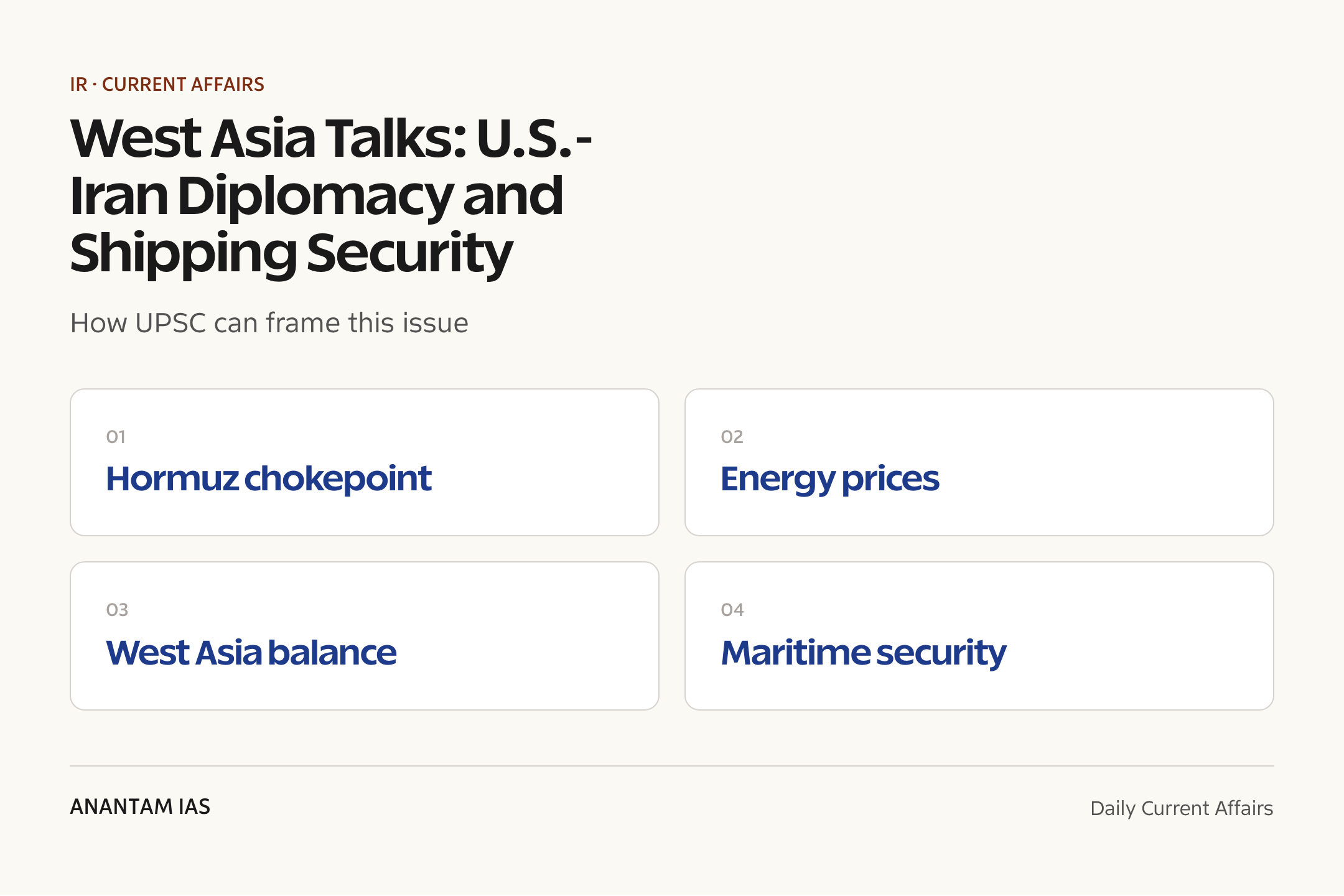
- India angle: shipping delays, insurance costs and Gulf energy prices affect India’s import bill, inflation, seafarer safety and external-sector stability.
The development matters in the context of:
- West Asia stability is not only a diplomatic issue for India; it is also an energy, freight, diaspora and balance-of-payments issue.
- Hormuz is a chokepoint where a narrow security incident can move crude prices, LNG markets and war-risk insurance.
- Frozen assets are a sanctions-relief signal, but the dispute over whether funds have actually moved shows why implementation matters.
- India’s strategic autonomy requires engagement with the U.S., Iran, Israel, Gulf Arab states and regional mediators at the same time.
UPSC Relevance
Prelims Relevance
- Strait of Hormuz connects the Persian Gulf with the Gulf of Oman and the Arabian Sea.
- Iran lies on the northern side of the strait; Oman lies on the southern side.
- Transit passage under the law of the sea is relevant to straits used for international navigation.
- Qatar and Pakistan were described as mediators in the current U.S.-Iran talks.
- 14-point interim accord and a 60-day negotiation window are the key reported diplomatic details.
- $6 billion out of $12 billion in Iranian resources in Qatar was the claim made by Iran’s President.
- Chabahar port lies on Iran’s Makran coast and gives India a route to Afghanistan and Central Asia outside Hormuz.
- Current Account Deficit can widen when crude oil prices or freight costs rise.
- War-risk insurance is a shipping cost that rises when vessels move through conflict-prone waters.
Mains Relevance
GS Paper 2
- International relations: India’s West Asia balancing between the U.S., Iran, Israel, Qatar, Pakistan and Gulf Arab states.
- Strategic autonomy: protecting India’s energy and connectivity interests without being pulled into one regional camp.
- Diplomacy and mediation: role of small and middle powers such as Qatar, Oman and Pakistan in conflict management.
GS Paper 3
- Energy security: crude, LNG, freight and insurance exposure through the Strait of Hormuz.
- Indian economy: oil-price shocks can affect inflation, the rupee, the current account and fiscal space.
- Maritime security: protection of sea lines of communication and Indian seafarers in the Gulf region.
Essay
- Chokepoints show how geography can shape the economics of peace and conflict.
- Strategic autonomy is tested most sharply when energy security and diplomacy overlap.
- Peace agreements matter only when implementation is visible, trusted and enforceable.
Background and Context
What the Doha Talks Are About
The current round is a technical negotiation, not just a public political statement.
- Doha talks began on Tuesday night and continued on July 1, 2026, according to The Hindu’s Reuters-based report.
- Chief negotiators and specialists were expected to handle the sessions, while Jared Kushner and Steve Witkoff helped lay the groundwork by meeting Qatar’s Prime Minister.
- Qatar was described as a mediator in the talks along with Pakistan, showing the multipolar nature of West Asia diplomacy.
- U.S. priority was reported as ensuring the free flow of traffic through the Strait of Hormuz.
- Iran’s priorities included management of the strait and the release of frozen Iranian assets.
- UPSC takeaway: technical talks are often where ceasefire terms become operational rules for ships, ports, payments and military restraint.
Why Hormuz Is the Core Issue
The diplomatic dispute matters because one narrow waterway carries a large share of global energy trade.
- Strait of Hormuz links the Persian Gulf to the Gulf of Oman and the Arabian Sea.
- Peacetime flow through the strait included about a fifth of traded oil and natural gas, according to The Hindu’s AP-based report.
- Iran wants international recognition of its role in managing the strait and its claimed ability to levy fees on vessels entering or leaving the Gulf.
- United States wants predictable, free movement of civilian shipping through the waterway.
- Oman’s territorial waters matter because routes on the Omani side were reported as part of efforts to keep inbound and outbound traffic moving.
- Practical risk: even partial reopening can stay patchy if route rules, vessel tracking, escorts and fee claims remain unclear.
The Interim Accord and Its Friction Points
The reported accord creates a negotiation window, but both sides still disagree over meaning and control.
- 14-point interim accord was reported as the basis for halting the war and reopening the Strait of Hormuz.
- 60 days of negotiations were reportedly set aside for a permanent peace deal.
- Ceasefire durability depends on whether both sides accept the same rules for shipping, military restraint and asset movement.
- Public sparring over the meaning of the interim pact has already created uncertainty for markets and ship operators.
- Container-ship grounding in shallow waters outside an Iranian-designated route was cited by Iran’s state media during the talks.
- Exam lens: implementation problems often sit between law, diplomacy and operational control, not in grand treaty language alone.
Frozen Assets and Sanctions Relief
The asset-release claim is important because it signals whether sanctions relief is becoming real.
- Masoud Pezeshkian said $6 billion out of $12 billion in Iranian resources held in Qatar would be released and returned to Iran.
- U.S. officials said no frozen Iranian assets had been released so far, according to The Hindu’s AP-based report.
- Qatar had not publicly acknowledged such a transfer in the report, which keeps the claim politically sensitive.
- Domestic politics in Iran matters because the President’s statement was presented as a way to sell the interim deal to the Iranian public.
- Sanctions relief is not only a financial issue; it affects Iran’s bargaining space, oil-market expectations and regional confidence.
- India link: any credible sanctions easing can affect payment channels, crude supply expectations and projects such as Chabahar port.
India's External-Sector Exposure
For India, Hormuz tension is an economic transmission channel as much as an IR headline.
- Crude-import bill rises when West Asia risk pushes oil prices and shipping costs higher.
- Inflation can widen through fuel, transport, fertilizer, power and logistics channels.
- Current account comes under pressure when energy imports become costlier and the rupee faces imported inflation.
- Freight and insurance costs matter because war-risk premiums can rise even before a full closure of the waterway.
- Indian seafarers face direct safety risks when tankers and cargo ships operate in contested waters.
- Static link: connect this with the earlier U.S.-Iran peace-deal note for the oil, Hormuz and India framework.
Maritime Law and Shipping Security
The legal issue is whether a strategic strait can stay open when littoral states and external powers contest control.
- International navigation through straits is governed by the law-of-the-sea framework, especially rules on passage through straits used by global shipping.
- Littoral states such as Iran and Oman have coastal jurisdiction, but global commerce needs predictable transit rules.
- Shipping lanes require clear navigation routes, traffic separation, maritime advisories and deconfliction with military forces.
- Naval signalling can protect sea lanes, but it can also escalate risk if not paired with diplomacy.
- Energy chokepoints make private actors such as insurers, tanker operators and commodity traders part of the security picture.
- UPSC angle: maritime security is not only naval power; it includes law, insurance, ports, crews, energy policy and crisis communication.
Regional Spillover Risks
The Hormuz talks sit inside a wider West Asia crisis with links beyond Iran and the U.S.
- U.S.-Israeli strikes on Iran in February were cited in the report as the starting point of the latest war.
- Iranian attacks on Gulf states hosting U.S. military bases widened the regional risk environment.
- Bahrain and Kuwait were named in the AP-based report as targets of Iranian drone and missile attacks on June 29, 2026.
- Lebanon track also matters because the interim deal was reported to include an end to conflict involving Israel and Hezbollah.
- Oil prices edged higher after prior declines, showing how markets react to both de-escalation and renewed uncertainty.
- Policy lesson: India should track the Gulf as a connected security complex, not as isolated bilateral disputes.
Way Forward
Stabilise Shipping Rules
- Clear passage protocols should define approved routes, communication channels, distress procedures and incident reporting.
- Independent monitoring by neutral maritime actors can reduce disputes over whether vessels followed a declared route.
- Insurance clarity is needed so tankers and cargo ships can price risk without panic premiums.
Keep Diplomacy Multi-Channel
- Qatar, Oman and Pakistan can keep back-channel talks alive when public U.S.-Iran statements harden.
- India should quietly support de-escalation, freedom of navigation and protection of civilian shipping without entering the dispute as a party.
- Consular readiness for Indian seafarers should stay active while shipping remains uncertain.
Reduce India's Chokepoint Vulnerability
- Energy diversification across suppliers, fuels and routes can reduce exposure to a single West Asia shock.
- Strategic petroleum reserves and long-term LNG planning should be treated as economic-security tools.
- Chabahar and INSTC remain useful connectivity hedges when sanctions and sea-lane politics shift.
Separate Claims from Implementation
- Asset-release claims should be read against verifiable fund movement, official acknowledgements and sanctions waivers.
- Ceasefire claims should be tested through actual vessel movement, route safety and absence of retaliatory strikes.
- Market signals such as crude prices, tanker rates and insurance premiums can show whether confidence is returning.
Conclusion
The Doha technical talks show that West Asia diplomacy is now moving from headline ceasefire language to implementation details: shipping lanes, asset release, route control and crisis communication.
For India, the central issue is practical. If Hormuz remains open and predictable, oil prices, freight costs, seafarer safety and the current account become easier to manage.
The durable UPSC lesson is simple: energy security and foreign policy meet at maritime chokepoints, and strategic autonomy works best when India keeps multiple routes, partners and diplomatic channels open.
UPSC Practice Questions
Prelims MCQ 1
With reference to the Strait of Hormuz, consider the following statements:
- It connects the Persian Gulf with the Gulf of Oman and the Arabian Sea.
- Iran lies along its northern side and Oman along its southern side.
- It is important for global oil and natural gas trade.
How many of the above statements are correct?
(a) Only one (b) Only two (c) All three (d) None
Answer: (c) All three
Explanation:
All three statements are correct. Hormuz links the Persian Gulf to the Gulf of Oman and Arabian Sea, has Iran and Oman on opposite sides, and is a major energy chokepoint.
Prelims MCQ 2
Which statement best captures the reported July 2026 U.S.-Iran technical talks in Doha?
(a) They were only a bilateral trade negotiation between India and Iran. (b) They focused on Hormuz shipping flows, ceasefire implementation and frozen Iranian assets. (c) They created a new South Asian free-trade bloc led by Qatar. (d) They declared the Strait of Hormuz closed to all civilian shipping.
Answer: (b) They focused on Hormuz shipping flows, ceasefire implementation and frozen Iranian assets.
Explanation:
The talks were reported as U.S.-Iran technical negotiations in Doha, mediated by Qatar and Pakistan, with shipping through Hormuz and frozen-asset issues at the centre.
UPSC Mains Questions
- The Strait of Hormuz is both a maritime security issue and an economic vulnerability for India. Discuss in the context of the July 2026 U.S.-Iran technical talks.
- India’s West Asia policy requires strategic autonomy, energy security and protection of sea lines of communication. Examine with reference to U.S.-Iran diplomacy and Gulf shipping risks.
- Peace agreements often fail at the implementation stage. Analyse how shipping rules, sanctions relief and third-party mediation can shape the durability of ceasefire arrangements.
Sources: The Hindu (Reuters) and The Hindu (AP).
Frequently Asked Questions
Why do the talks matter to India?
The talks matter because Hormuz shipping affects India’s crude costs, LNG security, freight rates and inflation. If the strait stays open and predictable, India’s import bill and current-account pressure ease. If it becomes risky again, war-risk insurance and energy prices can rise quickly.
What is the shipping dispute?
The dispute is over who controls practical movement through the Strait of Hormuz. The U.S. wants free flow of traffic. Iran wants recognition of its role in managing the strait and has raised fee and route-control claims. Ship operators need predictable rules.
What is the asset-release issue?
Iran’s President said $6 billion out of $12 billion in Iranian resources held in Qatar would be released. U.S. officials said no assets had been released so far, and Qatar had not acknowledged such a transfer in the report. This makes verification central.
Why is Qatar important here?
Qatar is important because it was described as a mediator and because the frozen Iranian resources are held there. In West Asia diplomacy, smaller Gulf states often provide venues, communication channels and financial pathways that larger rivals cannot use openly.
How does Hormuz affect oil prices?
Hormuz is a narrow energy chokepoint. If tankers face attacks, detention risk or unclear routes, insurers charge more and traders price in supply uncertainty. Even a partial disruption can lift oil and LNG prices, which affects import-dependent economies such as India.
What should India watch next?
India should watch actual vessel movement, shipping advisories, crude prices, insurance premiums, asset-transfer confirmation and signs of renewed strikes. Diplomatic statements matter, but the real test is whether ships, payments and energy supplies move safely.
Source: https://anantamias.com/current-affairs/us-iran-technical-talks-shipping-west-asia/
AI Audit: Payroll fraud detection in Chhattisgarh Police
Why in News?
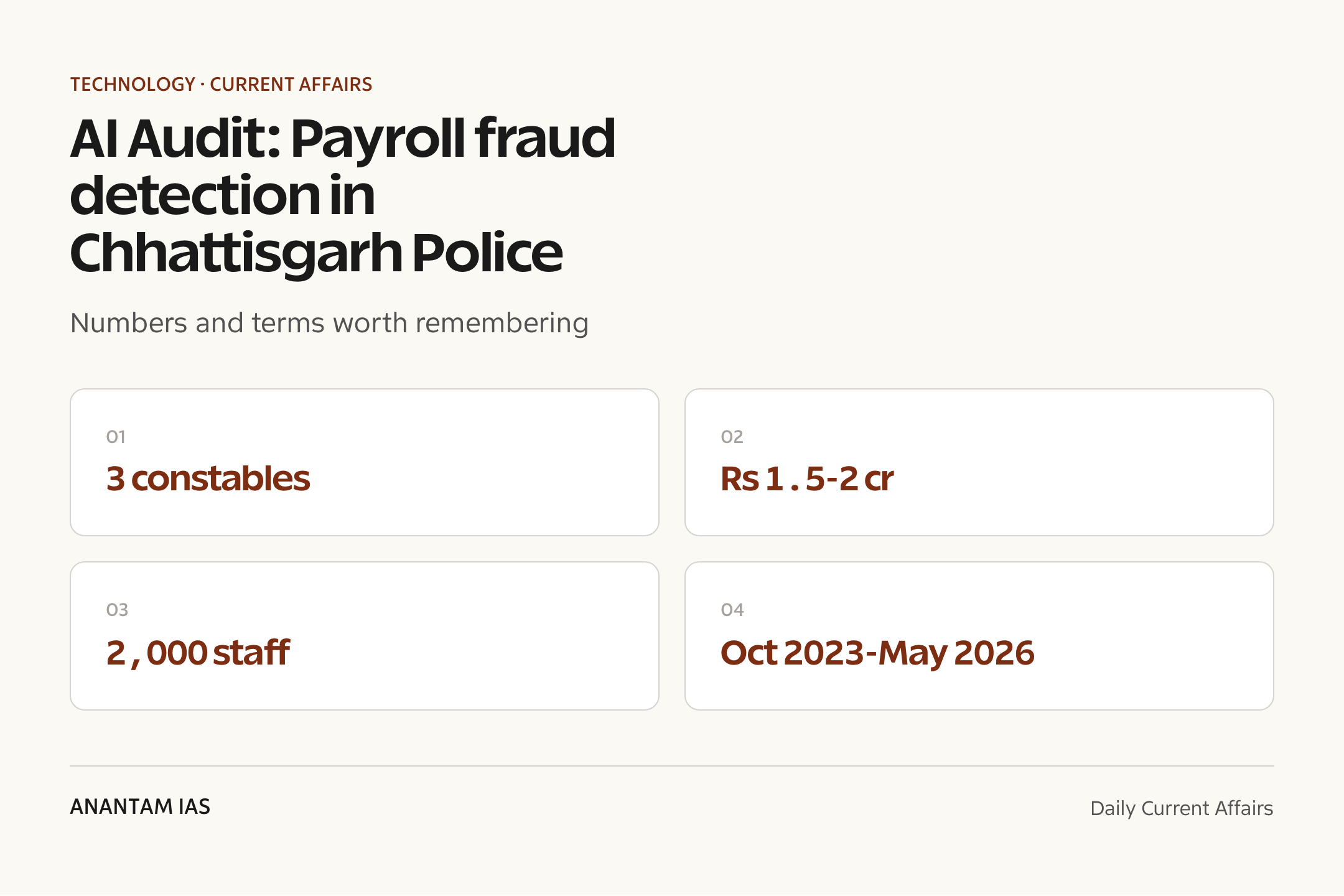
The AI payroll fraud detection case in Chhattisgarh Police came into focus after Indian Express reported that three constables from Bastar were arrested over alleged salary inflation detected during an AI-assisted audit.
The report said auditors analysed salary data for around 2,000 personnel and spotted anomalies in a case where the accused allegedly siphoned off between Rs 1.5 crore and Rs 2 crore from October 2023 to May 2026.
- Place: the alleged manipulation was linked to the office of the Superintendent of Police, Jagdalpur in Bastar district.
- Accused: Indian Express named constables Girish Rai, Rajkumar Katlam and Hemant Mathew as the arrested personnel.
- Modus: investigators said salary soft copies were allegedly edited before processing, raising monthly salary amounts in small increments.
- Detection: auditors used AI tools on voluminous salary data and noticed patterns that routine manual checks had missed.
- Legal action: the report said the accused were booked under the Bharatiya Nyaya Sanhita for offences including cheating, forgery, criminal breach of trust and misappropriation of government funds.
The development matters in the context of:
- Governance angle: payroll fraud is not only a police misconduct issue; it is a public finance control failure inside a state institution.
- Technology angle: the case shows how anomaly detection can flag suspicious patterns in large administrative datasets.
- Safeguards angle: AI can identify risk signals, but disciplinary and criminal action still needs human verification, due process and evidence.
- Internal security angle: integrity of police administration affects public trust, morale and the legitimacy of law-enforcement agencies.
UPSC Relevance
Prelims Relevance
- Artificial Intelligence refers to computer systems performing tasks such as pattern recognition, classification and prediction from data.
- Anomaly detection means identifying data points or transactions that deviate from normal patterns; payroll audits can use it to flag unusual salary jumps.
- Bharatiya Nyaya Sanhita, 2023 replaced the Indian Penal Code as India’s principal criminal code from 1 July 2024.
- Forgery, cheating and criminal breach of trust are classic financial-integrity offences in public administration.
- CAG derives its audit authority from Articles 149-151 of the Constitution, while internal and departmental audits work within the executive chain.
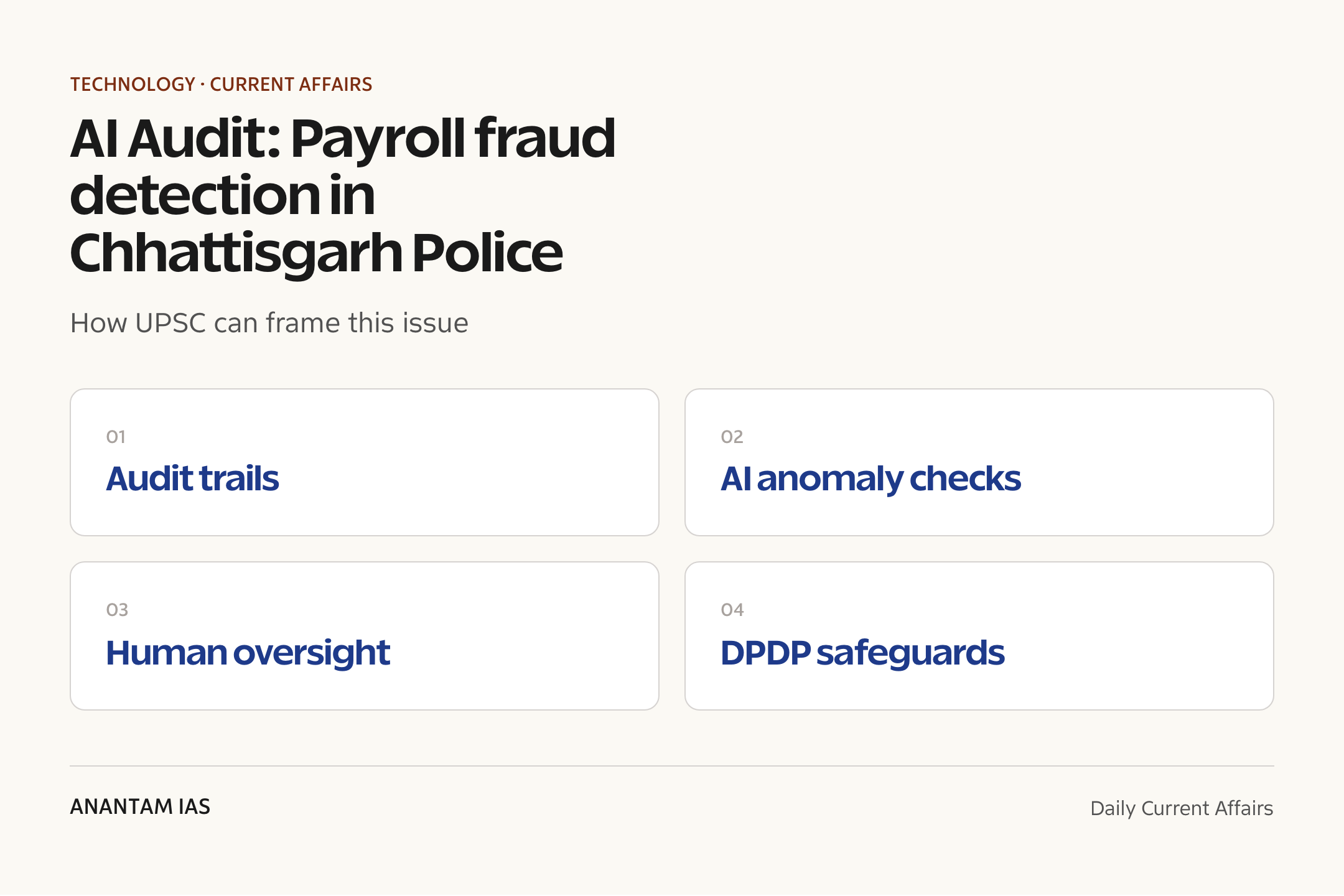
- Audit trail means a traceable record of who changed data, when it was changed and what exactly was changed.
- Digital Personal Data Protection Act, 2023 matters when employee salary and identity data are processed through digital systems.
- False positive in audit analytics means a transaction flagged as suspicious that turns out to be legitimate after verification.
Mains Relevance
GS Paper 2
- Governance: use this case to discuss administrative accountability, internal controls, audit capacity and public trust.
- Polity: connect departmental vigilance with rule of law, due process and the need to avoid punishment by algorithm.
GS Paper 3
- Science and Technology: AI can improve fraud detection, but its design must address bias, explainability, cybersecurity and data quality.
- Internal Security: police integrity is a security concern because corruption inside law-enforcement bodies weakens operational legitimacy.
GS Paper 4
- Ethics: the case is useful for integrity, probity, accountability, misuse of public office and conflict between trust and verification.
Essay
- Technology and trust: digital systems can strengthen governance only when accountability keeps pace with automation.
- Clean government: corruption control needs culture, process and data, not only stricter punishment.
- Human oversight: the state must not outsource moral judgment to machines.
Background and Context
What the case shows
The Chhattisgarh case is a useful micro-example of how routine public expenditure can leak when controls are weak.
- Payroll fraud is often low-visibility because salary bills are recurring, predictable and trusted by default inside departments.
- Indian Express reported that the alleged inflation continued for nearly three years, from October 2023 to May 2026.
- Small monthly increments can avoid attention better than one large withdrawal because the change looks like routine allowance variation.
- Police salary bills are especially complex because transfers, postings and personnel-strength changes can alter expenditure each month.
- Administrative lesson: where process complexity is high, exception reporting should be stronger, not weaker.
- Control failure is the real exam issue: if salary changes can pass for years without reconciliation, the institution has a systems problem beyond the accused officials.
- Public trust suffers because salary fraud turns a routine personnel process into a question about integrity inside the state’s coercive arm.
How AI helps auditors
AI in this context should be read as decision support for auditors, not as an independent judge.
- Anomaly detection can compare monthly salary entries, past payment history, designation, sanctioned pay level and peer-group patterns.
- Outlier analysis can flag employees whose salary growth is inconsistent with increments, allowances, arrears or transfer-linked changes.
- Pattern recognition is useful when the dataset is too large for line-by-line manual checking, as in salary data for around 2,000 personnel.
- Machine-assisted audit reduces search cost; it does not by itself prove criminal intent, mens rea or departmental guilt.
- Human confirmation remains essential through voucher checks, bank-credit verification, digital logs, service records and statement recording.
- Audit triage is the best use case: software can rank suspicious transactions so scarce audit staff spend time on high-risk files first.
- Responsible design should keep the tool explainable enough for finance officers, not only data scientists, because departmental action needs understandable reasons.
Static anchor: public audit
For UPSC, the durable issue is the audit architecture that protects public money.
- Internal audit is the first line of defence inside a department; it checks compliance before small irregularities become systemic.
- External audit, especially through the CAG framework, adds constitutional independence and reporting to the legislature.
- Articles 149-151 place the CAG at the centre of public audit, but day-to-day payroll control also needs treasury, DDO and departmental checks.
- Segregation of duties is critical: the person preparing salary data should not also approve, modify and reconcile the same bill without oversight.
- Audit trails should capture edits to salary files so investigators can trace the user account, timestamp, old value and new value.
- Treasury integration is important because departmental bills, sanctioned posts and bank-credit files should match before money leaves the public account.
- Legislative oversight gains value when audit findings are reported in a form that committees can track across departments, not as one-off scandals.
Law and accountability
The reported offences fall within the classic integrity concerns of public service.
- Cheating involves deception leading to wrongful gain or wrongful loss; payroll manipulation can fit this logic when facts are proved.
- Forgery is relevant when records are altered or created dishonestly to support a false financial claim.
- Criminal breach of trust matters when a person entrusted with official responsibility dishonestly misuses that position.
- Misappropriation of government funds shows why public finance cases should be treated as governance failures, not only individual misconduct.
- Due process still applies: AI flags may justify inquiry, but arrest, charge, departmental action and conviction need legally admissible evidence.
Safeguards for algorithmic governance
The case links directly to India’s wider debate on algorithmic governance and data protection.
- Data minimisation means auditors should process only the employee data necessary for payroll verification, not unrelated personal details.
- Purpose limitation means salary datasets used for fraud detection should not drift into unrelated surveillance without legal authority.
- Explainability matters because an employee should know why a transaction was flagged if disciplinary consequences follow.
- False positives are a real risk; legitimate arrears, court-ordered payments, deputation allowances or back wages can look abnormal.
- Read with algorithmic governance and bias, artificial intelligence in India and the DPDP data-protection framework.
Police administration and internal security
A police payroll case may look administrative, but it has a security and ethics dimension.
- Police legitimacy depends on citizens believing that law-enforcement institutions obey the law internally.
- Bastar is a sensitive internal-security region; financial integrity inside police units matters for morale and operational credibility.
- Corruption risk inside salary sections can weaken trust between field personnel, headquarters and finance staff.
- Cybersecurity becomes part of policing when salary data, service books and payment files move through digital workflows.
- Read with NCRB cybercrime trends to connect fraud, digital records and law-enforcement capacity.
Way Forward
Strengthen payroll controls
- Maker-checker workflow should separate data entry, approval, bill generation and reconciliation across different officials.
- Monthly exception reports should flag sudden salary jumps, duplicate bank accounts, unusual arrears and repeated manual edits.
- Digital signatures and role-based access should make every edit attributable to a named official account.
- Bank reconciliation should compare sanctioned salary, treasury bill and employee bank credit before closing the monthly cycle.
Use AI with guardrails
- Human-in-the-loop audit should make AI a screening tool, with auditors responsible for final findings.
- Explainable models should show why an entry was flagged: amount change, frequency, peer mismatch, duplicate pattern or edit history.
- Model validation should test the tool on known fraud cases and known legitimate salary variations before deployment.
- Independent review should check whether the system is missing fraud in small offices or over-flagging certain units.
Protect rights and records
- DPDP-compliant processing should define purpose, access, retention and deletion rules for employee salary data.
- Grievance channels should allow employees to challenge wrong flags, mistaken recoveries or reputational harm.
- Evidence preservation should secure original files, edit logs and device records before accused officials can alter the trail.
- Audit capacity should be upgraded through training in data analytics, forensic accounting and cyber evidence handling.
Conclusion
The Chhattisgarh Police payroll case is a compact example of how AI-assisted audit can make hidden leakages visible in public administration. Its value for governance lies less in the novelty of AI and more in the reminder that public money needs traceable records, routine exception reports and credible follow-up.
For UPSC answers, the balanced position is clear: AI can improve audit speed and detection, but accountability must remain human, legal and transparent. A good state uses technology to sharpen scrutiny, not to replace due process.
UPSC Practice Questions
Prelims MCQ 1
With reference to AI-assisted payroll audits in public administration, consider the following statements:
- Anomaly detection can flag salary entries that deviate from normal payment patterns.
- An AI-generated flag by itself is enough to establish criminal guilt in a court.
- Audit trails help identify who changed a digital record and when the change was made.
How many of the above statements are correct?
(a) Only one (b) Only two (c) All three (d) None
Answer: (b) Only two
Explanation:
Statements 1 and 3 are correct. Statement 2 is wrong because AI can flag suspicion, but guilt requires legally admissible evidence and due process.
Prelims MCQ 2
In the context of public audit in India, Article 149 of the Constitution is primarily associated with which institution?
(a) Central Vigilance Commission (b) Comptroller and Auditor General of India (c) Finance Commission (d) Public Accounts Committee
Answer: (b) Comptroller and Auditor General of India
Explanation:
Article 149 deals with the duties and powers of the Comptroller and Auditor General in relation to the accounts of the Union, States and other authorities as provided by law.
UPSC Mains Questions
- The Chhattisgarh Police payroll fraud case shows that technology can expose leakages, but cannot substitute for institutional accountability. Discuss the governance lessons for public audit, departmental controls and data-driven administration. (250 words)
- AI-assisted anomaly detection can strengthen public finance management, but it also raises concerns of privacy, false positives and opacity. Examine with suitable examples from public administration. (250 words)
- Police integrity is not only an ethics issue but also an internal-security requirement. Analyse this statement in the context of corruption risks within law-enforcement institutions. (150 words)
Source: Indian Express.
Frequently Asked Questions
What happened in Chhattisgarh Police?
Indian Express reported that three constables from Bastar were arrested after auditors used AI tools to detect alleged salary inflation. The alleged fraud ran from October 2023 to May 2026 and involved between Rs 1.5 crore and Rs 2 crore.
How did AI help the audit?
AI-assisted analysis helped auditors scan salary data for around 2,000 personnel and flag unusual patterns. In such cases, AI works as a screening tool. Auditors and investigators still need to verify records, bank credits, edit logs and intent.
Why is this relevant for UPSC?
The case links GS2 governance with GS3 science and technology. It gives a concrete example for public audit, financial controls, algorithmic governance, data protection, internal security and ethics in public service.
Can AI prove payroll fraud?
No. AI can identify suspicious transactions, but it cannot by itself prove guilt. Criminal action requires admissible evidence, investigation, human judgment, due process and court scrutiny under the applicable law.
What safeguards are needed?
Departments need maker-checker workflows, audit trails, role-based access, monthly exception reports, DPDP-compliant data handling, human review of AI flags and grievance channels for wrongly flagged employees.
Why does police payroll integrity matter?
Police forces depend on public trust and internal morale. If salary systems are manipulated, it weakens institutional credibility, diverts public funds and damages confidence in the same agency expected to enforce the law.
Source: https://anantamias.com/current-affairs/ai-payroll-fraud-chhattisgarh-police/
Cardamom Hill Reserve: Kerala HC PIL on Tree-Felling
Why in News?
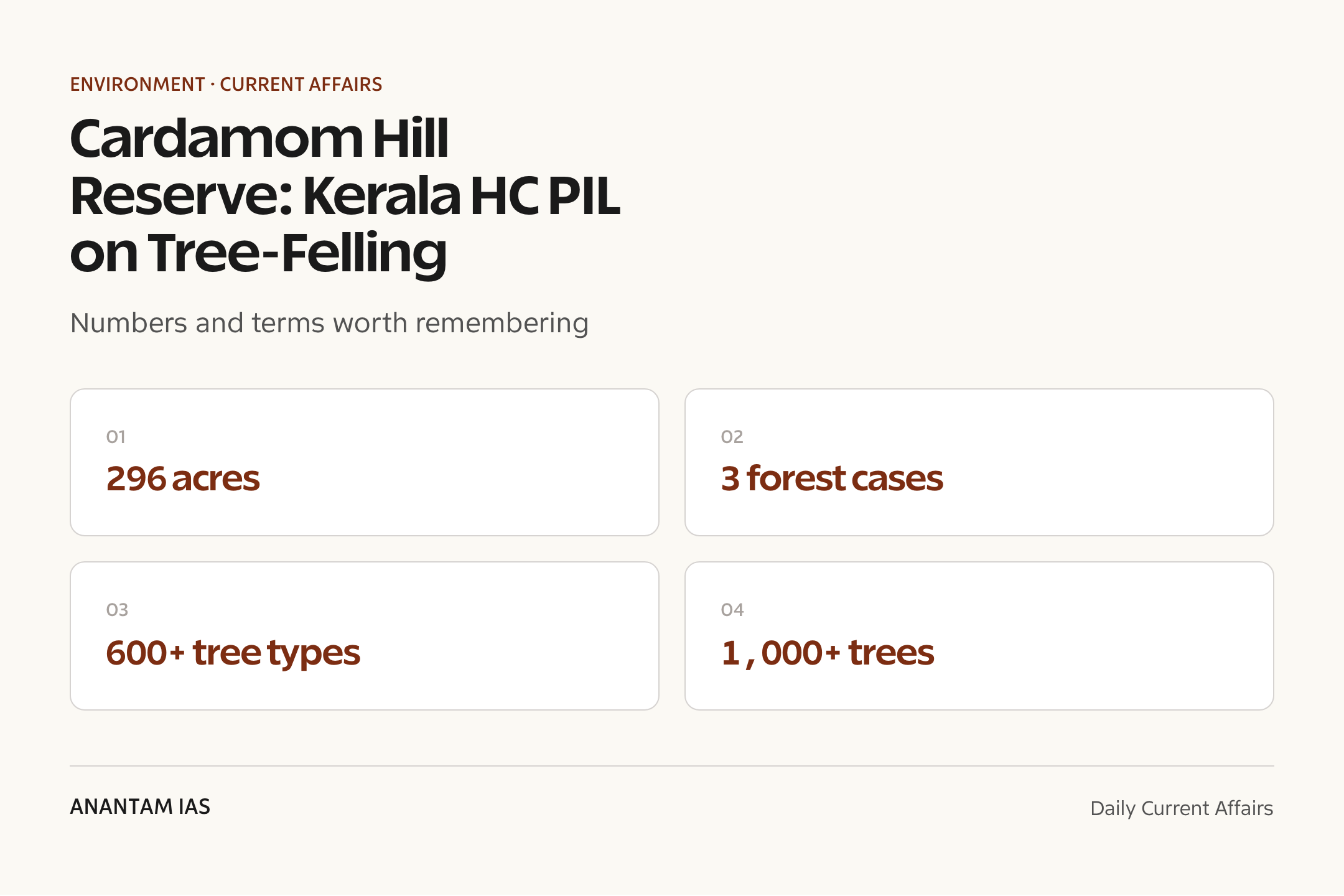
The Hindu reported that the Kerala High Court registered a suo motu PIL on July 1, 2026 over alleged large-scale tree-felling and unauthorized construction on about 296 acres of cardamom title land at Gudanpara Estate in Idukki.
The case places the Cardamom Hill Reserve in focus because it raises exam-relevant questions on forest land, land records, judicial oversight, biodiversity protection and governance of ecologically sensitive Western Ghats landscapes.
- Location: Gudanpara Estate, Idukki, under the Ponmudi Forest Section of the Devikulam Range.
- Allegation: tree-felling and unauthorized construction were reported on around 296 acres of cardamom title land.
- Forest action: the report said three cases had been registered by the Forest Department over felling of rare tree species.
- Government parties: the Chief Secretary, Forest and Revenue departments, Chief Conservator of Forest, DFO Devikulam and District Collector Idukki were impleaded.
- Ecological claim: the estate was described as sharing a boundary with Tamil Nadu and containing more than 600 varieties of trees.
- Recent context: another CHR tree-felling case was reported last year at Uchilukuth in Santhanpara, where over 1,000 indigenous trees were felled on 40 acres.
The development matters in the context of:
- Forest governance is tested when land is legally sensitive, privately claimed, leased, cultivated and ecologically valuable at the same time.
- Judicial oversight through PIL can force administrative departments to explain records, permissions, enforcement gaps and restoration steps.
- Western Ghats ecology makes local tree-felling more than a property dispute because it affects biodiversity, slope stability, water catchments and habitat connectivity.
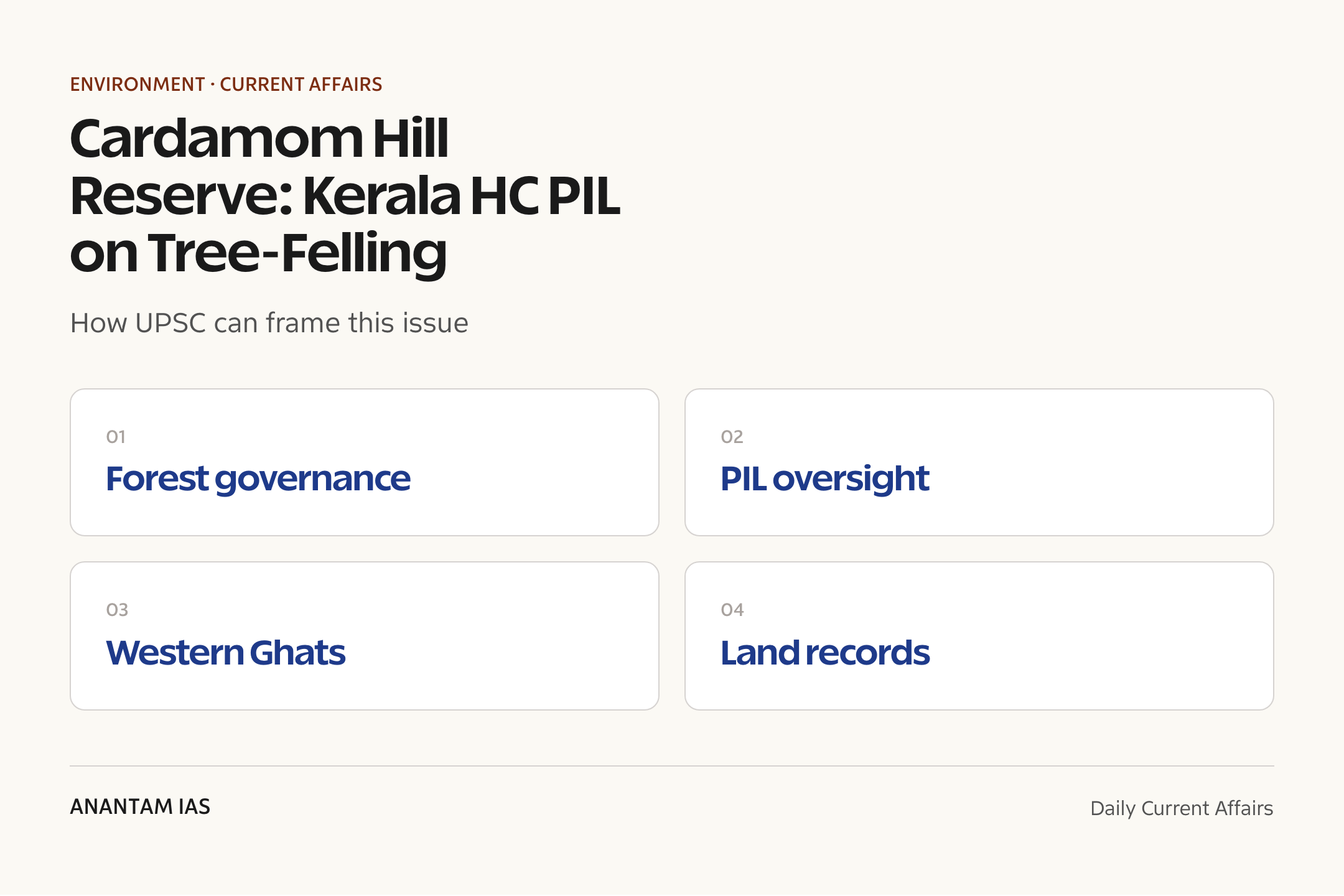
- UPSC linkage: the issue connects GS3 environment with GS2 courts, federal administration and Article 226 remedies.
UPSC Relevance
Prelims Relevance
- Cardamom Hill Reserve is located in Idukki district of Kerala in the southern Western Ghats.
- CHR notification: Kerala Forest Department’s archived record traces the C.H. Reserve notification to the Travancore Government Gazette of August 24, 1897.
- Kerala High Court can entertain PILs and writ petitions under Article 226 of the Constitution.
- Suo motu means a court takes cognisance on its own motion without waiting for a formal petitioner to move it.
- Forest (Conservation) Act, 1980 is relevant where forest land is diverted or used for non-forest purposes.
- Kerala Preservation of Trees Act, 1986 is relevant to tree growth in private forests, Cardamom Hill Reserve and cardamom-cultivated areas.
- T.N. Godavarman case expanded the operational meaning of forest for conservation law to include dictionary forests and government-recorded forests.
- Western Ghats is one of India’s major biodiversity hotspot regions and has repeated conflicts over development, plantations and ecologically sensitive areas.
- Forest and Revenue departments often share responsibility in such cases because titles, leases, plantations, tree permissions and enforcement sit in different offices.
Mains Relevance
GS Paper 3
- Environment and ecology: forest conservation, biodiversity loss, habitat fragmentation, ecological sensitivity of Western Ghats and restoration after illegal felling.
- Disaster link: tree cover in high-range slopes affects soil erosion, landslide risk, water regulation and catchment stability.
GS Paper 2
- Judiciary: PIL, suo motu cognisance, Article 226, continuing mandamus and court-monitored environmental governance.
- Governance: coordination failures between Forest, Revenue, district administration and local enforcement machinery.
GS Paper 1
- Geography: Western Ghats high ranges, plantation landscapes, rain-shadow transitions, catchments and state-border ecological corridors.
Essay
- Environmental rule of law begins with land records, local enforcement and credible restoration, not only national targets.
- Courts and ecology show how constitutional remedies can protect public goods when ordinary administration is slow.
- Development versus conservation becomes sharper in landscapes where livelihoods, plantations and forests overlap.
Background and Context
What the PIL Covers
The case is about alleged damage to a sensitive high-range landscape, not a routine local land dispute.
- The Hindu reported that the Kerala High Court registered the case as a suo motu PIL after a report on destruction of forest land in the name of cardamom cultivation.
- Gudanpara Estate is the immediate site, with the allegation centred on around 296 acres of cardamom title land.
- Forest Department cases have reportedly been registered in relation to felling of rare tree species.
- Unauthorized construction is part of the allegation, which widens the issue from tree offences to land-use change.
- Officials impleaded include senior State, Forest, Revenue and district authorities, signalling that the court wants institutional answers.
What is Cardamom Hill Reserve?
Cardamom Hill Reserve is a legally and ecologically important landscape in Kerala’s high ranges.
- Cardamom Hill Reserve lies in Idukki district and forms part of the southern Western Ghats landscape.
- Kerala Forest Department hosts an archived C.H. Reserve notification from the Travancore Government Gazette, dated August 24, 1897.
- Official notification language recorded the specified tracts as reserved forests under the then Travancore forest regulation framework.
- Cardamom cultivation created a special governance history: plantations, lease claims, tree shade, forest protection and revenue records overlap.
- Static geography can be revised through Cardamom Hills, which places the hills within the wider Western Ghats frame.
Why the Western Ghats Angle Matters
Tree-felling in CHR has larger ecological consequences because the Western Ghats is a fragile mountain ecosystem.
- Western Ghats influence monsoon rainfall, river catchments, hill-slope stability and species movement across peninsular India.
- Idukki high ranges contain plantations, forests, reservoirs, steep slopes and settlements, making land-use decisions ecologically sensitive.
- Tree cover in such terrain regulates runoff, reduces soil erosion and protects slope stability during intense rainfall.
- Biodiversity loss is a direct concern because The Hindu report described the estate as habitat for several wildlife species.
- ESA debates around the Ghats can be connected with Western Ghats ESA for the development-versus-ecology governance context.
Legal Framework Around Tree-Felling
The legal lens depends on whether the land is forest land, cardamom reserve land, private claim land or a mix of these categories.
- Forest (Conservation) Act, 1980 restricts de-reservation and non-forest use of forest land without the required central approval.
- Kerala Forest Act, 1961 provides the State-level forest law framework for forest offences and enforcement.
- Kerala Preservation of Trees Act, 1986 is relevant because it protects tree growth in private forests, CHR and cardamom-cultivated areas.
- Environment Protection Act, 1986 works as an umbrella law for environmental protection; revise the statutory frame through Environment Protection Act 1986.
- Wildlife Protection Act, 1972 becomes relevant if habitat disturbance affects protected fauna; compare the protected-area basics with National Park vs Wildlife Sanctuary.
Why PIL is Relevant Here
Environmental PIL allows courts to treat ecological damage as a public injury rather than a private grievance.
- Suo motu PIL is especially important when affected ecosystems, future generations or local communities may not have direct access to litigation.
- Article 226 gives High Courts wide writ jurisdiction against State authorities and other bodies performing public functions.
- Continuing mandamus can help courts monitor compliance through status reports, inspections, restoration plans and departmental accountability.
- Natural justice still matters because owners, claimants, officials and affected communities may need hearings before final directions.
- PIL evolution can be revised through Public Interest Litigation in India for the GS2 polity angle.
Forest-Revenue Governance Problem
CHR cases often become difficult because the ecological unit and the administrative records do not always move together.
- Revenue records decide title, lease, possession and land assignment questions.
- Forest records decide reserve status, tree permissions, offences, ecological sensitivity and conservation enforcement.
- Plantation claims complicate enforcement when cardamom cultivation is used as the stated reason for clearing tree growth.
- Inter-departmental delay can allow irreversible damage before record verification, field inspection and enforcement action converge.
- District administration is crucial because land-use change, construction, access roads, local policing and restoration need district-level coordination.
Exam Pointers from the Case
For UPSC, treat this as a compact case study on environmental rule of law.
- Prelims hook: CHR, Idukki, Western Ghats, Kerala HC, PIL, Article 226 and forest laws.
- Mains hook: illegal tree-felling shows the gap between legal protection and field-level enforcement.
- Governance hook: overlapping authority can weaken accountability unless records, inspections and penalties are coordinated.
- Ethics hook: ecological trusteeship requires officials to protect public resources even when local pressure favours short-term land conversion.
- Answer value: use this case to connect biodiversity, disaster resilience, land governance and judicial review in one example.
Way Forward
Verify Land and Forest Records
- Revenue and Forest departments should jointly map title, lease, reserve notification, tree permissions and construction status for the disputed parcel.
- Digital land records should be cross-checked with old gazette notifications, forest maps, settlement records and field boundaries.
- Public record disclosure can reduce repeat disputes where land status is used to justify tree removal.
Stop Damage and Secure Evidence
- Status quo orders and site sealing may be needed where fresh felling or construction is continuing.
- Geo-tagged inspection, drone imagery and stump enumeration can create reliable evidence for prosecution and restoration.
- Chain of custody for seized timber, machinery and field records is essential for successful enforcement.
Restore the Landscape
- Ecological restoration should use native species suited to the high-range landscape, not cosmetic plantation targets.
- Slope safety, drainage, soil stabilization and invasive-species control should be built into the restoration plan.
- Community monitoring can help report fresh encroachment, illegal transport and construction activity before damage spreads.
Fix Institutional Accountability
- Time-bound reports from Forest, Revenue and district officials should identify who approved, ignored or failed to prevent the activity.
- Penalty and restoration costs should reflect ecological damage, not only the market value of felled timber.
- Western Ghats governance needs routine coordination among land, forest, disaster management and local-body authorities.
Conclusion
The Cardamom Hill Reserve PIL is useful for exam preparation because it shows how a local tree-felling allegation can open larger questions of forest law, land records, biodiversity and judicial review.
The main lesson is that environmental governance cannot rely only on old notifications or courtroom concern. It needs verified land records, quick field enforcement, credible restoration and clear accountability across departments.
UPSC Practice Questions
Prelims MCQ 1
With reference to the Cardamom Hill Reserve issue, consider the following statements:
- Cardamom Hill Reserve is located in Idukki district of Kerala.
- The Kerala High Court took suo motu cognisance of alleged tree-felling on CHR land.
- Article 226 is relevant because High Courts have writ jurisdiction under it.
How many of the above statements are correct?
(a) Only one (b) Only two (c) All three (d) None
Answer: (c) All three
Explanation:
All three statements are correct. The reported issue concerns CHR land in Idukki, a suo motu PIL by the Kerala High Court and the wider Article 226 writ-jurisdiction frame.
Prelims MCQ 2
Which one of the following best explains the term suo motu in judicial proceedings?
(a) A case transferred from a lower court by appeal (b) Cognisance taken by a court on its own motion (c) A petition filed only by the Union government (d) A dispute that cannot be heard by a High Court
Answer: (b) Cognisance taken by a court on its own motion
Explanation:
Suo motu means the court acts on its own motion. In this case, the High Court registered a PIL after taking note of reported environmental concerns.
UPSC Mains Questions
- The Cardamom Hill Reserve tree-felling PIL shows how forest conservation problems often arise from weak land records and departmental overlap. Discuss with reference to Western Ghats ecology, forest law and district-level governance.
- Environmental PILs can strengthen administrative accountability, but they cannot replace routine field enforcement. Examine this statement using the Kerala High Court’s suo motu PIL on alleged tree-felling in CHR land.
- Illegal tree-felling in ecologically sensitive hill landscapes has consequences beyond biodiversity loss. Explain how such activity affects disaster risk, water security, land governance and public trust.
Sources: The Hindu and Kerala Forest Department CHR notification.
Frequently Asked Questions
What is Cardamom Hill Reserve?
Cardamom Hill Reserve is a high-range landscape in Idukki district, Kerala, associated with cardamom cultivation and forest protection in the southern Western Ghats. Its legal history includes an 1897 Travancore-era reserve notification, and its present governance involves forest, revenue and land-record questions.
Why is CHR in the news?
The Kerala High Court registered a suo motu PIL after reports of alleged large-scale tree-felling and unauthorized construction on about 296 acres of cardamom title land at Gudanpara Estate in Idukki. The case also involves biodiversity and forest-law concerns.
What is a suo motu PIL?
A suo motu PIL is a public interest matter taken up by a court on its own motion. It is useful in environmental cases because forests, wildlife and future generations may suffer damage even when no individual petitioner immediately approaches the court.
Which laws are relevant?
Forest (Conservation) Act, 1980, Kerala Forest Act, 1961, Kerala Preservation of Trees Act, 1986, Environment Protection Act, 1986 and Wildlife Protection Act, 1972 can become relevant depending on land status, tree permission, habitat damage and construction activity.
Why does this matter for Western Ghats?
Western Ghats landscapes support high biodiversity, water catchments and slope stability. Tree-felling in high-range areas can affect habitats, increase erosion, disturb wildlife corridors and worsen landslide or runoff risks during heavy rainfall.
What should administrators do next?
Forest and Revenue departments should verify land status, freeze further damage, secure evidence, identify officials responsible for lapses and prepare ecological restoration. A court-monitored process can help, but routine field enforcement remains the real test.
Source: https://anantamias.com/current-affairs/cardamom-hill-reserve-tree-felling-pil/
OBC Reservation: West Bengal’s legislative reset
Why in News?
Indian Express Explained reported that the West Bengal Assembly passed two amendment Bills on 29 June 2026 to reset the state’s OBC reservation framework after the Calcutta High Court’s 2024 ruling.
The immediate change is a rollback from 17% reservation to 7% reservation, with the recognised list reduced from 179 sub-castes to 66 sub-castes.
- Two Bills were passed: the West Bengal Backward Classes (Other than SCs and STs) Reservation of Vacancies in Services and Posts (Amendment) Bill, 2026, and the West Bengal Commission for Backward Classes (Amendment) Bill, 2026.
- Reservation quantum now returns to 7%, the level associated with the pre-2010 OBC framework in the state.
- Post-2010 inclusions are the main target of the reset, after the High Court questioned the legal basis for several additions.
- Calcutta High Court on 22 May 2024 cancelled OBC certificates issued after 2010 but protected people already in service or already selected.
- Backward Classes Commission remains central for future inclusion, because fresh additions must rest on inquiry, recommendation and statutory compliance.
The development matters in the context of:
- Affirmative action must balance social justice with constitutional equality and administrative fairness.
- Backward-class identification needs measurable social and educational backwardness, not political claims or religion alone.
- Legislature-court relations are tested when a state amends reservation law after judicial invalidation of earlier classifications.
UPSC Relevance
Prelims Relevance
- Article 15(4) allows special provisions for socially and educationally backward classes, SCs and STs.
- Article 16(4) permits reservation in public employment for a backward class not adequately represented in state services.
- Article 46 directs the State to promote educational and economic interests of weaker sections.
- Article 340 enables appointment of a commission to investigate conditions of backward classes.
- Article 338B gives constitutional status to the National Commission for Backward Classes.
- Article 342A(3), added by the 105th Amendment, clarifies state power to maintain a State SEBC list.
- Indra Sawhney is linked with the 50% ceiling, creamy layer exclusion and commission-based review.
- OBC-A and OBC-B refer to West Bengal’s earlier sub-categorisation into more backward and backward groups.
Mains Relevance
GS Paper 2
- Polity: judicial review of reservation laws, limits of legislative correction and institutional role of backward-class commissions.
- Social justice: empirical identification of backwardness, creamy layer, sub-categorisation and safeguards against exclusion.
- Governance: certificate validity, transition protection, public employment rules and administrative trust.
GS Paper 1
- Indian society: caste, community, religion and backwardness as overlapping but distinct social categories.
- Social empowerment: affirmative action as a tool for dignity, representation and access to state opportunities.
Essay
- Justice and equality: how a republic corrects historical disadvantage without weakening constitutional neutrality.
- Evidence in welfare: why social policy needs field data, not only electoral urgency.
Background and Context
What Changed in West Bengal
The 2026 Bills reset the statutory list and quota design for OBC reservation in West Bengal.
- Quota level has been revised from 17% to 7%, reversing the expanded structure that grew after 2010.
- Recognised communities have been reduced to 66, compared with 179 listed earlier.
- Legislative route was chosen because the High Court questioned statutory provisions and executive additions linked to the 2012 framework.
- Ministerial position, as reported by Indian Express Explained, is that 113 classes included without field survey have been removed.
- Future inclusion is not closed; the government said any Commission-backed recommendation can be considered under the rules.
How the State List Expanded
The dispute comes from a long expansion of the OBC list through executive and legislative steps.
- 1993 framework began with 66 OBC sub-castes in West Bengal, including 54 Hindu and 12 Muslim sub-castes, as reported by Indian Express Explained.
- 2010 executive orders added 42 new classes between 5 March and 10 September 2010; 41 were Muslim communities.
- 17% structure emerged with 10% for OBC-A or more backward groups and 7% for OBC-B groups.
- 2012 Act provided the statutory basis for reservation of vacancies in state services and posts for backward classes other than SCs and STs.
- Later additions under the previous state government expanded the total list, which became the core of the court challenge.
Constitutional Basis of OBC Reservation
OBC reservation is constitutionally permitted, but the permission is conditional and evidence-driven.
- Article 14 permits reasonable classification, but the classification must have an intelligible differentia and a rational link with the objective.
- Article 15(4) supports special provisions for socially and educationally backward classes; see the Anantam IAS explainer on Articles 15 and 16.
- Article 16(4) is an enabling provision for public employment reservation, not an automatic fundamental right to quota.
- Article 340 gives the commission model constitutional legitimacy because backwardness must be investigated, not merely asserted.
- SEBC identification must distinguish caste, class, occupation, social exclusion and educational disadvantage; see Socially and Educationally Backward Classes.
- 105th Amendment restored clarity on state power to prepare State SEBC lists; see the Anantam IAS note on the 105th Amendment.
Why the High Court Order Matters
The 2024 Calcutta High Court order turned the dispute from a policy debate into a constitutional compliance problem.
- Judgment date was 22 May 2024, in petitions challenging West Bengal’s OBC classification and certificate regime.
- Core objection was that religion appeared to be the sole criterion for granting OBC status to 77 communities.
- Commission role was central because the court faulted the state for excluding or weakening the statutory Commission’s role in identification.
- Certificate impact was limited by a saving clause for people already in service, already benefiting from reservation or already successful in a selection process.
- State obligation after such a ruling is not merely to re-pass a law, but to rebuild the evidentiary basis for each inclusion.
- Judicial review does not ban OBC reservation; it checks whether the classification is constitutionally valid.
Mandal Logic and Creamy Layer
The West Bengal debate should be read with the national reservation framework developed after Mandal.
- Mandal Commission shaped the modern OBC framework by recommending 27% reservation for OBCs in central services; see Mandal Commission notes.
- Indra Sawhney upheld OBC reservation but insisted on the creamy layer principle and normally capped total reservation at 50%.
- Creamy layer prevents socially advanced sections within OBCs from cornering benefits meant for the backward sections.
- Sub-categorisation can be used to prevent dominant OBC groups from capturing the quota, but it also needs data and legal design.
- Religion alone cannot be the basis of reservation, though communities belonging to any religion may qualify if they meet social and educational backwardness tests.
- Reservation in India remains a constitutional tool for representation, not a substitute for schooling, jobs and anti-discrimination enforcement; see analysis of reservation in India.
Governance Issues for the State
A quota reset creates administrative questions beyond courtroom compliance.
- Certificate verification must separate invalidated future claims from protected past benefits.
- Recruitment rules need clear transition dates so candidates and departments know which list applies.
- Education admissions may need aligned instructions if state institutions use the same OBC lists or categories.
- Data collection should include occupation, literacy, representation, income proxies, landholding and local disadvantage where relevant.
- Public reasoning matters because reservation disputes quickly become communal or electoral unless decisions are transparent.
- Litigation risk will remain high if future inclusions bypass inquiry, ignore objections or use unclear criteria.
Way Forward
Use an Evidence-First Identification Process
- Household and community data should support each claim of social and educational backwardness.
- Backwardness indicators must go beyond religion and include education, occupation, representation and social exclusion.
- Public notice should invite objections before final inclusion so the list can survive judicial scrutiny.
Strengthen the Commission Route
- Backward Classes Commission should be the filter for inclusion, exclusion and sub-categorisation.
- Reasoned reports should record the data considered, criteria applied and reasons for accepting or rejecting a claim.
- Periodic review can remove stale entries and assess whether benefits are reaching the most disadvantaged groups.
Protect Administrative Fairness
- Saved beneficiaries must be clearly protected where the court has preserved appointments or completed selections.
- Pending candidates need unambiguous instructions on certificate validity and applicable quota.
- Departmental manuals should be updated so recruiters do not apply old OBC-A and OBC-B rules by mistake.
Reduce Communal Polarisation
- Policy communication should explain that communities from any religion can qualify if they satisfy backwardness criteria.
- Social justice framing should focus on deprivation, representation and constitutional equality.
- Legislative debate should keep the issue tied to evidence and rights, not identity mobilisation.
Conclusion
West Bengal’s OBC reset is not only about a fall from 17% to 7%. It is a test of whether affirmative action can remain both socially responsive and constitutionally disciplined.
For UPSC, the issue connects Articles 15 and 16, the Backward Classes Commission, Indra Sawhney, the 105th Amendment and the larger question of how courts review welfare classifications without freezing social justice.
UPSC Practice Questions
Prelims MCQ 1
With reference to OBC reservation and backward-class identification, consider the following statements:
- Article 15(4) permits special provisions for socially and educationally backward classes, Scheduled Castes and Scheduled Tribes.
- Article 16(4) creates an automatic fundamental right to reservation for every community declared backward.
- Article 340 enables appointment of a commission to investigate the conditions of backward classes.
How many of the above statements are correct?
(a) Only one (b) Only two (c) All three (d) None
Answer: (b) Only two
Explanation:
Statements 1 and 3 are correct. Article 16(4) is an enabling provision for the State; it does not create an automatic quota right for every listed group.
Prelims MCQ 2
The 2026 West Bengal OBC amendment Bills are best understood as a response to which issue?
(a) Creation of a new all-India Central OBC list (b) Implementation of EWS reservation in state services (c) Judicial scrutiny of post-2010 OBC inclusions and certificate validity (d) Abolition of all reservation in public employment
Answer: (c) Judicial scrutiny of post-2010 OBC inclusions and certificate validity
Explanation:
The Bills followed the Calcutta High Court’s 2024 order questioning post-2010 inclusions and the legal process used for OBC identification in West Bengal.
UPSC Mains Questions
- The West Bengal OBC reservation controversy shows the tension between social justice and constitutional discipline. Discuss the role of empirical data, backward-class commissions and judicial review in maintaining this balance.
- Reservation policy cannot be based on identity labels alone, but it also cannot ignore historical social disadvantage. Examine this statement with reference to OBC classification, creamy layer and sub-categorisation.
- How should legislatures respond when courts strike down welfare classifications? Discuss with reference to separation of powers, institutional dialogue and protection of affected beneficiaries.
Sources: Indian Express Explained and India Code, West Bengal Act XXXIX of 2012.
Frequently Asked Questions
What did West Bengal change?
West Bengal passed two OBC amendment Bills in June 2026. The reported effect is a return from 17% reservation to 7% reservation and a reduction of the recognised OBC list from 179 to 66 sub-castes.
Why did the High Court object?
The Calcutta High Court questioned post-2010 OBC inclusions because religion appeared to be the sole criterion for many communities. It also found problems in the role given to the Backward Classes Commission during identification.
Is religion always irrelevant to OBC status?
A community from any religion can qualify as socially and educationally backward. The constitutional problem arises when religion itself becomes the sole basis. The test must focus on backwardness, representation and evidence.
What is OBC-A and OBC-B?
OBC-A referred to the more backward category in West Bengal’s earlier structure, linked with 10% reservation. OBC-B referred to the backward category, linked with 7% reservation. The 2026 reset moves away from that expanded design.
Which constitutional articles matter here?
Article 15(4), Article 16(4), Article 46, Article 340, Article 338B and Article 342A are important. Together, they frame affirmative action, commission-based inquiry and state power over SEBC lists.
What should students remember for Mains?
Use the case to show that affirmative action is valid only when backed by evidence, procedure and constitutional purpose. It is a strong example for answers on social justice, judicial review and welfare governance.
Source: https://anantamias.com/current-affairs/west-bengal-obc-reservation-bills/
Manipur Violence: Border Villages and Internal Security Risks
Why in News?
The Hindu reported that armed groups set fire to about 20 houses along the India-Myanmar border in Manipur’s Kamjong district on July 1, 2026.
The incident matters because it connects ethnic conflict, porous border management, refugee presence, village-level security gaps and the governance challenge of restoring trust in a hill district.
- Location: Kamjong district lies in Manipur’s eastern hill belt and borders Myanmar, making it a location-in-news topic for map-based prelims.
- Immediate trigger: Kuki and Naga organisations made competing allegations about who torched houses in and around Phaimol, Huimin Thana and Kherongram.
- Security vacuum claim: Kuki organisations alleged the attack followed the vacation of an Assam Rifles security post at Phaimol.
- Cross-border angle: The Hindu report referred to allegations involving Myanmar-based armed groups, making the issue relevant to transnational insurgency and border surveillance.
- Displacement layer: A Naga organisation claimed that camps sheltering 365 Burmese refugees at Kherongram were also torched.
- Durable syllabus: The case belongs to GS3 internal security, but also links with GS2 governance, Centre-State coordination and humanitarian administration.
The development matters in the context of:
- Manipur’s conflict has moved beyond a single valley-hill divide and now shows overlapping ethnic, territorial and border-security claims.
- Border villages face a double burden: local community insecurity and exposure to armed movement across difficult terrain.
- Myanmar’s instability has produced refugee flows and armed-group movement that complicate policing, intelligence and humanitarian management.
- Administrative credibility depends on neutral protection, quick relief, fair investigation and visible restraint by security forces.
UPSC Relevance
Prelims Relevance
- Kamjong district is in Manipur and shares proximity with the India-Myanmar border.
- India-Myanmar border touches four Indian States: Arunachal Pradesh, Nagaland, Manipur and Mizoram.
- Assam Rifles is a central armed force with a major role in Northeast border security and counter-insurgency support.
- NSCN (Isak-Muivah) refers to the Isak-Muivah faction of the National Socialist Council of Nagalim.
- Free Movement Regime historically allowed limited movement by border communities across the India-Myanmar border.
- Internal security questions often combine insurgency, porous borders, illegal arms movement, refugees and local alienation.
- Refugees from Myanmar raise a governance challenge because India has no single national refugee law.
- Border management uses fencing, surveillance, intelligence, road connectivity, local policing and community confidence-building.
- Ethnic conflict can become a security challenge when community militias, misinformation and territorial claims interact.
Mains Relevance
GS Paper 3
- Internal security: ethnic violence, insurgency networks, porous borders and the role of central armed forces.
- Border management: fencing, surveillance, intelligence coordination and community-sensitive policing along the India-Myanmar frontier.
- Security-development link: poor connectivity, refugee pressure and weak village protection can widen the space for armed actors.
GS Paper 2
- Governance: rule of law, relief, rehabilitation and neutral state response in a communally sensitive zone.
- Federal coordination: Centre-State roles in policing, paramilitary deployment, border policy and refugee documentation.
- Rights balance: protect civilians, prevent collective punishment and ensure due process during security operations.
Essay
- Security without trust can pacify territory but not rebuild society.
- Borders are lived spaces, not just lines on a map.
- Peacebuilding requires justice, development and credible institutions.
Background and Context
What Happened in Kamjong
The incident is best read as a security-governance problem, not only as a local arson case.
- The Hindu reported a village-burning incident in Kamjong district on July 1, 2026, with about 20 houses set on fire.
- Kuki organisations, including the Committee on Tribal Unity and the Kuki CSO Working Committee, alleged that armed groups linked to the NSCN coordinated a targeted attack.
- Naga groups made a counter-claim that Kuki armed groups used the Phaimol arson as a pre-planned basis to attack nearby Tangkhul Naga settlements.
- Phaimol, Huimin Thana and Kherongram appear in the report as the immediate village cluster around the violence.
- Assam Rifles is relevant because one allegation says a security post at Phaimol was vacated shortly before the attack.
- UPSC takeaway: in conflict zones, the factual question is not only who attacked, but whether the state can provide equal protection and credible investigation.
Why Kamjong Matters as a Border District
Kamjong’s geography turns a local conflict into an internal security issue with an external dimension.
- Kamjong lies in eastern Manipur and is part of the hill belt adjoining Myanmar.
- District Administration Kamjong identifies the area with the Tangkhul community and records its historic cultural links with Myanmar and neighbouring hill communities.
- Terrain in the eastern hills is difficult for policing because village settlements, forests, hill roads and border tracks complicate surveillance.
- Border villages are not only security posts; they are lived communities with kinship, trade, church, clan and refugee relationships across the frontier.
- Location-in-news angle: Manipur borders Myanmar; nearby Northeast States sharing the Myanmar border include Nagaland, Mizoram and Arunachal Pradesh.
- Static link: revise Indian States, Boundaries and International Borders with this case as a Manipur example.
Internal Security Risks
The incident shows how local violence can create multiple security risks at once.
- Insurgent overlap: allegations name armed groups with roots in ethnic politics, territorial claims and cross-border sanctuaries.
- Arms movement is a recurring risk in porous border zones because illegal weapons can move through informal routes and forest tracks.
- Retaliatory violence can spread faster than formal policing if villages believe that the state protects one community more than another.
- Refugee camps add a humanitarian layer; the claim about camps for 365 Burmese refugees at Kherongram shows why documentation and protection matter.
- Misinformation can deepen panic when competing community statements circulate before a neutral investigation is complete.
- Security doctrine: counter-insurgency in populated areas must separate armed actors from civilians without treating the entire community as suspect.
- Static link: connect this with Internal Security of India for insurgency, border and policing frameworks.
Border Management Challenge
The India-Myanmar border requires a blend of security control and community sensitivity.
- India-Myanmar border is a high-sensitivity frontier because it intersects with ethnicity, insurgency, trade, migration and refugee flows.
- Free Movement Regime was designed to acknowledge cross-border ethnic and familial ties, but the same openness can be misused by armed groups and traffickers.
- Fencing alone cannot solve the problem if village protection, roads, intelligence, policing and trust remain weak.
- Assam Rifles, State Police, intelligence units and civil administration need interoperable communication in border villages.
- Community intelligence works only when people believe their information will not expose them to revenge or biased enforcement.
- Static link: revise Border Management: India’s Land and Maritime Borders for integrated border management concepts.
Governance and Humanitarian Dimension
Violence in a border village creates immediate governance duties beyond criminal investigation.
- Relief and shelter must be quick, non-partisan and documented, especially when homes or refugee camps are damaged.
- Rehabilitation requires land records, household verification, compensation norms and temporary housing before the next monsoon or winter stress.
- Due process is crucial because rival allegations can make arrests appear partisan unless evidence is independently documented.
- Refugee management needs biometric documentation, humanitarian protection and coordination with national security agencies.
- Local administration must maintain school access, health services, food supply and road movement while security forces handle the threat environment.
- Static link: use India Refugee Policy to revise why India handles refugees through executive and administrative measures rather than a single refugee law.
Centre-State Coordination
Manipur’s conflict requires layered coordination because powers and capabilities are distributed across institutions.
- Law and order is primarily a State subject, but border security, central armed forces and foreigner management involve the Union.
- Home Ministry decisions on border policy, armed-group talks and central force deployment shape the security environment in Manipur.
- State Police retains the frontline role in FIRs, investigation, arrests and local intelligence collection.
- District administration handles relief, civil supplies, documentation and village-level confidence-building.
- Security forces need clear rules of engagement, human rights safeguards and accountability channels.
- UPSC angle: Centre-State coordination is not abstract federalism here; it decides whether a border village feels protected or abandoned.
Way Forward
Immediate Security Response
- Area domination should prioritise village protection, safe return routes and prevention of retaliatory attacks.
- Joint command rooms should integrate State Police, Assam Rifles, intelligence inputs and district administration updates.
- Evidence preservation through videography, witness protection and forensic documentation can reduce allegation-driven policing.
- Neutral communication by officials should state verified facts, casualty status, relief steps and investigation progress.
Civilian Protection and Relief
- Relief camps should separate humanitarian registration from security profiling so genuine victims don’t avoid the state.
- Compensation should be tied to verified damage assessment, not community pressure or media visibility.
- Special attention is needed for women, children, elderly people and refugees affected by village burnings.
- Public services such as health, school access, food distribution and mobile connectivity should be restored early.
Border Governance Reform
- Smart surveillance should combine patrols, drones where lawful, sensors, road access and local intelligence.
- Border policy must balance fencing and regulation with the social reality of divided ethnic communities.
- Community liaison committees should include village elders, women representatives, youth groups and district officials.
- Refugee documentation should be accurate, humane and security-aware, with periodic verification.
Long-Term Peacebuilding
- Truth-based inquiry into village attacks can reduce rumor cycles and collective blame.
- Dialogue mechanisms should include Kuki, Naga, Meitei and smaller community concerns without allowing armed groups to monopolise representation.
- Development-security convergence should focus on roads, telecom, livelihoods, health and border trade facilities.
- Rule of law should be visible through fair prosecution of arson, arms movement and intimidation across all communities.
Conclusion
The Kamjong violence shows that Manipur’s crisis is not only about identity; it is also about state capacity in vulnerable border spaces.
For UPSC, the case is a strong example of how internal security, border management, refugee administration and local governance converge in one district.
A durable response must protect civilians first, investigate impartially, secure the border intelligently and rebuild trust village by village.
UPSC Practice Questions
Prelims MCQ 1
With reference to Kamjong district and the India-Myanmar border, consider the following statements:
- Kamjong district is located in Manipur.
- Manipur shares an international border with Myanmar.
- The India-Myanmar border touches only Manipur and Mizoram among Indian States.
How many of the above statements are correct?
(a) Only one (b) Only two (c) All three (d) None
Answer: (b) Only two
Explanation:
Statements 1 and 2 are correct. Statement 3 is incorrect because the India-Myanmar border touches Arunachal Pradesh, Nagaland, Manipur and Mizoram.
Prelims MCQ 2
Which of the following best explains why violence in Manipur’s Kamjong district is relevant to GS3 Internal Security?
(a) It concerns only municipal administration in an urban district (b) It links ethnic conflict, border management, armed groups and displacement (c) It is primarily a monetary policy issue (d) It relates only to coastal security
Answer: (b) It links ethnic conflict, border management, armed groups and displacement
Explanation:
Kamjong is a border district where local ethnic violence intersects with cross-border armed movement, refugee presence and state security response.
UPSC Mains Questions
- Violence in border villages often reflects both local grievances and cross-border security vulnerabilities. Examine this statement with reference to Manipur’s Kamjong district and India’s internal security framework.
- Border management along the India-Myanmar frontier requires more than fencing. Discuss the role of community trust, refugee documentation, intelligence coordination and local governance.
- How should the Indian state balance security operations and humanitarian responsibilities in ethnic-conflict zones? Use Manipur as a case study.
Sources: The Hindu and Kamjong District Administration.
Frequently Asked Questions
Why is Kamjong in news?
Kamjong is in news because The Hindu reported that about 20 houses were set on fire in border villages of the district on July 1, 2026. Kuki and Naga organisations made rival allegations, turning the incident into a larger internal security and governance issue.
Where is Kamjong district?
Kamjong district is in Manipur’s eastern hill region near the India-Myanmar border. Its location makes the incident important for location-in-news, border management, ethnic conflict and Northeast security questions.
Why is this a GS3 topic?
It is a GS3 Internal Security topic because it links armed groups, porous borders, ethnic violence, refugee presence, local policing and central armed force deployment. The issue goes beyond law and order because it affects national border security.
What is the governance angle?
The governance angle includes neutral investigation, relief for affected families, refugee documentation, Centre-State coordination, protection of civilians and restoration of public trust in a conflict-hit border district.
What is the India-Myanmar border issue?
The India-Myanmar border is difficult to manage because it passes through hilly terrain and communities with cross-border ethnic ties. Security agencies must address insurgency, illegal arms movement, refugee flows and local livelihoods together.
Should this issue have a map?
A map can help locate Kamjong and the India-Myanmar frontier, but this draft omits a map because the two study graphics are enough and the prompt asks to avoid optional map or image fields unless necessary.
Source: https://anantamias.com/current-affairs/manipur-border-village-violence-kamjong/
Women Farmers: Maharashtra Bill and the Identity Gap
Why in News?
Women farmers entered the governance spotlight after The Hindu reported that the Maharashtra government introduced the Women Farmers’ Empowerment Bill in the State Assembly on July 1, 2026.
The Bill proposes a Woman Farmer Certificate as an official identity document for women engaged in agriculture and allied activities, even when they do not own land.
- Women Farmers’ Empowerment Bill was tabled during the ongoing Monsoon session of the Maharashtra Assembly.
- Woman Farmer Certificate is meant to help women access government schemes, subsidies, institutional finance, services and market support.
- Land ownership will not be the sole gateway; the Bill recognises women who cultivate family or community land without formal title.
- Allied activities such as fisheries, livestock rearing, poultry farming and forest-produce collection are part of the recognition frame.
- Gram Sabhas and urban local bodies are proposed as certificate-issuing authorities, with an appeal route for rejected applications.
- Women Farmer Support Officers are to be appointed at district and taluka levels from existing officials.
The development matters in the context of:
- Identity gap is the core policy issue: women may work as cultivators but remain invisible in land records, credit systems and scheme databases.
- PIB data from Agriculture Census 2015-16 records that female operational holders operated only 11.72% of total operated area in India.
- Gender-neutral schemes can still exclude women when eligibility depends on land title, bankable collateral or recorded farmer status.
- Decentralised certification links the Bill to local governance, social justice and last-mile delivery through Gram Sabhas and urban local bodies.
UPSC Relevance
Prelims Relevance
- Women Farmers’ Empowerment Bill: Maharashtra Bill to recognise women engaged in agriculture and allied activities as farmers.
- Woman Farmer Certificate: proposed official identity document for access to schemes, subsidies, institutional finance and market support.
- Gram Sabha: village-level body proposed as one issuing authority for the certificate in rural areas.
- Urban local bodies: proposed issuing authorities for eligible women in urban or peri-urban contexts.
- Women Farmers’ Fund: proposed Maharashtra State Women Farmers’ Fund for supporting women farmers.
- Three-tier framework: Women Farmers’ Empowerment Council, State Monitoring Committees and Women Farmers’ Empowerment Cell.
- MKSP: Mahila Kisan Sashaktikaran Pariyojana under DAY-NRLM, aimed at enhancing women’s participation and livelihoods in agriculture.
- Agriculture Census 2015-16: official source showing female operational holders operated 11.72% of total operated area in India.
Mains Relevance
GS Paper 2
- Social justice: gendered exclusion from welfare schemes, credit and public services despite women’s agricultural work.
- Governance: local-body certification, database creation, appeal mechanisms and convergence across departments.
- Rights-based delivery: moving from informal recognition in households to formal identity in State systems.
GS Paper 3
- Agriculture: feminisation of farm work, access to extension services, credit and market support.
- Rural economy: land title, collateral, institutional finance and productivity constraints for women cultivators.
- Allied sectors: livestock, poultry, fisheries and forest-produce livelihoods as part of farm policy.
Essay
- Recognition is often the first step toward redistribution.
- Land records can decide who receives the benefits of development.
- Gender equality in agriculture needs identity, assets and bargaining power.
Background and Context
What the Maharashtra Bill Proposes
Maharashtra is trying to convert women’s farm work into a formal administrative identity.
- Core purpose: recognise women engaged in agriculture and allied activities as women farmers.
- Certificate route: issue a Woman Farmer Certificate that works as an official identity document for farm-linked benefits.
- Access promise: connect recognised women to entitlements, subsidies, services, credit and market support.
- Land-neutral design: avoid making land ownership the only condition for recognition where women cultivate without title.
- Allied activities: include women working in fisheries, livestock rearing, poultry farming and forest-produce collection.
- Policy significance: the Bill treats farm identity as a governance problem, not only as a land-record problem.
Why Land Title Creates Exclusion
Land title is a gatekeeping document in Indian agriculture, but women often work outside formal ownership records.
- Scheme eligibility frequently depends on land records, tenancy proof, collateral or recorded cultivator status.
- Family land may be cultivated by women, but the title often remains with male household members.
- Community land or informal cultivation can make women visible in the field but invisible in files.
- Agricultural labourer label can undercount women who actually make cultivation decisions without formal ownership.
- Credit access weakens when banks cannot easily verify farmer identity or collateral through land records.
- Land reforms are the broader historical context; see Land Reforms in India for the structural background.
Institutional Design in the Bill
Institutional design decides whether a recognition law becomes a working delivery system.
- Women Farmers’ Empowerment Council is proposed as part of the top-level framework and includes the Chief Minister, Deputy Chief Ministers and Agriculture Minister as ex-officio members.
- State Monitoring Committees are meant to track implementation instead of leaving certificates as a one-time paper exercise.
- Women Farmers’ Empowerment Cell adds an administrative unit for coordination, data and follow-up support.
- Women Farmers’ Fund is proposed as a dedicated Maharashtra State fund for women farmers.
- Women-farmer database can improve targeting, but it must protect privacy and avoid excluding women with weak documents.
- Appeal mechanism matters because rejected applications can reproduce the same exclusion the Bill is trying to fix.
Role of Gram Sabhas and Local Bodies
Local verification is useful because village institutions often know who actually cultivates the land.
- Gram Sabhas are proposed as certificate-issuing authorities in rural areas, making local knowledge part of recognition.
- Urban local bodies are included for eligible women in urban, peri-urban or administratively urban areas.
- Panchayati Raj institutions can reduce paperwork distance between women farmers and the State; revise the governance base through Panchayati Raj.
- Local capture risk remains: caste, household pressure, political influence or local disputes can affect certification.
- Due process needs clear criteria, written reasons for rejection, time limits and easy appeal access.
- Digital records should support, not replace, local verification where women’s work is informal but real.
National Policy Context
Women farmers are already recognised in national schemes, but access often depends on documents and implementation capacity.
- PIB has stated that beneficiary-oriented schemes of the Department of Agriculture and Farmers Welfare require States and implementing agencies to incur at least 30% expenditure on women farmers.
- MKSP under DAY-NRLM has been implemented since 2011 to enhance women’s participation and create sustainable rural livelihoods.
- Agriculture Census 2015-16 shows the mismatch between women’s farm participation and female-operated area, which stood at 11.72% of total operated area.
- Gender-neutral policy is not enough when the access route is built around documents that women are less likely to possess.
- Women empowerment in this case is economic, legal and administrative; connect it with Women Empowerment in India.
- Convergence with credit, insurance, extension, FPOs and market-linkage schemes will decide the Bill’s field impact.
Agriculture Governance Lens
Agriculture governance increasingly depends on databases, certificates and delivery channels as much as on subsidies.
- Farmer identity is becoming the entry point for public support, from credit and insurance to input subsidy and market access.
- Extension services often reach the recorded landholder, so women without formal farmer status may miss training and advisory support.
- Institutional finance can improve if banks treat the certificate as credible proof of farming activity, subject to clear guidelines.
- Market support should include procurement access, FPO membership, storage, transport, value addition and digital-market onboarding.
- Allied livelihoods need equal weight because livestock, poultry, fisheries and forest produce are major income streams for rural women.
- Indian agriculture is not only a production sector; it is also a rights, identity and welfare-delivery system. See Indian Agriculture for the wider policy frame.
Way Forward
Make recognition verifiable and inclusive
- Eligibility criteria should recognise cultivation, allied work and contribution to farm decisions, not only ownership papers.
- Evidence options should include Gram Sabha verification, SHG records, FPO membership, tenancy evidence, livestock records and local-body certification.
- Appeal timelines should be simple and time-bound so rejected women are not pushed into repeated office visits.
Connect certificates to real benefits
- Credit linkage should be clarified with banks, cooperative institutions and NABARD-linked channels so the certificate has operational value.
- Scheme convergence should map certificates to PM-KISAN-like databases where applicable, crop insurance, KCC, extension services and market-support channels.
- Support officers should be trained on gender-sensitive delivery, documentation help and grievance handling.
Guard against new exclusion
- Database design should prevent duplicate, fake or coerced claims without making documentation impossible for landless women.
- Social audit through Gram Sabhas, women’s SHGs and civil-society partners can check local bias and elite capture.
- Outcome tracking should measure credit received, schemes accessed, extension visits, FPO membership and income gains, not only certificates issued.
Conclusion
Maharashtra’s Bill is important because it recognises a simple but persistent reality: a woman can be central to farming and still be missing from the official farmer category.
The real test will come after certification. If the Woman Farmer Certificate opens doors to credit, schemes, extension and markets, it can narrow the identity gap in agriculture. If it remains a paper document, the old exclusion will survive with a new name.
UPSC Practice Questions
Prelims MCQ 1
With reference to Maharashtra’s proposed Women Farmers’ Empowerment Bill, consider the following statements:
- It proposes a Woman Farmer Certificate for women engaged in agriculture and allied activities.
- The certificate is proposed only for women who individually own agricultural land.
- Gram Sabhas or urban local bodies are proposed as certificate-issuing authorities.
How many of the above statements are correct?
(a) Only one (b) Only two (c) All three (d) None
Answer: (b) Only two
Explanation:
Statements 1 and 3 are correct. Statement 2 is incorrect because the Bill aims to recognise women farmers irrespective of whether they own land.
Prelims MCQ 2
Which one of the following best explains the governance problem behind the women-farmer identity gap?
(a) Women are legally barred from all allied agricultural activities. (b) Agriculture schemes never use land records for eligibility. (c) Women may perform farm work but remain outside formal land, credit and scheme records. (d) Gram Sabhas cannot verify any rural livelihood activity.
Answer: (c) Women may perform farm work but remain outside formal land, credit and scheme records.
Explanation:
The identity gap arises when women’s actual agricultural work is not reflected in land titles, farmer databases, credit channels or scheme records.
UPSC Mains Questions
- Women’s work in agriculture is often visible in the field but invisible in official records. Discuss how farmer identity, land title and welfare delivery interact in the context of Maharashtra’s proposed Women Farmers’ Empowerment Bill.
- A certificate-based recognition system can improve access to credit and schemes, but it can also create new administrative barriers. Examine the safeguards needed for inclusive implementation.
- Discuss the role of Gram Sabhas and local bodies in identifying beneficiaries for welfare schemes, with reference to women farmers, local verification and risks of exclusion.
Sources: The Hindu and PIB, Ministry of Agriculture and Farmers Welfare.
Frequently Asked Questions
What is the Bill about?
Maharashtra’s Women Farmers’ Empowerment Bill seeks to recognise women engaged in agriculture and allied activities as farmers. Its central proposal is a Woman Farmer Certificate that can support access to schemes, subsidies, credit, services and market support.
Why is land ownership important?
Land ownership often decides who is treated as a farmer in scheme records, bank documents and subsidy systems. Many women cultivate family or community land without title, so they may work as farmers but remain outside formal benefits.
Who will issue certificates?
The Hindu reported that Gram Sabhas or urban local bodies are proposed as issuing authorities. This local route matters because village and local institutions can verify actual farm work, but the process also needs safeguards against bias.
What allied activities are covered?
The Bill’s recognition frame includes fisheries, livestock rearing, poultry farming and collection of forest produce. This is important because many rural women earn through allied activities that are not always captured in narrow landholder-based definitions.
How does MKSP connect here?
Mahila Kisan Sashaktikaran Pariyojana under DAY-NRLM is a national programme for women’s agricultural livelihoods. The Maharashtra Bill works at the State-recognition layer, while MKSP shows the broader policy aim of enhancing women’s participation and productivity.
What is the main risk?
The main risk is that certification becomes another paperwork layer. The Bill will matter only if the certificate actually unlocks credit, insurance, subsidies, extension services, FPO access and market support for women farmers.
Source: https://anantamias.com/current-affairs/maharashtra-women-farmers-empowerment-bill/
Messaging Apps: Usernames and Intermediary Accountability
Why in News?
Messaging apps came under fresh regulatory attention after the Centre reportedly asked Meta not to roll out WhatsApp’s username feature in India until consultations were completed.
Indian Express reported that the notice sought a detailed explanation within three days, while The Hindu placed the issue beside WhatsApp username reservations and the wider debate on Telegram-style identifiers, platform blocking and online fraud.
- WhatsApp announced username reservations on June 29, 2026, with the feature planned for a gradual launch later in the year.
- Usernames would let people chat without revealing their phone numbers to a new person or business, if the user enables the feature.
- WhatsApp says there will be no public directory, no username suggestions, and an optional username key to control first contact.
- Government concerns focus on impersonation, phishing, digital arrest scams, identity spoofing and lookalike handles for public authorities or financial institutions.
- The Hindu also flagged a parallel legal concern: whether the State can stretch Section 69A blocking powers from specific information to entire intermediary platforms such as Telegram.
The development matters in the context of:
- Digital identity is shifting from phone numbers to handles, business-scoped identifiers and privacy-preserving contact methods.
- Intermediary accountability is moving from content takedown to product-design choices that can either reduce or amplify harm.
- Cyber fraud in India increasingly depends on trust signals, official-looking names, rapid messaging and social-engineering pressure.
- Privacy and traceability must be balanced because hiding phone numbers can protect citizens while also complicating enforcement.
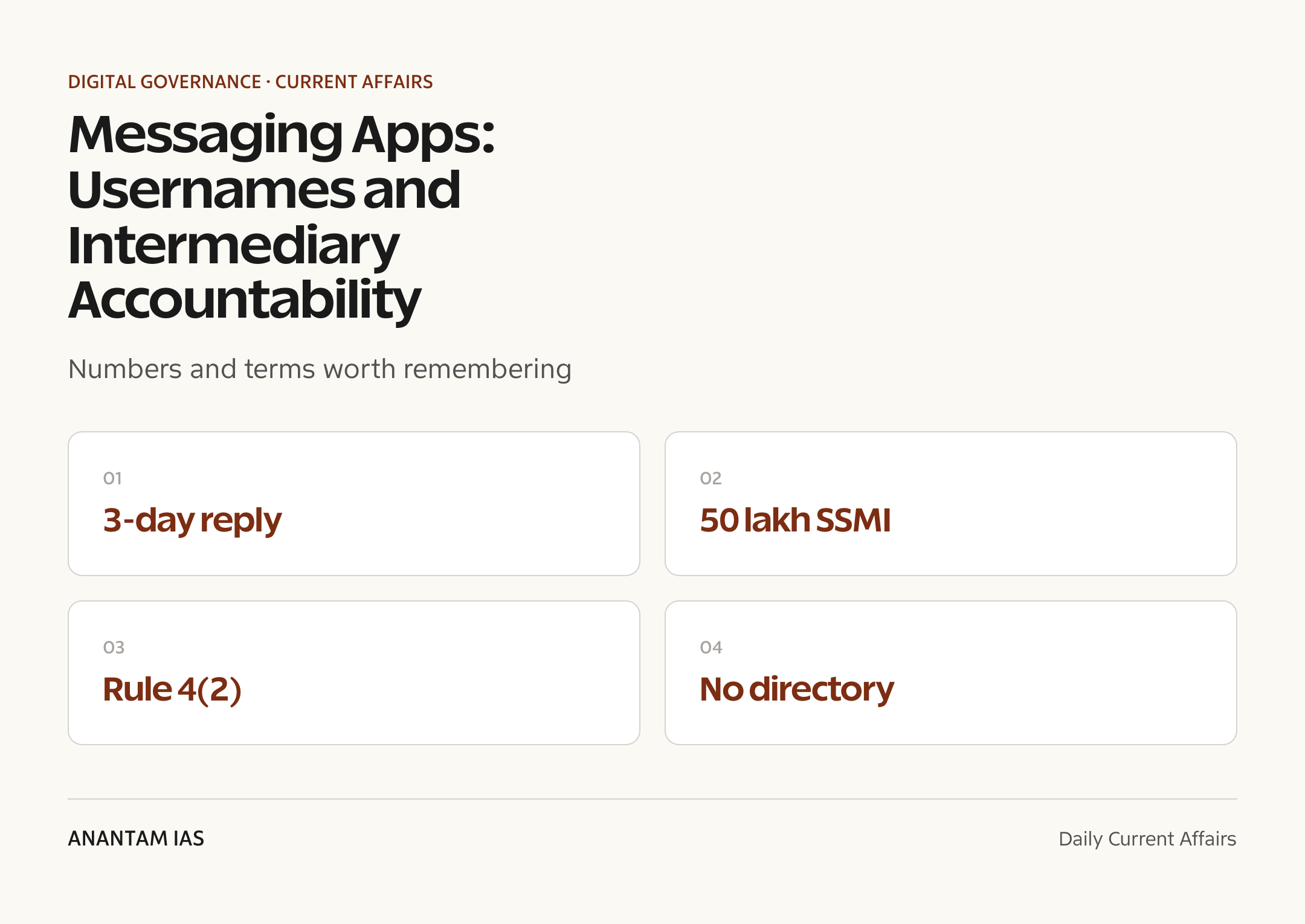
UPSC Relevance
Prelims Relevance
- Information Technology Act, 2000 is the parent law for intermediary liability, blocking powers and CERT-In functions.
- IT Rules, 2021 prescribe due diligence, grievance redressal and additional duties for significant social media intermediaries.
- Significant Social Media Intermediary status applies above the notified 50 lakh registered users threshold in India.
- Rule 4(2) deals with identification of the first originator for messaging services under limited lawful orders.
- Section 69A permits blocking of public access to information on specified grounds and through prescribed safeguards.
- CERT-In directions are relevant for cyber incident reporting, log retention and coordinated cyber response.
- DPDP Act frames personal data processing duties; revise the privacy layer through Anantam IAS DPDP notes.
- Safe harbour under Section 79 depends on due diligence; revise the legal framework through Anantam IAS IT intermediary notes.
Mains Relevance
GS Paper 2
- Governance: accountability of private platforms performing quasi-public communication functions.
- Rights and regulation: balancing privacy, free speech, due process and citizen safety in digital public spaces.
- Institutional design: role of MeitY, courts, grievance officers and appellate mechanisms in platform oversight.
GS Paper 3
- Internal security: phishing, impersonation, digital arrest scams and cross-platform fraud networks.
- Cyber security: identity verification, abuse detection, incident reporting and evidence preservation.
- Science and technology: privacy-by-design, metadata, encryption and product architecture in messaging systems.
Essay
- Privacy versus safety in a high-trust digital society.
- Technology design as governance: code, law and accountability.
- Digital India and the challenge of trust at population scale.
Background and Context
What the username feature changes
The core design shift is from phone-number discovery to handle-based first contact.
- Phone numbers are both identity markers and contact points; once shared, they can expose users to spam, profiling and unwanted calls.
- Usernames create a separate contact layer, allowing a person to connect without disclosing the underlying mobile number at the start.
- WhatsApp Blog says reservations began in the week of June 29, 2026, with a gradual country-wise launch over the coming months.
- No public directory is important because users cannot browse or guess contacts through a searchable list inside the app.
- Username key is an optional extra control: even if a username leaks, a first-time sender may need the key to start contact.
- Businesses and creators may be able to claim names linked to their existing Instagram or Facebook presence, reducing some brand-impersonation risk.
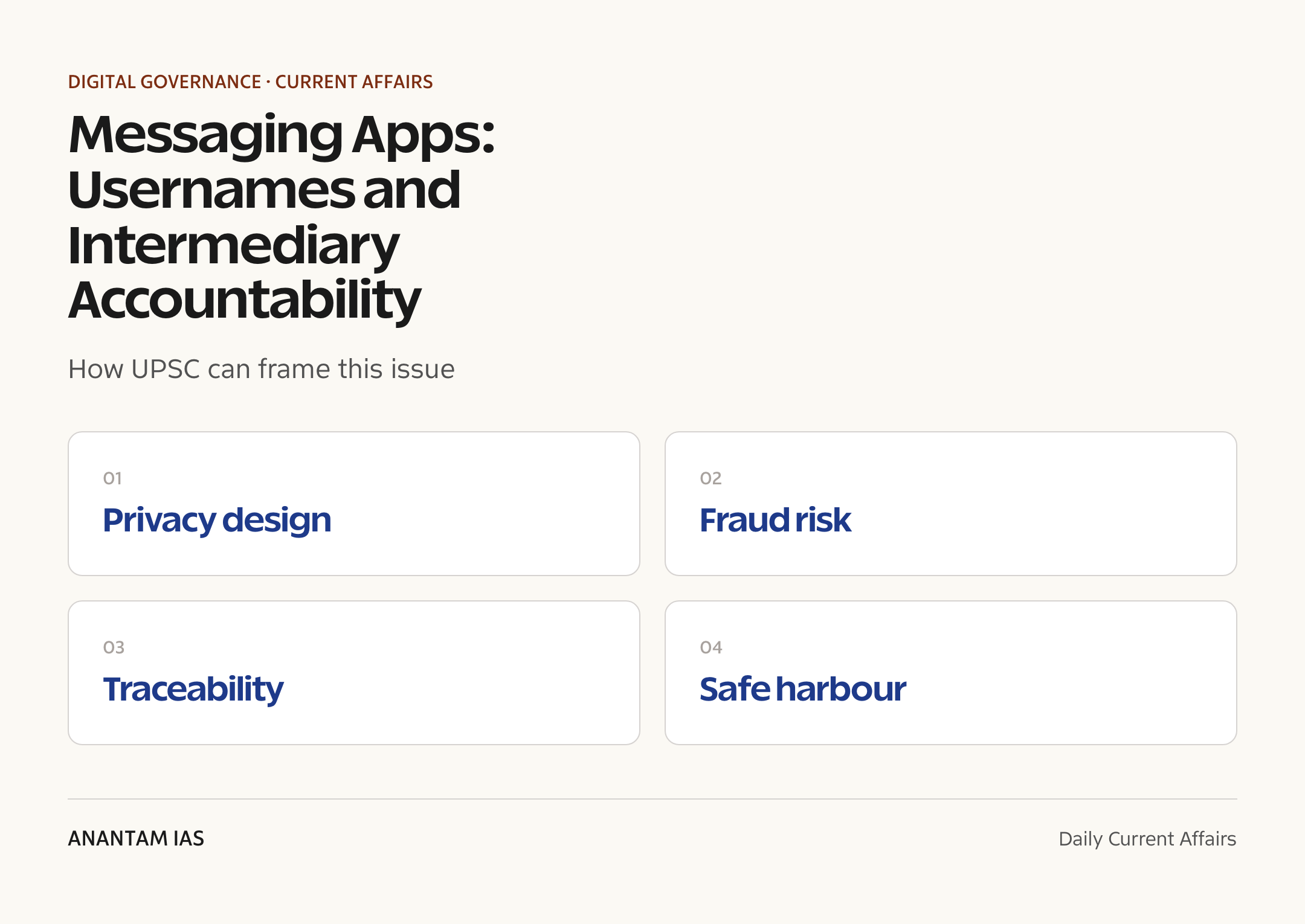
Why the government is worried
The same design that protects privacy can also create new fraud surfaces if naming and first-contact controls are weak.
- Indian Express reported that the Centre asked Meta to pause the India rollout and provide a detailed explanation within three days.
- Impersonation is the main risk: small spelling changes can make a handle look like a bank, government office, police unit or public figure.
- Digital arrest scams often work by simulating official authority; username-based contact could make fake official identities easier to project.
- Phishing becomes sharper when an attacker combines a familiar display name, a plausible username and urgent financial or legal pressure.
- Network effects matter: WhatsApp’s large Indian user base makes even low-rate abuse significant at population scale.
- Platform safeguards need to be tested before launch, not after harm spikes; this is why consultations and risk assessment matter.
Intermediary law behind the debate
India’s platform rules focus on safe harbour, due diligence and extra obligations for large social media intermediaries.
- Section 79 of the IT Act provides conditional safe harbour to intermediaries for third-party information they host or transmit.
- Due diligence is the price of that safe harbour: platforms must publish rules, act on lawful orders and maintain grievance mechanisms.
- Rule 3 of the IT Rules, 2021 requires intermediaries to secure their systems, retain specified records and report cyber incidents to CERT-In.
- Rule 4 adds duties for significant social media intermediaries, including compliance officers, nodal contact, monthly reports and first-originator capability for messaging services.
- First originator identification is limited to serious grounds such as sovereignty, State security, public order and specified offences, with less intrusive means preferred.
- Encryption concerns arise because traceability demands can collide with private messaging architecture; revise basics through Anantam IAS cyber security notes.
Privacy gains are real
A username system is not automatically anti-privacy; it can reduce exposure of personal numbers in many ordinary situations.
- Phone-number privacy helps students, gig workers, customers, activists, teachers and small businesses communicate with less personal exposure.
- Women and vulnerable users may benefit when joining temporary groups or contacting service providers without revealing a permanent number.
- Data minimisation under modern privacy law supports collecting and exposing only the identity data necessary for a specific purpose.
- DPDP principles push platforms to reduce avoidable personal data circulation; see Anantam IAS right to privacy notes for the constitutional layer.
- Optionality matters: users should be able to keep phone-number contact, enable usernames, use keys and change handles through transparent controls.
- Privacy-by-design means the safety architecture must be embedded in naming, discovery, reporting and abuse throttling from the start.
Telegram and Section 69A angle
The Telegram debate broadens the issue from user handles to State power over entire platforms.
- The Hindu analysed how Telegram raised concerns about reading an entire platform as information for blocking purposes.
- Section 69A is meant for blocking public access to information on specified grounds, not as a casual substitute for platform-wide regulation.
- Proportionality asks whether a narrower measure can solve the problem before a broader restriction affects lawful users.
- Due process requires reasoned orders, prescribed safeguards and a meaningful route to challenge overbroad action.
- Intermediary platforms are legal entities and infrastructure layers; treating them as a single piece of information can blur statutory boundaries.
- Judicial review becomes crucial when blocking, traceability or identity design affects speech, privacy and business continuity at the same time.
The governance problem in one line
The State is not only regulating what users post; it is increasingly asking how platforms design identity, discovery and trust.
- Product design can either prevent harm at source or externalise harm to citizens, police stations and banks.
- Lookalike prevention should reserve sensitive government, banking, law-enforcement and emergency-service names before public launch.
- Abuse throttles should limit high-volume first messages, repeated name changes and newly created accounts contacting many strangers.
- Verified public handles can reduce fraud only if verification is visible, tamper-resistant and not confused with paid vanity features.
- User reporting must be fast enough for scams, because delayed takedown after a payment or disclosure often has little value.
- Regulatory dialogue should ask for design evidence, test results and audit trails rather than relying only on post-harm penalties.
Way Forward
Pre-launch risk assessment
- Meta should share a India-specific risk assessment covering impersonation, fraud workflows, child safety, business names and government identifiers.
- MeitY can require phased rollout, red-team testing and consultation with cybercrime cells, consumer protection bodies and sectoral regulators.
- High-risk handles such as police, court, bank, income tax, UPI, Aadhaar and emergency-service variants should be reserved or subject to stricter verification.
Privacy-preserving safety design
- Username keys should be easy to enable, reset and explain, especially for users who face harassment or spam.
- Exact-match discovery should continue; public search directories and auto-suggestions would expand the attack surface.
- Metadata minimisation should be paired with enough auditability for lawful, targeted investigation under due process.
Fraud response architecture
- Cybercrime reporting should connect platform reports, the 1930 helpline ecosystem and law-enforcement escalation for fast freezing of fraudulent flows.
- Financial institutions should coordinate with platforms on verified identifiers and public advisories against username-based impersonation.
- User education should stress one simple rule: a username is not proof of authority, employment or official status.
Legal clarity
- Section 69A use should remain targeted, reasoned and proportionate, especially when a dispute concerns platform architecture rather than a specific harmful post.
- Traceability orders should follow the narrow grounds in Rule 4(2) and avoid weakening end-to-end encryption for all users.
- Parliamentary oversight can review whether India’s intermediary law needs clearer rules for platform design changes with public-safety effects.
Conclusion
Messaging app usernames are not a simple privacy upgrade or a simple fraud risk. They are both, depending on naming rules, first-contact controls, verification design and law-enforcement safeguards.
India’s regulatory task is to protect phone-number privacy without creating a new impersonation economy. The better path is narrow, evidence-based design review backed by due process, not blanket suspicion of every privacy feature.
UPSC Practice Questions
Prelims MCQ 1
With reference to the IT Rules, 2021, consider the following statements:
- A significant social media intermediary providing messaging services may be required to enable identification of the first originator under specified lawful orders.
- The first-originator requirement allows the government to demand disclosure of the contents of every message in a private chat.
- Significant social media intermediaries have additional due-diligence duties beyond the general duties of intermediaries.
How many of the above statements are correct?
(a) Only one (b) Only two (c) All three (d) None
Answer: (b) Only two
Explanation:
Statements 1 and 3 are correct. Rule 4(2) deals with first-originator identification under limited conditions, while the rule says content of messages need not be disclosed for such compliance.
Prelims MCQ 2
Which of the following best captures the governance issue raised by username-based messaging?
(a) It removes all need for cybercrime investigation. (b) It converts every messaging app into a telecom operator. (c) It requires balancing phone-number privacy with impersonation and fraud-prevention safeguards. (d) It makes Section 69A irrelevant for online platforms.
Answer: (c) It requires balancing phone-number privacy with impersonation and fraud-prevention safeguards.
Explanation:
Username systems can reduce exposure of phone numbers, but they also need anti-impersonation, abuse reporting and lawful investigation safeguards.
UPSC Mains Questions
- Messaging apps are now designing identity systems, not merely carrying messages. Discuss how username-based contact features can affect privacy, cyber fraud and intermediary accountability in India. Suggest safeguards for a rights-respecting rollout.
- Examine the tension between traceability, end-to-end encryption and due process under India’s intermediary regulation. How should the State respond when platform design changes create public-safety risks?
- Section 69A powers must remain targeted even when digital platforms create large-scale risks. Analyse this statement in the context of Telegram-style identifiers, platform blocking and proportionality.
Sources: MeitY IT Rules 2021 and The Hindu, Indian Express and WhatsApp Blog.
Frequently Asked Questions
What is a messaging username?
A messaging username is an optional handle that lets someone contact a user without first seeing the user’s phone number. It separates contact discovery from the mobile number used for registration, but it needs strong safeguards against impersonation and unwanted first contact.
Why did India question the rollout?
The reported government concern is that usernames may increase impersonation, phishing, digital arrest scams and lookalike official identities. The Centre reportedly asked Meta to pause the rollout in India and explain the feature before consultations are completed.
Does a username remove phone numbers completely?
No. WhatsApp’s public explanation says phone numbers still remain necessary for account registration. The change affects what a new person or business sees when first contacting a user, if the user has enabled the username feature.
What is intermediary accountability?
Intermediary accountability means platforms that host, transmit or enable user communication must follow due diligence, grievance redressal, lawful orders and safety obligations. In this case, accountability also covers product design choices that may make fraud easier or harder.
How does privacy fit into this debate?
Privacy supports reducing unnecessary exposure of phone numbers. But privacy cannot mean weak safeguards against fake banks, fake police handles or fake government identities. A rights-based design protects users from both surveillance and fraud.
What should students remember for mains?
Frame the issue as a governance trade-off: privacy-by-design, cyber safety, platform responsibility, proportionality and due process. Avoid treating regulation as a ban-versus-freedom binary; the real answer is calibrated design review.
Source: https://anantamias.com/current-affairs/messaging-app-usernames-digital-governance/
Census 2027: Houselisting and Demography Questions
Why in News?
The Hindu reported on 2 July 2026 that enumerators had begun door-to-door visits in Kerala for the Houselisting phase linked to Census 2027.
A separate report said a demography panel was preparing a detailed questionnaire for States to study population changes after the last completed Census in 2011.
- Houselisting is the first operational layer of the Census; it records houses, amenities and household-level conditions before population enumeration.
- Census 2027 matters because India’s administrative, welfare and electoral systems have been working with an unusually old 2011 baseline.
- State inputs into a demography questionnaire can shape how migration, fertility, ageing, urbanisation and household change are read.
- Kerala is important as an early field site because it has high literacy, high ageing, outward migration and a distinct demographic transition.
- UPSC hook: this is not just data collection; it affects federalism, social justice, delimitation, finance and public-service delivery.
The development matters in the context of:
- Policy targeting needs updated population and household information to locate beneficiaries, service gaps and regional vulnerabilities.
- Delimitation and reservation debates become politically sensitive when population change is uneven across States and social groups.
- Data quality is central because errors in enumeration can travel into welfare lists, urban planning, infrastructure and fiscal formulas.
- Privacy and trust matter because household visits require citizens to share personal information with the state.
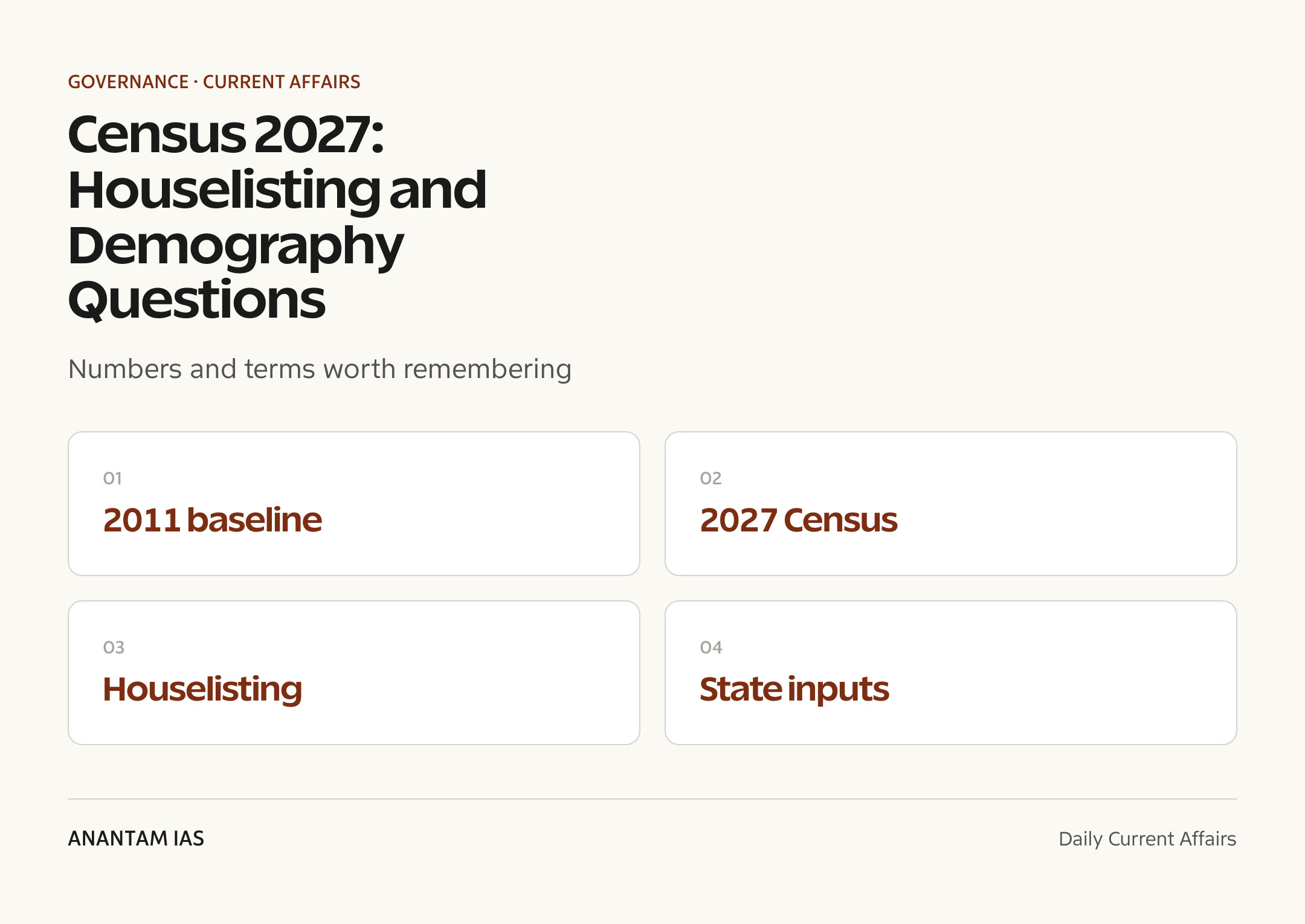
UPSC Relevance
Prelims Relevance
- Census in India is conducted under the Census Act, 1948 and managed by the Office of the Registrar General and Census Commissioner.
- Houselisting precedes population enumeration and collects information on buildings, households and basic amenities.
- 2011 Census is the last completed national Census baseline currently used across many policy datasets.
- Kerala has an advanced demographic transition, with high literacy, lower fertility and a rising share of elderly population.
- Registrar General of India also oversees the Civil Registration System and Sample Registration System.
- Population data is relevant for delimitation, welfare schemes, urban planning, disaster planning and health infrastructure.
- Household amenities such as drinking water, sanitation, electricity and housing condition are typical houselisting indicators.
- Demographic transition refers to the shift from high birth and death rates to lower birth and death rates over time.
Mains Relevance
GS Paper 2
- Governance: updated population data is a foundation for evidence-based welfare, service delivery and district planning.
- Federalism: population change affects representation, grants, State comparisons and Centre-State bargaining.
GS Paper 1
- Society: fertility decline, migration, ageing, household size and urbanisation change the nature of social policy.
- Population geography: regional demographic differences can reshape labour markets, dependency ratios and social infrastructure.
GS Paper 4
- Public trust: enumerators must collect sensitive information with neutrality, accuracy and respect for citizens.
Essay
- Counting people is also about recognising needs, rights and regional diversity.
- Data and democracy: representative institutions depend on credible public statistics.
- Development planning improves when the state sees household realities clearly.
Background and Context
What houselisting does
Houselisting is the operational foundation on which the population count is later built.
- House-to-house visits help identify buildings, census houses, households and basic living conditions before the main population enumeration.
- Amenities data gives administrators a picture of sanitation, drinking water, electricity, cooking fuel, housing quality and asset access.
- Enumeration blocks are organised so that the later population count is manageable, locally verifiable and mapped to field units.
- Kerala rollout shows the field stage of a national statistical exercise that depends on local bodies, teachers, officials and trained enumerators.
- Quality control at this stage matters because a missed house, duplicate listing or wrong household unit can distort later population data.
- Field maps and clear block boundaries reduce overlap between enumerators and help supervisors confirm whether every habitation has been visited.
- Institutional households, hostels, shelters and worksite settlements need separate attention because they are easy to miss in a normal family-household frame.
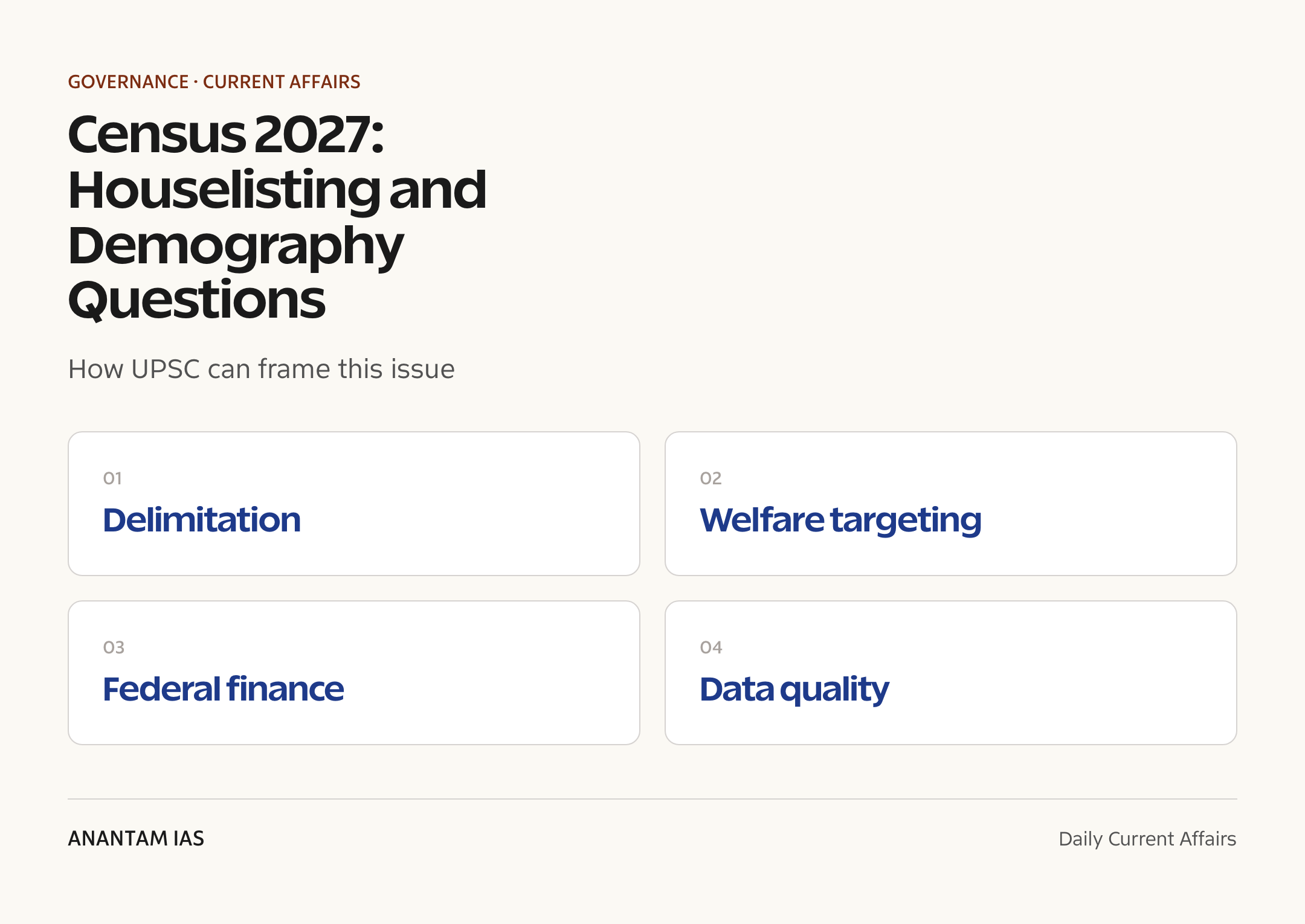
Why Census 2027 is important
The long gap after the 2011 Census makes the next count unusually consequential.
- Old baseline problem: many schemes, projections and district plans still lean on 2011 population structures despite migration and urban growth.
- Welfare delivery needs current household information to estimate coverage gaps in food security, housing, sanitation, health and education.
- Urban planning is affected because fast-growing peri-urban areas often outpace official population and service data.
- Health systems need age, sex and household information for elderly care, maternal health, immunisation and disease surveillance planning.
- Disaster management depends on knowing settlement patterns, vulnerable groups, housing types and local population concentration.
Demography panel and State questionnaire
A State-focused questionnaire can help connect national counting with regional demographic realities.
- Post-2011 changes include fertility decline, ageing, migration, urbanisation, household fragmentation and changing dependency ratios.
- State diversity is central: Kerala, Bihar, Uttar Pradesh, Tamil Nadu and the North-East do not face the same demographic policy problems.
- Migration data can help States plan labour markets, hostels, rental housing, portability of welfare and urban transport.
- Ageing needs sharper data because pension systems, geriatric care and social support networks depend on reliable elderly-population estimates.
- Question design must avoid confusing wording, overlapping categories and politically loaded framing that can reduce response quality.
Federalism and representation
Population numbers are never neutral in a federal democracy because they affect power and resources.
- Delimitation debates are linked to population change because seat allocation and constituency size depend on credible demographic data.
- Fiscal transfers often use population-related indicators, so States care about how people are counted and which baseline is used.
- Southern States often raise concerns that successful fertility reduction should not reduce political weight or fiscal fairness.
- High-growth States need adequate resources for schools, health centres, jobs and urban services because absolute population pressure remains high.
- Cooperative federalism requires transparent methodology so States accept the numbers even when the policy consequences are difficult.
Data quality and citizen trust
The Census succeeds only when citizens trust enumerators and enumerators record data consistently.
- Training is critical because field workers must understand definitions of household, census house, usual resident, migration and amenities.
- Digital tools can reduce delay and transcription error, but they also need backups, cybersecurity and support for low-connectivity locations.
- Privacy safeguards should reassure citizens that individual information is collected for statistical purposes and handled under lawful rules.
- Verification through supervision, random checks and local review helps reduce undercounting of migrants, homeless persons and remote households.
- Communication should make citizens understand what is being asked, why it is being asked and how accurate answers improve public policy.
- Inclusion risk is highest for migrants, homeless persons, nomadic groups and remote hamlets, so field plans should actively look for people outside settled addresses.
- Post-enumeration checks can estimate coverage error and help statisticians understand whether undercounting has a regional or social pattern.
UPSC analytical frame
For exam answers, treat the Census as a governance instrument, not a clerical exercise.
- Evidence-based policy begins with reliable counts; weak data creates weak targeting, weak planning and weak accountability.
- Social justice depends on visibility of vulnerable groups, household deprivation, migration and uneven access to basic services.
- Ethical administration requires enumerators to be neutral, patient and accurate even when the field situation is politically or socially sensitive.
- Comparability across time is important because changing definitions too casually can make 2027 data hard to compare with 2011.
- Balanced answer: support updated data collection, but mention privacy, capacity, federal concerns and public communication.
Way Forward
Improve field reliability
- Enumerator training should use local-language examples for household definitions, migration categories and amenities.
- Supervision protocols should include random back-checks, error dashboards and escalation routes for confusing cases.
- Local-body support can help identify missed settlements, institutional households, migrant clusters and informal housing.
Protect trust and privacy
- Public communication should explain the purpose of houselisting and separate statistical counting from policing or benefit denial fears.
- Data security should cover devices, authentication, backups, access control and retention rules.
- Grievance channels should let citizens report missed houses, wrong entries or misconduct by field staff.
Use data responsibly
- Transparent methodology should make State-wise comparisons credible and politically defensible.
- Policy integration should connect Census findings with health, education, urban planning, disaster management and welfare databases.
- Federal consultation should address concerns on representation and finance before numbers become political flashpoints.
Conclusion
Census 2027 is important because India is trying to update the statistical foundation of governance after a long data gap. Houselisting is the quiet but decisive first step: it tells the state where households are, how they live and what basic services they have.
For UPSC, the issue should be framed around credible public statistics, federal sensitivity and citizen trust. A good Census can improve welfare and planning; a weak one can carry errors into policy for another decade.
UPSC Practice Questions
Prelims MCQ 1
With reference to the Census process in India, consider the following statements:
- Houselisting is generally conducted before population enumeration.
- The Office of the Registrar General and Census Commissioner is associated with Census operations.
- The 2011 Census is the last completed national Census baseline.
How many of the above statements are correct?
(a) Only one (b) Only two (c) All three (d) None
Answer: (c) All three
Explanation:
All three statements are correct. Houselisting comes before the population count, the Registrar General is central to Census operations, and 2011 remains the last completed Census baseline.
Prelims MCQ 2
Which of the following is the best reason why Census data is important for federal governance?
(a) It replaces all State-level surveys (b) It affects planning, representation and fiscal-policy debates (c) It is used only for birth and death registration (d) It is collected only in urban areas
Answer: (b) It affects planning, representation and fiscal-policy debates
Explanation:
Census data informs welfare planning, constituency debates, fiscal formulas, infrastructure needs and social-sector policy. It does not replace every survey.
UPSC Mains Questions
- Census 2027 is more than a population count. Discuss its significance for welfare targeting, federalism, delimitation debates and evidence-based governance.
- What safeguards are needed to maintain citizen trust and data quality during large-scale household enumeration in India?
- Population change after 2011 has been uneven across Indian States. Examine the governance challenges that can arise from this uneven demographic transition.
Sources: The Hindu and Office of the Registrar General and Census Commissioner.
Frequently Asked Questions
What is houselisting?
Houselisting is the pre-enumeration stage in which enumerators identify houses, households and basic amenities. It prepares the field frame for the later population count and helps capture housing and service-delivery conditions.
Why is Census 2027 important?
It can update India’s core population and household database after the 2011 baseline. This affects welfare targeting, district planning, urban infrastructure, delimitation debates, fiscal comparisons and social-sector policy.
Who conducts the Census?
The Census is managed through the Office of the Registrar General and Census Commissioner under the Union Home Ministry, with extensive field support from State governments, local bodies and trained enumerators.
Why does Kerala matter here?
Kerala is a useful demographic case because it has high literacy, lower fertility, ageing, migration and strong local governance. Early field activity there highlights the practical demands of household enumeration.
What are the privacy concerns?
Household enumeration collects sensitive information. Citizens need clarity on purpose, confidentiality, data security, lawful access and grievance channels so that accurate answers do not feel risky.
How can UPSC ask this topic?
UPSC can frame it through governance data, federalism, social justice, demographic transition, public trust, digital enumeration, delimitation or welfare targeting. It suits both Prelims facts and Mains analysis.
Source: https://anantamias.com/current-affairs/census-2027-houselisting-demography-panel/