Daily Digest
UPSC · Civil Services Examination
Current Affairs · Sunday, 27 September 2026
Current affairs curated and edited by Anantam IAS faculty — pulled from The Hindu, PIB, IDSA, Foreign Affairs and the ministries. Read, annotate, revise.
Old Rajinder Nagar · Delhi 110005 · anantamias.com
Kandla e-Methanol: Linking Renewable Inputs to Shipping Fuel
Why in News?
The foundation stone for a proposed e-methanol plant at Deendayal Port, Kandla, was laid on 26 September 2026, linking renewable energy inputs with future marine-fuel production.
- The 150-tonne-per-day planned capacity is a joint initiative of Deendayal Port Authority and Assam Petro-Chemicals Ltd.
- The announced inputs are renewable power, water and biogenic carbon dioxide; the fuel is intended for ships on the Asia-Europe trade corridor.
- The project is planned in phased modules. The announcement establishes a foundation-stone event, not commissioned production or verified fuel deliveries.
- Marine-fuel transition requires production, port storage and compatible vessels to develop together; a fuel plant alone cannot establish a functioning shipping corridor.
- The central policy question is whether clean inputs and credible emissions accounting survive the entire chain from electricity generation to ship propulsion.
UPSC Relevance
Prelims Relevance
- E-methanol: methanol synthesised using electrolytic hydrogen and a carbon source.
- Electrolysis: electricity splits water to produce hydrogen and oxygen.
- Biogenic carbon dioxide: carbon dioxide originating from biological material or processes.
- Well-to-tank: emissions associated with making and delivering fuel.
- Tank-to-wake: emissions associated with fuel use aboard a ship.
Mains Relevance
GS Paper 3
- Connecting renewable-energy supply with industrial decarbonisation and port infrastructure.
- Evaluating alternative marine fuels through lifecycle emissions and commercial readiness.
Essay
- A transition is credible when its supply chain matches its environmental promise.
Background and Context
How renewable electricity becomes a liquid fuel
E-methanol stores energy in a manufactured molecule, allowing electricity to serve uses that cannot easily connect directly to the grid.
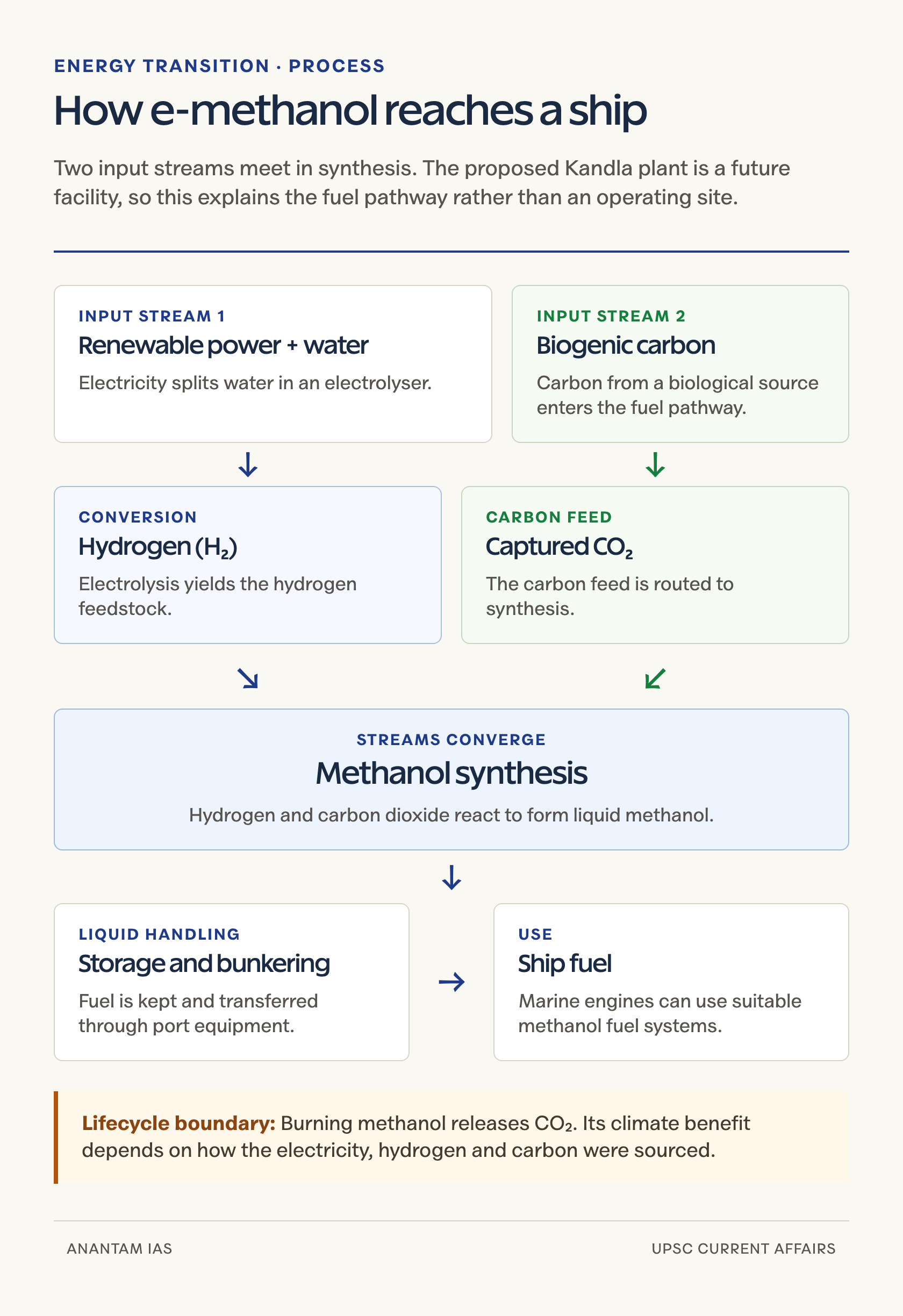
- Renewable electricity powers electrolysis, which splits water into hydrogen and oxygen. Hydrogen becomes a chemical feedstock; electricity is not poured directly into a ship’s fuel tank.
- The hydrogen is combined with captured carbon dioxide through methanol synthesis. Carbon dioxide supplies the carbon atom, while hydrogen supplies another essential building block of the resulting fuel.
- The product is methanol, a liquid that can be stored and delivered through appropriately designed facilities. Turning electricity into fuel adds conversion steps and energy requirements.
- In the Kandla proposal, the carbon input is biogenic CO2. The official release names this category but does not identify the specific supplier or document its full chain of custody.
- IRENA identifies renewable hydrogen and sustainable carbon sourcing as central to renewable methanol. The same chemical product can carry different environmental footprints depending on how its inputs are obtained.
Why the carbon source matters
Biogenic carbon belongs to a biological carbon cycle; its presence does not automatically certify the complete fuel as sustainable.
- Biogenic CO2 can arise from biological processing, such as fermentation. Its origin differs from carbon released by extracting and burning fossil fuels that were stored underground.
- Carbon capture for fuel reuses carbon in a product that will later be consumed. It is different from keeping captured carbon in durable geological storage.
- Burning methanol releases carbon dioxide. A claim of reduced lifecycle emissions must account for the carbon’s origin and processing; it cannot mean that the exhaust contains no carbon.
- The renewable-electricity claim also needs evidence. Electricity used for hydrogen production is part of the fuel pathway, so emissions can arise upstream even when they are invisible at the port.
- A credible assessment tracks input provenance alongside quantities produced. The planned plant’s green-fuel description cannot substitute for measured operating data once production and deliveries actually begin.
Read shipping fuels through the whole lifecycle
IMO’s lifecycle approach joins upstream fuel production with onboard use, preventing emissions from disappearing merely because they occur elsewhere.
- Well-to-tank covers the supply chain before onboard consumption, including feedstock sourcing, fuel manufacture and delivery. Moving emissions outside the vessel does not remove them from this boundary.
- Tank-to-wake covers fuel use on the vessel. Evaluating only this segment can miss electricity-related emissions and the carbon burden created earlier in the production process.
- Well-to-wake combines both segments. This boundary helps compare alternative fuels on a common basis rather than judging them solely through labels such as green or conventional.
- Lifecycle evidence is needed before assigning a project-specific emissions saving. The foundation-stone release does not supply a verified operating lifecycle assessment for the proposed Kandla plant.
Why a port location helps, and what remains unproven
Port integration can connect manufacturing with customers, but construction, fuel availability and vessel adoption remain separate milestones.
- Port-based production can place fuel supply near ships that need bunkering, meaning refuelling. Storage, transfer equipment and operating procedures must still be designed for the actual fuel.
- Demand coordination matters: producers need buyers, while ship operators need dependable supplies. A planned production capacity is not evidence of purchase contracts or routine bunkering services.
- Compatible machinery and handling remain essential. Methanol’s industrial usefulness does not erase its hazards, as the separate note on methanol safety and regulation explains.
- Operational readiness requires evidence beyond an announced project. The distinction between demonstration and dependable service also appears in the technology-readiness explainer; commissioning must be verified independently.

Way Forward
Make the supply chain auditable
- Require traceable electricity and carbon inputs, with a clear accounting boundary and independent verification of lifecycle emissions.
- Track commissioning and actual deliveries separately from announced capacity, projected costs and ceremonial milestones.
- Coordinate fuel producers, port operators and shipowners on storage, handling, compatible equipment and dependable purchase arrangements.
Conclusion
- Kandla’s e-methanol proposal illustrates how renewable electricity can reach shipping through hydrogen and a manufactured liquid fuel, with carbon sourcing determining an essential part of its environmental case.
- For an answer on clean shipping, connect the production mechanism with lifecycle accounting and port readiness; distinguish planned capacity from an operating, verified low-emissions supply chain.
UPSC Practice Questions
Prelims MCQ 1
With reference to e-methanol as a marine fuel, consider the following statements:
- Renewable hydrogen can be combined with carbon dioxide to produce methanol.
- Methanol combustion releases no carbon dioxide because its hydrogen is renewable.
- Well-to-wake assessment includes fuel production and onboard use.
How many of the above statements are correct?
(a) Only one (b) Only two (c) All three (d) None
Answer: (b) Only two
Explanation:
Statements 1 and 3 are correct. Methanol contains carbon and releases carbon dioxide on combustion; renewable inputs do not make the exhaust carbon-free.
Prelims MCQ 2
Which distinction is most important when assessing the environmental claim of a proposed e-methanol plant?
(a) Port ownership versus ship ownership (b) Fuel colour versus storage-tank colour (c) Announced green-fuel capacity versus verified lifecycle performance (d) Domestic cargo versus imported cargo alone
Answer: (c) Announced green-fuel capacity versus verified lifecycle performance
Explanation:
An announcement establishes an intention and planned capacity. Environmental performance needs evidence about electricity, carbon inputs, production and fuel use.
UPSC Mains Questions
- Explain the production pathway of renewable e-methanol and assess why lifecycle accounting is essential to its use in shipping.
- How can port-based fuel production support maritime decarbonisation? Discuss the coordination and verification requirements beyond construction of a fuel plant.
Sources: PIB, Ministry of Ports, Shipping and Waterways and IMO, Lifecycle GHG intensity of marine fuels.
Frequently Asked Questions
What is e-methanol?
E-methanol is methanol produced using electrolytic hydrogen and a carbon source. A renewable pathway depends on renewable electricity and suitable carbon sourcing; the final molecule alone does not establish its emissions footprint.
Is the Kandla e-methanol plant already operating?
The 26 September announcement concerns a foundation stone and a proposed phased plant. It does not establish commissioned production, actual fuel deliveries or verified operating emissions performance.
Does e-methanol produce zero emissions when burned?
No. Methanol contains carbon, and combustion releases carbon dioxide. Its potential climate benefit must be assessed across the complete production and use pathway, including electricity supply and the carbon source.
Why does well-to-wake accounting matter?
Well-to-wake accounting combines emissions from producing and delivering fuel with emissions from using it aboard a vessel. It helps prevent an apparent onboard improvement from hiding emissions shifted upstream.
Source: https://anantamias.com/current-affairs/kandla-emethanol-renewable-inputs-shipping-fuel/
Minority Development Programmes: Independent Checks on Assets and Training
Why in News?
The Ministry of Minority Affairs signed agreements on 25 September 2026 for independent assessment of selected PMJVK infrastructure and monitoring of PM VIKAS training in the South zone.
- CUBE, IIT Madras will assess technical and social aspects of selected completed and ongoing PMJVK projects.
- IIM Bangalore will undertake independent third-party monitoring of PM VIKAS training across the South zone.
- The announced work includes field inspections, stakeholder consultations and checks on training delivery, attendance, certification and placement outcomes.
- These are signed agreements for assessment; the announcement reports no completed audit findings, detected fraud or new beneficiary entitlement.
- A completed building and a completed training course are outputs; their usefulness depends on access, functioning services and credible learning or employment outcomes.
- Independent field evidence can expose implementation gaps that expenditure statements and progress reports alone cannot explain.
UPSC Relevance
Prelims Relevance
- PMJVK: Pradhan Mantri Jan Vikas Karyakram.
- PM VIKAS: Pradhan Mantri Virasat Ka Samvardhan.
- Both initiatives fall under the Ministry of Minority Affairs.
- CUBE, IIT Madras: selected PMJVK infrastructure assessment.
- IIM Bangalore: South-zone PM VIKAS training monitoring.
Mains Relevance
GS Paper 2
- Independent monitoring and accountability in welfare programme implementation.
- Distinguishing asset creation, service utilisation and outcomes for social inclusion.
Essay
- Public spending creates value when citizens can use what it finances.
Background and Context
PMJVK: checking whether infrastructure serves its purpose
PMJVK assessment connects the physical condition of an asset with the service people can actually obtain from it.
- The announced scope covers selected completed and ongoing projects in education, health, skill development, and women and child development. It does not establish a nationwide assessment of every asset.
- Technical quality asks whether a structure and its facilities perform as intended. A completion certificate alone cannot answer whether the building remains functional during everyday use.
- Social assessment considers accessibility and utilisation. For example, a usable classroom building can still deliver limited value if intended users cannot reach it or services are unavailable.
- Maintenance and sustainability concern continued service after construction. The assessment includes these parameters, allowing asset management to look beyond the date a project is recorded as complete.
- The same service-delivery distinction appears in rural water maintenance: infrastructure creation needs functioning operations, repairs and checks before it translates into a dependable public service.
PM VIKAS: checking the training delivery chain
Training monitoring follows delivery and participation through to certification and placement, rather than relying on a single completion total.
- Field-level inspections allow monitors to examine training infrastructure and delivery where courses operate. They complement administrative records with direct evidence about the conditions experienced by trainees.
- Checking beneficiary and trainer participation matters because a scheduled course does not establish regular teaching. Attendance records become more informative when compared with what participants report on the ground.
- Certification records a recognised completion or assessment stage; placement outcomes concern the employment transition. Keeping the two distinct prevents the certificate count from standing in for employment evidence.
- The agreement provides for concurrent monitoring, which examines implementation while training is underway. This can support timely correction, instead of waiting until every course has ended before identifying delivery problems.
- The announced geographic scope is the South zone. Any later finding must be read against that coverage; it cannot automatically describe all PM VIKAS centres across the country.

Triangulation: how independent evidence becomes useful
The useful mechanism is comparing different evidence sources, then asking why they agree or conflict.
- Administrative records show what implementing bodies report; site observations show present conditions; stakeholder consultations show user experience. Together, they can test a claim more carefully than any source alone.
- A difference between records and observations is a verification question, not automatic proof of fraud. Monitors should examine timing, definitions and supporting material before drawing an adverse conclusion.
- Independent assessment adds an external perspective, but useful findings still require transparent methods and appropriate coverage. Institutional reputation alone cannot establish that an assessment is reliable or representative.
- Actionable recommendations should connect each identified gap with a practical response. Repairing inaccessible facilities requires a different intervention from correcting attendance recording or improving the quality of instruction.
- As with school nutrition delivery, implementation arrangements shape results. Reviewing the delivery chain helps identify where an intended public benefit is being weakened.
Monitoring and impact evaluation answer different questions
Checking delivery is essential, but establishing how much a programme caused an outcome requires a further analytical step.
- Monitoring asks whether promised activities occur and recorded outcomes can be verified. It can reveal a non-functional asset or a training delivery gap without calculating the programme’s causal impact.
- Impact evaluation asks what difference the intervention made compared with a credible alternative. Employment can also change because of labour demand, previous skills or other support received by trainees.
- The release announces assessment partnerships, not a completed impact evaluation. Their actual findings and subsequent corrective action will determine what can eventually be concluded about programme performance.
Way Forward
Turn findings into tracked corrections
- Specify assessment methods and coverage so readers can distinguish project-specific findings from broader patterns.
- Assign each recommendation an implementing authority and follow-up step, then check whether the reported problem has been resolved.
- Use trainee and service-user feedback alongside records, while protecting personal information in any published findings.
Conclusion
- PMJVK asset assessment and PM VIKAS training monitoring illustrate two routes to programme accountability: test whether infrastructure works, and verify whether training delivery and reported outcomes match field evidence.
- For an answer on welfare governance, connect independent evidence with corrective action. Signed partnerships create a route for scrutiny; improvements must be demonstrated through findings, implementation responses and subsequent checks.
UPSC Practice Questions
Prelims MCQ 1
With reference to the announced minority development monitoring partnerships, consider the following statements:
- CUBE, IIT Madras will assess selected PMJVK infrastructure projects.
- IIM Bangalore’s announced PM VIKAS monitoring covers the South zone.
- The agreements establish that all assessed projects have already failed quality checks.
How many of the above statements are correct?
(a) Only one (b) Only two (c) All three (d) None
Answer: (b) Only two
Explanation:
The first two statements describe the announced scope. The release reports agreements for assessment and monitoring, not completed findings or universal project failures.
Prelims MCQ 2
Which question most directly requires impact evaluation beyond routine programme monitoring?
(a) Was a training session conducted? (b) Is the training centre functional? (c) Did recorded trainees attend? (d) How much additional employment did the programme cause?
Answer: (d) How much additional employment did the programme cause?
Explanation:
Causal impact requires assessing what difference the intervention made against a credible alternative. The other questions concern implementation verification.
UPSC Mains Questions
- Explain how independent technical and social assessment can improve accountability in public infrastructure programmes. (150 words)
- Distinguish training completion, verified placement outcomes and causal impact. How should welfare programme monitoring use these distinctions? (250 words)
Source: PIB, Ministry of Minority Affairs.
Frequently Asked Questions
What will CUBE, IIT Madras assess under PMJVK?
It will assess selected completed and ongoing infrastructure projects for technical and social quality, including functionality, accessibility, utilisation, maintenance and sustainability. The announcement does not claim coverage of every PMJVK asset.
What is IIM Bangalore’s PM VIKAS monitoring role?
The announced partnership covers training across the South zone. Field inspections and consultations will examine delivery, infrastructure, participation, attendance, certification and placement outcomes to identify implementation gaps and inform improvements.
Do the agreements announce completed audit findings?
No. They establish arrangements for independent assessment and monitoring. The release does not report completed assessments, detected fraud or verified programme-wide improvements, and it does not create a new beneficiary entitlement.
How does monitoring differ from impact evaluation?
Monitoring checks delivery and verifies reported results. Impact evaluation asks how much change the programme caused compared with a credible alternative, accounting for other influences on outcomes such as employment.
Source: https://anantamias.com/current-affairs/pmjvk-pmvikas-independent-quality-outcome-assessment/
Cross-Border Health Preparedness: Sharing Alerts While Retaining Data Control
Why in News?
African leaders and partners adopted a call for cross-border health preparedness and responsible AI use in New York on 25 September 2026, WHO reported the following day.
- The New York Call to Action seeks stronger cooperation on infectious threats across national borders.
- WHO highlighted the emerging Preparedness Data Exchange, which combines preparedness and risk information to assist decisions.
- The proposed approach combines national data control with sharing useful intelligence for collective readiness.
- The report describes a political commitment and intended capabilities; it provides no measured improvement in AI prediction or emergency outcomes.
- An alert crossing a border is useful only when the receiving authority can interpret, verify and act on it.
- Sharing information requires trust about its purpose, reliability and handling, alongside staff capable of responding.
UPSC Relevance
Prelims Relevance
- Preparedness intelligence: interpreted information supporting readiness and risk decisions.
- PDX: WHO Africa’s Preparedness Data Exchange.
- Points of entry: locations where travellers enter a country and relevant health screening can occur.
- AI-assisted analysis: analytical support whose outputs still require accountable assessment.
- National data control and cross-border intelligence sharing are compatible policy objectives.
Mains Relevance
GS Paper 2
- Cross-border health cooperation and the institutional conditions for timely alerts.
- Data governance, sovereignty and responsibility in shared public-health decisions.
GS Paper 3
- Assessing AI-assisted risk analysis without confusing technical capability with demonstrated performance.
Essay
- Shared risks require cooperation that earns public trust.
Background and Context
From a local signal to a useful cross-border warning
Preparedness intelligence turns observations into a decision about what to check, where to prepare and whom to notify.
- A signal is a reason to investigate, rather than confirmation of an outbreak. Consider an unusual cluster of illness near a crossing: its significance depends on verification and surrounding circumstances.
- A practical alert should explain the suspected threat, relevant location and uncertainty. Sending an unexplained risk score gives neighbouring officials too little information to judge what response the evidence actually supports.
- Comparable reporting makes warnings interpretable. If neighbouring services use different meanings for a suspected case, combining their reports can create an apparent change that reflects classification rather than a changing health threat.
- Response capacity completes the chain. Earlier information has limited value if officials cannot contact counterparts, investigate a signal or arrange necessary support; readiness should be assessed through these practical links in the chain.
- A useful feedback loop returns investigation findings to those who raised the alert. Correcting an unconfirmed signal prevents it from circulating indefinitely and helps reviewers improve later decisions without hiding uncertainty.
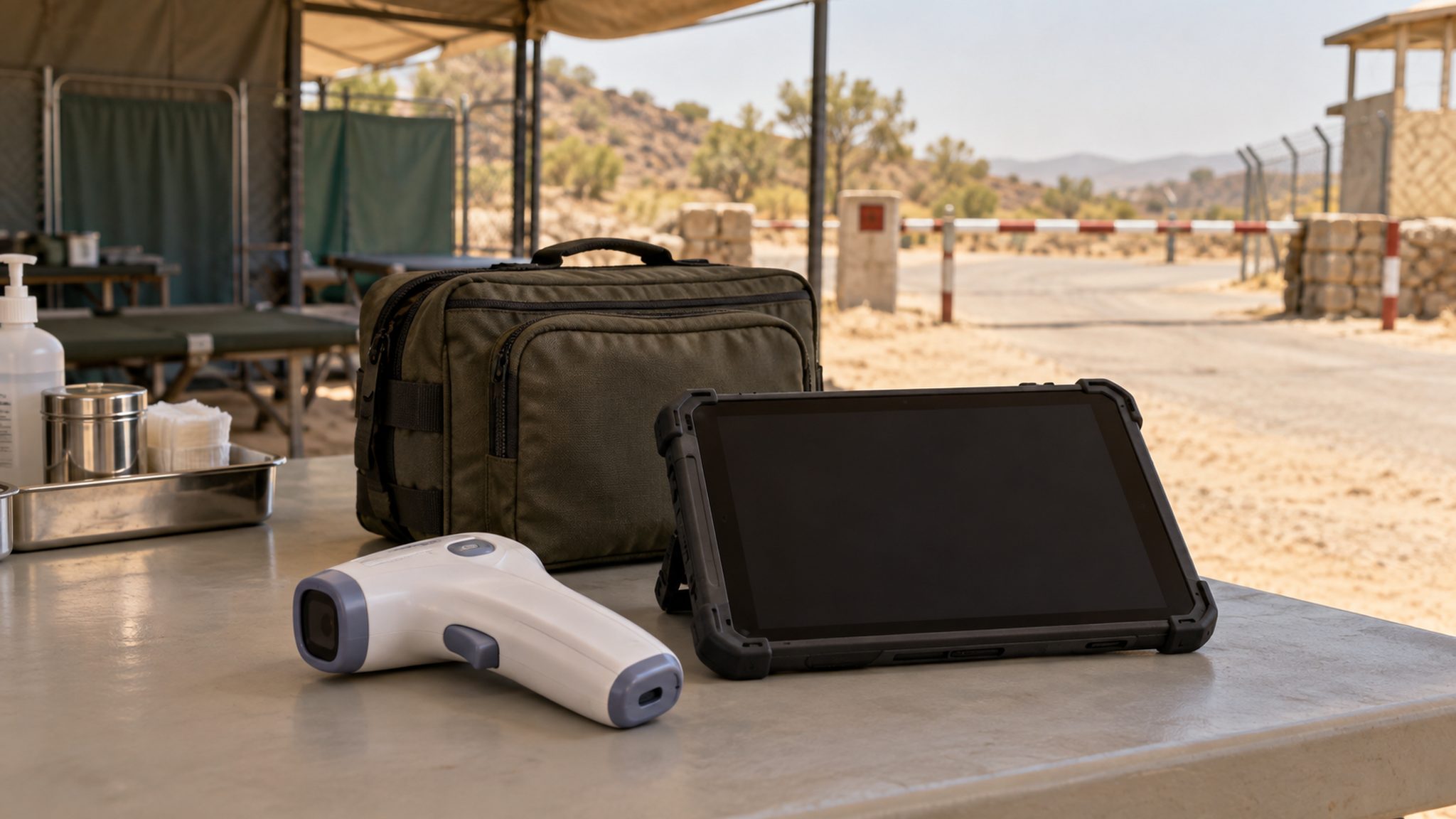
Sharing intelligence while retaining control
The WHO report states the policy objective; implementation still needs clear decisions about what is shared and who may use it.
- Purpose matters: a neighbouring authority may need a verified warning and readiness assessment. That need does not automatically justify unrestricted access to every underlying personal record collected during local health work.
- Control should be translated into operational rules: authorised recipients, permitted uses, correction procedures and responsibility for onward disclosure. These are governance questions for implementation, not confirmed technical features of the announced approach.
- A shared assessment needs enough context to be challenged. Recipients should understand missing observations, uncertain locations or reporting delays before comparing areas; apparently precise scores can conceal substantial gaps in the underlying evidence.
- The NHA research environment addresses governed research access. Here the immediate question is how authorities exchange actionable warnings across borders, rather than how researchers obtain permission to analyse protected records.
- PABS negotiations concern pathogen access and benefit sharing. This preparedness call should be studied separately: coordinating warnings does not settle negotiations over access to pathogen materials and the benefits connected with their use.
What responsible AI adds, and what must be demonstrated
WHO’s health-AI guidance makes ethics, human rights and accountability central to design, deployment and use.
- AI-assisted triage could help reviewers organise incoming information and identify patterns worth checking. A suggested priority remains an analytical output; officials need reasons and supporting evidence before escalating it into a response.
- Human accountability requires an identifiable authority to review consequential decisions. Calling a system intelligent should never obscure who can challenge its recommendation, correct an error or explain the response to affected communities.
- Unequal reporting creates an evaluation problem: areas with weak reporting can appear quieter. An assessment should examine where observations are missing before treating the absence of an alert as evidence of lower risk.
- Performance evidence should address missed threats as well as false alarms. A system producing many warnings can overwhelm staff; a quiet system can still fail to identify events that require urgent investigation.
- The test for adoption should compare usefulness under real working conditions, including delayed reports and limited staffing. This is an evaluation recommendation; the WHO announcement does not supply those results or certify a predictive model.
Way Forward
Make cooperation operational and auditable
- Agree on alert definitions, named contact points and correction procedures before relying on automated prioritisation.
- Specify permitted information flows and responsibilities for receiving, using and correcting shared intelligence.
- Test decision usefulness through exercises and independent evaluation, recording false alarms, missed threats and response bottlenecks.
- Fund local surveillance and response staff so improved analysis translates into practical readiness.
Conclusion
- Cross-border preparedness depends on usable information and a functioning response chain. The African initiative offers a cooperation framework, while reliable performance and enforceable handling rules remain matters to establish through implementation.
- For a Mains answer, connect early warning, accountable decisions and national data control. Assess whether cooperation makes action more timely without treating unrestricted data access or an AI label as evidence of success.
UPSC Practice Questions
Prelims MCQ 1
With reference to the New York Call to Action on Cross-Border Preparedness Intelligence in Africa, consider the following statements:
- It advocates stronger cooperation on cross-border health preparedness.
- Its proposed approach allows countries to retain control over their data while sharing preparedness intelligence.
- WHO’s announcement establishes a validated AI system with proven outbreak-prediction accuracy.
How many of the above statements are correct?
(a) Only one (b) Only two (c) All three (d) None
Answer: (b) Only two
Explanation:
The call supports cooperation and national data control. The announcement describes emerging capabilities, without providing validation results or predictive-accuracy evidence.
Prelims MCQ 2
Which situation best illustrates the distinction between a health signal and a verified warning?
(a) An automated risk score is treated as a confirmed diagnosis. (b) An unusual illness report is investigated before its implications are communicated to neighbouring authorities. (c) Missing reports are interpreted as proof that no health threat exists. (d) Every warning automatically authorises unrestricted disclosure of patient records.
Answer: (b) An unusual illness report is investigated before its implications are communicated to neighbouring authorities.
Explanation:
A signal calls for investigation. Verification and interpretation establish what can responsibly be communicated and acted upon; an unexplained score alone does not confirm an outbreak.
UPSC Mains Questions
- How can countries improve cross-border health intelligence while retaining control over sensitive data? Discuss the institutional conditions required.
- AI-assisted early warning cannot substitute for public-health capacity. Examine with reference to verification, accountability and response readiness.
Sources: WHO Regional Office for Africa and WHO: Ethics and governance of artificial intelligence for health.
Frequently Asked Questions
What is cross-border preparedness intelligence?
It is interpreted information that helps neighbouring authorities anticipate health risks and prepare responses. Its value depends on verification, shared understanding and practical arrangements for action across borders.
What is the Preparedness Data Exchange?
PDX is an emerging WHO Africa platform combining preparedness and risk information to support decisions. WHO describes AI-enabled capabilities intended to assist analysis and readiness, without reporting validated prediction outcomes in this announcement.
Does the call require unrestricted sharing of patient records?
WHO describes a proposed model that preserves countries’ control over their data while sharing useful preparedness intelligence. The report does not establish unrestricted access to personal records or specify every technical safeguard.
Does the announcement prove that AI predicts outbreaks reliably?
No. It reports commitments and intended analytical capabilities. Reliability would require evaluation of missed threats, false alarms and usefulness under actual operating conditions, with clear responsibility for consequential decisions.
Source: https://anantamias.com/current-affairs/africa-cross-border-preparedness-intelligence-data-control/
Bulk-Drug Manufacturing: Backward Integration and Fermentation Capacity
Why in News?
On 25 September 2026, the Department of Pharmaceuticals reported commissioned bulk-drug facilities under PLI, highlighting domestic production of critical pharmaceutical inputs.
- The Penicillin G facility at Kakinada has installed capacity of 15,000 tonnes annually; the release reports restoration of domestic manufacturing after about three decades.
- A potassium clavulanate fermentation facility at Nalagarh adds 400 tonnes annually of installed capacity, according to the department.
- The update also covers Para Amino Phenol for paracetamol and cardiovascular APIs, showing investment across different stages of medicine production.
- Finished-medicine production can remain exposed to imported upstream inputs; an interruption before API manufacture can affect several downstream products.
- Commissioning demonstrates additional manufacturing capability. It does not establish full import independence, continuous output at rated capacity or guaranteed affordability.
UPSC Relevance
Prelims Relevance
- KSM: key starting material entering a pharmaceutical production pathway.
- Drug intermediate: material requiring further processing before the API is obtained.
- API: ingredient responsible for the intended pharmacological activity.
- Formulation: the medicine prepared in a usable dosage form.
- Penicillin G → 6-APA: a production pathway leading to semisynthetic penicillins.
- Clavulanate: a beta-lactamase inhibitor combined with certain antibiotics.
Mains Relevance
GS Paper 3
- Industrial policy: targeting upstream bottlenecks and assessing production incentives through sustained domestic value addition.
- Biotechnology: fermentation capability, process control and manufacturing resilience.
GS Paper 2
- Health security: connecting reliable medicine inputs with quality assurance and affordable access.
Essay
- Strategic autonomy depends on mastering production processes as well as expanding final-product output.
Background and Context
How the pharmaceutical chain fits together
A medicine reaches patients through linked transformations; strength at the final stage cannot automatically remove an earlier supply bottleneck.
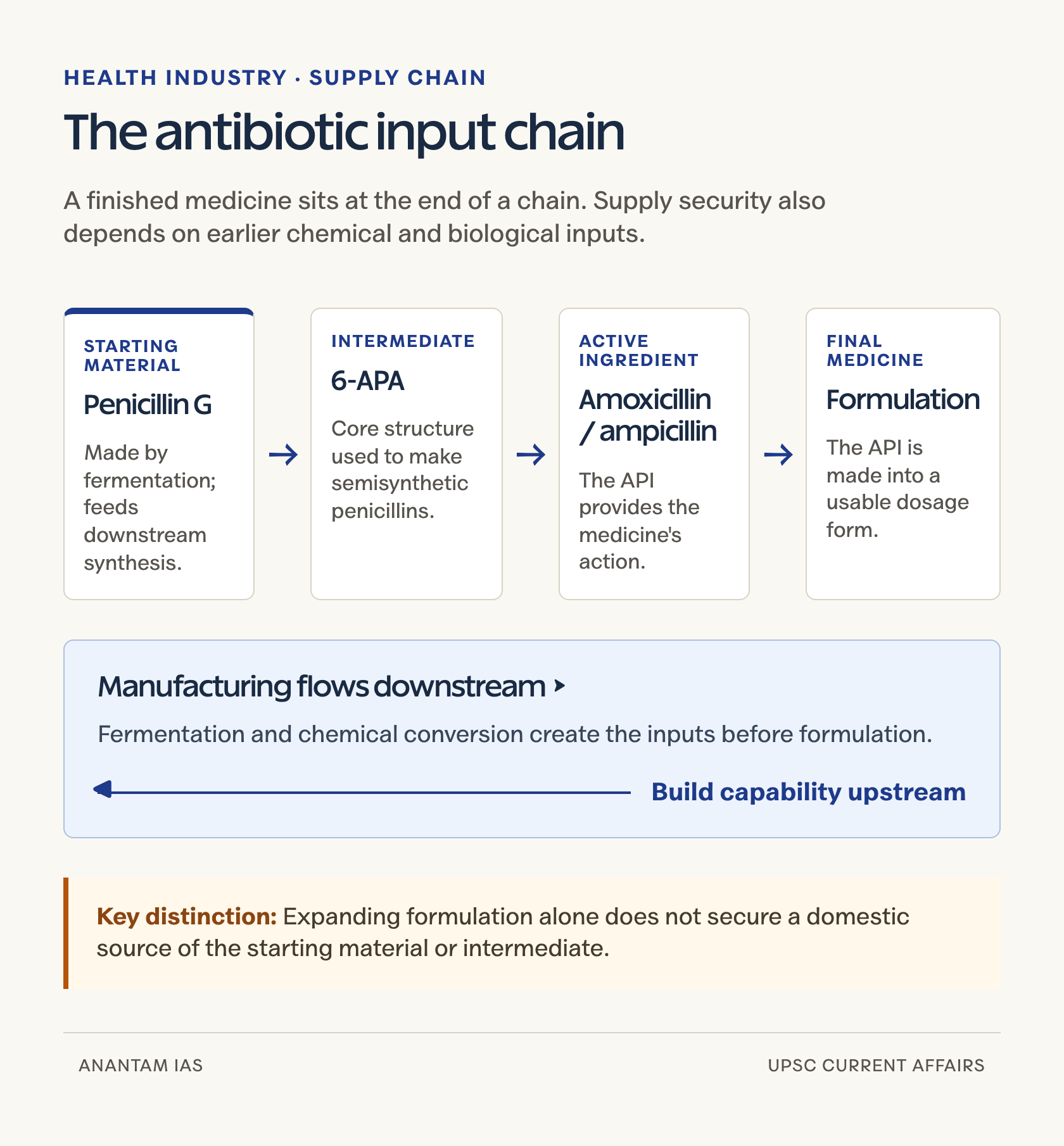
- A key starting material enters a production pathway and undergoes processing. Its strategic importance depends on whether downstream manufacturers have dependable alternatives when one supplier becomes unavailable.
- A drug intermediate is a partially processed material that needs further conversion or purification. It sits between starting materials and the active ingredient in the selected manufacturing route.
- The active pharmaceutical ingredient provides the intended pharmacological activity. A formulation turns that ingredient into a usable dosage form, such as a tablet, with appropriate additional ingredients.
- The release identifies Penicillin G as a fermentation-derived starting material for 6-APA, an intermediate used in making semisynthetic antibiotics including amoxicillin and ampicillin.
- Backward integration extends domestic capability towards earlier production stages. Making formulations locally while importing their critical starting material leaves that upstream point exposed to external disruption.
Why fermentation capacity is a distinct capability
Fermentation uses living production systems, adding biological process control to the challenge of manufacturing medicines consistently at industrial scale.
- In fermentation, microorganisms produce a desired substance under controlled conditions. The product must then be recovered and purified; a filled reactor is not yet a finished medicine.
- Temperature, nutrients and oxygen supply influence production. Process discipline must continue across batches, so expanding equipment capacity also requires maintaining reliable operating conditions and trained technical teams.
- Contamination control protects the process from unwanted organisms. Purification addresses unwanted material after production; these solve related but different problems in obtaining a suitable pharmaceutical ingredient.
- The commissioning update includes both fermentation-based and chemically synthesised inputs. Supporting bulk drugs consequently involves several manufacturing capabilities rather than a single interchangeable factory technology.
- A useful distinction is production capacity versus process capability: capacity describes potential volume, while capability includes obtaining material that consistently meets the required identity and quality.

Two inputs with different roles in antibiotic production
Penicillin G and clavulanate illustrate why a supply-chain article must distinguish the role of an input from its final clinical use.
- Penicillin G supports the upstream pathway to semisynthetic penicillins. Its domestic production can strengthen access to an input used by manufacturers at later stages of the chain.
- Clavulanate inhibits beta-lactamase enzymes that can disable certain antibiotics. The release describes combining it with penicillin-group antibiotics such as amoxicillin to protect their effectiveness against susceptible mechanisms of resistance.
- The two examples address different supply requirements: one supplies a starting point for further manufacture; the other supplies a component used in selected antibiotic combinations.
- Greater domestic availability does not make an antibiotic effective against every resistant organism. Manufacturing resilience and appropriate antibiotic use remain distinct public-health questions, each requiring its own safeguards.
- Health security also includes access arrangements discussed in pandemic benefit-sharing; producing an input alone cannot resolve every barrier between a medicine and a patient.
How to judge whether backward integration works
The next analytical step is to test whether commissioned plants translate into dependable supply, rather than treating announced capacity as the final outcome.
- Installed capacity is potential output, while realised production depends on operation, demand and process performance. The commissioning update establishes new facilities but does not prove continuous full-capacity utilisation.
- Domestic value addition asks how much production value is created locally. A local final-stage operation can still depend on imported inputs, equipment or other essential upstream supplies.
- Import substitution is most useful when it reduces a critical bottleneck. Continued dependence elsewhere in the chain means one successful project cannot establish complete pharmaceutical self-sufficiency.
- Quality assurance must accompany greater output. As with pharmacopoeial standards, identifying what a product must contain is separate from assuming every manufactured batch satisfies that requirement.
- A strong assessment connects reliable supply, competitive cost and consistent quality. Incentive-supported investment becomes durable when manufacturers can maintain these conditions beyond the initial commissioning milestone.
Way Forward
Measure supply resilience after commissioning
- Track actual production and supply continuity alongside capacity, with product-specific assessment of the upstream bottlenecks that remain.
- Strengthen process skills and quality systems so domestic output remains reliable across batches and production cycles.
- Combine domestic capability with supplier diversification to reduce concentration risks rather than shifting dependence to another single source.
- Evaluate cost and availability for downstream manufacturers, while preserving quality controls and appropriate antibiotic-use safeguards.
Conclusion
- Backward integration makes medicine production more resilient when it secures an otherwise vulnerable upstream stage; local formulation capacity alone is an incomplete measure of independence.
- Use this update to connect industrial policy with health security, while distinguishing commissioned capacity from sustained production, reliable quality and patient access.
UPSC Practice Questions
Prelims MCQ 1
With reference to pharmaceutical manufacturing, consider the following statements:
- Penicillin G can serve as a starting material for producing intermediates used in semisynthetic penicillins.
- A finished formulation and an active pharmaceutical ingredient necessarily describe the same production stage.
- Backward integration can reduce exposure to an upstream supply bottleneck.
How many of the above statements are correct?
(a) Only one (b) Only two (c) All three (d) None
Answer: (b) Only two
Explanation:
Statements 1 and 3 are correct. An API supplies pharmacological activity; formulation prepares the medicine in a usable dosage form. They are distinct stages.
Prelims MCQ 2
Which statement best describes the role of clavulanate in selected antibiotic combinations?
(a) It replaces every antibiotic ingredient. (b) It eliminates all forms of antimicrobial resistance. (c) It inhibits beta-lactamase enzymes that can disable certain antibiotics. (d) It converts a tablet into a drug intermediate.
Answer: (c) It inhibits beta-lactamase enzymes that can disable certain antibiotics.
Explanation:
Clavulanate is a beta-lactamase inhibitor used with certain antibiotics. This mechanism does not overcome every form of antimicrobial resistance.
UPSC Mains Questions
- Explain how backward integration in bulk-drug manufacturing can strengthen India’s health security. What indicators should be used beyond installed capacity?
- Distinguish fermentation capability from final formulation capacity. Discuss why industrial support for pharmaceutical inputs must be accompanied by quality assurance.
Sources: PIB, Department of Pharmaceuticals and US FDA, ICH Q7A manufacturing guidance.
Frequently Asked Questions
What is backward integration in pharmaceutical manufacturing?
It means developing capability at earlier stages of production, such as making a critical starting material or intermediate domestically. This can reduce the vulnerability of downstream API and formulation manufacturers.
Is the September 2026 update a new PLI scheme?
No. The Department of Pharmaceuticals reported commissioned facilities and production under the existing bulk-drug PLI scheme. The development concerns manufacturing progress, rather than the launch of a new incentive programme.
Why does fermentation capacity matter?
Some pharmaceutical inputs are produced using microorganisms under controlled conditions. Domestic fermentation capability can secure these inputs, but reliable output also depends on contamination control, recovery, purification and consistent process performance.
Do new bulk-drug plants prove complete import independence?
No. A commissioned plant adds capability for specified products. Assessing independence also requires evidence on actual output, remaining imported inputs, supplier concentration, quality and the continuity of supply to downstream manufacturers.
Source: https://anantamias.com/current-affairs/bulk-drug-pli-backward-integration-fermentation-inputs/
Quad-at-Sea: Coast Guard Learning Through Shipboard Observation
Why in News?
Indian Coast Guard ship Shaunak sailed from Chennai for Perth on 25 September 2026, beginning the Quad-at-Sea Ship Observer Mission.
- Six sea riders embarked: two officers each from India and Japan, and one each from Australia and the United States.
- The programme involves shipboard activities and professional exchanges, with interoperability, coordination and mutual trust identified as objectives.
- The PIB release records departure and intended cooperation; it does not report a completed mission or measured operational results.
- Shared procedures can make maritime cooperation more practical, because different services must understand how partners communicate and make decisions.
- An observer exchange offers a focused example of institution-building through professional contact, while leaving national responsibilities intact.
UPSC Relevance
Prelims Relevance
- Quad participants: India, Australia, Japan and the United States.
- Shaunak: Indian Coast Guard ship carrying the mission’s sea riders.
- Embarked observers: personnel placed aboard a host ship for observation and professional exchange.
- Coast guard functions: maritime safety, law enforcement, assistance to distressed fishermen and marine-environment protection.
Mains Relevance
GS Paper 2
- Functional maritime cooperation within the Quad.
- Professional exchanges as a means of building institutional trust.
GS Paper 3
- Coordination for maritime safety and security while respecting jurisdiction.
Essay
- Trust becomes useful when institutions learn how to work together.
Background and Context
What a ship observer mission does
Embarked observation exposes visiting personnel to how a partner service operates aboard a working ship.
- A sea rider joins the host vessel rather than bringing a separate national ship. Here, officers from all Quad countries share one platform for professional exchanges.
- The learning opportunity comes from seeing procedures in context: how personnel organise work, communicate requirements and respond to operating conditions, rather than only describing those routines at meetings.
- The release confirms shipboard activities but supplies no detailed training schedule. Particular rescue drills, boarding operations or surveillance exercises should not be presented as verified components of this voyage.
- Observers can compare familiar practices with a partner’s approach and identify questions for follow-up. This is a potential learning pathway, rather than an outcome already demonstrated by departure.
- The news concerns the start of an exchange. Arrival, completion, subsequent exercises and changes to standard procedures would each require separate evidence before being reported as accomplished.

How observation can become operational learning
Experience becomes institutional capacity only when participants can carry relevant lessons back into their own organisations.
- Interoperability means being able to work together effectively. Compatible equipment helps, but personnel also need a shared understanding of messages, responsibilities and the sequence of a coordinated response.
- A useful debrief would distinguish practices that transfer easily from those dependent on the host service’s equipment, staffing or rules. Copying a procedure without those conditions may fail.
- For example, partners discussing a hypothetical distress incident could identify the information needed for coordination. This illustrates the learning mechanism; it is not a reported activity of this mission.
- Professional contacts can help officers understand whom to approach and what information to provide. Such familiarity supports coordination but cannot replace formal communication channels or responsible authorities.
- Institutional follow-through matters more than attendance alone: lessons need review, suitable training and later assessment. Participation counts cannot establish that services will coordinate successfully during an actual emergency.
Why coast guard cooperation matters
Coast guard cooperation connects external partnerships with practical protection of people, resources and the marine environment.
- The Indian Coast Guard’s official charter includes assistance to fishermen in distress. Maritime cooperation can be assessed through this public-service lens alongside wider security objectives.
- Marine-environment protection and pollution response also require coordination. Understanding another service’s working methods can be relevant when discussing support, although this announcement creates no particular response arrangement.
- Maritime law enforcement differs from combat operations in purpose and procedure. Officers need clarity about the applicable mandate, permitted actions and the authority responsible for decisions.
- The Indian Coast Guard is an Armed Force of the Union, according to its official description. Its safety and enforcement responsibilities should not be confused with being an unarmed civilian agency.
Observer exchange, exercise and patrol: keep the categories clear
The activity announced determines the claim an answer can safely make about maritime cooperation.
- An observer exchange places personnel aboard a host platform for learning. A combined exercise involves planned activities undertaken together; the terms should not be used interchangeably.
- The earlier SLINEX note concerns naval exercise phases. This mission instead provides an example of coast guard personnel learning through an embarked exchange.
- The Colombo Security Conclave tabletop note examines scenario-based discussion. Shipboard observation adds exposure to an operating environment, without making every shared voyage an exercise.
- A joint patrol or enforcement mandate cannot be inferred from foreign officers boarding Shaunak. The release announces an observer mission and gives no new authority to police another country’s waters.
- The Quad participants’ cooperation here does not establish a collective-defence obligation. Describe the specific maritime activity rather than treating this announcement as evidence of a new military alliance.
Way Forward
Turn exposure into testable improvements
- Use structured debriefs to record transferable lessons, procedural differences and questions requiring clarification by each service.
- Convert suitable lessons into training objectives, then assess communication and coordination in authorised follow-up activities.
- Keep information-sharing and command responsibilities explicit so professional familiarity supports accountable decisions.
- Report verified outcomes after the mission, separating participation from demonstrated improvements in operational coordination.
Conclusion
- Quad-at-Sea illustrates how a small embarked exchange can support practical maritime cooperation through observation, professional contact and institutional learning.
- In an answer, connect interoperability to procedures and follow-through, while keeping observer participation distinct from completed results, combat exercises and new enforcement powers.
UPSC Practice Questions
Prelims MCQ 1
With reference to the Quad-at-Sea Ship Observer Mission announced in September 2026, consider the following statements:
- Shaunak sailed from Chennai for Perth.
- The embarked sea riders included officers from India, Japan, Australia and the United States.
- The announcement granted participants a new joint maritime enforcement mandate.
How many of the above statements are correct?
(a) Only one (b) Only two (c) All three (d) None
Answer: (b) Only two
Explanation:
The first two statements match the PIB release. It announces shipboard activities and professional exchanges, without granting a new joint enforcement mandate.
Prelims MCQ 2
Which best describes the purpose of an embarked observer exchange?
(a) Automatically transferring command of the host vessel (b) Establishing a collective-defence obligation (c) Learning partner practices through shipboard observation and professional exchange (d) Granting unrestricted enforcement rights in foreign waters
Answer: (c) Learning partner practices through shipboard observation and professional exchange
Explanation:
The exchange supports familiarity, coordination and interoperability. Participation alone does not confer command, treaty obligations or foreign enforcement authority.
UPSC Mains Questions
- How can coast guard observer exchanges contribute to practical maritime cooperation? Discuss the institutional follow-through needed to convert participation into capacity.
- Distinguish an embarked observer exchange from a combined exercise and a joint patrol. Why do these distinctions matter when assessing Indo-Pacific cooperation?
Sources: PIB, Ministry of Defence and Indian Coast Guard: Charter of Duties.
Frequently Asked Questions
What is the Quad-at-Sea Ship Observer Mission?
It is an embarked professional exchange involving officers from Quad countries aboard Indian Coast Guard ship Shaunak. The announced objectives include improving interoperability, coordination and mutual trust through shipboard activities.
Which countries sent sea riders aboard Shaunak?
India and Japan contributed two officers each, while Australia and the United States contributed one each. The six sea riders embarked for the observer mission as Shaunak sailed from Chennai for Perth.
Is this mission a combined combat exercise?
The official release describes a ship observer mission involving professional exchanges and shipboard activities. It does not identify a combined combat exercise, announce a joint patrol or confer new maritime enforcement authority.
What should determine whether an observer exchange is useful?
Its value should be assessed through relevant lessons, institutional follow-through and later improvements in coordination. The announcement of departure or the number of participating officers alone cannot demonstrate those operational outcomes.
Source: https://anantamias.com/current-affairs/quad-at-sea-coastguard-observer-operational-learning/
ECI SIR Decisions: Doorstep Verification and Statutory Control
Why in News?
On 26 September 2026, the Election Commission approved doorstep document collection during Special Intensive Revision (SIR), exceptional hearings and a review of ECINET’s statutory compliance.
- BLOs will collect documents at home from persons issued notices for being unmapped or having logical discrepancies, then upload them for the ERO’s decision.
- Hearings will be exceptional, as decided by the ERO, and preferably online; electors may authorise an adult family member to represent them.
- District Election Officers must arrange help desks or special camps for vulnerable groups according to need.
- An ECINET review committee, including an independent IIT/IIIT expert, will examine compliance with the Acts and Rules and report to the Commission.
- Administrative access matters when travel costs, lost wages or difficulty obtaining documents make an otherwise available procedure hard to use.
- Digital permissions must reflect the powers of election officials; an upload or software flag cannot substitute for the authorised decision.
UPSC Relevance
Prelims Relevance
- BLO: Booth Level Officer; the announcement assigns home visits, document collection and upload.
- ERO: Electoral Registration Officer; documents are uploaded for this officer’s decision.
- DEO: District Election Officer; responsible for arranging adequate help desks and special camps as required.
- ECINET: the digital system whose role-based access and compliance with electoral law are to be reviewed.
- Family representation: an elector may authorise an adult family member to attend a required hearing.
Mains Relevance
GS Paper 2
- Electoral administration: balance roll verification with practical access for vulnerable electors.
- Institutional accountability: align software permissions, field discretion and review with statutory powers.
Essay
- Democratic participation depends on whether administrative procedures can actually be used.
Background and Context
What changes at the voter's doorstep?
The decision changes how documents reach the deciding officer when specified discrepancies trigger a notice during the ongoing revision.
- The announced home-visit procedure covers people issued notices for being unmapped or having logical discrepancies. It should not be described as a universal waiver of document requirements for every electoral application.
- The BLO collects and uploads the documents to ECINET for the ERO’s decision. Collection is an evidentiary step: receiving papers at the doorstep does not itself determine inclusion in the electoral roll.
- Such persons need not attend the ERO/AERO office for a routine hearing. This can reduce repeated travel and lost work time, especially where the office is distant or transport is costly.
- An exceptional hearing remains possible when the ERO decides it is needed, preferably online. The release also calls for stronger online-hearing facilities; it does not guarantee that connectivity barriers have already disappeared.
- An elector may authorise an adult family member to attend a necessary hearing. This is representation on the elector’s behalf, rather than a transfer of the official’s responsibility to assess the case.

Access still needs an accountable decision
Easier submission must lead to a traceable decision, while people who cannot use the usual channels need practical assistance.
- DEOs must organise help desks or camps for people in night shelters, labourers, poor people and homeless persons as needed. Their purpose is to make the process reachable beyond ordinary office-based access.
- The release allows left-out electors and first-time voters to apply to the concerned ERO through continuous updating, and directs a special enrolment drive. This avenue should not be confused with automatic enrolment.
- The earlier draft-roll deletion analysis concerns aggregate changes. The present issue is case-level procedure: how a notified individual supplies evidence and receives consideration from the responsible official.
- A useful implementation test is whether documents collected during a visit appear correctly in the case record. Missing uploads or unreadable scans could defeat doorstep access even when a visit was completed.
- The broader inclusion problem also appears in tenant-farmer registries: record mismatches require a workable correction route. The analogy concerns administrative design; electoral eligibility continues to follow its own governing framework.
Why review the software against the law?
A digital system can channel official decisions, so its permissions must preserve the authority assigned by law.
- According to the Commission, field officers have role-based ECINET access corresponding to their statutory powers. The proposed review will double-check compliance; announcing it is not evidence that compliance has already been independently established.
- The committee will be headed by a Senior Deputy Election Commissioner and include an independent expert from IIT/IIIT. It must review the system and submit its report to the Commission for consideration.
- The Commission says portal upgrades have already followed State Chief Electoral Officers’ inputs and further necessary flexibility will be enabled. Operational convenience must still fit the powers assigned to each official role.
- Future IT modules and portals must first be discussed in the Committee of Officers before Commission approval. This adds an internal scrutiny stage; it does not turn a committee discussion into final approval.
- The practical governance question is whether software rules let the authorised officer consider evidence and exercise permitted judgment. A mismatch flag should prompt the prescribed process, rather than become an unexplained final outcome.
Way Forward
Make each case traceable
- Give electors a receipt or acknowledgement that identifies collected documents and the next step, with an accessible route to report missing uploads.
- Test online and assisted hearings with people facing connectivity or mobility barriers, and record whether authorised family representation works in practice.
- Review permissions and decision logs against statutory roles, including whether officers can correct erroneous flags without losing the audit trail.
- Assess help-desk coverage through unresolved cases and successful access, rather than counting camps alone.
Conclusion
- Doorstep verification can lower the burden of supplying evidence, but its value depends on accurate upload, accessible hearings and a decision by the responsible authority.
- ECINET’s review links technology governance to electoral accountability: software should preserve statutory roles and usable procedures, while the announced review remains a pending exercise.
UPSC Practice Questions
Prelims MCQ 1
With reference to the ECI’s September 2026 SIR decisions, consider the following statements:
- BLOs will upload documents collected during specified home visits for the ERO’s decision.
- Every person covered by the doorstep procedure must attend a physical office hearing.
- An elector may authorise an adult family member to attend a required hearing.
How many of the above statements are correct?
(a) Only one (b) Only two (c) All three (d) None
Answer: (b) Only two
Explanation:
Statements 1 and 3 are correct. Hearings are exceptional, as decided by the ERO, and preferably online; routine physical office attendance is not required for the specified cases.
Prelims MCQ 2
What is the announced purpose of the ECINET review committee?
(a) To replace ERO decisions with automatic inclusion (b) To transfer all electoral decisions to an IIT (c) To examine compliance with the Acts and Rules and report to the Commission (d) To certify that every existing entry is valid
Answer: (c) To examine compliance with the Acts and Rules and report to the Commission
Explanation:
The committee’s task is to double-check ECINET’s legal compliance. Its announcement neither completes the review nor transfers statutory decision-making powers.
UPSC Mains Questions
- How can doorstep document collection and assisted hearings improve electoral inclusion? Discuss the implementation safeguards needed to make these measures effective.
- Digital platforms used by constitutional institutions must preserve statutory authority. Examine this proposition with reference to role-based access and the proposed ECINET review.
Source: PIB, Election Commission of India.
Frequently Asked Questions
Who collects the documents under the announced SIR procedure?
BLOs will visit people issued notices for being unmapped or having logical discrepancies, collect their documents and upload them to ECINET. The documents go to the ERO for a decision.
Does doorstep collection guarantee electoral-roll inclusion?
No. Collection and upload provide evidence for the ERO’s consideration. The announcement changes the submission procedure for specified cases; it does not say that handing over documents automatically settles an elector’s inclusion.
Can a family member attend a hearing?
Yes. The elector may authorise an adult family member to attend a required hearing on their behalf. Hearings are exceptional, as decided by the ERO, and are preferably held online.
Has the ECINET compliance review been completed?
The release announces a committee-led review and a report to the Commission. It does not report a completed independent finding. The committee includes an independent expert from IIT or IIIT.
Source: https://anantamias.com/current-affairs/eci-sir-doorstep-documents-ecinet-statutory-review/
RuTAG 2.0: Field Validation Before Rural Technology Scale-Up
Why in News?
The third annual review of RuTAG 2.0, held at IIT Roorkee on 24–25 September 2026, examined field validation and pathways for wider rural technology adoption.
- The Office of the Principal Scientific Adviser reviewed cumulative progress across all seven RuTAG centres.
- Discussions covered user feedback, measurable outcomes, fabrication pathways and institutional partnerships.
- The review stressed that affordability must preserve quality, reliability, safety and durability.
- This was a programme review; the release does not establish that every showcased technology has achieved commercial scale.
- A working prototype still needs evidence that rural users can operate, maintain and afford it under everyday conditions.
- The policy question is who supports sustained use after researchers complete development or demonstration.
UPSC Relevance
Prelims Relevance
- RuTAG stands for Rural Technology Action Group.
- RuTAG connects technical institutions with rural technology needs.
- RuTAG 2.0 places emphasis on field engagement, validation, commercialisation and wider application.
- Field validation examines performance in actual use conditions.
- Local fabrication and maintenance capacity affect the feasibility of continued adoption.
Mains Relevance
GS Paper 3
- Appropriate technology, rural livelihoods and translation of research into practical applications.
- Local manufacturing, repair capacity and sustainable technology adoption.
GS Paper 2
- Institutional coordination between researchers, producer organisations, state governments and enterprises.
Essay
- Innovation succeeds when its users can keep it working.
Background and Context
What RuTAG connects
RuTAG connects scientific capability with practical rural needs; the review asks whether that connection survives beyond a successful demonstration.
- Rural Technology Action Group is an initiative of the Office of the Principal Scientific Adviser. Its purpose connects technical expertise with problems identified in rural communities, rather than treating equipment supply as sufficient.
- User engagement helps define the actual task: who performs it, what causes difficulty and which constraints matter. A technically impressive modification can miss the problem if users cannot fit it into daily work.
- RuTAG 2.0 emphasises field engagement, validation and wider application. The annual review examined progress and future pathways; it did not announce a fresh programme launch or certify universal adoption of participating projects.
- Co-development should let users influence design changes. This engineering focus complements the agronomic advice and dissemination discussed in Krishi Vigyan Kendra extension, while serving a different immediate purpose.
Why field validation needs repeated user feedback
Field validation tests whether a technology remains useful when ordinary operators encounter real materials, working conditions and interruptions.
- Laboratory performance establishes what a design can do under specified conditions. Field use adds variable inputs, uneven infrastructure and different working habits, revealing weaknesses that a controlled demonstration may leave hidden.
- Baseline comparison should ask what changes relative to the existing practice. Relevant measures might include effort, output quality, operating cost or downtime; these are evaluation choices, not outcomes reported for every RuTAG project.
- User feedback must lead to a decision: retain the design, modify a component or abandon an unsuitable approach. Collecting testimonials alone cannot explain whether the equipment solves its intended problem consistently.
- Representative trials should include the intended operators and relevant seasons or settings. Success with a trained project team does not automatically show that unfamiliar users can safely repeat the same performance.
Maintainability changes the affordability calculation
A low purchase price can conceal an expensive technology if breakdowns require distant specialists or unavailable replacement parts.
- Total ownership cost includes operation, servicing and lost work during failure. An adoption assessment should examine these burdens alongside the purchase price before describing a design as affordable for its intended users.
- Local fabrication can connect the design to nearby manufacturing capability. Clear specifications matter because uncontrolled substitutions can change performance, durability or safety, even when the finished equipment appears similar to the prototype.
- Repairability requires accessible components, suitable tools and people who understand routine faults. A maintenance plan should identify who supplies spares and provides assistance after the demonstration team leaves the community.
- Service continuity is also central to rural water maintenance. For RuTAG, the distinct lesson concerns adapting the equipment and its support system together, before expecting durable rural adoption.
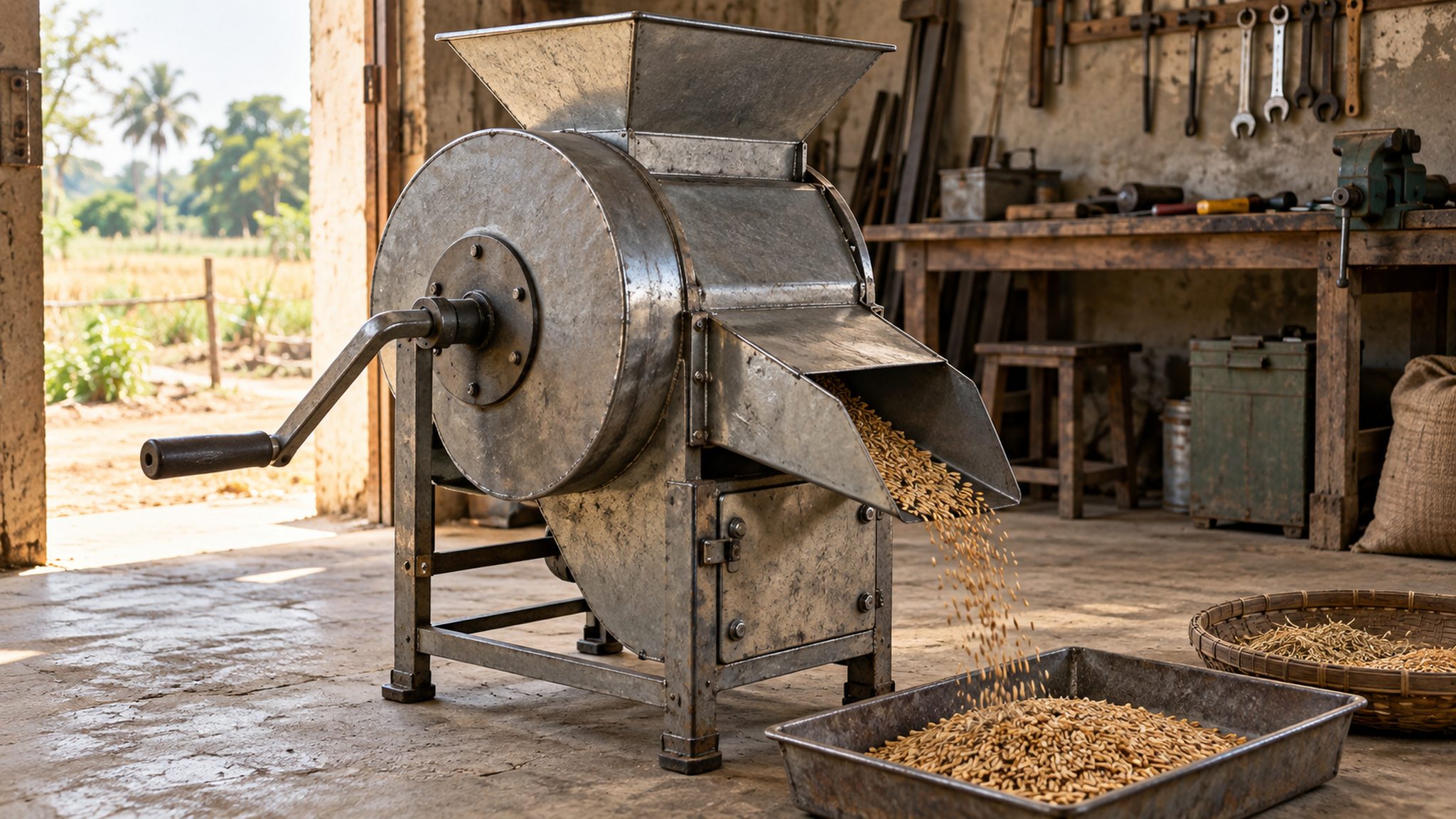
Who carries a mature technology into continued use?
Adoption needs an organisation able to take responsibility for production, access and support when research funding no longer carries the technology.
- Producer organisations may help aggregate demand and organise shared use. Their involvement still requires clear responsibility for access, scheduling and maintenance; collective ownership alone does not remove operational problems.
- Manufacturers and local fabricators can translate an accepted design into repeatable production. The review identified these actors among possible adoption partners; it did not report a single mandatory delivery model for all technologies.
- State governments, incubators and financial institutions can address different adoption barriers. Their role should follow the technology’s actual needs, rather than assuming the same package will work for every livelihood or region.
Way Forward
Make adoption evidence usable
- Record trial conditions and failures alongside benefits, so later users can judge whether the technology fits their setting.
- Assign maintenance responsibility, spare-parts supply and user training before expanding deployment.
- Track continued use and user experience after installation; compare these with the problem the technology was meant to solve.
Conclusion
- Rural innovation needs a chain of responsibility linking user needs, design revisions, dependable fabrication and continued support.
- Use RuTAG 2.0 to explain why adoption is an institutional and maintenance challenge as well as an engineering achievement.
UPSC Practice Questions
Prelims MCQ 1
With reference to RuTAG 2.0 and rural technology adoption, consider the following statements:
- RuTAG connects technical institutions with rural technology needs.
- Field validation can reveal problems absent in controlled demonstrations.
- The September 2026 review established that every RuTAG technology had reached commercial scale.
How many of the above statements are correct?
(a) Only one (b) Only two (c) All three (d) None
Answer: (b) Only two
Explanation:
The first two statements are correct. The review examined progress and wider adoption pathways; it did not establish commercial scale for every technology.
Prelims MCQ 2
Which factor best indicates that rural equipment is maintainable locally?
(a) A low initial purchase price alone (b) A successful exhibition demonstration (c) Available spares, suitable tools and trained repair support (d) A large number of prototype photographs
Answer: (c) Available spares, suitable tools and trained repair support
Explanation:
Maintainability depends on the ability to diagnose faults and restore operation. Purchase price or demonstration success alone cannot establish that capability.
UPSC Mains Questions
- Why does successful prototype development not guarantee rural technology adoption? Discuss with reference to RuTAG 2.0.
- Explain how local fabrication, repair capability and user participation can improve the sustainability of rural technological interventions.
Source: PIB, Office of the Principal Scientific Adviser.
Frequently Asked Questions
What is RuTAG?
RuTAG stands for Rural Technology Action Group, an initiative of the Office of the Principal Scientific Adviser that connects scientific and technical institutions with practical technology needs in rural communities.
What happened at the September 2026 review?
The third annual RuTAG 2.0 review at IIT Roorkee examined project progress, field validation, user feedback and adoption pathways. It was a review of ongoing work, rather than a new programme launch.
Why is field validation necessary?
Field validation examines how equipment performs with intended users in everyday conditions. It can reveal operating difficulties, unreliable components or unsuitable assumptions that remain hidden during a controlled demonstration by a trained project team.
Why does local repair matter for affordability?
Local repair can reduce downtime and dependence on distant specialists. An affordability assessment should include servicing, replacement parts and interrupted work alongside the purchase price, without assuming every locally produced design will automatically be reliable.
Source: https://anantamias.com/current-affairs/rutag-rural-technology-field-validation-adoption/
Farm Machinery Testing: From Equipment Claims to Verifiable Performance
Why in News?
An agricultural machinery testing facility was inaugurated at the International Centre for Automotive Technology (ICAT), Manesar, on 25 September 2026.
- The Ministry of Heavy Industries announced the inauguration through PIB, describing the facility as an expansion from automotive into agricultural testing and certification.
- The stated aim is reliable agricultural equipment; the announcement does not publish a detailed accredited test scope, list of applicable standards or product-wise certification procedure.
- No universal certification mandate for farm machines follows from this release. The opening of a facility and a legal requirement to use it are separate matters.
- Machinery purchases involve information asymmetry: manufacturers know more about equipment performance than buyers. Independent, interpretable test results can help farmers question claims before committing scarce capital.
- A machine must also suit its working conditions. Measured performance is useful evidence, but operating cost, local repair support and the intended farm task still shape a purchase decision.
UPSC Relevance
Prelims Relevance
- ICAT: International Centre for Automotive Technology, located at Manesar.
- Commercial testing: establishes performance characteristics of machines in, or ready for, commercial production.
- Batch testing: examines machines already tested or being commercially manufactured.
- User surveys: can assess durability and after-sales service under farmers’ operating conditions.
- Testing and certification: measurement and an assessment of conformity have different purposes.
Mains Relevance
GS Paper 3
- Agricultural mechanisation, productivity and appropriate technology.
- Quality infrastructure as a means of reducing farmers’ equipment risks.
GS Paper 2
- Transparent public testing services and evidence-based consumer protection.
Essay
- Trust in technology depends on evidence that users can understand.
Background and Context
How testing makes performance claims useful
The following principles explain machinery testing generally; they are not a list of capabilities announced for ICAT’s new facility.
- A useful test question names the work being assessed and the conditions of measurement. Saying a machine is powerful is less informative than specifying the task and recorded result.
- Comparable conditions matter when interpreting results. Differences in equipment configuration, operating settings or test conditions can make apparently similar figures unsuitable for a direct comparison between two machines.
- A test report should identify the tested model, method and limitations. Buyers need to know what was measured before treating a headline performance claim as evidence for their own purchase.
- The official Budni institute’s testing framework distinguishes commercial tests, which establish performance characteristics, from confidential tests supplying manufacturers with development information. These are examples from an existing institution.
- An equipment demonstration can show a machine working; documented testing makes the conditions and findings examinable. Neither should be interpreted as proof that every user will obtain identical results.

Performance, safety and certification answer different questions
A performance claim does not settle every question about a machine’s quality or permitted use.
- Performance concerns how equipment carries out its intended task. A result must be read with the operating conditions; a favourable finding on one parameter does not establish overall superiority.
- Safety assessment addresses hazards and protective requirements relevant to the equipment. It should not be inferred from a productivity result, a manufacturer’s reputation or the simple fact that testing occurred.
- Certification concerns conformity with specified requirements within an identified scope. The practical question is what the certificate covers, rather than whether an advertisement merely uses the word certified.
- Accreditation and the opening of a laboratory are also different claims. Readers should check the published scope before assuming that every agricultural machine or every test falls within it.
- For ICAT’s new facility, the release confirms inauguration and intended purpose. It does not establish the detailed standards, accreditation coverage or compulsory certification rules that an applicant would need to verify.
Why field suitability remains a separate decision
Controlled evidence supports farm decisions, while actual use reveals whether equipment fits the user’s work and support network.
- A purchase assessment should connect measured capability with the farm operation, available power and working conditions. Passing a specified test cannot itself decide whether ownership is economically sensible for a particular farmer.
- Budni’s framework includes user surveys within its batch-testing programme to examine durability and after-sales service at farmers’ fields. This illustrates why evidence from use complements initial performance measurements.
- Repair access matters because equipment that cannot be restored promptly may miss a seasonal operation. Purchase comparisons should examine service availability and consumable parts alongside the advertised machine specification.
- The Krishi Vigyan Kendra extension discussion offers a related policy link: local advice can help farmers translate technical information into choices suited to their conditions.
- The REWARD field-evidence approach illustrates a broader lesson: local validation improves implementation. It complements laboratory evidence without turning each farm observation into a formal certification result.
Way Forward
Make testing evidence usable
- Publish the facility’s service scope, applicable methods, application process and report limitations so that manufacturers and users know exactly what can be assessed.
- Provide plain-language report summaries alongside technical findings, distinguishing measured performance, assessed safety requirements and matters outside the test.
- Connect test results with local demonstrations and service information, helping farmers compare suitable purchase or hiring options rather than relying on promotional claims.
Conclusion
- Farm machinery testing can reduce information gaps when reports make conditions, results and limitations clear. The ICAT inauguration creates an institutional opportunity; outcomes will depend on the services actually delivered.
- For an answer on mechanisation, connect quality assurance with suitability and serviceability. Better machinery decisions require both credible technical evidence and a realistic assessment of the farmer’s operating needs.
UPSC Practice Questions
Prelims MCQ 1
With reference to agricultural machinery testing, consider the following statements:
- Commercial tests can establish the performance characteristics of machinery ready for commercial production.
- A favourable performance result necessarily proves conformity with every applicable safety requirement.
- User surveys can provide evidence about durability and after-sales service.
How many of the above statements are correct?
(a) Only one (b) Only two (c) All three (d) None
Answer: (b) Only two
Explanation:
Statements 1 and 3 match Budni’s published testing framework. Statement 2 is incorrect: performance findings do not automatically establish safety conformity beyond the assessed scope.
Prelims MCQ 2
Which conclusion is supported by the September 2026 announcement about ICAT?
(a) Every farm machine must now obtain certification exclusively from ICAT. (b) All agricultural testing laboratories have received identical accreditation. (c) An agricultural machinery testing facility was inaugurated at ICAT. (d) Field evaluation of agricultural machinery has been discontinued.
Answer: (c) An agricultural machinery testing facility was inaugurated at ICAT.
Explanation:
PIB confirms the inauguration. It announces neither an exclusive certification mandate nor universal accreditation, and it does not discontinue field evaluation.
UPSC Mains Questions
- How can independent machinery testing reduce information asymmetry in agricultural equipment markets? Discuss the limits of relying on test results alone.
- Distinguish machinery performance, safety conformity and field suitability. Suggest measures to make testing infrastructure more useful for farmers.
Sources: PIB, Ministry of Heavy Industries and Central Farm Machinery Training and Testing Institute, Budni.
Frequently Asked Questions
What did ICAT announce in September 2026?
PIB reported the inauguration of an indigenous agricultural machinery testing facility at ICAT, Manesar. The stated purpose is to support reliable equipment and expand the institution’s testing and certification work into agriculture.
Does every farm machine now need certification from ICAT?
The announcement does not establish such a requirement. It confirms a facility opening but does not set out an exclusive certification mandate, detailed standards list or product-wise compulsory certification procedure.
Why is performance testing different from safety assessment?
Performance testing examines how a machine carries out a task under specified conditions. Safety assessment examines relevant hazards and protective requirements. A favourable result in one area does not automatically establish conformity in the other.
Why do field observations matter after laboratory testing?
Field observations help explain durability, service support and suitability under actual operating conditions. They complement controlled results, allowing users to consider maintenance and local needs without assuming that one test predicts every farm’s experience.
Source: https://anantamias.com/current-affairs/icat-agricultural-machinery-testing-performance-safety/