Why in News?
African leaders and partners adopted a call for cross-border health preparedness and responsible AI use in New York on 25 September 2026, WHO reported the following day.
- The New York Call to Action seeks stronger cooperation on infectious threats across national borders.
- WHO highlighted the emerging Preparedness Data Exchange, which combines preparedness and risk information to assist decisions.
- The proposed approach combines national data control with sharing useful intelligence for collective readiness.
- The report describes a political commitment and intended capabilities; it provides no measured improvement in AI prediction or emergency outcomes.
- An alert crossing a border is useful only when the receiving authority can interpret, verify and act on it.
- Sharing information requires trust about its purpose, reliability and handling, alongside staff capable of responding.
UPSC Relevance
Prelims Relevance
- Preparedness intelligence: interpreted information supporting readiness and risk decisions.
- PDX: WHO Africa’s Preparedness Data Exchange.
- Points of entry: locations where travellers enter a country and relevant health screening can occur.
- AI-assisted analysis: analytical support whose outputs still require accountable assessment.
- National data control and cross-border intelligence sharing are compatible policy objectives.
Mains Relevance
GS Paper 2
- Cross-border health cooperation and the institutional conditions for timely alerts.
- Data governance, sovereignty and responsibility in shared public-health decisions.
GS Paper 3
- Assessing AI-assisted risk analysis without confusing technical capability with demonstrated performance.
Essay
- Shared risks require cooperation that earns public trust.
Background and Context
From a local signal to a useful cross-border warning
Preparedness intelligence turns observations into a decision about what to check, where to prepare and whom to notify.
- A signal is a reason to investigate, rather than confirmation of an outbreak. Consider an unusual cluster of illness near a crossing: its significance depends on verification and surrounding circumstances.
- A practical alert should explain the suspected threat, relevant location and uncertainty. Sending an unexplained risk score gives neighbouring officials too little information to judge what response the evidence actually supports.
- Comparable reporting makes warnings interpretable. If neighbouring services use different meanings for a suspected case, combining their reports can create an apparent change that reflects classification rather than a changing health threat.
- Response capacity completes the chain. Earlier information has limited value if officials cannot contact counterparts, investigate a signal or arrange necessary support; readiness should be assessed through these practical links in the chain.
- A useful feedback loop returns investigation findings to those who raised the alert. Correcting an unconfirmed signal prevents it from circulating indefinitely and helps reviewers improve later decisions without hiding uncertainty.
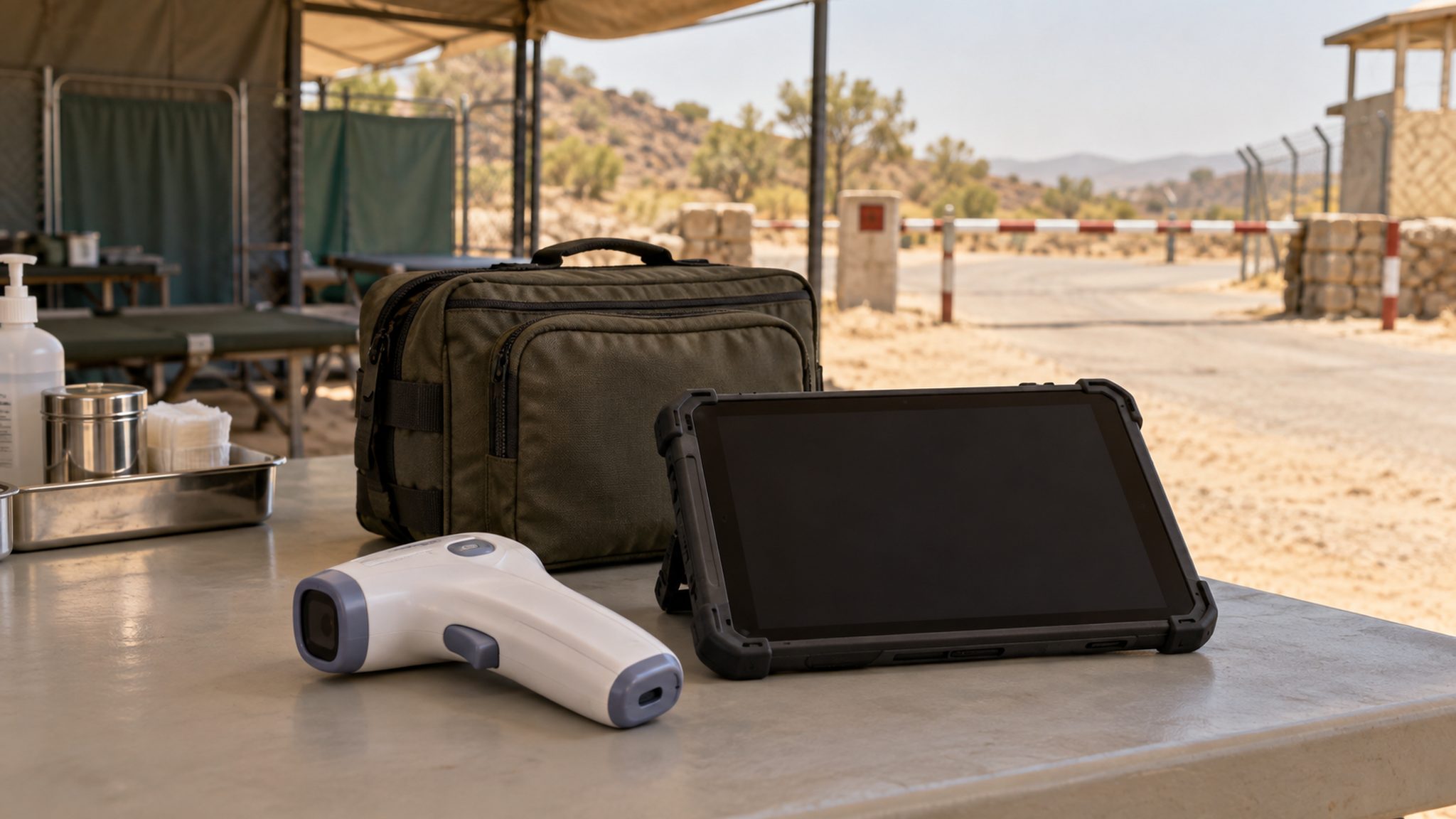
Sharing intelligence while retaining control
The WHO report states the policy objective; implementation still needs clear decisions about what is shared and who may use it.
- Purpose matters: a neighbouring authority may need a verified warning and readiness assessment. That need does not automatically justify unrestricted access to every underlying personal record collected during local health work.
- Control should be translated into operational rules: authorised recipients, permitted uses, correction procedures and responsibility for onward disclosure. These are governance questions for implementation, not confirmed technical features of the announced approach.
- A shared assessment needs enough context to be challenged. Recipients should understand missing observations, uncertain locations or reporting delays before comparing areas; apparently precise scores can conceal substantial gaps in the underlying evidence.
- The NHA research environment addresses governed research access. Here the immediate question is how authorities exchange actionable warnings across borders, rather than how researchers obtain permission to analyse protected records.
- PABS negotiations concern pathogen access and benefit sharing. This preparedness call should be studied separately: coordinating warnings does not settle negotiations over access to pathogen materials and the benefits connected with their use.
What responsible AI adds, and what must be demonstrated
WHO’s health-AI guidance makes ethics, human rights and accountability central to design, deployment and use.
- AI-assisted triage could help reviewers organise incoming information and identify patterns worth checking. A suggested priority remains an analytical output; officials need reasons and supporting evidence before escalating it into a response.
- Human accountability requires an identifiable authority to review consequential decisions. Calling a system intelligent should never obscure who can challenge its recommendation, correct an error or explain the response to affected communities.
- Unequal reporting creates an evaluation problem: areas with weak reporting can appear quieter. An assessment should examine where observations are missing before treating the absence of an alert as evidence of lower risk.
- Performance evidence should address missed threats as well as false alarms. A system producing many warnings can overwhelm staff; a quiet system can still fail to identify events that require urgent investigation.
- The test for adoption should compare usefulness under real working conditions, including delayed reports and limited staffing. This is an evaluation recommendation; the WHO announcement does not supply those results or certify a predictive model.
Way Forward
Make cooperation operational and auditable
- Agree on alert definitions, named contact points and correction procedures before relying on automated prioritisation.
- Specify permitted information flows and responsibilities for receiving, using and correcting shared intelligence.
- Test decision usefulness through exercises and independent evaluation, recording false alarms, missed threats and response bottlenecks.
- Fund local surveillance and response staff so improved analysis translates into practical readiness.
Conclusion
- Cross-border preparedness depends on usable information and a functioning response chain. The African initiative offers a cooperation framework, while reliable performance and enforceable handling rules remain matters to establish through implementation.
- For a Mains answer, connect early warning, accountable decisions and national data control. Assess whether cooperation makes action more timely without treating unrestricted data access or an AI label as evidence of success.
UPSC Practice Questions
Prelims MCQ 1
With reference to the New York Call to Action on Cross-Border Preparedness Intelligence in Africa, consider the following statements:
- It advocates stronger cooperation on cross-border health preparedness.
- Its proposed approach allows countries to retain control over their data while sharing preparedness intelligence.
- WHO’s announcement establishes a validated AI system with proven outbreak-prediction accuracy.
How many of the above statements are correct?
(a) Only one (b) Only two (c) All three (d) None
Answer: (b) Only two
Explanation:
The call supports cooperation and national data control. The announcement describes emerging capabilities, without providing validation results or predictive-accuracy evidence.
Prelims MCQ 2
Which situation best illustrates the distinction between a health signal and a verified warning?
(a) An automated risk score is treated as a confirmed diagnosis. (b) An unusual illness report is investigated before its implications are communicated to neighbouring authorities. (c) Missing reports are interpreted as proof that no health threat exists. (d) Every warning automatically authorises unrestricted disclosure of patient records.
Answer: (b) An unusual illness report is investigated before its implications are communicated to neighbouring authorities.
Explanation:
A signal calls for investigation. Verification and interpretation establish what can responsibly be communicated and acted upon; an unexplained score alone does not confirm an outbreak.
UPSC Mains Questions
- How can countries improve cross-border health intelligence while retaining control over sensitive data? Discuss the institutional conditions required.
- AI-assisted early warning cannot substitute for public-health capacity. Examine with reference to verification, accountability and response readiness.
Sources: WHO Regional Office for Africa and WHO: Ethics and governance of artificial intelligence for health.
Frequently Asked Questions
What is cross-border preparedness intelligence?
It is interpreted information that helps neighbouring authorities anticipate health risks and prepare responses. Its value depends on verification, shared understanding and practical arrangements for action across borders.
What is the Preparedness Data Exchange?
PDX is an emerging WHO Africa platform combining preparedness and risk information to support decisions. WHO describes AI-enabled capabilities intended to assist analysis and readiness, without reporting validated prediction outcomes in this announcement.
Does the call require unrestricted sharing of patient records?
WHO describes a proposed model that preserves countries’ control over their data while sharing useful preparedness intelligence. The report does not establish unrestricted access to personal records or specify every technical safeguard.
Does the announcement prove that AI predicts outbreaks reliably?
No. It reports commitments and intended analytical capabilities. Reliability would require evaluation of missed threats, false alarms and usefulness under actual operating conditions, with clear responsibility for consequential decisions.
Tell Google you want more of this.
Add Anantam IAS as a preferred sourceOne tap, and this site shows up more often in your own Top Stories, AI Overviews and AI Mode. Remove it any time.