Why in News?
On 25 September 2026, the Department of Pharmaceuticals reported commissioned bulk-drug facilities under PLI, highlighting domestic production of critical pharmaceutical inputs.
- The Penicillin G facility at Kakinada has installed capacity of 15,000 tonnes annually; the release reports restoration of domestic manufacturing after about three decades.
- A potassium clavulanate fermentation facility at Nalagarh adds 400 tonnes annually of installed capacity, according to the department.
- The update also covers Para Amino Phenol for paracetamol and cardiovascular APIs, showing investment across different stages of medicine production.
- Finished-medicine production can remain exposed to imported upstream inputs; an interruption before API manufacture can affect several downstream products.
- Commissioning demonstrates additional manufacturing capability. It does not establish full import independence, continuous output at rated capacity or guaranteed affordability.
UPSC Relevance
Prelims Relevance
- KSM: key starting material entering a pharmaceutical production pathway.
- Drug intermediate: material requiring further processing before the API is obtained.
- API: ingredient responsible for the intended pharmacological activity.
- Formulation: the medicine prepared in a usable dosage form.
- Penicillin G → 6-APA: a production pathway leading to semisynthetic penicillins.
- Clavulanate: a beta-lactamase inhibitor combined with certain antibiotics.
Mains Relevance
GS Paper 3
- Industrial policy: targeting upstream bottlenecks and assessing production incentives through sustained domestic value addition.
- Biotechnology: fermentation capability, process control and manufacturing resilience.
GS Paper 2
- Health security: connecting reliable medicine inputs with quality assurance and affordable access.
Essay
- Strategic autonomy depends on mastering production processes as well as expanding final-product output.
Background and Context
How the pharmaceutical chain fits together
A medicine reaches patients through linked transformations; strength at the final stage cannot automatically remove an earlier supply bottleneck.
- A key starting material enters a production pathway and undergoes processing. Its strategic importance depends on whether downstream manufacturers have dependable alternatives when one supplier becomes unavailable.
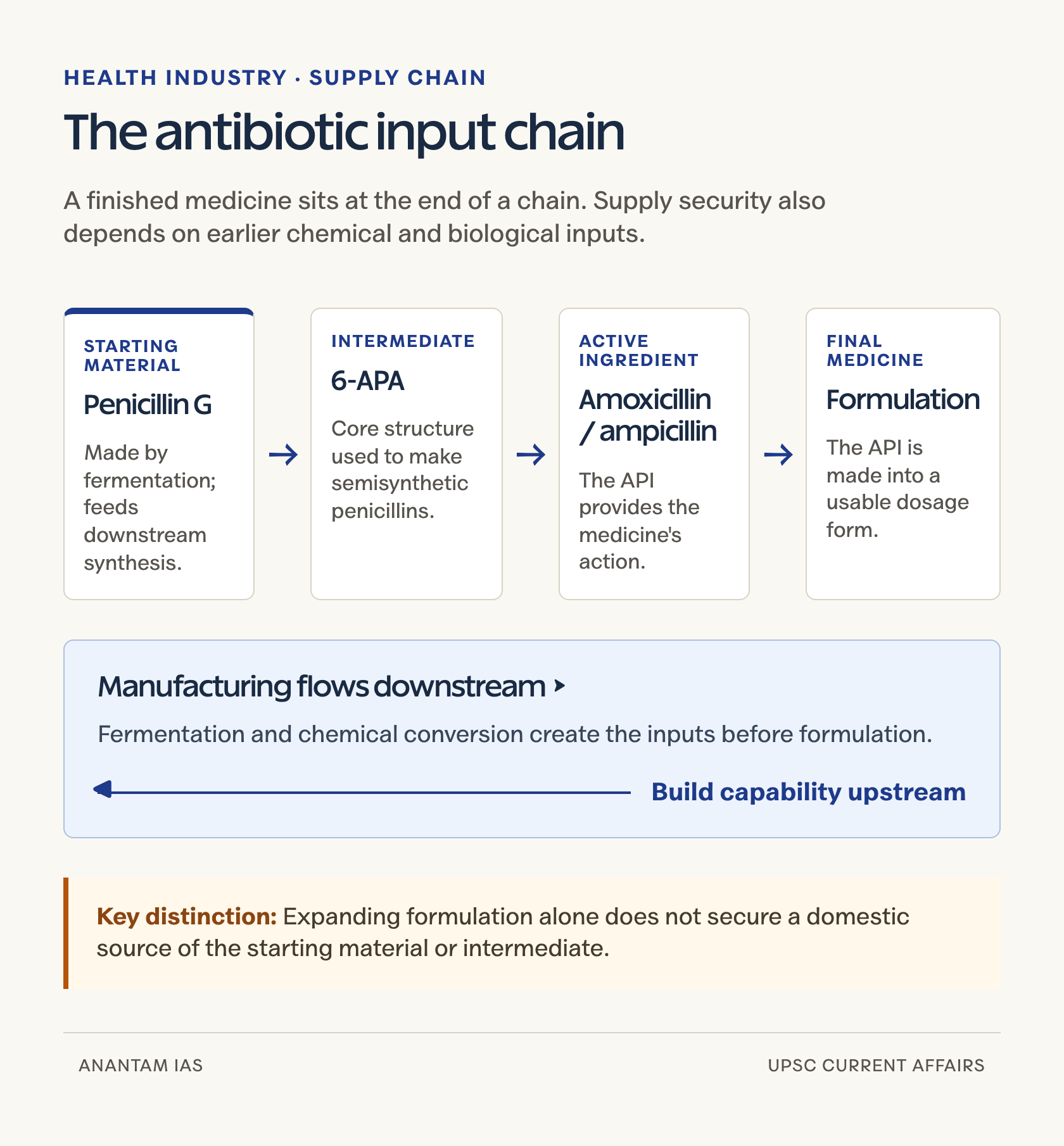
- A drug intermediate is a partially processed material that needs further conversion or purification. It sits between starting materials and the active ingredient in the selected manufacturing route.
- The active pharmaceutical ingredient provides the intended pharmacological activity. A formulation turns that ingredient into a usable dosage form, such as a tablet, with appropriate additional ingredients.
- The release identifies Penicillin G as a fermentation-derived starting material for 6-APA, an intermediate used in making semisynthetic antibiotics including amoxicillin and ampicillin.
- Backward integration extends domestic capability towards earlier production stages. Making formulations locally while importing their critical starting material leaves that upstream point exposed to external disruption.
Why fermentation capacity is a distinct capability
Fermentation uses living production systems, adding biological process control to the challenge of manufacturing medicines consistently at industrial scale.
- In fermentation, microorganisms produce a desired substance under controlled conditions. The product must then be recovered and purified; a filled reactor is not yet a finished medicine.
- Temperature, nutrients and oxygen supply influence production. Process discipline must continue across batches, so expanding equipment capacity also requires maintaining reliable operating conditions and trained technical teams.
- Contamination control protects the process from unwanted organisms. Purification addresses unwanted material after production; these solve related but different problems in obtaining a suitable pharmaceutical ingredient.
- The commissioning update includes both fermentation-based and chemically synthesised inputs. Supporting bulk drugs consequently involves several manufacturing capabilities rather than a single interchangeable factory technology.
- A useful distinction is production capacity versus process capability: capacity describes potential volume, while capability includes obtaining material that consistently meets the required identity and quality.
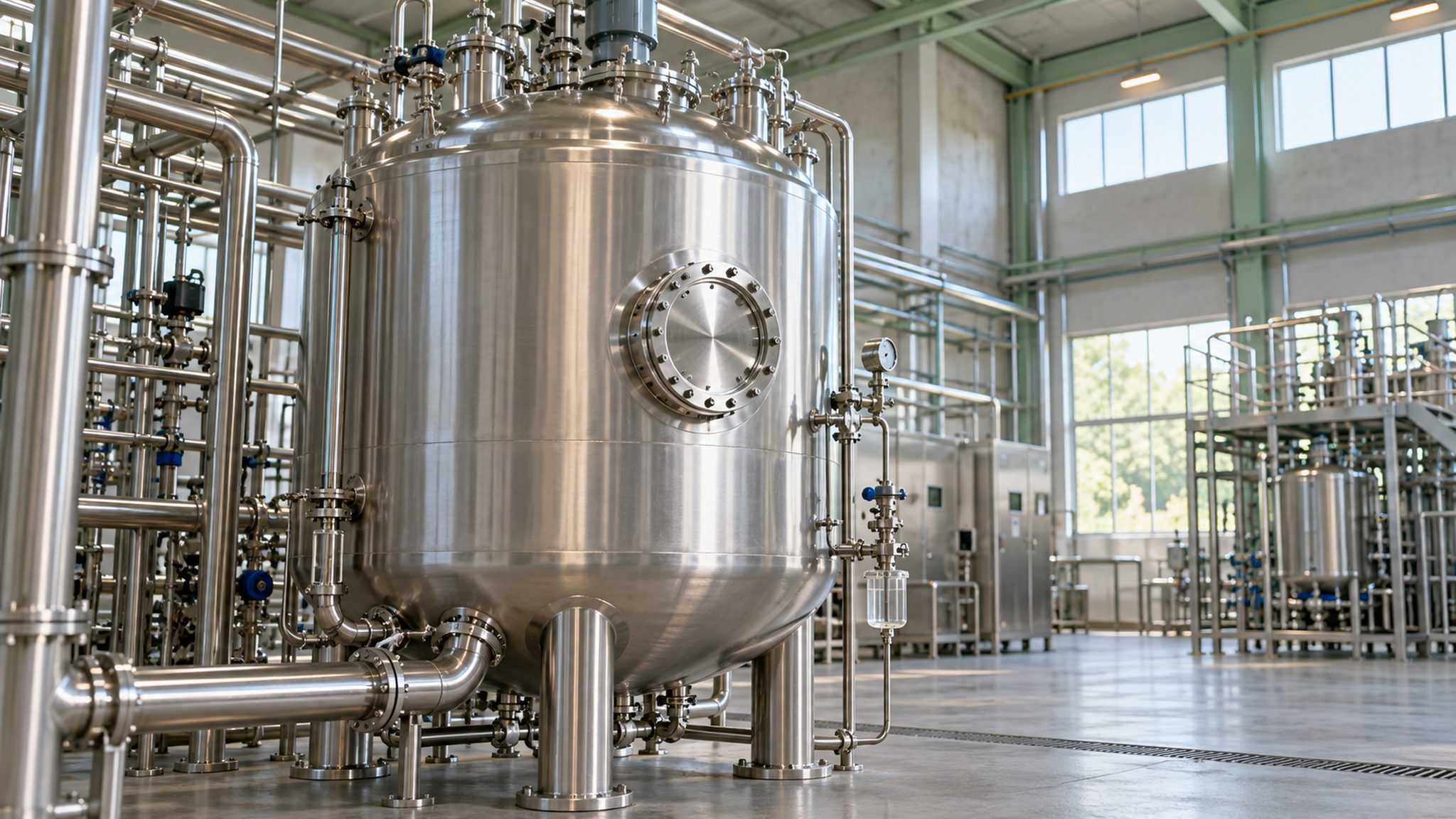
Two inputs with different roles in antibiotic production
Penicillin G and clavulanate illustrate why a supply-chain article must distinguish the role of an input from its final clinical use.
- Penicillin G supports the upstream pathway to semisynthetic penicillins. Its domestic production can strengthen access to an input used by manufacturers at later stages of the chain.
- Clavulanate inhibits beta-lactamase enzymes that can disable certain antibiotics. The release describes combining it with penicillin-group antibiotics such as amoxicillin to protect their effectiveness against susceptible mechanisms of resistance.
- The two examples address different supply requirements: one supplies a starting point for further manufacture; the other supplies a component used in selected antibiotic combinations.
- Greater domestic availability does not make an antibiotic effective against every resistant organism. Manufacturing resilience and appropriate antibiotic use remain distinct public-health questions, each requiring its own safeguards.
- Health security also includes access arrangements discussed in pandemic benefit-sharing; producing an input alone cannot resolve every barrier between a medicine and a patient.
How to judge whether backward integration works
The next analytical step is to test whether commissioned plants translate into dependable supply, rather than treating announced capacity as the final outcome.
- Installed capacity is potential output, while realised production depends on operation, demand and process performance. The commissioning update establishes new facilities but does not prove continuous full-capacity utilisation.
- Domestic value addition asks how much production value is created locally. A local final-stage operation can still depend on imported inputs, equipment or other essential upstream supplies.
- Import substitution is most useful when it reduces a critical bottleneck. Continued dependence elsewhere in the chain means one successful project cannot establish complete pharmaceutical self-sufficiency.
- Quality assurance must accompany greater output. As with pharmacopoeial standards, identifying what a product must contain is separate from assuming every manufactured batch satisfies that requirement.
- A strong assessment connects reliable supply, competitive cost and consistent quality. Incentive-supported investment becomes durable when manufacturers can maintain these conditions beyond the initial commissioning milestone.
Way Forward
Measure supply resilience after commissioning
- Track actual production and supply continuity alongside capacity, with product-specific assessment of the upstream bottlenecks that remain.
- Strengthen process skills and quality systems so domestic output remains reliable across batches and production cycles.
- Combine domestic capability with supplier diversification to reduce concentration risks rather than shifting dependence to another single source.
- Evaluate cost and availability for downstream manufacturers, while preserving quality controls and appropriate antibiotic-use safeguards.
Conclusion
- Backward integration makes medicine production more resilient when it secures an otherwise vulnerable upstream stage; local formulation capacity alone is an incomplete measure of independence.
- Use this update to connect industrial policy with health security, while distinguishing commissioned capacity from sustained production, reliable quality and patient access.
UPSC Practice Questions
Prelims MCQ 1
With reference to pharmaceutical manufacturing, consider the following statements:
- Penicillin G can serve as a starting material for producing intermediates used in semisynthetic penicillins.
- A finished formulation and an active pharmaceutical ingredient necessarily describe the same production stage.
- Backward integration can reduce exposure to an upstream supply bottleneck.
How many of the above statements are correct?
(a) Only one (b) Only two (c) All three (d) None
Answer: (b) Only two
Explanation:
Statements 1 and 3 are correct. An API supplies pharmacological activity; formulation prepares the medicine in a usable dosage form. They are distinct stages.
Prelims MCQ 2
Which statement best describes the role of clavulanate in selected antibiotic combinations?
(a) It replaces every antibiotic ingredient. (b) It eliminates all forms of antimicrobial resistance. (c) It inhibits beta-lactamase enzymes that can disable certain antibiotics. (d) It converts a tablet into a drug intermediate.
Answer: (c) It inhibits beta-lactamase enzymes that can disable certain antibiotics.
Explanation:
Clavulanate is a beta-lactamase inhibitor used with certain antibiotics. This mechanism does not overcome every form of antimicrobial resistance.
UPSC Mains Questions
- Explain how backward integration in bulk-drug manufacturing can strengthen India’s health security. What indicators should be used beyond installed capacity?
- Distinguish fermentation capability from final formulation capacity. Discuss why industrial support for pharmaceutical inputs must be accompanied by quality assurance.
Sources: PIB, Department of Pharmaceuticals and US FDA, ICH Q7A manufacturing guidance.
Frequently Asked Questions
What is backward integration in pharmaceutical manufacturing?
It means developing capability at earlier stages of production, such as making a critical starting material or intermediate domestically. This can reduce the vulnerability of downstream API and formulation manufacturers.
Is the September 2026 update a new PLI scheme?
No. The Department of Pharmaceuticals reported commissioned facilities and production under the existing bulk-drug PLI scheme. The development concerns manufacturing progress, rather than the launch of a new incentive programme.
Why does fermentation capacity matter?
Some pharmaceutical inputs are produced using microorganisms under controlled conditions. Domestic fermentation capability can secure these inputs, but reliable output also depends on contamination control, recovery, purification and consistent process performance.
Do new bulk-drug plants prove complete import independence?
No. A commissioned plant adds capability for specified products. Assessing independence also requires evidence on actual output, remaining imported inputs, supplier concentration, quality and the continuity of supply to downstream manufacturers.
Tell Google you want more of this.
Add Anantam IAS as a preferred sourceOne tap, and this site shows up more often in your own Top Stories, AI Overviews and AI Mode. Remove it any time.