Why in News?
On 26 September 2026, the Election Commission approved doorstep document collection during Special Intensive Revision (SIR), exceptional hearings and a review of ECINET’s statutory compliance.
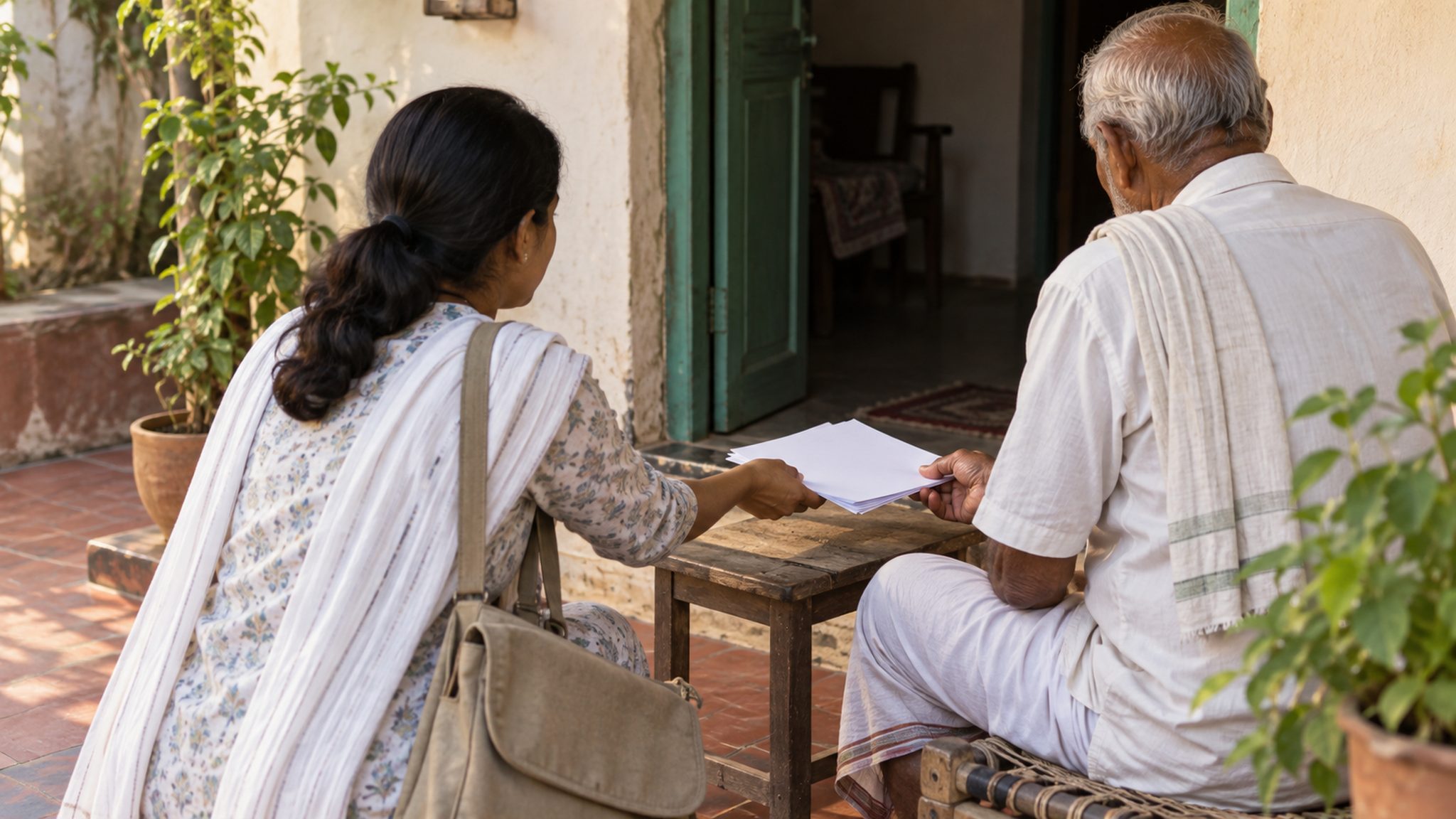
- BLOs will collect documents at home from persons issued notices for being unmapped or having logical discrepancies, then upload them for the ERO’s decision.
- Hearings will be exceptional, as decided by the ERO, and preferably online; electors may authorise an adult family member to represent them.
- District Election Officers must arrange help desks or special camps for vulnerable groups according to need.
- An ECINET review committee, including an independent IIT/IIIT expert, will examine compliance with the Acts and Rules and report to the Commission.
- Administrative access matters when travel costs, lost wages or difficulty obtaining documents make an otherwise available procedure hard to use.
- Digital permissions must reflect the powers of election officials; an upload or software flag cannot substitute for the authorised decision.
UPSC Relevance
Prelims Relevance
- BLO: Booth Level Officer; the announcement assigns home visits, document collection and upload.
- ERO: Electoral Registration Officer; documents are uploaded for this officer’s decision.
- DEO: District Election Officer; responsible for arranging adequate help desks and special camps as required.
- ECINET: the digital system whose role-based access and compliance with electoral law are to be reviewed.
- Family representation: an elector may authorise an adult family member to attend a required hearing.
Mains Relevance
GS Paper 2
- Electoral administration: balance roll verification with practical access for vulnerable electors.
- Institutional accountability: align software permissions, field discretion and review with statutory powers.
Essay
- Democratic participation depends on whether administrative procedures can actually be used.
Background and Context
What changes at the voter's doorstep?
The decision changes how documents reach the deciding officer when specified discrepancies trigger a notice during the ongoing revision.
- The announced home-visit procedure covers people issued notices for being unmapped or having logical discrepancies. It should not be described as a universal waiver of document requirements for every electoral application.
- The BLO collects and uploads the documents to ECINET for the ERO’s decision. Collection is an evidentiary step: receiving papers at the doorstep does not itself determine inclusion in the electoral roll.
- Such persons need not attend the ERO/AERO office for a routine hearing. This can reduce repeated travel and lost work time, especially where the office is distant or transport is costly.
- An exceptional hearing remains possible when the ERO decides it is needed, preferably online. The release also calls for stronger online-hearing facilities; it does not guarantee that connectivity barriers have already disappeared.
- An elector may authorise an adult family member to attend a necessary hearing. This is representation on the elector’s behalf, rather than a transfer of the official’s responsibility to assess the case.
Access still needs an accountable decision
Easier submission must lead to a traceable decision, while people who cannot use the usual channels need practical assistance.
- DEOs must organise help desks or camps for people in night shelters, labourers, poor people and homeless persons as needed. Their purpose is to make the process reachable beyond ordinary office-based access.
- The release allows left-out electors and first-time voters to apply to the concerned ERO through continuous updating, and directs a special enrolment drive. This avenue should not be confused with automatic enrolment.
- The earlier draft-roll deletion analysis concerns aggregate changes. The present issue is case-level procedure: how a notified individual supplies evidence and receives consideration from the responsible official.
- A useful implementation test is whether documents collected during a visit appear correctly in the case record. Missing uploads or unreadable scans could defeat doorstep access even when a visit was completed.
- The broader inclusion problem also appears in tenant-farmer registries: record mismatches require a workable correction route. The analogy concerns administrative design; electoral eligibility continues to follow its own governing framework.
Why review the software against the law?
A digital system can channel official decisions, so its permissions must preserve the authority assigned by law.
- According to the Commission, field officers have role-based ECINET access corresponding to their statutory powers. The proposed review will double-check compliance; announcing it is not evidence that compliance has already been independently established.
- The committee will be headed by a Senior Deputy Election Commissioner and include an independent expert from IIT/IIIT. It must review the system and submit its report to the Commission for consideration.
- The Commission says portal upgrades have already followed State Chief Electoral Officers’ inputs and further necessary flexibility will be enabled. Operational convenience must still fit the powers assigned to each official role.
- Future IT modules and portals must first be discussed in the Committee of Officers before Commission approval. This adds an internal scrutiny stage; it does not turn a committee discussion into final approval.
- The practical governance question is whether software rules let the authorised officer consider evidence and exercise permitted judgment. A mismatch flag should prompt the prescribed process, rather than become an unexplained final outcome.
Way Forward
Make each case traceable
- Give electors a receipt or acknowledgement that identifies collected documents and the next step, with an accessible route to report missing uploads.
- Test online and assisted hearings with people facing connectivity or mobility barriers, and record whether authorised family representation works in practice.
- Review permissions and decision logs against statutory roles, including whether officers can correct erroneous flags without losing the audit trail.
- Assess help-desk coverage through unresolved cases and successful access, rather than counting camps alone.
Conclusion
- Doorstep verification can lower the burden of supplying evidence, but its value depends on accurate upload, accessible hearings and a decision by the responsible authority.
- ECINET’s review links technology governance to electoral accountability: software should preserve statutory roles and usable procedures, while the announced review remains a pending exercise.
UPSC Practice Questions
Prelims MCQ 1
With reference to the ECI’s September 2026 SIR decisions, consider the following statements:
- BLOs will upload documents collected during specified home visits for the ERO’s decision.
- Every person covered by the doorstep procedure must attend a physical office hearing.
- An elector may authorise an adult family member to attend a required hearing.
How many of the above statements are correct?
(a) Only one (b) Only two (c) All three (d) None
Answer: (b) Only two
Explanation:
Statements 1 and 3 are correct. Hearings are exceptional, as decided by the ERO, and preferably online; routine physical office attendance is not required for the specified cases.
Prelims MCQ 2
What is the announced purpose of the ECINET review committee?
(a) To replace ERO decisions with automatic inclusion (b) To transfer all electoral decisions to an IIT (c) To examine compliance with the Acts and Rules and report to the Commission (d) To certify that every existing entry is valid
Answer: (c) To examine compliance with the Acts and Rules and report to the Commission
Explanation:
The committee’s task is to double-check ECINET’s legal compliance. Its announcement neither completes the review nor transfers statutory decision-making powers.
UPSC Mains Questions
- How can doorstep document collection and assisted hearings improve electoral inclusion? Discuss the implementation safeguards needed to make these measures effective.
- Digital platforms used by constitutional institutions must preserve statutory authority. Examine this proposition with reference to role-based access and the proposed ECINET review.
Source: PIB, Election Commission of India.
Frequently Asked Questions
Who collects the documents under the announced SIR procedure?
BLOs will visit people issued notices for being unmapped or having logical discrepancies, collect their documents and upload them to ECINET. The documents go to the ERO for a decision.
Does doorstep collection guarantee electoral-roll inclusion?
No. Collection and upload provide evidence for the ERO’s consideration. The announcement changes the submission procedure for specified cases; it does not say that handing over documents automatically settles an elector’s inclusion.
Can a family member attend a hearing?
Yes. The elector may authorise an adult family member to attend a required hearing on their behalf. Hearings are exceptional, as decided by the ERO, and are preferably held online.
Has the ECINET compliance review been completed?
The release announces a committee-led review and a report to the Commission. It does not report a completed independent finding. The committee includes an independent expert from IIT or IIIT.
Tell Google you want more of this.
Add Anantam IAS as a preferred sourceOne tap, and this site shows up more often in your own Top Stories, AI Overviews and AI Mode. Remove it any time.