Why in News?
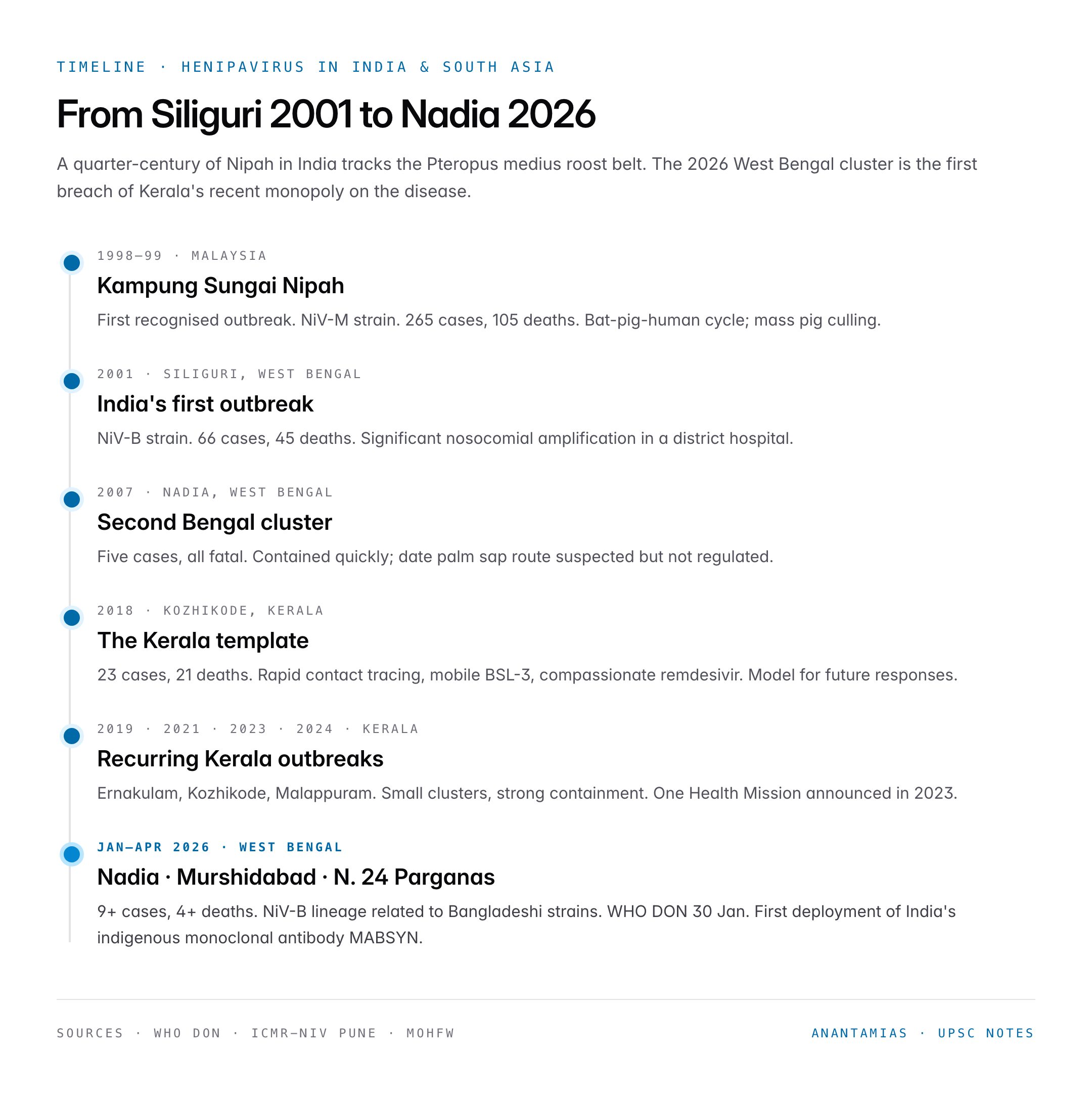
Between January and April 2026, West Bengal confirmed India’s first geographically distinct cluster of Nipah virus infections outside Kerala since the disease was first recognised in Siliguri and Nadia districts in 2001 and 2007. The index case, a 34-year-old date palm sap collector from Nadia, was confirmed positive at the ICMR-NIV Pune reference laboratory on 28 January 2026, with subsequent confirmations at the AIIMS Kalyani Viral Research and Diagnostic Laboratory (VRDL).
The World Health Organization issued a Disease Outbreak News notification on 30 January 2026, recording nine laboratory-confirmed cases and four deaths across Nadia, Murshidabad and North 24 Parganas districts. The Indian Council of Medical Research, in coordination with the Union Ministry of Health and Family Welfare, activated the National One Health Mission response protocol and, for the first time in India, deployed the indigenously validated monoclonal antibody candidate MABSYN under a compassionate use authorisation.
The cluster has ended the assumption, held since the Kozhikode outbreak of 2018, that Nipah in India is a Kerala-specific problem tied to Western Ghats Pteropus roosts. It has also exposed surveillance gaps in eastern India’s date palm sap supply chain, a transmission route documented in Bangladesh since 2001 but largely under-monitored on the Indian side of the border.
UPSC Relevance at a Glance
| Dimension | Relevance |
|---|---|
| GS Paper | GS3 primary (Science and Technology, Health, Disaster Management); GS2 secondary (Governance, Health Policy, One Health) |
| Prelims | Nipah virus, Henipavirus genus, Pteropus medius, BSL-4 labs, ICMR-NIV Pune, NIHSAD Bhopal, One Health Mission, MABSYN, Disease Outbreak News (WHO) |
| Mains | Zoonotic spillover risk; surveillance architecture; biosafety infrastructure; vaccine R&D gaps; centre-state coordination in outbreak response |
| Syllabus Tags | Issues relating to development and management of Health; Awareness in the fields of Biotechnology; Disaster and disaster management |
Background and Context
Nipah virus is a Biosafety Level 4 (BSL-4) pathogen first isolated in 1999 during an outbreak in pig farmers in Kampung Sungai Nipah, Malaysia. It belongs to the genus Henipavirus within the family Paramyxoviridae, which also includes Hendra virus and the more recently described Langya henipavirus. Its natural reservoir is the fruit bat of the genus Pteropus, commonly known as flying foxes.
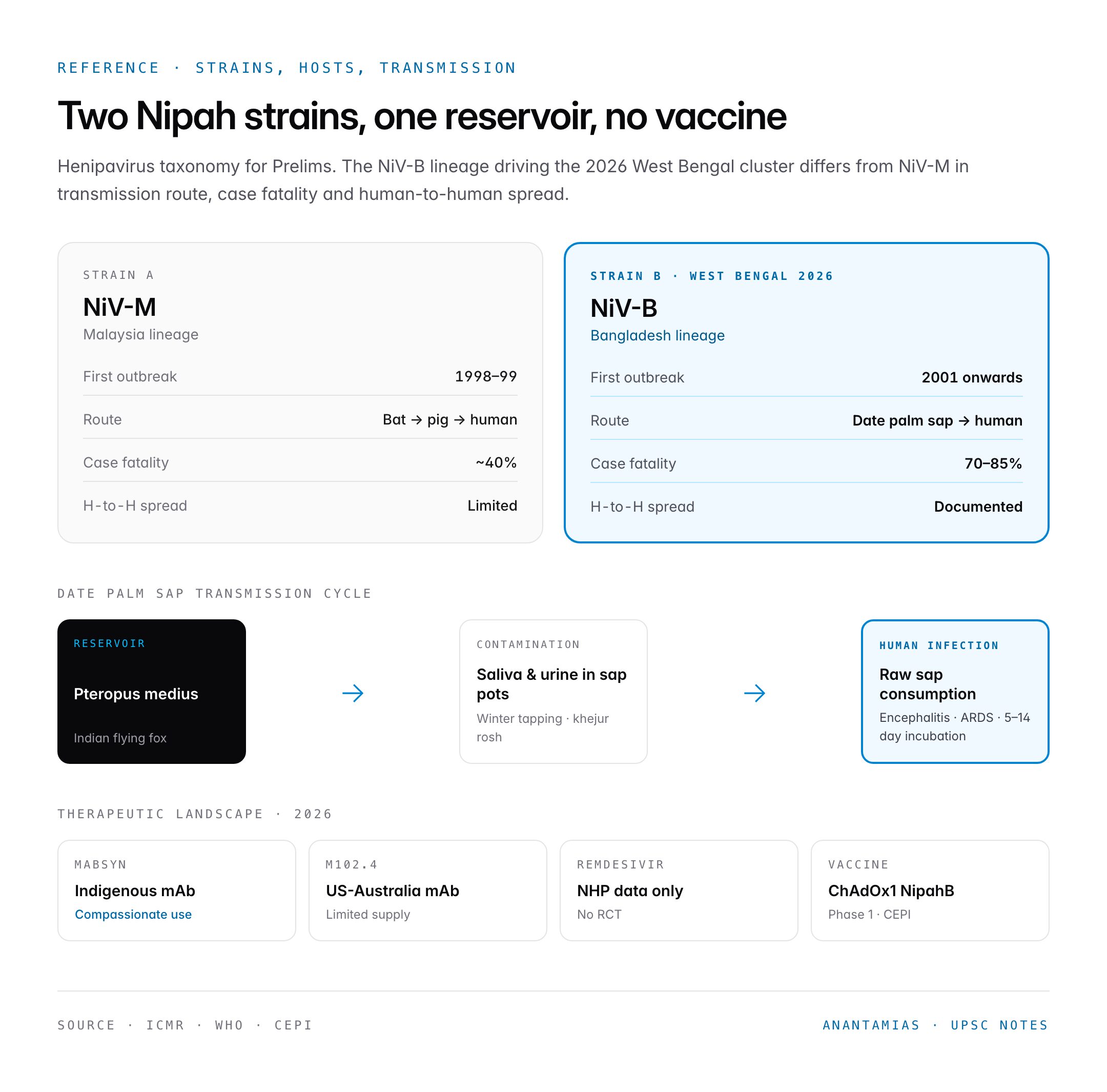
Two distinct lineages circulate: NiV-M (Malaysia strain), which caused the 1998 to 1999 epizootic in pigs and a bat to pig to human cycle with a case fatality around 40 percent, and NiV-B (Bangladesh strain), which has driven near-annual outbreaks in Bangladesh since 2001 through the consumption of raw date palm sap contaminated by bat saliva or urine. NiV-B shows higher case fatality, frequently cited in the 70 to 85 percent range, and notable human-to-human transmission in healthcare and household clusters.
India’s recognised outbreaks prior to 2026 were confined to two states. Siliguri in 2001 recorded 66 cases and 45 deaths, with Nadia following in 2007. Kerala then became the recurring epicentre, with outbreaks in Kozhikode in 2018 (23 cases, 21 deaths), Ernakulam in 2019 (one case, contained), Kozhikode again in 2021, Kozhikode in 2023, and a further cluster in Malappuram and Kozhikode in 2024. Kerala’s experience built a template of rapid contact tracing, mobile BSL-3 units, and fever surveillance that the Union government has sought to replicate nationally through the National One Health Mission announced in 2023.
The West Bengal cluster breaks that geographical pattern. It also reopens questions about the density of Pteropus medius populations in the Gangetic plain, the regulatory vacuum around raw date palm sap (khejur rosh) in winter months, and the readiness of tier-2 district hospitals to manage a pathogen that remains without any approved vaccine and without a licensed therapeutic.
Key Features of the Outbreak and Response
The epidemiological profile
The index case worked as a seasonal shiuli, tapping date palms and selling raw sap in morning village markets across Nadia. He developed fever, encephalitis and respiratory distress between 18 and 22 January 2026, was referred from a block hospital to AIIMS Kalyani, and died on 25 January. Throat swabs and cerebrospinal fluid sent to NIV Pune returned positive on RT-PCR and confirmed by whole genome sequencing as the NiV-B lineage, closely related to strains circulating in Faridpur and Rajshahi divisions of Bangladesh.
Of the nine confirmed cases, five were household or close caregiver contacts, two were fellow sap collectors, and two were hospital-acquired infections in nursing staff who attended the index patient before isolation protocols were activated. Case fatality in the cluster so far is 44 percent, closer to the Malaysia strain than to typical NiV-B figures, a deviation attributed provisionally to earlier diagnosis and supportive intensive care.
The ICMR MABSYN deployment
MABSYN is a humanised monoclonal antibody targeting the G glycoprotein of Nipah virus, developed in collaboration between ICMR, the Translational Health Science and Technology Institute Faridabad, and Bharat Biotech. It was granted a restricted emergency use authorisation under the New Drugs and Clinical Trials Rules 2019 for compassionate deployment in confirmed cases and high-risk contacts. Seven of the nine confirmed cases received MABSYN; five survived.
This is India’s first human deployment of a Nipah-specific biologic. Globally, the only comparable product is m102.4, a monoclonal antibody developed at the Uniformed Services University and tested in limited compassionate use in Australia and the United States.
Surveillance and containment
The Union Ministry of Health and Family Welfare dispatched a central team under the Integrated Disease Surveillance Programme. The National Centre for Disease Control established mobile BSL-3 testing at Kalyani. The Department of Animal Husbandry and Dairying, through the ICAR-National Institute of High Security Animal Diseases (NIHSAD Bhopal), began Pteropus serosurveys in twelve districts. The state government banned the sale of raw date palm sap in affected districts until 31 March 2026 and mandated protective sap collection using bamboo skirts around trees, a technique piloted in Bangladesh.
Laboratory and biosafety architecture
India has one operational BSL-4 laboratory, the Maximum Containment Laboratory at NIV Pune, supported by BSL-3 facilities at NIHSAD Bhopal, AIIMS Delhi, and a network of VRDLs. The West Bengal outbreak has accelerated Union Cabinet in-principle clearance for a second BSL-4 facility at the proposed National Institute of One Health in Nagpur.
Significance
- Breaks the Kerala-centric narrative. The cluster demonstrates that any state with Pteropus medius roosts and raw date palm sap consumption carries endemic risk, shifting surveillance priorities to Bengal, Assam, Bihar and Odisha.
- First Indian deployment of a domestically validated Nipah monoclonal antibody marks a leap in sovereign biomanufacturing capacity for BSL-4 pathogens, reducing dependence on US and Australian supply chains for m102.4.
- Validates the One Health Mission as more than a framework on paper. Coordinated action across the Ministry of Health, the Ministry of Fisheries Animal Husbandry and Dairying, and the Ministry of Environment Forest and Climate Change was evident within 72 hours of confirmation.
- Reinforces the value of the VRDL network established under the Department of Health Research, which brought AIIMS Kalyani’s diagnostic turnaround from seven days to under 18 hours.
- Strengthens the case for a second BSL-4 facility and expanded Pteropus ecology research, long recommended by the ICMR Vision 2030 document and the Principal Scientific Adviser’s Pandemic Preparedness Roadmap.
- Provides a real-world stress test of India’s International Health Regulations (2005) reporting obligations, with the WHO DON issued within 48 hours of laboratory confirmation.
Concerns and Challenges
The outbreak exposes several structural fragilities. Surveillance for zoonotic spillover outside Kerala has been thin. The Integrated Disease Surveillance Programme’s syndromic surveillance typically flags encephalitis clusters only after multiple admissions, creating a lag of seven to ten days during which human-to-human transmission can occur. The two nosocomial infections at AIIMS Kalyani point to gaps in respiratory isolation infrastructure at tertiary public hospitals outside metros.
There is no approved vaccine for Nipah anywhere in the world. Candidates in the pipeline include the Oxford ChAdOx1 NipahB platform in Phase 1 trials supported by the Coalition for Epidemic Preparedness Innovations, and a Public Health Vaccine LLC attenuated vesicular stomatitis virus vector candidate. India has no indigenous vaccine candidate in clinical trials, a gap that the Department of Biotechnology’s Mission COVID Suraksha did not extend to henipaviruses.
Treatment options remain limited. Ribavirin showed a modest mortality benefit in the Malaysian outbreak but has not been confirmed in controlled trials. Remdesivir, used compassionately in the 2018 Kozhikode outbreak, has shown activity in non-human primate models but lacks randomised data. MABSYN itself has been deployed on a single-arm compassionate basis without a controlled trial, which limits the evidentiary weight of the West Bengal survival data.
Socio-economic factors complicate containment. Date palm sap is embedded in Bengal’s winter food culture, supports seasonal livelihoods for thousands of sap collectors, and is sold largely through informal channels that resist regulatory notifications. A blanket ban displaces livelihoods without offering compensation, while half-measures fail epidemiologically. The federal structure adds friction. Animal husbandry is a state subject, public health is primarily a state subject, and wildlife is concurrent, creating overlapping jurisdictions that slowed the Pteropus serosurvey by several weeks.
Comparative and Historical Perspective
| Outbreak | Year | Location | Strain | Cases | Deaths | Key Lesson |
|---|---|---|---|---|---|---|
| Malaysia | 1998-99 | Kampung Sungai Nipah | NiV-M | 265 | 105 | Bat-pig-human cycle; culling response |
| Siliguri | 2001 | West Bengal | NiV-B | 66 | 45 | Nosocomial amplification |
| Bangladesh | 2001-present | Annual | NiV-B | 300+ | 200+ | Date palm sap route |
| Kozhikode | 2018 | Kerala | NiV-B | 23 | 21 | Rapid contact tracing template |
| West Bengal | 2026 | Nadia, Murshidabad | NiV-B | 9+ | 4+ | MABSYN deployment; One Health activation |
The comparison underscores a consistent pattern. NiV-B outbreaks in South Asia track raw date palm sap consumption and produce case fatality between 40 and 85 percent. What the 2026 cluster changes is the therapeutic landscape, not the epidemiology. For the first time, an Indian outbreak response has an indigenous biologic in the toolkit, shifting the country closer to self-reliance in pandemic countermeasures envisaged in the Atmanirbhar Bharat Abhiyan and the Biotechnology for Economy, Environment and Employment (BioE3) Policy.
Way Forward
- Expand Pteropus ecology mapping nationally under the Wildlife Institute of India in coordination with NIHSAD Bhopal, with continuous serosurveillance in roosts near human settlements across eastern and northeastern India.
- Operationalise the proposed BSL-4 facility at the National Institute of One Health Nagpur and strengthen the Viral Research and Diagnostic Laboratory network to achieve district-level turnaround under 24 hours.
- Fund indigenous Nipah vaccine development through the Department of Biotechnology and the Biotechnology Industry Research Assistance Council, with public-private partnerships modelled on the Covaxin pathway.
- Institutionalise sap collection safety standards through the Food Safety and Standards Authority of India and the Ministry of Agriculture’s Krishi Vigyan Kendras, including subsidised bamboo skirt kits for registered sap collectors.
- Strengthen Integrated Disease Surveillance Programme event-based surveillance with AI-assisted syndromic pattern detection at the block level, piloted by the National Centre for Disease Control.
- Operationalise the One Health Data Platform mandated by the National One Health Mission, linking human, animal and wildlife disease databases across the Ministry of Health, the Ministry of Fisheries Animal Husbandry and Dairying, and the Ministry of Environment.
- Embed pandemic preparedness in the Finance Commission’s health grants to states, with dedicated capex for respiratory isolation wards in every district hospital by 2030.
Conclusion
The West Bengal Nipah cluster of 2026 is neither a black swan nor a surprise. It is the predictable consequence of an ecology that India shares with Bangladesh, a livelihood economy that India has not regulated, and a surveillance architecture that India has only recently begun to consolidate under the One Health umbrella. The response, faster than Siliguri 2001 and more therapeutically equipped than Kozhikode 2018, shows that institutional learning has taken hold across the Union health ministry, ICMR and the state government.
The larger test is sustained. A single indigenous monoclonal antibody does not compensate for the absence of a vaccine, and a 72-hour activation does not substitute for year-round surveillance. For India to translate this episode into durable pandemic preparedness, the response must move from outbreak reaction to ecological stewardship, from compassionate use to controlled trials, and from Kerala’s playbook to a pan-Indian standard. The stakes are measured not in the 44 percent case fatality of this cluster but in the next zoonotic spillover, which may not offer the luxury of a familiar virus.
Prelims Pointers
- Nipah virus belongs to the genus Henipavirus, family Paramyxoviridae.
- Natural reservoir is the fruit bat genus Pteropus, with Pteropus medius being the principal Indian species.
- Two lineages circulate: NiV-M (Malaysia) and NiV-B (Bangladesh); NiV-B drives South Asian outbreaks.
- Case fatality ranges from 40 percent (NiV-M) to 75 percent or higher (NiV-B).
- First human outbreak was in Kampung Sungai Nipah, Malaysia, in 1998-99.
- India’s first recognised outbreak was Siliguri 2001; Kerala outbreaks occurred in 2018, 2019, 2021, 2023 and 2024.
- Nipah is a Biosafety Level 4 pathogen; India’s sole operational BSL-4 facility is at the Maximum Containment Laboratory, ICMR-NIV Pune.
- ICAR-NIHSAD Bhopal handles animal BSL-4 and BSL-3 work.
- MABSYN is India’s indigenous monoclonal antibody against the Nipah virus G glycoprotein.
- No approved vaccine exists globally; leading candidate is Oxford ChAdOx1 NipahB under CEPI.
- Date palm sap (khejur rosh) is the dominant transmission route in Bangladesh and eastern India.
- The National One Health Mission was announced in 2023; Nagpur is the proposed site for the National Institute of One Health.
Mains Practice Question
Q. The 2026 Nipah virus cluster in West Bengal demonstrates that India’s zoonotic disease preparedness cannot rest on a single-state template. Critically examine the institutional, therapeutic and surveillance dimensions of India’s response and suggest a One Health roadmap. (15 marks, 250 words)
Answer skeleton:
- Map the institutional response: ICMR-NIV Pune confirmation, AIIMS Kalyani VRDL, central team deployment under IDSP, MABSYN compassionate use, and NIHSAD Pteropus surveys; evaluate centre-state coordination gaps and the jurisdictional overlap between health, animal husbandry and wildlife.
- Assess therapeutic and biosafety capacity: lone BSL-4 at NIV Pune, absence of approved Nipah vaccine, limited randomised data on ribavirin and remdesivir, and the strategic significance of the first indigenous monoclonal antibody deployment.
- Recommend a One Health roadmap: second BSL-4 at Nagpur, nationwide Pteropus mapping, sap collection safety standards via FSSAI and KVKs, indigenous vaccine pipeline through DBT-BIRAC, IDSP AI-assisted surveillance, and Finance Commission health grants for district-level isolation infrastructure.
Frequently Asked Questions
What is Nipah virus and why is it classified BSL-4?
Nipah virus is a zoonotic henipavirus in the family Paramyxoviridae, first identified in Malaysia in 1998. Fruit bats of the genus Pteropus are its natural reservoir. It is classified as a Biosafety Level 4 pathogen because it has high case fatality between 40 and 75 percent, can transmit between humans, and has no approved vaccine or licensed therapeutic.
Why is the 2026 West Bengal Nipah outbreak in the news?
West Bengal confirmed a nine-case cluster in Nadia, Murshidabad and North 24 Parganas districts between January and April 2026. The WHO issued a Disease Outbreak News notification on 30 January 2026. It is India’s first significant Nipah cluster outside Kerala since Siliguri 2001 and Nadia 2007, and the first deployment of India’s indigenous monoclonal antibody MABSYN.
What is the difference between NiV-B and NiV-M strains?
NiV-M, the Malaysia strain, caused the original 1998-99 pig farmer outbreak with case fatality around 40 percent through a bat-pig-human cycle. NiV-B, the Bangladesh strain, drives near-annual outbreaks in Bangladesh and India with case fatality between 70 and 85 percent, spreads chiefly through raw date palm sap contaminated by bat saliva or urine, and shows stronger human-to-human transmission.
What is MABSYN and how is it different from existing therapies?
MABSYN is India’s first indigenous humanised monoclonal antibody targeting the Nipah virus G glycoprotein, developed through ICMR, THSTI Faridabad and Bharat Biotech. It was deployed under compassionate use in the 2026 West Bengal cluster. Unlike remdesivir and ribavirin, which have limited randomised evidence, MABSYN is a targeted biologic comparable to the US-Australian antibody m102.4.
How does date palm sap transmit Nipah virus?
Fruit bats of the species Pteropus medius lick or urinate into earthen pots collecting raw date palm sap during winter months in eastern India and Bangladesh. Humans who drink the unboiled sap within a few hours of collection ingest viable virus. This route has driven most NiV-B outbreaks in Bangladesh since 2001 and now in West Bengal’s 2026 cluster.
What is the One Health Mission and how did it respond?
The National One Health Mission, launched in 2023, coordinates surveillance across the Ministry of Health, the Ministry of Fisheries Animal Husbandry and Dairying, and the Ministry of Environment. In the West Bengal cluster, it activated joint action within 72 hours, dispatched IDSP teams, mobilised NIHSAD Bhopal for Pteropus serosurveys, and coordinated sap collection restrictions with state authorities.
Why does India have only one BSL-4 laboratory?
BSL-4 facilities require sealed containment, hazmat suits, dedicated air handling and specialised waste management, making them expensive to build and operate. India’s sole BSL-4 is the Maximum Containment Laboratory at ICMR-NIV Pune, supported by BSL-3 sites at NIHSAD Bhopal and AIIMS Delhi. A second BSL-4 at the proposed National Institute of One Health in Nagpur has received in-principle Cabinet clearance.
How does the Nipah outbreak help in UPSC preparation?
The topic integrates GS3 Science and Technology with GS2 Governance and Health. It offers factual depth for Prelims on henipaviruses, Pteropus, BSL levels and ICMR architecture, while providing Mains material on zoonotic surveillance, One Health, pandemic preparedness, centre-state coordination, and indigenous vaccine and biologics development under BioE3 policy and Atmanirbhar Bharat.
Tell Google you want more of this.
Add Anantam IAS as a preferred sourceOne tap, and this site shows up more often in your own Top Stories, AI Overviews and AI Mode. Remove it any time.