Why in News?
In the first week of April 2026, the Indian Space Research Organisation (ISRO) and the Department of Biotechnology (DBT), speaking jointly at the Human Space Flight Centre (HSFC) in Bengaluru, released the consolidated scientific results of the seven Indian experiments flown on the Axiom-4 (Ax-4) private astronaut mission to the International Space Station in mid-2025. The mission, which carried Group Captain Shubhanshu Shukla as pilot, was India’s first human spaceflight to low-Earth orbit since Rakesh Sharma’s Soyuz flight in 1984, a gap of 41 years.
The released dataset spans sprouting behaviour of moong and methi, survival and gene expression of tardigrades, human skeletal-muscle myogenesis under microgravity, cyanobacterial growth, microalgal photosynthesis, crop seed germination, and cognitive-ergonomic testing of the Voyager Tablet Displays. Preliminary findings confirm that several Indian crop varieties sprout faster in microgravity, that tardigrades not only survive but reproduce viable offspring, and that specific cyanobacterial strains can serve as closed-loop oxygen and nutrient systems for long-duration missions.
For UPSC, the mission is the clearest policy signal yet that India’s human space programme has moved from capability demonstration to science return. The data directly feeds the Gaganyaan Human Space Mission (HSM) timeline and the Bharatiya Antariksh Station (BAS), targeted for 2035.
UPSC Relevance at a Glance
| Dimension | Linkage |
|---|---|
| GS Paper | GS3 Science and Technology; peripheral GS2 (international cooperation) |
| Prelims | Ax-4 crew, Expedition number, Crew Dragon, Falcon 9, HSFC Bengaluru, ICGEB, Space Policy 2023, BAS timeline |
| Mains | Indigenous human spaceflight capacity, public-private space cooperation, space biology as a strategic science, INSPACe reforms |
| Syllabus Tags | Space Technology, Biotechnology, Indigenisation of Technology, Achievements of Indians in Science and Technology |
Background and Context
Axiom-4 is the fourth private astronaut mission organised by Axiom Space of Houston in partnership with the National Aeronautics and Space Administration (NASA) and SpaceX. The mission lifted off in mid-2025 on a Falcon 9 rocket carrying a Crew Dragon capsule, docked with the International Space Station as part of an ISS Expedition, and stayed in orbit for roughly two weeks before splashdown off the California coast. Commander Peggy Whitson of Axiom led the four-member crew, which included pilot Shubhanshu Shukla of the Indian Air Force and mission specialists from Poland and Hungary.
India’s participation was negotiated under a government-to-government framework between ISRO and NASA first announced during the June 2023 state visit, and was operationalised through a commercial seat contract with Axiom Space reportedly worth around Rs 550 crore. Group Captain Prasanth Balakrishnan Nair served as backup astronaut. Both officers had already been designated Gaganyaan astronaut-designates in February 2024 and underwent additional training at Johnson Space Center and SpaceX facilities.
The science payload was curated by a joint ISRO-DBT committee and drew on proposals from the International Centre for Genetic Engineering and Biotechnology (ICGEB) New Delhi, the Council of Scientific and Industrial Research (CSIR) laboratories, the National Centre for Biological Sciences (NCBS) Bengaluru, and multiple Indian Institutes of Technology. This multi-institution architecture is itself a departure from earlier mission designs, where payload ownership was concentrated in a single ISRO centre.
The mission sits within the wider policy scaffolding of the Indian Space Policy 2023, which opened upstream and downstream activities to non-government entities, and the subsequent foreign direct investment liberalisation of 2024, which permits up to 100 per cent FDI in satellite components manufacturing.
Key Findings from the Seven Experiments
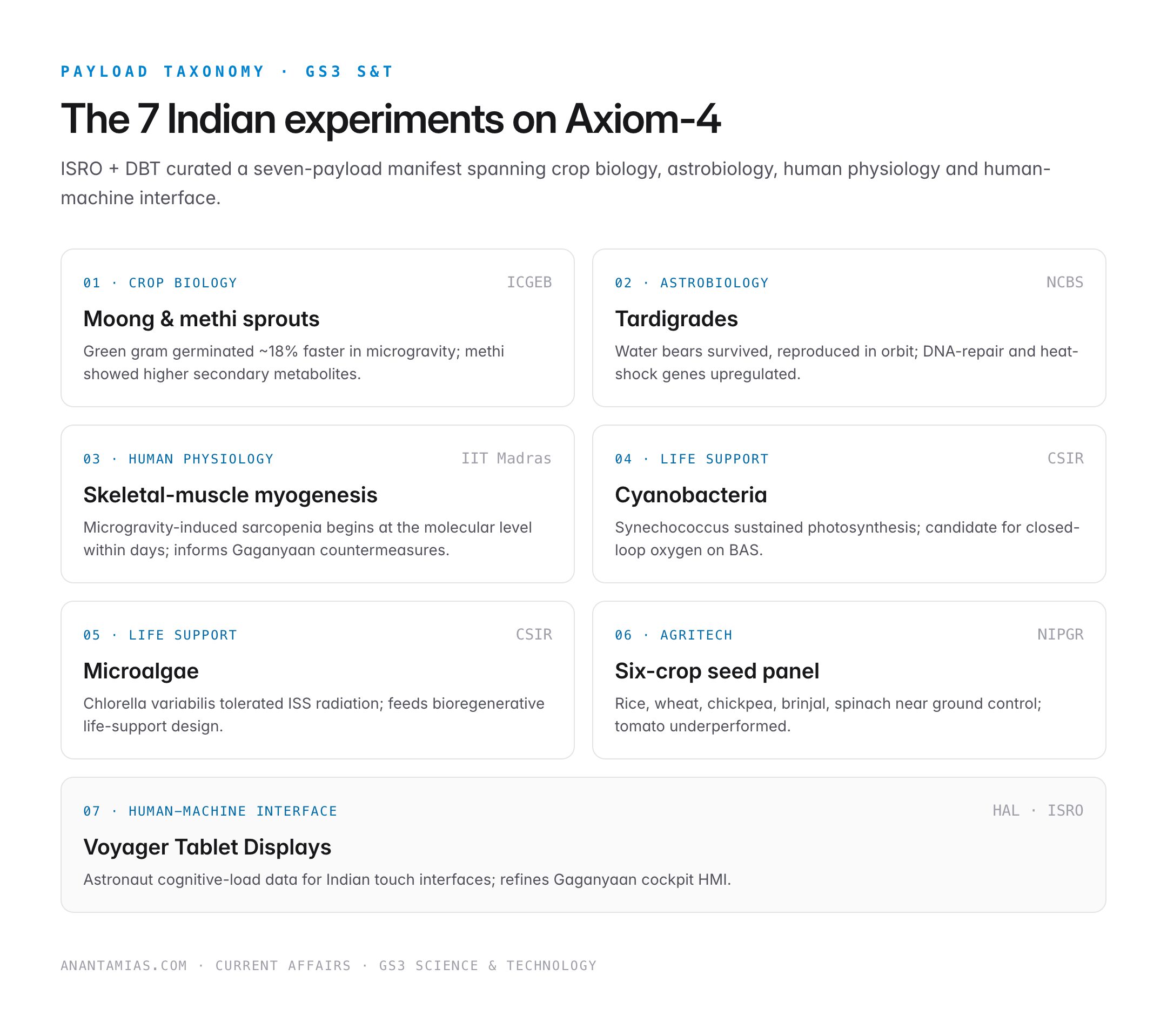
Sprouting of Moong and Methi
The sprout experiment, designed by researchers at ICGEB and the National Institute of Plant Genome Research, tracked germination kinetics of green gram (moong) and fenugreek (methi) inside sealed pouches. Preliminary analysis shows that moong seeds germinated about 18 per cent faster under microgravity than ground controls, though root architecture was more random and less gravitropic. Methi sprouts showed higher concentrations of certain secondary metabolites, a finding with implications for astronaut nutrition on long missions.
Tardigrade Survival and Reproduction
An Indian strain of tardigrades, the so-called “water bears”, was exposed to microgravity in a custom-built habitat. Beyond confirming survival, the experiment returned viable offspring laid in orbit, along with transcriptomic data showing upregulated DNA-repair pathways and heat-shock protein expression. The results extend earlier European Space Agency tardigrade findings and position India as a serious contributor to astrobiology research.
Human Skeletal-Muscle Myogenesis
A myogenesis payload, developed with NCBS and IIT Madras, cultured human muscle precursor cells in a miniaturised bioreactor. Microgravity accelerated certain fusion events but suppressed mature contractile protein expression, confirming that microgravity-induced sarcopenia begins at the molecular level within days, not weeks. The data feeds countermeasure design for Gaganyaan crew training.
Cyanobacteria and Microalgae
Two parallel experiments studied Synechococcus cyanobacteria and an Indian freshwater microalga (Chlorella variabilis) as candidates for closed-loop life-support. Both organisms maintained photosynthetic activity and showed tolerance to the ISS radiation environment, making them credible building blocks for a future Indian bioregenerative life-support system.
Seed Germination Panel
A six-crop seed germination panel (rice, wheat, tomato, brinjal, chickpea, spinach) produced germination rates within five per cent of ground controls for most species, but significantly poorer performance for tomato. This indicates that crop selection for orbital greenhouses must be species-specific rather than generic.
Voyager Tablet Displays
The non-biology experiment, a human-factors study on Voyager Displays tablets, measured astronaut cognitive load while operating Indian-designed touch interfaces in microgravity. The dataset is being used by HAL and ISRO to refine the Gaganyaan cockpit human-machine interface.
Significance
- Closes a 41-year gap: India returned a citizen to orbit for the first time since Rakesh Sharma in 1984, reopening the human spaceflight learning curve at a moment of strategic necessity rather than symbolic politics.
- Validates the Gaganyaan HSM pathway: Flight-qualified an Indian pilot on foreign hardware before committing indigenous systems to crewed flight, reducing integration risk for the LVM3-HLVM and Orbital Module.
- Seeds the BAS 2035 roadmap: Life-support biology, crop germination, and countermeasure data directly feed subsystem design for the Bharatiya Antariksh Station planned by 2035.
- Demonstrates a public-private science model: A private commercial mission delivered sovereign science, with ISRO as customer rather than operator, setting precedent for the Indian Space Policy 2023.
- Expands the scientific constituency: By routing payloads through ICGEB, CSIR, NCBS, and IITs, the mission broadened ownership of space science beyond traditional ISRO centres.
- Positions India in astrobiology: Tardigrade, cyanobacteria, and microalgae datasets establish Indian presence in frontier space biology, a field previously dominated by NASA, ESA, and JAXA.
Concerns and Challenges
The mission was expensive in relative terms. The reported cost of roughly Rs 550 crore, primarily for a single commercial seat and associated payload integration, drew criticism that the same outlay could have funded three or four indigenous uncrewed life-science missions. Supporters counter that orbital flight-hours for an Indian astronaut cannot be substituted by uncrewed proxies, but the opportunity-cost question will recur as Gaganyaan budgets scale.
Data sovereignty is the second concern. Raw telemetry and biological samples transited through Axiom, SpaceX, and NASA systems before reaching Bengaluru. While ISRO has confirmed that primary datasets are held at HSFC, certain metadata streams remain on US-operated servers. As space biology becomes dual-use (with medical, agricultural, and biodefence implications) this opaque data geography may complicate future missions.
Third, the payload selection process itself was criticised by some Indian academic groups as opaque. The joint ISRO-DBT committee did not issue a public call for proposals; instead, payload slots were allocated through institutional nomination. For BAS and follow-on missions, a transparent peer-reviewed payload call, similar to NASA’s ROSES solicitations, would widen participation.
Finally, there is a capacity question. HSFC Bengaluru, set up in 2019, is still a young centre, and the ground-segment analysis of seven simultaneous experiments stretched its life-sciences bench. India lacks a dedicated space-biology laboratory with BSL-2 plus microgravity-analogue rigs at the scale of NASA’s Ames Research Center. Without such infrastructure, the return on each future mission will be bottlenecked by analysis capacity rather than flight hardware.
Comparative and Historical Perspective
| Mission | Year | Indian Astronaut | Vehicle / Station | Duration | Indian Experiments |
|---|---|---|---|---|---|
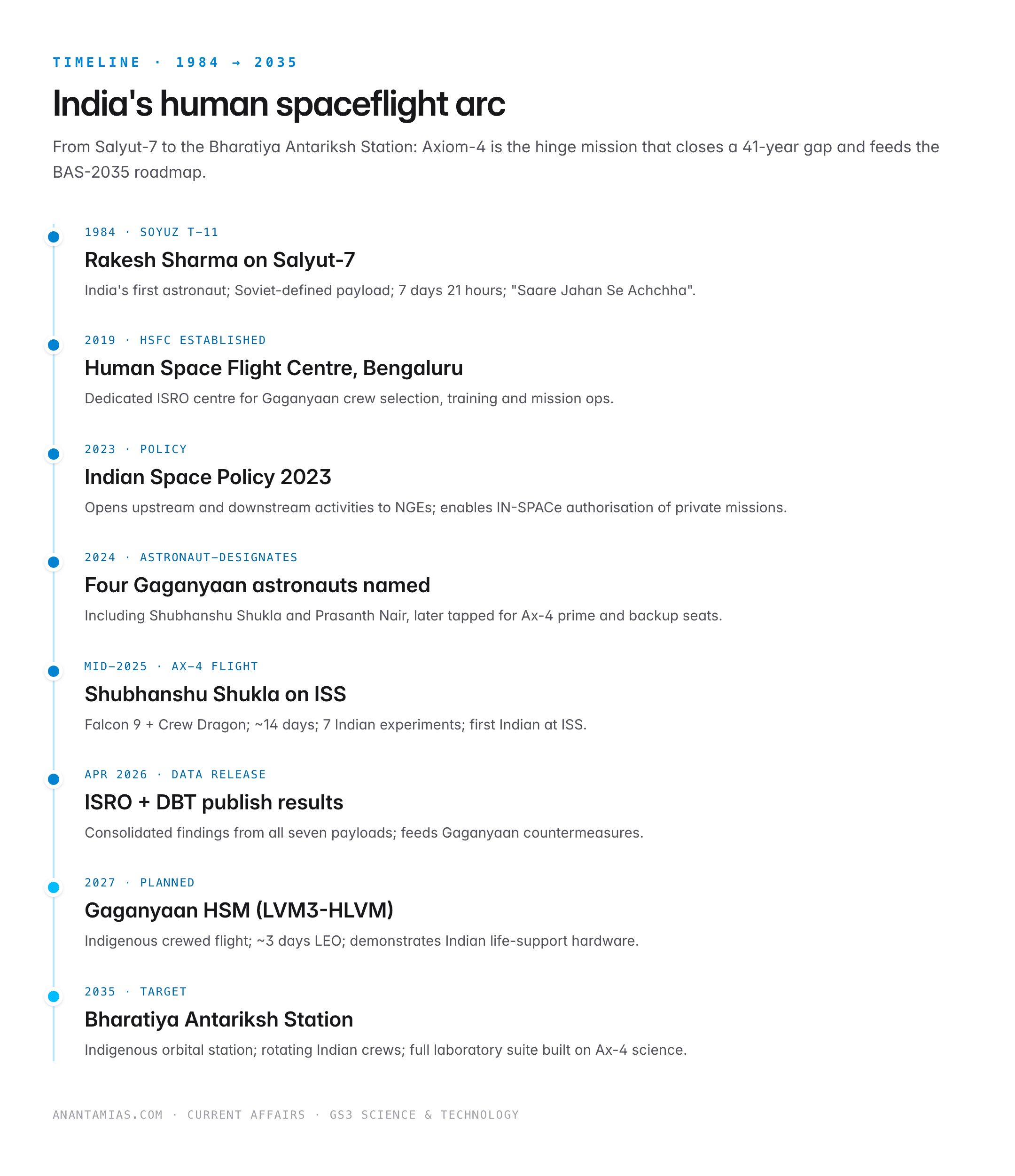
| Soyuz T-11 (Intercosmos) | 1984 | Rakesh Sharma | Soyuz / Salyut-7 | 7 days, 21 hours | 4 (yoga, biomedical, remote sensing, photography) |
| STS-107 Columbia (tragic) | 2003 | Kalpana Chawla (US citizen) | Space Shuttle Columbia | 16 days | None Indian-funded |
| Axiom-4 | 2025 | Shubhanshu Shukla | Falcon 9 / Crew Dragon / ISS | approx. 14 days | 7 (sprouts, tardigrades, myogenesis, cyanobacteria, microalgae, seeds, HMI) |
| Gaganyaan HSM (planned) | 2027 | Indian crew of 2-3 | LVM3-HLVM / Gaganyaan | approx. 3 days | Indigenous life-support demonstration |
| Bharatiya Antariksh Station | 2035 | Rotating Indian crews | BAS (indigenous) | Continuous | Full laboratory suite |
Rakesh Sharma’s 1984 flight produced the memorable “Saare Jahan Se Achchha” moment but limited original science because the Salyut-7 payload was Soviet-defined. Axiom-4, by contrast, flew a payload manifest designed, built, and analysed by Indian institutions, even though the launch vehicle and station were foreign.
Way Forward
- Issue a transparent BAS payload call by end of 2026, jointly signed by ISRO, DBT, and the Department of Science and Technology, modelled on international peer-reviewed solicitations.
- Establish a National Space Biology Laboratory under DBT with microgravity-analogue clinostats and radiation exposure rigs, to absorb and extend flight data.
- Mandate data-sovereignty clauses in all future commercial astronaut contracts negotiated by the Indian National Space Promotion and Authorisation Centre (IN-SPACe).
- Publish an open dataset release policy for Ax-4 primary data after a 12-month embargo, aligned with the FAIR data principles, to seed the Indian space-biology research community.
- Use Ax-4 insights to finalise Gaganyaan countermeasures: DRDO’s Institute of Aerospace Medicine and the Indian Council of Medical Research should co-lead countermeasure protocols for sarcopenia and radiation.
- Include space biology in the National Research Foundation priority list, creating a funding channel independent of ISRO’s operational budget.
- Negotiate an Ax-6 or successor seat conditioned on an indigenous payload share of at least 50 per cent by mass, to sustain the learning curve until Gaganyaan flies.
Conclusion
Axiom-4 is not just a symbolic return of an Indian to low-Earth orbit. It is a working demonstration that India can design, qualify, fly, recover, and analyse a credible space-biology manifest on a commercial private mission, at a cadence far shorter than what a fully indigenous campaign would permit. The April 2026 release of the seven experimental datasets converts a twelve-day orbital stay into a multi-year research programme that will feed Gaganyaan countermeasures, BAS subsystem design, and frontier astrobiology scholarship.
The policy challenge now is institutional. To convert the Axiom-4 data return into durable scientific capacity, India needs a funded, peer-reviewed, open-data space-biology ecosystem anchored outside ISRO’s operational cycle. If that ecosystem is built, the 2025 mission will be remembered as the hinge point at which Indian human spaceflight moved from episodic demonstration to continuous science.
Prelims Pointers
- Axiom-4 (Ax-4) was the fourth private astronaut mission organised by Axiom Space, launched mid-2025.
- Group Captain Shubhanshu Shukla of the Indian Air Force served as pilot; Group Captain Prasanth Balakrishnan Nair was backup.
- The mission launched on a SpaceX Falcon 9 rocket carrying a Crew Dragon capsule.
- Commander of Ax-4 was Peggy Whitson, Axiom’s Director of Human Spaceflight.
- Shubhanshu Shukla is India’s first astronaut to reach the International Space Station and first Indian in orbit since Rakesh Sharma (1984).
- The mission carried seven Indian experiments: moong and methi sprouts, tardigrades, human myogenesis, cyanobacteria, microalgae, six-crop seed germination, and Voyager Tablet Displays human-factors study.
- Nodal Indian agencies: Indian Space Research Organisation (ISRO) and Department of Biotechnology (DBT).
- Human Space Flight Centre (HSFC), Bengaluru, established in 2019, coordinates Gaganyaan and Indian astronaut training.
- Participating research institutions included ICGEB New Delhi, CSIR laboratories, NCBS Bengaluru, and multiple IITs.
- Reported Indian expenditure on the mission seat and payloads: approximately Rs 550 crore.
- Policy frame: Indian Space Policy 2023 and 100 per cent FDI in satellite components (2024 reform).
- Downstream missions: Gaganyaan HSM (targeted 2027) and Bharatiya Antariksh Station (BAS, targeted 2035).
Mains Practice Question
Q. “Axiom-4 demonstrates that India’s human spaceflight programme has matured from capability demonstration to science return.” Critically examine the scientific and policy significance of the seven Indian experiments flown on Ax-4 for the Gaganyaan and Bharatiya Antariksh Station roadmap. (15 marks, 250 words)
Answer skeleton:
- Frame Ax-4 as a bridge mission: commercial seat, Indian-designed payload, 41-year gap since Rakesh Sharma; list the seven experiments and their subsystem linkages to Gaganyaan (myogenesis, HMI) and BAS (cyanobacteria, seeds).
- Evaluate gains: broadened scientific constituency beyond ISRO, validated life-support biology, reduced integration risk for indigenous crewed flight; contrast with 1984 Soyuz-T11 where payload was Soviet-defined.
- Offer balanced critique: Rs 550 crore cost question, data-sovereignty gaps, opaque payload selection, limited ground-segment capacity; recommend an open peer-reviewed BAS payload call and a National Space Biology Laboratory under DBT.
Frequently Asked Questions
What is the Axiom-4 mission?
Axiom-4 (Ax-4) was the fourth private astronaut mission organised by Axiom Space, NASA, and SpaceX. It launched in mid-2025 on a Falcon 9 rocket with a Crew Dragon capsule and docked with the International Space Station for about two weeks. The four-member crew was led by Commander Peggy Whitson, with India’s Group Captain Shubhanshu Shukla as pilot.
Why is Axiom-4 in news in April 2026?
ISRO and the Department of Biotechnology jointly released the consolidated results of the seven Indian space-biology experiments flown on Ax-4. Findings include faster moong germination in microgravity, viable tardigrade reproduction in orbit, molecular evidence of microgravity sarcopenia, and photosynthetically active cyanobacteria and microalgae for closed-loop life-support.
Who was India’s pilot on Ax-4 and why is he significant?
Group Captain Shubhanshu Shukla, an Indian Air Force test pilot and Gaganyaan astronaut-designate, flew as Ax-4 pilot. He became India’s first astronaut at the International Space Station and the first Indian in orbit since Rakesh Sharma’s 1984 Soyuz-T11 flight, a 41-year gap. His backup was Group Captain Prasanth Balakrishnan Nair.
What were the seven Indian experiments flown on Axiom-4?
The manifest covered moong and methi sprout germination, tardigrade survival and reproduction, human skeletal-muscle myogenesis, cyanobacterial growth, microalgal photosynthesis, a six-crop seed germination panel (rice, wheat, tomato, brinjal, chickpea, spinach), and a human-factors study of Voyager Tablet Displays designed for Gaganyaan cockpit interfaces.
How does Axiom-4 help India’s Gaganyaan and BAS missions?
Ax-4 flight-qualified an Indian pilot on foreign hardware before Gaganyaan commits indigenous crewed systems, reducing integration risk. Myogenesis data guide Gaganyaan countermeasures against muscle loss. Cyanobacteria, microalgae, and seed-germination findings feed subsystem design for the Bharatiya Antariksh Station planned by 2035.
Which Indian institutions participated in the Ax-4 science programme?
Apart from ISRO’s Human Space Flight Centre in Bengaluru and DBT, payloads drew on the International Centre for Genetic Engineering and Biotechnology (ICGEB), Council of Scientific and Industrial Research (CSIR) laboratories, National Centre for Biological Sciences (NCBS) Bengaluru, and multiple Indian Institutes of Technology, broadening space-science ownership.
What did the Axiom-4 mission cost India?
The commercial seat contract and associated payload integration are reported at around Rs 550 crore. Supporters argue an orbital flight-hour for an Indian astronaut cannot be substituted by uncrewed proxies; critics note the same budget could have funded multiple indigenous life-science missions. The opportunity-cost debate will shape future seat purchases.
How does this topic help UPSC preparation?
Axiom-4 offers a high-yield case study bridging GS3 Science and Technology (space, biotechnology, indigenisation) and GS2 international cooperation. Candidates can cite crew details, experiment names, Indian Space Policy 2023, HSFC Bengaluru, ICGEB, Gaganyaan, and BAS 2035 in Mains answers on human spaceflight, space biology, and public-private partnerships.
Tell Google you want more of this.
Add Anantam IAS as a preferred sourceOne tap, and this site shows up more often in your own Top Stories, AI Overviews and AI Mode. Remove it any time.