Introduction
The Chief Justice of India (CJI) heads the Supreme Court, the apex constitutional court of the Indian Republic. Beyond delivering judgments, the CJI is the Master of the Roster who decides which bench hears which case, the head of the Collegium that appoints and transfers higher judiciary judges, and the notional constitutional successor who administers the oath to every new President and Vice-President of India. The office anchors the separation of powers in a parliamentary democracy where judicial review is wide and often decisive.
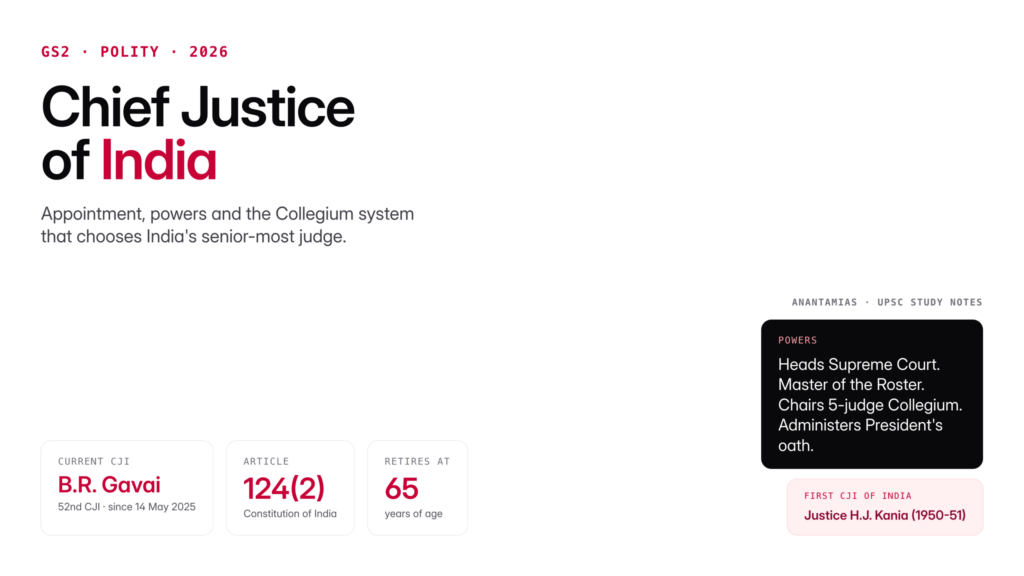
As of April 2026, Justice Bhushan Ramkrishna Gavai is the 52nd Chief Justice of India, having assumed office on 14 May 2025 after the retirement of Justice Sanjiv Khanna. Justice Gavai is the first CJI from the Scheduled Castes in the 21st century and the second Dalit CJI after K.G. Balakrishnan. For UPSC aspirants, the post sits at the intersection of Constitutional Law (Articles 124-147), ongoing debates on the Collegium vs NJAC, and the broader question of judicial accountability in India.
Quick Facts at a Glance
| Parameter | Detail |
|---|---|
| Current CJI | Justice Bhushan Ramkrishna Gavai |
| CJI number | 52nd |
| Oath taken | 14 May 2025 |
| Retirement | 23 November 2025 (turns 65) |
| Appointing authority | President of India |
| Constitutional basis | Article 124(2) |
| Retirement age | 65 years |
| Salary (basic) | Rs 2,80,000 per month (as per Second National Judicial Pay Commission revisions) |
| Seat | Supreme Court of India, Tilak Marg, New Delhi |
| Oath under | Article 124(6), Third Schedule |
Background and Historical Context
The office of the Chief Justice of India dates back to the Federal Court of India established under the Government of India Act 1935. Sir Maurice Gwyer became its first Chief Justice in 1937. After the Constitution came into force on 26 January 1950, the Federal Court transitioned into the Supreme Court and Justice Harilal Jekisundas Kania was sworn in as the first CJI of independent India. He served until his death in office on 6 November 1951, making him the only CJI to die in harness.
Between 1950 and 1973, the convention of seniority for appointment as CJI was rarely questioned. The first open break came in 1973 when the Indira Gandhi government superseded three senior judges, A.N. Grover, K.S. Hegde and J.M. Shelat, to appoint Justice A.N. Ray as CJI, days after the Kesavananda Bharati verdict established the Basic Structure doctrine. A similar supersession occurred in 1977 when H.R. Khanna, the lone dissenter in the ADM Jabalpur habeas corpus case, was bypassed in favour of Justice M.H. Beg.
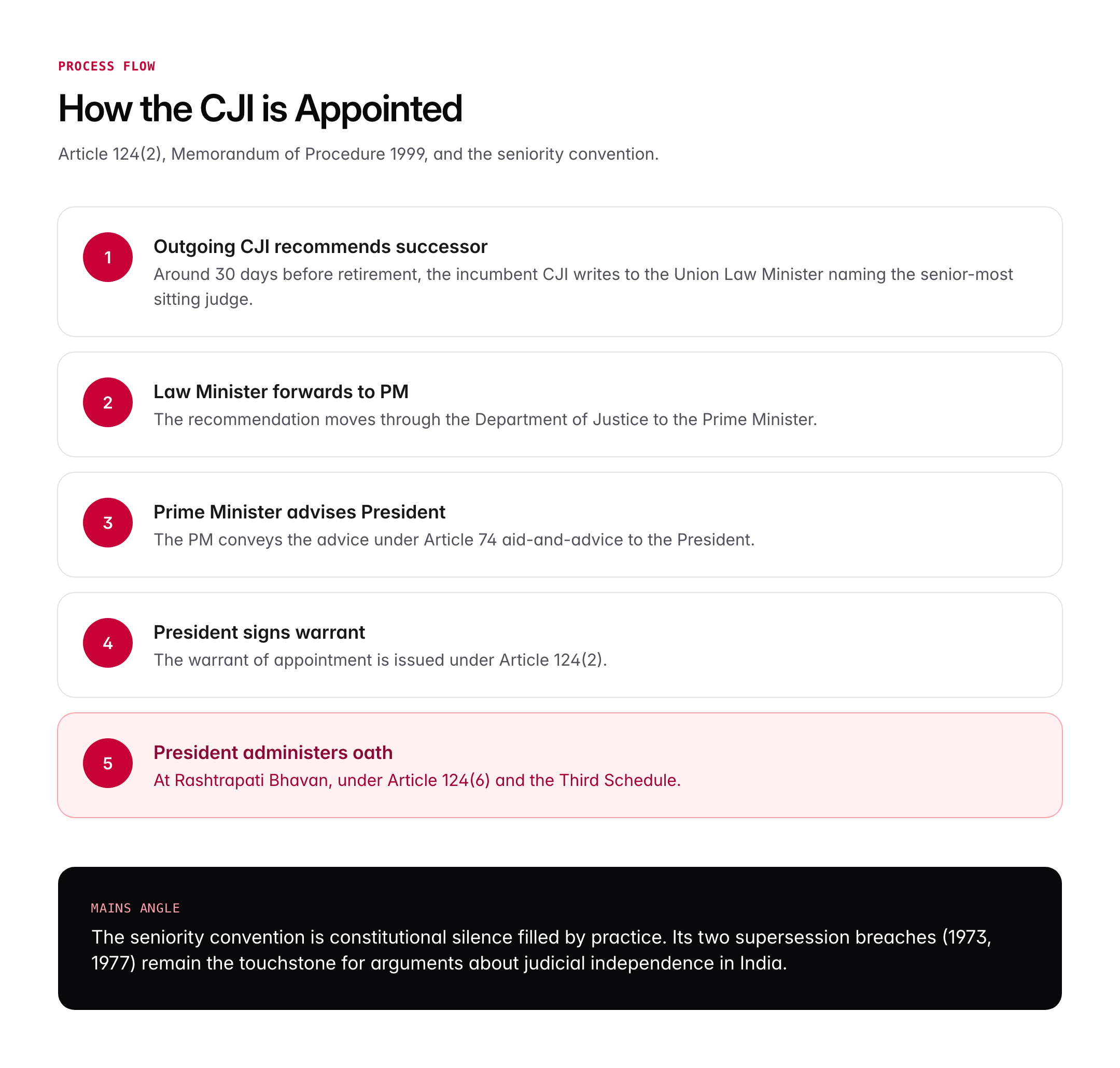
These events consolidated the informal seniority convention so strongly that every CJI since 1977 has been the senior-most sitting judge of the Supreme Court at the time of the outgoing CJI’s retirement. The Memorandum of Procedure (MoP), finalised in 1999 after the Second and Third Judges Cases, now codifies this practice.
In 2015, the Supreme Court struck down the Ninety-ninth Constitution Amendment and the National Judicial Appointments Commission Act in the NJAC judgment (Supreme Court Advocates-on-Record Association v. Union of India), reaffirming the Collegium system as part of the basic structure. The Collegium, led by the CJI, now drives appointments to the Supreme Court and the High Courts, though reform proposals continue to surface.
Key Features and Provisions
Appointment under Article 124
Article 124(2) states that every judge of the Supreme Court, including the CJI, shall be appointed by the President “after consultation” with such judges of the Supreme Court and High Courts as the President may deem necessary. In the First Judges Case (1981) the Court held that “consultation” did not mean concurrence. The Second Judges Case (1993) reversed this, holding that the CJI’s opinion prevails. The Third Judges Case (1998) clarified that the CJI must consult a collegium of the four senior-most judges of the Supreme Court. In practice, the senior-most judge after the outgoing CJI is recommended as the next CJI.
Qualifications
A person is eligible to be appointed as a Supreme Court judge, and therefore CJI, under Article 124(3) if he or she:
- is a citizen of India, and
- has been a judge of a High Court or of two or more High Courts in succession for at least five years, or
- has been an advocate of a High Court or of two or more such courts in succession for at least ten years, or
- is, in the opinion of the President, a distinguished jurist.
No “distinguished jurist” has ever been appointed directly.
Oath, Tenure and Salary
The CJI is administered the oath by the President under Article 124(6) and the Third Schedule. The tenure runs until the CJI attains the age of 65 years, as fixed by Article 124(2) proviso (a). The salary is determined by Parliament under Article 125. Under the Second National Judicial Pay Commission recommendations accepted in 2018 and subsequent revisions, the CJI draws a basic salary of Rs 2,80,000 per month plus allowances and post-retirement benefits. The salary is charged on the Consolidated Fund of India and cannot be varied to the CJI’s disadvantage during tenure.
Removal
A CJI can be removed only through the impeachment process under Article 124(4) on grounds of proved misbehaviour or incapacity. The motion requires a special majority in each House, that is a majority of the total membership and two-thirds of members present and voting. The Judges (Inquiry) Act 1968 provides the detailed procedure. No CJI has ever been removed. Justice V. Ramaswami (1993) is the only Supreme Court judge against whom an impeachment motion reached voting, and it fell in the Lok Sabha.
Significance for UPSC and General Knowledge
- The CJI is the administrative head of the Supreme Court and the first among equals, not a superior judge in the judicial hierarchy.
- The CJI heads the Collegium that recommends appointments to the Supreme Court, and the respective High Court Collegiums draw their names based on CJI consultation.
- The CJI administers the oath of office to the President (Article 60) in the absence of the CJI the senior-most judge does so.
- Bench composition and case allocation are at the CJI’s discretion, subject to the 2018 Supreme Court Advocates-on-Record Association clarification.
- Post-retirement, several CJIs have accepted gubernatorial, NHRC chairperson, and other positions, reviving debates on the cooling-off period.
- The Supreme Court e-Committee, chaired by a designate of the CJI, drives digital reforms such as e-filing, virtual hearings and the National Judicial Data Grid.
Powers and Functions of the CJI
The CJI exercises a cluster of judicial, administrative and symbolic functions. Judicially, the CJI presides over constitution benches, five-judge and larger formations that decide questions of constitutional interpretation under Article 145(3). Landmark matters such as the Aadhaar case, Sabarimala, Ayodhya and the Article 370 judgment have been heard under the CJI’s leadership. The CJI also writes the opening opinion in important matters and decides whether a case raises a substantial question of law.
Administratively, the CJI is the Master of the Roster. Every writ petition, special leave petition and transfer petition is allocated to a bench by the CJI’s order, either directly or through computerised allocation supervised by the CJI. The landmark Prashant Bhushan case (2018) and the press conference by four senior judges (12 January 2018) flagged this power as the most significant internal check in the Supreme Court. The Supreme Court has since held that the CJI is Master of the Roster but must exercise this power reasonably.
The CJI chairs the Supreme Court Collegium of five judges for Supreme Court appointments, and a three-judge Collegium for High Court appointments. The CJI also recommends transfers of High Court judges to the President under Article 222. The CJI is ex-officio the Patron-in-Chief of the National Legal Services Authority and the Chairperson of the Supreme Court e-Committee.
Symbolically, the CJI administers the oath of office to the President of India (Article 60) and the Vice-President in the absence of the President. The CJI also takes charge as acting President under Article 65 in specific incapacitation scenarios, although this has never occurred in practice because the Vice-President is available. The CJI’s annual address on Constitution Day (26 November) and the inauguration of the Supreme Court calendar are significant public rituals of the Indian constitutional order.
The Collegium in Practice
The Collegium’s recommendations are forwarded through the Department of Justice to the President. The Union Government can return a name once; if the Collegium reiterates, the Government is bound to accept. Recent standoffs, most notably over Justice K.M. Joseph’s elevation in 2018 and the delay in notifying names such as Saurabh Kirpal, have stress-tested this mechanism. Proposals for a Memorandum of Procedure 2.0 with objective criteria and a secretariat remain pending.

Comparative Perspective
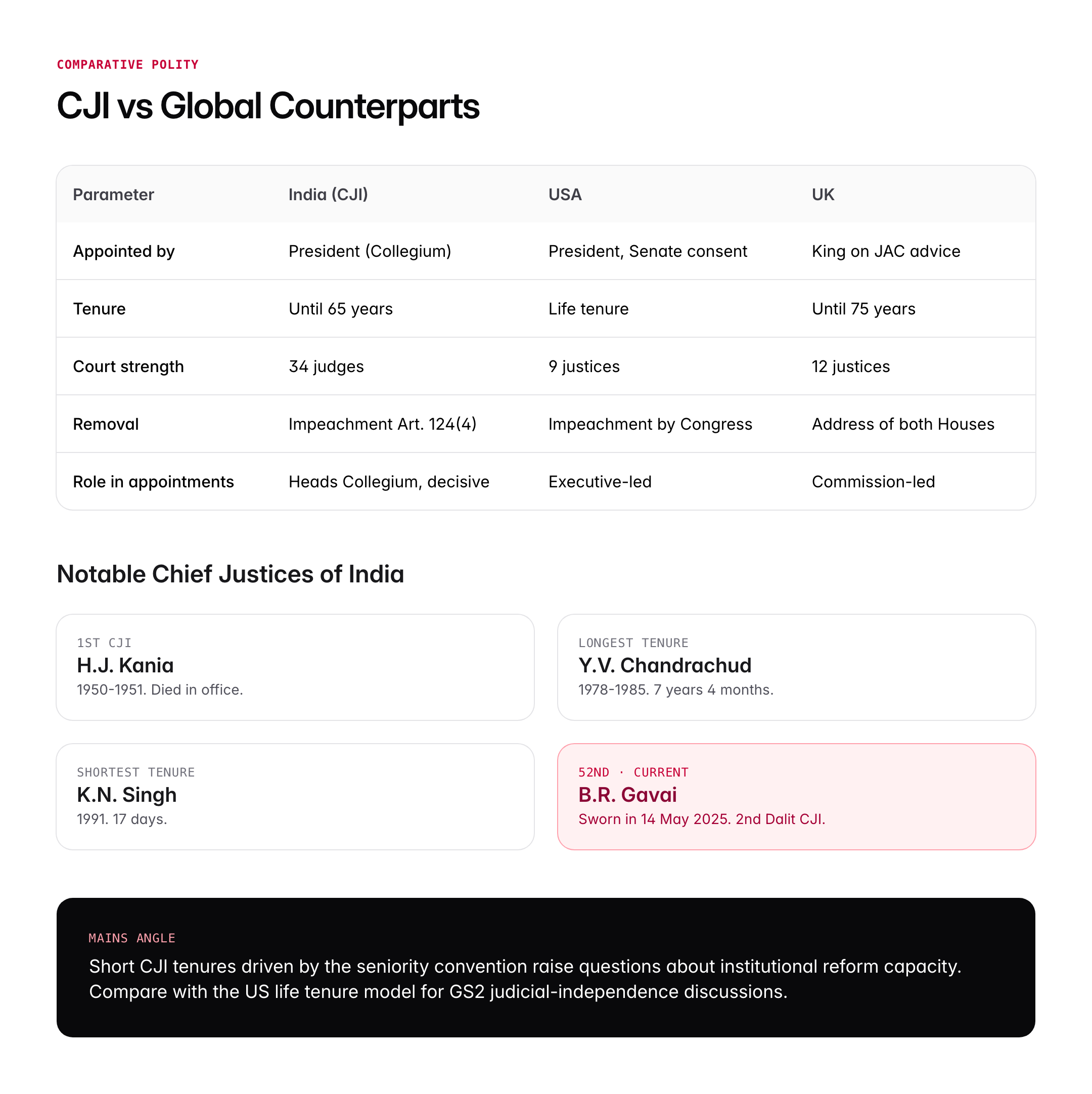
| Office | India (CJI) | United States | United Kingdom |
|---|---|---|---|
| Title | Chief Justice of India | Chief Justice of the United States | President of the Supreme Court |
| Appointment | By President on Collegium recommendation | By President, Senate confirmation | By Lord Chancellor on commission recommendation |
| Tenure | Until age 65 | Life tenure (good behaviour) | Until age 75 (earlier 70) |
| Removal | Impeachment by Parliament | Impeachment by Congress | Address by both Houses |
| Strength of court | 34 judges (including CJI) | 9 justices | 12 justices |
| Role in appointments | Heads Collegium, effectively decisive | Nominated by President, confirmed by Senate | Chairs JAC commission |
India’s CJI model is comparatively powerful in appointments because the Collegium is judge-led, while retirement at 65 produces a rapid turnover of CJIs, sometimes several in a single calendar year. The UK and US systems offer longer tenures but concentrate more power in the executive at the appointment stage.
Challenges and Criticisms
Three recurring criticisms shape public debate on the CJI’s office. First, the seniority convention can lead to extremely short tenures, for example Justice U.U. Lalit’s 74-day term in 2022 or Justice Sanjiv Khanna’s 6-month tenure ending May 2025. Short tenures limit reform capacity and institutional memory. Second, the Collegium system is criticised for opacity, the absence of a written criteria for selection, and the lack of a secretariat. The 2014 NJAC proposal tried to introduce a mixed commission including the Law Minister and eminent persons, but the Court struck it down.
Third, the Master of the Roster power has produced episodes of internal dissent, notably the January 2018 press conference by Justices Chelameswar, Gogoi, Lokur and Joseph. The Court has since admitted that the CJI exercises this power as first among equals, but safeguards remain largely internal. Post-retirement appointments of CJIs to bodies like NHRC, Rajya Sabha or governor posts raise perceived conflicts of interest and have prompted calls for a mandatory cooling-off period, as recommended by the 14th Law Commission and echoed by the Supreme Court Bar Association.
Prelims Pointers
- The CJI is appointed by the President under Article 124(2) of the Constitution.
- Retirement age of a Supreme Court judge, including CJI, is 65 years.
- The first CJI of independent India was H.J. Kania (1950-1951).
- The current CJI (2026) is Justice B.R. Gavai, the 52nd in office, sworn in on 14 May 2025.
- The Collegium comprises the CJI plus the four senior-most judges of the Supreme Court.
- Article 124(4) provides for removal through impeachment.
- The CJI administers the oath of office to the President under Article 60.
- The CJI heads the National Legal Services Authority (NALSA) as Patron-in-Chief.
- Justice M. Fatima Beevi was the first woman judge of the Supreme Court (1989), but India has yet to have a woman CJI.
- The Ninety-ninth Constitutional Amendment Act 2014, establishing the NJAC, was struck down in 2015.
- The Supreme Court currently has a sanctioned strength of 34 judges including the CJI.
- Justice Y.V. Chandrachud served the longest tenure as CJI (7 years, 4 months, 1978-1985).
Mains Practice Questions
Q1. The Collegium system as it operates today is neither collegial nor transparent. Critically examine in the light of the Ninety-ninth Constitutional Amendment judgment. (15 marks, 250 words)
- Explain the evolution from First to Third Judges Cases and the consolidation of Collegium primacy.
- Discuss NJAC structure and the basic-structure reasoning for its strike-down.
- Propose reforms: MoP 2.0, secretariat, published criteria, reasoned reporting.
Q2. The Chief Justice of India is first among equals. Examine the Master of the Roster power in light of this principle. (10 marks, 150 words)
- Define Master of the Roster and its constitutional and administrative basis.
- Reference the 2018 press conference and Prashant Bhushan judgment.
- Suggest safeguards: published roster policy, senior-judge consultation, transparency on bench allocation.
Conclusion
The Chief Justice of India combines constitutional guardianship, administrative leadership, and symbolic responsibility in a single chair. As an institution, the office has weathered supersessions, impeachment attempts, and the NJAC confrontation to emerge as one of the strongest CJI offices in common-law democracies. Its power comes both from the Constitution, particularly Articles 124 and 145, and from judge-led doctrinal development through the Judges Cases.
For the republic’s next decade, the challenge is not to diminish the CJI’s authority but to make it more transparent. Codified Collegium criteria, published bench-allocation protocols and a credible cooling-off regime for post-retirement appointments would strengthen rather than weaken the office. For UPSC aspirants, the CJI is a compact case study of how constitutional text, convention, and judicial interpretation shape a high office in India’s democracy.
Frequently Asked Questions
Who is the current Chief Justice of India?
As of April 2026, Justice Bhushan Ramkrishna Gavai is the 52nd Chief Justice of India. He took oath on 14 May 2025 after the retirement of Justice Sanjiv Khanna. Justice Gavai will retire on 23 November 2025 on attaining 65 years of age. He is the second Dalit CJI in Indian history.
What is the Chief Justice of India?
The Chief Justice of India is the head of the Supreme Court, the senior-most judicial officer of the country, and the presiding officer of the Supreme Court Collegium that recommends judicial appointments. The CJI is appointed by the President of India under Article 124(2) of the Constitution and retires on attaining 65 years.
Why is the Chief Justice of India important for UPSC?
The CJI sits at the centre of GS2 topics on the Indian judiciary, including Articles 124-147, the Collegium system, the NJAC judgment, and judicial accountability. UPSC frequently asks about appointment process, powers, Collegium debates, Master of the Roster, and landmark judgments delivered under various CJIs.
How is the Chief Justice of India appointed?
Under Article 124(2) the President appoints the CJI after consultation with such judges of the Supreme Court and High Courts as required. By convention, reinforced by the Memorandum of Procedure 1999 and the Judges Cases, the senior-most judge of the Supreme Court is appointed as CJI. The Collegium system effectively controls the process.
How is the CJI related to the Collegium system?
The CJI heads the Supreme Court Collegium, which comprises the CJI and the four senior-most judges of the Supreme Court. This body recommends names for appointment to the Supreme Court and also considers High Court elevations and transfers. For High Court appointments a three-member Collegium led by the CJI is involved.
What is the retirement age of the CJI?
A judge of the Supreme Court, including the Chief Justice of India, retires on attaining 65 years of age under Article 124(2) proviso (a). Because the senior-most judge is appointed by convention, CJI tenures are often short and vary from a few weeks to several years, depending on the age at elevation.
Who was the first Chief Justice of independent India?
Justice Harilal Jekisundas Kania was the first Chief Justice of India after the Constitution came into force on 26 January 1950. He died in office on 6 November 1951, the only CJI ever to pass away in harness. He had earlier served as Chief Justice of the Federal Court.
Can the Chief Justice of India be removed?
Yes, but only through the impeachment process under Article 124(4) on the grounds of proved misbehaviour or incapacity. A motion requires a special majority in each House of Parliament, that is a majority of the total membership and two-thirds of members present and voting. No CJI has ever been removed through this process.
Tell Google you want more of this.
Add Anantam IAS as a preferred sourceOne tap, and this site shows up more often in your own Top Stories, AI Overviews and AI Mode. Remove it any time.