Introduction
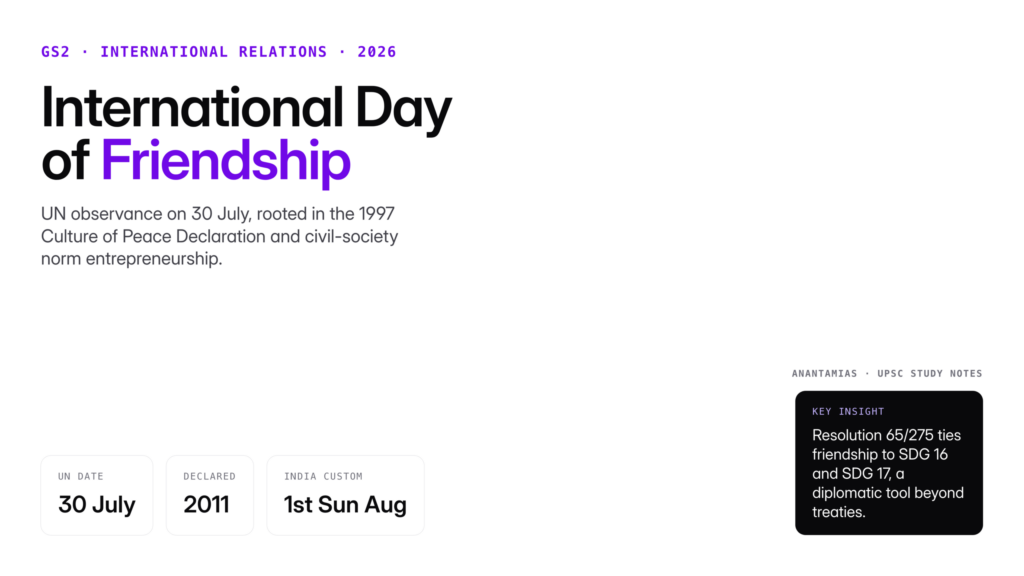
Every calendar year a quiet but globally resonant observance arrives on 30 July, the date the United Nations General Assembly fixed in 2011 as the International Day of Friendship. For UPSC aspirants the friendship day date is more than a trivia answer. It is a small doorway into the wider architecture of UN-led soft diplomacy, the Culture of Peace programme, and the behavioural foundations that bind states, communities and individuals across borders. In an era of renewed great-power rivalry, climate displacement and digital polarisation, a designated day that nudges governments and civil society to cultivate friendship reads less as symbolism and more as a structural reminder that treaties alone cannot sustain peace.
India complicates and enriches the story. Long before the UN resolution, Indians, especially urban youth since the 1990s, had already adopted the first Sunday of August as Friendship Day, tying friendship bands around each other’s wrists in schools, colleges and offices. The divergence between the official UN friendship day date of 30 July and India’s popular first-Sunday observance is itself a useful case study in how global norms and local cultures negotiate with each other. This guide walks an aspirant through the historical origins, the UN framework, India’s distinctive practice, and the examination-oriented takeaways.
Quick Facts at a Glance
| Parameter | Detail |
|---|---|
| UN observance date | 30 July, every year |
| India’s popular date | First Sunday of August |
| Declared by | UN General Assembly, Resolution A/RES/65/275 |
| Year of UN declaration | 27 April 2011 |
| Original 1958 proposal | World Friendship Crusade, Paraguay |
| Proposer of 30 July date | World Friendship Crusade |
| UNESCO parent programme | Culture of Peace and Non-Violence |
| First Indian observance | Popularised in early 1990s |
| Theme-setting body | UN Department of Global Communications |
| Relevant UN SDG | SDG 16 (Peace, Justice and Strong Institutions) |
Background and Historical Context
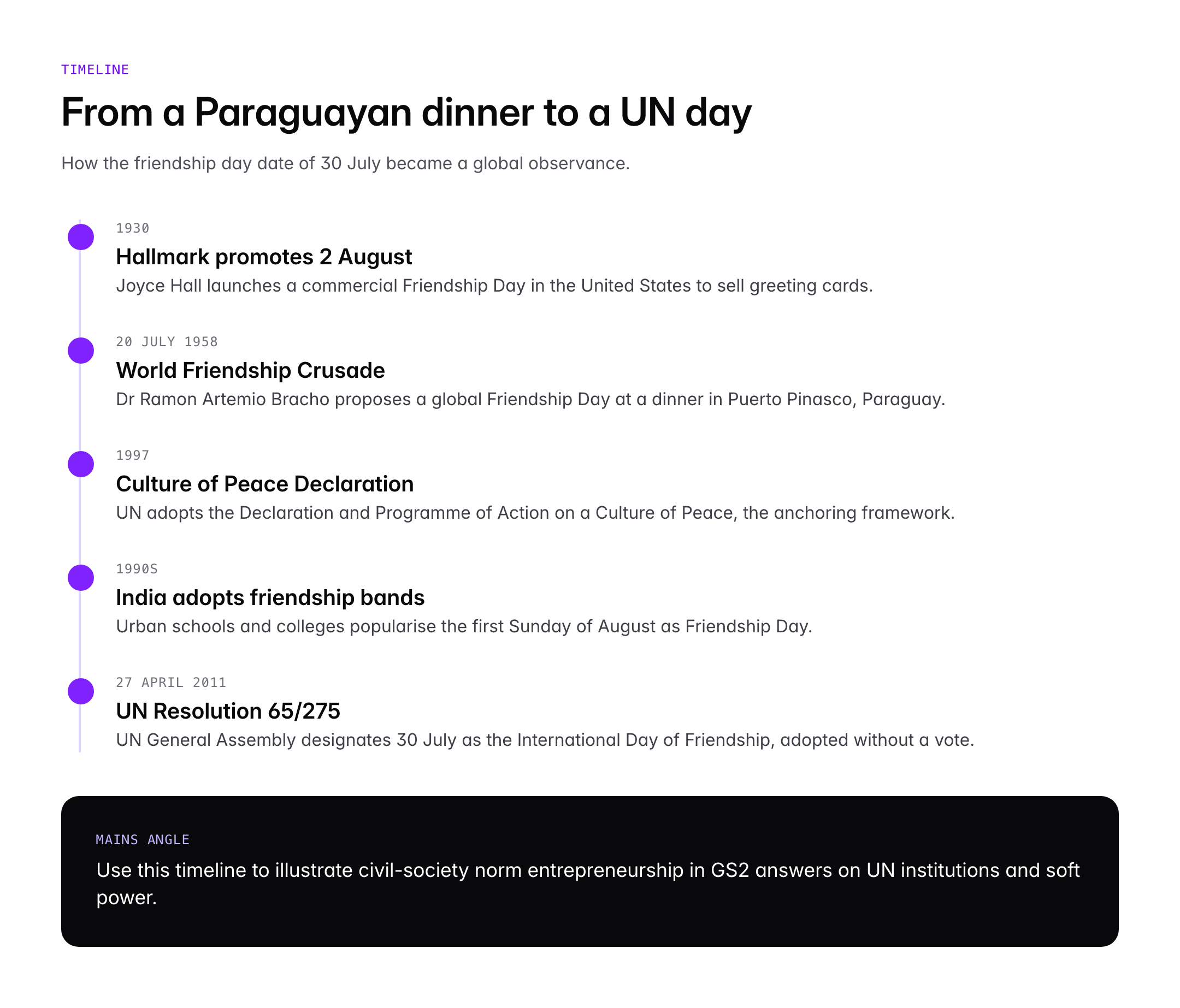
The modern idea of a codified Friendship Day traces back to Dr Ramon Artemio Bracho, a Paraguayan physician, who on 20 July 1958 gathered a group of friends at a dinner in Puerto Pinasco and proposed an annual International Friendship Day. His initiative crystallised into the World Friendship Crusade, a civil-society movement that spent five decades lobbying governments and the UN to recognise friendship as a global value. The Crusade’s persistence is a textbook example of norm entrepreneurship, the process by which non-state actors push ideas onto the international agenda.
A separate commercial strand emerged in the United States. In 1930 Joyce Hall, founder of Hallmark Cards, promoted 2 August as Friendship Day in the hope of selling greeting cards. The American market gradually tired of the idea and by the 1940s it had faded. Yet the commercial seed quietly travelled to South and Southeast Asia, where it was revived in a fresh, school-age, friendship-band form in the 1990s. India’s first-Sunday-of-August observance is a direct cultural descendant of this American practice, reshaped by Bollywood films and college culture.
The UN General Assembly’s Resolution 65/275 of 27 April 2011, adopted without a vote, picked 30 July as the official friendship day date, closer to the Paraguayan origin than to Hallmark’s 2 August. The resolution grounded the day in the 1997 Declaration and Programme of Action on a Culture of Peace and the 2001-2010 International Decade for a Culture of Peace and Non-Violence for the Children of the World. By embedding friendship inside a peace framework, the UN framed the observance not as a greeting-card occasion but as an instrument of conflict prevention, reconciliation and inclusion.
Key Features of the International Day of Friendship
The UN Mandate
The UN resolution invites member states, international and regional organisations, and civil society to observe the day in a manner consistent with the culture of each society, with a specific focus on involving young people as future leaders. It encourages activities that promote dialogue, solidarity, mutual understanding and reconciliation.
Themes and the Culture of Peace
Each year the UN Department of Global Communications aligns messaging with a Culture of Peace theme. Past emphases have included friendship across cultures and peoples, shared humanity during the COVID-19 pandemic, and, more recently, friendship as a driver of sustainable development under the 2030 Agenda.
Link to the Sustainable Development Goals
Friendship is explicitly tied to SDG 16 on peace, justice and strong institutions, and to SDG 17 on partnerships for the goals. The UN treats interpersonal and inter-state friendship as preconditions for the cooperative behaviour SDGs require.
India’s First Sunday of August Tradition
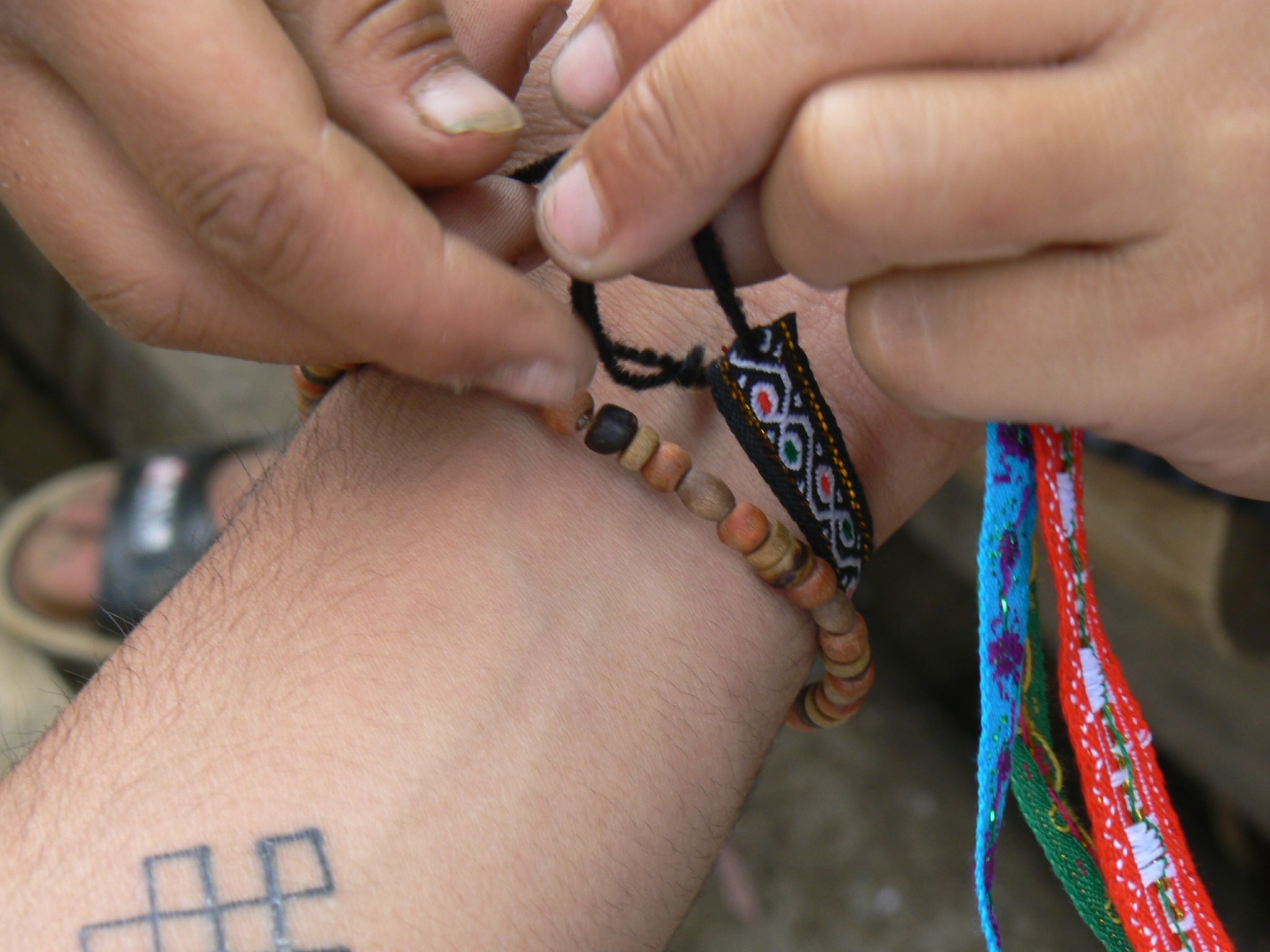
In India the friendship day date in popular usage is the first Sunday of August. The practice of tying friendship bands, often in vivid threads with small charms, became widespread in metropolitan schools and colleges in the 1990s. Hindi cinema, notably the 1998 film Kuch Kuch Hota Hai, mainstreamed the band across small-town India.
Corporate, Civic and Diplomatic Observance
Indian missions abroad, UN country offices, NGOs and corporate CSR programmes use the occasion to host youth dialogues, pen-pal exchanges, peace runs and inter-school events. The Ministry of External Affairs has, on select years, marked the day with messages highlighting India’s historical friendships, for instance with Bhutan, Japan, France and the United States.
Distinct From Other Related Days
The Day of Friendship must be distinguished from International Women’s Friendship Month (September, US), Friendship Day in Finland and Estonia (14 February, coinciding with Valentine’s Day) and the Sister Cities International programme. The UN’s 30 July observance is the only one with universal intergovernmental endorsement.
Significance for UPSC and General Knowledge
- It illustrates UN soft-power instruments beyond binding treaties, useful for GS Paper 2 questions on international institutions.
- The observance connects to the Culture of Peace framework, a concept that appears in UNESCO-oriented questions.
- India’s divergent first-Sunday practice offers a ready case study on globalisation and cultural hybridisation for essays and ethics papers.
- The day is linked to SDG 16 and SDG 17, relevant for GS Paper 3 questions on sustainable development.
- It highlights the role of norm entrepreneurs like the World Friendship Crusade, a concept tested in International Relations optional.
- The friendship day date of 30 July is itself a factual Prelims-level pointer on UN observances.
Detailed Analysis: Friendship as a Diplomatic Instrument
In diplomacy the word friendship is never decorative. Since the 1815 Congress of Vienna, states have signed Treaties of Amity and Friendship that imply commitments short of alliance but beyond mere recognition. The India-Bhutan Treaty of Friendship of 1949, revised in 2007, is a live example in Indian foreign policy. The India-USSR Treaty of Peace, Friendship and Cooperation of 1971 altered the subcontinent’s strategic calculus on the eve of the Bangladesh Liberation War. More recently the India-Japan Special Strategic and Global Partnership carries strong public diplomacy branding of friendship, reinforced by annual bilateral summits and exchange programmes.
At the people-to-people layer, the International Day of Friendship plays into cultural diplomacy tools such as the Indian Council for Cultural Relations programmes, the Nehru Memorial Fellowships, scholarships for foreign students, and diaspora outreach under the Pravasi Bharatiya Divas framework. The UN’s emphasis on youth on this day dovetails with the Indian Youth Exchange Programmes with ASEAN, SCO and BRICS partners.
A subtler analytic point concerns reconciliation and conflict prevention. The UN’s 2011 resolution arrived at a moment when Track II diplomacy, civil society dialogues and sports-based exchanges were being recognised as essential complements to government negotiations. Programmes such as the Aman ki Asha initiative between India and Pakistan journalists, or Indo-Sri Lanka inter-school friendship tournaments, fit within this spirit. While their strategic impact is difficult to quantify, they reduce the psychological distance that sustains conflict.
For aspirants the key analytical takeaway is that friendship, as codified on 30 July, sits at the intersection of three vocabularies, the legalistic language of treaties, the institutional language of the UN, and the affective language of civil society. Mastering these layers helps structure balanced answers in Mains GS 2 and essay papers that ask about India’s soft power or the changing nature of diplomacy.
Comparative Perspective
| Feature | UN International Day of Friendship | India’s First Sunday of August | US Hallmark-era Friendship Day |
|---|---|---|---|
| Date | 30 July | First Sunday of August | 2 August |
| Originator | Paraguay, 1958 | Urban Indian youth, 1990s | Joyce Hall, Hallmark, 1930 |
| Nature | Intergovernmental | Cultural and social | Commercial |
| Core symbol | Dialogue, peace messages | Friendship bands | Greeting cards |
| Policy link | Culture of Peace, SDGs | No formal link | None |
| Youth focus | Explicit UN mandate | Strong, school and college driven | Weak after 1940s |
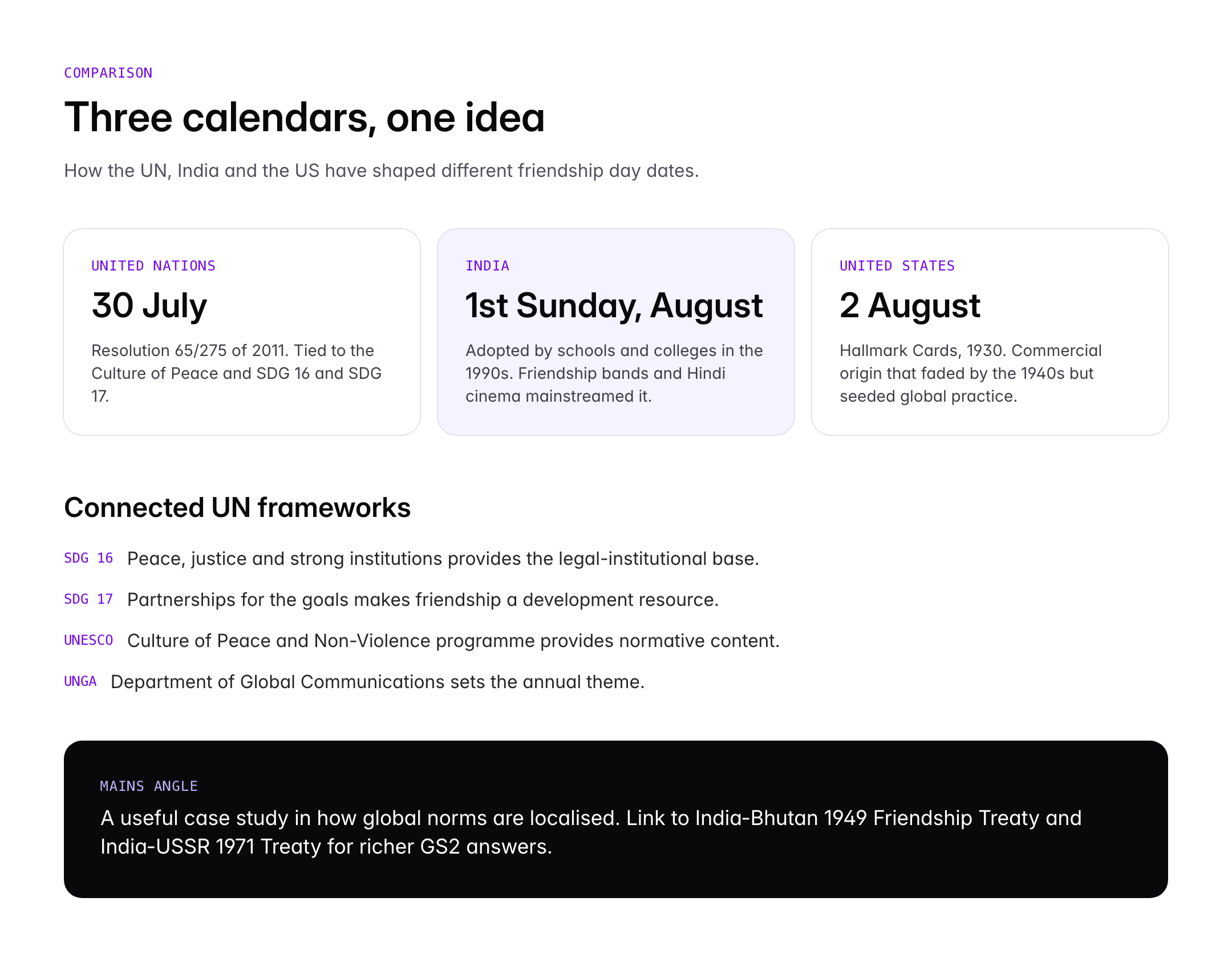
The table makes visible a simple pattern. The UN date is institutionally anchored, India’s date is culturally organic, and the American date is commercially nostalgic. All three can coexist, and many Indian brands today market across both 30 July and the first Sunday of August to capture the double peak.
Challenges and Criticisms
Critics point out that designating yet another international day risks observance fatigue. With more than 150 such UN days on the calendar, media attention on any single observance has dwindled. A second critique targets the commercialisation of the day in India, where friendship bands, cafe discounts and app-based gift deliveries can overshadow the peace dimension that the UN intended.
There is also a more philosophical concern. When states invoke friendship in treaty language the term can obscure asymmetric power relations. Scholars of South Asian politics note that treaties signed under hegemonic conditions, for instance certain unequal colonial-era arrangements, were also labelled treaties of friendship. For a UPSC ethics answer, this tension between rhetorical friendship and substantive equality is a productive line of argument.
Finally, digital polarisation complicates the day’s ideals. Social media algorithms tend to reward outrage over amity, making collective celebration of friendship harder to scale. Yet this also strengthens the case for a designated day as a counter-programming device.
Prelims Pointers
- International Day of Friendship is observed on 30 July.
- It was declared by UN General Assembly Resolution 65/275 on 27 April 2011.
- The resolution was adopted without a vote.
- Its origins lie in the World Friendship Crusade launched by Dr Ramon Artemio Bracho in Paraguay on 20 July 1958.
- India popularly observes Friendship Day on the first Sunday of August.
- Joyce Hall of Hallmark Cards initially promoted 2 August as Friendship Day in 1930.
- The day is anchored in the 1997 Declaration on a Culture of Peace.
- It is linked to SDG 16 and SDG 17 of the 2030 Agenda.
- The UN Department of Global Communications coordinates annual themes.
- Finland and Estonia observe Friendship Day on 14 February.
- Bhutan-India Treaty of Friendship was signed in 1949 and revised in 2007.
- India-USSR Treaty of Peace, Friendship and Cooperation was signed in 1971.
Mains Practice Questions
- The International Day of Friendship, observed on 30 July, reflects the United Nations’ evolving approach to peace-building beyond traditional security instruments. Discuss. (250 words)
- Explain the 2011 resolution, its roots in the Culture of Peace programme and SDG linkages.
- Contrast with traditional security mechanisms like the UN Charter Chapter VII.
- Assess India’s use of the day in soft-power and cultural diplomacy.
- Cultural observances imported from outside India often acquire distinctive local forms. In the light of this statement, examine India’s adoption of Friendship Day. (150 words)
- Trace origins from Hallmark and the UN to Indian school and college culture.
- Discuss the first-Sunday-of-August tradition and the role of cinema.
- Evaluate benefits and risks of commercialisation.
Conclusion
The friendship day date of 30 July is a small pin on a very large map. Behind it sits a six-decade civil society movement, a carefully framed UN resolution, and a global Culture of Peace programme that links friendship to the hard work of preventing conflict. For an aspirant, remembering the date is the start, not the end, of engagement with the topic.
In India the observance operates on two registers, the UN’s 30 July and the popular first Sunday of August. That dual existence is itself revealing. It shows how global norms and local cultures co-produce meaning, how commerce and idealism cohabit, and how a simple thread tied around a wrist can carry the weight of diplomacy. Holding both registers together is good preparation for the kind of nuanced answer the UPSC rewards.
Frequently Asked Questions
What is the International Day of Friendship?
The International Day of Friendship is a United Nations observance marked every year on 30 July. It was declared by UN General Assembly Resolution 65/275 in 2011 and is grounded in the 1997 Declaration on a Culture of Peace. The day encourages governments, civil society and youth to promote friendship between peoples, countries and cultures as a foundation for lasting peace.
What is the official friendship day date?
The official friendship day date recognised by the United Nations is 30 July each year. In India, however, popular culture treats the first Sunday of August as Friendship Day. This difference exists because India’s practice evolved from an earlier American tradition before the UN fixed a formal date in 2011.
Why is the International Day of Friendship important for UPSC?
It connects several syllabus themes: UN institutions and soft power under GS Paper 2, the Culture of Peace framework, SDG 16 and SDG 17 under GS Paper 3, and India’s cultural diplomacy. Aspirants can use it as a case study in essay and ethics papers on cooperation, reconciliation and norm entrepreneurship by civil society actors like the World Friendship Crusade.
How is Friendship Day related to the Culture of Peace programme?
The UN resolution establishing the day explicitly ties it to the 1997 Declaration and Programme of Action on a Culture of Peace and to the 2001-2010 International Decade for a Culture of Peace. The idea is that interpersonal friendship, like inter-state friendship, helps prevent conflict, reduce prejudice and build the social trust required for sustainable peace and development.
Who first proposed a global Friendship Day?
Dr Ramon Artemio Bracho, a Paraguayan physician, proposed the idea at a dinner with friends in Puerto Pinasco on 20 July 1958. This led to the founding of the World Friendship Crusade, which spent decades lobbying governments and the United Nations to recognise friendship as a universal value, finally succeeding with the 2011 resolution that set 30 July as the day.
Why does India celebrate Friendship Day on the first Sunday of August?
India’s practice descends from an American tradition promoted by Hallmark Cards in the 1930s, which initially pegged the day to 2 August. Urban Indian youth, schools and colleges adopted it in the 1990s and floated it to the nearest Sunday for convenience. Hindi cinema, especially the 1998 film Kuch Kuch Hota Hai, cemented the first-Sunday-of-August tradition nationwide.
What is the significance of friendship bands?
Friendship bands are colourful threaded wristbands exchanged between friends as a token of affection. In India they became the dominant symbol of Friendship Day from the 1990s onward. Beyond the commercial aspect, they serve as a simple, tangible ritual of bonding that crosses class and region, comparable to the rakhi thread in terms of emotional resonance though secular in character.
How does India use Friendship Day in its diplomacy?
Indian missions abroad occasionally mark 30 July with public messages highlighting historic friendships, for example with Bhutan, Japan, France, the United States and ASEAN partners. The Ministry of External Affairs and the Indian Council for Cultural Relations coordinate youth exchanges, cultural events and social media campaigns that use the day to reinforce India’s soft power and its identity as a responsible, cooperative global actor.
Tell Google you want more of this.
Add Anantam IAS as a preferred sourceOne tap, and this site shows up more often in your own Top Stories, AI Overviews and AI Mode. Remove it any time.