Introduction
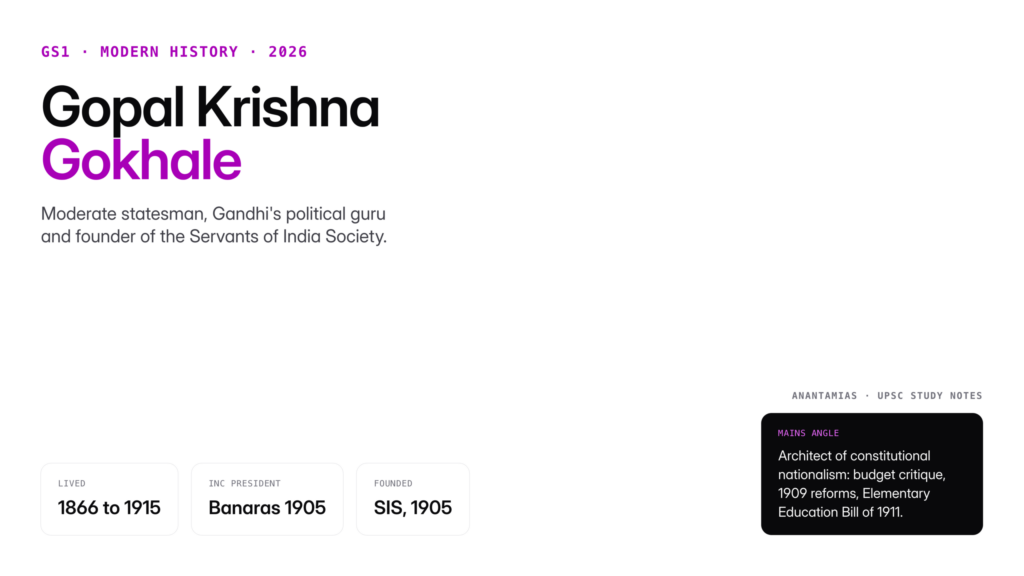
Gopal Krishna Gokhale occupies a singular place in the story of modern India. He was the economist who taught a generation of Indians to read the colonial budget as a moral document, the parliamentarian who turned the Imperial Legislative Council into a classroom of responsible dissent, and the reformer who built the Servants of India Society to produce public workers rather than politicians. When Mahatma Gandhi returned from South Africa in 1915, he called Gokhale his “political guru” and spent a year, at Gokhale’s insistence, travelling across India before entering public life. That single endorsement captures why Gokhale, who died at forty-eight, still matters to every UPSC aspirant studying the Moderate phase of the Indian National Congress.
For the Prelims and Mains student, Gokhale is not merely a name on a timeline between Dadabhai Naoroji and Bal Gangadhar Tilak. He is the bridge between the early Congress tradition of petition and the later mass politics of satyagraha, the voice that demanded elementary education as a right in 1911, and the reformer whose ideas on public finance, constitutionalism and ethical public service remain embedded in the Indian republican imagination. This article offers a complete portrait of his life, work and enduring relevance.
Quick Facts at a Glance
| Attribute | Detail |
|---|---|
| Full name | Gopal Krishna Gokhale |
| Born | 9 May 1866, Kotluk, Ratnagiri district, Bombay Presidency |
| Died | 19 February 1915, Pune, aged 48 |
| Education | Elphinstone College, Bombay (Graduate, 1884) |
| Profession | Professor of English and Political Economy, Fergusson College |
| Political affiliation | Indian National Congress (Moderate faction) |
| Key organisation | Servants of India Society, founded 1905 |
| Signature role | President, INC (Banaras session, 1905) |
| Legislative career | Central Legislative Council, 1902 to 1915 |
| Mentor | Mahadev Govind Ranade |
| Famous mentees | Mahatma Gandhi and Muhammad Ali Jinnah |
| Best-known bill | Elementary Education Bill, 1911 |
Background and Historical Context
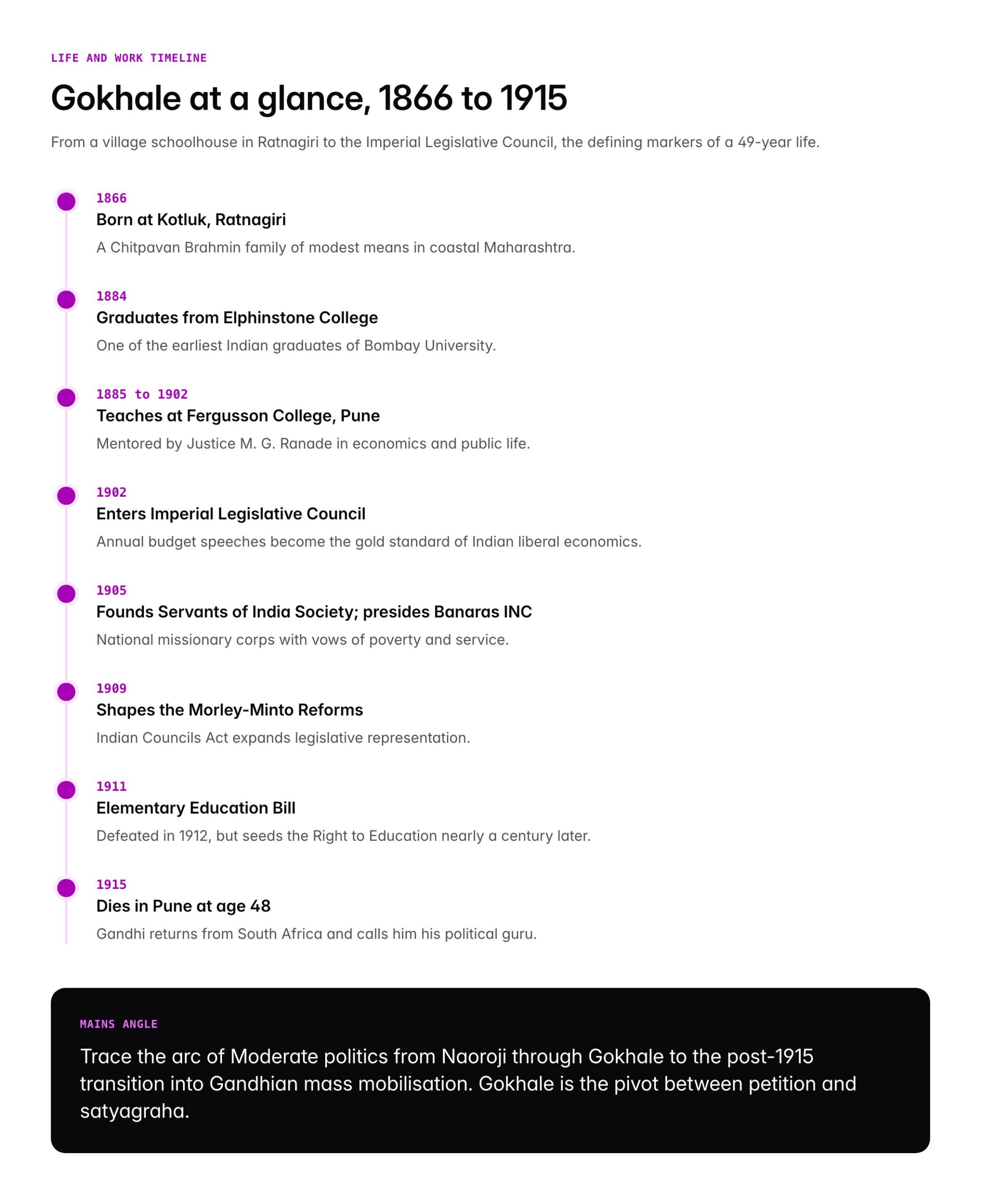
Gokhale was born into a lower-middle-class Chitpavan Brahmin family in coastal Maharashtra during the high noon of Victorian imperialism. His father died when he was thirteen, and the family’s straitened circumstances meant Gopal walked long distances to school, famously reading under street lamps. He graduated from Elphinstone College in 1884 at eighteen, one of the first generation of Indians to complete a full English university education, and soon joined the New English School in Pune, founded by the reforming triumvirate of Vishnu Shastri Chiplunkar, Bal Gangadhar Tilak and Gopal Ganesh Agarkar.
The Pune of the 1880s was a laboratory of the Indian public sphere. The Deccan Education Society ran schools and colleges to build an indigenous intelligentsia; the Sarvajanik Sabha, founded by Ranade, functioned as a proto-legislature that scrutinised the colonial budget; and journals like the Mahratta and Sudharak debated social reform with ferocity. Gokhale entered this world as Ranade’s protégé. For fifteen years, Ranade trained him personally in the arithmetic of imperial finance, the logic of free trade, the history of Maratha land revenue and the ethics of public work. Gokhale later said that he learned from Ranade that “public life must be spiritualised”.
The surrounding political context matters. The Indian National Congress, founded in 1885, was still defining its method. Its early leaders, Dadabhai Naoroji, Surendranath Banerjee, Pherozeshah Mehta and Ranade, pursued what later came to be called the “three Ps” strategy, prayer, petition and protest, using constitutional memoranda to expose the economic drain, press for Indianisation of services, and seek legislative representation. Gokhale inherited this tradition, refined it with rigorous statistics, and carried it into the Imperial Legislative Council during the Curzon and Minto viceroyalties. He straddled two ages, the age of Ranade’s cautious constitutionalism and the coming age of Tilak’s extremism and Gandhi’s mass politics, and his life is the story of how one disciplined public servant tried to keep both instincts in conversation.
Key Features of His Public Life
The Economist in the Legislative Council
Elected to the Central Legislative Council in 1902, Gokhale delivered an annual budget speech that became a ritual of the early Indian public sphere. Drawing on Naoroji’s drain theory and his own painstaking analysis, he attacked the Salt Tax as regressive, critiqued the Home Charges for bleeding India of silver, and argued that defence expenditure was disproportionately funded by Indian peasants. His 1902 speech ran to three hours and was reprinted across the country. Viceroy Lord Curzon reportedly read Gokhale’s speeches before drafting his replies, an unusual concession from an autocrat.
Architect of the Morley-Minto Reforms, 1909
Gokhale’s second great legislative contribution was his negotiation with Secretary of State John Morley in London that fed into the Indian Councils Act of 1909. The Act expanded legislative councils, introduced the principle of election (albeit indirect and communal), and allowed Indian members to move resolutions. The reforms were criticised for the separate electorates they created for Muslims, but Gokhale defended them as the first concrete step toward representative government, a necessary foothold on the long climb to self-rule.
Founder of the Servants of India Society
In 1905, Gokhale founded the Servants of India Society in Pune with the explicit aim of training “national missionaries” who would devote their lives to unpaid public service. Members took vows of poverty, obedience and political integrity, received a subsistence allowance, and worked on famine relief, tribal welfare, cooperative credit and education. The Society outlived Gokhale by a century and produced figures like Hriday Nath Kunzru and Srinivasa Sastri.
Champion of Elementary Education
In March 1911 Gokhale introduced a private members’ bill in the Imperial Legislative Council seeking free and compulsory elementary education in any area where ten per cent of male children were already in school. The bill was defeated in March 1912, but its arguments, that education was a public good, that the state had a duty to fund it, and that India could not modernise without universal literacy, anticipated Article 45 of the Directive Principles and eventually the Right to Education Act of 2009.
Mentor to Gandhi
When Mohandas Gandhi visited India in 1896 to seek support for Indians in South Africa, Gokhale hosted him in Pune. The two corresponded for two decades. Gokhale travelled to South Africa in 1912 to see Gandhi’s satyagraha campaign firsthand, and when Gandhi returned permanently in 1915, Gokhale’s parting advice, to spend a year observing India in silence before acting, shaped the entire arc of the Gandhian movement.
Significance for UPSC and General Knowledge
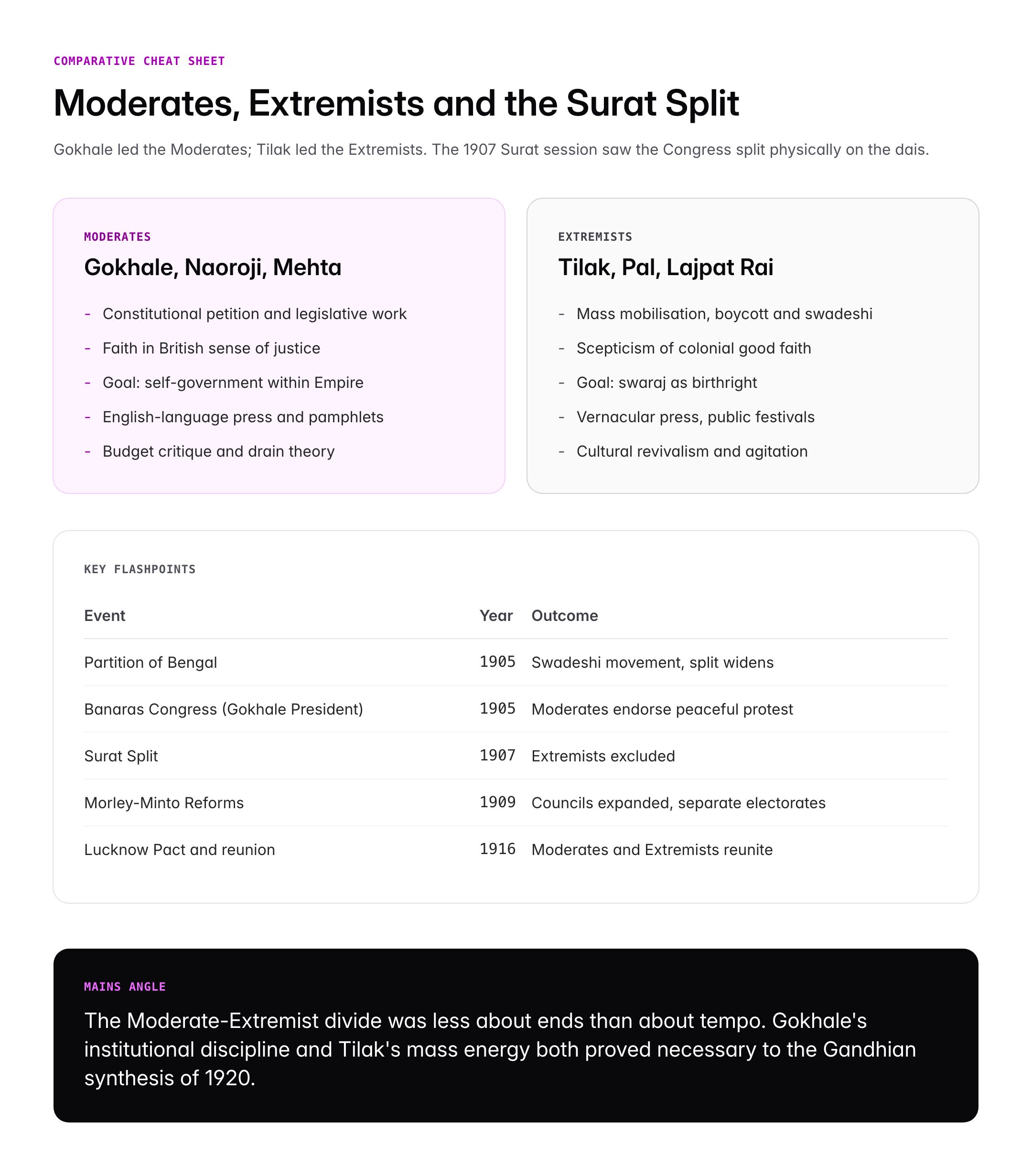
- Gokhale is essential for the GS1 Modern History theme of the Moderate phase of the Congress (1885 to 1907) and the Swadeshi aftermath.
- His Elementary Education Bill of 1911 is a direct antecedent of the Right to Education Act of 2009, a favourite Prelims linkage.
- The Servants of India Society illustrates the ethical tradition of public service that shapes Gandhian and later Sarvodaya thought, relevant for GS4 ethics case studies.
- His dispute with Tilak at the 1907 Surat Split is a classic case of method versus tempo in anti-colonial politics, useful for Mains essays on gradualism.
- His mentorship of both Gandhi and Jinnah is a poignant reminder that the Indian freedom movement was not predestined to partition.
- Gokhale’s budget critiques anticipated the economic nationalism that would power the swadeshi and later import-substitution policies of independent India.
Political Contributions and Reformist Agenda
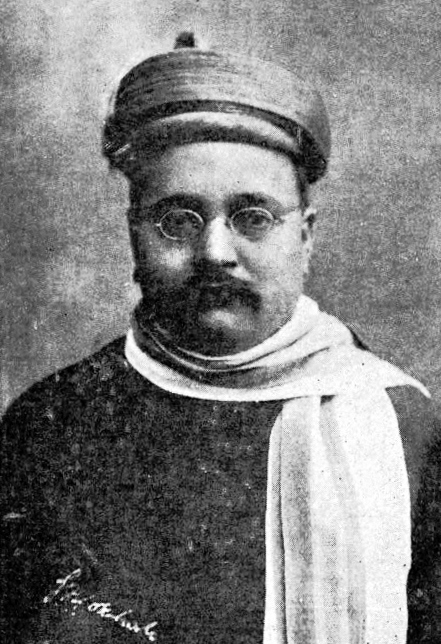
Gokhale’s politics can be read as a sustained argument for constitutional nationalism, the belief that Indians could secure self-government by demonstrating, through disciplined legislative work, administrative competence and moral integrity, that they were ready to govern themselves. This placed him in opposition to the extremist faction led by Tilak, Bipin Chandra Pal and Lala Lajpat Rai, who argued that British rule would yield only to mass pressure and boycott.
The clash climaxed at the Congress session in Surat in December 1907, when Tilak’s supporters disrupted the proceedings and the party formally split. Gokhale, as a senior Moderate, helped draft the new Congress constitution that limited membership to those who accepted the goal of self-government within the Empire through constitutional means, effectively excluding the extremists for the next nine years. Modern historians have criticised this exclusion as short-sighted, but Gokhale’s defenders point out that the Moderate leadership protected the Congress from the kind of repression that might have strangled it entirely.
His agenda ran wider than the constitutional question. He campaigned against the indentured labour system that sent Indians to Natal, Fiji and Mauritius, and his 1912 South African tour pushed the imperial government toward the 1914 Indian Relief Act. He supported the cooperative movement as a tool of rural credit reform, backed the Servants’ work with the Bhil and Gond tribal communities in central India, and argued in print for a moderate land revenue assessment. On social reform he was a liberal Hindu, supporting the Age of Consent Act and opposing untouchability, though he was temperamentally cautious on questions of ritual practice that he felt should be left to an awakened society rather than imposed by the colonial state.
His death in February 1915 at forty-eight, from diabetes and overwork, left the Moderate cause without its most articulate spokesman. Gandhi lit the lamp at his funeral in Pune and wore a plain dhoti in mourning. Within five years, Gandhi’s non-cooperation movement had overtaken the Moderate method entirely, yet every later Congress leader who debated the merits of constitutional engagement, from Motilal Nehru to B. R. Ambedkar, was arguing within a frame Gokhale had drawn.
Comparative Perspective
Gokhale is best understood alongside the two other architects of early Indian nationalism. The table below sets out the contrast.
| Leader | Era of Peak Activity | Method | Signature Idea | Legacy |
|---|---|---|---|---|
| Dadabhai Naoroji | 1870s to 1900s | Petition and parliamentary lobbying in London | Drain theory | Economic critique of empire |
| Gopal Krishna Gokhale | 1895 to 1915 | Legislative engagement and moral public service | Constitutional nationalism, public service as vocation | Mentor to Gandhi, Servants of India Society |
| Bal Gangadhar Tilak | 1890s to 1920 | Mass mobilisation, festivals, vernacular press | Swaraj as birthright | Radical nationalism, mass politics |
Where Naoroji supplied the economic theory, Tilak supplied the emotional charge, and Gokhale supplied the institutional discipline that translated ideas into legislative text. All three were necessary; Gokhale’s distinctive contribution was to show that a public life could be austere, numerate and ethical at the same time.
Challenges and Criticisms
Gokhale’s legacy is not without contention. Critics argued then and argue now that his faith in British liberalism was naive, that the Morley-Minto reforms with their separate electorates seeded the politics of communal division, and that the Moderate method of petitioning was simply too slow for a country of three hundred million under foreign rule. Tilak famously charged that the Moderates were “political mendicants” whose memoranda the British filed and forgot. The Surat Split of 1907 is sometimes read as a Moderate coup that suppressed legitimate radical dissent.
A second line of criticism concerns social reform. Gokhale’s caution on caste and gender questions, though consistent with the liberal gradualism of Ranade, meant that he did not sharply confront the internal hierarchies of Hindu society. B. R. Ambedkar, who admired Gokhale’s intellect, nonetheless treated the Moderate tradition as insufficiently attentive to the caste question. Balanced against these criticisms, Gokhale’s defenders point to the Servants of India Society, the Elementary Education Bill, his lifelong simplicity, and his role in shaping Gandhi’s practice of truth as evidence that his was a politics of slow, serious institution-building rather than performative protest.
Prelims Pointers
- Born 9 May 1866 at Kotluk in Ratnagiri district, Maharashtra.
- Educated at Elphinstone College, Bombay, graduating in 1884.
- Taught English and Political Economy at Fergusson College, Pune, from 1885.
- Political mentor was Mahadev Govind Ranade.
- Elected to the Bombay Legislative Council in 1899 and the Imperial Legislative Council in 1902.
- Presided over the Banaras session of the Indian National Congress in 1905.
- Founded the Servants of India Society in Pune on 12 June 1905.
- Played a major role in framing the Indian Councils Act of 1909, or Morley-Minto Reforms.
- Introduced the Elementary Education Bill in the Imperial Legislative Council in March 1911; bill defeated in 1912.
- Visited South Africa in 1912 at Gandhi’s invitation.
- Was a leader of the Moderate faction at the Surat Split of the Congress in December 1907.
- Died on 19 February 1915 in Pune at the age of 48.
Mains Practice Questions
- “Gopal Krishna Gokhale’s politics of constitutional nationalism laid the institutional foundations on which Gandhian mass politics later built.” Critically examine. (250 words)
- Explain constitutional nationalism: budget speeches, legislative reform, Morley-Minto engagement
- Show how Servants of India Society and ethical public service prefigured Gandhian satyagraha
- Weigh criticisms of gradualism; conclude on continuity between the two traditions
- Discuss the significance of the Servants of India Society founded by Gokhale in 1905 for the evolution of public service ethics in India. (150 words)
- Describe the Society’s vows, membership and social work programmes
- Link to Article 45 and the later Right to Education Act, 2009
- Relate to contemporary debates on ethical public administration in GS4
Conclusion
Gopal Krishna Gokhale died young, in the year that the Indian freedom movement was about to accelerate beyond anything he had imagined. Yet the institutions he built, the arguments he framed, and the disciples he mentored shaped every phase of what followed. The Servants of India Society outlived the empire it was founded to reform. The Elementary Education Bill became, decades later, a fundamental right. His student Gandhi, and his later political rival Jinnah, each carried some piece of his commitment to constitutional argument into the most consequential political careers of the twentieth century.
For the UPSC aspirant, Gokhale is a case study in the long durée of institution-building. He teaches that nation-making is not only about moments of mass mobilisation but also about the quieter work of drafting bills, training cadre and modelling integrity. In a Republic still arguing about the ethics of public life, his austere example, a professor who lived on a cot and spoke the language of budgets, remains quietly indispensable.
Frequently Asked Questions
Who was Gopal Krishna Gokhale?
Gopal Krishna Gokhale (1866 to 1915) was a liberal Indian statesman, economist and social reformer who led the Moderate faction of the Indian National Congress, served in the Imperial Legislative Council from 1902 to 1915, founded the Servants of India Society in 1905 and was the political mentor of Mahatma Gandhi.
Why is Gopal Krishna Gokhale important for UPSC?
Gokhale appears in GS1 Modern History as a leading Moderate, in GS2 discussions of constitutional reform through his role in the Morley-Minto Act of 1909, and in GS4 as an exemplar of public service ethics through the Servants of India Society and his 1911 Elementary Education Bill, a precursor to the Right to Education Act.
How is Gokhale related to Mahatma Gandhi?
Gandhi called Gokhale his political guru. Gokhale hosted Gandhi in 1896, supported the South African satyagraha, visited Gandhi there in 1912, and on Gandhi’s return to India in 1915 advised him to spend a year touring the country before entering public life. That advice shaped the entire Gandhian strategy of grounded mass politics.
What was the Servants of India Society?
Founded by Gokhale in Pune on 12 June 1905, the Servants of India Society trained full-time public workers who took vows of poverty and ethical service. Members worked on famine relief, education, tribal welfare and cooperative credit. It produced leaders like Hriday Nath Kunzru and Srinivasa Sastri and continues to function today.
What was Gokhale’s role in the Morley-Minto Reforms of 1909?
Gokhale negotiated extensively with Secretary of State John Morley, supplying data and arguments that shaped the Indian Councils Act of 1909. The Act expanded legislative councils, introduced elected Indian members and allowed resolutions on the budget, though it also created separate electorates for Muslims, a feature Gokhale accepted reluctantly.
What did Gokhale’s Elementary Education Bill propose?
Introduced in March 1911, the bill sought free and compulsory elementary education in any locality where ten per cent of male children of school age were already enrolled. The government opposed it and it was defeated in 1912, but its principles anticipated Article 45 of the Directive Principles and the Right to Education Act, 2009.
What was Gokhale’s role in the Surat Split of 1907?
At the Surat session of the Indian National Congress in December 1907, Gokhale led the Moderate faction against Tilak’s Extremists. The Congress split physically on the dais and Gokhale helped draft a new constitution that effectively excluded the Extremists until 1916. Critics argue this suppressed legitimate radical dissent.
How did Gokhale and Tilak differ politically?
Tilak argued for mass mobilisation, boycott and the slogan that swaraj was a birthright. Gokhale preferred legislative engagement, budget critique and reform within constitutional limits. Both were Chitpavan Brahmins from Maharashtra and both taught in Pune, but they represented rival strategies, tempo versus method, within the Indian freedom movement.
Tell Google you want more of this.
Add Anantam IAS as a preferred sourceOne tap, and this site shows up more often in your own Top Stories, AI Overviews and AI Mode. Remove it any time.